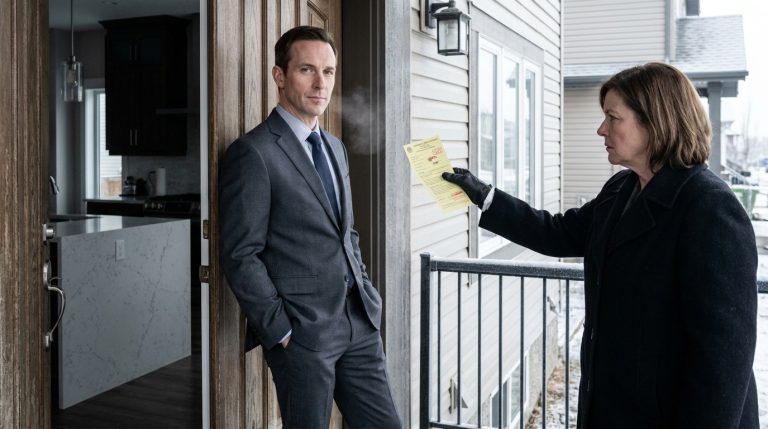
The Iron Boundary: Defending the Rusted Homestead Against Whispering Pines’ Uniform Reach
CHAPTER 1: The Rusted Gate and the Evening Watch
The sun hung low over the western ridge, bleeding a dull, coppery light across the dry earth and casting long, crooked shadows from the old apple trees. Out on the county road, tires hummed in a monotonous, high-pitched rhythm against the asphalt, but inside our fence line, the only sound was the dry rattle of corn husks brushing against the weathered cedar boards.
I hooked my thumb through the handle of the grease bucket and walked toward the gate, my boots crunching heavily into the gravel path that my grandfather had laid down by hand in nineteen-fifty-eight. Around our tiny, stubborn island of wild grass and unpainted wood, the world had been scraped flat and rebuilt into a mirror image of corporate efficiency. The Whispering Pines subdivision stretched in every direction—hundreds of identical beige boxes with manicured lawns that looked like green felt stretched tightly over the dirt.
And right on the other side of the rusted wire fence stood Brenda.
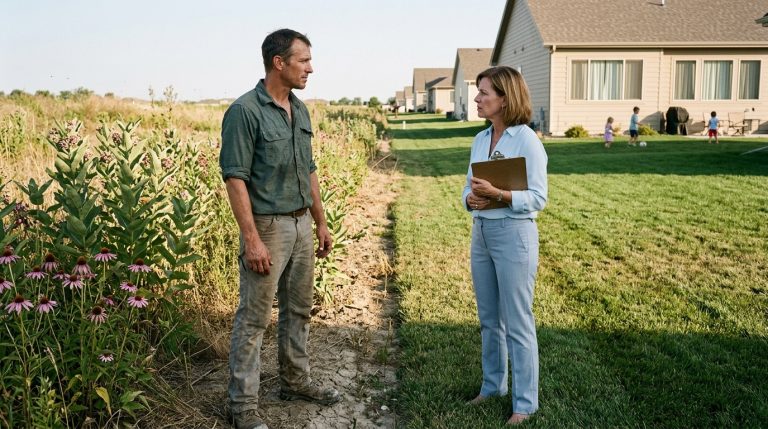
She didn’t move. She stood with her weight shifted onto one hip, her clipboard pressed against her pastel cardigan like a shield, watching me with eyes as sharp and cold as a fresh nail. Her lawn was a masterpiece of dead symmetry—every blade of grass cut to a precise two inches, every decorative shrub trimmed into an unnatural sphere. Compared to her domain, our place looked like a scrap heap. The green paint on our shutters was blistering and peeling like old sunburned skin, and the rain gutters sagged under the weight of accumulated oak leaves.
“You’re tracking dirt onto the easement,” Brenda called out, her voice thin and carrying clearly across the dry evening air. She didn’t bother stepping closer; she merely pointed the tip of her silver pen at the corner of my fence. “And that utility shed violates municipal sightline clearance code four-dash-eight.”
I didn’t answer right away. I set the grease bucket down on the bottom step of the wrap-around porch, the wood groaning in protest under the weight, and wiped my palm against the thigh of my denim jeans. The metallic taste of dust coated the back of my throat.
“There is no easement here, Brenda,” I said, my voice flat, worn down by months of these monotonous border skirmishes. “The county map stops at the fence post.”
“For now,” she replied, her lips thinning into a tight, pale line as she scribbled something viciously onto her yellow notepad. “The board is reviewing all boundary exceptions next Tuesday. You might want to have your paperwork ready when the county marshal serves the notice.”
She turned on her heel then, marching back toward her immaculate patio with rigid, mechanical steps, her clipboard tucked firmly under her arm like a ledger of debts.
I stood by the rusted gate for a long moment, watching the dust settle around her manicured flowerbeds. My grandfather had built this fence out of salvaged railroad ties and heavy-gauge wire when the developers first rolled their heavy machinery into the valley, swearing he would never sell an inch of the dirt his father had cleared. He had spent his final years sitting on this very porch, watching the cookie-cutter world creep up to his doorstep like rising water against a levee.
When I pulled the heavy cream envelope from the metal box, the paper felt thick and expensive—far too costly for a simple neighborhood memo. I tore the corner open with my thumb, sliding out the stiff sheet inside. Bold, black type stared back at me, demanding a five-hundred-dollar remittance for unauthorized property modifications and noise violations, payable directly to the Whispering Pines association office within forty-eight hours, or face an immediate property lien.
The sun dipped completely below the horizon, plunging the yard into a deep, bruised gray. The iron latch of the gate clicked softly in the evening breeze, and a cold certainty settled into my bones: Brenda wasn’t just nagging anymore. She was laying siege.
CHAPTER 2: The Envelope in the Mailbox and the Iron Fine
The heavy cream paper of the HOA letter felt cold between my fingers as I walked back up the gravel path toward the house. Inside the envelope, the demand for five hundred dollars was printed in a stark, sans-serif font that looked utterly out of place against the peeling paint of the porch pillars. My grandfather had always said that men who hide behind printed paper are usually the ones afraid of a fair fight, and looking at the official letterhead, the sentiment rang true. Brenda hadn’t signed her own name; she had stamped it with the generic seal of the Whispering Pines association office, attempting to cloak a personal grudge in the heavy machinery of corporate governance.
I stepped across the threshold, the old floorboards groaning under my boots, and dropped the letter onto the battered oak desk in the corner of the living room. Dust motes danced lazily in the sliver of dying sunlight cutting through the wavy, historic glass of the front window.
The house was quiet, save for the low, rhythmic hum of the old refrigerator in the kitchen. For ten years, this place had been an island. While the surrounding cornfields and orchards had been systematically bulldozed, graded, and paved over into uniform cul-de-sacs, our small parcel remained untouched, its boundaries defined by rusted barbed wire and stubborn memory. Yet, looking at the fine, a cold realization settled into my chest. This wasn’t just about an un-mowed patch of grass or a non-regulation bird bath anymore. Brenda was escalating the pressure, testing the structural integrity of our legal exemption with every petty notice.
I pulled open the middle drawer of the desk, shoving aside a clutter of old hardware, dried pruning shears, and rusted spare keys until my fingers brushed against a heavy, leather-bound folder.
Inside lay the original land patent and the county exemption deeds from nineteen-forty-eight—yellowed, fragile parchment edged with brown decay, bearing the signatures of county commissioners long since passed. My grandfather had forced the original developers to legally carve our plot out of their master plat map, filing the paperwork with a stubbornness that border-lined on obsession. He had known then what I was beginning to suspect now: paper can be weaponized, but it can also be used as a shield, provided you know where to look.
I flipped open the folder, tracing the faded ink of the survey coordinates with the tip of my thumb. The subdivision’s master plan showed our property as a gray, unallocated void right in the center of their pristine grid—a literal thorn in the side of a multi-million-dollar development firm that owned every other square foot for a mile in every direction.
Why push so hard now over a backyard barbecue? Brenda had lived next door for years, grumbling about our wild apple trees and unpaved driveways, but this aggressive legal posturing—complete with formal fines and threats of property liens—felt too coordinated, too legally precise for a mere neighborhood busybody acting on her own accord. She was using a template, a standardized corporate intimidation tactic designed to wear down holdouts until they surrendered their deeds out of sheer exhaustion.
I closed the folder with a soft thud, the sound muffled by the thick layer of dust coating the desk.
If Brenda wanted to play legal games using the weight of the Whispering Pines association, I needed more than just my grandfather’s old parchment. I needed to see what the county clerk’s archives said about the original subdivision agreements, and more importantly, who was really underwriting the association’s legal expenses.
The grandfather clock in the hallway chimed once, a deep, hollow sound that seemed to rattle the loose panes in the window. I slipped the exemption deed into my jacket pocket, zipped it shut, and walked toward the front door. The sun had completely vanished below the horizon, leaving the uniform roofs of Whispering Pines bathed in the uniform amber glow of streetlamps, but our little patch of earth remained dark, anchored in the heavy, unyielding shadows of the past.
CHAPTER 3: The Cold Iron Knocker and Brendas Dismissive Grin
The evening chill was beginning to settle over the dry earth, turning the humid air sharp and biting by the time I walked down our cracked concrete path toward the county road. I didn’t take the car; the old pickup had a cracked manifold that rattled like a tin can full of bolts, and pulling out of the driveway after dark always drew the immediate, critical attention of the neighborhood. Instead, I kept my hands shoved deep into the pockets of my canvas jacket, feeling the rigid corner of the leather-bound folder press against my ribs with every stride.
Whispering Pines was deathly quiet at this hour. Behind the neat rows of uniform hedges and manicured lawns, the beige houses sat like sealed monoliths, glowing with the sterile, bluish flicker of large-format television screens through closed blinds. Not a single child played on the sidewalks. Not a single car sat parked on the asphalt. Everything was engineered for absolute conformity, a sterile ecosystem designed to erase any trace of the past.
Brenda’s house sat three properties down, occupying the corner lot where the cul-de-sac curved sharply around our property’s invisible northern boundary. Even in the dim light of the amber streetlamps, her home looked aggressively maintained. The white vinyl siding gleamed without a speck of dust, the decorative shutters were painted a precise, approved shade of slate gray, and a pair of perfectly symmetrical boxwood shrubs stood guard on either side of the front steps like green sentinels.
I didn’t use the curved cobblestone walkway that led to her polished brass knocker. I cut across the edge of her pristine lawn, letting the dry heels of my work boots leave distinct, crushed impressions in the chemical-green turf.
When I reached the heavy mahogany front door, I didn’t knock politely. I struck the wood twice with the flat of my fist—a dull, heavy thud that reverberated through the hollow frame.
Inside, the muffled sound of a television abruptly cut off. A moment later, the silhouette of a figure appeared behind the frosted glass pane of the sidelight, pausing as the shadow hesitated before the latch. The lock turned with a crisp, mechanical click, and the door swung open six inches, restrained securely by a heavy brass security chain.
Brenda peered through the narrow gap. Her hair was still pulled back into its signature severe bun, but her pastel cardigan was gone, replaced by a dark wool blazer that made her look even sharper against the warm light of her foyer. Her eyes flicked from my face down to the canvas jacket, narrowing with practiced disdain.
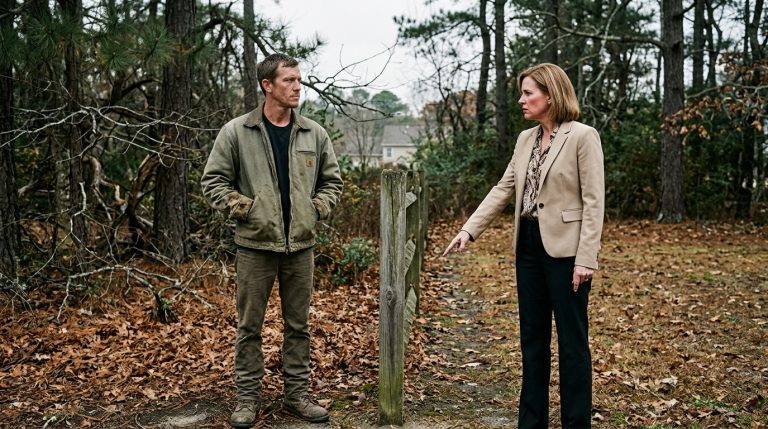
“Private property,” Brenda said, her voice clipped and cold, devoid of any pretense of neighborly warmth. “You’re standing on association easements. I suggest you step back before I call the county marshal to log a formal trespass.”
I didn’t move an inch. I kept my weight planted squarely on the threshold of her light, letting the cold air of the street drift past me into her hallway.
“You can call whoever you want, Brenda,” I said, keeping my tone flat, stripped of anger. “But before you do, you might want to check the actual plat maps down at the courthouse. The fine you slapped on my mailbox yesterday doesn’t carry any legal weight. My grandfather’s deed predates your entire subdivision by twenty years.”
Brenda let out a short, sharp bark of dry laughter. It was a practiced, dismissive sound meant to signal absolute authority.
“Your grandfather’s little scrap of paper was filed away and forgotten decades ago,” she replied, her chin lifting slightly as she looked down her nose at me. “The board governs every square inch of this valley now. If you don’t pay that five-hundred-dollar remittance by Thursday evening, we initiate the lien process. You won’t even have enough timber left on that overgrown jungle of yours to pay the legal fees.”
She reached for the edge of the door to slam it shut, but I stepped closer, my shoulder brushing against the outer trim, blocking the swing before the latch could catch.
Through the narrow gap of the chain, I caught a brief, fleeting glimpse of her entryway—specifically, the mahogany side table where a stack of bright pink past-due utility notices lay half-hidden beneath a leather-bound association ledger. The topmost envelope bore the unmistakable logo of the county water authority, stamped in glaring red ink with a final disconnection warning.
Brenda’s hand froze on the edge of the door, her knuckles tightening until the skin stretched white over the bone. For a single micro-second, the rigid mask of absolute control slipped, replaced by a flash of raw, unfiltered panic in her eyes before she shoved hard against the wood, pulling the door tight until the security chain rattled against the stop.
“Thursday,” her muffled voice hissed through the thick grain of the wood. “Check your mail.”
The deadbolt threw itself home with a heavy, final thud. I stood on her porch for a moment longer in the gathering dark, listening to the sharp click of her heels retreating down the carpeted hallway, the pieces of the puzzle finally beginning to grind together with the heavy, unyielding friction of a rusted gear.
CHAPTER 4: The County Vault and the DustCovered Deeds
The heavy oak door of the county clerk’s archive room groaned open on ungreased brass hinges, releasing a stale wave of dry paper, old leather bindings, and iron-gall ink that had spent decades baking in the dark. The overhead fluorescent tube flickered twice before catching with an irritating, high-pitched hum, casting a harsh, jaundiced glare over rows of grey steel filing cabinets that stretched deep into the windowless basement.
I stepped inside, letting the heavy door click shut behind me to muffle the distant clatter of typewriter keys and ringing phones echoing from the main floor above.
My fingers felt coated in a fine layer of grey grit as I dragged out the steel drawer labeled Whispering Pines Subdivision – Master Plats & Original Covenants (1942-1950). The metal glided forward with a heavy, grinding shudder, protesting the sudden disturbance. Inside, row after row of thick, manila-jacketed folios sat tightly wedged together, each one marked with faded red classification stamps and handwritten docket numbers.
This was where the actual architecture of the neighborhood lived—not in the manicured lawns or the passive-aggressive letters left in mailboxes, but in the binding legal agreements that tied the land together. If Brenda was weaponizing the association bylaws to enforce compliance on my grandfather’s property, I needed to find the exact legal firewall he had constructed sixty years ago.
I pulled folder seventy-four-B from the rack, carrying it over to the scarred oak reading table in the center of the room. The cardboard cover was warped at the edges, warped by moisture from some forgotten pipe leak years ago.
Flipping open the cover, I ran my thumb down the index of original parcels. The pages were brittle, the paper turning yellow-brown at the margins like old parchment. There was the initial purchase agreement by the development syndicate; there were the utility right-of-way easements signed off by the county commissioners; and right in the middle, wedged between pages twelve and thirteen, lay the handwritten addendum bearing my grandfather’s signature.
The ink was dark, iron-gall black, written with the heavy, deliberate pressure of a man who knew he was signing away neither his history nor his ground.
Exception Clause 4: The homestead parcel, measuring precisely one point two acres as surveyed in 1938, shall remain perpetually exempt from any municipal, residential, or corporate association governance created or to be created by the syndicate.
I let out a slow, measured breath, the dry air scratching at my throat. It was ironclad. Brenda had no more legal right to issue an HOA fine to my mailbox than she had to tax the stars.
But as I turned the page to examine the secondary documentation—the financial underwritings and administrative charters of the Whispering Pines association itself—a separate paper clipped to the back caught my eye. It wasn’t part of the original nineteen-forty-eight filing. It was a recent amendment slip, stamped just fourteen months ago by the county recorder’s office, detailing an administrative transfer of contingency funds.
My eyes scanned the corporate entity listed as the primary financial guarantor underwriting the association’s legal defense fund. It wasn’t the residents of Whispering Pines paying for Brenda’s clipboard, her postage, or her formal letterheads.
It was Apex Land Development LLC—the exact commercial real estate firm that had tried to buy out our land a decade ago, and the same syndicate currently buying up distressed mortgages across the county.
The revelation hit with the quiet, devastating force of a falling beam. Brenda wasn’t acting as an independent neighborhood watchdog fueled purely by a passion for uniform landscaping. She was an outsourced collection agent for a corporate development syndicate, using the guise of homeowner association rules to harass, fine, and eventually force a tax lien foreclosure on the last remaining holdout property in the valley.
Outside the basement window, a sudden gust of dry wind howled across the asphalt, rattling the wire-mesh glass pane and sending a shiver down my spine. The stakes had just multiplied. This wasn’t a local dispute over un-mowed grass; it was an organized corporate land grab, and Brenda was just the tip of the spear.
CHAPTER 5: The Ledger of Interests and the Boardroom Confrontation
The heavy glass door of the Whispering Pines community center swung open with a muffled pneumatic hiss, pushing a wave of chilled air-conditioning and artificial lemon cleaner out into the blinding afternoon sun. Inside, the main lobby was a temple of suburban sterility—beige walls, framed aerial photographs of identical houses, and a polished mahogany reception desk that stood completely empty.
I didn’t wait for an invitation. I crossed the industrial carpet, my boot heels clicking sharply against the floor tiles, and headed straight down the interior hallway toward the double doors marked Executive Boardroom.
Through the frosted glass panels of the boardroom doors, I could see two blurred silhouettes sitting around the long conference table: Brenda, rigid and upright in her dark blazer, and an older man with graying temples leaning over an open ledger.
I didn’t bother knocking. I gripped the brushed-steel handle, pushed the door open, and stepped into the room.
The heavy oak door bounced slightly against the wall behind me. Brenda jerked upright in her leather executive chair, her face draining of color before instantly hardening into a mask of furious indignation. The man beside her—association treasurer Robert Vance—closed the ledger with a sharp snap, his expression shifting from surprise to wary confusion.
“You have no authority to enter this room,” Brenda snapped, her voice cutting through the quiet hum of the overhead projector. She stood up, planting both palms flat on the mahogany surface as if trying to physically block my access to the table. “This is a closed executive session. Step out immediately or security will escort you off the premises.”
“Security won’t be coming, Brenda,” I said, my voice steady, carrying the flat, cold weight of absolute certainty. I reached into my canvas jacket, pulled out the leather-bound folder containing the county clerk’s certified copies and the corporate underwriting addendums, and dropped them heavily onto the center of the conference table. The papers hit the polished wood with a dull, echoing slap.
Robert Vance leaned forward, his eyes dropping to the protruding seal of the county recorder’s office stamped across the top document. “What is this?”
“That,” I said, keeping my gaze locked on Brenda’s twitching jawline, “is the paper trail for every unauthorized fine, every fraudulent lien threat, and every penny of legal backing funneling through this association from Apex Land Development LLC.”
Brenda’s breath hitched, a microscopic fracture appearing in her unyielding armor. “That’s a lie. The association operates independently under municipal bylaws.”
“Does it?” I stepped closer, resting my knuckles on the edge of the table. “Because the county clerk’s archive downstairs shows that the association’s legal defense fund hasn’t been financed by homeowner dues in over a year. It’s subsidized entirely by a commercial syndicate whose sole corporate purpose is acquiring distressed land titles in this valley. You aren’t enforcing neighborhood standards, Brenda. You’re acting as an outsourced collection agent for a corporate bulldozer, using fake fines to push foreclosures because your own personal finances are collapsing under the weight of mounting debts.”
Robert Vance pulled the folder toward himself, his fingers trembling slightly as he flipped open the heavy parchment pages. He scanned the financial transfer ledgers, his eyes widening as the corporate names and contingency accounts laid bare the truth of what Brenda had been running behind the board’s back.
“Brenda,” Robert whispered, looking up from the pages with a look of profound horror. “You didn’t bring this to the board. You never logged any of these legal actions against the grandfather’s homestead.”
Brenda opened her mouth to speak, but no sound came out. The rigid posture collapsed, her shoulders sinking as the stark reality of the exposed ledger stripped away every layer of manufactured authority she had wielded for years.
I turned on my heel, leaving the documents spread out across the mahogany table like a dismantled trap, and walked out of the boardroom without looking back, knowing the foundation beneath her feet had finally given way.
CHAPTER 6: The Unyielding Porch and the Long Shadow of the Past
The walk back from the community center felt shorter than it should have, measured not in steps, but in the slow, grinding collapse of an old structure finally meeting its foundation. By the time I turned the corner onto our gravel drive, the sun was sinking low behind the ridge, painting the sky in bruises of amber and deep slate.
The house stood precisely as it always had—stubborn, weathered, and entirely unyielding against the uniform sea of beige siding that bordered our property line.
I pushed open the rusted iron gate, the hinge letting out a familiar, high-pitched screech that carried across the property line. Just twenty yards away, Brenda’s house sat in unnerving silence. The immaculate lawn looked sterile under the amber streetlamp, but the driveway was empty. No pastel sedan sat parked in the bay; no clipboard-wielding figure stood behind the fence with a phone recording our every move. Robert Vance’s emergency board meeting had moved swiftly once the corporate ledgers were laid bare. By mid-afternoon, the association had formally revoked Brenda’s presidency, nullified every outstanding fine issued against our parcel, and issued a binding resolution recognizing our historic exemption in perpetuity.
More than that, the county notices I had glimpsed on her mahogany side table had finally caught up with her. Without the association’s slush funds masking her personal debts and legal maneuvers, her own financial ruin had crashed down around her all at once.
I walked up the creaking wooden steps of the wrap-around porch, the weathered grain familiar and solid under my boots. Leaning against the peeling green pillar was a toolbox my grandfather had left behind in nineteen-eighty-two, its steel latches coated in a fine layer of orange iron-oxide.
I set the canvas folder down on the porch bench, popped the metal latches of the toolbox with a dull metallic snap, and pulled out a small wire brush and a tin of dark green exterior paint.
The wood of the railing had weathered gray over the seasons, splintered by frost and baked dry by summer heat. For years, Brenda and the corporate developers behind her had tried to sand down the rough edges of this property, to scrape away its history until nothing was left but a blank, uniform canvas that fit their corporate blueprints. They had used fake fines, legal intimidation, and administrative fraud, all driven by a quiet, desperate terror of losing their own fragile standing in a world built on artificial perfection.
I dipped the bristle brush into the thick green paint, feeling the heavy, satisfying drag of the pigment against the wood. With slow, deliberate strokes, I began to work the paint over the splintered grain of the railing, covering the scars of old weather and neglect with a fresh, deep coat of color that refused to blend in with the sterile world beyond our fence.
Down the path, Brenda’s front door opened a crack, a sliver of dim interior light cutting across her manicured lawn. She stood in the shadow of the frame, watching me through the screen—no clipboard in her hand, no authority left to command, just another neighbor looking out at a boundary she could no longer cross.
I didn’t look away, but I didn’t gloat either. I simply continued painting, the rhythmic sweep of the brush silencing the noise of the subdivision. When the job was done, I set the brush down, wiped my hands on an old rag, and sat back in the wooden rocking chair my grandfather had built by hand. The air smelled of dry earth, crushed cedar, and cooling iron. The land was ours, locked in place by history and unyielding ground, and for the first time in a very long time, the quiet on the porch felt entirely complete.