The Rust and the Right-of-Way: How a Texas Rancher Grounded a Suburban Crusade in Federal Iron
CHAPTER 1: THE IRON HINGE
The diesel in my nose was old and sharp, mixing with the dust kicked up from the caliche road. Behind the trailer, forty thousand dollars worth of black Angus milled and shifted, their hooves scraping the aluminum floor with a rhythm like rolling gravel. Twelve miles of detour were already burned into my tires, and two calves were wheezing with the early rattle of shipping fever from the extended haul.
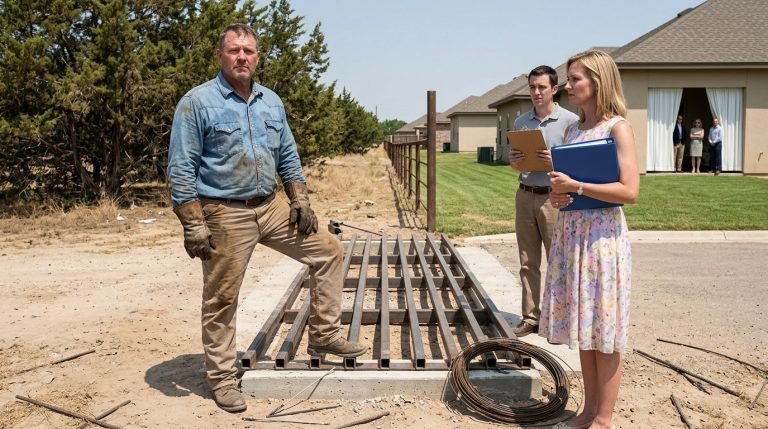
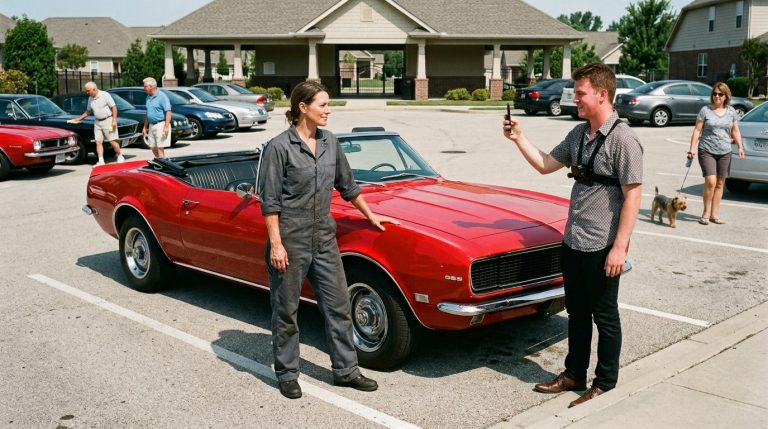
Bethann Whitmore didn’t flinch when I killed the truck’s ignition. She stood beside her driver’s side door in a matching set of obsidian yoga pants that had never seen a speck of mud, her phone held out at chest height like a sighting iron. The morning sun caught the polished chrome of her rearview mirror, bouncing a blinding speck of light across the weathered cedar posts my grandfather had set into the limestone back when Eisenhower was in office.
“This is private HOA property now,” she said. Her voice had that crisp, sanitized edge common to people who moved into the Hill Country with a checklist and a grievance. “You’re not coming through.”
I didn’t reach for the door handle right away. I let the silence stretch, thick with the sound of panting cattle and the faint, rhythmic clack-clack of a cooling exhaust pipe. My thumb rested against the worn leather steering wheel, feeling the grain where my father’s hands had worn it smooth before the cancer took him, long before the developers traded mesquite roots for manicured lawns and zero-lot-line foundations.
“That right,” I said, keeping my tone flat, tuned to the register of a man talking to a restless bull. “Strange thing for a gate that’s had a recorded right-of-way since nineteen-fifty-two.”
“Things change, Mr. Sullivan,” she snapped, her thumb tapping rhythmically against her phone screen, logging frames, recording data, building her little digital case file. “We have community standards to uphold. Property values don’t protect themselves while heavy livestock is tracked across decorative asphalt.”
She stepped back half a pace, positioning herself deliberately between my front bumper and the gate latch, as if her sheer presence could rewrite county deed records. But it wasn’t her stance that made the hair on my arms prickle. It was the mechanical sweep of a small, dome-shaped housing mounted high on a cedar tree just twenty yards inside the development line—a lens that hadn’t been there when I hauled out two days ago, tracking my cab with a slow, electronic pivot.
CHAPTER 2: THE PAPER TRAIL
The lens stopped pivoting. It gave a faint, metallic click-whir that sounded too clean for the scrub oak and limestone of the Hill Country, locking its gaze right on the dented driver’s side fender of my Ford.
Bethann didn’t lower her phone. If anything, she tilted the screen upward, framing the angle so the morning sun caught her glossed lips. “I’m documenting an active obstruction of community standards, Garrett,” she said, her voice dropping into that performative, lilting register she reserved for her digital audience. “Refusing to move a non-compliant transport vehicle on private property. Make your choice. Either back it down the highway or wait for the sheriff.”
I didn’t answer her. I shifted the truck into neutral, letting the diesel settle into a deep, vibrating idle that rattled the coffee thermos in the cup holder. Through the windshield, the forty head of black Angus shifted again, the smell of hot hair, manure, and high-protein feed pressing thick against the glass. These weren’t speculative cattle bought with venture capital or corporate board bonuses. They were three generations of selective breeding, four decades of drought survival, and the hard equity that kept my daughter Emma’s name off community scholarship handouts.
“You’ve got three minutes before the patrol car turns off County Road four,” Bethann added, checking her watch with theatrical precision. Her designer watchband caught the light—cold, polished steel that looked entirely out of place against the caliche dust coating my boots.
“Take your time, Bethann,” I said softly, my voice barely carrying over the engine block. “The gate’s been here seventy years. It’ll hold out a few minutes longer.”
I killed the engine. The sudden silence that rushed in was heavy, filled only by the dry rasp of cicadas and the muffled huff of a steer pressing its nose against the trailer slats. I didn’t reach for my phone. I didn’t argue the perimeter lines. I simply sat there with my hands resting on the steering wheel, watching the reflection of her Escalade’s white paint distort in my side mirror. It was the exact posture my grandfather had taught me when the bank surveyors came calling during the seventy-seven drought: let a man talk himself into a corner, because a corner is where the math stops working in his favor.
When the county sheriff’s cruiser finally rolled up forty minutes later, kicking up a rooster-tail of white dust that settled over the manicured St. Augustine grass of Willowbrook Estates, Bethann was already waiting at the edge of the asphalt with her phone out, ready to narrate the arrest. But Deputy Ramos didn’t pull up alongside her Escalade with his lights flashing. He parked thirty yards back, stepped out into the dry heat, and walked over to my driver’s window with a heavy, dust-caked clipboard tucked under his arm. He didn’t look at Bethann. He looked past her, his eyes locking onto the faded USDA decal on my front bumper and the permanent federal inspection plates bolted beneath the tailgate.
“Morning, Garrett,” Ramos said, tipping the brim of his straw hat. “Heard you were hosting a traffic jam.”
Before Bethann could slide into her rehearsed speech about trespassing and municipal code violations, I reached into my breast pocket and pulled out a manila folder that smelled of basement floor wax and sixty-year-old parchment. I didn’t hand it to Ramos. I laid it flat on the dashboard where the sun hit the yellowed, water-stained edges of the 1952 county surveyor’s map.
The transition from the dusty heat of the gate to the damp, climate-controlled vault of the county clerk’s office twenty miles away took less than an hour, but it felt like dropping into a different century. The air in the basement archives smelled of vinegar-rotted paper and institutional bleach—a sterile, antiseptic counterweight to the smell of cedar and dry cow manure outside.
I set my leather briefcase on the steel-framed table and unlatched the brass clips with a dull clack.
My mind snagged briefly on a memory I hadn’t invited: Sarah sitting at our kitchen table three years ago, her fingers thin and pale as she smoothed out the creases of our property tax receipts, whispering that we needed to make sure the land stayed whole for Emma no matter what the county assessors tried. I swallowed the dry taste in my throat, blinked away the phantom scent of hospital eucalyptus, and focused my fingers on the metal rings of the archive binder.
Spread out beneath the fluorescent strip lighting were the original deeds, hand-copied plats, and easement riders from the Truman administration. The paper was heavy, cotton-rag bond that crackled like dried corn husks when you turned a corner.
“Looking for something specific, Mr. Sullivan?” the clerk asked from behind the high counter, her bifocals sliding down her nose.
“Just verifying where a limestone boundary meets a legal right-of-way,” I muttered, sliding a yellowed index card from the tray.
There it was. Book 412, Page 88. Filed October 14, 1952. …and the party of the first part doth hereby reserve an easement twenty feet in width across the southern quadrant of said section, perpetual and unencumbered, for the movement of agricultural stock and equipment, running with the land in perpetuity, binding upon all subsequent heirs, assigns, and corporate successors.
No expiration clause. No sunset provision tied to housing developments, aesthetic zoning, or HOA bylaws. It was welded into the very bedrock of the Hill Country.
And as I traced the cursive signature of my grandfather at the bottom of the page, I noticed something else—a small, secondary notation stamped in purple ink by a county surveyor back when the original developer, Jim Crawford, first broke ground in 2019. It was a note regarding the perimeter buffer zones and the specific acreage set aside for county road access. A note that Crawford had initialed, but that subsequent corporate filings—the ones handled by a Phoenix-based property management group under a new slate of directors—seemed to have quietly omitted from their welcome packets.
My phone buzzed against the metal table. A text from Emma: Dad, why is there a white SUV parked across the south pasture lane again?
I didn’t reply right away. I pulled out my digital camera and framed a tight, macro shot of Crawford’s original signature, right next to the purple county seal. The macro lens caught the tiny fibers of the cotton paper lifting away from the ink. It was solid, undeniable physical friction—the kind of evidence that didn’t care about Facebook petitions or yoga-pant ordinances.
The rust on the old gate hinges back home was nothing compared to the friction building under the manicured lawns of Willowbrook Estates, and Bethann Whitmore had just signed her name to a document she never bothered to read.
CHAPTER 3: THE COUNTERSURVEY
The wind came off the flat caliche plains like a dry rasp, carrying the scent of parched mesquite and baking asphalt straight across the county courthouse steps. I closed my leather briefcase with a solid, brass-clipped snap, feeling the weight of the 1952 deeds pressed securely inside against the lining.
Behind me, the heavy glass doors of the clerk’s office swung shut with a pneumatic hiss, sealing in the smell of vinegar-rotted paper and floor wax. But the dust didn’t care about archives. It swirled around the bed of my parked Ford, coating the fenders in a fine, chalky layer of Hill Country grit that made the blue paint look faded, scrubbed raw by the elements.
Deputy Ramos was leaning against the fender of his cruiser twenty yards down the lane, arms crossed over his khaki uniform shirt, watching me approach with a slow, measured squint. He didn’t move until I was a few feet away, his boots crunching on the loose gravel.
“Found what you were looking for, Garrett?” he asked, his voice low beneath the howl of the wind slicing between the brick storefronts of the square.
“Found enough to keep a fence where a fence belongs,” I said, resting my hand on the cool metal of my truck bed. “And enough to show that the decorative stone pillars marking the front door of Willowbrook Estates aren’t quite sitting where the original plat map says they should.”
Ramos let out a dry, humorless chuckle, pulling a folded pack of gum from his pocket. “Bethann’s been on the radio with county road and bridge all morning. Claims your cattle trucks are chewing up the asphalt right up to her property line. She’s pushing for a formal boundary review.”
“Tell her to go ahead,” I muttered, sliding behind the steering wheel and turning the key. The diesel caught with its familiar, heavy rumble, shaking off the morning chill. “Sometimes when a neighbor asks the county to measure twice, they end up finding out they built their front porch on public right-of-way.”
The drive back to the ranch was a slow, uninterrupted grind down County Road Four. The wind battered the side of the truck box, rattling the empty aluminum slats of the livestock trailer behind me. There were no shortcuts here, no sudden leaps across miles or hours; every mile marker clicked past with the steady, unforgiving rotation of rubber on hot asphalt.
When I turned onto the gravel access lane leading to the ranch, the sight waiting at the perimeter was enough to make my jaw tighten.
A silver surveyor’s tripod was planted squarely in the center of the easement road, its aluminum legs gleaming under the harsh midday sun. Next to it stood a county surveyor I recognized—an older fellow named Miller who had spent thirty years mapping limestone ridges and property pins without playing politics. Bethann Whitmore was standing right beside him, her arms folded tightly across a designer windbreaker, pointing a manicured finger toward the exact spot where my grandfather’s split-rail fence met the modern asphalt of the subdivision entrance.
I cut the engine and stepped down into the grit, letting the truck door slam shut with a heavy thud that carried across the dry brush.
“—entirely unacceptable,” Bethann was telling Miller as I walked up, her voice sharp enough to cut wire. “The encroachment is blatant. Their cattle runoff and oversized trailers are eroding the base of our community entrance. We want a formal stop-work and citation issued immediately.”
Miller didn’t look up from the aluminum housing of his transit level. He twisted a brass thumb screw, locked the crosshairs, and wiped a line of sweat from his forehead with a khaki handkerchief. Then he looked over at me, his eyes tired and lined with the specific weariness of a man who had mediated a hundred suburban property wars between old Texas and new money.
“Afternoon, Garrett,” Miller said, nodding.
“Tom,” I replied, stopping a few feet short of the surveyor’s tripod. I kept my hands loose at my sides, feeling the dry wind tug at the brim of my cap. “Looks like you’ve got your work cut out for you today.”
“Well, Mrs. Whitmore here requested a complete boundary verification of the south quadrant,” Miller said, pulling a rolled blueprint from his belt clip and snapping it open against the wind. He pointed a calloused thumb at the intersecting lines near the cattle gate. “She wants to establish exact liability for the easement clearance.”
“Good,” I said, pulling the certified copy of the 1952 plat map from my back pocket and flattening it against the hood of the nearest survey truck. “Because according to Book 412, Page 88, that twenty-foot right-of-way runs straight through where your decorative stone entrance pillars are standing right now, Tom.”
Bethann’s face stiffened, the color draining from her cheeks beneath her designer sunglasses. “That’s impossible. Those pillars were approved by the county zoning board when the development was registered three years ago.”
Miller adjusted his spectacles, bending down over my faded paper map and comparing the ink lines to his modern digital tablet. He traced a finger across the coordinates, muttered something under his breath about setback requirements, and then walked slowly over to the brick-and-mortar pillars bearing the brass letters Willowbrook Estates.
He pulled a steel tape measure from his belt, hooked the metal end onto the base of the primary stone pillar, and walked it back toward the official county road marker.
The silence that followed was heavy, broken only by the whistling of the wind through the cedar brakes.
Miller stood up slowly, his expression flat. He looked from the tape measure to Bethann, and then back to me. “Well, Mrs. Whitmore,” he said quietly. “It looks like Mr. Sullivan is right. These pillars and the electronic gate housing… they’re sitting roughly three feet past your property boundary, right on the county road easement.”
Bethann stepped forward, her heels clicking sharply against the gravel. “That’s absurd. This is a targeted error. I demand a secondary review by the county commissioners—”
“A secondary review isn’t going to move the limestone, ma’am,” Miller interrupted, his tone hardening. “Technically speaking, your HOA is trespassing on county right-of-way. You’re looking at a formal notice of violation, and unless it’s corrected, you’re facing fifteen grand in survey adjustments and relocation costs just to clear the entrance.”
The look that Bethann shot me then wasn’t anger; it was the cold, calculating glare of a predator realizing the trap had just clicked shut on its own paw. She turned on her heel without another word, her windbreaker snapping in the wind as she marched back toward her Escalade, leaving the county surveyor standing in the dust with his tape measure.
I stood by the fence line, watching her tail-lights disappear into the subdivision, knowing this was only the first ripple of a much larger wave.
CHAPTER 4: THE SURVEILLANCE WEB
Tom Miller packed his transit level into its aluminum case with a sharp metallic click, leaving the surveyor’s tripod standing like a stark iron skeleton beside the county road marker. The dust he’d kicked up took several minutes to settle back onto the dry weeds, leaving the air tasting of crushed limestone and exhaust.
I didn’t rush back to the truck. I stood by the open bed of the Ford, watching the horizon where the dark green cedars met the flat glare of the midday sky. Across the boundary line, inside the pristine borders of Willowbrook Estates, the manicured lawns looked artificial, like a green rug laid over a dry bone.
When I finally climbed back into the cab, the cab air was heavy with heat. I started the engine, turned the steering wheel hard, and eased the truck forward down the caliche track toward the main ranch house. There were water troughs in the south pasture that needed checking before the sun crested the ridge, and a diesel generator down by the well house that had been sputtering since Tuesday.
The trouble with running a three-generation spread in the middle of a expanding county is that you don’t get to pause for local theater. The land demands its rhythm: check the wire, test the PH of the stock tank, grease the tractor fittings, keep the rust at bay.
Yet, as I pulled up to the weathered wooden fence surrounding the barn lot, something felt off. A low, synthetic frequency thrummed just beneath the ambient hiss of the wind through the live oaks.
I cut the engine, stepped down onto the packed earth, and listened.
Whir. Click. Whir.
It wasn’t the cicadas. It wasn’t the wind.
Mounted high on a cedar tree just ten feet inside the fence line—angled directly down toward my equipment shed and the stock loading chute—was a second security dome. It wasn’t there yesterday. It was small, matte black, and housing a wide-angle lens that pulsed with a faint, blinking amber LED.
Emma came walking out from the back porch screen door, holding two glasses of iced tea that clinked softly against each other in the heavy air. She stopped at the bottom of the wooden steps, her eyes fixed on the black dome mounted on the cedar trunk.
“That wasn’t there when I fed the chickens this morning,” she said, her voice tight. “She put another one up.”
“Looks that way,” I said, unlatching my gate and walking over to inspect the wiring. The black cable was neatly zip-tied to the rough bark of the cedar, running underground beneath the fence line straight toward the back property line of the nearest Willowbrook house.
“Dad, can she legally point a camera directly into our working area like that?” Emma asked, stepping closer, the ice in her glass melting fast under the heat. “It feels like we’re living inside a fishbowl.”
“She’s building an evidence file,” I told her, my fingers brushing the rough bark beneath the bracket. “Every time I start a tractor, every time a calf bawls, every time a truck rolls down the easement—she’s recording it to prove we’re a nuisance to her precious community standards. She wants the county to slap us with a formal injunction for aggressive agricultural operations.”
Emma looked down at her glass, then back up at me, her young face set with an expression that looked too much like her mother’s when things got difficult. “Well, she’s recording a working ranch doing ranch work. What’s she going to do next? Sue the cows for breathing too loud?”
“Wouldn’t put it past her,” I muttered, taking the glass of tea she offered. The cold moisture felt good against my calloused palm. “But let her record. Every hour of footage she stores of us maintaining this property is an hour of documented proof that we’ve been operating this land continuously and openly for decades. She thinks she’s watching us. All she’s really doing is creating a permanent paper trail of her own harassment.”
We stood there for a long moment in silence, the synthetic hum of the camera lens ticking softly in the dry heat.
I knew as well as Emma did that Bethann wouldn’t stop at cameras. Local complaints about noise and dust were just the opening skirmish. People like her didn’t back down when they realized a surveyor’s map proved them wrong; they doubled down, looked for bigger levers, and tried to find someone higher up the chain to swing the hammer for them.
The sun was dropping lower behind the hills, turning the sky the color of old copper, when my phone buzzed in my shirt pocket. It wasn’t a local number. It was an Austin area code attached to a regional extension from the USDA Rural Development office.
I pulled the phone out, stared at the glowing screen for a second, and pressed accept.
“Sullivan,” I said.
“Garrett,” Janet Morrison’s voice came through the speaker, crisp and carrying the dry crackle of a government landline. “I’m looking at an official complaint letter that just landed on my supervisor’s desk twenty minutes ago. It’s got your name all over it, and it accuses you of using your federal inspection credentials to threaten local property development.”
I let out a slow breath, looking back up at the black lens blinking on the cedar tree. The trap was springing, exactly as scheduled.
CHAPTER 5: THE FEDERAL THRESHOLD
The phone receiver felt heavy, its black plastic warm against my ear as Janet Morrison’s words settled into the quiet kitchen air. Outside the screen door, the sun had fully dipped below the horizon, leaving the Texas hills wrapped in a deep, indigo shadow.
“She didn’t just file a standard local grievance, Garrett,” Janet repeated, her voice carrying the unmistakable fatigue of a bureaucrat staring down a mountain of red tape. “The complaint letter landed straight on my supervisor’s desk this morning. She’s alleging that you’ve been using your USDA Rural Development inspection authority to threaten property values, coerce local homeowners, and run a personal vendetta against the Willowbrook Estates board.”
I pulled out a wooden chair from the pine table and sat down, my eyes fixed on the stack of tax receipts and utility bills resting near the salt shaker. “That’s quite an imagination for someone whose entrance pillars are currently trespassing three feet onto county right-of-way.”
“I know it’s garbage,” Janet said, shuffling papers on her end—a sharp, crisp rustle of documents over the line. “Your annual review last month was spotless, and your field logs match every inspection quota. But here’s the catch under federal protocol: when an external party files a formal ethics complaint against a federal agricultural inspector alleging local intimidation, it triggers an mandatory internal review.”
I rubbed the back of my neck, feeling the grit of caliche dust still lingering in my skin. “Meaning?”
“Meaning my office is legally required to pull the file, review your district operations, and cross-reference any rural development projects in your county to ensure no conflict of interest exists,” Janet said slowly. “And, Garrett… when we pull the development files for Willowbrook Estates, we don’t just look at property lines. We look at the federal grants that built the infrastructure in the first place.”
A slow, grim realization began to take root behind my ribs. Bethann had spent weeks trying to weaponize the system against a local rancher, entirely ignorant of the fact that the very agency she was dragging into her petty feud held the keys to her community’s entire financial foundation.
“What did the grant audit show, Janet?” I asked.
“Initially, nothing out of the ordinary,” she replied, her tone dropping into a professional register. “Standard regional infrastructure development. But once the mandatory review opened up, our compliance accountants started digging into the historical drawdowns for Willowbrook’s phase-one development. Garrett… there are three hundred and forty thousand dollars in federal grants tied to that subdivision. Flood mitigation funds, rural infrastructure support, environmental conservation allotments.”
She paused, and through the phone line, I heard the faint click of a pen against a desk.
“And?”
“And none of it matches the site inspections,” Janet said quietly. “The federal flood mitigation grant specifically required native wetland preservation and erosion control basins. According to the satellite and aerial surveys we pulled from the county GIS map today, those funds were diverted into decorative limestone water features and imported palm trees that actually increase local runoff risk. The annual compliance reports filed by the HOA leadership certified that the environmental requirements were fully met. Which means…”
“Which means they filed false statements to a federal agency,” I finished.
“Which is a federal felony,” Janet confirmed. “Ignorance of grant guidelines doesn’t excuse structural fraud. The moment Bethann forced this review to protect her subdivision’s aesthetics, she essentially handed us a magnifying glass and told us to look right at her own balance sheets.”
The silence in the kitchen stretched out, broken only by the steady hum of the refrigerator. I stood up, walked over to the window, and looked out toward the southern pasture. Through the dark branches of the live oaks, I could see the faint, rhythmic blinking of the security camera lens Bethann had mounted on the cedar tree earlier that day—still recording, still gathering its digital evidence, entirely blind to the federal avalanche it had just triggered.
“What’s your next step, Janet?” I asked.
“My office is legally obligated to hand the compliance discrepancy over to regional enforcement and the white-collar division,” she said. “Once a federal grant violation of that scale is flagged under an active review, it cannot be quietly dropped, no matter how many complaint letters Mrs. Whitmore mails to congressional offices. You keep your head down, Garrett. Do your ranch chores, maintain your logs, and let the paperwork do its job.”
The call clicked dead, leaving a soft dial tone humming in the quiet dark. I lowered the phone, staring out at the perimeter fence where the rusted iron gate waited in the dark. Bethann wanted a war of attrition, believing she held all the high ground. She had no idea she had just dug her own trench right above a federal powder keg.
CHAPTER 6: THE PANICDRIVEN SCRAMBLE
The sound hit my ears before the sun had even cleared the eastern limestone ridge—a high, mechanical scream of two-stroke engines chewing through green timber.
I pushed away from the kitchen table where Janet’s call had left me hours before, my boots hitting the braided rug with a heavy thud. The digital clock on the microwave read 5:42 a.m. Normally, dawn on the ranch belonged to the lowing of cattle and the quiet whistle of the wind through the live oaks. This morning smelled like raw cedar sawdust and burnt fuel.
I stepped out onto the back porch, pulling my canvas work jacket over my shoulders against the morning chill. Through the gaps in the cedar line, the amber security lens on Bethann’s camera blinked in the gray light, its housing vibrating from the commotion fifty yards away.
In the vacant common lot just across our southern boundary, a crew of hired landscape workers in high-visibility vests were swarming like ants around a cluster of imported palm trees. Two men with heavy Husqvarna saws were knee-deep in wood chips, severing the thick, fibrous trunks of the non-native palms that Bethann had spent thousands planting three years ago. The expensive, tropical trees were crashing into the manicured turf with dull thuds, their fronds scattering across the decorative gravel.
Behind them stood Bethann herself, wrapped in an oversized puffer jacket over her designer workout clothes, her hair unbrushed and her face pale in the predawn gloom. She was shouting over the roar of the engines, waving a rolled-up blueprint in one hand while directing a skid-steer loader toward a newly excavated drainage ditch.
I walked down the steps, stepping past the stock tank toward the fence line. The ground under my boots was cold and hard, dusted with a light morning frost.
“Faster!” Bethann yelled at a burly operator on the skid-steer. “Get those out of sight before the county inspectors arrive! I want native grasses dropped in by noon, do you hear me? Native species! Everything compliant!”
She turned abruptly, her eyes locking onto me where I stood leaning against the weathered cedar posts of my grandfather’s fence. For a second, her expression faltered—the hardened, algorithmic confidence slipping to reveal the raw, jittery panic of someone whose house of cards was sliding off the table.
She marched right up to the wire, her boots crunching on the frozen weeds. “You think you’re clever, don’t you, Sullivan?” she hissed, keeping her voice low so her crew wouldn’t hear. “Running to your federal buddies with fabricated complaints just because you can’t stand a modern neighborhood.”
“Looks like you’re doing a lot of landscaping for a Tuesday morning, ma’am,” I said, my voice steady, matching the cold, neutral register of a man watching a dry creek bed flood. “Those palms look like they just went in last year. Hate to see good decorative trees get chopped down after all that investment.”
“It’s scheduled maintenance,” she snapped, though her jaw twitched and her hands were clenched so tight around her blueprint tube that her knuckles were white. “Standard seasonal rotation to improve watershed management. Nothing more.”
“Right,” I replied, letting my gaze drift past her shoulder to where a crew member was hurriedly shoveling black mulch over a patch of exposed corrugated drainage pipe that had clearly never met federal specifications. “Nothing says seasonal rotation like a 6:00 a.m. chainsaw crew tearing out evidence before the sun comes up.”
Bethann stepped closer to the wire, her breath pluming white in the cold air. “You keep your nose out of subdivision business, Sullivan. I have an army of attorneys reviewing your harassment file, and if you think a few nuisance complaints are going to stop the HOA from protecting its property values, you’ve got another thing coming.”
“I’m just standing on my own land, Bethann,” I said quietly. “Though if I were you, I’d worry less about my fence and more about the kind of questions federal grant administrators ask when a project’s paper trail doesn’t match what’s actually sitting in the dirt.”
The color drained entirely from her face, leaving her skin the gray of wet cement. She didn’t snap back a retort. She simply stared at me for three long, silent seconds, the chainsaw roaring behind her like an approaching storm, before she turned on her heel and marched back toward the skid-steer, shouting orders with a frantic, desperate edge that echoed across the dry hills.
I stayed by the fence long enough to watch the first palm tree get hauled away into the bed of a dump truck. She was destroying the physical proof of her own violations under the panicked delusion that sweeping the evidence under a rug would make federal auditors go away. She didn’t understand the first rule of the law: when you start hiding a crime, you stop being a nuisance defendant and start becoming a criminal case file.
CHAPTER 7: THE COMMUNITY TRIBUNAL
The folding chairs in the Willowbrook Estates community center were designed for brief committee meetings and polite architectural reviews, not for a tribunal. They creaked under the weight of two hundred restless homeowners whose murmurs filled the room like the low, angry hum of an approaching squall line. The air smelled of stale coffee, burnt carpet, and the distinct, metallic tang of panic.
I sat on an unvarnished wood bench near the back exit, my cap held loosely between my knees. My boots were caked with dry caliche mud from morning chores, leaving faint, dusty arcs on the linoleum floor that contrasted sharply with the polished designer loafers of the suburban residents around me. Up front, beneath a plastic banner reading Protect Willowbrook Values, the HOA board members sat behind a long metal table with stiff, wooden postures.
Bethann Whitmore occupied the center seat. She wore a severe charcoal blazer, her hair pulled back into a tight chignon that made her cheekbones look sharp as flint. Her eyes darted continuously toward the side doors, where two county sheriff deputies stood with their arms folded, their utility belts heavy with gear. She didn’t look like an executive defending her community; she looked like a cornered animal calculating the trajectory of the hounds.
The side door clicked open, but it wasn’t the local patrol.
Three figures in dark, tailored suits stepped through the threshold, moving with the quiet, unhurried precision of people who didn’t need to raise their voices to command a room. Leading them was Agent Martinez from the federal white-collar crime unit, followed closely by Assistant U.S. Attorney Sarah Campbell and my supervisor, Janet Morrison. They carried thick, canvas-bound evidence cases instead of clipboards, their faces wiped clean of any local pleasantries.
The murmurs in the room died down instantly, replaced by a heavy, suffocating silence.
Bethann stood up abruptly, her metal chair scraping violently against the linoleum. “This is a private homeowners association proceeding,” she announced, her voice pitching slightly higher than normal. “Federal agents have no jurisdiction over neighborhood architectural rules or parking easements. I demand you clear the room.”
Agent Martinez didn’t even break stride. He walked straight past the front row, placed a heavy, manila-tagged evidence box on the edge of the board’s metal table, and unlatched the brass clasps with a dull clack.
“Mrs. Whitmore,” Martinez said, his voice carrying effortlessly across the room without a microphone. “You’re entirely right that this isn’t about parking easements anymore.”
He pulled out a thick stack of stapled documents, the yellowed corners bearing federal seals. “My name is Special Agent Martinez, U.S. Department of Justice. We are here pursuant to a federal grand jury indictment issued early this morning against Bethann Louise Whitmore, acting president of Willowbrook Estates, for systematic wire fraud, false statements to federal agencies, and the fraudulent diversion of three hundred and forty thousand dollars in federal grant funds.”
The shock wave that rolled through the community center was physical. Gasps cut through the quiet like breaking glass. A middle-aged man in the third row half-rose from his chair, staring blankly at the prosecutor.
“What?” someone shouted from the left aisle. “What grant money? We’re a private HOA!”
Sarah Campbell stepped forward, opening a second file containing aerial maps and financial ledgers. “You are a private HOA that inherited federal infrastructure and environmental grant contracts originally secured by the initial developer,” she explained, her tone sharp and precise. “Funds designated specifically for wetland flood mitigation, native species watershed preservation, and rural drainage protection. Funds that, over the past three years, were systematically diverted into decorative fountains, non-native palm tree imports, and unauthorized cosmetic landscaping.”
She turned a page, holding up a certified copy of an annual compliance report bearing Bethann’s signature.
“Furthermore, when federal auditors initiated a routine review prompted by formal complaints filed by this very office,” Campbell continued, her eyes locking onto Bethann, “current management engaged in active evidence tampering, financial record destruction, and the filing of fraudulent completion certificates to conceal the shortfall. Ignorance of grant obligations does not void federal felony statutes.”
Bethann’s face turned the color of ash. Her fingers clawed desperately at the edge of the metal table, her mouth opening and closing like a landed fish as she tried to find words to bridge the impossible gap between her suburban fantasy and the federal reality now resting on her desk.
“This is a conspiracy!” she finally shrieked, her voice cracking as she pointed a trembling finger straight toward the back row where I sat. “That rancher! He orchestrated this! He used his USDA connections to fabricate investigations because we challenged his illegal grazing rights!”
Every head in the room whipped around, two hundred pairs of eyes locking onto me in the back shadows. The weight of their collective panic was suffocating.
I didn’t flinch, and I didn’t stand up. I simply let my gaze meet Bethann’s across the sea of folding chairs, my thumb absently tracing the worn brass rivet on my cap.
Agent Martinez didn’t turn around. He simply reached down to his belt, unclipped a pair of steel handcuffs, and laid them flat on the metal table right beside the indictment papers.
“Mrs. Whitmore,” Martinez said quietly. “Federal grant compliance is not a matter of neighborhood opinion. Put your hands behind your back.”
The silence in the room was absolute, broken only by the low, mechanical hum of the air conditioning unit overhead—a cold, unyielding sound that didn’t care about property values, yoga pants, or decorative stone pillars.
CHAPTER 8: THE CLEAR HORIZON
The heavy oak gavel didn’t just end a trial; it felt like it settled the very limestone bedrock beneath the Hill Country. In federal court down in Austin, Judge Patricia Stevens had looked down from her elevated bench with the dry, unblinking focus of a hawk, delivering a five-year sentence and a four-hundred-thousand-dollar restitution order that stripped away every layer of the corporate evasion Bethann Whitmore had spent three years constructing. There were no dramatic late-hour reprieves, no loopholes in federal grant statutes, and no clever Facebook campaigns left to mount.
Back in Willowbrook Estates, the transition had been swift and absolute. Under the interim leadership of Margaret Campbell—who had turned over every hidden ledger and shredded memo the moment the grand jury subpoenas dropped—the neighborhood had begun the messy, necessary work of undoing the damage. The decorative water features built with diverted flood-mitigation money were dismantled, replaced by proper, engineered drainage culverts that actually held back the heavy Hill Country rains. The exotic palm trees that had threatened local watersheds were gone, supplanted by deep-rooted native grasses and live oaks that gripped the soil against erosion. Property values stabilized not through artificial cosmetic standards or harassment campaigns, but because the community was finally honest with itself.
Standing at my gate on a crisp Tuesday morning, the cool metal of the hinge felt familiar beneath my palm. The air smelled of damp grass, fresh coffee from my thermos, and the clean scent of woodsmoke drifting from the homestead chimney.
Emma walked out from the screen door of the porch, carrying two glasses of sweet tea. The ice clinked against the glass with a sharp, clear ring that cut through the early morning quiet. She stopped beside me, her eyes tracking the cattle grazing peacefully across the southern pasture where the grass was knee-high and green.
“Dad,” she said, handing me a glass. “You think the new board is actually going to leave us alone this term?”
I took the glass, feeling the cold condensation against my calloused fingers. I looked past the fence line, toward the subdivision entrance where the old, trespassing stone pillars had been pushed back three feet onto their proper side of the boundary. In their place stood a clean, freshly graveled stretch of the 1952 easement road, flanked by a small, permanent federal marker bolted securely to a treated cedar post, confirming agricultural right-of-way in perpetuity.
“They don’t have a choice,” I told her, taking a slow sip of the tea. “When you build a fence on truth instead of paperwork, you don’t have to spend your mornings looking over your shoulder.”
We stood together in silence for a long moment, watching the morning mist burn off the limestone ridges. The distant lowing of a calf rolled across the pasture, blending with the steady, unhurried rhythm of the land. The war of attrition was over. The paperwork was filed, the court orders were locked, and the three-generation legacy of the ranch was safe behind wire that had finally stopped shaking.