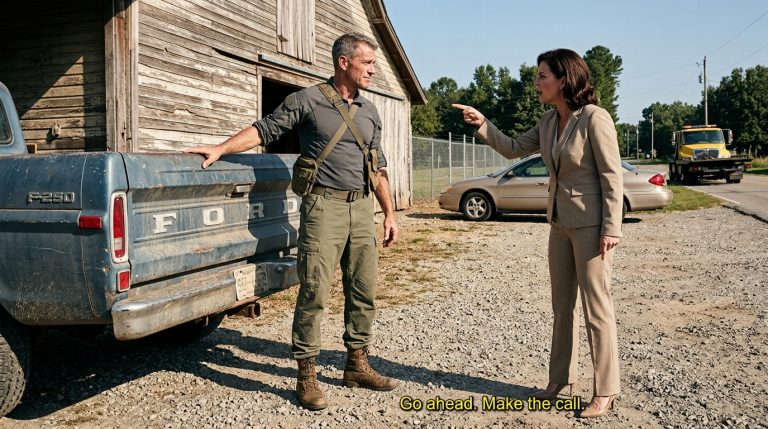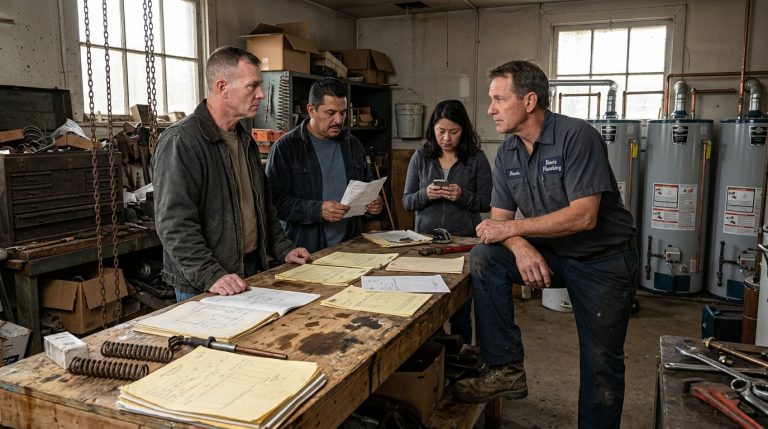
The Price of Quiet Ground: How a Retired Marine Built a Fortress of Paper and Iron
CHAPTER 1: THE DRAINED GROUND
The silence hit before the smell did.
Ten years of water moving over flagstone—that steady, cool rushing sound that kept the highway noise out of my skull—was completely gone. I set Sarah’s suitcase down on the gravel driveway, my boots crunching into the dry dirt, and walked around the cedar fence line into the backyard.
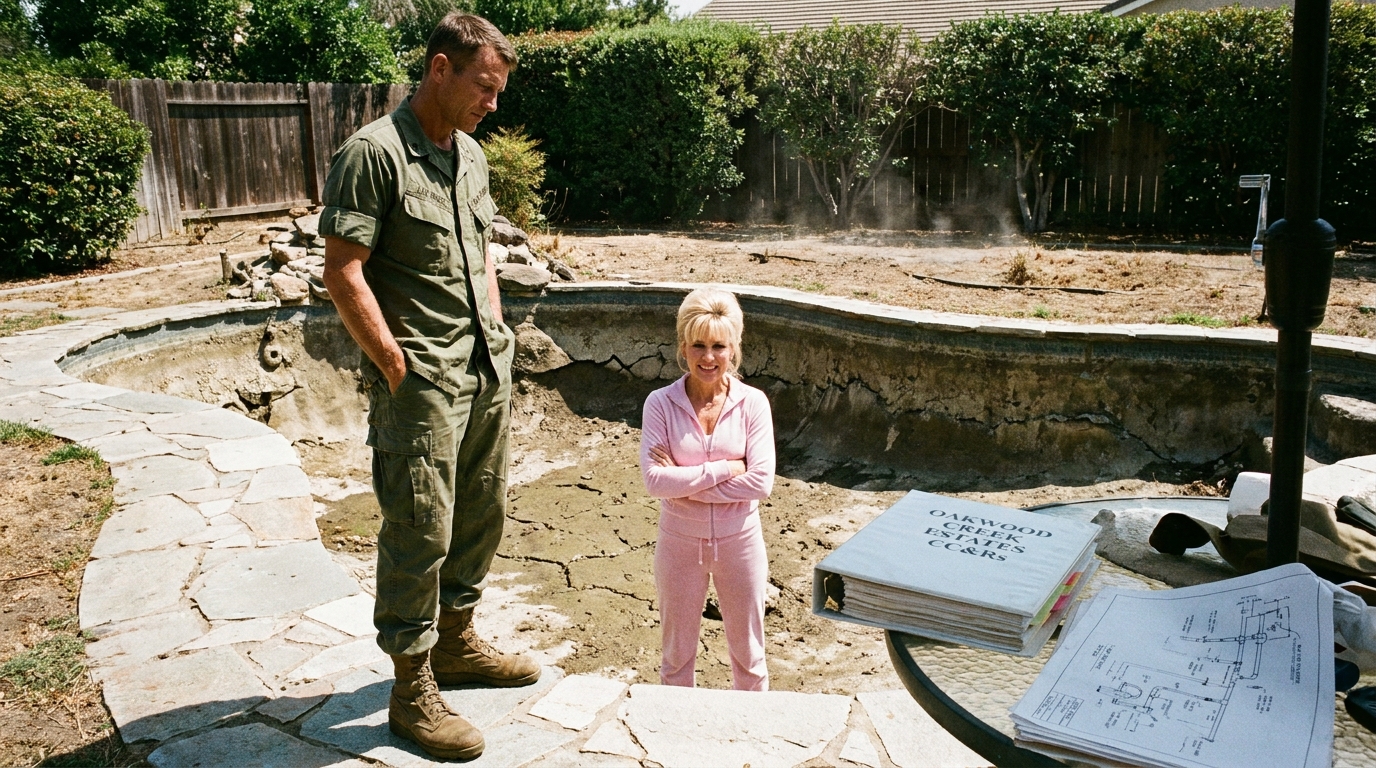
The centerpiece was just a gray, muddy wound. Ten thousand gallons of clear water, stripped to the bare liner.
On the cracked bottom, tangled in a clogged filtration intake, lay Jin Rin. The pearlescent scales along his flank were turned up toward the 90-degree afternoon heat, dull and stiff. Next to him, Kenji’s black sumi markings looked like dried ink spilled across the rubber matting. Fifteen fish. Ten years of tracking lineage, adjusting pH levels, and hand-feeding. Over a quarter of a million dollars in certified stock, rotting in three inches of stagnant sludge.
A heavy brass challenge coin—issued from my second tour in Fallujah— sat deep in my right pocket. I slid two fingers around its notched edge, turning it against my thumb until the metal warmed against my palm.
“Your little fish were making the neighborhood look untidy, Mr. Davies.”
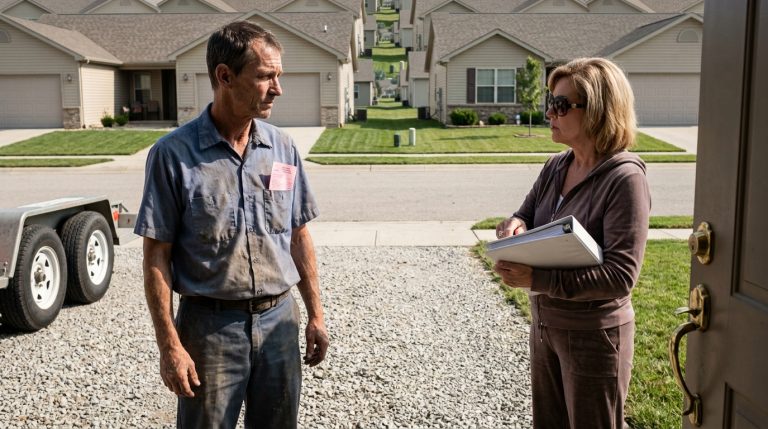
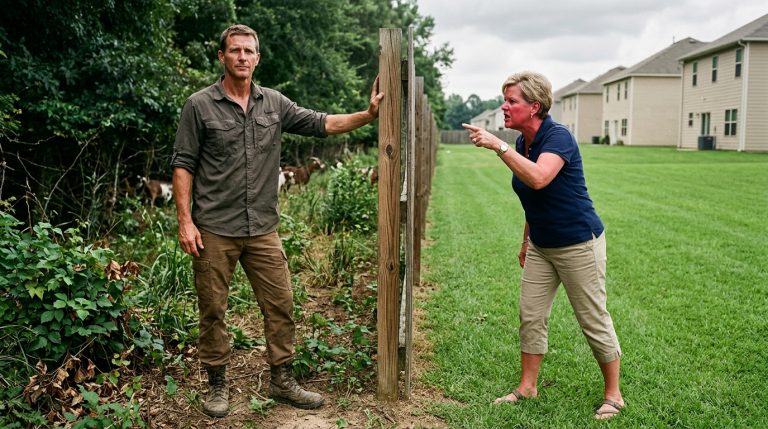
The voice came from the flagstone path near the side gate. Karen Miller stood there in a pastel pink tracksuit that strained across her chest, her arms locked over her torso like a barricade. Her blonde hair didn’t move in the breeze; it was shellacked into a rigid dome that caught the glare of the sun.
I didn’t step down into the mud. I stayed on the stone ledge, my fingers pressing the brass coin flat against my thigh.
“We simply tidied up,” she added. The corners of her mouth twitched into a tight, smug line.
“You came onto my property,” I said. The words came out slow, low in the throat, cleared of any heat. “You destroyed my filtration pump. You killed fifteen champion-grade Nishiki Koi.”
“The bylaws are quite clear.” She took one short step forward, her white sneakers squeaking against the dry stone. “The Architectural Control Committee has broad authority to address eyesores and public health risks. We received a formal complaint regarding stagnant water and mosquito breeding.”
“That water was turned over every forty minutes through a dual-bead biological filter,” I said. “It wasn’t stagnant.”
“Well, it’s gone now,” she said. She pulled a folded sheet of white paper from her jacket pocket and flicked it toward the patio table. It landed near my hand-drawn plumbing schematics. “That is the notice of abatement. You will also be receiving a bill for the drainage contractor’s time, along with a five-hundred-dollar fine for maintaining an unapproved water feature.”
I looked down at the paper. The ink at the bottom was still dark, the signature penned in round, loopy blue strokes: Karen Miller, HOA President.
“Those fish were appraised six months ago by the American Koi Breeders Association,” I said, keeping my eyes locked on the edge of her pink collar. “Two hundred and seventy-eight thousand dollars.”
For a fraction of a second, her chin dropped a quarter-inch. The pink fabric around her neck shifted as she swallowed, a small, involuntary twitch catching in her jaw muscle. Then her shoulders squared back up.
“Oh, don’t be dramatic,” she barked, letting out a short, wet laugh. “They’re just feeder fish. You can buy more at the pet store for two dollars a bag. Clear the liner by Friday, Mr. Davies, or the fines double.”
She turned on her heel, her sneakers grinding a loose pebble into the flagstone as she walked toward the street.
I didn’t follow her to the gate. I stood on the edge of the dry pit, the metal coin digging into the meat of my thumb until the skin went pale.
CHAPTER 2: THE AUDIT OF PAPER
The patio table was littered with dry pine needles and the single, curling sheet of paper she had left behind.
I pulled my thumb back from the coin, letting it drop into my pocket with a heavy clink against my keys. I picked up the notice. The paper was crisp, bright white, and completely free of humidity—not a single soft fold from sitting outdoors.
I turned it over. Printed across the bottom margin in tiny, faded gray ink was a timestamp from an office printer: Printed Today, 1:14 PM.
She hadn’t posted this notice three days ago. She had run it off her home computer twenty minutes before I pulled into the driveway.
I carried the paper inside, stepping over the threshold into the dark, air-conditioned quiet of the kitchen. Sarah was at the sink, her hands shaking slightly as she filled a glass with tap water. She didn’t ask about the backyard. She had already seen the dry pit through the window.
“Jack,” she said, her voice barely above the hum of the refrigerator. “What are we going to do?”
“We’re going to read,” I said.
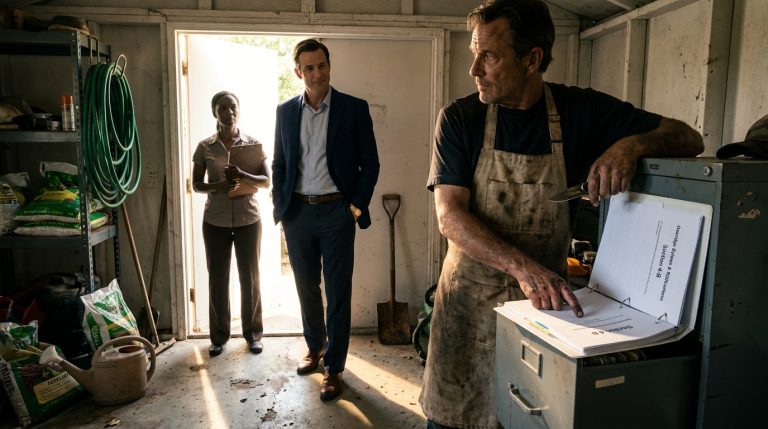
I went straight to the built-in desk in the hallway and pulled down the blue three-ring binder labeled Oakwood Creek Estates CC&Rs. It was three inches thick, dense with fifteen-year-old legal typography designed to make normal people give up after page four.
I laid the binder flat on the dining table, flipping past the section on grass height and mailbox colors until I reached Article 11: Emergency Abatement and Health Hazards.
The text was explicit. Emergency actions required a verified hazard documented by county officials, followed by a certified letter sent thirty days prior to any physical entry. If the work exceeded five hundred dollars, the board was legally required to secure three independent, sealed bids.
I looked back at the invoice Karen had slapped onto my patio table. Karen’s Clean-Cut Landscaping. Total: $1,200.
The company name sat right at the top of the bill, complete with a local landline number. I pulled out my phone, typed in the state business registry URL, and ran the LLC corporate filing number listed in the fine print.
The owner of Karen’s Clean-Cut Landscaping was Gary Slater.
I didn’t need a military intelligence clearance to connect the dots. Gary Slater was married to Karen’s younger sister, Brenda.
I sat back in the wooden dining chair, the leather of my belt creaking in the silent room. She hadn’t just overstepped her petty authority. She had trespassed on my land, destroyed a quarter-million dollars in documented property, and handed a non-bid contract to her own brother-in-law using HOA funds to do it.
The rage that had been brewing in my chest since I saw Jin Rin dead in the mud cleared away, replaced by the quiet, cold focus of a tactical problem.
I pulled a yellow legal pad from the drawer, uncapped a black pen, and wrote three words at the top of the page: Process. Paper. Paperwork.
She thought she was dealing with a retired fish hobbyist who would throw a noisy tantrum and pay the fine just to make the headache go away. She had no idea she had just handed me every single piece of rope needed to construct her own gallows.
I picked up my phone and dialed a number I hadn’t called in four years.
“Dave,” I said when the line picked up. “I’ve got a contract problem. And I need a Marine.”
CHAPTER 3: BUILDING THE COALITION
“Don’t file a complaint yet, Jack,” Dave said over the phone line. “The moment you throw a formal charge at her, she hides behind the HOA’s retainer lawyer. Gather the neighbors first. Find out how many people she’s bled dry.”
I tapped the legal pad twice, uncapped the pen, and wrote two names: Gable. Rodriguez.
Ten minutes later, I walked down the asphalt curve of Elm Street, a clipboard under my arm and a fresh Tupperware of Sarah’s oatmeal cookies in my hand. I wasn’t marching in uniform. I was just a neighbor taking a walk on a humid Tuesday afternoon.
Mrs. Gable was kneeling near her front flowerbed, her white cotton gloves caked in topsoil. The moment my boots clicked against her walkway, her head snapped up, her eyes darting nervously toward Karen’s two-story house across the street.
Before I could speak, her hands darted into the rosebushes, tucking a six-inch ceramic gnome behind a thorny stem.
“I was just taking him inside, Jack,” she stammered, her hands trembling as she smoothed her apron. “Mrs. Miller said the colorful ones violate the architectural unity code. She said the seventy-five-dollar fine posts tomorrow.”
“Mrs. Gable,” I said quietly, setting the container of cookies on the porch railing. “I’m not here about the gnome. Look at my backyard.”
She blinked, wiping her forehead with the back of a dirty glove. “I heard the pumps stopped. Jack… what happened?”
“She drained it,” I said. “Every gallon. Killed all fifteen fish.”
Her mouth opened, but no sound came out. She looked down at her own hands, then back at the rosebushes.
“She told me if I didn’t pay the gnome fines by the fifteenth, she’d put a lien on my title,” Mrs. Gable whispered, her voice cracking. “I’m on a fixed income, Jack. My husband built this porch. I can’t lose this house.”
“You won’t,” I said. “Do you still have the fine notices?”
She nodded quickly, scrambling up from the soil and hurrying inside. When she returned, she handed me a stack of six pink paper citations—every single one signed by Karen Miller, with no board seal, no meeting record, and no right-of-appeal form attached.
I filed them neatly under the clipboard clamp. “Thank you, Mrs. Gable. Keep your gnome where it is.”
I crossed the street to the Rodriguez house. Carlos Rodriguez was standing in his concrete driveway, staring up at a portable basketball hoop set near the garage door. A bright orange violation sticker was plastered across the backboard.
“Don’t tell me,” Carlos growled, not turning around as I approached. “It’s an attractive nuisance. That’s what the letter said. My boys can’t even shoot hoops at four in the afternoon.”
“She’s charging you a hundred a month,” I said, stepping up beside him.
Carlos turned, his jaw set hard. “How do you know that?”
“Because she’s doing it to everyone,” I said, slipping the legal pad out from under the clipboard. “Mrs. Gable for a lawn ornament. Me for my pond. She’s running a shakedown, Carlos. And every dime of those fines goes into an un-audited operating account.”
He stared at the pink slips on my clipboard, his eyes narrowing as he read Mrs. Gable’s citations.
“My kids are terrified to play out front,” Carlos said, his voice dropping into a dangerous register. “I work sixty hours a week at the site to keep this place clean. What are we supposed to do? Let her run us out?”
“No,” I said, pulling out a pen and handing it to him. “We sign a collective petition demanding a full audit of all vendor contracts. Starting with Gary Slater’s landscaping bills.”
Carlos took the pen, his knuckles going white against the plastic, and pressed his signature onto the line.
CHAPTER 4: THE LEGAL AND INTELLIGENCE STRIKE
I walked back into my house, set the clipboard on the dining table, and pulled my phone from my pocket.
Mike Tanaka answered on the third ring. “Jack. I pulled the corporate filings and the bank routing profiles on Karen’s Clean-Cut Landscaping.”
I pulled a fresh wooden chair out, sitting down as Sarah set a warm cup of black coffee next to my elbow. “What did you find, Mike?”
“It’s not just inflated bids, Jack,” Mike said, his keyboard clicking rapidly in the background. “Gary Slater’s business account has been wire-transferring twenty-two hundred dollars on the first of every month directly into a personal checking account owned solely by Karen Miller. Listed as ‘consulting fees.’ She’s not just hiring her brother-in-law—she’s taking a kickback on every dollar the HOA pays him.”
I took a slow sip of the coffee, letting the heat settle in my chest. “How long has this been going on?”
“Thirty-six months,” Mike said. “Total embezzlement comes out to just over seventy-eight thousand dollars. It’s wire fraud, Jack. It’s criminal.”
“Send the full digital ledger to Dave,” I said. “We’re ready.”
By five o’clock that evening, Dave Reynolds met me on my front porch carrying a stiff leather briefcase. He pulled out a twenty-page formal legal demand letter printed on heavy corporate stationery.
“This is the broadside, Jack,” Dave said, tapping the thick document against his palm. “We’re suing for the full three hundred and fifty-five thousand dollars—the appraised value of the certified stock, the complete reconstruction of the pond, and legal fees.”
“And the settlement trap?” I asked.
Dave grinned, a sharp, cold expression that didn’t reach his eyes. “We offer to drop the personal damages to direct costs only under two conditions: a full written apology read aloud at the next HOA meeting, and the immediate cancellation of Gary Slater’s maintenance contract.”
“She’ll never take it,” I said.
“That’s the point,” Dave replied, sliding the document into a thick manila envelope. “A narcissist can’t apologize in public. She’d rather burn the entire neighborhood down than admit she broke a rule. She’ll reject the reasonable settlement, call a meeting to fight us, and walk right into the room we’ve set up for her.”
The front doorbell rang twice—short, aggressive jabs that echoed through the foyer.
I opened the door. Karen stood on the porch step, holding a brand-new yellow slip of paper. Her face was flushed dark red, a thin sheen of perspiration ruining the thick powder around her nose.
“You’re storing animal remains in an unapproved garage freezer, Mr. Davies,” she snapped, thrusting the paper toward my chest. “A neighbor reported an industrial appliance visible from the driveway. You have twenty-four hours to dispose of those dead fish or face a two-hundred-dollar daily fine.”
I didn’t take the yellow paper. I looked past her shoulder at her sister’s husband’s truck parked across the street, then looked back into her eyes.
Dave stepped up right beside me, slipping the heavy manila envelope into her outstretched hand instead.
“Karen Miller,” Dave said softly. “You’ve just been served with a formal demand notice for civil fraud and conversion. Have a good evening.”
CHAPTER 5: THE TOWN HALL TRIBUNAL
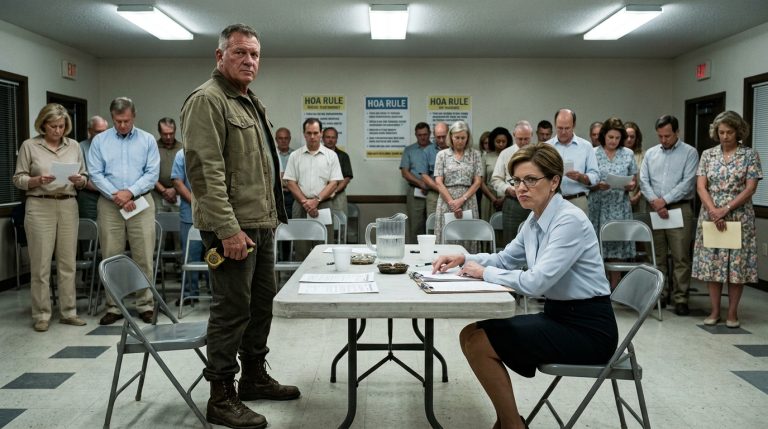
The community center clubhouse was packed wall-to-wall by seven o’clock.
Over a hundred homeowners sat in the folding metal chairs, the air thick with hum of low whispers and rustling papers. Karen sat at the head table, flanked by the four other board members. She wore a bright turquoise blazer, her posture rigid, her face locked in a mask of stern, motherly concern.
“Welcome, everyone,” Karen announced, tapping a wooden gavel against the folding table. “We are here to vote on a crucial amendment to strengthen our architectural guidelines regarding hazardous water features.”
I stood up from the front row before she could raise the gavel a second time.
“Point of order, Madam President,” I said, my voice cutting through the room without raised volume.
Karen’s chin snapped up, her eyes narrowing behind her gold-rimmed glasses. “Mr. Davies, this is not the time for public comment. We are moving directly to the board vote.”
“According to Section 4, Article B of our bylaws,” I said, stepping toward the podium with my laptop, “any proposed rule change requires thirty minutes of open floor debate before a vote can be called.”
Gerald, the board accountant sitting to her left, cleared his throat nervously and checked his binder. “He’s right, Karen. We have to allow the debate.”
Karen’s jaw tightened, a twitch forming in her left eyelid as she gestured toward the screen. “You have three minutes.”
I plugged the cable into my laptop. The projector screen flashed white, then filled with a high-resolution photograph of Mrs. Gable’s front yard, a red circle drawn around her tiny ceramic gnome.
“This is Mrs. Gable’s garden,” I told the crowd. “Over the last six months, she has been fined four hundred dollars for this four-inch decoration. Fines that were issued without a board vote.”
Murmurs rippled through the back rows.
I hit the spacebar. The screen changed to a photo of Carlos Rodriguez’s driveway, showing the orange violation sticker across his sons’ basketball hoop.
“This is the Rodriguez house. A hundred dollars a month in fines for a portable hoop.” I turned to face the audience. “And three weeks ago, my backyard pond was drained and destroyed while I was out of state. Over two hundred and seventy thousand dollars in certified property killed in three inches of mud.”
“That pond was a stagnant health hazard!” Karen shrieked, slamming her hand flat onto the table. “I used my executive authority to protect this community!”
“You used your authority to pay your brother-in-law,” I said softly.
I hit the spacebar again.
The screen split into two documents: the corporate filing for Karen’s Clean-Cut Landscaping listing Gary Slater as owner, side-by-side with thirty-six months of bank wire transfers showing two thousand two hundred dollars moving from Slater’s business account directly into Karen Miller’s personal checking account every single month.
The room went completely silent for two seconds. Then it exploded.
Homeowners leapt to their feet, waving their own violation notices in the air, shouting over one another toward the head table. Gerald shrank back in his chair, his hands raised in surrender, while the other board members stared at Karen in sheer horror.
“Lies!” Karen screamed into the microphone, her voice rising to a high, cracking pitch as she stood up, her chair scraping violently against the linoleum floor. “These are fabricated documents! You are a dishonest, vengeful man who couldn’t handle being told no! I did this neighborhood a favor by destroying that filthy swamp, and I would do it again tomorrow!”
In the second row, Dave Reynolds stood up, unbuttoning his suit jacket.
“Thank you, Madam President,” Dave said, his voice echoing over the uproar. “That statement was recorded by twelve separate homeowners. On behalf of my client, Jack Davies, you have just been formally served.”
Dave walked to the head table and laid a fresh stack of legal papers directly over her wooden gavel.
“Three hundred and fifty-five thousand dollars for property destruction,” Dave said, “and a separate suit for personal defamation. Good night, Karen.”
CHAPTER 6: THE NEW NORMAL
The aftermath didn’t happen overnight, but the momentum was unstoppable.
Without HOA insurance to cover her personal liability for fraud, Karen Miller stood alone against the civil suit and the county district attorney’s financial task force. Within sixty days, her lawn bore a cold metal “For Sale” sign, her personal assets drained to satisfy the three hundred and twenty-six thousand dollar settlement check that arrived in my mailbox via certified mail.
The board was completely restructured, with Carlos Rodriguez taking over as president. Mrs. Gable’s ceramic gnome sat proudly on her front porch, unbothered, while the neighborhood children’s basketball games rang out down the block every afternoon.
Now, the sun was low over the backyard, painting the cedar fence line in warm amber light.
The new commercial-grade rubber liner sat smooth and tight beneath four feet of gin-clear water. The brand-new biological filtration system hummed in the pump house—a low, steady rumble that drowned out the distant highway traffic.
I sat on the teak bench near the flagstone ledge, a small bag of high-protein pellet food resting on my knee.
Across the clear surface, twelve young, one-year-old Tosai koi glided in a synchronized arc. A bright orange and white Kohaku broke the water first, its mouth opening against the surface tension with a tiny splash.
I reached down into my right pocket, my fingers brushing past the heavy brass challenge coin. I didn’t pull it out to turn it against my thumb. I left it sitting flat at the bottom of the canvas lining.
I dipped my hand into the bag, took a single handful of pellets, and scattered them across the moving water.
The fish surged forward in a ripple of color, making small, rhythmic pops against the quiet evening air.
I leaned back against the wooden slats, folded my hands across my chest, and watched the water turn.