The Weight of Silence: A Mother and Daughter’s Quiet Reclamation of Light After the Storm
CHAPTER 1: The Echo of Silence
The hospital waiting room was a desert of beige and fluorescent hum. Emily’s legs dangled off the edge of the seat, her sneakers barely brushing the linoleum. Every time the elevator chimed, her heart gave a sharp, frantic kick against her ribs. She was nine, but in the silence between the chimes, she felt as old as the dusty paintings that used to line the Caldwell hallway.
Her mother, Susan, sat perfectly still beside her. Her hands, usually so busy—folding laundry, arranging trays, scrubbing surfaces until they shone—were folded tightly in her lap. The white bandage on Emily’s knuckles was clean, stark against her skin, a badge she didn’t want to wear.
“He’s going to be okay, Mama,” Emily whispered. It was an anchor of a sentence, dropped into deep water.
Susan turned, her eyes red-rimmed but clear. She reached out and tucked a loose strand of hair behind Emily’s ear. Her touch was hesitant, as if Emily were made of glass. “I know, baby. I know.”
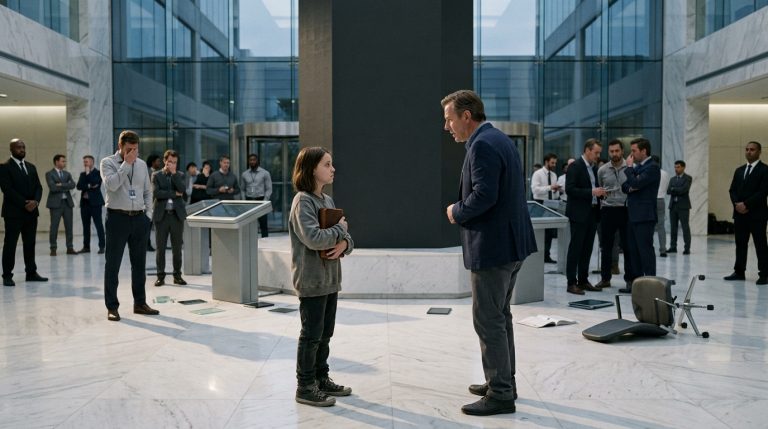
The automatic doors slid open with a soft, pneumatic sigh. A man stepped in, his suit charcoal gray and perfectly pressed. He didn’t look like a doctor, and he certainly didn’t look like a guest. He carried a leather briefcase that caught the morning light. He scanned the waiting area, his gaze pausing briefly on the vending machine before landing, with surgical precision, on them.
Emily pulled her hand back into her pocket, her fingers brushing against the crinkled plastic of the straw she’d kept—a small, sharp memory of the dark.
The man walked toward them, his footsteps swallowed by the carpet. He stopped three feet away, offering a practiced, hollow smile. “Susan Miller? And Emily?”
Susan stood up, her posture shifting from weary to defensive. “Who are you?”
“My name is Arthur Vane,” the man said, setting the briefcase on the empty chair beside her. He didn’t sit. “I represent the interests of the Caldwell estate. We’re very concerned about the… visibility of the current situation. We’d like to discuss how to manage the transition for your family.”
Emily watched his eyes. They weren’t warm like Mr. Caldwell’s had been in the kitchen; they were flat, like the glass of a mirror. He looked at the bandage on her hand, then at her mother’s tired face, and Emily felt a cold, familiar prickle at the back of her neck. He wasn’t there to check on Thomas. He was there to tidy up the room.
“We don’t want to talk to you,” Emily said. Her voice was small, but it cut through the hum of the room.
Arthur Vane’s smile didn’t reach his eyes. It merely shifted, becoming a fraction tighter. “I think you’ll find, Emily, that silence is a very expensive commodity. And right now, you’re holding a great deal of it.”
He reached into his jacket pocket and pulled out a plain, cream-colored envelope. He didn’t hand it to them; he laid it on the plastic chair. It felt heavy, like it held something harder than paper.
“Mr. Caldwell is grateful,” Vane said, his voice dropping to a low, conspiratorial register. “But grateful people often have short memories. We’d like to help you make sure yours is very, very long.”
He turned to leave, but before he walked toward the elevators, he stopped. He looked back at Emily, and for a split second, the mask dropped. It wasn’t hate, like Margot’s. It was something far worse: it was pity.
“Some doors aren’t meant to be opened, little girl,” he said, his voice barely a whisper. “Even when they’re in the walls.”
The doors slid shut behind him, leaving Emily and her mother in the sudden, ringing silence of the waiting room. Susan looked down at the envelope, her hand trembling as she reached for it.
CHAPTER 2: The Currency of Silence
Susan’s fingers, usually calloused and steady from years of labor, trembled as she touched the cream-colored flap of the envelope. It was heavy, of a quality that didn’t exist in the world Emily and her mother inhabited. It wasn’t just paper; it was a wall, thick and insulating, designed to shut out the noise of the rest of the world.
Emily watched her mother’s hands. She saw the way the skin caught on the edge of the envelope, a tiny snag of reality against the polished aesthetic of the Caldwell estate. The air in the hospital lobby felt like it had been scrubbed too clean, lacking the scent of jasmine or the bitter undercurrents she had come to associate with Margot’s presence. Instead, there was only the smell of antiseptic—sharp, cold, and final.
“Don’t open it, Mama,” Emily said. Her voice didn’t waver, but the sound felt too loud in the cavernous, quiet room.
Susan looked down at her daughter. Her eyes were clouded, a mixture of fatigue and the deep, marrow-shaking fear that had been her constant companion since they arrived at the estate. “We have to know, Emily. We have to know what they think our silence is worth.”
“It’s not worth anything,” Emily replied, her own hand aching from where the bandage pressed against the raw skin of her knuckles. She remembered the boy in the wall. Thomas. She remembered the way his skin had felt, cold and clammy, and the way the plaster dust had coated her like a shroud. That hadn’t been about money. That had been about survival. Mr. Vane’s arrival, his briefcase, the smooth, unctuous way he had spoken—it felt like a different kind of imprisonment. A gilded one, where the locks were replaced by expectations.
Susan tore the flap. She didn’t rip it; she pulled it back with a slow, deliberate grace. Inside was a single check and a card, heavy enough to weigh down her palm. She didn’t look at the amount. She stared at the card, her breathing shallow and rhythmic, like a bird trapped in a cage.
Emily stood up, the plastic chair clattering against the floor—a jarring, mechanical sound that made a nurse at the nearby station look up. Emily ignored her. She stepped closer, leaning into her mother’s space, and saw the embossed letters on the stationery. It wasn’t a bank draft. It was a formal request for a meeting, a non-disclosure agreement that seemed to stretch on for pages, and a set of instructions for “future management” of their housing and education.
“It’s not just money, Mama,” Emily whispered, the realization settling into her bones like winter. “It’s a leash.”
The memory of the hallway—the dark, suffocating space behind the wallpaper—flashed before Emily’s eyes. She felt the phantom brush of cold brick against her shoulder. She was back in that hallway, the sound of Margot’s sharp heels clicking on the marble, the smell of jasmine masking something rotting underneath. The fear wasn’t gone; it had just transformed. Before, it was the fear of a monster. Now, it was the fear of being swallowed by the system that had allowed the monster to exist in the first place.
“We can’t sign this,” Emily said.
Susan finally looked up. The fatigue was still there, but beneath it, something sharper was beginning to take root. She looked at the envelope, then at the hospital doors, then back at her daughter. “If we don’t, Emily, we have nothing. We lose the apartment. We lose everything.”
“We didn’t have anything before, and we were okay,” Emily countered. She was only nine, but she understood the physics of their life: you either moved forward on your own feet, or you let someone else carry you—and those who carried you always chose the direction.
A sudden commotion at the elevator—the doors opening to reveal a flurry of doctors and orderlies—drew their attention. A stretcher was being wheeled out, the rhythmic thump-thump of the wheels mimicking the sound of the wedding band’s bass from the night before. Emily turned away from the spectacle, her gaze landing on a trash can near the vending machine.
She walked over to it. The metallic ring of the pedal beneath her sneaker felt final. She looked at her mother, who was still holding the check as if it were a fragile bird.
“Mama,” Emily said, her voice steadying. “Grandpa Joe told me that bravery isn’t about being scared. It’s about doing the right thing anyway. Keeping that,” she gestured to the envelope, “isn’t the right thing. It’s just staying quiet.”
Susan watched her daughter. For a long, silent moment, the only sound was the sterile hum of the hospital and the distant, haunting whine of an ambulance siren pulling into the emergency bay. Susan slowly lowered her hand. She didn’t drop the envelope, but she let it rest against her side, her grip loosening.
“You’re right,” Susan whispered, more to herself than to Emily. “It’s a debt. But it’s not ours.”
They sat back down, but the air between them had shifted. The beige walls didn’t feel as oppressive as they had moments before. Emily reached out and took her mother’s hand, her own fingers carefully navigating around the bandage. They were sitting in a waiting room, waiting for news about a boy who had almost been erased from the world, and they were, for the first time in their lives, looking at the door that led out, rather than the one that led deeper into the maze.
But as the hospital doors swung open again, this time to admit a man in a rumpled suit who looked less like a corporate lawyer and more like a detective, Emily realized that the silence wasn’t going to be their only problem. The story was still moving, and they were still the only ones who knew where the walls had been cracked.
CHAPTER 3: The Tangled Thread
The man in the rumpled suit didn’t look at the empty chairs or the vending machine. He looked directly at Susan and Emily. He had the kind of face that seemed permanently etched with the fatigue of long, unsolved nights—deep lines around his eyes and a mouth set in a permanent, pragmatic grimace. He held a small, plastic evidence bag in his hand, and inside it was a single, rusted nail.
Emily recognized it instantly. It was the color of the old ships in the Caldwell hallway paintings, the color of the secrets hidden behind the silk wallpaper.
“I’m Detective Miller,” the man said, his voice gravelly, like stones shifting in a stream. He didn’t offer a handshake. He looked at the cream-colored envelope still sitting on the chair. “I see Vane paid you a visit.”
Susan’s posture tightened, her shoulders squaring against the sterile backdrop of the lobby. “He offered us a way out,” she said, her voice strained but firm. “We’re not taking it.”
Miller nodded once, a sharp, jerky movement. “Good. Because ‘ways out’ from the Caldwell estate usually lead straight into a cul-de-sac. I’m not here to offer you money, Mrs. Miller. I’m here because the pool man, Jim, decided he didn’t want to go down for attempted murder alone.”
He stepped closer, his presence expanding to fill the small space between them and the automatic doors. He looked at Emily, his eyes softening just enough to be unsettling. “You’re the one, aren’t you? The girl who listens to walls.”
Emily didn’t answer. She just tightened her grip on her mother’s hand. The clinical smell of the hospital felt thicker now, suffocating. She felt the phantom weight of the loose panel under her fingers again, the cold, damp darkness of the wall, and the sudden, sharp realization that the story was moving faster than she could comprehend.
“We told the police everything we know,” Susan said. “The night of the wedding, the boy, the way Margot looked at us. There’s nothing left to say.”
“There’s always something left to say,” Miller replied, pulling a chair over and sitting down, his knees popping. He placed the evidence bag on the small table between them. “Margot’s story is simple: she claims she was being blackmailed by Jim. She says he forced her to help him hide the boy, that she was a victim of his coercion. She’s playing the ‘distraught bride’ angle so well that the D.A. is already having nightmares about the trial.”
Emily looked at the rusted nail in the bag. “She’s lying.”
“I know she is,” Miller said, his gaze fixed on the nail. “But proving that she acted on her own, rather than as part of a larger, well-funded mechanism of disappearance, is another thing entirely. The Caldwells are very good at ‘managing’ truths. They don’t just destroy evidence; they restructure reality until the evidence no longer makes sense.”
Susan let out a sharp, jagged breath. “What do you want from us, Detective?”
“I want the ‘why’,” Miller said. “And don’t tell me it was just because she didn’t like the boy. People like Margot don’t risk a billionaire’s fortune for a petty grudge. She had a goal. She had an objective. And she had help—the kind of help that doesn’t leave fingerprints, but leaves traces in bank accounts, in property deeds, and in the quiet, empty spaces behind walls.”
Emily’s mind raced. She thought of the estate, the way Margot had scanned the room like a hawk, the way Mr. Vane had moved with the confidence of someone who owned the very air they were breathing. It wasn’t just about Margot. It was about the house itself. The paintings, the heavy curtains, the way the staff were trained to be invisible. The house was a trap, and Margot was just one of the teeth in the mechanism.
“She wasn’t just hiding him,” Emily whispered, the thought surfacing as if from deep water. “She was waiting for something.”
Miller leaned in, his interest piqued. “What do you mean?”
“She wasn’t just mad at him,” Emily continued, her voice gaining strength. “She was… she was measuring things. Whenever she looked at the walls, she looked like she was checking a measurement. Like she was waiting for the house to be ready.”
Miller went still. He reached into his jacket and pulled out a notebook, the pages worn and dog-eared. “Measuring the house,” he muttered, scribbling something down. “That’s… that’s not a grudge. That’s a renovation.”
He looked at Susan. “Mrs. Miller, I need you to think back. Was there anyone—anyone at all—who visited the estate in the weeks leading up to the wedding? Anyone who wasn’t a guest? Contractors, architects, people who looked like they were checking the structure, not the decor?”
Susan frowned, her brow furrowing. “There were… there were men. In the basement. I thought they were just fixing the foundation. The estate is old, and the pipes are always leaking. I just thought…”
“Contractors,” Miller finished, his voice grim. “If they were working on the foundation, they weren’t fixing pipes. They were modifying the architecture. They were building a tomb.”
He stood up, his joints aching. “They aren’t just going to pin this on Jim, and they aren’t going to let Margot take the fall for everything. They’re going to scrub the estate clean before the police can get a warrant for the structure itself. We have to move, and we have to move now, before they finish the ‘renovations’.”
Emily looked at her mother. The choice they had made to refuse the money, to stay silent, had just vanished. They were no longer witnesses; they were now the only ones with the map to a house that was actively trying to rewrite its own history.
“We can help,” Emily said.
Miller looked at her, then at Susan. “It won’t be safe. And it definitely won’t be quiet.”
“We’ve been quiet long enough,” Susan said, her voice hardening with a resolve Emily had never heard before.
Miller nodded and turned toward the exit, his heavy footsteps echoing in the silence of the lobby. “Then let’s go. I know a place where the walls don’t have ears, and we’re going to talk about exactly what you saw behind that wallpaper.”
They walked out of the hospital, the bright, harsh daylight of the city hitting them like a physical force. Emily took one last look back at the sliding doors, at the beige waiting room that now felt like a relic of a simpler, more terrifying time. The city stretched out before them, noisy, chaotic, and filled with millions of people who had no idea what lay behind the walls of the Caldwell estate. She reached into her pocket, felt the cold, hard edges of the straws she had kept, and stepped into the light.
CHAPTER 4: Beneath the Foundation
The ride to the temporary safe house—a quiet, drafty apartment on the outskirts of the city—was not quiet. Detective Miller drove with a nervous, staccato energy, his eyes flicking to the rearview mirror every few seconds. Susan sat in the passenger seat, her hands gripped so tightly on her bag that her knuckles were white. Emily sat in the back, her gaze fixed on the passing blur of streetlights, but her mind was still trapped in that dark, narrow corridor.
When they finally arrived, Miller led them down into a basement that felt like a tomb. It was crowded with filing cabinets, stacks of police reports, and a large, wooden table covered in architectural schematics of the Caldwell estate. The air smelled of old paper and ozone, the scent of a storm trapped indoors.
“These are the original blueprints,” Miller said, clearing a space on the table. He unrolled a large, yellowed sheet of paper that crackled like dry leaves. “I’ve been tracking the modifications to the Caldwell estate for three days. You said you saw men working in the basement, Susan. You weren’t wrong.”
He pointed to a section of the floor plan. It was a labyrinth of support beams and piping, but Emily noticed something immediately. There were sections that weren’t labeled. Empty voids.
“They weren’t fixing pipes,” Miller said, his finger tapping against the paper. “They were creating secondary access points. Look at the ballroom floor plan. This area behind the wall where you found Thomas? It’s not just a gap between studs. It’s part of a larger, interconnected network of ‘hollows’ built throughout the house.”
Emily leaned closer, her breath hitching. She traced the lines with her finger. She had always thought of the estate as a palace, a place of light and perfection. But looking at these plans, it looked more like a machine. A machine designed to isolate. To conceal.
“Why would they build a house like this?” Susan asked, her voice hushed.
“Control,” Miller replied. “If you can control the internal acoustics of a home, you can control what people hear, where they go, and who they think they are. Margot didn’t just ‘find’ a place to put that boy. She knew exactly which part of the house was designed to be ignored. She was using the architecture as a weapon.”
Emily felt a shiver run down her spine. The “renovations”—the men she had seen—weren’t maintenance. They were architects of silence. She looked at the schematic of the hallway where she had found Thomas, and then she looked at the master suite. There was a direct line between them. A line that didn’t appear in the original designs of the house.
“They aren’t finished,” Emily whispered.
Miller looked up, his face grim. “What do you mean?”
“The way Margot looked at the walls,” Emily said, her voice growing stronger. “It wasn’t just checking. She was listening. Like she was waiting for the house to respond.”
Miller’s expression shifted from professional detachment to something closer to horror. “If the house is an active system, and she was the operator, then what happens to that system when the operator is removed?”
“Maybe it doesn’t stop,” Emily said.
Suddenly, a dull thud echoed from the floorboards above them. Miller froze, his hand dropping to the holster at his hip. The room went deathly silent. Susan grabbed Emily, pulling her back into the shadows of the filing cabinets.
“Did you hear that?” Miller whispered.
“It sounded like… footsteps,” Emily said.
They waited, every sense heightened. The damp concrete walls seemed to press in on them, the air growing colder. Then, a voice floated down from the stairs—a voice that was cold, polite, and terrifyingly familiar.
“Detective Miller,” the voice said. It was Arthur Vane. “You really should be more careful about where you park your car. It’s quite easy to follow a trail when the one leaving it is so predictable.”
Miller surged forward, but the basement door slammed shut before he could reach it. The sound echoed like a gunshot, and then came the click of a heavy, industrial-grade lock sliding into place.
“We’re locked in,” Susan whispered, her voice trembling.
Emily looked at the schematics on the table. She saw the lines of the basement, the way they interconnected with the rest of the house, and she realized the trap hadn’t just been set at the estate. It was everywhere. They were in a system that was designed to catch them, and the walls were no longer silent.
She scrambled to the table, her fingers flying over the blueprints. “Miller, look! There’s an emergency ventilation shaft in the laundry room area. If we can reach the junction box, we might be able to override the main security link.”
Miller stared at the girl, his eyes widening. “You know how to read these?”
“I don’t know how to read them,” Emily said, her heart hammering against her ribs like a trapped bird. “I just know how to find the cracks.”
She grabbed a heavy wrench from the table. The basement was getting darker as Vane cut the power. The only light came from the flickering bulb of Miller’s flashlight, casting long, jagged shadows against the wall. The game had shifted. They were no longer investigating; they were fighting to exist in a reality that Margot and her cohorts had spent years perfecting.
“Stay behind me,” Miller commanded, moving toward the far wall.
But Emily didn’t listen. She was already moving, her eyes scanning the ceiling, looking for the tell-tale seam in the concrete. The house, the plans, the silence—it was all one big, ugly truth, and she was the only one who could see the way out. As she reached the corner of the basement, she stopped. There, etched into the mortar, were the same marks she had seen behind the wallpaper in the estate.
They weren’t just construction markings. They were a signature.
“They’re already here,” she whispered, and as if to answer her, the basement wall began to hum—a low, rhythmic vibration that felt like the heart of the estate starting to beat.
CHAPTER 5: The Architects Signature
The vibration wasn’t just in the walls; it was in the air, a low-frequency thrum that made Emily’s teeth ache. The basement was transforming. Where moments ago there had been only concrete and shadows, the walls began to shift. It was subtle—a groan of metal against metal, the soft hiss of pneumatic lines—but it was unmistakable. The entire structure of the house was tightening.
“Miller, the blueprints!” Emily shouted, her voice thin against the rising mechanical roar. “The mark! It’s not just a signature, it’s a trigger!”
Miller was already scrambling toward the laundry room, his flashlight beam swinging wildly across the cluttered floor. Susan followed close behind, her eyes wide, but she wasn’t looking at the walls—she was watching the ceiling, where a ventilation grate was slowly, rhythmically vibrating out of its housing.
“If this house is a machine,” Miller yelled back, his voice strained, “then it needs a central hub! If we can’t reach the override, we’re going to be buried down here.”
Emily didn’t wait for him to finish. She ignored the shifting walls and focused on the floor. She remembered the marks she’d seen—the strange, interlocking geometry etched into the basement mortar. She dropped to her knees, the cold, gritty concrete biting into her skin. She didn’t look for a door; she looked for the line of the foundation, the place where the house met the earth.
“Here!” she cried, jamming the wrench into a narrow seam between two blocks.
The floor groaned. It didn’t open like a door; it slid, a heavy concrete slab retracting into the floor with a sound like grinding teeth. Beneath it, there wasn’t a crawlspace—there was a series of glowing cables, thick as an arm, pulsing with an unnatural, amber light. This was it. The lifeblood of the house.
“It’s a network,” Miller said, reaching the edge of the pit, his face illuminated by the amber glow. “This isn’t a residential estate. It’s a node. They were using the house to monitor, to track, to store… they were using this place to disappear people who knew too much.”
“Not just Margot,” Susan whispered, her voice trembling. “She was just the person who managed the house. She wasn’t the one who built it.”
As if to confirm her words, the house reacted. The ceiling began to descend—not quickly, but with an inexorable, hydraulic weight. The walls started to vibrate with increasing intensity, the low thrum becoming a high-pitched whine that signaled an impending lockdown.
“We have to cut the power,” Miller said, his eyes scanning the chaos of wires. “But if we touch the wrong one, the feedback will fry everything in a fifty-foot radius.”
Emily looked at the cables. She saw the pattern. It wasn’t random. It was the same geometry as the sketches, the same interlocking shapes she had seen scratched into the walls. She realized then that the house wasn’t just a building; it was an extension of the system that Vane represented. It was designed to keep its secrets, and if it couldn’t keep them, it was designed to destroy them.
“The orange one,” Emily said, her hand steady despite the tremors shaking her body. “It’s the feedback loop. If we sever it, we force the system to restart. The doors will unlock for sixty seconds.”
“Are you sure?” Miller asked, his hand trembling as he reached for the wire.
“I’m sure,” Emily said. She remembered the boy in the wall, the way he had scratched at the brick, the desperation in his voice. She remembered Grandpa Joe. She realized that the bravery she needed wasn’t to fight the machine; it was to understand it.
Miller lunged for the cable with his heavy-duty pliers. Snip.
The sound was sharp, definitive.
For a heartbeat, nothing happened. Then, the amber light vanished. The house went deathly still—no hum, no groan of metal, no shifting walls. The heavy silence that followed was more terrifying than the noise.
“Go!” Miller roared.
They scrambled toward the stairs. The heavy basement door, which had been locked only moments before, now hung slightly ajar. They sprinted up the stairs, their lungs burning, their feet pounding against the wooden steps. They burst into the hallway on the ground floor.
It was pitch black. The power was dead. But in the darkness, Emily could see the outline of the front door.
“Wait,” Susan gasped, stumbling. “Where’s the envelope? Miller, you had it in your bag.”
Miller stopped, his flashlight flickering. He checked his side pocket. “I… I must have dropped it near the junction box.”
“We can’t leave it,” Emily said, her voice dropping. “It’s not just a contract. It’s proof of the system. If they have that, they have our names. They have everything they need to come after us.”
“We don’t have time,” Miller said, his voice urgent. “The reset is only sixty seconds. We have to go.”
Emily looked at the door. She looked back toward the basement. She knew if they left that envelope, they would never be free of the Caldwells. The system would follow them, regardless of where they went.
“You and Mama go to the car,” Emily said, her resolve hardening into something cold and permanent. “I know where it is. I can get it.”
“Emily, no!” Susan cried, reaching for her, but Miller pulled her back, his eyes searching the shadows.
“She’s right, Susan. If they have that envelope, we’re never safe. Go to the car, start the engine. I’ll cover the perimeter.”
Emily turned back into the darkness of the house. She didn’t need the flashlight. She knew the way. She felt the texture of the walls, the cold, smooth silk of the wallpaper, the rough, unfinished edge of the panel she had ripped away days ago. The house was trying to hold on to her, but she wasn’t a part of it anymore. She was a ghost in their machine, and she was coming to reclaim her future.
As she reached the basement door, she heard the sound—a soft, metallic click. The system wasn’t restarting; it was reconfiguring. The trap wasn’t over.
CHAPTER 6: The Weight of the Unspoken
The house shuddered once, a long, deep vibration that traveled up through the soles of Emily’s sneakers and into her teeth. Then, silence. It was a heavy, unnatural silence—the kind that only exists when a constant noise is suddenly cut away. The humming in the walls, the subtle mechanical pulses that had defined the Caldwell estate for as long as Emily had known it, had ceased.
Emily stood in the dark basement, the flashlight in her hand casting a pale, trembling beam against the concrete. She didn’t move. She couldn’t. The air felt thin, stripped of the pressure that had been squeezing the life out of the house. In her hand, she clutched the cream-colored envelope she had retrieved from the junction box, its edges damp and slightly crumpled. It was the key to the entire architecture.
She turned and began the climb back up the stairs. Every step felt magnified in the stillness. When she reached the main floor, she saw the moonlight streaming through the grand windows, casting long, skeletal shadows across the marble foyer. The estate looked the same, yet it felt fundamentally hollow.
Detective Miller and her mother were waiting by the front entrance, their silhouettes framed by the porch light. As Emily emerged from the darkness, Susan ran to her, her hands checking Emily’s arms, her face, her hair, seeking out injuries that weren’t there.
“I have it,” Emily whispered, holding up the envelope.
Miller stepped forward, his expression grave. He took the envelope, sliding out the contents with steady, practiced movements. He read the documents under the dim porch light, his jaw tightening with every line.
“It’s not just a nondisclosure agreement,” Miller said, his voice hard. “This is a distribution log. A list of every house, every estate, every ‘renovation’ project managed by the firm Vane works for. Margot wasn’t the operator; she was the product. They were selling the architecture of disappearance.”
The truth didn’t hit Emily like a lightning strike; it settled over her like dust. Layer two—the layer she had glimpsed but never fully grasped—revealed itself. The Caldwells weren’t just victims of a bad marriage. They were the architects of a system that thrived on the silence of people like her. Margot was just the face of a machine that had been operating in the shadows for decades, turning homes into holding cells and lives into line items.
“We have to get this to the federal authorities,” Miller said, looking at Susan. “This isn’t just an estate matter anymore. This is a regional operation.”
Susan looked at the house—the grand, beautiful, terrible house. “What happens to Thomas?”
“He’s safe,” Miller said. “He’s with his father at the hospital. And he’ll never have to step foot in this place again.”
Emily looked at the marble floor, the place where she had stood as a nine-year-old girl, an invisible servant, and shouted at the world to listen. She realized then that the “Cool Down” wasn’t about returning to how things were; it was about accepting that the world had changed.
They stood together for a long moment, the cool night air clearing the smell of ozone and plaster from their lungs. Miller walked to his car, radioing in a coordinate that would bring the state police and the forensic auditors to the estate before sunrise.
Emily reached into her pocket and pulled out the small, jagged piece of plaster she had kept—a fragment of the wall that had held Thomas. She walked over to the base of the grand staircase, where the mortar was cracked and worn from time. She knelt, placing the piece back into the seam, a quiet, symbolic act of closure. She wasn’t fixing the house; she was finishing the work of breaking it.
“Emily?” her mother called softly.
“I’m coming, Mama,” she said.
She stood up, brushing the dust from her jeans. Her knuckles still throbbed, a dull ache that reminded her of the cost, but as she walked out the front door, she didn’t look back. She didn’t look at the paintings of ships on stormy seas, or the stiff, angry men in collars.
She reached the car, and for the first time in her life, the future didn’t feel like a locked door. It felt like a vast, open road. They drove away, the headlights cutting through the darkness, leaving the Caldwell estate behind them. Behind them, the house stood silent and dark—a monumental, gilded cage that had finally lost its voice.
As the sun began to peek over the horizon, painting the sky in soft, bruised colors of violet and gold, Emily leaned her head against the cool glass of the window. She thought of Grandpa Joe. She realized that bravery wasn’t just about what you did in the middle of the terror; it was about what you carried with you when it was over. She had carried the truth out of the wall, and now, that truth was the only thing that mattered.
The car moved steadily through the city, heading toward a new, quiet life. The “debt” Mr. Caldwell had spoken of would never be repaid with checks or schools—it would be repaid by the fact that she, and her mother, were finally free to walk through any door they chose.
The story had been written in the silence of a wall, but it was being finished in the light of a new day. Emily closed her eyes, and for the first time in weeks, she slept.