A Symphony in the Quiet Halls: Finding the Courage to Sing Beyond the Invisible Shadows
CHAPTER 1: The Echo in the Dark
The auditorium was a cathedral of silence, vast and imposing. At this hour, the velvet curtains didn’t just hang; they breathed, heavy with the weight of decades of applause Elara would never hear. She gripped the mop handle, her knuckles white, the wood grain worn smooth by months of nights just like this.
She wasn’t supposed to be here. She was the ghost of the academy, the girl in the gray uniform who cleared the remnants of the elite’s day. But the acoustics—the way the high, vaulted ceiling caught a single hum and turned it into an ocean—were the only things that made her feel human.
She took a breath, the air tasting of floor wax and old secrets. She began to hum, a soft, tentative note that vibrated against her ribs.
“Keep going.”
The voice didn’t come from the stage. It came from the shadows of the mezzanine, sharp and precise.
Elara stumbled, the mop clattering against the polished hardwood. She spun around, heart hammering against her chest like a trapped bird. Julian stood in the aisle, his designer jacket caught in a shaft of moonlight filtering through the high clerestory windows. He looked like he belonged to the architecture itself—immaculate, cold, and entirely out of place in her sanctuary.
“I’m just finishing the floors,” she whispered, her voice cracking. The lie felt heavy, a physical weight in her throat.
Julian walked down the stairs, his footsteps echoing with an authority that silenced the very ghosts of the room. He stopped twenty feet away, his expression unreadable. He held a small, crumpled piece of paper—a sheet of music she had been practicing, one she’d left tucked inside her cleaning caddy.
“You have a voice that belongs to a different world,” he said, holding the paper up. He wasn’t mocking her, which made it infinitely worse. He was analyzing her, treating her like a specimen under a microscope. “My father says people like you are defined by what you can provide. But you? You’re hiding a masterpiece in a bucket of dirty water.”
“It’s just a job,” Elara said, stepping back, her eyes darting to the exit.
“Is it?” He took another step, closing the distance. “Then why, when you think no one is watching, do you sing as if your life depends on it?”
He dropped the paper at her feet. It landed in a puddle of cleaning solution she’d spilled. She watched the ink bleed, the notes blurring into illegible dark smears.
“Sing,” he commanded softly. “Or I start asking the headmaster why the scholarship student is using the auditorium for ‘unauthorized rehearsals’ instead of cleaning the library.”
Her pulse raced. If she lost this job, the medical bills for her mother would swallow them whole. But as she looked up, she noticed something beneath the velvet seat of the chair Julian had been occupying: a thick, leather-bound ledger, partially obscured, with her mother’s name embossed on the spine.
How could her mother’s name be on a ledger in the billionaire’s private archive?
CHAPTER 2: Dust and Fading Melodies
The silence in the auditorium wasn’t empty; it was pressurized, like the air inside a glass jar just before it shatters. Elara remained frozen, her fingers still curled around the mop handle as if it were a life raft in a rising tide. The ledger remained visible under the velvet seat, a heavy, leather-bound anomaly that shouldn’t have existed in a place built for prestige and polished reputations.
Julian didn’t look at the ledger. He looked at her, his eyes tracing the frayed cuff of her uniform with a clinical curiosity that felt more dangerous than a direct threat.
“You’re shaking,” he remarked, the tone devoid of pity. It was an observation, a simple entry in the ledger of his own internal calculations. “Do you want to know why that name is in there? Or are you going to keep staring at the floorboards until the janitor comes to find you?”
Elara swallowed the protest rising in her throat. Every instinct screamed at her to turn, to run, to bury this moment in the anonymity of her midnight shifts. But the name—her mother’s name—pulsed in her mind, a rhythmic, painful reminder of the hospital bills that sat on their kitchen table like a death sentence.
“It’s a mistake,” Elara said, her voice barely rising above the hum of the ventilation system. She moved slowly, her movements deliberate, calculating the distance between herself and the seating area. “A mix-up in the scholarship archives. The administration does that sometimes. They lose things. They misplace people.”
“They don’t misplace legacies,” Julian countered. He shifted, his hand brushing against the back of the seat, inches from the ledger.
As he moved, the light caught a smudge on the wood near her feet—a residue of floor wax she had applied hours ago. The sight of it brought a sudden, sharp memory of her mother’s hands, cracked and calloused from years of the same labor, the same cycle of cleaning up after people who wouldn’t acknowledge her existence. The phantom weight of her mother’s voice echoed in the cavernous space, a lullaby she used to sing during the long, dark winters when the heat was cut off. Be invisible, Elara. To be seen is to be vulnerable.
“I need to finish the stage,” Elara said, the words coming out firmer, though the tremor in her hands hadn’t subsided. She stepped forward, ignoring him, and began to mop the spot where the ink had bled into the wood. The friction of the mop against the grain was a grounding sensation, a return to the tactile reality of her service.
Julian didn’t move. He stood in her path, a silent, immovable obstacle. “You can clean away the ink, Elara. But you can’t clean away the fact that you’re already part of the ledger. My father doesn’t keep records of people who aren’t assets—or liabilities.”
He reached down, his fingers hovering over the leather-bound book, but he didn’t pick it up. Instead, he watched her reaction. He was fishing, casting a line into the dark water of her life to see what would bite.
“What do you want?” she asked, looking up at him. The auditorium lights flickered, a momentary brownout that turned the shadows into elongated, reaching fingers. “You’re not here for the music. You’re not here for the cleaning.”
“I’m here because I’m bored of the performance,” Julian said, his voice dropping to a low, intimate register that made the hair on her arms stand up. “Everyone in this school is reading from a script. They play their roles, they wear their masks, they pretend that the wealth under their feet doesn’t cost anything. But you? You’re the only one who doesn’t have a script.”
He stepped closer, invading her space, and for a moment, the scent of his cologne—expensive, cold, like winter air—clashed with the smell of ammonia and dust.
“Sing,” he repeated, his eyes locking onto hers. “Show me if the voice is worth the cost of the secret.”
Elara looked at the ledger, then at the man before her. She understood then that the “dare” was never about the music. It was a test of survival. If she played the part of the meek servant, she remained invisible and safe. If she sang, she stepped out of the shadows, and the light would reveal not just her talent, but the fractures in the world she was trying to navigate.
She let go of the mop handle. It fell against the floor with a hollow, resonant thud that echoed into the rafters. She took a breath, closing her eyes, and let the ghost of her mother’s melody rise, not as a whisper, but as a challenge. She sang a single, haunting note—a resonance that vibrated through the floorboards and into the very foundation of the building.
The auditorium held the sound for a second too long, the acoustics warping the note into something deeper, something ancient. When she opened her eyes, Julian’s expression had shifted. The cold, analytical mask had cracked. For a heartbeat, there was something else—recognition.
“That,” he whispered, a faint tremor in his own voice, “is a dangerous thing to carry.”
He turned and walked toward the exit, leaving the ledger exactly where it was. Elara stood alone on the stage, the silence rushing back in to fill the space, but it was no longer the same silence. The world felt thinner, more fragile, and the path ahead was no longer a cycle of mopping and cleaning. It was a descent into the truth behind the ink, and she was already standing at the edge of the first step.
She walked over to the seat and reached down. Her fingers brushed the leather cover. It was cold to the touch. As she pulled it into the light, she didn’t open it immediately. She listened, straining to hear if Julian had truly left, or if the shadows of the auditorium were still watching, waiting to see what she would do with the weight of her own history.
CHAPTER 3: The Dare at the Podium
The thud of the exit doors echoing in the vast space sounded like a judge’s gavel. Elara stood alone on the stage, the ledger clutched against her chest like a shield. The air in the auditorium seemed to have grown thinner, colder, as if the building itself were reacting to the presence of the book. She looked toward the back of the room, expecting to see Julian lingering, but there was only the hollow expanse of empty seats and the long, reach of the shadows cast by the moon.
She didn’t dare open the ledger here. Not under the watchful, unblinking eyes of the mezzanine lights. She navigated the stage with the practiced, silent gait of someone who had spent their entire life trying not to be heard. Every floorboard groan felt like a shout; every rustle of her uniform fabric sounded like a warning.
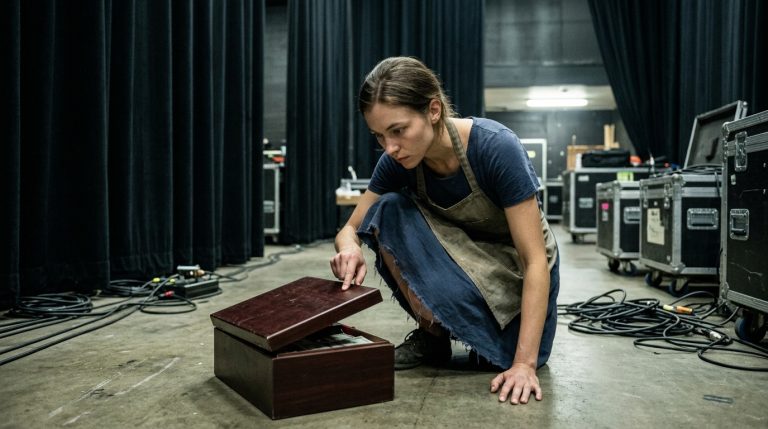
She retreated to the wings, where the heavy velvet curtains offered a sliver of sanctuary. She slid behind the thick fabric, the dust motes dancing in the faint light of a distant emergency exit sign. Only then, with her back pressed against the cold brick of the backstage wall, did she finally loosen her grip on the ledger.
It was heavier than it looked. The leather was worn at the corners, the gold embossing of the school’s crest faded, but her mother’s name was still starkly visible on the spine, hand-written in elegant, frantic script. She flipped it open. The pages were dense with columns of names, dates, and amounts—numbers that swam before her eyes in the dim light. Most were financial records of tuition payments and scholarship endowments.
Her heart skipped a beat as she reached a section labeled Indigent Support & Ancillary Maintenance. There, under a date from three years ago, was her mother’s name. The entry wasn’t for a payment received, but for a “disbursement of medical care oversight.” Beside it, a cryptic series of codes followed by a red-inked note: Liability identified. Monitor output.
The breath left Elara’s lungs. Her mother hadn’t been a recipient of charity; she had been a subject of interest, a line item in a ledger that treated human life as a variable in a much larger equation.
A sudden, sharp metallic click from the direction of the stage floor made her jump, the ledger nearly slipping from her fingers. She stayed perfectly still, her breathing shallow, her eyes fixed on the gap between the curtain panels.
A pair of polished oxfords appeared in the sliver of light, pacing back and forth. It wasn’t Julian. The gait was different—slower, more deliberate, the heavy tread of someone who didn’t fear being heard.
“I know it’s here, somewhere,” a voice grumbled, low and authoritative. It was the Head Custodian, a man who usually slept through his shifts in the basement office. “He said he left it on the seat. If the scholarship girl touched it, I’ll have her badge by morning.”
Elara’s world tilted. The “he” wasn’t Julian—or at least, he wasn’t acting alone. The entire administration was connected to this. She clutched the ledger to her ribs, feeling the sharp corner of the cover dig into her skin. If she was caught, the scholarship would be revoked, her mother’s treatment would be terminated, and she would vanish into the same obscurity that had swallowed her mother’s history.
She needed to move, but the custodian was blocking the only path to the janitor’s closet. She looked around the cramped backstage area, searching for an alternative. Her eyes landed on the old freight elevator, a relic of the school’s founding that hadn’t moved in a decade. It was rusted, draped in heavy canvas, but the gears—if she could turn them manually—might just groan loudly enough to drown out her footsteps if she timed it right.
She pushed the ledger deep into the bottom of her cleaning caddy, covering it with a wet rag and a heavy bag of trash. She had to act like the invisible ghost they expected her to be. She stepped out from behind the curtain, her expression schooled into the blank, obedient mask she wore every day.
The custodian turned, his eyes narrowing as he caught sight of her.
“You,” he barked, his voice echoing off the concrete walls. “What are you doing over there? The auditorium floor was supposed to be finished twenty minutes ago.”
Elara kept her head bowed, her shoulders slumped in the posture of submission. “The lights flickered, sir,” she said, her voice small, trembling exactly as it was meant to. “I was waiting for the circuit to reset so I could finish the polishing. I didn’t want to leave streaks.”
The man scrutinized her, his gaze lingering on the cleaning caddy. Elara forced herself to hold his stare for a split second, then looked away, letting her eyes cloud over with the practiced dullness of the downtrodden.
He scoffed, turning his back to her to adjust his radio. “Get it done. And keep your head down. Things are changing around here. We don’t need people asking questions about books they shouldn’t be reading.”
Elara nodded, her hands tightening on the handle of the caddy. As she walked past him, she could feel the weight of the ledger—the weight of her mother’s entire existence—pressing against her side. She didn’t look back. She pushed through the double doors and into the long, dimly lit corridor that led to the dormitory basements, knowing that for the first time, she wasn’t just cleaning the halls—she was charting a way out of them.
CHAPTER 4: The Unseen Witness
The basement was a graveyard of discarded history. Racks of broken music stands, crates of moth-eaten stage costumes, and the smell of trapped humidity defined the space. Elara’s footsteps were muffled by layers of accumulated dust, a stark contrast to the echoing, polished marble of the floors above. Every turn she took felt like moving deeper into the throat of the beast.
She stopped at the junction leading to the central archive vault, a heavy steel door that looked as if it hadn’t been opened since the academy’s founding. This was where the older, non-digitized records were kept—the kind that wouldn’t show up on a school-wide server, and perhaps, the place where the true story of her mother’s “disbursement” was hidden.
As she knelt to catch her breath, the dim light glinted off something metallic resting in the corner. She reached out, her fingers closing around a slim, brushed-aluminum keycard. It was unmarked, save for a small, embossed symbol of an owl—the same crest that decorated the school’s oldest chapel. It hadn’t been there when she swept this area yesterday.
The weight of the ledger in her caddy felt heavier, an accusing presence. She tucked the keycard into her pocket, the sharp edge digging into her thigh. Someone had left this, or dropped it in haste. The custodian’s words from earlier—Things are changing around here—reverberated in her mind. Was she being watched, or was this a piece of a larger, more dangerous game?
She stood, her muscles aching from the strain of the day. She couldn’t afford to hesitate. She approached the steel vault, the cold surface of the door radiating a chill that seeped through her uniform. She held the keycard to the sensor. For a terrifying second, nothing happened. Then, the lock clicked—a heavy, mechanical sound that vibrated through the floorboards.
The door groaned open, revealing a room bathed in stagnant, stale air. Dust motes hung suspended in the stagnant stillness, untouched by the circulation systems that kept the rest of the school breathable. This was the archive. Shelves lined with paper files, organized by decade, towered into the gloom.
Elara stepped inside, her flashlight cutting a thin, fragile path through the dark. She walked past rows of student files, past disciplinary records, until she reached the section for “Staff & Ancillary.” She scanned the labels, her hands trembling as she pulled a file from the shelf. Support Staff – Legacy Records.
She opened it, the paper brittle and yellowed. Her mother’s name was there, but it wasn’t a standard employment file. It was a series of medical reports, dated years before her mother had even started working at the academy.
Patient Status: Subject zero for localized cognitive recovery.
Her stomach turned. Her mother hadn’t been hired; she had been observed, studied, perhaps even used as a test subject for something the academy was developing. And then, she realized with a jolt of horror, the dates tracked perfectly with the onset of her mother’s current illness.
“So, you found it.”
The voice was soft, melodic, and entirely devoid of warmth. Elara spun around, the flashlight beam sweeping across the room until it landed on a woman sitting in the shadows at the back of the vault. It was Professor Halloway, the head of the music department—a woman known for her icy perfection and her unwavering dedication to the academy’s prestige.
She wasn’t holding a weapon, but she held something far more intimidating: a digital tablet, its screen glowing with the same ledger layout Elara had seen on the seat.
“I didn’t expect you to be this persistent, Elara,” Halloway continued, standing slowly. Her movements were graceful, predatory. “Most girls in your position are far too concerned with the immediate—the next paycheck, the next shift. They don’t look at the foundation of the house they’re scrubbing.”
“What did you do to her?” Elara asked, her voice steady despite the sheer terror radiating through her. She clutched the ledger hidden in her caddy, her knuckles white. “What is this place?”
“This place is a conservatory of excellence,” Halloway said, walking toward her. The light caught the sharp angles of her face, the expressionless mask that hid the machinations of a truly cold intellect. “Excellence requires a catalyst. Your mother was… a very patient subject. She provided the data we needed to understand the limits of human resonance. The medical bills? A way to keep her—and you—within our sphere of influence. We don’t discard our research, Elara. We simply move it to a different stage.”
The realization hit Elara with the force of a physical blow. The embezzlement, the medical aid, the “scholarship”—it was all a cycle of exploitation designed to keep them trapped in the academy’s orbit.
“You’re not going to take that file,” Halloway said, nodding at the paper still clutched in Elara’s hand. “And you aren’t going to tell anyone. Because if you do, the funding for her final, critical treatment stops. Today. You will lose her, Elara, and then you will lose the only life you have.”
Elara looked at the file, the ink blurring, and then at Halloway. The choice wasn’t about truth anymore. It was about existence. She backed away, her heel catching on an uneven floorboard. Halloway didn’t move to stop her, confident in the trap she had set.
Elara turned and ran, the sound of her own heartbeat deafening in the silence of the vault. She didn’t know where she was going, only that she had to get out, and she had to survive long enough to burn this entire, rotten house to the ground.
As she reached the door, she caught a glimpse of herself in a dusty mirror hanging on the wall. She looked different—less like a ghost, more like a storm. The invisible girl was gone, and the cost of being seen was already far higher than she had ever imagined.
CHAPTER 5: Shadows of the Ledger
The hallway outside the vault was a tomb. Elara didn’t stop to catch her breath; she moved with a kinetic, desperate energy, her feet finding the rhythm of the floor tiles. The file she had taken was dense—pages of clinical observations, handwritten notes detailing the progress of her mother’s cognitive decline, and signatures that belonged to the board of directors. Every step away from the vault felt like she was dragging a massive, invisible weight behind her.
She reached the service stairwell, the only route to the student dormitories that avoided the main atrium. She didn’t dare use the elevator. She took the stairs two at a time, her breath coming in ragged, controlled gasps. The school was quiet, the elite students tucked away in their suites, cocooned in the very luxury that had been built upon the foundation of her mother’s suffering.
The silence of the dormitory basement was stifling. She reached her room—a cramped, converted storage closet that barely held a cot and a small desk—and slipped inside, locking the door behind her. The click of the bolt was the only comfort she had. She pulled the file and the ledger from her caddy, spreading them across the small desk.
The documents were a map of a systematic, cold-blooded machine. Halloway wasn’t just a professor; she was an architect of the academy’s shadow economy. The file detailed “Phase 3: Integration,” a section that described using scholarship students as conduits for complex, proprietary audio-data processing, a task that required them to work through the nights in the auditorium. The music she loved wasn’t just her solace—it was the input, the raw material for a system she was inadvertently fueling every time she sang.
A sudden, sharp knock at the door made her freeze.
“Elara? You in there?”
It was Julian. His voice was muffled by the heavy door, but the tone was urgent, lacking the detached, analytical coolness of their encounter in the auditorium. Elara scrambled to cover the documents with a pile of dirty linens, her heart hammering against her ribs like a trapped bird.
“I’m resting,” she called out, her voice straining for normalcy. “It’s been a long shift.”
“I saw the Custodian heading toward the basement with a security team,” Julian said, his voice dropping to a whisper. “He was talking about a breach in the archives. If you took something, Elara, you need to hide it—or get rid of it. They don’t just fire people for digging here. They make sure you never find work again.”
The concern in his voice was unexpected, a discordant note in the symphony of her terror. Was this another test? Or had the “equal intellect” she perceived in him finally shifted into something more complicated? She approached the door but didn’t unlock it.
“Why do you care, Julian?” she asked, her hand hovering over the bolt. “You’re part of them. You’re the reason I’m here in the first place.”
“I’m the reason you’re here because my father wanted to keep an eye on the daughter of his most successful project,” he replied, his voice chillingly candid. “But I didn’t know what the project was. I didn’t know about the medical bills, or the data processing. My father keeps the books; I just live in the house he built.”
He paused, the silence in the hallway heavy with unspoken truths.
“I have a key to the off-campus maintenance access,” he continued. “If they find you with those files, you’re done. There’s a transport leaving in ten minutes for the supply run. It’s the only way to get out of the security perimeter without triggering a lockdown.”
Elara looked at the pile of linen, then at the door. The choice was a razor’s edge. If she left, she abandoned the only home she’d known, but she also saved the proof of their crimes. If she stayed, she risked being erased—not just from the school, but from her mother’s memory.
“Why are you helping me?” she whispered, her brow furrowed in concentration, calculating the risk.
“Because,” Julian said, his voice losing its composure for the first time, “I’m tired of the silence. And I want to hear what happens when you’re finally allowed to sing for yourself.”
Elara pulled back the bolt. The door creaked open, revealing Julian in the dim hallway light. He looked different—his coat was rumpled, his hair disheveled, the veneer of the privileged heir entirely stripped away. He wasn’t a predator here; he was a desperate, tired boy.
She shoved the ledger into her small backpack, took a deep breath, and stepped out into the hall. She didn’t look back at the room that had been her only sanctuary. She followed Julian toward the service exit, her senses dialed to every shadow, every sound, knowing that the real performance was only just beginning.
The path to the loading bay was a series of dimly lit corridors and heavy fire doors. Each one she pushed open was a physical commitment to the path of resistance. As they reached the final corridor, the sound of heavy boots echoed from the floor above. Security. They were already checking the dormitories.
Elara tightened her grip on the backpack, the rough edges of the ledger biting into her spine. She wasn’t an invisible girl anymore. She was a witness, and she was carrying the weight of a thousand secrets that the academy was desperate to keep in the dark.
CHAPTER 6: The Weight of the Metronome
The service bay was a cavern of grease, industrial shadows, and the smell of diesel. A massive freight truck idled in the center of the bay, its engine a low, vibrating thrum that rattled the bones in Elara’s chest. She stood behind a stack of wooden shipping pallets, her breath hitching in her throat as she watched the security team pass by the entrance, their flashlights cutting erratic, jagged arcs across the concrete.
“Stay close,” Julian whispered. He was no longer the poised, untouchable heir of the academy. He was hunched, alert, his eyes darting between the security personnel and the driver’s cabin. “When I move, you move. Don’t hesitate. Don’t look back.”
Elara adjusted the backpack. The weight of the ledger and the file felt immense, a physical manifestation of everything she stood to lose—and everything she was trying to save. She remembered the old, fraying metronome she kept in her cleaning caddy, the steady, rhythmic ticking that had kept her sane through years of isolation. In this moment, the idling engine was that metronome, a relentless countdown that demanded she move, act, or be erased.
Julian signaled with a sharp, downward motion of his hand. They sprinted. The distance across the open floor felt like a mile. Elara’s boots skidded on an oil slick, but she corrected her balance instantly, her focus narrowing to the space between the truck’s rear wheels and the loading dock. She dove into the dark gap behind the rear tires, pressing herself against the cold, metal chassis of the vehicle. Julian followed, sliding in beside her, his chest heaving.
Above them, the voices of the security team were muffled by the truck’s engine noise.
“She’s not in the dorms,” one of the guards said, his voice clipped and impatient. “Halloway wants the perimeter locked down. If that girl has the ledger, she’s a walking liability.”
“She’s just a maid’s daughter,” another replied, followed by a harsh, dismissive laugh. “She doesn’t know what she’s holding.”
Elara squeezed her eyes shut, the arrogance in their voices fueling a cold, steady resolve. They didn’t know her. They thought she was a variable in their equation, a pawn that didn’t know the rules of the game. But she had seen the records, the cold, clinical truth of her mother’s suffering, and the realization was a fire that burned away the fear.
She turned to Julian, leaning close enough that she could feel the heat radiating from him. “Why are you really doing this?” she hissed, her voice barely audible over the rumble of the engine. “You knew who your father was. You lived in the house he built.”
Julian looked at her, his eyes unreadable in the dim light. “Because the house is falling down, Elara. My father isn’t an architect; he’s a hoarder of ghosts. I realized months ago that the academy wasn’t producing excellence—it was consuming it. I was just the next piece of furniture waiting for my turn to be replaced.”
He reached into his pocket and pulled out a small, encrypted drive—the kind used for high-level data transfers. “This contains the digitized copies of the files you have. It’s the key to the school’s server. If you get out of here, if you find someone who isn’t bought and paid for, this will finish what you started.”
Elara took the drive, her fingers brushing his. It was small, light, and terrifyingly significant. “And you?”
“I’m staying,” Julian said, his expression settling into a mask of calm. “Someone needs to be on the inside when you start the fire. If I leave, they’ll just scrub the records and replace the locks. If I stay, I can keep them looking at the decoy while you dismantle the real thing.”
A heavy thud shook the loading dock—the driver had finished his manifest. The truck groaned as it shifted into gear.
“Move,” Julian urged, pushing her toward the opening beneath the trailer. “Now!”
Elara scrambled up onto the metal grate behind the axle, pulling her bag tight against her back. The truck lurched forward, the wheels spinning, and then they were rolling, moving out of the service bay and into the cool, biting air of the night. She didn’t look back at the receding silhouette of the academy, nor at Julian, who stood in the shadows of the loading dock, a silent sentinel in the dark.
The wind whipped around her, the cold air stinging her skin. She held onto the support beams, her muscles trembling from the vibration, but her mind was clear. She wasn’t running away anymore. She was carrying the evidence, the truth, and the means to end the cycle. The metronome in her mind ticked louder, faster, pushing her forward into the darkness, towards the unknown, towards the resolution of the story that had been written for her before she even had a chance to speak.
CHAPTER 7: A Vulnerable Alliance
The world stopped with a lurch that nearly threw Elara from the metal frame. The truck’s momentum vanished, replaced by the violent, uneven vibration of tires biting into loose gravel. She stayed pinned to the chassis, her lungs burning as she sucked in the acrid smoke wafting up from the front wheel well. Above her, the driver’s door swung open, the slam vibrating through the entire frame of the vehicle like a death knell.
She didn’t wait. She dropped into the darkness, her boots hitting the hard-packed dirt of the shoulder with a muffled thud. She rolled instinctively, coming up in a crouch behind the rear bumper, her hand instinctively shielding her backpack. The driver was cursing, his flashlight beam cutting erratic, yellow swaths through the gloom, but he was focused entirely on the front axle.
She needed to move. Every second she spent near the truck increased the probability of discovery. She skirted the edge of the woods, the dense wall of pine trees offering a shadowed, uneven path away from the road. The silence of the forest was absolute, interrupted only by the distant, angry shouting of the driver as he kicked at the mangled tire.
She didn’t know where she was—some nameless stretch of highway miles from the academy—but the solitude was a relief. She navigated by the stars, her internal compass honed by years of late-night transit to and from her mother’s hospital. As she put distance between herself and the transport, the adrenaline began to ebb, replaced by a deep, hollow ache in her muscles.
A twig snapped behind her.
Elara spun, her back pressed against the rough, resin-slick bark of a pine. She pulled the encrypted drive from her pocket, gripping it like a knife. The shadow that detached itself from the trees wasn’t a guard, nor was it a threat. It was Julian.
He was breathing hard, his expensive jacket torn, a smear of grease across his forehead. He hadn’t been on the truck—he must have followed in the support vehicle, or perhaps he had taken the perimeter road, knowing exactly where the transport would stall.
“You’re alive,” he said, his voice ragged. He didn’t approach, keeping his hands visible in the pale moonlight.
“How did you get here?” she asked, her voice tight. She didn’t lower her guard. The trust she had felt in the dormitory was fading, replaced by the cold, biting pragmatism of survival.
“I tracked the driver’s manifest. I knew there was a scheduled stop at the depot twenty miles down the road. If the truck stopped here, it wasn’t an accident. It was a scheduled interception.” He stepped closer, the moonlight revealing a jagged scrape on his cheek. “They knew you were on the truck, Elara. The security team didn’t check the dorms; they redirected to the highway.”
The realization hit her like a frost. The “breach” had been a lure, a way to flush her out into the open where they could contain her away from the watchful eyes of the campus. The academy wasn’t just managing the problem; they were hunting it.
“They’re behind you, aren’t they?” she whispered, glancing back toward the road.
“We have maybe ten minutes before they reach this coordinates,” Julian said, his eyes scanning the horizon. “There’s a train station three miles east. It’s an old line, mostly freight, but if we can make it to the cargo yard before dawn, we can get past the regional perimeter.”
He reached out a hand, and for a moment, the gap between them—the distance between the heir of a corrupt empire and the daughter of its victim—seemed to narrow. But Elara looked at his hand and saw not a lifeline, but a gamble. She looked at the encrypted drive, the weight of the digital truth she was carrying.
“Why help me, Julian?” she asked again, searching his face for a flicker of deceit. “Why throw away your life for a girl who was supposed to be invisible?”
“Because when you sang,” he said, his voice dropping, “it was the first time I heard the truth in this building. I’ve spent my entire life surrounded by the noise of my father’s lies. I don’t want to be a ghost in his house anymore.”
She hesitated, then took his hand. It was cold, calloused, and surprisingly firm. Together, they turned away from the road and into the deep, tangled darkness of the woods. The journey to the train yard was a test of endurance—they moved through thick underbrush, scrambled over moss-covered ravines, and navigated by the dim, silver light of the moon.
As they crested a ridge, the distant, mournful whistle of a train pierced the night air. It was a sound that belonged to a different world—a world of movement, of transition, of escape. Elara felt the rhythm of her own heart syncing with the distant, chugging cadence of the engine. She wasn’t just a subject or a liability anymore. She was a moving target, and as long as she kept moving, she held the power to shatter everything they had built.
They reached the edge of the cargo yard, the massive, rusted tracks spreading out before them like a web of iron veins. The engine was warming up, the steam hissing into the cold night air. They didn’t stop, didn’t look back; they ran toward the shadows of the empty boxcars, the weight of the files in her bag feeling suddenly, miraculously, like a promise of something better.
CHAPTER 8: The Decoy Revelation
The boxcar was a cavern of shadow, filled with crates marked for regional distribution. Elara moved toward the sliding door, hoping for a glimpse of the passing landscape to orient herself, but the heavy steel was sealed tight. When she reached for the lever, it didn’t budge. It had been bolted from the outside.
Julian, crouched near a crate of machinery, looked up, his face pale in the faint moonlight filtering through the slats. “They didn’t just follow us,” he whispered, his voice barely audible over the screech of iron on iron. “They knew exactly which train we’d target.”
Elara’s mind raced. The encrypted drive in her pocket, the physical files in her bag—she was holding everything they needed to bring the academy down, but she was trapped. The train slowed, the whistle screaming a long, mournful note that echoed across the desolate plains. It wasn’t pulling into a cargo yard. It was coming to a halt in the middle of a forest clearing, isolated from any transit station.
“We need to get out,” Elara said, her voice sharp with tactical urgency. She scanned the interior, looking for anything that could serve as a pry bar. Her eyes locked onto a rusted iron strut protruding from one of the crates. “If we can leverage the latch from the inside, we might be able to jump before they open the door.”
Julian moved to help, but as he shifted, the floor beneath him emitted a hollow, metallic clank. It wasn’t the sound of a wood floor. It was a panel. Elara knelt, clawing at the dust and debris. Beneath the grime, there was a seam in the metal. She jammed the iron strut into the gap and hauled back with all her weight. The panel groaned, then popped open, revealing a hidden compartment beneath the carriage floor—a space meant for contraband or transport of sensitive assets.
Inside the compartment wasn’t just space; it was a cache. There were stacks of legal documents, bundles of cash, and a digital terminal linked to the school’s private server. Elara reached in, pulling out a file that bore her mother’s name again. This one was dated last week.
Her heart stuttered. The document was a transfer request, signed by the board of directors, shifting ownership of all “intellectual property”—her mother’s cognitive data—to a private biotechnology firm. It wasn’t just embezzlement; the scholarship fund was a laundering front for selling research data collected from the students and staff. The medical bills, the oversight, the “support”—it was all a cover for a massive, multi-million dollar data-mining operation.
“The ledger was the decoy,” Elara realized, her voice trembling as the pieces snapped together. “They kept the ledger in the vault because they knew someone like me would eventually go looking for it. It was the bait. The real truth isn’t the embezzlement. It’s the trade. They aren’t just stealing money; they’re harvesting people.”
The train jerked to a final, bone-jarring halt. The silence that followed was heavy, punctuated by the rhythmic thumping of heavy boots on the gravel outside.
“Elara,” Julian said, his hand closing over her arm. “They’re not here for the ledger. They’re here for the files you just found. If you have that information, you aren’t a liability anymore. You’re a threat to an entire network of firms.”
She looked at the terminal. It was live. She could send the data, blast the proof of the human experimentation to every news outlet in the region, but it would take time—time she didn’t have. She grabbed the drive from her pocket and plugged it into the terminal, the screen glowing with a soft, blue light.
“What are you doing?”
“I’m opening a window,” she said, her eyes fixed on the progress bar. “If I can’t take the files with me, I’m going to make sure they can’t hide them.”
Outside, the door of the boxcar slid back with a screech of tortured metal. A floodlight washed the interior in blinding, white light. Halloway stood on the gravel, her expression a mask of cold, controlled fury, flanked by two men in tactical gear.
“You were always such an observant girl, Elara,” Halloway said, stepping into the light. “But you’re still working from a position of profound ignorance. Do you really think anyone is going to believe the story of a scholarship student and a runaway heir? You aren’t just a threat. You’re an inconvenience.”
Elara’s hand hovered over the ‘Enter’ key. The upload was at 80%.
“You lost,” Elara said, her voice steady, despite the cold barrel of a weapon she could see leveled at her from the shadows. “The data is already in motion. You can’t stop it.”
“I don’t need to stop it,” Halloway replied, a small, cruel smile touching her lips. “I only need to make sure that when the information reaches the public, it’s coming from an unreliable source. I’ve spent the last hour painting you as a thief, Elara. A mentally unstable, vengeful girl who stole sensitive research files to extort the academy. By the time the world sees your ‘truth,’ it will look like nothing more than a desperate delusion.”
The progress bar stalled at 95%. The men moved forward, their boots crunching on the floor of the car. Julian stepped between them, his posture defensive, his eyes flashing with a dormant, protective fire.
“Don’t,” he shouted, but the first guard lunged, tackling him into the side of the boxcar. The impact shook the entire carriage. Elara lunged for the terminal, her fingers dancing across the keys, but a heavy hand slammed onto her wrist, pinning her down.
The terminal screen flickered, the upload hanging in a state of suspended animation. Elara looked up into the face of her captor, the reality of her failure crashing down upon her. She had been so focused on the ledger, so certain that the truth would be enough, that she hadn’t seen the wall they had been building around her the entire time.
CHAPTER 9: The Anatomy of a Secret
The guard’s grip was like iron, bruising the bone of her wrist until her fingers went numb, forcing her hand away from the keyboard. The terminal screen bathed the boxcar in a flickering, ghostly blue light, the progress bar mocking her with its stagnant 95%. Halloway stepped into the boxcar, the light reflecting off her rimless glasses, obscuring her eyes. She moved with the slow, deliberate grace of a predator who has already finished the hunt.
She didn’t look at Elara. She looked at the screen. With a quick, practiced motion, she tapped a command, and the terminal went black. The silence that followed was absolute, save for the heavy, ragged breathing of the guards and the distant, cooling tick of the train’s engine.
“You have a penchant for the dramatic, Elara,” Halloway said, her voice smooth, the sound of velvet over gravel. She walked to the center of the boxcar, her heels clicking on the metal floor. “But you’ve confused intent with impact. An upload that doesn’t complete is just data in the wind. A story that lacks a publisher is just noise.”
She gestured, and the guard shoved Elara backward. She hit the side of a crate, the impact driving the air from her lungs. Julian, still pinned against the far wall, groaned. His face was masked in blood, but his eyes tracked Elara’s every movement, a silent, desperate warning.
“Why?” Elara gasped, clutching her bruised wrist. “My mother… she was a person. Not a test subject. Not a variable. How do you sleep knowing what you’ve done?”
Halloway stopped, her expression flickering for the first time. It wasn’t remorse—it was a cold, intellectual curiosity. “I sleep because I understand the architecture of progress. Your mother was a damaged instrument, Elara. We merely utilized the resonance of her decline to harmonize the academy’s research. We didn’t create her suffering; we simply recorded the frequency of it.”
The cruelty of the words was a physical weight, pressing down on Elara, threatening to crush the last of her resolve. The “resonance”—the very thing she had used to find her own voice, the thing she had cherished in the dark of the auditorium—was the very thing they had been stripping away from her mother. The music she loved was the extraction tool.
She looked at the encrypted drive, still slotted into the terminal. She hadn’t been able to finish the upload, but she had managed something else. She had triggered a local cache download—a direct, physical copy of the server’s primary node. She had shoved the drive into her boot when the guard lunged, and though she was pinned, she could feel the hard, rectangular edge of it pressing against her ankle.
“You think you’ve won,” Elara whispered, the words bubbling up from a place of cold, hollow fury. “You think you can erase the data, but you can’t erase the fact that someone saw it. Someone heard it.”
Halloway leaned in, her scent of expensive perfume and antiseptic clashing with the metallic tang of the boxcar. “Who? The world? The people who pay their tuitions? They don’t want the truth, Elara. They want the prestige. They want the sound of the ‘excellence’ that I create. You’re a ghost in their machine. And ghosts don’t have a voice.”
She signaled to the guards. “Take the boy back to the campus. Keep him under watch. As for the girl… she is an anomaly. Remove her from the records. Ensure she never leaves this clearing.”
The words were a death sentence, delivered with the casual indifference of a clerk discarding a paperclip. Elara felt the guards grab her, the rough fabric of her uniform straining under their force. They didn’t drag her; they moved her with a terrifying, efficient purpose.
As they forced her toward the open door, toward the dark expanse of the forest, the memory of her mother’s voice surged in her mind—not the weak, fading whisper of the hospital ward, but the clear, resonant note she had hummed in the auditorium. It was a sound that had survived the neglect, the trauma, and the extraction. It was the only thing they hadn’t been able to map, quantify, or sell.
She looked at the terminal one last time, the darkness of the screen a perfect mirror of her own reflection. She was being discarded, yes, but she was holding the key. And as the guards stepped out into the damp, cold night air, she realized that Halloway had made one fatal error. She had underestimated the frequency of a person who has absolutely nothing left to lose.
They marched her into the trees, the undergrowth snagging on her clothes, the shadows deepening around them. But Elara’s eyes were focused on the ground, on the path, on the way the moon cast its light between the pines. She was calculating, measuring, watching. The resonance wasn’t gone; it was gathering strength. And the next time she opened her mouth, the sound wouldn’t just be a song. It would be an alarm.
CHAPTER 10: Preparing the CounterHarmony
The silence of the woods was not peaceful; it was watchful. Elara sat in the damp darkness, her breathing shallow, listening to the fading sound of the guards’ heavy footsteps retreating toward the train tracks. They assumed she was dead, or at the very least, broken beyond recovery. That assumption was the thin margin of her survival.
She reached down and pulled the encrypted drive from her boot. The brushed aluminum was cold, but the data it held felt like fire. She couldn’t get back to the boxcar, and she couldn’t reach a public terminal while the academy’s security net was active. She needed a different kind of leverage.
She stood, her legs trembling with a fatigue that had nothing to do with her muscles and everything to do with the trauma of the last few hours. She looked toward the distant, glowing silhouette of the academy on the horizon. They were still there, still operating, still turning the resonance of their victims into currency. But they had made a mistake—they had left the conduit alive.
She began to move, navigating by the stars and the faint, rhythmic hum of the high-voltage lines that crisscrossed the forest. If she could reach the main transformer station, she could bypass the local network. It was a long shot, a desperate act of sabotage, but it was the only way to broadcast the truth without going through the public channels Halloway already controlled.
Hours passed. The sky began to bleed a pale, bruised purple. She navigated the treacherous terrain with a singular, focused intensity, her movements efficient and quiet. She reached the perimeter of the substation just as the first birds began to stir in the trees. It was a sprawling grid of steel towers and buzzing, hum-filled transformers, enclosed by a high chain-link fence topped with razor wire.
She found a breach near the ground—a gap where the earth had eroded away under the fence. She slid through, the wire snagging on her clothes, tearing the fabric of her uniform. She didn’t care. She crawled into the center of the grid, the ozone smell so thick it tasted like metal on her tongue.
She approached the main control relay, a heavy, weatherproof box mounted to the side of a humming transformer. It was a relic, the kind of analog override that Halloway’s modern, digital security protocols had likely ignored. She opened it, her fingers slick with sweat, and pulled the drive from her boot. She needed to bridge the connection.
A shadow fell over the control relay.
Elara froze. She looked up, her hand instinctively reaching for the iron strut she’d grabbed from the boxcar. Standing on the other side of the fence, watching her with a mixture of disbelief and profound sadness, was Julian. He was battered, his coat missing, but he had made it. He had bypassed their guards.
“I didn’t think you’d make it this far,” he said, his voice quiet. He didn’t come closer. He knew, perhaps, that she was in a state of hyper-focus that bordered on the lethal.
“They’re going to find us,” Elara said, her eyes fixed on the wiring. “If I finish this, they’ll trace the signal back to this location within minutes.”
“I know,” Julian replied. He reached into his own coat and pulled out a small, handheld transmitter. “This will scramble the local security feed. It’ll give you five minutes—maybe ten. It won’t stop them, but it’ll blind them long enough for the upload to hit the regional hub.”
He tossed the transmitter over the fence. It landed in the dirt at her feet. Elara looked at it, then at him. He was offering her the final piece of the puzzle, and in doing so, he was sealing his own fate.
“Why?” she asked again, though the question felt smaller now, eclipsed by the reality of what they were doing.
“Because,” Julian said, his eyes meeting hers with a clarity that was terrifying, “I want to hear the end of the song.”
Elara turned back to the control relay. She worked with the practiced, clinical precision of someone who had spent her life understanding the mechanics of sound, the way vibrations could be amplified, transformed, or destroyed. She spliced the connection, the spark of the live wire stinging her fingers, a sharp, white-hot pain that she welcomed.
The terminal on the relay box flickered to life. The progress bar began to move, slow and steady. 10%. 20%.
Across the forest, the academy’s security alarms began to wail—a deep, jarring sound that tore through the morning silence. They knew.
“Elara,” Julian warned, his eyes scanning the horizon. Two black SUVs were tearing down the access road, their headlights cutting through the dawn like twin spears. “You have to go. Leave the drive. I’ll make sure it finishes.”
“No,” Elara said, her hand on the relay. “If I leave, they’ll stop it. If I stay, they have to deal with me.”
“You don’t understand,” Julian said, his voice frantic, his facade finally shattering. “They’re not here to capture you. They’re here to erase the substation. They’ll kill you to save the data.”
“Then let them come,” Elara whispered, the resonance of her voice vibrating through the steel of the relay box. She didn’t look at the cars, didn’t look at the coming end. She looked at the progress bar. 50%. The song was playing, and for the first time, she was the one who controlled the volume.
The cars slammed to a halt at the fence line. Men in tactical gear poured out, their movements disciplined, efficient, and lethal. Elara stood her ground, her hand resting on the relay, the light of the upload bar reflecting in her eyes, turning them into cold, hard shards of blue. She was no longer an invisible girl. She was the truth, and the truth was finally ready to be heard.
CHAPTER 11: The Auditorium Stand
The hum of the transformers shifted from a low drone to a high-pitched, screeching whine, then abruptly cut to nothing. The entire substation went dead. The floodlights pointed at Elara flickered and extinguished, plunging the grid into a sudden, disorienting gray of pre-dawn. In the dark, the tactical team faltered, their momentum checked by the sudden loss of power to their comms and optics.
Elara didn’t move. She couldn’t. Her hand was locked to the relay housing, the residual charge of the upload making her arm feel like it was filled with liquid lead. She watched the glowing terminal screen pulse—once, twice, and then turn steady. The upload was complete. Every file, every medical record, every ledger entry documenting the academy’s systematic harvesting of student potential was now scattered across the servers of every major news agency, law enforcement hub, and academic regulatory board in the state.
“You’re too late,” Elara said, her voice sounding unnaturally loud in the sudden, ringing silence.
Halloway emerged from the shadows near the fence, her composure finally beginning to fray. She wasn’t looking at Elara anymore; she was looking at her phone, the screen lighting up with a cascade of frantic notifications. The academy’s iron-clad reputation, built on decades of silence and manufactured prestige, was dissolving in real-time.
“You have no idea what you’ve unleashed,” Halloway hissed, stepping into the substation. She stopped ten feet from Elara, her hands clenched at her sides. “The academy isn’t just a school. It’s an institution that maintains the stability of the entire regional educational infrastructure. By exposing us, you aren’t just destroying a career—you’re destabilizing an entire sector. You’ve burned the house down, yes, but you’ve also trapped yourself in the ashes.”
“Then I’ll learn to breathe in the smoke,” Elara countered. She pulled her hand from the relay, her palm scorched and raw.
Julian, who had been restrained by the guards near the gate, suddenly surged forward, knocking the nearest operative off-balance. In the chaos, the tactical team’s cohesion shattered. They were no longer acting as a coordinated unit; they were agents of an institution that was currently being dismantled by the very truth they had tried to bury.
The sound of sirens began to bleed into the morning air—not the academy’s private security, but the heavy, authoritative wail of state police.
Halloway looked toward the road, then back at Elara. The realization of her own downfall was written in the sudden, sharp lines around her eyes. She reached into her pocket, not for a weapon, but for a small, thin ledger—the master key to the digital vault she had fought so hard to protect. She looked at it, then at the spreading dawn, and with a slow, deliberate motion, she dropped it into the oil-slicked mud at her feet and ground it into the dirt with her heel.
“You wanted the truth, Elara?” Halloway said, her voice hollow. “You have it. But remember this: truth is a parasite. It lives off the host until there is nothing left. Your mother? She will never recover the time they stole. And you? You will spend the rest of your life answering for the chaos you’ve just invited into the world.”
Elara stepped past her, the metallic tang of the station and the smell of ozone clinging to her clothes like a warning. She didn’t look at Halloway. She didn’t look at the ruin of the substation. She looked at Julian, who was limping toward the fence, his face bruised and swollen but his eyes alight with a grim, exhausted satisfaction.
As the state police cars crested the hill, their light bars painting the morning forest in strobing flashes of red and blue, the world seemed to hold its breath. The academy was done. The machines were cold. The silence that followed wasn’t the suffocating, heavy quiet of her life as a cleaner; it was the sharp, clean silence of a space waiting to be filled with something else.
Elara walked toward the fence, her boots crunching on the gravel. She reached into her pocket and pulled out the old, fraying metronome she had kept in her cleaning caddy, the one constant object she had carried through the entire ordeal. She held it for a moment, then set it down on the concrete base of the main transformer—a final, symbolic deposit of the rhythm she had been forced to live by, and the one she was now, finally, ready to break.
She met Julian at the gate. Together, they watched as the authorities swarmed the substation, the focus of the world shifting away from the academy and toward the truth that was now, irrevocably, out in the open.
CHAPTER 12: The Quiet Aftermath
The hospital room was bathed in the pale, amber light of a late afternoon sun. It was a space of muted colors and hushed sounds—a far cry from the cold, industrial echo of the academy or the biting, metallic tension of the substation. Elara sat in the wooden chair beside the bed, her fingers tracing the smooth, familiar grain of the armrest. Her hands were still bandaged, the palms raw, but the sensation of touch was returning, sharp and welcome.
Her mother’s breathing was slow, rhythmic, and peaceful. The chaotic, frantic beeping of the machines had smoothed into a steady, comforting pulse. The medical staff had been… apologetic. A word that felt hollow, yet necessary in the wake of the news cycle that had swallowed the academy whole.
Julian sat in the corner of the room, his arm in a sling, staring out the window at the city skyline. He looked different—not just the bruises and the bandage on his forehead, but the way he carried himself. The sharp, guarded edge of the billionaire’s son had dissolved. In its place was a quiet, contemplative stillness. He had lost his inheritance, his name, and his path, yet he seemed, for the first time, unburdened.
“They’ve started the audit,” he said, not looking away from the window. “Every account, every scholarship fund, every shell company. My father is in custody, and the board has been dissolved. It’s a total liquidation of the academy’s assets.”
“And the data?” Elara asked. Her voice was steady, the tremors that had plagued her for weeks finally absent.
“Every researcher who had a hand in the… studies… is being tracked down. The evidence you pulled from the server wasn’t just proof of embezzlement; it was a blueprint of their entire operation. They can’t hide it. Not anymore.”
Elara looked back at her mother. She reached out, gently taking her mother’s hand. It was thin, the skin translucent, but it was warm. The Kintsugi of their lives—the cracks, the breaks, the missing pieces—hadn’t been erased. They were still there, a map of what they had endured. But the light was finally catching the seams, revealing a strength that had been forged in the crucible of their struggle.
She thought of the old, fraying metronome she had left behind at the substation. She didn’t miss it. The rhythm of her life was no longer dictated by the rigid, mechanical pulse of the academy’s expectations. It was something new, something slower, something that allowed for pauses, for silence, and for the grace of healing.
“What now?” Julian asked, turning to look at her.
Elara didn’t have an immediate answer. The future was a blank, unwritten page, and for the first time, she wasn’t afraid of the emptiness. She was the one holding the pen.
“We start over,” she said, her voice soft but firm. “We find a place where the music isn’t a tool, but a choice.”
She stood and walked to the window, standing beside him. Below, the city was bustling, the streets alive with the chaotic, beautiful, and unscripted lives of thousands of people who had no idea how close they had come to becoming variables in Halloway’s machine.
She looked at her own reflection in the glass. The girl in the janitor’s uniform was gone. The witness who had stood in the substation was changing, hardening, and softening all at once. She saw the scar on her palm—a physical reminder of the night she had chosen to be heard.
She pressed her hand against the glass, the cool surface grounding her. She thought of the auditorium, the vast, empty space where she had once hidden her voice. She would sing again, she knew that. But when she did, it wouldn’t be in the dark, and it wouldn’t be for them. It would be in the light, for herself, and for the ones who had finally, truly, been set free.
The sun dipped below the horizon, casting long, golden shadows across the room. Outside, the city began to light up, a million tiny, independent flickers of life against the encroaching night. It was a symphony of a different kind—messy, discordant, and entirely, beautifully, their own.
Elara turned back to the room, the door clicking shut behind Julian as he left to handle the next round of legal inquiries. She was alone with her mother, the quiet hum of the world moving forward. She took a breath, the air filling her lungs, clean and unburdened, and for the first time, she simply hummed. It wasn’t a challenge or a protest. It was just a note. A simple, honest, and entirely human note.