
The Weight of Steel and Ash: How One Captured Machine Gun Shattered the Industrial Myth of an Empire
CHAPTER 1: THE BATTERED RECEIVER
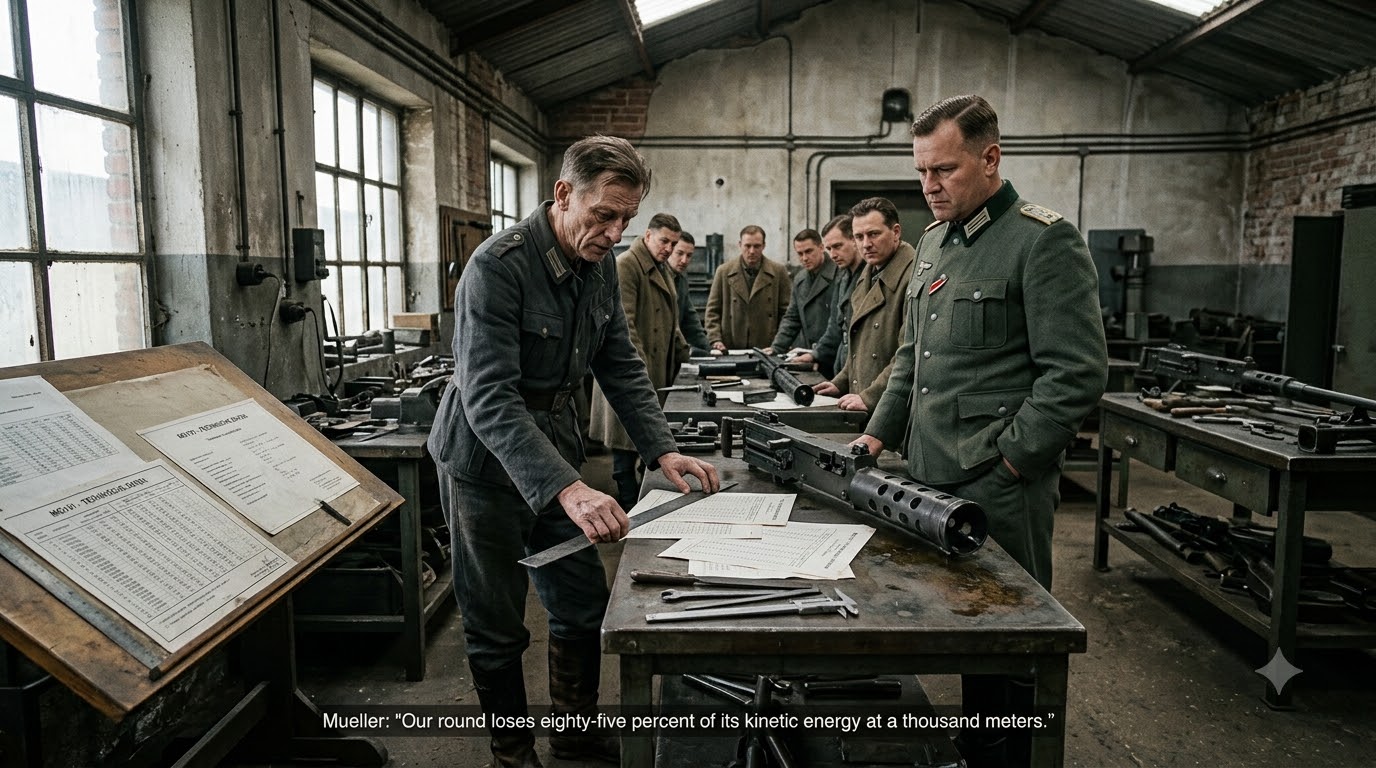
The metal was cold, bearing the unmistakable scorch marks of a long fall over occupied French soil. Senior engineer Mueller ran a calloused thumb along the heavy receiver, feeling the coarse texture of American phosphate finish. Around the workbench, his team stood in silence, hands buried deep in their coat pockets, watching the way the fluorescent light caught the weapon’s massive proportions. No one spoke of tactical brilliance or ideological destiny here. There was only the weight of the steel, the uncompromising thickness of the barrel, and the quiet, mounting dread that what they were holding represented something their entire industrial apparatus could not replicate.
CHAPTER 2: THE BALLISTIC DISPARITY
The numerical charts lay scattered across the drafting table, their columns of muzzle velocities and kinetic outputs glaring under the weak autumn sun. Mueller picked up the German MG131 specification sheet, noting the neat, compact dimensions that his peers had praised back in Berlin. It was a masterpiece of constrained engineering, weighing barely sixteen kilograms and firing at a blistering nine hundred rounds per minute. Yet the physical reality of the numbers refused to flatter the design.
He slid a heavy steel ruler down the page, comparing the thirteen-millimeter cartridge against the American fifty-caliber benchmark.
—The muzzle energy is a fraction of what they field on every truck, — Hauptmann Weber muttered, his fingers tracing the edge of the captured Browning’s cooling jacket. —We optimized for space and high explosive shells in the air. They optimized for brute mass on the ground.
Mueller did not answer immediately. He stared at a faint, out-of-place score mark on the receiver—a minor metallurgical flaw born of rushed factory production in America that somehow functioned flawlessly despite its lack of refined craftsmanship. It was a jarring anomaly in a weapon designed purely for utilitarian destruction.
—A fraction is being generous, — Mueller said finally, laying the caliper down with a dull metallic click. —Our round loses eighty-five percent of its kinetic energy at a thousand meters. Their fifty-caliber keeps enough force at that range to punch clean through our light armor.
The workshop fell back into a heavy, oppressive silence, broken only by the distant rumble of a supply train shifting down the valley. There were no grand ideological speeches here, only the cold, unyielding friction of physics and ballistic tables that did not care about the Reich’s tactical brilliance.
CHAPTER 3: THE INDUSTRIAL BLIND SPOT
Mueller did not look up as Weber dropped the revised production estimates beside the captured receiver. The pages were thin, stamped with red classification marks that warned of severe material shortages across every major manufacturing center in the Reich. They had built an entire doctrine around elite craftsmanship and specialized tactical brilliance, betting everything on the assumption that superior engineering would always outclass mere output.
—The supply lines to the East cannot sustain another quarter of this depletion, — Weber said, his voice dropping into a harsh, dry register. —And high command still expects us to design a ground mount for an aircraft gun that lacks the structural tolerances of what the Americans are churning out by the tens of thousands.
Mueller pinched the bridge of his nose, feeling the deep, chronic exhaustion behind his eyes. It was not just a failure of imagination; it was a fundamental miscalculation of what total war demanded.
—They are not winning because their design is a work of art, — Mueller muttered, staring past the heavy steel barrel on the table. —They are winning because their factories do not stop to polish the edges.
A sudden gust of wind rattled the corrugated iron roof, carrying the faint, hollow echo of an air-raid siren wailing miles away in the industrial district. The gap between what they hoped to achieve and what raw mathematics permitted was widening into an unbridgeable chasm, leaving them stranded in the cold dust of their own assumptions.
CHAPTER 4: THE INEVITABLE VERDICT
The final report sat squarely in the center of the desk, unreadied by high command and unpolished by bureaucratic optimism. There was no miraculous breakthrough waiting in the margins, no hidden design flaw that would magically equalize the industrial gap on the map. They had weighed the metal, measured the tolerances, and calculated the ballistic outputs down to the last grain of powder.
Weber pulled his coat tighter against the draft, his jaw set in a hard, uncompromising line.
—We file it as incomplete, — Weber murmured, his fingers hovering over the edge of the stack. —We tell them the metallurgy requires resources we no longer possess.
Mueller shook his head slowly, watching the dull gray light fade entirely from the windowpane. To hide behind technical excuses was to lie to themselves about the true cost of their doctrine.
—No, — Mueller said, sliding the pen away to leave the surface clean. —We tell them the truth. Quality cannot outrun infinity.
The workshop grew dead silent around them, stripped of illusions and empty of hope. The captured American heavy machine gun rested on the oak workbench, an enduring monument to a reality where sheer, overwhelming volume had already rewritten the rules of the world.