The Second Queen: A Billionaire’s Redemption and the Quiet Power of a Pawn’s Sacrifice
CHAPTER 1: The Ivory Battlefield
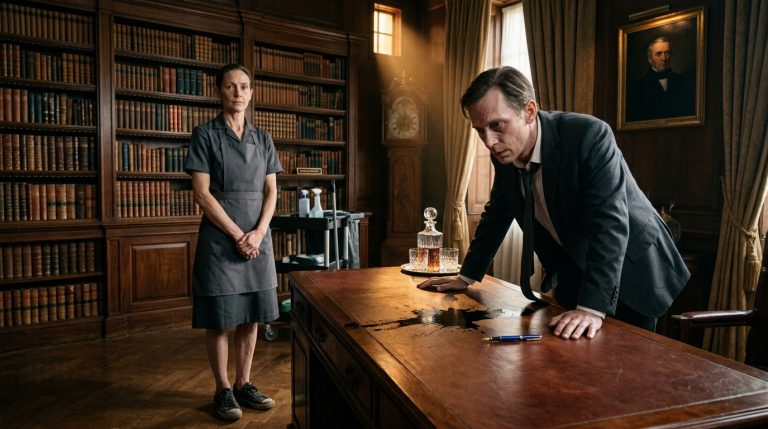
The library was an ocean of stillness, the air thick with the smell of old leather and the metallic bite of expensive wood polish. Sunlight stretched through the arched windows, catching dust motes that swirled like trapped spirits above the marble pedestal. At the center of the room, the ivory and obsidian pieces stood in rigid, silent formation.
Preston Montgomery leaned forward, his hands braced on the table. His knuckles were white, a stark contrast to the dark jade board. He was a man who measured his life in quarterly growth and hostile takeovers, a man who saw the world as a series of assets to be optimized. But the girl sitting across from him—Abigail—was a variable he had not accounted for. Her golden hair caught the dying light, and her stillness was so absolute it felt unnatural, like a calm before a landslide.
“A child?” Preston’s laugh was a jagged shard of sound, cutting through the silence of his empire. “You think you can play, Abigail? This isn’t a game for the simple-minded. It is a war of attrition.”
Abigail didn’t blink. She sat in the oversized mahogany chair, her small feet dangling, her gaze locked onto the board. The ticking of the ornate clock on the mantelpiece seemed to grow louder, a rhythmic, insistent heartbeat counting down the seconds of Preston’s arrogance. Every tick-tock felt like a nail in the coffin of his pride.
“I know it’s a war, sir,” she said. Her voice was thin, almost wispy, yet it possessed a terrifying, measured gravity. “But you’re playing for territory. My grandfather taught me that you should play for the pieces.”
Preston narrowed his eyes. He reached out to move his bishop, a calculated, aggressive strike intended to dismantle her defensive line in one swift motion. He expected her to flinch, to scramble, to reveal the amateur fragility he was so certain lay beneath her calm.
Instead, she moved her knight with a fluid, practiced grace. It was a move that didn’t just counter his aggression; it ignored it entirely, shifting her focus to the center of the board with a subtle, predatory patience.
The air in the room shifted. Preston felt a sudden, cooling draft. He reached for the ivory king, his fingers brushing the cool, polished material, but a strange, nagging detail caught his eye. A small piece of dust sat on the rim of the jade board, an imperfection in his perfect, ordered world. He tried to brush it away, but his hand trembled—a microscopic tremor that he barely recognized as his own.
He looked at Abigail again. She was watching him, not with the wide-eyed wonder of a child, but with the steady, detached focus of someone who had spent their entire life preparing for this specific moment. He was the most powerful man in the city, but in the silence of the library, he felt suddenly, dangerously small.
“You’re making a mistake, little girl,” he whispered, his own voice sounding hollow to his ears.
“I’m making a move, Mr. Montgomery,” she replied. She reached out and touched a pawn—the most discarded, forgotten piece on the board. She shifted it forward one square, a quiet, unassuming action that sent a ripple of tension across the ivory battlefield.
Preston stared at the pawn. He looked back at her, and for the first time, he saw it: the flicker of a name he hadn’t heard in fifty years, buried deep within the architecture of her face. A sense of vertigo hit him, the floor beneath his feet feeling less like marble and more like thinning ice.
“Who taught you that opening?” he asked, his voice tighter than he intended.
Abigail smiled, a small, sad gesture that didn’t reach her eyes. “You did, sir. Fifty years ago.”
The clock on the mantelpiece skipped a beat, and the silence that followed was so heavy it felt like suffocation.
CHAPTER 2: The Echo of the Ticking Clock
Preston did not move. His hand, still resting near the obsidian bishop, felt heavy, as if the very marble of the table had begun to seep its chill into his skin. The library, once his sanctuary of triumph, felt suddenly alien. The tall, arched windows held the dying light of the afternoon, casting long, bruised shadows that seemed to reach for his boots. He looked at Abigail—really looked at her—and the arrogance that had defined his adult life began to fray at the edges, like a tapestry left too long in the sun.
He pulled his hand back, gripping the edge of his mahogany desk until the wood bit into his palms. “Fifty years ago,” he repeated, the words tasting of ash. “You weren’t even a thought, child. Don’t play riddles with me.”
Abigail remained perfectly still, her hands resting on the jade board. The ticking of the mantel clock was no longer a background element; it was a rhythmic assault, a metronome keeping time for a ghost he had buried under billions of dollars in assets and iron-clad legal loopholes.
“The game is the riddle, Mr. Montgomery,” she said, her voice remaining that unsettling, unwavering whisper. “You said you never lose. But you’re already losing. You’re just looking at the wrong board.”
A sudden, sharp memory flared in Preston’s mind, unbidden and brutal. He was back in his father’s study, smelling of stale cigar smoke and the metallic tang of liquid capital. He saw his father’s hands—calloused, strong, and devoid of tremor—moving a knight across a wooden board. He remembered the way his father had looked at the competition, at the small, desperate men who stood in the way of the Montgomery expansion, with the same cold, reptilian detachment he had used on Susan Miller only minutes ago.
Always take the pawn, Preston. It’s the easiest way to expose the heart.
The phantom voice of his father echoed in his inner ear, mingling with the steady tick-tock, tick-tock of the library clock. Preston’s breathing hitched. He felt an intrusive, cold sensation at the base of his neck—a psychological phantom that made him want to bolt, to run until the air in his lungs stopped burning. He looked down at the board again. Abigail’s pawn sat there, defiant in its isolation, a tiny monument to a history he had convinced himself was dead.
He forced himself to straighten, to put on the mask of the billionaire, but the mask felt loose, ill-fitting. “My father played that opening,” he muttered, the confession slipping out before he could catch it.
“He played a lot of things,” Abigail said. She didn’t look up. Her focus was entirely on the ivory king. “But he never learned that every sacrifice has a price. Some debts don’t accrue interest in a bank, Mr. Montgomery. They accrue in the blood.”
Preston felt his heart stutter. The sheer weight of the room, the thousands of pages of first editions, the cold marble, the heavy velvet curtains—they all seemed to be pressing inward, demanding an accounting. He reached out to knock the pieces over, to end the game and clear the board, to restore order to his world. But his fingers froze mid-air. He realized, with a sudden, sickening clarity, that if he tipped the board, he wouldn’t just be ending a game. He would be admitting that he was afraid.
“What do you want?” he asked, his voice raw.
“I want you to finish the game,” she replied. She finally raised her eyes to his. They were blue, crystalline, and impossibly old. “You said you never lose. Prove it. Win this game, and you get to keep your delusion a little longer. Lose, and you finally have to look at the mess you’ve made.”
Preston swallowed hard. He looked at his hand—the hand that controlled global markets, the hand that had signed the orders to demolish neighborhoods, to shutter factories, to turn lives into line items. It was shaking. Just a tremor, a tiny flutter of the muscles, but it was there.
He didn’t move to attack her position. Instead, he reached out and touched his own king. It was cold, carved from the finest ivory, representing everything he had fought to become. For the first time, he felt the hollowness of the material. It was just a piece of bone.
“I don’t play against ghosts,” he said, though the words lacked conviction.
“You’re playing against me,” Abigail countered. Her voice softened, a terrifying shift from the clinical precision she had maintained. “And I’m still here.”
She nudged a bishop forward, opening a lane that Preston hadn’t even realized existed. It wasn’t just a tactical error on his part; it was a psychological trap, designed to lure him into an aggressive, reflexive strike. He knew it. Every instinct he possessed screamed at him to pull back, to re-evaluate, to find the safety of the perimeter. But the rhythm of the clock—tick-tock, tick-tock—was driving him, pushing him toward the mistake he knew he was about to make.
He realized then that he couldn’t stop. He was committed to the board, committed to the game, and most terrifyingly, he was committed to the path his father had laid out for him. He was a piece of the puzzle, and Abigail was moving him exactly where he needed to go.
He reached for his knight, his fingers sweating. As he touched the piece, the scent of the library—that polish, that dry, aging paper—seemed to turn into the scent of burnt oil and rusted iron. He wasn’t in his library anymore. He was in the ruins of a life, a life he had never lived, yet had caused to end.
He moved the knight. It was the only move he had.
Abigail didn’t hesitate. She moved her queen, a swift, elegant sweep that didn’t just threaten his king—it completely severed his connection to his own defense. Preston watched, helpless, as the strategy he had relied on for decades crumbled in the space of a single, breath-taking second.
The silence that followed was broken only by the clock. The billionaire sat back, the air leaving his lungs in a long, shuddering exhale, and for the first time in his life, he didn’t reach for a counter-move. He just stared at the board, waiting for the ceiling to come down.
CHAPTER 3: The Ledger of Ghosts
Preston’s hand hovered above the board, but the ivory king suddenly seemed like nothing more than a hollow trinket. The adrenaline that had fueled his initial arrogance had drained away, leaving behind a cold, hollow ache in his chest—a physical symptom of his world view finally cracking under the pressure of Abigail’s quiet, devastating move.
He stood up, his chair scraping harshly against the marble floor—a sound that made Susan, still huddled by the door, flinch. Abigail did not react. She remained seated, her posture impeccable, watching the board as if the game were still very much alive, even though her move had essentially dismantled Preston’s entire position.
Preston ignored her. He needed to be elsewhere, to be away from the jade board that had become an altar to his defeat. He walked toward the locked cabinet in the corner, his footsteps heavy and uneven. His fingers, still trembling slightly, fumbled with the key—a cold, jagged piece of brass. He inserted it, turned it, and the lock clicked with a finality that sounded like a verdict.
He reached inside and pulled out the heavy, leatherbound volume from the 1970s. As he placed it on the small writing desk beside the library windows, a cloud of fine, grey dust motes danced in the fading light. He opened the album, the pages stiff and brittle, the smell of decaying adhesive and ozone hitting him with the intensity of a physical blow.
His father’s face stared back from the glossy prints: a younger version of himself, eyes gleaming with that same predatory hunger he recognized in his own reflection. Standing beside him was the man in the cheap, ill-fitting suit—Frank Miller. Preston’s heart hammered against his ribs as he turned the page, searching for the specific photograph he knew was hidden in this archive.
There it was. The Miller and Sons precision tool factory. A humble building, but one that radiated a kind of industry and pride that his own glass-and-steel skyscrapers lacked. He traced the photograph with a trembling finger, his nail catching on a small, weathered detail in the corner: a handwritten ledger note, barely legible, tucked into the frame.
June 12th. Final offer rejected. They don’t understand the market. They only understand legacy. It’s a flaw I can exploit.
The words weren’t his father’s voice—they were his father’s handwriting, scrawled in black ink. Preston felt a wave of nausea. He had spent his entire life believing the myths his father had spun: that the acquisition of Miller and Sons had been a brilliant, necessary maneuver in a cutthroat economy. Now, looking at the date and the location, he realized it had been a surgical extraction of a family’s identity.
He looked back at the chessboard. Abigail was still watching him, her blue eyes reflecting the dim light of the room. She hadn’t said a word, yet the entire room felt heavy with the unspoken accusation of the ledger.
“You knew,” Preston whispered, his voice barely audible over the relentless ticking of the clock. “You knew what was in these albums.”
Abigail slowly stood up. Her movements were fluid, lacking any of the nervous energy that plagued Preston. She walked over to the desk, standing just a few feet away from the open ledger. She didn’t look at the photo of the factory; she looked at Preston, her expression one of profound, weary patience.
“My grandfather didn’t teach me how to win games, Mr. Montgomery,” she said. “He taught me how to read the pieces. And when you look at these albums, you don’t see history. You see a set of moves that have been played before.”
Preston felt the grit of the charcoal dust from the old album on his fingertips. It felt like ash—the ash of a life he had never considered until this exact moment. He looked at the photo again, noticing a small figure in the background of the shot—a young woman, barely twenty, holding a newborn. It was Susan. She wasn’t a stranger; she was the survivor of his father’s first conquest, a victim he had kept in his house for three years without ever bothering to see her true face.
The room seemed to shrink. The first editions on the shelves felt like tombstones. He looked at Susan, who had finally moved away from the door, her eyes wet with tears as she peered at the ledger. She saw it too—the history of her own displacement, written in his father’s arrogant hand.
“I didn’t know,” Preston said again, the words sounding pathetic even to his own ears. He turned to Susan, his eyes pleading. “Susan, I promise you, I had no idea. My father… he kept the books, he kept the stories. I just inherited the structure. I never looked underneath it.”
Susan didn’t speak. She just looked at the ledger, then back at him. There was no hatred in her gaze, just a deep, draining exhaustion that hit Preston harder than any insult could have.
Abigail stepped forward, her hand resting on the edge of the desk. “The structure is the problem, Mr. Montgomery,” she said. “The board is tilted. You’ve been playing with the pieces your father gave you, never questioning why they were carved that way.”
She reached out and closed the album. The sound of the heavy cover hitting the pages was final. The ghosts of Miller and Sons felt present in the room, watching, waiting for the billionaire to realize that his empire was nothing more than a house of cards built on someone else’s foundation.
Preston stared at the closed book. He realized he was standing in the middle of a war he hadn’t known he was fighting. He had the power, the money, and the influence, but he had lost the board. He looked at Abigail, and for a moment, he wasn’t looking at a child. He was looking at the future, standing over the wreckage of his past, and he realized with terrifying certainty that he was no longer the one holding the pieces.
CHAPTER 4: The Humility Threshold
Preston didn’t reach for the intercom immediately. His hand remained on the cover of the photo album, the leather cool and unyielding beneath his palm. The sound of the buzzing device cut through the heavy, suffocating atmosphere of the library, sharp and mechanical, a stark reminder of the corporate machine he had spent decades feeding.
“Mr. Montgomery?” Henderson’s voice crackled over the speaker, sounding distant yet intensely focused. “I have the preliminary report on the Millers. There’s a discrepancy in the property records from ’72. You’re going to want to see this before the board meeting tomorrow.”
Preston looked at Susan. Her eyes were fixed on the intercom, her shoulders braced as if she expected a blow. He turned his gaze to Abigail, who hadn’t moved from her spot by the desk. Her expression was unreadable, but there was a quiet, almost imperceptible tilt to her head—as if she were listening to something Preston couldn’t hear.
“Not now, Henderson,” Preston replied, his voice raspy. He leaned over, his finger poised to cut the connection, but Abigail’s hand moved with startling speed, pressing the ‘Talk’ button.
“Let him in,” she said, her voice clear and authoritative, cutting through the static.
Preston stared at her. “Abigail, this is not—”
“The game has to move forward, Mr. Montgomery,” she said, her eyes never leaving his. “You can’t keep the pieces off the board forever.”
The intercom clicked off. The sound of the library door unlocking—a deep, resonant metallic thud—echoed through the room. Preston felt a rush of adrenaline. This was the moment the fragile peace he had managed to construct began to disintegrate. He looked at Susan, wanting to offer some comfort, some shield, but he realized he was the one who needed protection. He was the one whose entire history was about to be scrutinized by the man who knew every dirty secret he had ever buried.
Henderson entered the library a moment later. He was a man of sharp angles and steel-grey eyes, his suit perfectly tailored, his presence like a physical weight. He didn’t look at the chessboard. He didn’t look at Abigail or Susan. His focus was entirely on Preston, his eyes scanning the billionaire with the detached efficiency of a predator.
“Sir,” Henderson said, his gaze shifting to the open desk where the photo album lay. His eyes narrowed. “I didn’t know you kept the archival files out.”
“It’s a private matter, Henderson,” Preston said, straightening his tie, attempting to reclaim the mantle of authority that had felt so flimsy only minutes ago. “Whatever you found, keep it to yourself until I’ve had a chance to review it.”
Henderson stepped further into the room, his movements slow and deliberate. He stopped beside the desk, his eyes dropping to the open page—the photograph of the Miller factory. He didn’t flinch. He didn’t even look surprised. He just stared at the page, a faint, cold smile touching his lips.
“It’s funny, sir,” Henderson said, his voice dropping to a conversational murmur that somehow carried more threat than a shout. “I’ve been digging through the city archives for the last three hours. You know what I found? The land the factory sat on wasn’t just bought. It was condemned for a public project that was cancelled three days after your father took the deed.”
The room went completely silent. Preston felt the blood drain from his face. He had spent his life believing in the legal legitimacy of his empire, in the clean, hard lines of his acquisitions. He looked at Susan, and he saw the flicker of understanding in her eyes—the realization that the theft was not just an ethical lapse, but a systemic crime.
“Henderson, enough,” Preston commanded, his voice shaking.
“The board members are already asking questions, sir,” Henderson continued, ignoring the command. He turned his head to look at Abigail. His eyes were hard, calculating. “And they’re very curious about why the Montgomery estate has suddenly become interested in small-town genealogy.”
Preston felt the ground shift. The ‘decoy’—the chess game—was no longer enough to contain the truth. The corporate machine he had built was beginning to turn on him, not because of his change of heart, but because of his instability. He looked at Abigail, and for the first time, he saw the true danger of her strategy. She hadn’t just checkmated him in the library; she had set a fire in his office, and now, the entire structure was starting to burn.
“You knew,” Preston said, his voice a low, strangled realization. “You knew they would dig. You knew this would happen.”
Abigail looked at the photo album, then back at Henderson. “I just wanted to see if the Montgomery empire was as strong as everyone says,” she said quietly. “It seems it’s built on paper.”
Henderson took a step closer, his hand drifting toward his inner jacket pocket. “We need to handle this, Mr. Montgomery. Before the press gets wind of a century-old land fraud. I can have the records sealed by morning, but it’s going to require… decisive action regarding the parties involved.”
Preston looked at Susan. He looked at the girl who had challenged him, humbled him, and was now essentially dismantling his legacy in the name of a grandfather she had never met. He was the most powerful man in the room, but he realized with a sickening thud of his heart that he had reached the humility threshold. He had to choose: continue the fight he had already lost, or start the long, painful process of letting it all go.
He turned to Henderson, his jaw set. “There will be no sealing of records, Henderson. You’re done.”
Henderson’s eyes flashed with something akin to pity. “Sir, you don’t understand. This isn’t just about you anymore. The board is ready to act. If you won’t do what’s necessary to protect the firm, they will.”
The threat hung in the air, a cold, sharp edge. Preston felt the weight of his empire pressing down on him, not as a source of power, but as a cage. He looked at Abigail, and she simply watched, her expression unreadable, waiting to see if he would reach for the sword or the shield.
CHAPTER 5: The Foundation of Restitution
The documents sprawled across the mahogany table like a roadmap to a crime scene. Preston looked at them, his breath coming in shallow, ragged hitches. Henderson stood back, his arms crossed, his face a mask of professional disapproval. The air in the room felt thin, drained of oxygen by the sheer scale of the deception that had been laid bare.
“You really want to go through with this, sir?” Henderson asked, his voice devoid of the usual deference. “If you sign these, you’re not just handing over the foundation of your wealth. You’re inviting the board to cannibalize what’s left of the firm.”
Preston didn’t answer. He turned his gaze toward Abigail. She was standing by the window now, watching the grey, persistent rain streak against the glass. The faded texture of the world outside—the blurred streetlights, the weeping trees—seemed to mirror the internal collapse he was experiencing. He had spent his entire life building a fortress, only to realize he had been the warden of a prison for ghosts.
“I’m not signing them to save the firm, Henderson,” Preston said, his voice stronger than it had been all evening. “I’m signing them because the debt is real. And it’s overdue.”
He reached for a pen, but his hand hung suspended over the signature line of the Frank Miller Foundation charter. He looked at Susan, who was standing beside Abigail. She wasn’t looking at the money or the legal power contained in the papers. She was looking at the photograph of her father-in-law, her face reflecting a quiet, profound grief that felt more substantial than any corporate asset.
“Is this what you wanted?” Preston asked, his gaze fixed on Abigail. “To see it all broken? To see me standing in the ruins of my father’s work?”
Abigail turned away from the window. She didn’t look triumphant. She looked tired—a weariness that sat heavy on her small frame. “The ruins were already there, Mr. Montgomery,” she said. “You just spent your whole life pretending the buildings were still standing. I didn’t break anything. I just stopped looking away.”
The realization struck Preston with the force of a physical blow. He had been the one who had kept the lie alive. He had been the one who had curated his own ignorance, choosing the cold, clear logic of the chessboard over the messy, uncomfortable truth of human cost. The ‘simple game’ of chess he had played with her wasn’t a distraction; it was a mirror. He had been so obsessed with the king that he hadn’t noticed the pawns until they had reached the back rank.
He looked at Henderson, who was still waiting for a command, still waiting for the ‘decisive action’ that would preserve the Montgomery status quo.
“Get out, Henderson,” Preston said.
“Sir, if you do this—”
“I said, get out.” Preston’s voice was a low, dangerous growl. “And tell the board that if they want to fight, they can bring their evidence to the light of day. Let’s see how their portfolios handle the truth.”
Henderson stiffened, his professional veneer cracking to reveal the raw, unadulterated opportunism beneath. He didn’t offer a rebuttal. He just turned and walked out of the library, the heavy oak doors closing behind him with a finality that felt like the snapping of a tether.
Preston was finally alone with them. The silence of the library returned, but it was no longer heavy or suffocating. It felt hollow—like the space inside a room after the furniture has been removed. He picked up the pen and signed the documents. His signature, once the most feared mark in the city, felt light, inconsequential.
He leaned back, the leather of his chair creaking. “What now?” he asked, staring at the ceiling. “I’ve signed away the empire. I’ve invited the collapse. What is left of the game?”
Susan walked over to the desk, her hand reaching out to touch the signed papers. She looked at Preston, her expression shifting from fear to a tentative, fragile empathy. “What’s left is the foundation,” she said. “The one we’re actually going to build. Not one based on stolen land, but on something real.”
Preston looked at Abigail. She was walking toward the jade chessboard, her hand moving to reset the pieces—not in the complex, aggressive lines of the game they had played, but back into the simple, humble formation of the starting rank.
“The game isn’t over, Mr. Montgomery,” she said, her voice soft, lacking the edge of her earlier challenges. “But we’re changing the rules. We’re not playing for pieces anymore. We’re playing for the board.”
She stood there, the small blonde girl in the heart of his fading empire, and for the first time, Preston didn’t feel the urge to conquer or control. He felt the cold, sharp relief of exhaustion. He had spent his life fighting ghosts, only to realize he had been one himself. As the rain continued to beat against the glass, he watched her reset the last pawn, and he knew that for the first time in his life, he wasn’t afraid of the endgame. He was ready for whatever came after.
CHAPTER 6: The Final Game
The walk to the public park was quiet, a steady rhythm of footsteps against the pavement that felt more like a retreat than a departure. Preston walked beside Abigail, his hands buried deep in his pockets, the weight of the signed documents now a distant, abstract burden. The city around them was indifferent, a blur of passing cars and the hum of early evening, but here, in the small, tree-lined clearing where the chess tables sat, the world seemed to slow to a crawl.
It was an autumn afternoon, the air crisp and smelling of damp leaves and distant rain. Abigail moved toward their usual table, a weathered stone slab beneath the canopy of an ancient oak tree. She pulled the battered, wooden board from her bag—the one her grandfather had used—and laid it out with a reverence that silenced Preston’s inner turmoil.
He sat across from her. The contrast was stark: the magnificent, jade-and-obsidian set of the library, the source of his pride and his ruin, was replaced by these simple, worn-smooth pieces. He reached out and touched a pawn, its surface pitted and faded. It felt real—more real than anything in his mansion.
“I expected you to be gone,” Preston said, his voice barely rising above the rustle of the wind in the oak branches. “With the foundation signed, with the restructuring underway… I expected you and your mother to be halfway across the country.”
Abigail began to set the pieces, her movements methodical and unhurried. “The game isn’t finished, Mr. Montgomery. We just stopped playing for the wrong reasons.”
She looked up, and for the first time, Preston didn’t see the ghost of a strategist or the cold calculation of a victim. He saw a girl who was finally allowed to be a girl, even if the weight of her grandfather’s legacy still tethered her to this table.
“My grandfather used to say that you don’t play the board,” she said, her voice quiet. “You play the person sitting across from you. If you don’t respect who they are, you never really understand why they move the way they do.”
Preston looked at his hands. They were steady now. The tremor was gone. He looked at the pieces—the king, the queen, the pawns—and he understood the final, bitter lesson he had spent fifty years failing to grasp. He had played his father’s game, a game of conquest and extraction, and he had won everything while losing himself. Abigail had played a game of restoration, and in doing so, she had forced him to look at the ruins of his father’s greed.
“I spent my life trying to erase what my father did,” Preston admitted, his voice hollow and honest. “I thought if I made enough, if I dominated enough, I could bury the past under a layer of gold. But you didn’t erase it, Abigail. You gave it a voice.”
“I gave it a chance to rest,” she corrected.
She moved a pawn to the center. It was the same opening move she had made in the library, but here, under the canopy of the oak, it felt different. It wasn’t a challenge; it was an invitation.
Preston moved his knight, a move that wasn’t designed to trap or threaten, but to develop his side of the board. It was the first time in his entire life he had played without the intention to dominate. It was a terrifying, liberating sensation. He watched her reaction. She didn’t press the advantage. She didn’t look for the opening to execute a swift, brutal checkmate. She simply mirrored his pace, keeping the board balanced, the tension meaningful but not toxic.
As they played, the sun began to dip behind the cityscape, casting long, golden fingers of light across the board. The park around them emptied, the sounds of the day fading into the soft, rhythmic hum of the approaching night. The game lasted for an hour, then two. There were no insults, no psychological warfare, no tactical traps. Just two people, connected by a thread of history that had almost torn them both apart, finding the quiet rhythm of a conversation held in silence.
When the final move came, it wasn’t a grand gesture. Preston moved his king into a position where it could no longer defend the center, a subtle acknowledgment that he had surrendered the struggle. Abigail moved her queen, not to checkmate, but to protect his pawn—a move of such profound, unexpected grace that it stole the breath from Preston’s lungs.
The game was a draw.
Preston looked at the board, then at Abigail. She was packing the pieces away, her hands gentle as she tucked each one into the velvet-lined box. She looked at him, and the last vestiges of the ‘old eyes’—that cold, ancient weight—seemed to soften, leaving behind the spark of a child who was finally seeing the world for what it was, not just for the battles it offered.
“You let me draw,” Preston said.
“I let you play,” she replied. She stood up, swinging her bag over her shoulder. The crisp evening air carried the scent of woodsmoke and the distant promise of change. “Tomorrow, the board changes. The foundation begins its work. You’ll have a seat on the advisory board, just like we discussed. You’ll have to listen to the people you spent your life ignoring.”
Preston stood up, his body feeling lighter than it had in decades. He looked at the old stone table, the site of their final, honest engagement. He remembered the library, the marble pedestal, the feeling of his empire—that gilded cage—and realized he didn’t miss it. Not even a little.
“I’ll listen,” he said, and he knew it was the truest thing he had ever promised.
As they walked toward the park exit, the city skyline glittered in the distance—thousands of lights, millions of lives, each one a piece in a game that was far larger than the one he had been playing. He didn’t see the city as a map for conquest anymore. He saw it as a place of work. A place where the debts were paid, where the history was acknowledged, and where, if you were lucky enough to find the right partner, you could finally learn how to move with grace.
He looked at Abigail, walking beside him, the gold in her hair catching the last of the light, and he knew the game was indeed just beginning. But for the first time in his life, he wasn’t afraid of the endgame. He was just ready for the next move.