The Daughter They Discarded Found Her Own Seat At The Table—Then Locked The Door Behind Her
CHAPTER 1: THE COLD EXCLUSION
The non-refundable flight confirmation on my laptop screen read November 24th, Boston to Hartford.
I was turning a heavy, chipped ceramic coffee mug between my palms, watching the steam fade into the cold air of my studio apartment, when my phone vibrated against the desk.
“Hey, Mom,” I said, leaning back against the kitchen counter. “I was just checking the snow forecast for Thursday.”
“Tori.” Her voice didn’t have its usual flutter; it was flat, clipped, like a judge reading a routine eviction notice. “I need to tell you something. Don’t come home this year. Victoria doesn’t want drama.”
The ceramic mug froze between my thumbs.
“Drama?” I asked, my voice level, though my throat tightened around the word. “I haven’t spoken to Victoria since June.”
“Exactly,” Mom snapped, the line crackling with her sharp breath. “She’s pregnant again, Tori. She doesn’t need the stress of you bringing up the past or asking why you weren’t invited to the gender reveal. You always turn everything into a court case.”
“I asked her one question on text.”
“Get a refund on your ticket, Victoria needs her family around her right now without your shadow over the table.”
The call disconnected with a sharp click.
I didn’t cry. I set the chipped mug down on the formica counter, picked up my phone, and dialed my father’s cell.
It rang four times before his cautious voice came through the speaker, accompanied by the low rumble of a football game in the background. “Hey, kiddo.”
“Dad, did Mom tell you what she just did?”
A long, heavy pause stretched through the line. I heard the soft click of his recliner locking into place. “She mentioned it, Tori. You know how your mother gets when your sister is stressed.”
“She uninvited me from Thanksgiving, Dad. Are you okay with that?”
He cleared his throat, a dry, raspy sound. “It’s just one year. Let’s keep the peace.”
“You’re asking me to take the hit so you don’t have to argue with her.”
“I’m saying,” he said, his voice dropping into that familiar, cowardly whisper, “it’s better if you listen to your mother.”
I ended the call without another word, set the phone beside the coffee mug, and looked out the window at the gray Boston snow beginning to stick to the fire escape.
CHAPTER 2: THE FOUND TABLE
The hostess stared at my snow-flecked coat, her eyes scanning my empty hands. “Just one tonight?”
“Just one,” I said.
She led me to a narrow wooden table wedged into a back corner, right beside a large family spread across three pushed-together booths. The air smelled of sage stuffing, roast turkey, and buttered rolls. People were laughing, passing heavy porcelain platters hand-to-hand without looking, an effortless rhythm built over decades.
I stared down at the crisp white paper menu. My phone sat face-down on the dark wood next to my water glass. No missed calls. No texts.
Out of habit, I opened Instagram. A fresh post sat at the top of my feed, uploaded twenty minutes prior by my sister. Victoria, glowing in a cream cashmere sweater, cradling her bump, surrounded by Mom, Dad, and her husband. Five place settings were arranged around our family’s oak dining table. Five chairs.
They hadn’t just uninvited me. They had removed my place from the memory of the room.
My chest tightened, a sharp, cold knot binding my ribs. I shoved the phone face down into my coat pocket and turned my face toward the frosted window pane, swallowing hard against the lump rising in my throat.
“Honey?”
I froze. A woman in her late sixties was standing at the edge of my table. She wore a soft gray wool sweater, her silver hair pinned back cleanly, and her eyes held a quiet, unhurried weight.
“I’m fine,” I said automatically, pressing the edge of my linen napkin against my eye. “Just the snow.”
“Allergies don’t usually act up in November inside a steakhouse,” she said gently. She didn’t press forward, but she didn’t step back either. “I’m Eleanor. Eleanor Morrison.”
“Tori,” I managed.
“Well, Tori,” Eleanor glanced back at her noisy table—an older man holding court with a breadstick, two younger couples, three kids wriggling in their seats—then looked back at me. “My husband’s jokes are terrible, and my youngest son is about to start an argument about sports. Come sit with us. No one eats alone on Thanksgiving.”
“Oh, no,” I shook my head, my fingers tightening around the edge of my water glass. “I couldn’t intrude. You have your family.”
“I’m not asking for a favor, dear. I’m telling you there’s an extra chair.”
The older man at the head of the booth waved a napkin toward me. “She won’t let it go, miss! Forty-three years I’ve tried saying no to her—it doesn’t work!”
A quiet laugh escaped my chest before I could catch it.
Five minutes later, I was wedged between Eleanor and her daughter-in-law, a heavy glass of cabernet pulled into my hands, a steaming plate of turkey and cranberry sauce pushed in front of me. They didn’t ask me to explain why I was alone. They asked what I did for work, debated the best graphic design software, and argued over who got the last corner piece of pecan pie.
When the restaurant began to clear out, Eleanor leaned closer, her hand resting beside mine on the tablecloth. “You have a family, Tori?”
I looked down at the empty pie plate. “I have a mother who told me three days ago that my presence was too much drama for my sister’s pregnancy. And a father who told me to obey her.”
Eleanor didn’t offer a canned pity statement. Her face grew still, her dark eyes sharpening. “People who accuse you of creating drama usually do it right when you start asking them to account for themselves.”
“I just wanted to know why I wasn’t invited to things anymore,” I whispered.
“That’s not drama, Tori,” Eleanor said softly, her voice carrying a firm, unyielding anchor. “That’s asking for basic decency. If they make you choose between shrinking yourself or being cut off, let them cut.”
She pulled a plain white card from her purse and slid it across the table. Eleanor Morrison. Just a name and a Brookline phone number written in ink. No flashy title. No corporate seal.
“Sunday dinners are at six,” she said, wrapping her warm coat around her shoulders as her husband brought her scarf over. “We expect you.”
I watched them walk out into the Boston snow, the card heavy in my palm. For twenty-seven years, I had begged for a seat at a table that required me to be invisible. I looked down at the handwritten phone number, turned off my phone entirely, and dropped my bio-family’s noise into the dark.
CHAPTER 3: THE UNINVITED INTRUSION
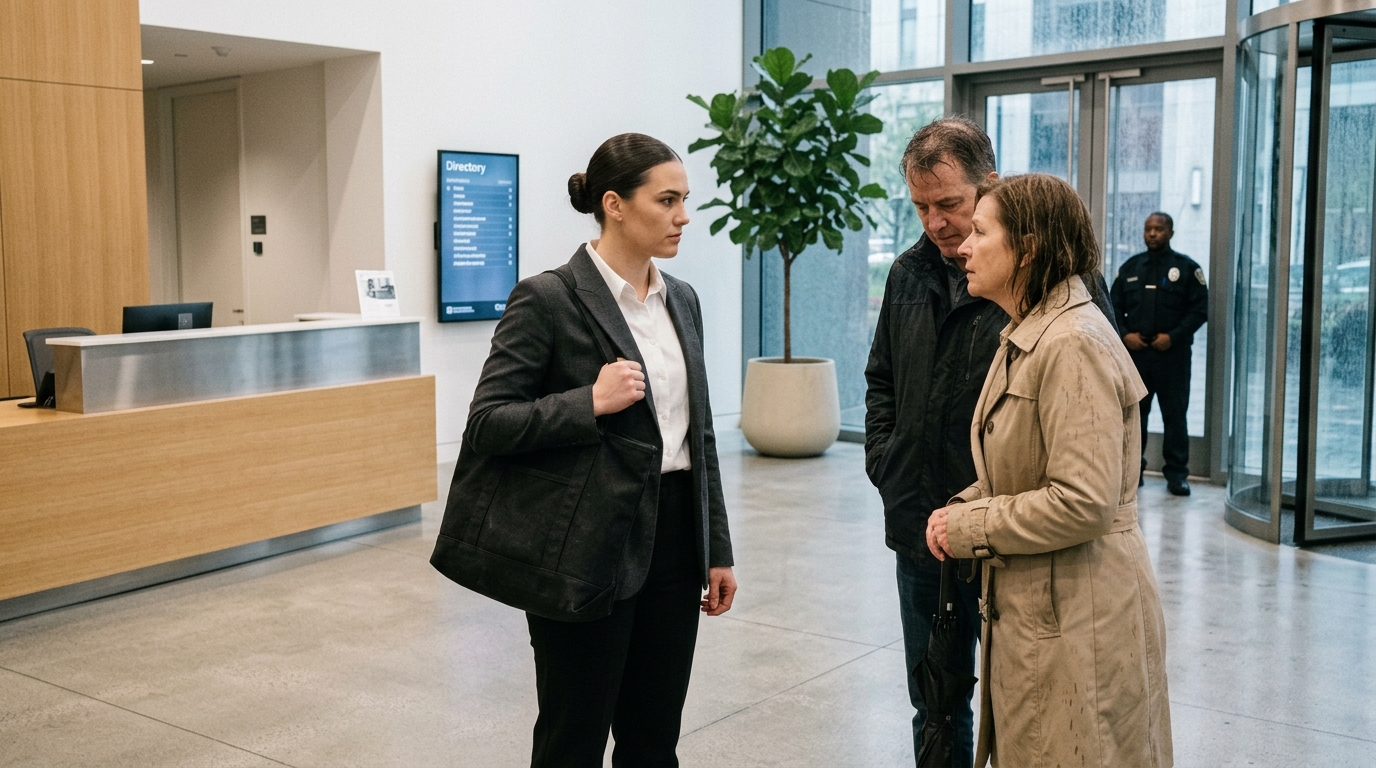
Linda stood near the reception desk in a damp beige trench coat, her umbrella dripping steady circles onto the polished marble floor. Robert lagged half a step behind her, hands jammed deep into his coat pockets, shifting his weight like a man who had been dragged into a room against his will.
I stopped four feet away. I didn’t reach for my phone. I didn’t reach for my keys. I just let my work bag hang heavy from my shoulder.
“Tori.” Linda’s lips pulled into a thin, tight line that she used to call a smile. “We’ve been waiting forty minutes. Security wouldn’t let us up to your office.”
“Security follows building policy,” I said. My voice was even, flat, stripped of the old urgency that used to make my throat ache. “What are you doing here, Linda?”
She flinched slightly at her first name, a nervous twitch catching the corner of her left eye. “We heard from Aunt Patricia that you’re getting married in three months. In Napa.”
“I am.”
“And we had to find out from family gossip?” Linda took a sharp step forward, her wet umbrella tapping against the marble. “No phone call? No invitation in the mail? Your sister was heartbroken when she heard.”
“Victoria hasn’t spoken to me in thirty-six months,” I said, looking her directly in the eyes. “And neither have you. You made your boundaries very clear three Thanksgivings ago.”
Robert cleared his throat, a dry, raspy cough he always used when a room got too small. “Tori, come on now. Your mother just wants to be part of your big day. We’re your parents.”
“You were my parents,” I corrected softly. “Until you decided that maintaining Victoria’s peace meant erasing my existence. I adapted.”
“You’re being stubborn!” Linda’s voice pitched higher, catching the attention of a security guard standing near the desk. She caught herself, smoothing the front of her coat with trembling fingers. “We came here to fix this. We want our seats at the family table for the ceremony. I deserve to walk down that aisle.”
I reached into my bag, pulled out my umbrella, and tightened the strap around the canvas. “You don’t have seats, Linda. Because you aren’t on the guest list.”
“You can’t do this to us!” she hissed, stepping into my path as I moved toward the revolving door. “We gave you twenty-seven years! You owe us respect!”
“I paid my debt in silence,” I said, brushing past her shoulder to hit the push bar on the glass door. “Don’t come to my workplace again.”
Behind me, Robert called out my name—a broken, hesitant sound—but I walked straight out into the Boston rain, the heavy glass swinging shut between us.
CHAPTER 4: THE FINAL SETTLEMENT
Linda marched down the carpeted aisle between eighty seated guests, her eyes locked on me, her shoulders rigid. Robert followed three steps behind, pulling at his stiff collar, his pale face slick with sweat under the warm chandelier lights.
Marcus shifted beside me, his hand resting lightly against the small of my back. “Do you want me to have them escorted out?”
“No,” I whispered, keeping my gaze level. “Let them stand there.”
Linda reached the front of the main table, her knuckles white as she slammed a heavy leather purse onto the corner of the linen cloth. “So this is what you do? You dress up in white and pretend you dropped out of the sky with no family?”
The low murmur of dinner conversation dried up across the hall. Glasses stopped mid-air. Eleanor and Richard sat at the primary family table two feet away, silent, watching without stepping in.
“You weren’t invited, Linda,” I said, my voice carrying clearly across the quiet room. “You were told explicitly three months ago not to show up.”
“I am your mother!” Her voice cracked, loud and erratic, echoing off the stone walls. “I carried you for nine months! You don’t get to erase us just because you got bitter over one Thanksgiving dinner!”
I pulled a folded piece of paper from inside my clutch—a carbon copy of a bank withdrawal slip I had found tucked into a box of my grandmother’s photo albums two years ago. The ink was faded, dated six years back, signed by Robert Thatcher, transferring forty thousand dollars from my late grandmother’s educational trust directly into Victoria’s husband’s failed auto-repair business.
I laid the paper flat on the linen, right under Linda’s eyes.
“It wasn’t about one Thanksgiving,” I said, my voice dropping an octave into absolute stillness. “It was about the six years before that. It was about Dad signing away my college fund so Victoria wouldn’t have to sell her house, and then telling me I was ‘causing drama’ when I asked why my tuition checks bounced.”
Linda stared down at the paper. Her mouth opened, her breath hitching, but no words came out. She glanced back at Robert.
Robert’s posture crumpled. He looked at the floor, his hands trembling as he jammed them deep into his trousers pockets. “Tori… we were going to pay it back. Victoria was struggling—”
“You didn’t pay it back,” I said. “And when I asked about it, you cut me off so you wouldn’t have to look at what you stole.”
“You have no right to humiliate us like this in front of these people!” Linda hissed, her hands shaking as she grabbed her purse, trying to gather the pieces of her outrage. “Family covers for family! We did what we had to do!”
“You did what was easy,” I said. “And now you have to live with the quiet.”
I looked at the venue manager standing discreetly near the stone archway and gave a single, firm nod. Two venue coordinators walked up quietly, positioning themselves on either side of my biological parents.
“Please step this way,” the coordinator said softly, gesturing toward the double doors.
Linda looked around the room—at eighty strangers staring at her with cold, uncomfortable clarity, at Eleanor sitting peacefully at the head table holding a glass of wine, and at me, standing straight in my dress, completely untouched by her panic.
“You’ll regret this, Tori!” Linda spat, her voice ringing hollow against the high ceilings as she was turned toward the exit. “You’ll realize blood matters!”
“My blood kept me quiet,” I said to the closing doors. “My choice kept me whole.”
The heavy oak doors clicked shut. The hall stayed quiet for three seconds before Richard raised his glass at the head table, the crystal catching the golden light.
“To Tori,” Richard said, his deep voice filling the space. “And to the home she built herself.”
Eighty glasses clinked in unison.
After the toasts, when the music restarted and the room filled with the warm, easy noise of people who actually wanted to be there, I walked back to my seat. I picked up my water glass, took a slow sip, and set it down on the clean white linen, exactly where it belonged.