The Original Line: A Veteran’s Stand Against Corruption Beneath the Forgotten Earth
CHAPTER 1: THE ENCROACHING SHADOW
The brass soil probe was cold in Jack’s palm, its T-bar handle worn smooth by thirty years of his wife’s grip and five years of his own. He kept his fingers wrapped around it, the tip of the rod still buried six inches deep in the dark, heavy clay of the monarch run. The scent of damp earth and crushed milkweed leaves hung thick between them, cut sharply by the artificial lavender of Karen’s perfume.
“The board has voted,” she said. She did not look at the field. Her eyes remained locked on the grid of her legal pad, her pen hovering over a list of names that Jack knew by heart. “We are exercising our right under Article 7, Section 3 of the covenants to improve unsightly lots. We’re paving it over for additional guest parking. The community needs it, Jack.”
Jack rose slowly. His left knee gave two short, dry pops—a familiar friction left over from an old bridge collapse outside of Da Nang. He didn’t brush the soil from his trousers. He simply stood, six feet of quiet, gray-headed engineering, looking down at the red-jacketed president of the Oak Creek Meadows Homeowners Association. Behind her, forty yards away on the asphalt, her white SUV sat idling, its exhaust coughing a pale, steady steam into the cool autumn air.
“This isn’t a lot, Karen,” Jack said. His voice was low, flat, carrying the rhythm of a man who measured his words by the ton. “This is a registered conservation habitat. The USDA signed the contract five years ago.”
“Our lawyer says that internet registry of yours is a paper shield,” Karen replied, a thin, triumphant smile pulling the corners of her mouth tight. “The excavators will be here Monday at eight sharp. I suggest you have your personal items cleared from the perimeter by then.”
She turned, her heels clicking a sharp, military rhythm against the concrete sidewalk as she retreated toward her idling vehicle. Jack didn’t watch her go. Instead, his gaze drifted down to the wooden survey stake marking the western edge of his property line. The pressure-treated pine had split down the grain, its orange flagging tape weathered to a pale, brittle pink.
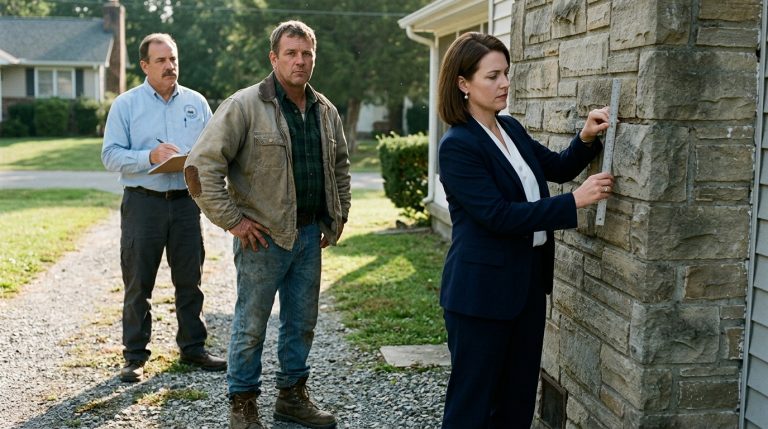
When he reached down to touch the wood, his fingers caught on something metallic—a small, rusted surveyor’s tag nailed into the base of the post, half-buried in the creeping thistle. The letters pressed into the lead cap were nearly gone, eaten away by twenty years of damp clay, but the first three characters were still visible under the dirt: S.P.A.
He pulled the brass probe from the ground. The iron-heavy earth clung to the tip, dark and stubborn. Monday was less than seventy-two hours away. Karen believed she was clearing an unsightly patch of weeds, but Jack knew the exact depth of the foundation she was trying to break. He walked back toward the house, his boots sinking into the soft prairie turf, the quiet thrum of the cicadas rising around him like the low vibration of an approaching engine.
CHAPTER 2: THE ARCHIVE OF EARTH
The screen door slapped shut with a flat, hollow crack that rattled the rusted hinges. Inside, the ranch house smelled of lemon wax, dried mint, and the deep, limestone cold of an old basement. It was a stillness Jack had lived in for five years, a quiet so thick he could hear the steady, mechanical click of the refrigerator compressor from the hallway.
He did not shed his boots. The dried gray clay from the monarch run flaked off in small, neat crusts along the linoleum as he walked toward the back bedroom Sarah had used as an office.
The brass soil probe went into the corner behind the door, its worn handle leaning against the faded floral wallpaper. On the desk sat three green binders, their spines cracked and white where the cheap vinyl had split over the cardboard. Jack pulled the middle one from the shelf. The binder didn’t slide; it resisted, the dusty textured cover dragging against the rough pine shelf with a sound like dry grass brushing against a boot.
He flipped the cover open. The first page was a hand-drawn map, rendered in Sarah’s tight, drafting-pen script. She had been meticulous, a woman who mapped root systems to the millimeter. At the bottom of the grid, right where his five acres met the wooded creek, her pen had circled a small square with three precise letters: S.P.A.
Jack’s thumb traced the ink. It wasn’t just a label. Underneath the drawing, tucked into a plastic sleeve, was a folded piece of heavy, high-fiber paper—the Peterson-Miller Boundary Agreement of 1974. The document was older than the subdivision, older than the developer’s slick brochures of vinyl-sided dreams. The paper was stiff, yellowed at the margins, smelling faintly of cellar mold and iron ink.
As he unfolded it, a small fragment of the rusted lead cap from the boundary post fell onto the desk, rolling like a dead weight before stopping against his brass paperweight.
The agreement laid out the original metes and bounds of the Sovereign Plains Annex. It was a protective agricultural covenant, locked into the deed before the land was ever carved up into neat half-acre lots for people who wanted lawns like golf greens. According to the old text, the five acres were not classified as residential common ground; they were a sovereign environmental buffer, bound by law to remain undisturbed.
“They didn’t look,” Jack muttered, his voice a dry rasp in the empty room. “They just saw grass.”
He pulled up the computer screen, the blue light reflecting off the glass of his old military medals mounted on the wall. He entered the official county land portal, his fingers tapping the keys with a deliberate, rhythmic precision. When the digital map loaded, he cross-referenced the deed numbers.
There was a discrepancy. The current HOA plat map showed his western boundary shifting twelve feet to the east—just enough to turn the thickest part of the monarch run into a clean, straight line for guest parking. The shift was clean, digital, and completely artificial. It had been redrawn on a computer screen, probably by some clerk hired by Karen to make the neighborhood layout look more symmetric.
But the federal registry didn’t use local plat maps.
Jack opened the USDA portal, inputting the active contract number for CFR-410-63. The screen flickered, loading the satellite overlay of the pollinator sanctuary. The green boundary lines of the federal contract matched Sarah’s hand-drawn map perfectly, swallowing the proposed parking lot whole.
The local board had drawn their parking spaces over a line protected by federal law. They had relied on a local map that had been quietly altered, ignoring the foundational deed that sat in his yellowing binder.
He leaned back in the creaking wooden chair, his gaze landing on the small, rusted lead fragment on his desk. It wasn’t a boundary dispute. It was a structural failure in their entire legal foundation. Karen had built her plan on a redrawn line, but the earth underneath still belonged to the old covenant.
He reached for the telephone. The black plastic receiver was heavy, cold against his ear. He dialed the number for Dave Hastings. The line rang twice before the deep, gravelly voice of the retired Gunnery Sergeant cut through the static.
“Hastings.”
“Dave,” Jack said, his eyes still fixed on the digital overlay of the Sovereign Plains Annex. “The dragon lady is using a crooked map. Get your camera ready for Monday. We aren’t just defending the fence line. We’re holding the original line.”
“Say no more, Jack,” Dave rumbled, the sound of a gun-cleaning rod clicking in the background. “I’ll be on your porch at first light.”
Jack hung up the receiver. He picked up the brass soil probe from the corner, his fingers finding the familiar worn grip. The metal was still cold, but the weight of it in his hand felt solid, balanced, and ready for the friction to come.
CHAPTER 3: SECURING THE FLANK
The black plastic receiver settled into its cradle with a definitive click that left the room feeling emptier than before. For a second, Jack stayed still, his hand resting on the smooth, cold curve of the phone, listening to the silence reclaim the corners of Sarah’s office. Outside, the dusk was thickening, turning the vibrant golds and purples of the wildflower field into muted, heavy grays. The wind was picking up from the west, carrying the damp, sharp smell of the creek and the faint, chemical scent of neighborly fescue.
He picked up the heavy brass paperweight, slipping it into his pocket alongside the old lead surveyor’s cap. His fingers brushed against the metal edges, feeling the deep corrosion that had eaten into the lead over decades. Monday’s confrontation was a tactical certainty now, but an army of one was simply a target. He needed eyes on the western flank, and he needed them before the first heavy tread of Frank’s machinery touched the grass.
He walked down the narrow hallway, the pine floorboards groaning under his weight, and stepped out onto the back porch. The screen door gave its familiar, dry rattle.
Across the shared fence line to the west, a warm yellow light spilled from the Millers’ kitchen window. Mark Miller was standing near his back patio, silhouetted against the glow, trying to thread a stubborn blue starter cord through the housing of an old lawnmower. His shoulders were hunched with the unmistakable tension of a man out of his depth, his knuckles white against the plastic handle.
Jack adjusted his stride, stepping off the porch stairs and onto the damp turf. The ground was soft here, the clay giving slightly under his boots with a faint, sucking sound. As he approached the chain-link divider, the dry weeds along the fence line scraped against his canvas trousers.
“Starter cup’s misaligned, Mark,” Jack said, his voice carrying clearly over the gentle rustle of the dry grass.
Mark flinched slightly, dropping the blue cord. He looked up, his face pale under the patio light, a smudge of dark grease smeared across his temple. “Jack. Yeah. This thing… I swear the spring inside is shot. I just wanted to get this patch cut before Monday. Before things get… loud.”
“Let me see it,” Jack said. He reached over the five-foot fence, his hands steady as he took the small metal housing from Mark’s hand. The metal was cold, smelling of stale gasoline and burnt oil. With a practiced twist of his thumb, he popped the retaining clip, letting the tension out of the spring with a soft, controlled click. “The coil was seated backward. Someone didn’t read the manual.”
“Probably me,” Mark muttered, wiping his hands on a rag that was already saturated with grime. He looked past Jack, his eyes scanning the wide, dark expanse of the wildflower field. “Karen was back on the Facebook page tonight. Her friend Carol posted a picture of your monarch run from three years ago—back when the thistle was bad. She’s calling it a public health hazard. My wife, Emily… she’s worried, Jack. She doesn’t want the kids near the fence if the board starts sending code enforcement officers with fines.”
“The board’s looking at a crooked plat map,” Jack said. He leaned his forearms against the top rail of the fence, feeling the cold, galvanized steel press through his sleeves. “They redrew the boundary twelve feet east to fit the parking stalls. That puts the excavation right through the milkweed beds.”
Mark sighed, a puff of white condensation in the cooling air. “They’re going to pave it anyway, aren’t they? When the HOA gets set on something, they just… write the check and do it. We tried to appeal our fence variance last year. It was like talking to a brick wall.”
“Not this time,” Jack said. He reached into his pocket and pulled out the folded copy of the Peterson-Miller Boundary Agreement, the stiff paper crackling in the autumn wind. He laid it flat on the top rail, pinning it down with his thumb. “This property is registered under the Sovereign Plains Annex. That means the deed has a permanent agricultural covenant that predates this entire development. Karen’s lawyer didn’t run the title search. If they dig, they aren’t just violating an HOA rule. They’re breaking a state-level deed restriction.”
Mark leaned in, squinting at the faded, elegant handwriting on the paper. His software-engineer eyes scanned the dry, legal jargon, tracing the old survey coordinates. “This… this says the entire western half of the development is subject to the easement. If they pave this, they invalidate the original tract charter.”
“Exactly,” Jack said. “But I need a paper trail of the encroachment. When they bring the equipment on Monday, I need you and Emily to document the exact location of the tracks relative to the old survey stakes. No shouting, no arguments. Just high-definition photos from your side of the fence.”
Before Mark could answer, the back door of his house opened, and Emily stepped out onto the patio, holding a steaming mug. The light behind her caught the determined set of her jaw. “We’ll do more than take photos, Jack,” she said, her voice clear and carrying no hesitation. “Lily has three sketchbooks of the monarchs from that field. I’m not letting them bury her childhood under six inches of asphalt.”
Jack gave her a single, firm nod. The flank was secured. He reached over, handed the repaired starter housing back to Mark, and turned back toward his dark field, his boots finding the path in the gathering gloom.
CHAPTER 4: THE LEGAL FRICTION
The damp turf gave way to the hard, unyielding concrete of the patio as Jack stepped back onto his own property. Behind him, the yellow glow of the Millers’ kitchen window cut through the dark, throwing his long, lean shadow across the gravel path. He walked inside, the screen door snapping shut with its dry, metallic rattle. He didn’t turn on the overhead lights. Instead, he made his way through the dim hallway to his study, where the soft blue luminescence of the computer monitor was the only source of light.
The air in the room was cool, smelling of old pine shelves and the faint, coppery scent of the brass surveyor’s tag resting on his desk. Jack pulled out his phone and opened the encrypted messaging link Maria Diaz had sent him. She was a woman who didn’t waste words, and she had instructed him to have all local documents digitized before their early-morning conference.
He pulled the heavy green binders back into the center of the desk, their vinyl covers squeaking against the polished wood. With precise, deliberate movements, he began feeding the yellowed pages of the Peterson-Miller Boundary Agreement into the flatbed scanner. The machine hummed—a low, rhythmic buzz that vibrated through the old desk. On the screen, the crisp digital lines of the 1974 agreement began to render, high-contrast and undeniable.
His fingers traced the rough grain of the next document: the official certified mail receipts from his original notifications to the board, their green cards stamped with faded ink. He scanned those next, alongside the federal CFR-410-63 enrollment certificates. He compiled them into a single, comprehensive PDF, labeling the file simply: SPA_Defense_Master.pdf.
The video call connected with a soft chime. Maria’s face appeared on the screen, framed by her sharp black bob. She was sitting in what looked like a home office, a stack of thick legal volumes behind her, a mug of black coffee steaming in her hand. She didn’t offer a greeting; she went straight to the point.
“Did you find the original deed filings, Jack?” her voice was crisp, cutting through the low hum of his computer’s cooling fan.
“Scanned and sent,” Jack replied, his fingers resting on the edge of the desk. “The Sovereign Plains Annex covenant is active. It was never extinguished when the developer bought the surrounding land. The HOA’s plat map is an artificial projection.”
Maria’s eyes moved rapidly as she scanned the document on her secondary monitor. A slow, predatory smile touched her lips, though her expression remained otherwise completely disciplined. “This is better than we calculated. The developer didn’t just build over a line; they explicitly agreed to indemnify the original agricultural trust in their initial incorporation documents. It’s right here in the third appendix. Karen’s board is operating under the assumption that they have plenary authority over ‘all undeveloped lots’ under Article 7. But under state law, a registered annex with a prior deed restriction is not an ‘undeveloped lot.’ It’s a sovereign agricultural tract.”
“So her authority is void,” Jack stated, his voice a flat, level rasp.
“Legally, it’s a fiction,” Maria said, leaning closer to her camera. “But we aren’t going to tell them that yet. If we file a temporary restraining order, we stop the bulldozers, but we also give their legal counsel time to dig into their errors and find a quiet way to retreat. I want them to commit. I want Frank’s excavation team to cross that line on Monday morning.”
Jack didn’t blink. He understood the tactical logic of the trap. “You want the physical trespass.”
“The moment a steel track touches the soil of the Sovereign Plains Annex, it becomes a willful violation of CFR-410-63 and a breach of a recorded state covenant,” Maria explained. “That’s when we trigger the real leverage. I’ve already drafted the notice to their insurance carrier. Under standard Directors and Officers policies, coverage is immediately suspended for acts committed with prior written notice of illegality. I’m going to send the carrier a copy of your certified mail receipts alongside this deed. When the board members realize they are personally liable for the federal restoration costs, the entire collective will disintegrate.”
Jack looked down at his desk, his thumb brushing the rough cap of the lead surveyor’s tag. The metal was cold and oxidized, leaving a gray smudge of zinc on his skin. “They think they’re building a parking lot. They have no idea how deep this hole is.”
“Let them dig,” Maria said, her voice dropping to a low, quiet register that matched the silence of the room. “I’ll have the electronic filing queued for Monday morning. You and Dave keep your cameras running and stay behind the line. Let the earth do the rest.”
The call ended with a quiet click, leaving Jack alone in the blue light of the monitor. He closed the laptop and walked to the window, looking out over the dark expanse of his field. The wind was rustling through the dry seed heads of the coneflowers, a soft, dry whispering that sounded like water flowing over gravel. He reached into his pocket, his fingers closing around Sarah’s brass soil probe, feeling the heavy, cold weight of the metal. The trap was set, and the line was drawn.
CHAPTER 5: THE WALL OF IRON
The pre-dawn frost had silvered the wild rye, turning the dark expanse of the field into a stiff, glittering sheet that crackled under the slightest movement. Jack stood on his back porch, the collar of his canvas coat turned up against a biting northern wind that smelled of frozen mud and decayed leaves. His hand was shoved deep into his pocket, his knuckles resting against the cold, hard curve of Sarah’s brass soil probe.
Exactly at 0700, the low, gravelly hum of a truck engine vibrated through the floorboards of the porch. A moment later, Dave Hastings materialized from the shadows near the garage. He walked with a short, stiff stride, his faded Marine Corps ball cap pulled low over his eyes. He didn’t say a word. He simply held up a large thermos in one hand and a black camcorder in the other, the metal housing of the lens already frosted over with a thin, icy sheen.
“Ground’s frozen solid down to an inch,” Dave said, his voice a low, dry rasp as he stepped up onto the porch. “Frank’s boys are going to have to fight the clay just to get their blades down.”
“Let them fight it,” Jack replied. He pulled a thick, laminated sheet from his inner pocket—the legal notice Maria Diaz had finalized the night before. The thick plastic cover was stiff and cold, resisting the bend of his fingers. “The moment they drop a blade past the old fence line, they’re in the boundary. I want the recording clear, Dave.”
“Got the wide-angle set to capture the entire western post,” Dave said, unscrewing the cap of his thermos. The steam rose in a thick, white column, vanishing almost instantly in the freezing wind. “Our software friend next door has his rig pointed out his window too. We’ve got three angles covered.”
At 0748, the quiet of Oak Creek Meadows was officially shattered.
The deep, throat-clearing roar of a heavy diesel engine echoed from the entrance of the subdivision. A massive flatbed truck, its yellow paint rusted at the wheel wells, rumbled down the asphalt and hissed to a stop directly in front of the western boundary line. Chained to its steel bed was a midsize bulldozer, its hydraulic arms weeping a dark line of grease. Behind it, a white Ford F-150 with a faded magnetic door sign—Frank’s Excavation—idled in the center of the road.
Across the street, the door of a pristine white SUV clicked open. Karen Peterson stepped out, her red wool coat a sharp, artificial slash of color against the gray gravel. She didn’t walk toward the property line. She stood by her front bumper, her hands jammed into her pockets, her chin tilted up in a silent posture of management.
Jack walked down the steps, his boots leaving dark, crushed tracks in the silver frost. Dave followed two paces behind, the camcorder already raised to his shoulder, its red recording light blinking a steady, silent warning.
A burly man in a flannel jacket got out of the F-150, holding a curled blueprint. He walked to the edge of the asphalt, looked at the frozen field, and then looked at Jack.
“You the owner?” the contractor asked, his breath clouding in the cold air.
“Jack Thompson,” Jack said, stopping exactly three feet from the split wooden stake of the Peterson-Miller Boundary Agreement. He held up the laminated document. “Before you unchain that dozer, you need to read this. This land is a federally protected conservation habitat under the Sovereign Plains Annex covenant. If you bring that machine across this line, you are in direct violation of CFR-410-63.”
The contractor took the sheet, his calloused thumb dragging across the laminated edge. He squinted at the official USDA seal, his eyes traveling down to the bolded civil liability figures. He let out a low whistle, then turned his head toward Karen’s SUV.
“Hey, lady!” he called out, his voice carrying over the wind. “The guy’s got a federal map here. Says this is a protected annex. My contract says this is a standard common lot.”
Karen walked forward, her boots crunching sharply on the frozen gravel of the roadside. Her face was flushed with the cold, her teeth clenched. “Don’t listen to him, Frank. Our legal counsel has already reviewed his paperwork. It’s an empty lot. He’s just trying to delay the project.”
“I’m not risking a civil penalty for a fifty-car parking lot,” Frank muttered. He looked at Jack, then back at the paper. “This has a seal on it. I don’t touch sealed property.”
“You have a binding agreement with the board!” Karen snapped, her voice rising to a thin, sharp pitch. “If you refuse to dig, we will hold your company liable for breach of contract!”
Frank stared at her for a long, silent three seconds. The wind rustled the dry thistle between them. Slowly, he handed the laminated sheet back to Jack. He walked back to his truck, grabbed his radio receiver, and spoke into the microphone. “Gus, hold the chains. We’ve got a boundary discrepancy. We’re idling until the office checks the registry.”
Karen took a step toward Jack, her fingers curling into tight fists inside her pockets. “You think you’ve bought yourself some time, Jack. But our lawyer is filing the injunction today. This eyesore is coming down.”
Jack stood his ground, his face a hard, unreadable mask. “The line doesn’t move, Karen. No matter how many maps you redraw.”
He turned and walked back toward his porch, the cold wind at his back. Beside him, Dave kept the camera rolling, capturing the silent, furious retreat of the HOA president toward her car. The first physical line had been held, but Jack knew the real fight was already shifting from the dirt to the paper on Maria’s desk.
CHAPTER 6: THE FRACTURING RING
The kitchen screen door gave its short, metallic snap behind them, locking the bitter morning frost outside. Inside the house, the air felt thick and heated, smelling of old, radiator-warmed dust and stale coffee. Jack took off his canvas coat, hanging it by the wooden peg in the hall. His knuckles were raw and red from the biting northern wind, his joints stiff.
Beside him, Dave Hastings placed his camcorder on the kitchen table with a dry, heavy thud. The red recording light was dead now, but the plastic casing was still slick with melted condensation. “The driver’s radio call was the wedge, Jack. I saw Frank’s face. He wanted no part of a federal beef. But Karen… she didn’t look like a woman who was going to go home and read a treaty. She looked like she was going to call her personal attorney before she even put her car in reverse.”
“She can call whoever she wants,” Jack said, his voice a low, level murmur. “The mail is already there.”
He walked back into his study, his boots leaving faint, damp smudges on the hallway rug. He clicked his computer screen awake. On the desk, the five green certified mail slips lay arranged in a neat, overlapping fan, their stamped ink dry and dark. A moment later, his terminal chimed with an incoming secure transmission from Maria Diaz.
The attached document was a legal notification of potential claim—but framed as a direct, unvarnished warning to the HOA’s insurance carrier, Landmark Indemnity Group.
Jack zoomed in on the scanned text. Maria had structured the letter with surgical coldness. She hadn’t just cited the Sovereign Plains Annex or the Peterson-Miller Boundary Agreement. At the very center of page two, she had inserted a bolded, high-contrast block quote from Landmark’s own D&O—Directors and Officers—policy manual.
EXCLUSION 4(b): The Carrier shall not be liable to make any payment for Loss in connection with any Claim made against an Insured person arising out of, based upon, or attributable to any deliberate, willful, or fraudulent violation of any federal, state, or local statute, provided there has been prior written notification of such non-compliance to the Insured.
Underneath the quote, Maria had attached high-resolution scans of the green certified mail slips, complete with the signatures of each individual board member—including Arthur Pinter, the treasurer, who had signed for his packet exactly eight days ago.
Jack’s phone buzzed on the desk. He didn’t pick it up immediately; he let the vibration rattle the wooden surface for three seconds before lifting the receiver.
“Thompson,” Jack said.
“Jack, it’s Mark next door.” Mark’s voice was hushed, vibrating with a tense, rapid energy. He was speaking from his home office, which looked directly out at the cul-de-sac. “You need to look outside. Arthur Pinter’s car is parked in Karen’s driveway, but he isn’t getting out. He’s just sitting there behind the wheel, staring at a stack of papers. He looks like he’s having a physical panic attack.”
“He just realized he’s uninsured,” Jack said flatly.
“What do you mean?”
“The certified letters I sent them. They signed for them. That means the insurance company won’t cover a single cent of their legal fees or the federal restoration fines under CFR-410-63. If they dig, they pay out of their own bank accounts. Their houses, their retirement. It’s all on the table now.”
There was a long, heavy silence on the other end of the line. Jack could hear the faint, rapid click of Mark’s fingers tapping on his keyboard. “My God, Jack. Pinter is a retired accountant. His entire life is built on protecting his assets. If he realizes his personal liability policy is void… he’s going to break.”
“He’s already breaking,” Jack said, his eyes returning to the green receipts on his desk. “Keep your camera on the western post, Mark. The board isn’t a team anymore. It’s five people trying to find the exit.”
As he hung up, Jack leaned back in the creaking chair. Through the window, the sun was finally breaking through the heavy autumn clouds, casting a cold, gray light over the frozen stalks of the wild indigo. The wind was still whistling through the gaps in the window frame, a thin, sharp sound that matched the tension settling over the neighborhood. The first crack in Karen’s defensive line had appeared, and it had nothing to do with bulldozers. It was the quiet, terrifying reality of a zero-sum balance sheet.
CHAPTER 7: THE RECKONING AT BEIGE HALL
The dry gravel of the clubhouse parking lot crunched under Jack’s tires, a sharp, grinding sound that cut through the low hum of his heater. He killed the engine. Through the sweeping arc of his windshield wipers, the community center loomed under the security lights—a squat, beige-sided building that smelled of damp floor wax and industrial disinfectant. The windows were steamed from within, casting a diffused, yellow haze into the freezing drizzle.
Jack checked his pocket. The laminated copy of the Sovereign Plains Annex certificate sat flat against his ribs. Beside him, Dave Hastings stepped out of the passenger side, his boots hitting the gravel with a heavy, deliberate thud. Dave was already carrying the black camcorder, its nylon strap wrapped twice around his wrist like a lanyard.
They did not speak as they crossed the wet asphalt. Every parking bay was full; even the grass verges were lined with SUVs, their tires turning the freezing clay into slick, gray ruts. The neighborhood had emptied itself into the hall.
The heavy double doors opened to a wall of sound—a low, vibrating drone of dozens of tense, whispered conversations. Inside, the sterile gym floor was packed with folding metal chairs, almost every seat occupied by homeowners in heavy winter coats. At the far end of the room, behind a long plastic folding table, sat the HOA board.
Arthur Pinter was there, his spectacles slipping down his nose as his fingers nervously sorted through a messy stack of printed emails. His face was gray, a sheen of sweat glinting under the hum of the fluorescent tubes. Beside him sat the other three board members, their postures stiff, their shoulders hunched as if trying to shrink away from the crowd.
But Karen Peterson sat dead-center. She wore her bright red powersuit, her hands flat on the plastic table, her gaze locked forward. When her eyes found Jack, her jaw tightened, a small muscle twitching along her cheek.
Jack took a seat in the second row, Dave slipping into the place beside him, his camera resting on his knee but pointed directly at the center of the board’s table. To his left, Mark Miller offered a short, anxious nod, his fingers tapping a fast, silent rhythm against his leg.
Karen did not wait for the chatter to die down. She grabbed her wooden gavel, striking the block with a sharp, echoing crack that silenced the room instantly.
“This emergency meeting of the Oak Creek Meadows Association will now come to order,” Karen announced, her voice flat, projected through a small, squeaking PA speaker. “We are here to clarify the procedural parameters of the proposed common area improvement project. There has been a significant amount of unauthorized documentation circulating through the neighborhood, and the board wishes to set the record straight.”
“Whose record, Karen?”
The voice came from the third row. It was Dave Hastings. He didn’t stand up, but his deep, gravelly baritone cut through the gymnasium like a saw. “Are we using the county plat maps, or the ones you redrew to ignore the Sovereign Plains Annex?”
A ripple of murmurs washed through the crowd. Karen’s eyes narrowed, her hand tightening around the gavel. “Mr. Hastings, you are out of order. This is a board-led informational session. If you have questions, you may submit them in writing to our legal counsel—”
“Our legal counsel is currently reviewing a reservation of rights letter from Landmark Indemnity,” Arthur Pinter interrupted.
The microphone caught the dry, cracking quality of Pinter’s voice. He stood up, his chair scraping violently against the linoleum. He didn’t look at Karen. His hands were shaking as he held up a thick packet of papers, his finger pointing at a highlighted paragraph near the top.
“We received a formal notice this afternoon,” Pinter said, his voice rising to a thin, panicked pitch that echoed off the metal rafters. “If we proceed with the excavation of APN 734-5B-21, we are doing so with full, documented knowledge of a federal conservation easement under CFR-410-63. The insurer has explicitly suspended our D&O coverage. If the USDA levies the five-figure daily restoration fines… the board members are personally liable. Individually. Every single one of us.”
The room exploded. Homeowners stood up from their metal chairs, shouting over one another, the noise climbing to a deafening roar.
“Is this true?” a man in the back yelled, slamming his hand against the wall. “Are you risking our collective reserve fund on a parking lot?”
“The reserve fund won’t cover it!” Pinter shouted back, his face flushing a deep, dangerous crimson. “It’s personal liability! It’s our homes, our bank accounts! Karen lied to us. She told us her office had cleared the title. She signed the project clearance anyway!”
Karen stood up, her red jacket stark against the pale beige wall behind her. She did not look at the shouting crowd; she stared down at Pinter, her face white, her teeth bared. “Sit down, Arthur. You are acting on incomplete legal theory—”
“It’s not a theory,” Jack said.
He rose slowly from his seat, the movement quiet but commanding enough to draw the eyes of the front three rows. He reached into his coat and pulled out the laminated sheet, holding it flat against his chest.
“The Peterson-Miller Boundary Agreement of 1974 is a recorded state deed restriction,” Jack said, his level voice carrying through the sudden hush that fell over the room. “The developer could not sell the easement, and the board cannot pave it. The line is locked. The only thing left to decide tonight is who pays for the trespass attempt.”
Maria Diaz stood up beside Jack, her leather briefcase clicking open with a sharp, mechanical snap. She didn’t look at Karen; her eyes were fixed on the remaining three board members, who were already whispering furiously to one another.
“I have filed a formal civil action for willful property damage and conspiracy,” Maria stated, her voice crisp and carrying the unyielding weight of a court order. “But my client is willing to execute a settlement. It requires the immediate, permanent recording of a conservation easement on the five acres, full reimbursement of legal fees, and the immediate resignation of the president.”
Karen reached for her gavel, her knuckles white, her breath coming in short, ragged gasps. “This board will not be bullied by—”
“I make a motion to remove Karen Peterson from the board for gross negligence,” Pinter barked, throwing his papers onto the plastic table.
“Seconded!” Mark Miller called out from the front row.
“Seconded!” a dozen more voices echoed from the back of the gym, the sound rising like a tide.
The acting vice president, a quiet woman who had sat in silence the entire night, slowly reached for the microphone. Her hand was trembling, but her voice was clear. “A motion has been made and seconded. All those in favor of removal, say aye.”
A deafening, unified roar of Aye shook the beige metal rafters of the clubhouse.
Karen stood frozen, her hand still hovering over the wooden block, her red jacket looking suddenly thin and fragile against the sterile light. She looked at her fellow board members, but none of them would meet her eyes. She was completely, utterly isolated.
Jack watched her slowly pick up her black leather purse, her clipboard slipping from her fingers and clattering to the floor unnoticed. She did not speak. She turned and walked down the side aisle, her heels clicking a fast, frantic rhythm against the concrete as she fled the room.
The crowd did not cheer. They simply watched her go, a quiet, heavy satisfaction settling over the space. Jack sat back down, his hand resting on the brass soil probe in his pocket, feeling the cold, familiar metal. The line had held.
CHAPTER 8: THE SOILS QUIET RETURN
The engine of the sedan ticked as it cooled, a sharp metal contraction that cut through the deep, wet quiet of the driveway. Jack did not move for a long minute. His hands remained resting on the steering wheel, his knuckles still pale under the faint green light of the dashboard. Outside, the freezing drizzle had stopped, leaving the oak branches dripping heavy, slow droplets onto the hood.
He climbed out of the cab, his boots meeting the gravel with a muted crunch. The air was clear now, the biting northern wind settling into a steady, freezing calm that smelled of wet wood and crushed stone. He walked toward the western edge of his property, his fingers automatically slipping into his pocket to find the tattered brass soil probe.
The physical line of his property was silent. The split wooden survey stake of the Peterson-Miller Boundary Agreement stood exactly where it had for fifty years, its pink flagging tape stiffened with frost. There were no heavy trucks on the road, no hum of diesel engines, and no red-jacketed figures clutching plastic clipboards.
Four months had passed since the night at the community center. The legal machinery had ground slowly, but it had ground with a heavy, crushing finality.
Jack reached the fence line. Mark Miller’s back patio light was off, but a new, low-voltage wire of LED path lights illuminated a fresh bed of loose, dark soil running parallel to the boundary. A row of hand-painted wooden plant tags—marked with Lily’s neat, childhood print—stuck out of the straw mulch: Asclepias syriaca. Common milkweed. The seed pods were already bursting, their silky white threads catching the starlight like tiny lanterns.
He knelt down on the damp turf, his knees popping softly in the quiet. He pressed his fingers into the soil at the base of the boundary post. It was cool and crumbly, the rich loam of the Sovereign Plains Annex finally free from the threat of the grader’s blade.
Under the terms of the settlement Maria Diaz had recorded with the county, the land was no longer just a private lot under the whims of an association charter. The recorded conservation easement had locked the five acres into a permanent, ironclad trust. No developer, no board, and no future owner could ever lay a sheet of asphalt over this dirt. The federal protection under CFR-410-63 was no longer a shield he had to hold up with trembling hands; it was a permanent law of the land, carved into the county deed book.
Karen’s house across the street was dark. A stark, wooden For Sale sign stood near her driveway, its post slightly askew in the dead turf. The $25,000 personal fine levied by the USDA’s Office of the Inspector General had been a public record, a heavy, unshielded blow that had shattered her standing in the county. She had tried to fight, filing a frantic, desperate appeal through her new litigator, but the signed certified mail receipts Jack had preserved in his green binders had closed every exit.
A shadow moved near the western fence. Dave Hastings walked up, carrying two cold bottles of local amber ale. He didn’t offer a dramatic greeting. He simply leaned his back against the shared fence post, his faded Marine cap pulled low, and handed a bottle over the wire.
“They recorded the easement at the courthouse this morning, Jack,” Dave said, his low baritone a comfortable hum in the cold. “Diaz called my place at noon. It’s done. The deed is locked.”
Jack took the bottle, the cold glass sweating against his palm. “It’s done,” he repeated.
“The board’s got a new charter draft,” Dave said, taking a slow sip. “We’re voting on the environmental stewardship clause next month. No more measuring grass with rulers, Jack. We’re putting in three more community plots near the creek.”
Jack didn’t answer immediately. He looked down at the brass soil probe resting on the grass beside his knee. The tarnished metal seemed to glow faintly in the starlight. He reached down, picked it up, and slid it into the pocket of his canvas coat.
“Sarah would have liked the milkweed,” Jack murmured, his voice dropping into a quiet, raspy register that was softer than it had been in years.
“She planted the first ones,” Dave said softly. “We just kept the clay off them.”
They stood in the dark for a long time, the quiet of the prairie stretching out before them, wild and stubborn and safe. The wind rustled through the tall dry grass, a soft, deep sigh that felt like the earth itself finally settling into peace. Jack looked down at the worn photograph of Sarah he kept in his pocket, then looked back at the wide, starlit field. The promise had been kept. The line had held.