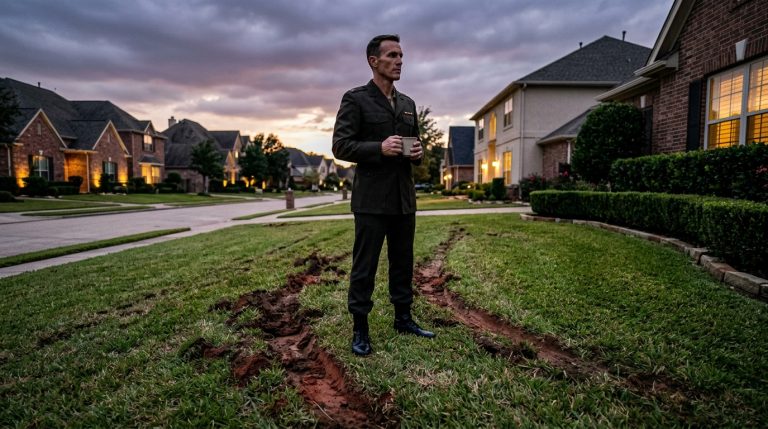
The Iron Boundary: A Retired Engineer’s Quiet War Against the Tyranny of the Suburban Beige
CHAPTER 1: THE TILE AND THE TENSION
The wet concrete gleamed like greasy slate in the raw morning sun. It was a crude, rough-edged ten-by-ten square, poured with a deliberate haste that left the corners ragged and the wooden framing planks half-submerged in the gray mire. Directly in the center, beneath three cubic yards of quick-setting mix, lay my private well cap—thick, industrial-grade steel I’d spent ten grand sleeving and sealing. It was gone now, entombed under a brutalist seal of wet rock.
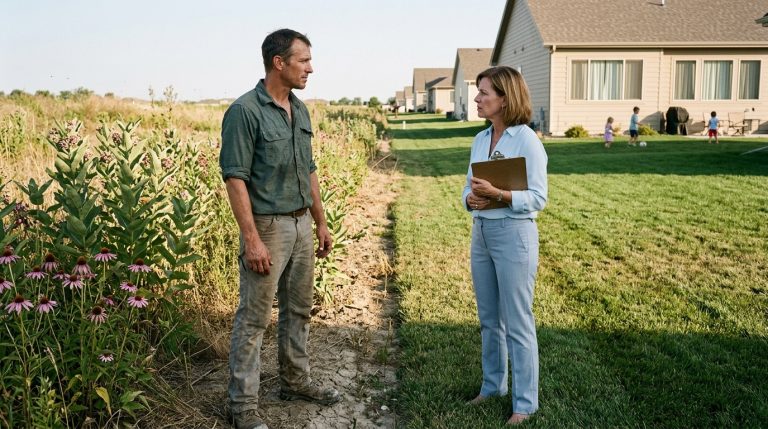
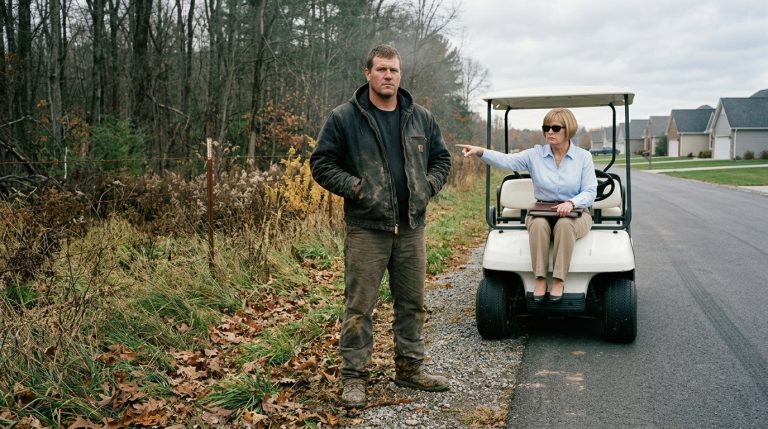
I looked from the slab to the woman standing on the edge of my gravel drive. Karen Johnson’s sneakers were caked in dry dust, but her chest was puffed out, her chin tilted at the precise angle of a bureaucrat who believed her signature carried the weight of federal law.
“The board has visual standards, Mark,” she said, her voice carrying that sharp, nasal ring that had scraped against my nerves for six months. “A polished steel cylinder visible from the walking trail isn’t in harmony with Whispering Pines. We gave you ninety days to screen it. You chose to ignore the covenants.”
I didn’t answer. In the deserts outside Al-Taji, when an improvised device took out a supply truck, the world didn’t get loud; it got incredibly quiet. The brain stops processing the static of wind and panic, narrowing down to the physical facts. The caliber of the threat. The distance to cover. The structural integrity of the nearest wall.
“I don’t belong to your association, Karen,” I said, my voice level, stripped of the anger she was clearly waiting for. “My deed is older than the first surveyor’s stake you drove into this dirt.”
“We all have to participate in the community’s preservation,” she replied, her smirk widening. She stepped back, her heels grinding into the gravel. “The county code allows for the abatement of public nuisances. If you want to discuss it further, you can attend the quarterly meeting next Tuesday. Otherwise, consider the matter settled.”
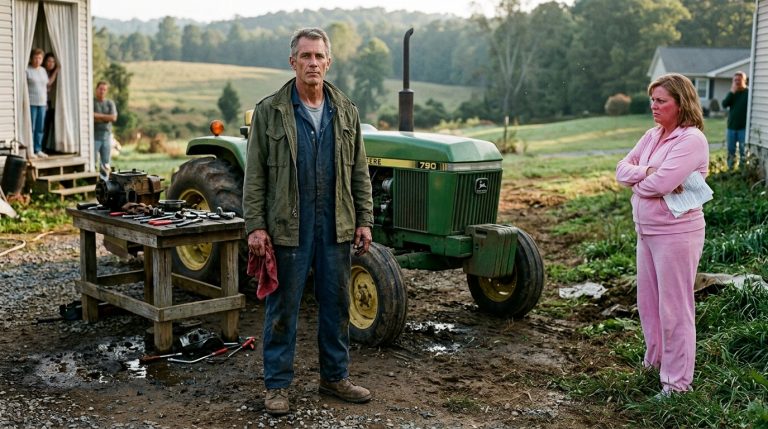
She turned, her floral pink tracksuit a loud, unnatural streak against the dry oak trees, and walked back toward the manicured beige line of the subdivision.
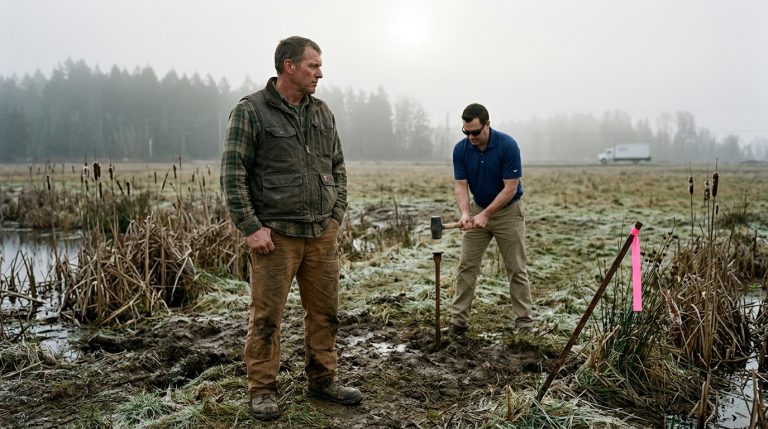
I knelt at the edge of the slab. The smell of wet cement was thick, mixing with the metallic tang of dry iron from my fence line. I reached down, my work gloves catching on a sharp fragment of the wooden frame. That’s when I saw it—a physical discrepancy. Near the eastern edge, pressed into a spill of half-cured slurry, was a distinct, waffle-patterned sneaker print, small and narrow, alongside a second set of heavy, deep-lugged work-boot tracks. But the contractor hadn’t worked from this side of the line. The fence wires were pulled taut, but one of the steel T-posts had been freshly wiped clean of its yellow paint.
I stood up, walking three paces back to the cedar post where my security camera was mounted. The coaxial cable didn’t just hang loose; it had been severed with a single, clean shear from a pair of wire cutters.
The calm in my chest settled deeper, cold and absolute. She had crossed my property line, disabled my tech, and brought a crew onto my soil. It wasn’t a civil dispute anymore. It was a footprint in the mud, and it was the first piece of ground she’d given up without realizing it.
CHAPTER 2: FORENSIC DUST
The copper fibers inside the sliced coaxial cable were bright, clean pink against the dark rubber sleeve. They hadn’t oxidized yet. The cut was so fresh that the scent of the rubber’s synthetic oil still lingered on the blade of my folding knife. Karen’s boots had crushed the dry clover along the fence line, leaving flattened green stems that were only now starting to curl and brown in the heat.
I let the wire drop. It slapped against the rusted steel of the T-post with a dull, hollow metallic chime.
A civilian would have called the police immediately, stood in the driveway waving their arms, and let their blood pressure spike into the red zone. But anger is a luxury of the unprepared. In the Corps, when a supply line was severed, you didn’t look for someone to yell at; you took an inventory. You mapped the perimeter of the failure.
I turned back to the concrete slab. The alkaline smell of the curing lime was heavy, catching in the back of my throat like dry dust. My boots crunched on the gravel as I walked a slow, wide circle around the perimeter of the wet gray square, keeping my eyes fixed three inches outside the wooden forming planks.
There, near the eastern edge where the spill had pooled over the property line, lay the waffle-patterned sneaker print. It was small—a woman’s size seven, likely—pressed shallowly into the slurry. But just four inches to the left, half-hidden under a discarded piece of yellow pine formwork, was the second track. It was deep, wide, and the tread was a series of heavy, chevron-shaped lugs. Standard-issue construction boots, size eleven or twelve, worn down at the outer heel.
I knelt, the dry earth of my pasture pressing through the denim of my knees. The contractor hadn’t poured this from my side of the fence; the tire tracks from the mixer truck were fifty yards away on the gravel road. The man who wore those heavy boots had been standing right next to Karen. He had stood there while she watched the cement fall, his heels digging deep into the soft loam of my property to steady himself as he pried the steel well cap loose.
My hand reached out, my fingers brushing the rough, splintered edge of the discarded pine plank. On the underside, a small white adhesive label was stuck to the wood, half-torn and smudged with gray grease. It didn’t have a contractor’s logo. Instead, printed in thermal ink that had faded to a dull purple, were three lines of text:
WP-S2-UTIL
M-EASE / SE-B
REF: Vanguard-41
I stared at the faded purple print. Vanguard. The word didn’t belong to a local concrete supplier or a residential fence company. It had the sterile, numbered ring of a commercial geotechnical firm. I pulled a small notebook from my breast pocket, sketched the tread pattern of the heavy boot, and copied the text from the adhesive label verbatim.
“Mr. Davies?”
The voice was thin, dry, and came from the other side of the fence.
I didn’t jump. I stood up slowly, letting my joints pop, and turned toward the line of young pines that bordered the Whispering Pines development. George was standing there, holding a pair of rusted pruning shears. His face was weathered, lined with the deep, permanent creases of a man who spent his retirement chasing crabgrass and watching his neighbors through binoculars.
“Saw the truck yesterday,” George said, his voice dropping to a low, conspiratorial murmur as he leaned against the wire. His eyes flicked toward the wet concrete slab, then back to me. “A1 Concrete. Little trailer-hitch mixer. Karen was out here in her track jacket, directing the driver like she was landing a helicopter. She told him it was an easement issue. Said you’d agreed to let them cap it for the community’s drainage project.”
“Did she?” I walked toward the fence, my boots leaving shallow prints in the dry, iron-rich soil. “Did you see who else was with her, George?”
“Big guy,” George nodded, scratching his chin with the blunt end of his shears. “Wore a gray hardhat and some kind of high-vis vest. Didn’t look like the concrete driver. He was carrying a clipboard and a long steel probe, sticking it into the dirt near your corner marker. I thought he was with the county, but his truck didn’t have municipal plates. Just a plain white Ford with a magnetic sign on the door.”
“Did you catch the name on the sign?”
George squinted, his eyes tracking a crow that had just landed on my barn roof. “Naw. Something small. But he and Karen were arguing before they poured. He wanted to pull a sample from the well casing itself. She told him to just cover it up and sign the report.”
I felt the gears shift in my head, the teeth clicking into place with a cold, heavy precision. This wasn’t just a petty HOA dispute about a mailbox or an unapproved barn. Karen wasn’t just trying to hide an eyesore; she was trying to bury something she didn’t want anyone—not even her own board—to look at too closely.
“Thanks, George,” I said, reaching into my pocket and pulling out my phone. “Keep your shears sharp. This is going to get dusty.”
I didn’t wait for him to reply. I turned and walked back toward my truck, my mind already mapping the route to the county administration building in town. The battle wasn’t going to be fought on this gravel driveway. It was going to be fought in the basement archives, under the yellow fluorescent lights where the old paper maps were kept.
CHAPTER 3: THE BASMENT ARCHIVE
My boots didn’t pause on the gravel. I pivoted away from the wire fence, leaving George holding his rusted shears, his weathered face still tracking the crow on my barn roof. The dry midday heat beat down on the hood of my F-250, radiating off the dark green paint in waves that distorted the silhouette of the pine trees behind it. I climbed into the cab, the vinyl seat hot enough to sting through my shirt, and shoved the heavy brass key into the ignition.
I turned it. Nothing. Just a single, dry click that died instantly in the quiet cab.
I didn’t curse. Cursing is a waste of breath when a circuit fails. I popped the hood latch, slid back out into the glare, and walked to the front of the truck. When I hoisted the heavy steel hood, the smell of hot grease, old radiator fluid, and scorched plastic hit me. The negative battery terminal was furred with a thick, blooming crust of white-and-green lead sulfate—corrosion eating away at the connection, choking the current.
I reached into the toolbox in the bed, pulled out a wire brush and a rusted ten-millimeter box wrench, and went to work. The white powder flaked off under my strokes, scattering down into the engine block like toxic snow. I scraped the lead until the dull gray of the metal showed through, then coated it in a thin layer of black wheel-bearing grease to seal out the humidity. It was messy, grimy work, the grease staining my knuckles and the smell of sulfur clinging to my skin, but when I climbed back in and turned the key, the starter motor caught instantly with a throaty, mechanical roar.
I backed down the long gravel driveway, the tires throwing up a plume of gray limestone dust that hung motionless in the humid air, and turned toward the county seat.
The drive to the administration building took exactly twenty-two minutes of steady, unhurried cruising down two-lane blacktop. The fields on either side were scorched a dull straw-yellow, the drainage ditches choked with dry weeds. This land had been mined for its topsoil decades ago, before the developers arrived with their sod rolls and their bright green sprinkler systems.
The county records office was located in the basement of a three-story brick building constructed in the late seventies. The air down there smelled of damp concrete, old cardboard, and the vinegar-sharp scent of degrading microfilm. There were no windows, just rows of industrial steel shelving holding thousands of heavy, canvas-bound ledgers and flat metal flat-files.
The clerk behind the counter was a woman named Arlene, whose fingers were permanently stained with blue ink. She didn’t look up when my boots squeaked on the linoleum.
“Need the plat maps for Sector Four,” I said, leaning my forearms against the high counter. “Specifically the original utility layouts for the Whispering Pines tract before the 1982 subdivision.”
Arlene sighed, her thumb flicking through a stack of yellow routing slips. “Those are on the old rolls. Haven’t been digitized. You’ll have to use the reader in the back corner. Don’t touch the glass with your fingers.”
Five minutes later, I was sitting in front of a heavy gray microfilm machine that hummed like a small refrigerator. The screen flickered with a dull green light as I slotted the reel into the plastic spindles and began cranking the wheel. The images flashed past—hand-drawn surveyor notes, old property lines, names of families long since bought out by real estate syndicates.
I stopped when I hit the master plan for the water infrastructure.
The map was dated November 12, 1978. My property was marked in bold black ink as the “Davies Homestead.” Running from the old agricultural well on my land, straight across the boundary line into what was now Magnolia Circle, was a dashed blue line. It was labeled Magnolia Easement.
But it wasn’t the easement itself that made me freeze. It was a stamp in the lower right-hand corner of the drawing, partially obscured by a coffee stain. The stamp read:
PROPERTY TRANSITION CONTROL
SUB-FILE: 79-ALPHA
RECLASSIFIED PER COUNTY WATER GOVERNANCE
I stared at the designation. File Code 79-Alpha. I pulled my notebook from my shirt pocket and compared it to the purple thermal label I’d scraped off the wooden plank at my well site. The label had referenced Vanguard-41, but the administrative tracking code for the water rights was right here on the official map.
I cranked the microfilm wheel forward, searching for the corresponding text of the easement agreement. When the page finally clicked into focus, the legal language was dense, but one clause stood out in stark, undeniable clarity:
“…the adjacent landowner retains sole physical custody of the pumping apparatus, provided that the municipal backup pressure remains below fifty pounds per square inch. In the event of secondary pressure failure, the county shall maintain access to the well head to prevent localized drop in hydrant volume…”
I pulled my phone out and took a high-resolution photo of the green screen, the text sharp against the digital grain.
As I leaned back, the metal chair scraping against the concrete floor, I noticed a second sheet attached to the appendix of the document. It was a letter on faded letterhead, dated only six months prior to the subdivision’s construction. The logo at the top was a stylized ‘V’ inside a compass rose—Vanguard Geotechnical Services.
The letter was addressed to the developer’s legal team. I read the first paragraph, my eyes scanning the faded type:
“Preliminary testing of the upper water table in Sector Four indicates severe silt infiltration. Soil stability report pending. We advise against municipal water connection without localized well-booster support to prevent pipe collapse under high-velocity flow…”
I took another photo.
Karen hadn’t just poured concrete to hide a steel pipe. She had sealed a valve that was legally designated as a critical county fail-safe. If that well was buried, the fire hydrants on Magnolia Circle weren’t just low-pressure; they were dry lines waiting for a spark. And she knew it. The work order she signed wasn’t for a cosmetic patio; it was a deliberate attempt to entomb the evidence of a water system that was failing from the ground up.
CHAPTER 4: THE CONTRACTORS RECEIPT
The green glare of the microfilm reader screen cast cold shadows across my knuckles as I slid my phone back into my breast pocket. The dry, static-filled hum of the machine finally died when I clicked the power switch down. Arlene didn’t look up as my boots crossed the basement linoleum, but the sharp, metallic snap of the heavy fire door closing behind me echoed down the concrete stairwell like a pistol shot.
The heat outside was a physical wall, thick with the smell of scorched asphalt and dry dust. I climbed back into the F-250, the starter catching with a heavy, satisfying thrum, and slotted the transmission into gear.
I didn’t head back to my pasture. I needed the name on that concrete work order. I needed the physical link that would tie Karen’s signature to the vandalism on my property before she could find a way to paper over the paper trail.
Ten minutes later, the truck rumbled into the industrial park on the south side of the county line. The offices of A1 Concrete were housed in a corrugated metal building behind a yard packed with massive, yellow-drummed mixer trucks and stacks of curing concrete pipes. The air here was chalky with cement dust, drying white on the weeds that pushed through the cracked gravel lot.
I pushed through the glass door of the office. A young woman with a phone headset wrapped around her temple was typing rhythmically at a laminate desk. Behind her, a corkboard was pinned with delivery slips, safety regulations, and a small, faded calendar.
“Can I help you?” she asked, her eyes briefly scanning the grease stain on my sleeve.
“I need to speak with the owner. Dave,” I said. My voice was low, flat, and carried the steady, quiet weight of a man who wasn’t planning on leaving until he got what he came for.
“Dave’s in the yard. He doesn’t take unscheduled vendor calls—”
“I’m not a vendor,” I interrupted calmly, leaning one gloved hand on the counter. “My name is Mark Davies. His crew poured three cubic yards of quick-setting mix on my private land yesterday morning. They disabled my security system to do it. I have the tire tracks, a clear boot print, and a copy of the county’s emergency utility plan that says your company just entombed a critical fire safety asset.”
The typing stopped. The silence in the small room became dense, punctuated only by the low rumble of a diesel engine idling in the yard outside. She looked at me for three seconds, her chin dipping slightly as she took in the lack of anger in my expression—the cold, tactical certainty.
She pressed a button on her desk phone. “Dave? There’s a Mr. Davies in the lobby. He’s talking about the Whispering Pines pour from yesterday.”
A side door made of hollow-core oak clicked open almost immediately. A broad-shouldered man with a graying beard and grease-stained hands stepped into the reception area. He wore a worn canvas vest and heavy work boots—the exact same chevron-patterned lug sole I’d sketched in my notebook at the well cap.
“I’m Dave,” he said, his eyes narrowing as he sized me up. “What’s the issue?”
“The issue is trespassing, felony vandalism, and conspiracy to disable public safety infrastructure,” I said, stepping back slightly to let him see the notebook I pulled from my pocket, open to the page with his tread pattern and the serial number from the pine formwork. “Your crew didn’t pour on community property, Dave. They poured fifteen feet inside my deeded line. And they did it while my security feed was cut.”
Dave’s jaw tightened. A small muscle near his left temple twitched. He looked at the sketch, then down at his own dusty boots.
“We had a work order,” Dave said, his voice dropping an octave, losing its defensive edge. “The HOA president, Johnson, she called it in. Said it was an emergency safety cap on a defunct well head that was sinking the walking path. She showed me a map with her signature and the association’s stamp on it.”
“She lied,” I said, pulling my phone out and tapping the screen to display the high-resolution photo of the Magnolia Easement map with the county water authority stamp. “That well head isn’t defunct. It’s the booster source for the hydrants on her own street. File Code 79-Alpha. You covered it up with three thousand dollars of your concrete, and you did it on my deeded soil.”
Dave stared at the digital map on my phone screen. The color slowly drained from his face, leaving his skin a weathered, clay-like gray. He wasn’t a stupid man; he knew exactly what happens when a contractor gets dragged into a structural vandalism lawsuit involving county emergency assets.
“The invoice,” Dave muttered, turning back toward his office door. “She had it billed to the association’s maintenance fund. She signed it herself.”
“I need a copy of that signed work order, Dave,” I said, my voice cutting through his rising panic like cold steel. “You give me that paper, and my lawyer names Karen Johnson as the sole instigator in the civil suit. You don’t, and A1 Concrete is named as a primary co-defendant. We start filing for damages tomorrow morning.”
Dave didn’t hesitate. He disappeared into his office for less than forty seconds before returning with a crisp sheet of white printer paper.
I took it. The paper was clean, but the signature at the bottom was written in Karen’s looping, aggressive hand, right next to a line item that read ‘Emergency Abatement: Esthetic Harmony Project.’
My fingers folded the sheet twice, sliding it into my pocket next to the notebook. I looked Dave straight in the eye.
“Keep your trucks in the yard tomorrow,” I said quietly. “It’s about to get very loud on Magnolia Circle.”
CHAPTER 5: THE LIGHT AT THE clubhouse
The signed copy of the work order was a stiff, folded square against my chest as I slid the F-250’s gear shift into drive. The engine block hummed with a low, vibrating warmth through the floorboards, its heat radiating up through my work boots. I guided the truck out of the concrete yard’s limestone dust, the white sediment clinging to the tires as they transitioned onto the dry, baked asphalt of the county road.
I didn’t head home. The sun was dipping below the tree line, casting long, bruised purple shadows across the dry pastureland. The dashboard clock clicked to 6:42 PM. The Whispering Pines special assembly was scheduled for seven.
As I drove toward the neighborhood clubhouse, the smell of dust and warm vinyl in the cab triggered a sharp, unbidden memory of the northern desert near Al-Taji. We’d had a supply sergeant who systematically falsified fuel manifests, hiding the shortfalls behind “evaporation loss” reports until a generator failed during an outpost sweep. When the dark settled, the truth didn’t come out through a polite memo; it came out when the lights died and the perimeter went black. The memory left a metallic, iron-like taste on my tongue, my fingers tightening on the steering wheel until the leather groaned.
The clubhouse parking lot was already choked with pristine taupe and silver SUVs when I pulled the truck onto the gravel shoulder just outside the formal entrance. The building itself was a sprawling, faux-stone lodge, lit with orange landscaping lights that made the manicured lawns look like theater sets.
I turned off the ignition. The truck settled with a hot, ticking sigh. I reached into the passenger footwell, hoisting my canvas satchel. Inside was my small, military-surplus digital projector and a thumb drive loaded with the county survey scans and the high-resolution image of the Vanguard Soil Report I’d pulled from Sub-File 79-Alpha.
My boots made a heavy, rhythmic crunch on the decorative gravel as I walked up the side path, avoiding the main double doors. I kept my chin down, the air smelling of fresh cedar mulch and sprinkler water—the expensive, artificial scent of a subdivision pretending the dirt beneath it wasn’t shifting.
I slipped inside through the side emergency exit, the door’s panic bar giving way with a soft, lubricated click. The interior corridor was cool, smelling of institutional carpet cleaner and stale coffee. Ahead, through the double doors of the main assembly hall, a nasal, amplified voice was already filling the room.
“…a persistent disregard for the aesthetic unity that protects all of our investments,” Karen was saying. The sound of her voice had a rhythmic, practiced cadence, punctuated by the occasional murmur of agreement from the crowd. “We are not just maintaining property values; we are defending a standard of living.”
I stepped through the back doors of the hall. The room was packed, at least sixty residents sitting in rows of padded folding chairs. At the front, behind a walnut lectern, stood Karen. She was wearing her red power blazer, her fingers gripping the edges of the wood as she gestured toward a large projection screen behind her.
To her left sat Arthur Py, the treasurer, his head tilted down as he scribbled nervously on a yellow legal pad, and Dr. Albright, who was staring at his own manicured nails.
“When individuals choose to operate outside these rules,” Karen continued, her eyes scanning the front rows, “they force the board’s hand. The concrete cap placed over the unregistered hazard on our border was a necessary, legally sound protective measure. We have a duty—”
“You have a signed invoice, Karen,” I said, my voice cutting through the climate-controlled air of the room.
The hall went instantly quiet. It wasn’t a loud shout, but the flat, hard delivery of a command sergeant major entering a chaotic barracks. Sixty heads turned in a single, synchronized wave.
Karen’s hands tightened on the lectern, her knuckles turning the color of dry candle wax. “Mr. Davies. This is a private member meeting. You are trespassing.”
“I’m standing in a public assembly space paid for by county-taxed utility easements,” I said, walking down the center aisle with a slow, deliberate stride. My boots left faint, gray dust marks from the concrete yard on the blue carpet. “Specifically, the Magnolia Easement.”
I didn’t wait for her to call for order. I reached the side of the room, set my canvas satchel on an empty table, and plugged the projector into the wall outlet. The machine whined to life, a high-intensity beam of white light cutting across the dim room and hitting the white wall directly next to Karen’s podium.
“What are you doing?” she demanded, her voice stepping up an octave, the polished veneer beginning to crack. “Arthur, call the security patrol.”
Arthur didn’t move. His pen was frozen over the yellow pad.
“Let’s look at the actual work order,” I said, tapping the spacebar on my laptop.
The white light on the wall resolved into a sharp, high-resolution scan of the A1 Concrete receipt. The looping, purple ink signature of Karen Johnson filled the left half of the screen, right next to the three-thousand-dollar charge billed to the Whispering Pines General Infrastructure Fund.
A collective whisper rustled through the rows of folding chairs like wind through dry corn husks.
“That’s the invoice for the concrete that buried my well cap,” I said, looking not at Karen, but at the faces in the crowd. “But it wasn’t paid for out of her pocket. She used your quarterly dues to fund a criminal trespass on deeded land. And she did it because of this.”
I hit the spacebar again.
The screen changed. The green-tinted microfilm scan of Sub-File 79-Alpha filled the wall. The bold red lines of the official property boundary ran directly through the center, but it was the highlighted text of the Vanguard Soil Report that drew every eye—the warning that the water table under Magnolia Circle was structurally compromised, and that my agricultural well was the only county-mandated booster keeping their fire hydrants from running dry.
Karen took one step back from the lectern, her heel catching on the power cord of her own microphone with a loud, static-laced screech.
“This is fabricated,” she hissed, her eyes darting from the screen to Arthur, then to the front row of residents. “He’s an outsider. He’s trying to intimidate us.”
But the room wasn’t listening to her anymore. The silence had turned heavy, cold, and suspicious.
CHAPTER 6: THE MARSHALLS MEASURE
The rumble of a heavy diesel engine vibrated right through the wooden planks of my front porch before I even saw the vehicle clear the bend of Magnolia Circle. It was exactly 9:00 AM. I set my tin mug of black coffee down on the cedar railing, the dark liquid rippling under the low-frequency thrum of the approaching machine.
A massive, cherry-red county pumper truck crested the gravel rise, its polished chrome fixtures catching the harsh morning glare. Behind it followed a white utility SUV with the county fire department seal magnetic-striped to the driver’s door. The vehicles did not park at the curb; they rumbled directly onto the shoulder, stopping right at the property line where my dry pasture met the immaculate, irrigated sod of the subdivision.
I stood up, adjusting the strap of my tool belt, and walked down the steps. The grass was still damp with a heavy, cold dew that smelled of wet clay and wild onion.
Karen Johnson’s front door flew open before the fire engine’s air brakes had even finished their long, mechanical hiss. She came storming down her paved driveway, her pink velour tracksuit replaced by a dark blue windbreaker that she had zipped all the way to her chin. Her face was pale, the skin around her eyes tight and dark from a lack of sleep, but her teeth were clenched in that same stubborn, desperate bite.
“This is restricted community property,” she yelled, her voice scraping against the quiet of the morning as she reached the shoulder. “You can’t park a commercial service vehicle on this easement without a board-approved variance.”
A tall man with a jawline that looked like it had been blocked out of a piece of hickory stepped out of the white SUV. He wore a dark blue uniform with brass captain’s bars on his collar and a heavy leather utility belt. He didn’t look at her. He didn’t look at me. He unclipped a thick yellow clipboard from his dashboard mount, slid his pen from his pocket, and walked straight to the yellow-painted iron fire hydrant sitting ten feet inside the Whispering Pines boundary.
“I’m Chief Miller, County Fire Prevention,” he said, his voice a low, dry rasp that carried the absolute weight of a state-authorized warrant. “We’re conducting a primary flow-rate diagnostic on Magnolia Circle per a reported utility hazard.”
“There is no hazard here,” Karen said, her hand reaching out to grab the sleeve of his jacket. “The board just resolved a structural easement dispute with the adjacent landowner yesterday. Everything is fully documented.”
Miller stopped. He turned his head slowly, his grey eyes dropping to where her fingers gripped his sleeve. He didn’t speak. He simply stood there, perfectly motionless, until she slowly let her hand drop back to her side, her fingers curling into tight fists.
“Hook up the gauges,” Miller commanded, turning to the two firefighters who had climbed down from the pumper truck.
The men moved with practiced, silent efficiency. They dragged a heavy, galvanized iron flow-meter and a brass pressure gauge from the truck’s side compartment. One of them fitted a massive spanner wrench over the hydrant’s side nozzle, his muscles straining against the rusted threading until it broke free with a loud, metallic crack.
The sound echoed off the front of Karen’s house like a hammer striking an anvil.
“Crank it,” the nozzleman said, bracing his boots against the sod.
The valve turned. A dull, hollow gurgle came from deep within the iron pipe, followed by a sudden, violent hiss of compressed air. But there was no torrent. No geyser of pressurized brown water. Instead, a sluggish, muddy trickle oozed out of the brass nozzle, spilling weakly over the concrete curb and into the storm drain.
The firefighter looking at the gauge shook his head. “Thirty-five PSI, Chief. Flow-rate is under three hundred gallons. It’s a dry line.”
Miller’s face went hard. He scribbled a single line on his clipboard, his pen scratching loudly against the paper. “Check the secondary hydrant at the corner.”
The crew disconnected the meter, their heavy rubber boots trampling the perfect grass as they moved forty yards down the street. Karen followed them step-for-step, her voice rising in a thin, panicked whine about landscaping damage and community bylaws. The second test yielded the exact same result—a weak, bubbling froth of yellow water that didn’t even have the force to clear the curb.
Miller turned away from the hydrant, his boots crunching on the gravel as he walked directly toward the boundary line where I stood. He stopped two feet from my fence, his eyes tracking the fresh, ugly gray slab of concrete that buried my well cap.
“Mr. Davies,” Miller said, his voice flat. “You filed the report regarding Sub-File 79-Alpha?”
“I did,” I said, leaning my hand on the rusted wire fence. “That slab right there is ten inches of solid mix. It’s sitting directly over the casing of the agricultural well head that supports the booster line for this entire sector.”
Miller stared at the concrete. The silence that settled over the street was thick, broken only by the rhythmic, mechanical thud of the pumper truck’s idle. He looked at the wet gray rock, then back at Karen, who was standing ten feet behind him, her arms crossed tightly over her chest.
“Ma’am,” Miller said, his voice dropping to a dangerous, quiet level that made the two firefighters pause what they were doing. “Did you authorize the pouring of this concrete over the designated emergency bypass?”
“It was a safety abatement,” Karen stammered, her eyes darting toward the other houses on the street, where blinds were now being pulled back, her neighbors watching from behind their glass. “The well was an open hazard. It was dropping the local water table. We have the soil reports—”
“You have a municipal violation,” Miller interrupted, pulling a thick, red-bordered citation pad from his leather case. “By capping this line, you have disabled the secondary pressure reserve for Phase One of this development. In the event of a structural fire, this entire street has zero suppression capability. Your hydrants are dead.”
He ripped the top sheet off the pad with a sharp, dry tear that sounded like a dry branch snapping. He stepped across the sod and shoved the paper directly into Karen’s hand.
“This is a Class A public safety endangerment citation,” Miller said. “The county will begin levying fines of five thousand dollars per day, retroactive to the date on the concrete contractor’s invoice. And a formal copy of this failure report is being routed to the state underwriting pool today. Every homeowner on this circle will have their fire insurance status flagged as high-risk by tomorrow morning.”
Karen stared at the red sheet in her hand, her mouth opening and closing in the silent, cold air. The paper fluttered in her trembling fingers, her pathetic little beige empire crumbling under the weight of a single, ballpoint signature.
CHAPTER 7: THE CRACKED FOUNDATION
The red paper of the county citation fluttered in Karen’s trembling fingers like a dry leaf caught in a draft. Behind her, along the manicured curve of Magnolia Circle, three separate front doors clicked open in rapid, unsynchronized succession. The residents of Whispering Pines did not step onto their lawns; they hovered near the edges of their paved driveways, their eyes wide, watching the towering frame of Chief Miller and the massive, idling pumper truck.
“This is a mistake,” Karen whispered, her throat dry, her gaze locked on the bold black letters of the state safety code stamped at the top of the citation. “We can… we can appeal this. The board has an advisory lawyer.”
“Appeal it with the county commissioner,” Miller said, his boots grinding into the crushed limestone shoulder as he turned his back on her. “Until that concrete is cleared and the flow rate meets standard, those lines are red-tagged. Good day, ma’am.”
The door of the white SUV slammed shut with a heavy, pressurized thud. I stood motionless on my side of the wire fence, my hands resting on the cold steel of a shovel handle, watching the white utility vehicle and the red pumper truck roll slowly down the street. The heavy tires threw up a parting spray of gray sand that settled over Karen’s spotless white sneakers.
She didn’t look at me. She turned around, her shoulders hunched under the blue windbreaker, and began a stiff, hurried walk back toward her house. But she didn’t make it to her porch.
Arthur Py was already waiting at her property line. He was still carrying the yellow legal pad from the night before, his face pale, his lips pressed into a thin, colorless line. A few yards behind him, Dr. Albright stood with his hands tucked deep into the pockets of his tailored slacks, his jaw set.
“Karen,” Arthur called out, his voice thin but carrying clearly across the quiet cul-de-sac. “The county just sent an automated notification to the board’s administrative portal. It’s a five-thousand-dollar-a-day levy. It’s already hit our operating ledger.”
“It’s a civil issue,” Karen said, her hand lifting to brush a stray lock of hair from her eyes, but her hand was shaking so hard she missed. “The adjacent landowner is coordinating with the fire marshall to force a easement settlement. We are legally insulated.”
“We aren’t insulated from this,” Dr. Albright said, stepping forward. His voice had lost its easy, neighborly warmth, replaced by the sharp, transactional coldness of a professional protecting his assets. “My office received a phone call ten minutes ago from our local carrier. They’re dropping my homeowner’s rider if the red-tag isn’t cleared within seventy-two hours. My mortgage requires that rider, Karen. I’m not the only one.”
“We can file an injunction—”
“There is no injunction for a public safety code violation,” Arthur interrupted, his finger tapping the yellow pad. “And there’s more. I called Dave at A1 Concrete. He told me about the map you showed him. He’s sending us the signed work order. You used the infrastructure fund for a personal easement dispute, Karen. Without a quorum vote.”
A third neighbor, a woman from 114 Magnolia, stepped onto her driveway, her phone held to her ear, her face tight with anger as she watched the three board members stand in the dry morning heat.
The alignment was shifting. The small, sterile kingdom of Whispering Pines was built on the absolute illusion of order, but the moment that order threatened their personal ledgers and their property values, the loyalty dissolved like salt in wet dirt.
“We need a closed meeting,” Karen muttered, her eyes darting toward the watching neighbors, her face blotchy and red. “Now. In my office.”
“There is no closed meeting,” Dr. Albright said, his voice flat. “Arthur and I are convening an emergency administrative session at the clubhouse in one hour. We’ve already contacted the association’s general counsel. We’re going to review the original developer records. The ones you kept locked in the basement cabinet.”
I watched them from the fence line. I didn’t say a word. I didn’t need to. The system I had studied in the county archives—the fragile, shifting soil reports, the falsified water logs of the Vanguard Soil Report, and the hidden codes of File Code 79-Alpha—was finally grinding its own gears to dust. Karen had spent six months trying to bury my well under three yards of rock, but she had only succeeded in sealing her own foundation inside a vault that was about to be cracked wide open.
CHAPTER 8: THE RUSTED TRUTH
The screen of my phone stayed dark in my hand as the three board members turned their backs on the street. Dr. Albright walked with a rigid, hurried stride, while Arthur Py trailed a half-pace behind, clutch-gripping his yellow legal pad against his ribs like a shield. I stood by the wire fence, my boots anchored in the dry pasture dirt, and watched them cross the asphalt of Magnolia Circle toward the clubhouse. The silence that returned to the cul-de-sac was heavy, thick with the smell of exhaust and the dry, chalky powder of pulverized cement.
By noon, the quiet was broken by a different kind of diesel thrum.
A flatbed truck carrying a commercial air compressor and a pair of heavy pneumatic jackhammers backed onto my driveway, its tires groaning as they crunched over the gravel. The crew I’d hired didn’t wear the clean, corporate vests of Karen’s builders. Their boots were scarred with grease, and their skin was burned to a tough, dark leather by the summer sun.
“The whole thing, Mr. Davies?” the foreman asked, spit-cleaning a speck of grit from his safety glasses.
“Every square inch,” I said, pointing the tip of my shovel toward the gray slab. “Take it down to the original grade. Leave the steel casing intact.”
The air compressor fired up with a deafening, metallic roar that shook the dry oak leaves overhead. When the first chisel bit into the edge of the slab, a sharp, white cloud of pulverized stone and dry lime blossomed in the air, drifting across the property line in a slow, ghost-like curtain.
I sat on the bottom step of my porch, a steel filesheet resting across my knees. The vibration of the hammers traveled up through the earth, a rhythmic, percussive pulse that felt like the heavy engineering work we used to do in the sand. Every fracture running through that gray rock was a line of code being deleted from Karen Johnson’s system.
It took five hours of continuous, punishing labor. By four in the afternoon, the slab had been reduced to a pile of rough, jagged gray rubble. The crew shoveled the debris into the bed of their truck, their shovels scraping over the hard clay underneath with a dry, metallic ring.
And there, in the center of the cleared ground, sat the well.
The polished steel cap was dusty, coated in a fine layer of gray limestone powder, but the heavy galvanized bolts were intact. The pressure gauge on the auxiliary booster line was intact. I walked over, knelt in the dirt, and blew the white dust off the brass face of the gauge. The needle was sitting dead on forty pounds.
“Davies.”
The voice was dry, cracking with exhaustion. I stood up, wiping my hands on my jeans, and looked across the wire.
Dr. Albright was standing there alone. He had taken off his tailored jacket; his white shirt was damp with sweat, the collar unbuttoned. He looked smaller, the polished composure of a wealthy neighborhood leader completely eroded by a day of reading real estate disclosures. He held a thick, blue manila folder under his arm—the original records from the subdivision’s construction cabinet.
“We found the files,” Albright said, his voice dropping as he looked at the exposed steel pipe of my well. “The real ones. Not the summaries Karen distributed to the board.”
“File Code 79-Alpha,” I said quietly.
“Yes,” he nodded, his fingers tightening on the edges of the blue folder. “The Vanguard Soil Report wasn’t an aesthetic assessment. The developers knew the water table under Magnolia Circle was sinking when they laid the foundations. They bypassed the county water authority’s building limits by signing the Magnolia Easement. They promised to maintain your well booster as an active system asset to keep the local hydrants from collapsing. But Karen… Karen wanted the easement erased to close a sale on her neighboring lot.”
“She wanted to sell the empty plot,” I stated, the pieces settling into their final, locked positions. “An active easement meant no building permits on her adjacent land. So she tried to bury the infrastructure.”
“She falsified the maintenance logs,” Albright said, looking down at his shoes. “She told the insurance underwriters the line was abandoned. Arthur is drafting the civil recovery complaint right now. We’re turning the file over to the state attorney’s office in the morning. The board… the board wants to pay for the entirety of your diagnostic costs, Davies. The settlement check will be delivered by courier tomorrow. We just want this cleared.”
I looked at him for a long moment, the quiet of the twilight settling over the pasture. The smell of dry clover and iron was returning, replacing the heavy, toxic scent of the wet cement.
“The check goes to my lawyer,” I said, my voice level. “And the easement stays on the plat. Unlocked.”
“It stays,” Albright said, his shoulders dropping in a gesture of absolute surrender. “We’re already rewriting the covenants.”
He turned and walked back toward his house, his shadow stretching long and thin across the perfect, dry sod of Magnolia Circle.
The next morning, the neighborhood was completely silent. The patrol car that used to sit at the entrance was gone. The white SUV was gone.
I walked down to the end of my gravel driveway, carrying a small cardboard box and a wire brush. The morning air was cool, the dew clinging to the rusted barbs of my fence wire. I stopped in front of my wooden mailbox post—the one Karen had fined me for three months ago because the paint was a rustic, unapproved red.
I took out my pocket knife and scraped away a loose, flaking patch of sun-dried paint near the latch. Beneath the old coat, the wood was solid, gray oak that had survived fifty years of prairie winters.
I shook a fresh can of vibrant, rustic red spray paint. The small metal ball inside rattled with a steady, rhythmic click-click-click. I pressed the nozzle, a fine, clean mist of red covering the dry wood, bright and defiant against the uniform beige of the subdivision behind it.
I wiped a fleck of overspray from my knuckle, turned my back on Magnolia Circle, and walked home.