The Iron Deed: A Measured Descent into the Controlled Ruin of a Petty Tyrant
CHAPTER 1: The Weight of Paper
The smell of the lake was still clinging to my jacket—pine needles, decaying leaves, and the cold, damp scent of deep water. It was the only thing I owned that didn’t feel like a mistake.
I sat in the driver’s seat of my truck, the engine ticking as it cooled, and stared at the violation notice. It was printed on heavy cardstock, the kind that feels expensive, the kind that smells faintly of bleach and bureaucracy. The words Unauthorized Structure and Daily Fines seemed to vibrate under my thumb.
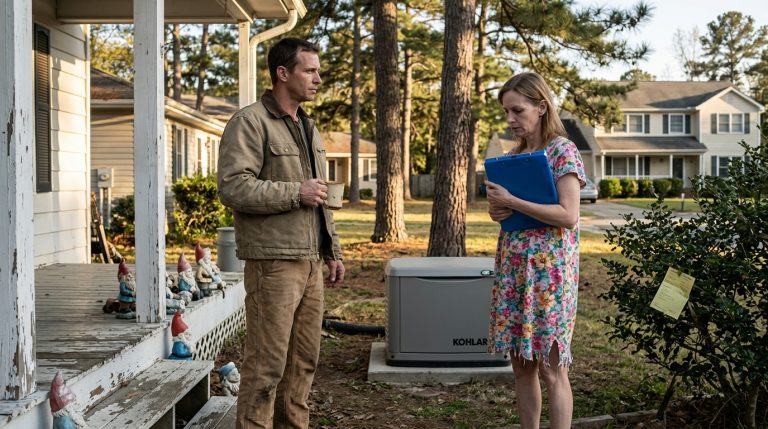
Outside, Cordelia Blackwood stood on the gravel with the rigidity of a statue. She was dressed in a blazer that cost more than my last apartment, her silver hair pulled back into a knot so tight it looked painful. She wasn’t just standing; she was occupying. She had that specific posture of someone who had never heard the word ‘no’ and didn’t expect to start now.
“Thirty days, Mr. Whitmore,” she said, her voice cutting through the silence of the lakefront like a scalpel. “The dock is an eyesore, and more importantly, it is a liability the association is no longer willing to underwrite.”
I rolled the window down an inch. The air was thin, smelling of ozone and the encroaching autumn. “My great-grandfather built this dock when the local government was still trading in dirt roads and spit,” I said, my voice deliberately flat. “It’s been here since 1887. I think it’ll hold until next Tuesday.”
Cordelia didn’t blink. She just tilted her head, a shark sensing a drop of blood in the water. She reached out and tapped the notice on the windshield, the sound sharp as a gunshot. “History is a charming hobby, Ezra. Compliance is a requirement.”
She turned on her heel, her designer loafers crunching rhythmically against the gravel. She didn’t look back as she walked toward her white Escalade.
I looked down at the dock. It was a sturdy, ugly thing of weathered cedar and iron bolts, sinking slightly into the silt at the edge of the 2,100 acres I had inherited. I could see the reflection of the towering pines in the water—dark, jagged shapes.
I picked up the notice again. There was a faint smudge of ink near the bottom of the page, a minor misalignment in the printed logo of the HOA. It was a tiny flaw, a glitch in the perfect presentation.
I felt a cold, familiar calculation start in my chest. If she wanted a war of paper and bylaws, she had chosen the wrong engineer. I looked at the dock, then at the Escalade’s retreating taillights, and realized something that made my skin prickle with a grim, hard thrill.
She had marked the wrong property.
I reached into the passenger seat and pulled out the thick, leather-bound envelope Harold had given me. Inside, the original 1887 deed sat waiting, its edges frayed, its ink still dark and defiant.
I started the engine. The sound was a low, hungry growl in the quiet morning.
CHAPTER 2: The Dust of Precedent
The county courthouse basement did not smell like the law. It smelled like the slow, patient decay of paper—a mixture of dry rot, basement mold, and the sharp, metallic tang of aging iron shelving. I pushed the heavy, brass-bound door open, and the hinges groaned, a sound that seemed to mock the frantic, high-gloss efficiency of the notice I’d left sitting on the dashboard of my truck.
The filing clerk, a woman whose skin had the texture of the vellum she guarded, didn’t look up as I approached the counter. She was engrossed in a ledger that looked older than the building itself. I leaned my hands against the worn wood, feeling the cold grain bite into my palms.
“I need to pull the original property surveys and deed registrations for the Mirror Lake watershed,” I said. “Starting with the Witmore family filings from 1887.”
She looked up then. Her eyes were milky with cataracts, but they were sharp, tracking me with an unnerving precision. “You’re the new owner on the north shore, aren’t you? The one the Blackwood woman is breathing down the neck of?”
I felt a flash of irritation. News traveled fast in a town that was essentially a collection of driveways and fences. “I’m the owner, yes. I’d like to see the files.”
She pointed a gnarled finger toward the back of the stacks. “Third aisle, bottom shelf, red-taped boxes. They haven’t been touched since the drought of ’92. People usually prefer the digital scans, but those are incomplete—missing the riparian annotations.”
I walked into the stacks, the fluorescent lights humming overhead with an angry, oscillating buzz. My boots clicked against the concrete, the sound swallowed by the suffocating density of the shelves. My mind drifted back to a briefing room in Kabul, the dust thick in the air, the tactical maps spread out on a wobbly table. We’d had to account for every gallon of water moving through the valley; one miscalculation could mean a broken levee or a dry village. The memory felt like an intrusion, a ghost of a different life, yet the logic remained the same: water followed the path of least resistance, and I was here to map the terrain.
I found the red-taped box and hauled it onto a nearby table. The dust was thick, coating my fingers in a gray, gritty powder. I opened it, and the scent of the 19th century hit me—a dry, pungent aroma of old ink and animal-hide glue.
The deed wasn’t just a document; it was a blueprint.
I traced the lines of the original survey with my index finger, feeling the indentations in the heavy, yellowed paper. My great-grandfather, Silas, hadn’t just bought land. He had bought a strategic position. The riparian authority wasn’t a standard clause; it was a master-key. He had tied the water rights to the physical maintenance of the spring-fed gate, and he had explicitly blocked any municipal annexation of those rights.
The HOA wasn’t just overstepping; they were attempting to claim authority over a closed system that legally did not exist in their administrative universe.
I looked at the legal description of the lakebed. There, buried in the fine, cramped script of a 19th-century scribe, was the provision for the emergency release. It was a failsafe. If anyone attempted to redirect the flow or levy fees for usage, the deed triggered an automatic revert, effectively draining the association’s ability to claim the water as a ‘community asset.’
It was a trap that had been waiting 139 years to be sprung.
My pulse quickened. The violation notice in my truck was an act of aggression, yes, but it was also an invitation to a fight the HOA could not win. I spent the next three hours photographing every page, the shutter of my phone sounding like a rhythmic, metallic pulse in the quiet basement.
I wasn’t just looking for a defense anymore. I was looking for the lever. By the time I left the courthouse, the sun was low, casting long, sharp shadows across the gravel drive. I walked back to my truck, the weight of the digital evidence in my pocket feeling like a heavy, cold stone.
Cordelia Blackwood wanted to treat the lake like her own personal country club. She didn’t know that the water wasn’t just an amenity. It was a foundation, and I was holding the key to the cellar.
I started the truck, the engine turning over with a steady, reliable rhythm. I pulled out of the courthouse lot and headed back toward the lake, my eyes scanning the road, calculating distances, noticing the way the shadows gathered in the willow groves where the old watergate hidden. The battle lines weren’t drawn on a map in an office; they were etched into the very earth and flow of the property.
She had brought a violation notice to a war.
CHAPTER 3: The Diner Strategy
The rain started as a fine, misting gray curtain that blurred the pines along the lake road into jagged, indistinct shapes. My windshield wipers fought a losing battle against the downpour, creating a rhythmic, mechanical slap that punctuated the silence inside the truck. My phone sat in the cupholder, the screen dark, but I knew the notification would come. They always did when the pressure started to shift.
I pulled into the gravel lot of the local diner, a place that served coffee strong enough to strip paint and food that tasted like institutional necessity. Tommy Reeves was already there. He was hunched over a booth, surrounded by a sprawl of legal pads and folders that looked like a paper storm had stalled over his table. When I walked in, the bell above the door gave a sharp, lonely chime. The place smelled of frying grease and old coffee grounds, a sharp, earthy contrast to the sterile, dusty air of the courthouse.
Tommy looked up. His eyes were wide, the frantic energy of a new attorney vibrating off him like heat off a radiator. He didn’t wait for me to sit.
“Ezra, you’re not going to believe what I pulled from the state records,” he said, pushing a folder toward me before I’d even eased into the booth. “The HOA’s financial disclosures for the last three years—the ones they filed with the state oversight board—they don’t match the internal reports they’ve been circulating to the residents. They’ve been cooking the books, and they aren’t even being subtle about it.”
I opened the folder, my fingers damp from the rain. The numbers were staggering. It was the same shell game I’d seen in the army, used to skim funds from construction contracts in regions where no one cared to look. Here, in the quiet, affluent sprawl of Mirror Lake, it was brazen.
“It’s not just embezzlement,” I said, my voice low, scanning the columns of misallocated funds. “It’s a deliberate strategy to manufacture a deficit. They want to drive the property values down so they can force a special assessment, squeeze out the old-timers, and then consolidate the land for that development deal.”
Tommy leaned back, his face tight. “If we take this to the local prosecutor, it’ll die on the desk. You know the sheriff is in Cordelia’s pocket. But the state board? They’re looking for a scandal. They’re looking to make an example of an association that’s been overstepping its mandate.”
Before I could respond, my phone buzzed. A text from an unknown number: Emergency HOA meeting tonight. Mandatory attendance. Rogue property owner situation.
I turned the screen toward Tommy. He stared at it for a long, quiet second, then a slow, predatory grin spread across his face—a look I recognized from my time in the engineering corps, the look of a man who realized he’d just found the structural weak point in a dam.
“They’re panicking,” he said, his voice a whisper. “Calling an emergency meeting in this weather? They’re trying to force a vote before we have time to organize. They want to paint you as the aggressor, frame you as the ‘environmental hazard’ to justify a summary action.”
“Let them,” I said, feeling the cold, hard logic of the situation lock into place. “If they try to force a vote without proper notice or legal basis, they’re creating a record of procedural abuse. Every move they make tonight is an exhibit for our counter-suit.”
The rain outside intensified, drumming a frantic, irregular beat against the diner’s plate-glass window. I thought about the watergate valve I’d seen earlier that day—the way the old, cast-iron handle had turned under my hand, smooth and precise. The machinery of this fight was just as old and just as reliable. It was about torque, about pressure, about knowing exactly where to apply the force to break the stalemate.
Suddenly, my watch vibrated. A sensor alert from my phone—one of the remote monitors I’d tucked into the marshy bank near the overflow channel. The water pressure in the secondary feed was dropping. Someone was playing with the valves, trying to force a localized drainage to ‘prove’ the lake level was unstable.
“They’re starting,” I said, standing up. The chair screeched against the linoleum.
Tommy looked at his watch, then up at me. “They’re trying to manufacture the emergency, aren’t they?”
“They’re trying to stage the crime scene,” I corrected, grabbing my coat. The air outside was colder now, the scent of damp earth and rust heavy in the wind. “But they don’t know the system. They think the lake is just an asset. They don’t know it’s a machine.”
We stepped out into the downpour. The sky was an iron-gray, and the lake, visible through the trees in the distance, was churning with the sudden, erratic current. The fight wasn’t just in the legal documents anymore. It was physical. It was tactical. And for the first time in six months, I didn’t feel like a guy trying to rebuild a life that had gone wrong. I felt like an engineer in the middle of a build, the blueprint clear in my mind, the materials ready to be laid.
We got into my truck, the engine roaring to life with a defiant, throaty sound that cut through the hiss of the rain. The road ahead was narrow, winding, and lined with trees that stood like sentinels in the dark. Cordelia Blackwood wanted an emergency meeting? She was about to get an education in structural integrity.
CHAPTER 4: The Emergency Meeting
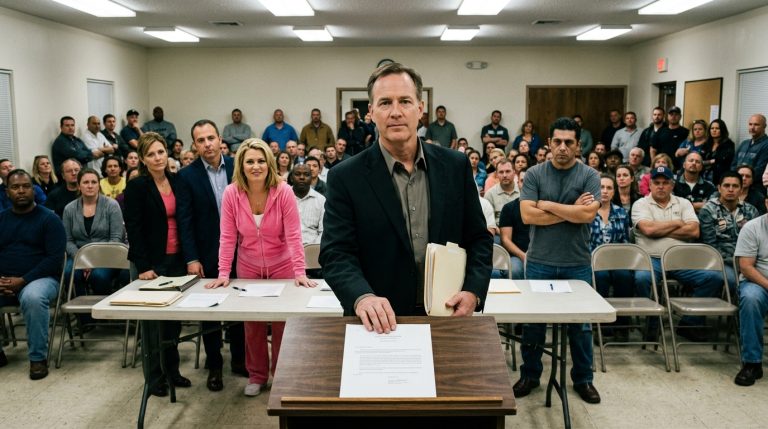
The community center lobby was a study in artificiality. It was bathed in the harsh, flickering glare of fluorescent tubes that made everyone’s skin look jaundiced and tired. The air was heavy, clinging to the back of my throat with the scent of industrial floor wax and stale, recycled air. Tommy and I pushed through the double doors, and the sound of dozens of folding chairs being shifted across the linoleum greeted us like a low, discordant hum.
Inside, the room was packed. It wasn’t the kind of attendance that suggested a routine administrative gathering. People were standing in the back, leaning against the walls, their faces tight with a mix of genuine worry and controlled anger. And then there was the board, arrayed at the front of the room like a row of judges. Cordelia Blackwood sat in the center. She was impeccable—a silver-haired statue in a navy blazer that looked armored against the chaos she had invited. She was busy consulting with a man in an expensive gray suit whom I didn’t recognize, his posture radiating the smug, practiced confidence of a corporate attorney.
We made our way to the back row, moving through the thick atmosphere of skepticism. I scanned the room, noting the faces. There were the Martinez family, huddled together near the emergency exit, looking tired; Mavis Lane, her eyes burning with a sharp, alert fire; and a handful of the “McMansion” set, sitting in the front rows, their expressions somewhere between indignation and confusion.
Something didn’t fit. I looked at the seating chart posted on the corkboard near the entrance—a list of “authorized attendees” that felt calculated. A deliberate, jarring discrepancy caught my eye: there were three names on the official HOA sign-in list that I knew for a fact had sold their properties months ago.
“Look at the sign-in list, Tommy,” I whispered, nudging him. “Ghosts. She’s padding the quorum.”
Tommy glanced at the list, his eyes narrowing. “She’s manufacturing a majority. If she can declare a quorum with phantom owners, she can bypass the voting bylaws entirely.”
“Exactly,” I said. My pulse settled into a cold, steady rhythm. The tactical exhaustion I’d felt earlier in the rain began to sharpen into focus. It was the engineering perspective: you don’t fight a flood by building a wall; you fight it by identifying where the pressure is being forced and then opening the relief valve.
Cordelia stood up, the chair scraping sharply against the floor—a sound that silenced the room instantly. Her voice, when she spoke, was polished and practiced, stripped of the jagged edge she’d shown me earlier.
“Ladies and gentlemen,” she began, her gaze sweeping the room with a practiced, practiced warmth that didn’t reach her eyes. “We are here tonight because of a threat to our community’s standards and safety. An unauthorized individual has been conducting independent water management operations that jeopardize the stability of Mirror Lake.”
She didn’t look at me directly, but I felt the weight of her performance pressing down on the room. The man beside her stood, taking the floor with a slow, deliberate grace.
“I am Marcus Pembroke, an environmental consultant,” he stated. He began to project a series of images onto the screen behind him—blown-up, high-contrast photos of my dock, the weathered cedar and iron hardware looking sinister and broken under the clinical magnification. “My team’s assessment indicates that these structures are, in fact, destabilizing the shoreline and creating potential for severe environmental damage.”
The murmurs began—a low, rising tide of confusion and fear. I saw people in the front rows nodding, their heads tilted toward Cordelia’s stagecraft. It was well-planned. It was a masterpiece of manufactured panic.
I stood up, the sound of my chair moving barely audible in the tense, expectant quiet. “Point of order,” I said, my voice cutting through the hum of the fluorescent lights.
The room froze. Cordelia’s hand stopped mid-gesture. She turned toward me, her eyes hardening into glass.
“Mr. Whitmore,” she said, her voice dropping into a register of patronizing calm. “This is a closed session for association members and invited guests. You are currently in violation of community safety protocols.”
“I’m an owner,” I replied, standing my ground. “And I’m here to discuss the procedural violations in your emergency declaration. Specifically, the illegal padding of your attendance list and the complete lack of a formal environmental impact study. Your consultant is using a hobbyist’s assessment to justify a power grab that has no legal standing.”
The room erupted. I saw Mavis stand up, her voice rising above the fray. “Why were we never notified about the lakefront development project, Cordelia? And why is the HOA reserve fund down to three months of expenses?”
The shift was instantaneous. The fear in the room began to curdle into something far more dangerous: suspicion. Cordelia’s mask twitched, a hairline fracture appearing in the perfection of her face. She looked at her attorney, then back at me, her eyes searching for a move I hadn’t yet made. But I had the records. I had the shell companies, the false audits, the entire architecture of her failure.
I looked at the light above us, the way the glare caught the edge of Cordelia’s blazer. She was the one who had built this structure. She was the one who had banked everything on the idea that the community was too frightened to look at the foundations.
She was wrong.
CHAPTER 5: The Regulatory Raid
The community center had devolved into a microcosm of civil war. On the floor, the orderly rows of folding chairs were being shoved aside, and the air was thick with the scent of cheap plastic and adrenaline. My standing position felt like the eye of a hurricane. Cordelia’s attorney was leaning in, his voice a low, steady drone of legal threats, while Mavis Lane was shouting over the din, her voice surprisingly strong, demanding to see the financial ledger.
I didn’t wait for the debate to resolve itself. I walked toward the back of the room, my focus narrowed down to the small, unassuming equipment cabinet where the HOA’s local server hub was housed. It was the heart of the “emergency” monitoring system they’d used to justify the harassment.
Tommy followed me, acting as a buffer, his suit jacket rumpled, his eyes scanning the periphery for any move by the HOA board. “They’re trying to call the sheriff, Ezra,” he muttered, his voice barely audible over the shouting match unfolding at the front. “We have maybe three minutes before they shut us down.”
I reached the cabinet and pried it open with a flathead screwdriver I’d kept in my back pocket. The smell hit me instantly: hot, ozone-tinged air from overworked circuit boards. The server was humming, its LEDs blinking in a frantic, erratic pattern. I hooked up my laptop, the interface screen reflecting the dim, flickering light of the room.
The files were there. Not just the official audits, but the internal “maintenance” logs.
My hands, for a fleeting second, felt a tremor—not from fear, but from the raw, kinetic realization of what I was looking at. Every single violation report filed against the long-term residents was cross-referenced with a specific, unauthorized withdrawal from the HOA reserve fund. It wasn’t just incompetence; it was a catalog of human cruelty. They had systematically manufactured the poverty of the families they wanted to push out, using their own money to fuel the machinery of their displacement.
Click. I initiated the mirror, the progress bar a thin, glowing blue line that felt agonizingly slow.
“Ezra, move,” Tommy hissed.
I looked up. The sheriff’s deputy was standing at the main entrance, his duty belt heavy, his hand resting near his radio. He wasn’t rushing; he was walking with the slow, deliberate pace of a man who’d already been told who to arrest. He looked straight at me, his gaze locking with mine.
I yanked the drive free just as the deputy started toward us. The plastic casing of the server cabinet groaned under the pressure. I stuffed the drive into my inner pocket, the cold weight of it against my chest like a brand.
“The records are copied,” I said, catching Tommy’s eye. We turned and moved toward the side exit, my movements precise, calculated. I didn’t run. Running was an admission of guilt. We navigated the edge of the crowd, avoiding the swirling center of the shouting match, and slipped through the emergency door into the cool, biting bite of the night.
The rain had stopped, but the ground was slick, and the air smelled of damp earth and the oncoming frost. The parking lot was a graveyard of cars, their dark shapes looming in the pale, sickly light of the streetlamps. I didn’t stop until we reached the shadow of my truck.
I leaned against the hood, my breath hitching in the cold air. The tremor in my hands returned, more violent this time, a physical manifestation of the adrenaline that was beginning to drain away. I stared at the dark building, the muffled sound of the meeting still audible—a confused, angry chorus.
“You got it?” Tommy asked, his voice shaking.
I patted my pocket. “I got it.”
I looked down at my hand. A jagged piece of the server’s plastic housing had cut into my palm. A single, dark drop of blood welled up, a bright, visceral contrast to the dull, gray asphalt. It felt absurdly real compared to the digital ghost I’d just stolen.
We were in the middle of a war, but we were fighting on ground they didn’t even realize was being compromised. The sheriff was coming, the HOA would double down, and the legal threat was only beginning—but the information in my pocket was the lever that could tilt the entire county on its axis.
I started the truck, the headlights cutting a sharp, clinical path through the dark. We pulled out of the lot just as the deputy reached the doors. I didn’t look back. The mission wasn’t just to survive the night; it was to ensure that by dawn, the leverage would be absolute.
CHAPTER 6: The Easement Trap
The drive back to the house was a blur of high-contrast shadows and sweeping wipers. Every time I hit a pothole, I felt the sharp, physical reminder of the drive in my pocket. Tommy sat in the passenger seat, staring out into the dark, his face illuminated by the intermittent flash of power lines swaying in the gale. He was silent, but his hands were gripping the armrest with a rigidity that mirrored my own.
We turned onto the gravel drive, the tires biting deep into the softened earth. The house was dark, a jagged silhouette against the storm-bruised sky. I pulled to a stop near the dock, but I didn’t kill the engine. I let it idle, the vibration a low-frequency hum that seemed to match the tension in the air.
“If we drop this at the state board’s office tomorrow morning, she’s done,” Tommy said, his voice quiet, almost fragile. “But if she catches us before then, if she realizes we have the internal server mirrors, she’s not going to play by the rules. She’s going to escalate.”
“She’s already escalated,” I said. I looked out at the lake. It was a vast, black expanse, invisible except for the occasional flicker of whitecaps. “She thinks this is a fight about a dock. She thinks this is a fight about water access. She has no idea what’s actually buried in the land records.”
I stepped out into the rain. It was colder now, a biting, autumnal chill that cut through my jacket. The smell of the lake—damp, mineral-rich, and ancient—was overwhelming. I walked toward the dock, the wood slick and uneven under my boots.
Halfway down, I stopped.
There was a shadow, deeper than the rest, standing near the pilings of the great-grandfather’s dock. It was a person, perfectly still, watching the water. My hand drifted to the flashlight on my belt, but I didn’t turn it on. I knew that posture. It was Cordelia.
She wasn’t in her designer blazer tonight. She was wrapped in a heavy, oversized raincoat, her silver hair plastered to her forehead by the downpour. She looked small, diminished, like a stage performer caught in the wings without her costume.
I didn’t call out. I just walked toward her, the sound of the rain masking my approach until I was ten feet away.
“You’re trespassing, Cordelia,” I said.
She turned. Her face was pale, the skin around her eyes tight, drawn with a kind of brittle exhaustion that made her look ten years older. She wasn’t holding a weapon. She was holding a stack of laminated maps—the same ones she’d projected at the meeting. They were soaked, the ink bleeding into the paper, transforming the sharp, precise lines of her development plan into illegible, dark smudges.
“I grew up here,” she said. Her voice wasn’t the sharp, commanding blade she’d wielded at the podium. It was thin, frayed, like a wire near its breaking point. “Before the mansions, before the HOA, before the lawyers. My father worked this lake. He used to say that if you held the water, you held the world.”
She gestured toward the lake, a sweeping, frantic motion. “You think you’re a hero, Ezra? You think you’re protecting some grand, noble legacy? You’re just a contractor who got lucky with a piece of paper. You have no idea what it takes to actually keep a place like this from rotting.”
“I know what it takes to keep it from being stolen,” I replied.
“Stolen?” She let out a sharp, jagged laugh. “I was saving it. Every dollar I moved, every parcel I optioned—it was for the project. For the infrastructure, the sewage, the erosion control. This place is dying, and no one wanted to pay for the cure.”
I felt a flash of cold, clinical clarity. She was in deep. She had convinced herself that the embezzlement was a necessary tax for the survival of the vision. It was the same pathology I’d seen in officers who thought they could justify burning a village to save a map coordinate.
“The cure you’re selling is a foreclosure on everyone else’s home, Cordelia,” I said. “And the sheriff is coming for you, not for me.”
She looked at me, and for a second, I saw the terror underneath the arrogance. She wasn’t looking at a threat; she was looking at a mirror. “You don’t understand,” she whispered. “If they find the books, it’s not just the HOA. It’s the bank, the developers, the zoning board. They all have their hands in it. You destroy me, you destroy the entire foundation of this county.”
“Maybe it needs to be destroyed,” I said.
A low, vibrating rumble echoed across the water—a mechanical moan from the lake’s depths. It was the watergate. The sensor network on my phone buzzed, a red notification flooding the screen: Critical Failure: Unauthorized Valve Manipulation.
Someone—one of her contractors, or maybe the man in the gray suit—was trying to force the gate. The water pressure was spiking, the weight of a million gallons of water surging against an iron gate that hadn’t been serviced in decades.
Cordelia’s eyes widened. She wasn’t just talking anymore; she was listening. “They’re moving,” she said, her voice turning clinical. “They’re going to drain the basin to ‘expose’ your illicit modifications. They’re going to ruin you before the sheriff ever arrives.”
I looked at the gate, the faint, silver glint of the iron handle visible through the mist. The lake wasn’t just a machine; it was a trap, and it was about to be triggered. I turned back to the house, toward the garage where the hydraulic tools and the override keys were kept.
“Stay here,” I commanded.
“I can’t,” she said, her voice hardening again, the tyrant reasserting itself. “I’m the only one who knows how to calibrate the secondary pressure valves. If that gate blows, the entire shoreline goes with it.”
She was bluffing, or maybe she was terrified. I didn’t care. I started to run, my feet pounding on the gravel, my lungs burning with the cold air. The game had stopped being about documents. It was about physics now, and I had exactly enough time to reach the gate before the pressure hit the breaking point.
CHAPTER 7: The Reckoning at the Gate
The grove of willows was a tangled, claustrophobic mess in the dark, the branches whipping against my face like skeletal fingers. I didn’t slow down. My boots found purchase in the slick, muddy slope that led down to the overflow channel. The roar of the water had changed; it wasn’t the steady, rhythmic pulse of a healthy spring-fed system anymore. It was a chaotic, thundering churn, the sound of a system being tortured into failure.
I reached the watergate valve, the ancient iron structure looming out of the dark like a piece of rusted sculpture. Cordelia was right behind me, her breathing ragged, her coat snagging on the brush. She stumbled, falling to her knees in the wet muck, but she scrambled up with a desperate, frantic intensity.
“The secondary bypass,” she gasped, pointing to a smaller, secondary wheel nestled behind the main gate’s housing. “If the main pressure blows, the whole channel will scour the foundation. You have to turn it clockwise—four full rotations—to equalize the flow before you touch the main wheel.”
I ignored her, dropping to my knees beside the main valve. The iron was freezing, covered in a thin, slick film of algae and rust. I grabbed the wheel with both hands and heaved. It didn’t budge. It was seized, locked tight by a century of oxidation and neglect.
“You’re going to shear the bolt!” Cordelia screamed, her voice cracking. She lunged forward, her hands clawing at the wheel, trying to help me, but she was useless, her movements frantic and uncoordinated.
I shoved her aside, the memory of the Kabul breach flashing white-hot behind my eyes—the way the pressure had felt against the breaching charges, the weight of the water, the sheer, indifferent force of it. I reached for the heavy pipe wrench I kept in my tool belt.
Clang.
The impact of the wrench against the iron handle vibrated up my arm, numbing my fingers. I locked the wrench onto the rim of the valve and put every ounce of my weight into the turn. The metal groaned—a long, agonizing shriek of tortured iron. I felt the valve seat give, a sudden, microscopic shift that sent a shudder through the entire housing.
“Keep turning,” Cordelia whispered, her face inches from mine, her eyes wide, reflecting the erratic flash of lightning from the retreating storm. “If you stop now, the backpressure will shatter the housing. You have to open the relief spillway.”
I didn’t need her instruction. I could feel the physics of the system through the wrench—the massive, incompressible weight of the water demanding an outlet. I swung the wrench again, the rhythm of the work taking over. Each movement was a calculated release, a slow, grueling dance of torque and friction.
The gate began to move.
A high-pitched whistle erupted from the seals, a sound like a screaming woman, and then, with a heavy, final thud, the valve seat cleared. A torrent of water—dark, turbulent, and cold—erupted from the spillway, spraying us both in a freezing, stinging mist. The pressure in the main channel dropped instantly. The roar of the water softened, returning to the steady, rhythmic pulse of a regulated flow.
I slumped back against the muddy bank, my hands shaking so violently I couldn’t hold the wrench. I was drenched, shivering, and covered in rust-stained sludge.
Cordelia sat in the mud, her expensive coat ruined, her hair a wild, silver halo in the dark. She stared at the spillway, her expression empty. The adrenaline had vanished, leaving only a hollow, brittle silence in the wake of the storm.
“You saved it,” she said, her voice barely audible. “You actually saved the damn system.”
I looked at her, and for a moment, the antagonism felt distant, stripped of its power. We were just two people huddled in the mud, breathing in the smell of wet iron and survival. But then, the low, steady sweep of headlights cut through the grove.
Blue and red light flickered against the trees.
The sheriff’s cruiser had reached the access road.
“They’re not here for the gate, Cordelia,” I said, standing up. My knees were stiff, aching with the cold. “They’re here for the audit.”
She didn’t run. She didn’t argue. She just looked at her hands—stained with the same red rust that covered the valve. “I suppose I knew they were coming,” she said. “I just didn’t think it would be tonight.”
I picked up my wrench, wiped the grit from the handle, and started the long, slow climb back up to the road. The fight was over. The physical machinery of the lake was stable, but the much larger, much colder machinery of the law was just beginning to turn. And as I reached the gravel drive, I knew that tomorrow, the lake wouldn’t belong to the HOA, or the developers, or the ghosts of 1887. It would finally, for the first time in a long time, just be water.
CHAPTER 8: The Weight of Ownership
The sun broke over the ridgeline two hours later, cutting through the retreating storm clouds with a clinical, unforgiving light. The lake was still, a polished mirror of dark water that betrayed none of the violence of the night. Cordelia was gone—led away in the back of a cruiser, her silhouette a small, diminished shape against the flashing blue lights. The scene was abandoned now, save for the lingering scent of wet rust and the distant, rhythmic chirping of birds beginning to reclaim the grove.
I stood by the watergate valve, the heavy iron handle still slick with rain. My hands were stiff, the skin torn and stained with grease, but the tremor was gone. I looked down at the relief spillway I had forced open—a deep, jagged cut in the earth that had saved the shoreline from a catastrophic blowout. It looked raw, a fresh scar on the landscape that had been there for over a century.
Tommy pulled up in his car, the engine quiet, and stepped out. He looked exhausted, his tie missing, his shirt wrinkled and damp. He didn’t speak. He just walked up beside me and looked out over the water.
“They found the drive,” he said. “The state attorney general’s office took the evidence at the station. They said it’s more than enough. The fraud, the embezzlement, the development collusion—they have enough to bury not just Cordelia, but half the board and the developers who were bankrolling her.”
I nodded, the weight of it settling in my chest. “What about the deed?”
Tommy pulled the heavy, leather-bound envelope from his bag. It looked small in his hands, fragile compared to the massive, sprawling reality of the corruption we had just dismantled. “They validated the riparian clause this morning. Silas Witmore’s 1887 document isn’t just a title. It’s a governing instrument. Because the HOA never registered the pre-existing rights, they legally ceded control of the entire watershed to you when they incorporated.”
I took the envelope, the paper heavy and cool. “So, I’m the water king,” I said, a bitter, hollow note to the irony.
“You’re the steward,” Tommy corrected. “That’s what the deed actually says. The Riparian Authority clause wasn’t meant for extraction; it was meant for protection. Your great-grandfather didn’t buy the lake to control it; he bought it to keep it from being subdivided. He wrote the failsafe into the deed to ensure that if anyone ever tried to monetize the flow, the rights would automatically snap back to the owner—who was legally bound to keep the water access free.”
I looked out at the water, the sunlight catching the ripples. The absolute truth of it hit me with a force that left me breathless. Cordelia had been fighting a ghost. The power she had been so desperate to steal, the leverage she had been willing to burn her entire life to acquire, had been designed from the start to be impossible to possess. She had been chasing a shadow, and in her desperation to seize it, she had ensured her own erasure.
The final payoff was quiet. The developers were already pulling their equipment from the north shore, their investment neutralized by the sudden, indisputable legal blockade of the water rights. The poetic justice wasn’t in Cordelia’s handcuffs; it was in the silence of the forest, the fact that the lake would remain exactly as it was, unmarred and unbought.
I took the wrench from my belt and walked to the valve housing. I spent the next hour cleaning the rust, oiling the gears, and resetting the pressure locks. It was the work I had been trained for—maintenance, stability, the quiet, repetitive labor of keeping a complex system from failing.
When I finished, I sat on the damp grass of the bank. The sun was fully up now, warming the back of my neck. I looked at the wrench—a heavy, utilitarian tool that had helped me dismantle a life. I placed it in the toolbox on the back of my truck, and for the first time in months, I didn’t reach for my phone or check the news.
I walked to the dock. I pulled a splintered section of cedar planking from the decking—the only piece that had been truly compromised by the storm—and began to sand it down with a block of coarse paper I found in the tool kit. The friction was rhythmic, soothing. I worked until the wood was smooth, then fitted it back into place, securing it with a new, galvanized bolt.
It was a small repair, a tiny, insignificant detail in the scope of what had happened, but it was mine.
“You going to sell?” Tommy asked from the truck, his voice hesitant.
I looked at the water. I saw the reflections of the pines, the way the light danced on the surface, the enduring, cold, steady presence of the lake that had seen off empires and would see off me.
“No,” I said, the word settling into the quiet. “I think I’ll stay. There’s a lot of work to do.”
I leaned back on the dock, the wood warm and solid beneath me. The war was over. The tyranny of the clipboards and the contracts was gone, replaced by the simple, enduring reality of the earth and the water. I closed my eyes and let the sound of the wind through the pines become the only thing that mattered.