The Bitter Iron of Miller Ridge: A Veteran’s Defiance Against the Creeping Suburban Machine
CHAPTER 1: THE BOUNDARY LINE
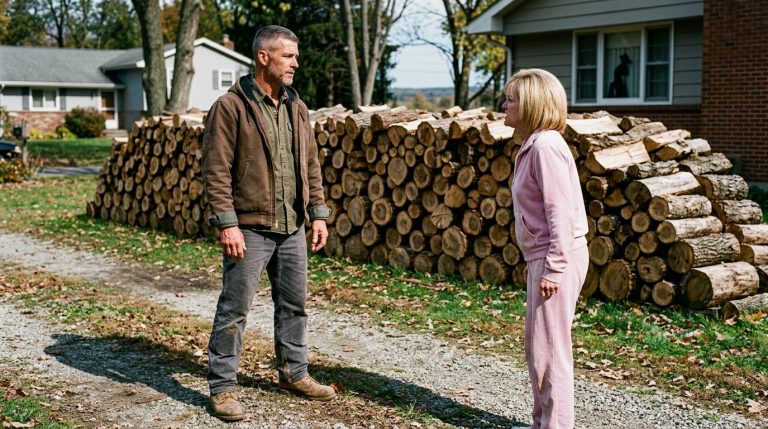
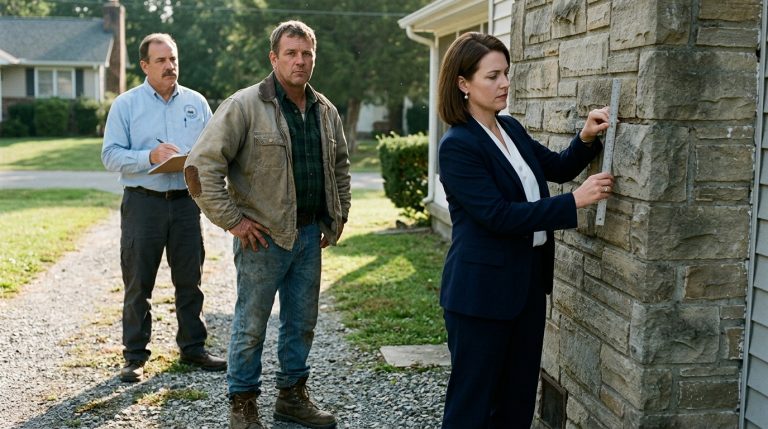
The words hung in the crisp autumn air, colder than the October wind that was rustling the last of the dead oak leaves across my gravel driveway. I didn’t shift my weight. I kept my hands buried deep in the pockets of my worn Carhartt jacket, the fabric stiff with grease and dried mud, feeling the cold brass rivets bite into my knuckles. I stared straight ahead at the woman who had just uttered the threat.
Her name was Karen Thorne. She was the president of the Oakridge Estates Homeowners Association, and she was shaped like a low-slung bulldog, topped with a perfectly quaffed helmet of blonde hair that stayed frozen despite the steady northern breeze. Her index finger was extended, a meticulously manicured spike pointed past my shoulder toward the hundred acres of dense timber and rolling bramble that stretched out behind my house. That land had belonged to my family since the county was nothing but surveyor stakes and mud.
To her, the woods were an untidy backyard lowering the property values of her sterile Eden. She stood squarely on the pristine asphalt of her side of the line—the community road that marked the border between her manicured kingdom and my ancestral dirt. The entitlement radiating from her was a physical weight, thick enough to clog an engine filter.
She had caught me out here while I was using a pair of rusted fencing pliers to check the tension on a fresh length of four-point barbed wire. Her electric golf cart had whined to a halt just three feet from my property line, a silent, battery-powered harbinger of bureaucratic war. The issue, she had spat, was the upcoming deer season. I had contracted to lease a secondary ridge to a small group of guys I used to serve with—bow hunters who knew how to treat the timber with respect. To Karen, this was equivalent to establishing a live-fire artillery range next to a school sandbox.
The sheer absurdity turned my stomach. Her subdivision was a collection of beige McMansions built barely ten years ago on acres bought from a bankrupt dairy farmer. My homestead predated the local government. My land wasn’t part of her association; it didn’t answer to her dictates on lawn height, and it didn’t require her permission for the color of a mailbox. Yet, looking into her bloodless, thin-lipped expression, I realized she didn’t care about geography. She viewed proximity as immediate jurisdiction.
“The fines begin on Monday, Mr. Miller,” she added, her voice dropping into a flat, transactional drone as she tapped a heavy leather binder resting on her lap.
I didn’t answer. I let the silence stretch out between us, long and heavy, the way my old platoon sergeant taught me to hold it when assessing a hostile position. I watched her eyes. For a fraction of a second, just behind the glare of her designer sunglasses, the confidence wavered. A small flicker of uncertainty crossed her brow before the mask of suburban authority slammed back down.
She had overplayed her hand. She thought she was dealing with a tired civilian trying to protect a hunting spot. She had no idea she had just initiated a campaign against twenty years of combat engineering experience.
Silently, I noticed a tiny detail—a gold-leaf emblem on the corner of her binder that didn’t match the county logo. A small physical discrepancy, out of place for a standard municipal warning. It bore the stamp of the Madison County Acquisition Fund, an defunct government entity my grandfather had negotiated with decades ago.
I kept my face expressionless as she turned the key, the golf cart whining softly as she retreated back toward the beige horizon. The war had officially begun.
CHAPTER 2: THE FIRST SALVO
The high-frequency whine of the electric motor took a long time to bleed out of the valley. I stood there on the edge of the county road, the heavy iron fencing pliers still balanced in my right hand, their cross-hatched jaws cold against my palm. The dust kicked up by Karen’s low-profile tires hung in the damp air like a dirty gray veil, settling slowly onto the goldenrod and the rusted lower strand of barbed wire. I didn’t move until the sound of her retreat was completely swallowed by the steady, hollow sigh of the wind through the pines.
When the silence returned, it felt heavier, packed with the dense friction of an impending storm. My boots ground into the flinty gravel as I turned back toward the house. I didn’t rush. Out here, rushing was how you dropped a tool or misjudged a step on a rotten root. I walked the hundred yards back up the driveway, my eyes tracing the clean, straight timber of the barn, the graying cedar shingles of the homestead, and the ancient, knotted maples that kept the western wind off the porch.
Three days passed in that deceptive, quiet suspension. I spent them working the timber, clearing the secondary ridge of fallen poplars with the chainsaw, the smell of bar grease and wet pine sawdust filling my throat. But the silence didn’t soften. Every time I reached the eastern boundary, where the meticulously mowed rye grass of Oakridge Estates met the rough, bramble-choked edge of my family’s woods, I felt the phantom weight of her stare. They were watching.
On Thursday, the mail carrier’s truck didn’t just rattle past my box; it stopped. The metallic thwack of the lid shutting echoed up the hill.
I walked down the gravel path, the dry earth crunching under my soles. Inside the rusted tin box sat a single envelope. It didn’t look like the utility bills or the farm supply catalogs that usually found their way out here. It was oversized, made of thick, cream-colored stock that felt slick and synthetic under my calloused thumb. In the upper left corner, embossed in a faux-gold foil that caught the harsh midday light, was the crest of the Oakridge Estates Homeowners Association.
I carried it back to the porch, sitting on the top step where the wood was still warm from the sun. I didn’t tear it open. I used the small blade of my pocketknife to slice the top seam with clean, deliberate friction.
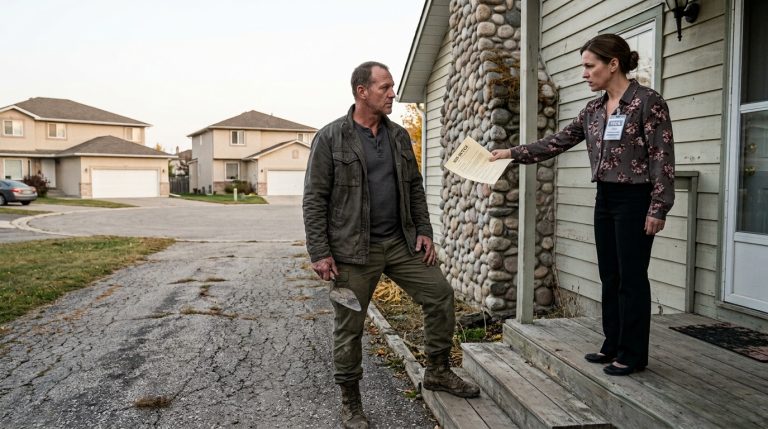
Inside was a single folded sheet of matching heavy paper, dense with legal jargon. My eyes bypassed the boilerplate preambles and locked onto the core of the text. It was a formal Notice of Covenant Violation. The words were constructed like a cage: …conducting a commercial enterprise incompatible with community standards. It cited Subsection 12-B of their internal bylaws, assigning a mandatory fine of five hundred dollars, with an additional one hundred dollars accruing for every twenty-four hours the violation remained active.
At the bottom of the page, printed in a neat, computerized font, was a specific identification: Respondent Property ID: MP-1889-04A.
My thumb traced the inked numbers. That prefix—MP-1889—was a detail that didn’t belong in a modern neighborhood directory. It was a direct, bastardized reference to the Madison Patent, the original land grant my family had held since the territory was chartered. Karen’s board hadn’t just looked up my address; they had actively searched the county’s digital index, using our historical identifier to manufacture an administrative link that didn’t exist. They were trying to build a paper bridge over my boundary line, dragging my ancestral soil into their private court of regulations.
Beside the document, on the rough oak table inside the kitchen where I laid the envelope down, the contrast was sharp. The gold-embossed paper looked flimsy and pretentious against the deep, oil-rubbed grain of the timber my grandfather had planed by hand. This was their opening play—not a physical assault, but a bureaucratic encirclement. They wanted to bury me in manufactured debt until the friction became too expensive to fight.
I reached for my coffee mug, the dark, bitter brew lukewarm against my tongue. I didn’t feel the heat of anger; I felt the cold, familiar alignment of a tactical problem. I opened the drawer beneath the table, pulling out a fresh manila folder. On the tab, using a black felt-tip marker, I wrote two words: Project Nightingale.
It was time to see how deep their foundations were actually poured. I folded the notice back into its cream envelope, slid it into the folder, and listened to the steady, rhythmic tick of the grandfather clock in the corner. The first shot had been fired, but they had aimed at the wrong target.
CHAPTER 3: THE ARCHIVE DUST
The heavy iron handle of my F-250’s door was cold, its latch releasing with a sharp, mechanical clunk that broke the quiet of the yard. I climbed inside, the worn vinyl seat cracking slightly under my weight as I turned the key. The diesel engine caught with a throaty, rhythmic rumble, vibration pulsing through the steering wheel and straight up my forearms. I didn’t back down the drive until the oil pressure needle settled into its proper notch.
The fifteen-mile drive into town was a study in changing textures. To my left, the dense, unyielding oak canopy of my family’s land stood thick and dark, a wall of weathered trunks that had filtered the wind for a century. To my right, the geometric, pastel-colored rooftops of Oakridge Estates sat behind their engineered retaining walls, their uniform vinyl siding looking like a plastic barrier trying to hold back the wild timber.
I parked in the gravel lot behind the old county administration building. The structure was a low-slung chunk of limestone built in the late fifties, its exterior blocks pitted by decades of acid rain and stained with dark streaks of coal dust near the foundation. I walked up the concrete steps, my work boots scuffing on the grit that had collected in the corners of the landing.
Inside, the air was still and smelled of damp paper, old floor wax, and the faint, sweet tang of heating oil. It was a space where time seemed to slow down, preserved under the low hum of ancient fluorescent ballast tubes. Behind the high, dark-stained wooden counter sat Marge, her spectacles hanging from a beaded chain around her neck, her gray hair pulled back in a tight, sensible bun.
She looked up, her expression softening into a slow, knowing smile as she recognized the set of my shoulders. “Jack Miller,” she said, her voice carrying the dry, comfortable rasp of someone who had spent thirty years whispering in these halls. “You look like you’re on a mission. Don’t tell me you’re finally selling off that ridge.”
“Not a chance, Marge,” I replied, leaning my forearms against the cool, polished oak of the counter. The wood beneath my sleeves was worn smooth by thousands of hands before mine. “Just the opposite. I’m checking the foundation.”
I pulled the manila folder from under my arm and slid the gold-embossed notice across the wood. She didn’t need to read the whole thing; her eyes locked onto the header and the manufactured property ID number at the bottom. Her lips thinned into a hard line, the smile vanishing.
“Oakridge Estates,” she muttered, shaking her head. “They’ve been in here three times this month, checking tax maps and asking about public utility easements. They think because they have a fancy gate, they own the whole valley.”
“I need to see the original plat maps for Section 4,” I said, my voice quiet but steady. “And the deed history for the public parcel adjacent to their eastern line. The five acres they’re calling Founders Green.”
Marge raised an eyebrow, a flicker of appreciation crossing her weathered face. “The old park. Give me ten minutes, Jack. The leather binders for that section are down in the vault.”
She disappeared through a heavy steel door behind the counter, the latch clicking shut with a solid, metallic ring. I waited in the quiet room, the sound of my own breathing the only noise against the steady hum of the microfilm readers in the corner. My fingers traced the worn edge of the wooden counter, feeling the grain, the places where the varnish had chipped away to reveal the raw, dry wood underneath.
When she returned, she was carrying a massive, leather-bound ledger that looked like it weighed thirty pounds. The cover was scuffed, the dark brown hide peeling at the corners, showing the gray board underneath. She laid it on the high counter with a heavy, muffled thud that sent a tiny puff of ancient dust into the air.
“Here’s the original record of survey,” she said, flipping the thick, yellowed pages with practiced care until she reached a large, fold-out map. “And the original land patent.”
I leaned over the page, my hand hovering just above the paper. There it was—the Madison Patent, dated 1889, its borders drawn with thick, black india ink that had faded to a dark, rusty brown over the last hundred and thirty years. The lines were clean, defined by surveyor chains and stone monuments.
And there, slicing through the eastern portion of our old boundaries, was the neat, sterile grid of the Oakridge subdivision. But my eyes didn’t stay on the residential lots. They tracked down to the five-acre rectangle marked Parcel 5B.
I turned the page to the deed of gift, dated 2004, bearing my grandfather John’s strong, angular signature at the bottom. The ink was dark, pressed deep into the paper by a steady hand. My eyes scanned the dense legal text, navigating the old-fashioned phrasing until they hit the section titled Covenant Clause 5B.
My pulse did not jump, but a cold, hard clarity settled into my chest as I read the words: …to be held in perpetuity as a public park for all residents of Madison County, without prejudice or restriction. And below that, in even smaller print, the reversionary clause: Should the grantee or any successor in interest attempt to restrict, exclude, or otherwise privatize access to said parcel, title shall immediately and ipso facto revert to the grantor or his legal heirs.
I looked up from the page, my eyes meeting Marge’s. She was watching me, a slow, grim smile spreading across her face.
“Your granddad knew what he was doing, Jack,” she whispered. “He didn’t trust them from the day they broke ground.”
“Can I get a certified copy of this entire deed?” I asked, my fingers tightening on the edge of the ledger. “Every page.”
“You bet,” she said, already pulling the heavy book toward her copying station.
I stood there, the weight of the paper in my hand before it was even printed, knowing the exact structure of the trap my grandfather had laid twenty years ago. Karen Thorne thought she was holding a five-hundred-dollar fine over my head. She had no idea I was about to lay claim to the ground her entire community stood on.
CHAPTER 4: THE OLD GUARD
The paper felt warm against my leg. I had laid the fresh, legal-sized packet on the cracked vinyl of the passenger seat, the stamped gold seal of the county clerk slightly raised, catching the gray light filtering through the windshield. Every vibration of the chassis over the washboard dirt of the county road traveled through that packet, a reminder of the leverage sitting right beside me. I turned the truck down the long, rutted driveway of the old Henderson place, the low-hanging branches of untrimmed crabapple trees scraping dryly against the cab.
At the end of the drive stood Arthur’s house—a two-story farmhouse that had lost its last coat of white paint sometime in the late nineties. The cedar siding was a dark, weathered silver now, matching the gray limestone of the chimney. On the porch, suspended from two rusted chains that groaned with every slow movement, sat a heavy wooden swing.
Arthur was there. He didn’t rise when the truck rolled to a stop, but his eyes, sharp and dark as obsidian under a frayed straw hat, locked onto the driver’s side door. His hands, large and knobby with arthritis, were wrapped around the handle of a hand-carved walking stick, the wood worn completely smooth by decades of friction.
I climbed out, the hinge of my truck door squealing for oil in the dry air. I grabbed the manila folder, the paper stiff in my grip.
“Jack,” he said, his voice a gravelly rumble that sounded like dry river stones grinding together. “Saw your truck heading into town earlier. You look like you’ve been digging.”
“I was,” I said, walking up the creaking porch steps. The wood beneath my boots was dry and split, offering little resistance to the weight of my stride. I stood near the railing, the scent of woodsmoke and dry earth coming off Arthur’s wool vest. “Karen Thorne decided to draft her own geography lessons. She sent a notice.”
Arthur spat over the porch railing into the dry dirt below. “That woman. She’s got a head like a concrete block. What’s she claiming now?”
“Covenant violations. Fines on my ridge.” I opened the folder, pulling out the certified copy of the 2004 deed. I didn’t hand it to him right away. “But while I was at the archives, I looked up the five acres next to our line. The playground.”
Arthur’s thumbs traced the top of his walking stick. “The park your granddad John gave the county. He did that after they put the first phase of those beige boxes in. Said the kids in the valley needed a place where they could see the sky without a permit.”
“He did,” I said, handing him the document. “But he put a padlock on the gate before he left. Look at Clause 5B.”
The paper rustled as Arthur took it, his thick, calloused fingertips tracing the highlighted lines of text. I watched his face. The slow, rhythmic movement of his jaw stopped. A subtle change came over his posture; the slouch of his eighty-five-year-old frame tightened, his shoulders leveling out as his eyes read the reversionary language.
As he read, my eyes drifted to the side of the porch, where a small, rusted iron box sat near the woodpile. It was a vintage surveyor’s transit case, its latches seized with orange corrosion. On the side, barely legible beneath decades of grime, was a hand-painted stencil: M.C.A.F.—the Madison County Acquisition Fund. It was the same defunct agency referenced by the modern ID code on my violation notice. It had been sitting there for twenty years, a physical relic of the transaction that carved out the park, forgotten by everyone but the earth.
“John was a sly old fox,” Arthur said, a low, rasping chuckle escaping his throat. He handed the paper back, his gaze shifting toward the distant, uniform rooftops of the subdivision. “He knew those developers. He knew the minute he died, they’d try to fence it off and call it their own. And that’s exactly what Karen did last summer. My granddaughter brought the kids down to use the swings. Karen came out in that little electric cart of hers, waving her clipboard, telling them they were trespassing because they didn’t live behind the gate.”
“She kicked them out?” I asked, my voice dropping.
“Told them it was private property. Paid for by HOA dues.” Arthur’s knuckles whitened against the dark wood of his stick. “My granddaughter was born in this county. Her father built the road they drive on. I was ready to go down there with my tractor and pull their fancy cedar sign down myself, but the wife held me back.”
“You won’t need a tractor, Arthur,” I said, sliding the deed back into the Project Nightingale folder. “I need a statement. Notarized. Just the facts of what happened to your granddaughter.”
Arthur looked up at me, his eyes narrowing to slits of cold determination. “I’ll write it out myself. Ink on paper. They want to play with deeds, we’ll show them how we hold our ground.”
He leaned back against the swing, the rusted chains screaming under the shift of weight, but the sound was different now—it sounded like the tension of a spring being wound too tight. The pieces of the landscape were beginning to lock together, and Karen Thorne’s kingdom was sitting right on the seam.
CHAPTER 5: THE NEUTRAL ZONE
The hum of the highway tires changed pitches as I transitioned from the gravel of Miller Ridge onto the cracked concrete of the state route. The passenger seat still held the physical weight of my grandfather’s 2004 deed, nestled safely inside the Project Nightingale manila folder. My mind mapped the distance remaining to the small coffee shop on the edge of the county line—a quiet, brick-faced spot where Sarah Jenkins had agreed to meet.
I parked my truck near the rusted metal grease trap behind the diner, my engine cutting with a final, heavy shutter of the diesel injectors. Walking through the side entrance, the smell of burnt coffee grounds and cheap floor wax hit my nose. The diner was nearly empty, save for an older couple in a corner booth speaking in hushed, rhythmic murmurs.
Sarah was already sitting at a table in the back. Her posture was straight, her hands wrapped around a thick ceramic mug that had a small, hairline crack running down the side. A leather briefcase sat flat on the vinyl bench beside her, its brass latches scratched and showing the yellowed base metal beneath the plating.
“Jack,” she said, her voice quiet but carrying a crisp, professional edge that cut through the low-frequency drone of the kitchen refrigerator. “You brought the records.”
“Everything,” I said, sliding into the opposite booth. The red vinyl seat hissed as it compressed under my weight. I laid the Project Nightingale folder flat on the laminate tabletop. “The county clerk certified the copy. The original donation deed from 2004.”
Sarah didn’t hesitate. Her fingers, lean and quick, flipped open the cover. She didn’t look at the maps first; her eyes targeted the dense columns of legal descriptions, scanning the text until they locked onto the yellow-highlighted lines of Covenant Clause 5B. Her jaw tightened slightly, a small muscle twitching near her cheekbone.
“I knew they were overreaching,” she whispered, her voice dropping another octave as she leaned forward, her elbows resting on the table. “But this is beautiful. Your grandfather didn’t just donate land, Jack. He built a structural fail-safe. If the county or any successor—which includes the HOA by extension of their management agreement—restricts public access, the entire five-acre parcel reverts to you.”
“They’ve already restricted it,” I said, my hand resting on the table, the skin of my knuckles dry and rough from the pine sap I’d been clearing. “Arthur Henderson’s granddaughter was run out of there last summer by Karen. Arthur’s signing a notarized statement to that effect today.”
Sarah’s fingers tapped the edge of the paper, a slow, deliberate cadence. “It’s a classic trap, and they walked right into it. They’ve spent five thousand dollars of HOA money on a cedar sign that explicitly claims the park is private. That sign is a physical confession of a breach of covenant.”
She pulled a yellow legal pad from her briefcase, the stiff cardboard backing scraping dryly against the laminate. “Our strategy can’t be defensive. We aren’t going to argue their ridiculous covenant violation fines. We are going to notify them of the breach on Parcel 5B. We offer them a choice: they dismantle the exclusionary signs and issue a public retraction to the county, or we file the paperwork to execute the reversionary clause and take the park back.”
“Will the board buckle?” I asked.
“The board will panic,” Sarah said, a cold, sharp smile breaking across her face. “But Karen Thorne is a cornered animal. She’s built her entire social standing in that neighborhood on her ability to dictate terms. She won’t surrender without trying to poison the well first. She’ll try to paint you as a greedy speculator trying to strip the neighborhood of its playground.”
“Let her try,” I said, my fingers tracing the worn edge of the wooden folder. “The paper doesn’t lie, and the land has a long memory.”
“I’ll have the formal notice letter drafted by tonight,” Sarah said, closing her briefcase with a sharp, dual-clicking of the brass latches. “We send it certified mail. Karen will have to sign for it herself. Then we wait for the reaction.”
I watched her walk out, her heels clicking cleanly on the linoleum floor. I stayed in the booth for a moment longer, looking at the grain of the laminate table. The first phase of the counter-offensive was laid out on paper. The machine had been set in motion, and the gears were about to grind against the hard, unyielding reality of the Madison Patent.
CHAPTER 6: THE POISONED WELL
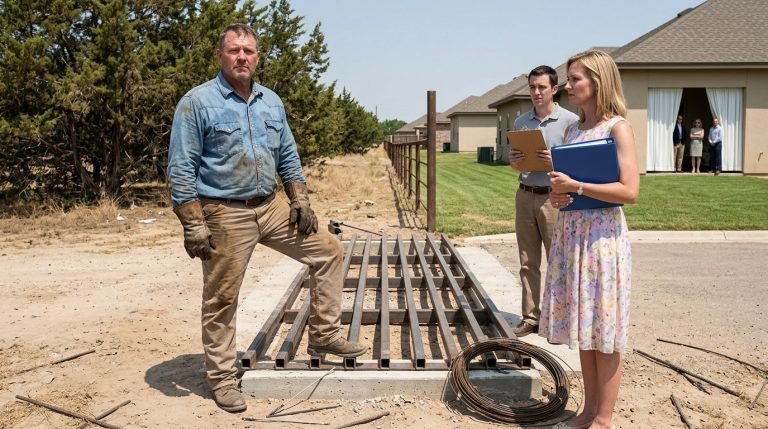
The diesel engine chattered in a low, uneven idle as I pulled my truck up to the foot of my driveway. I didn’t shut it off. My fingers clamped tight against the textured rubber of the steering wheel, my forearms stiffening under the cuffs of my work shirt. Right at the gap where my gravel met the asphalt, two heavy steel A-frame barricades painted in reflective orange and white stripes sat squarely across the path.
Stapled to the center of the crossbar was a fresh, water-resistant card. It was printed in high-visibility neon orange, the ink raw and smelling faintly of industrial solvents in the dry air. I left the truck running, the exhaust pipe coughing out a blue-gray plume that drifted across the ditch, and walked over to the barrier. The plastic warning card bore the stamp of the Madison County Road Commission, but beneath it was a typed addendum: Temporary Emergency Access Restriction – Utility Easement Maintenance under Order HOA-4A-09.
They were blocking my physical access to the main road. The dry earth beneath my boots felt loose and powdery as I kicked a stray pebble against the rusted steel foot of the barricade. I didn’t need to guess who had pulled the strings to get this emergency order signed on a Friday afternoon. Karen Thorne had signed the certified mail from Sarah’s office, and instead of retreating, she had used her ties with the county’s suburban expansion committee to squeeze the physical boundary.
A slow, dry scraping sound came from the nearby tree line. I turned my head. Parked fifty yards down the shoulder was a yellow county utility tractor, its backhoe attachment resting in the dirt like a heavy, rusted iron hand. No one was in the cab. The operator had left it there, a steel wedge driven right into the throat of my entrance.
My phone buzzed in my pocket, the vibration short and sharp against my thigh. I pulled it out, my thumb clearing the screen. It was a text from Sarah. Appended was a digital scan of the Oakidge Estates monthly community newsletter, distributed via email just twenty minutes prior.
I scrolled through the PDF with my thumb. The lead article was written under Karen’s direct byline. The headline was a blunt instrument: Securing Our Borders Against Unregulated Exploitation. The text didn’t print my name, but it described a “hostile, non-compliant neighbor on our eastern boundary” who was currently “attempting to leverage ancient administrative discrepancies to seize community assets for personal, speculative gain.” It went on to warn the residents that “unregulated, armed commercial enterprises” were planning to operate within yards of their properties, putting their children at immediate risk.
She was poisoning the well before we could even sit down. She was framing my grandfather’s deed not as a gift she had violated, but as a weapon I was using to steal their playground. The emergency road barricade was the physical manifestation of her narrative—a protective wall meant to show her residents she was actively defending them from a threat.
The hypocrisy was like iron filings in my teeth. She had taken a cold, clear legal document and turned it into a public spectacle of fear. She knew she couldn’t win on the merits of the deed, so she was trying to force me into a defensive, emotional reaction that would make me look like the aggressor.
I stood on the gravel, the heat from the truck’s radiator washing over my jeans. I looked from the neon orange card to the heavy yellow tractor parked on the shoulder. My chest didn’t tighten; my heart rate didn’t climb. Instead, a cold, calculated stillness took over. This was a classic containment maneuver. She wanted me to call the sheriff, to argue with the road crew, to make a scene that her residents could photograph and post on their community forums.
I wasn’t going to give her the spectacle.
I walked back to the truck, climbed into the cab, and shifted the heavy transfer case lever into four-low. The gear teeth meshed with a solid, metallic snick that vibrated through the floorboards. I backed the truck up ten yards, turned the wheel hard to the right, and drove straight over the shallow drainage ditch, bypassing the orange barricades entirely. The tires bit into the thick, dry brush of my own timber, the truck climbing the bank with a slow, relentless crunch of breaking cedar branches.
I parked the truck behind the barn, out of sight from the community road. I grabbed the Project Nightingale folder from the passenger seat, my grip firm on the cardboard. The letter Sarah had drafted was already in the mail, but the battleground had just shifted from the page to the dirt. I walked toward the house, the soles of my boots picking up the red clay of the ridge, knowing that by Tuesday, the entire neighborhood would be gathered in that clubhouse. And I was going to make sure the projector was ready to burn her lies to ash.
CHAPTER 7: THE CLUBHOUSE TRAP
The wooden steps of the back porch groaned under my weight as I scraped the sticky, iron-rich red clay from the soles of my boots. I stepped into the kitchen, the screen door slapping shut behind me with a hollow, metallic click. I laid the Project Nightingale folder down on the corner of the oak table, right next to the cold iron skillet from breakfast.
The weekend passed not in a fast-forward blur, but in the slow, grinding increments of a farm preparing for winter. On Saturday morning, I walked the southern fence line, checking the wire tension with the rusted pliers, my knuckles chapped from the dry, dusty wind. Sunday was spent in the barn, lubricating the tractor’s grease fittings, the scent of heavy oil and ancient dirt thick in my lungs. By Monday evening, Sarah Jenkins had finalized the digital files, sending them to my ancient desktop computer with a brief, text-only confirmation.
When Tuesday night finally arrived, the air had turned bitter, carrying the smell of woodsmoke and damp cedar. I loaded the heavy gray metal case of the office projector into the passenger footwell of my truck, the steel latches biting cold against my fingers.
I drove down the ridge road, passing the yellow county backhoe that still sat idle on the shoulder like a sleeping beast. I turned into the entrance of Oakridge Estates. The transition from my unpaved gravel to their smooth, sterile asphalt was a sudden, quiet jolt. The streetlamps cast a pale, uniform glow over the neat rows of beige McMansions, their identical vinyl siding offering no texture to the night.
The community clubhouse was a sprawling, double-door structure clad in synthetic stone. I parked in the back, away from the emerging cluster of sedans and SUVs. Carrying the projector case by its thick steel handle, I walked through the side service entrance.
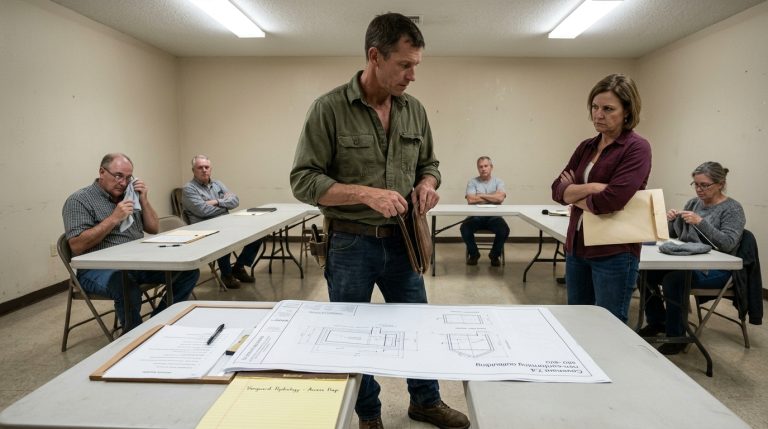
Inside, the main room was a vast, brightly lit box of white-painted drywall and linoleum floors that smelled of industrial lemon cleaner and stale coffee. Folding chairs had been set up in rigid rows facing a portable aluminum podium at the far end. At least forty residents had already taken their seats, their voices combining into a low, anxious hum that bounced off the hard surfaces of the room.
Sarah met me near the electrical outlet at the back. She didn’t speak. She simply nodded, her fingers smoothing the lapel of her gray wool blazer. I set the projector on a shaky utility table, the metal legs scraping sharply against the linoleum, and began running the heavy rubber-coated power cord along the baseboard.
At the front of the room, Karen Thorne stood beside the podium. She was wearing a dark blue power suit, her blonde hair sprayed into a solid, unyielding shelf. Her fingers gripped a black binder—the same one she had waved at me across the fence line. When her eyes drifted to the back of the room and locked onto me and the projector, her shoulders went rigid, the tendons in her neck straining against her collar.
She didn’t march over this time. Instead, she turned to the HOA treasurer, whispering something with sharp, rapid gestures before tapping the microphone. The feedback shrieked through the room, a high, metallic spike that silenced the crowd instantly.
“Thank you all for coming,” Karen began, her voice carrying an artificial, amplified warmth that didn’t reach her eyes. “We are here tonight to address a matter of critical safety and community integrity. As many of you read in the newsletter, our shared borders are currently facing an unprecedented challenge from a non-compliant neighbor.”
A murmur of agreement rippled through the front rows. Several residents turned in their chairs, their eyes searching the room until they settled on me. I didn’t shift my feet. I stood beside the projector, my hand resting flat on the cold metal casing.
“We have initiated formal code enforcement actions,” Karen continued, her tone hardening as she tapped the binder. “We will not allow our children’s sanctuary, our beautiful Founders Green, to be compromised by unregulated commercial enterprises.”
“The only compromise here,” Sarah’s voice cut through the room, clear and unamplified, “is the truth.”
Sarah stepped forward, her heels clicking deliberately on the floor as she walked down the center aisle. She held a stack of paper in her hand, the gold seal of the county registry visible on the cover.
“Karen,” Sarah said, stopping ten feet from the podium. “Before you ask this community to authorize legal funds for a fight you cannot win, you need to show them what is actually written on the title of the park.”
“This is an internal board matter, Sarah,” Karen snapped, her voice rising in pitch through the speakers. “You are out of order.”
“I clicked the remote in my pocket.”
The projector hummed to life, its cooling fan whirring as a blinding white beam cut through the dimming light of the room, hitting the smooth white wall directly behind the podium. Karen blinked, stepping to the side as the digital scan of the Madison Patent flashed ten feet high behind her.
The ancient india-ink lines of the 1889 survey showed the true boundaries, but it was the next slide that made the entire room hold its breath. The screen changed to the 2004 deed of gift, the yellow highlighted text of Covenant Clause 5B glowing like a beacon on the white wall.
“This land,” I said, my voice quiet but carrying to the corners of the silent room, “was given by my grandfather so that every family in this valley could have a piece of the sky. It was never yours to lock.”
Karen stared at the wall, her face turning the color of dry plaster under the projector’s glare. She opened her mouth to speak, but the words caught in her throat as the residents began to lean forward, their eyes locking onto the reversionary clause that threatened to take the park away forever.
CHAPTER 8: THE REVERSIONS WEIGHT
The white light from the projector cut through the dim room, casting the stark, clean lines of Covenant Clause 5B directly over Karen’s shadow. The silence in the clubhouse was heavy, broken only by the low, mechanical hum of the projector’s cooling fan. I watched her fingers dig into the edges of the black binder, the plastic cover warping under the sudden, desperate pressure of her grip.
“This is an old piece of paper,” Karen whispered, her voice cracking through the PA system. She tried to step in front of the lens, but the bright yellow text of the reversionary clause printed itself across her shoulder like a brand. “It doesn’t change our neighborhood bylaws. Our legal team approved the community plan. This land is under our management.”
Sarah walked up to the edge of the stage, her boots hitting the linoleum with a steady, unhurried cadence. “The Madison Patent of 1889 defined this valley, Karen. Your community plan exists because the Miller family permitted it. But your management ended the second you put up that sign and ran Arthur Henderson’s family out of a public space. Under Covenant Clause 5B, the title doesn’t wait for a lawsuit. It reverts automatically.”
A man in the third row stood up—it was the HOA treasurer, his face pale in the reflected white light. “Karen,” he said, his voice carrying no anger, only a flat, cold demand for reality. “Did the board know about this reversionary clause? Did you run a title search before we authorized five thousand dollars for that cedar sign?”
Karen didn’t answer. She looked at the treasurer, then at the forty residents sitting behind him. In her silence, the room found its answer. The collective front she had spent months building dissolved into a wave of quiet, tense murmurs. These were people who understood property values; they knew that a neighborhood without its central green was a neighborhood with a broken spine.
“The letter from my office was delivered last week,” Sarah said, turning back to the crowd. “Jack Miller isn’t asking for your homes. He is asking for the law to be respected. The signs come down. The park remains public. The harassment of his boundary line stops.”
Karen looked down at the podium, her shoulders slumping as the last of her manufactured authority evaporated under the harsh light of the projector. The black binder slipped from her fingers, hitting the floor with a hollow thump. She didn’t look at me as she stepped off the platform, her footsteps quick and uneven as she retreated toward the side exit, leaving the door swinging behind her.
The fallout was systematic and quiet, matching the steady approach of the first winter snow. Within forty-eight hours, the cedar “Founders Green” sign was cut down, its heavy posts unbolted from the concrete footings and left in the dry grass.
A week later, a county maintenance crew arrived to install a permanent metal sign at the park entrance. I stood on my porch, a hot mug of coffee warming my hands as I watched them bolt the green plate into place: John A. Miller Memorial Park – Open to the Public. The county road crew removed the orange barricades from my driveway, the yellow tractor crawling back down the valley.
The cold weather arrived on a Tuesday, bringing a hard frost that turned the red clay of my ridge into concrete. I walked down to the old hunting cabin, my dog Bunker trotting slowly behind me, his paws crunching on the frozen oak leaves.
I sat on the rough-hewn porch railing of the cabin, looking out over the hundred acres of timber that had survived the storm. The air was clean, carrying the sharp scent of damp pine and cold iron. On the porch floor sat my grandfather’s old timber scythe, its steel blade dull and rusted from seasons of neglect.
I pulled a flat whetstone from my pocket, spit on the grit, and began to work the edge. The high, rhythmic scree-chik of the stone against the metal was the only sound in the woods. With every pass, the orange rust flaked away, revealing the bright, silver steel beneath—the strong, honest iron that had cleared this land before the first beige house was ever imagined.
I looked up as the sun began to dip behind the ridge, painting the sky in deep, muted purples. In the distance, the lights of the subdivision flickered to life, but they didn’t look like an invading force anymore. They were just neighbors, living on the edge of the timber, sharing the valley under the quiet watch of the stars.
I wiped the steel blade clean with the sleeve of my Carhartt jacket, feeling the cold weight of the tool in my hands. The boundaries were clear. The promises had been kept. And on my land, the peace was earned.