The Stone Covenant: A Veteran’s Fight to Defend the Home His Late Wife Built Against a Ruthless HOA
CHAPTER 1: THE THRESHOLD OF STONE
The mortar was still damp enough to hold the smell of the river—that deep, mineral scent of wet shale and old earth that always clung to the valley before a storm. Jack Caldwell didn’t look at the paper she was holding. Instead, his thumb traced the edge of his father’s carbon-steel trowel, the handle worn smooth and darkened by decades of sweat until it fit the palm of his hand like a natural extension of his own bone. The steel was cool, holding the gray chill of the autumn morning.
“This is an esteemed community, Mr. Caldwell,” Karen Miller said. Her voice had the flat, nasal ring of someone who read municipal codes for pleasure, her fingers twitching against the laminated badge pinned to her floral lapel. “We have standards. A specific, curated harmony. This… monument of yours belongs in a mountain holler, not on a lot with streetlights.”
Jack stood on the bottom step of the porch he had framed with his own hands. Behind him, the chimney rose like a clean gray spine against the pale siding of the cottage. It was made of granite and riverstone, each piece hand-selected from the old quarry where Sarah used to collect wild fern. Some of the stones still had dry moss clinging to their crevices, tiny green threads defying the cold. It wasn’t perfect—the lines were rustic, following the natural curve of the earth rather than a level’s absolute zero—but it was solid. It had weight.
“It’s permitted,” Jack said. His voice was low, rusted from a week of near-total silence.
“County permits are not HOA approvals,” Karen replied, her face tightening into a sharp, thin line that mimicked the manicured edges of her lawn across the street. “This is a five-thousand-dollar fine for unauthorized structural modification, effective immediately. Every twenty-four hours it stands, another five hundred dollars is added to the ledger. You have until Friday to begin the demolition.”
She thrust the envelope toward him. The paper was heavy, a cream-colored stock that felt absurdly delicate against his calloused palms. Jack didn’t pull his gaze from her eyes—they were small, dark, and bright with the simple pleasure of an unchallenged boundary.
“My wife designed this,” Jack said softly.
“Your wife isn’t on the deed anymore, Mr. Caldwell. The Association is.”
She turned on her heel, her low heels clicking against the concrete driveway with a sharp, rhythmic snap. Jack watched her minivan—the dull, tea-colored color of stagnant water—pull away, its tires crunching over the gravel at the edge of his property line.
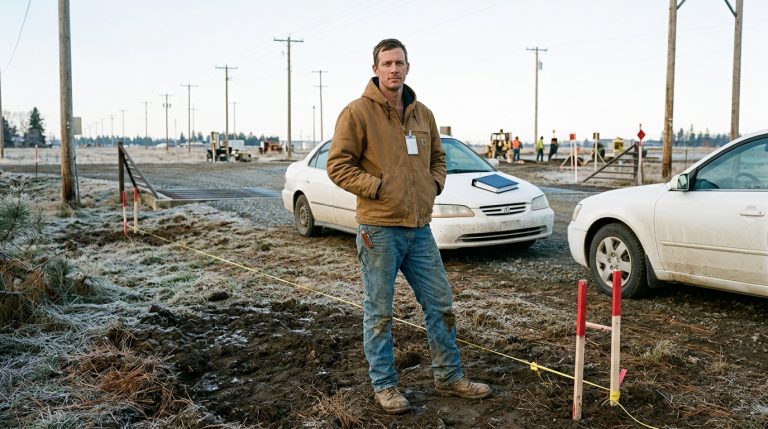
He didn’t move for a long time. The silence of the woods behind his house drifted back in, filling the space her voice had occupied. He looked down at the driveway. There, right where the gravel met the asphalt of Oakwood Estates, a small piece of rusted iron caught the pale morning sun. It was an old survey pin, half-buried under the sod, its head stamped with initials that didn’t match any modern developer’s map. He knelt, his fingers brushing the cold iron, feeling the hard, stubborn edge of something that had been planted long before the beige stucco houses had sprouted around him.
CHAPTER 2: THE COVENANT IN THE COLD
The rusted iron pin left a dark, metallic smudge across the meat of Jack’s thumb. He rose from the edge of the driveway, the gravel shifting beneath his boot with a dry, hollow rattle that felt too loud in the empty morning air. Across the cul-de-sac, the tea-colored minivan vanished around the bend of Whispering Pines Lane, leaving behind only the faint stink of exhaust and the heavy, lingering threat of the five-thousand-dollar envelope clamped in his left hand.
Jack walked back up the porch steps, his gaze fixed on the base of the riverstone chimney. The mortar there had taken three days to cure properly, deep down where the stones met the poured concrete footing. He could still see the slight indentation where Sarah’s thumb had pressed into the wet mix on the first day—a small, oval ridge that the frost hadn’t managed to flay away. He stepped past it, closed the heavy oak front door until the brass latch clicked home with a clean, singular thud, and shut out the gray morning.
The house was cold. The air inside held the specific, unmoving chill of a space that hadn’t seen a fire since the previous winter. Jack didn’t turn on the overhead lights; the pale, washed-out dawn filtering through the high windows was enough to illuminate the three-inch binder Prestige Homes had handed them in the hospital waiting room. It sat on the center of the oak dining table, its black plastic cover slightly warped from the humidity of the room.
He dropped the cream-colored HOA notice beside it. The contrast was stark—the pristine, heavy paper against the scratched, oil-finished grain of the wood. Jack pulled out the heavy Windsor chair, the joints groaning softly as he sat. He didn’t rush. Twenty years in the Corps had taught him that speed without reconnaissance was just a fast way to cross into an ambush.
He flipped the binder open. The pages inside were thin, almost translucent, covered in thousands of lines of single-spaced text that smelled faintly of stale toner and damp basements. His fingers, rough-skinned and stained with stone dust, turned the leaves methodically. He wasn’t looking for the rules about lawn heights or the permitted shades of beige; he was looking for the seams where the old world met the new.
His eyes traced the legal descriptions of the property boundaries. Prestige Homes Integrated Subdivision, Phase One. The print was crisp, clean, corporate. But three hundred pages deep, embedded within the section labeled Sub-Surface Rights and Pre-Existing Easements, the typography shifted. The ink was slightly faded, the letters showing the minor misalignments of an old mechanical typewriter.
It was an addendum, a single page titled The Peterson Vestry.
Jack’s thumb stopped on the word. The text detailed a parcel of land—Lot One, his land—that had been held in a private family trust before the corporate acquisition. According to the small print, the structural footprints established within the perimeter of the trust prior to the year 2016 were subject to a different standard. They were governed by a document referenced only as the Model-B Covenant.
He leaned forward, the wood of the table pressing hard against his forearms. The text didn’t define what the covenant allowed; it simply quarantined the property from the standard architectural review process, locking its core structural rights behind an old, pre-development legal shield. Karen hadn’t attached this addendum to her notice. She had sent the standard boilerplate, assuming he would look at the five-figure penalty and see only his dwindling savings.
A shadow flickered across the dining room wall—the reflection of a passing delivery truck on the main road outside. Jack didn’t look up. He stared at the signature line at the bottom of the faded addendum. The name Peterson was written in a sharp, slanted hand, the ink long since turned to a dull, iron-brown shade.
He closed the binder, the heavy plastic cover slapping shut with a sound that seemed to settle deep into the silence of the house. The paper notice from Karen still sat on the table, its text demanding immediate submission, its authority absolute. But the edges of her clean beige world were already beginning to fray at the corners, showing the old gray stone underneath.
CHAPTER 3: THE NEIGHBORS SILENCE
The dull echo of the binder closing still lingered in the corners of the dining room as Jack slid his chair back. The floorboards beneath his boots felt cold, unyielding. He didn’t let his hand linger on the table; instead, he slipped the heavy, cream-colored envelope into his coat pocket alongside the smooth handle of his father’s trowel. His fingers still carried the dark smudge from the rusted survey pin he’d examined only minutes before. He couldn’t shake the sensation of that raw iron, cold and buried, anchoring his land to a history Karen Miller wanted to erase.
He opened the front door. The morning chill hit him like a damp sheet, carrying the faint, smoky smell of wet leaf piles burning three streets over. Rather than taking his truck, Jack walked. His boots made a rhythmic, dry crunching sound against the gravel path that wound down toward the manicured asphalt of Whispering Pines Lane. The cookie-cutter McMansions stood in silent, uniform rows—their pristine beige stucco facades gleaming under the pale sky, devoid of any individual touch. It was a subdivision built on subtraction, where everything unique had been carefully shaved away.
He turned left at the corner of the cul-de-sac, heading toward Eleanor Vance’s property. Her house was a slightly older design, struggling to blend with the surrounding walls of corporate stucco. As Jack approached the low picket fence, he paused. The lawn was immaculately mowed, but near the flowerbeds, a gray patch of dry dirt sat empty.
Eleanor was there, kneeling on a thick foam pad. Her hands, clad in faded green gardening gloves, were gently clearing dead marigolds from the borders. Her wool sweater was frayed at the cuffs, the soft wool piling around her wrists.
“Mr. Caldwell,” she said, her voice small and slightly dry as she looked up. She offered a tired, fragile smile that didn’t reach her eyes. “You’re up early.”
Jack leaned against the wooden gatepost. The timber was damp under his palm, the white paint beginning to flake away in tiny, dry curls. “Saw the empty space by the hydrangeas, Eleanor. Where’s the bird bath?”
Eleanor’s gloved hands paused on a dried stem. She didn’t look up immediately, her shoulders slumping slightly beneath the heavy wool. When she did raise her head, her gaze drifted toward the tea-colored minivan parked three driveways down.
“The Board said it was a non-conforming ornament,” she whispered, her fingers twisting a dry stem until it snapped with a sharp, hollow sound. “By-law twelve, subsection four. It wasn’t on the approved list of stone structures. I… I couldn’t afford the daily penalty, Jack. They sent a brochure for a replacement from a contractor they recommended, but it was over eight hundred dollars. I couldn’t do it.”
Jack’s hand tightened around the paper in his pocket. The texture of the heavy cream envelope felt abrasive against his fingers. He looked down at the empty patch of earth where the simple concrete basin had sat for twelve years.
“They gave you a brochure,” Jack said, his tone flat, dropping into the steady cadence of an observer marking coordinates.
“Yes,” Eleanor said, pulling a folded piece of glossy paper from her apron pocket and handing it over. “Miller’s Quality Contracting. It had a little stamp on the back in faded red ink, some sort of tax code.”
Jack unfolded the paper. In the lower corner, half-smeared by wet garden soil, was a red ink stamp that read Rec: PV-09. The letters were faded, but the style of the print was identical to the typed characters he had just seen on the Peterson Vestry addendum in his dining room. A cold, familiar clarity began to settle behind his eyes. The aesthetic rules weren’t designed to protect the community’s value; they were designed to force a transaction.
He handed the brochure back, his thumb brushing the soft, damp paper. “Keep your hands warm, Eleanor,” he said softly. “The ground is freezing early this year.”
She looked at him, her eyes searching his face for something she couldn’t quite define—perhaps the quiet resolve of a soldier who had already begun to draw up his battle lines. “They have so many rules, Jack. It feels like we’re just renting our own lives from them.”
Jack didn’t answer. He turned and began the walk back up the hill, his boots tracing the same gravel path. Every house he passed now looked different—not like homes, but like occupied territory.
CHAPTER 4: THE DIGITAL HEARTH
Jack did not look back as he rounded the timber fencing of Eleanor’s lot, but the image of her empty garden bed remained etched in his mind like a dry fissure in slate. His boots maintained their steady, low-frequency rhythm against the wet asphalt of Whispering Pines Lane, the sound muffled by the damp morning air. The cold brochure for Miller’s Quality Contracting rested in his right hand, folded twice. He could feel the slight ridge of the Rec: PV-09 red stamp pressed against his thumb through the paper, a physical coordinate in an extortion scheme that had finally begun to draw its own boundaries.
Reaching his own driveway, Jack bypassed the front steps and walked around the stone chimney to the rear of the property. He entered through the mudroom, where the smell of oil-soaked boots and pine needles hung in the small, unheated transition space. He did not pause to remove his coat; instead, he carried the brochure straight into the kitchen, where the large oak table had been converted into a staging area.
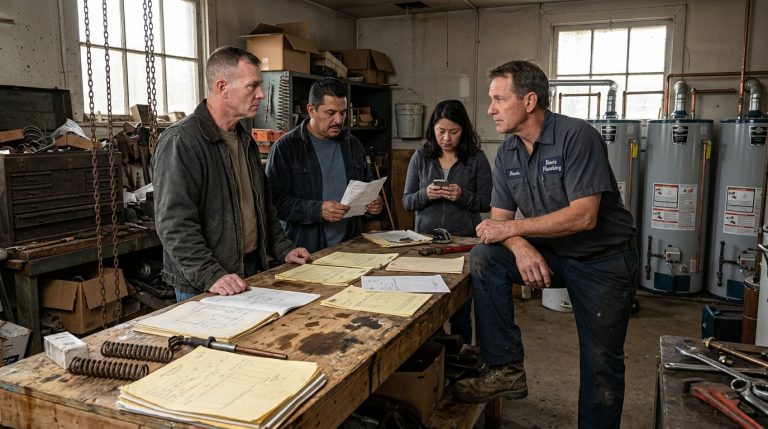
Arthur Kensington was already there. He sat with his spine perfectly straight, his vintage tweed jacket slightly frayed at the elbows, a steaming mug of black coffee sitting untouched on a cork coaster. Beside him, Mike had set up a ruggedized gray laptop, its cooling fan emitting a low, dry whirr that competed with the ticking of the grandfather clock in the hall. The tabletop was a mosaic of scanned documents, handwritten logs, and legal notices—the scattered pieces of their neighborhood’s silent distress.
“She’s systematically clearing the grandfathered properties,” Jack said, his voice cutting through the hum of the laptop. He laid the folded brochure down next to Arthur’s hand, aligning its creased edges with the margin of a highlighted copy of the HOA bylaws. “Look at the stamp on the back. It’s the same ink and alignment as the Peterson Vestry entry in the master binder.”
Arthur adjusted his spectacles, his fingers—spotted with age and dry like parchment—gently pulling the brochure closer. He tilted it toward the gray light coming through the kitchen window. “The Peterson Vestry,” he murmured, his voice a low, gravelly rasp. “It’s more than an exemption. It’s a legal boundary line. If she can force enough of these older parcels into compliance disputes, she can cloud the titles, making them impossible to sell or transfer without settling her specific vendor debts. It’s a closed-loop system, Jack. Simple, elegant, and entirely corrupt.”
Mike clicked a key on his laptop, bringing up a secure interface labeled Oakwood United. The screen reflected a pale, bluish glow across his face, highlighting the tense set of his jaw. “The portal is live, Mr. Caldwell. I’ve restricted access to the physical MAC addresses of the routers within our tax district. It’s a closed network. No one from the board can sniff the packets without leaving a clear digital footprint.”
“We need the physical records to match the uploads,” Jack said. He pulled a small flatbed scanner toward himself, the glass clean and cold under the kitchen light. He took the Rodriguez family’s beige door denial notice, which Mike had brought over earlier, and placed it face down on the scanning bed. The mechanical sweep of the sensor bar began, a slow, green line of light slicing through the dim room, hummed with a predictable, steady friction.
“I’ve already initiated the baseline,” Mike said, his fingers dancing across the mechanical keyboard with a sharp, hollow clatter. “We have forty-two addresses mapped. I’m setting up an encrypted database directory under the name Weyland-Prestige Ledger as a placeholder for the financial audits. If Arthur is right about where the money is going, we’re going to need a secure locker for the bank statements.”
Jack watched the progress bar on the screen fill up, block by block. “It’s not just about the money,” he said, his voice dropping into that quiet, tactical register that both men had learned to listen to. “It’s about the land. She’s using the bylaws like a wedge, trying to pry loose the foundations of the homes that were here before her brother’s trucks arrived.”
Arthur took a slow sip of his coffee, his eyes never leaving the red-stamped code on the brochure. “Then we don’t just defend, Jack. We map her movements. Every violation she issues, every fee she collects, must be logged in real-time. If we give the community a safe place to speak, the fear will begin to shift directions.”
Jack nodded, his hand resting on the cool lid of the scanner. Outside, a crow called out from the high branch of an old oak, its voice harsh and stark in the autumn quiet. The line had been drawn, the digital hearth was lit, and for the first time since the tea-colored minivan had pulled onto his driveway, Jack felt the balance of weight begin to turn.
CHAPTER 5: THE SHADOW ON THE TITLE
The steady green sweep of the scanner had barely finished its journey back to the housing when a sudden, violent gust of wind rattled the glass pane of the mudroom door. Outside, the sky had bruised into a deep, heavy indigo, a cold front rolling over the ridge with unseasonable speed. A low rumble of thunder vibrated through the floorboards of the kitchen, shifting the focus from the digital layout on Mike’s screen to the reality of the raw, exposed masonry outside.
Jack stood up, his joints protesting with a dry click. He checked his watch—the storm was hours ahead of the local forecast. “The chimney,” he said, his voice flat but carrying the immediate weight of command. “The lime mortar on the upper cap isn’t fully carbonated yet. If the driving rain hits it raw, it’ll wash the joints clean out.”
“Go,” Arthur said, his hand already reaching for a stack of physical tax maps to keep them from catching the draft. “Mike and I will lock down the local directory uploads. The data is safe.”
Jack stepped into the mudroom, grabbing a heavy, wax-treated canvas tarp and a bundle of braided nylon utility cord. The cold air hit him as soon as he unlatched the back door, smelling of ozone and wet pine needles. The wind caught the edge of the tarp, making the thick fabric snap like a sail. He struggled past the woodpile, his boots sinking into the sodden grass at the base of the stone structure.
As he reached the foot of the chimney, he saw something stuck to the storm door of the main house—a yellow plastic sleeve containing a document, weighted down by a brick.
He didn’t open it yet. He secured the rope around his waist, throwing the heavy end over the low eave of the roof to anchor himself against the rising wind. He climbed the extension ladder, his boots slipping slightly on the wet aluminum rungs. The cold rain began to fall in heavy, slanted sheets, stinging his eyes and darkening the granite stones to a deep, slick charcoal. Working by touch, his knuckles scraping against the rough riverstones, he pulled the heavy canvas over the top of the flue, wrapping the nylon cord tight around the masonry crown, securing it with three tight half-hitches.
Drenched, his breath coming in shallow, controlled drags, he slid back down the ladder and unclipped his line. Only then did he reach for the yellow plastic sleeve.
He pulled the wet paper from the plastic. It was not a standard HOA citation. The heading at the top was printed in stark, bold-face type: NOTICE OF RECORDING OF STATUTORY LIEN – OAKWOOD ESTATES HOA vs. CALDWELL, LOT 1.
Jack’s fingers left a dark, wet smudge on the paper as he read. The amount was seventeen thousand, four hundred and fifty dollars—comprising the initial fine, retrospective non-compliance fees, and interest compounded daily. But it was the small print at the bottom of the page that caught his eye, typed in the same narrow font as the Weyland-Prestige Ledger notations: Title holding restricted under terms of the Peterson Vestry pending full administrative clearance.
He looked up from the document. Through the gray sheet of falling rain, he could see the silhouette of a vehicle idling at the mouth of his driveway. It wasn’t Karen’s minivan. It was a black, commercial-grade pickup truck with a magnetic logo on the door—a stylized crest that matched the header on the brochure he’d taken from Eleanor’s garden.
The engine revved slightly, the headlights cutting through the dark afternoon storm, before it backed out slowly, its tires throwing up wet gravel as it disappeared into the gloom of the subdivision.
Jack stood in the rain, the notice of lien clutched in his fist, feeling the cold water seep through the collar of his coat. They weren’t waiting for the Friday deadline. They were moving to encumber the land immediately, locking his title before he could leverage the original blueprints. He turned back toward the mudroom door, his jaw set, his mind already recalculating the tactical distance between his kitchen table and the courthouse.
CHAPTER 6: THE UNMASKING
The yellow plastic sleeve clung to Jack’s wet palm as he stepped back over the threshold of the mudroom. Water pooled in the tread of his boots, dripping onto the concrete floor with a slow, heavy patter. He did not shed his soaked coat. Instead, he walked straight back into the warm, yellow light of the kitchen, his boots leaving a dark trail of moisture on the wide oak planks.
Arthur looked up from the table, his spectacles sliding down the bridge of his nose. Mike’s fingers froze over the keyboard. The hum of the laptop fan was the only sound in the room, steady and indifferent to the storm drumming against the windowpanes.
“They didn’t wait,” Jack said. He laid the damp, yellow-sleeved notice of lien onto the center of the oak table, right on top of the clean scans of Eleanor’s denial letters. The paper inside was bloated with moisture, its corners already swelling. “Seventeen thousand. Filed directly against the deed of Lot One. They’re locking the title before the county offices close on Friday.”
Arthur picked up the wet plastic sleeve, his touch cautious, as if the document itself were hot to the touch. He slid the paper out, his thumb tracing the bold ink of the statutory declaration. “They’ve accelerated the timeline,” he murmured, his voice tightening into a hard, clinical rasp. “A lien of this speed requires a direct administrative waiver. Look at the signature block. It bypasses the standard county clerk queue entirely. They used a pre-authorized escrow block.”
“That’s the Weyland-Prestige Ledger,” Mike said, swiveling his screen toward Jack. He tapped a fingernail against a column of scanned corporate filings on his display. “I just pulled the regional developer transaction logs from the state tax database. Ten years ago, when the developer bought out the family trusts, they set up an escrow holding called the Peterson Vestry to handle outstanding liabilities. The board has a direct key to that escrow, Jack. Karen’s brother didn’t just start a landscaping company last year. He was the designated liquidator for those holding funds.”
Jack pulled the Windsor chair out and sat down, the wet fabric of his trousers sticking to the polished wood. He felt no surge of heat, no sudden impulse to strike. His mind had transitioned entirely into the quiet, rhythmic pacing of a tactical operations center. “They are using the HOA to trigger default clauses on the grandfathered properties. If the owners can’t clear the lien, the title reverts to the escrow holding.”
“Exactly,” Arthur said, his eyes narrowing behind his lenses. “It’s a legal land-clearance mechanism disguised as neighborhood preservation. By the time any of us realized we were being priced out, the development would own our dirt. But they made a crucial mistake.” He tapped the wet document in front of him. “By pushing this through without a formal board vote or an active architectural review committee, Karen signed this as an individual representative of the corporation. She has personally assumed the liability of a fraudulent claim.”
“We have forty-two testimonies on Oakwood United,” Mike added, sliding a small, ruggedized USB drive across the table toward Jack. The plastic of the drive was black, scuffed at the edges from being carried in his pocket. “I’ve compiled the scanned copies of every fine, every denial, and the corresponding quotes from Miller’s Quality Contracting. It’s all here. Every single transaction matches the transfer dates in the ledger.”
Jack picked up the small drive. It felt light in his hand, almost weightless, yet it held the collective weight of every neighbor who had spent the last five years painting their doors in silence, paying fees they didn’t owe, and hiding their bird baths from the street. He closed his fingers around the plastic, the hard edges pressing into his palm.
“We don’t send this to a lawyer yet,” Jack said, his voice quiet, dropping into the space between the thunderclaps outside. “If we go to court now, they’ll tie us up in discovery for three years while the lien sits on my title. We need a public forum. We need the community to see the foundation before we pull the house down.”
Arthur met his gaze, a slow, predatory glint returning to his eyes. “The annual meeting is in forty-eight hours, Mr. Caldwell. The bylaws state she cannot cancel it without a unanimous vote of the board. And I’ve already spoken with George.”
Jack stood up, his coat dripping a final, cold circle of water onto the kitchen floor. He walked over to the small stove, where the kettle sat cold on the grate. “Then we set the perimeter,” Jack said. “Mike, keep the portal live. Arthur, draft the formal notice of dispute. I’m going to make sure the stone has enough time to dry.”
The storm rattled the glass behind him, but the warmth of the room had begun to hold its own ground.
CHAPTER 7: THE TRIBUNAL OF THE COMMONS
Jack’s fingers tightened around the worn, flat edges of the black USB drive, the dry plastic warming against his skin. The cold puddle at his feet in the mudroom had already begun to sink into the unsealed concrete, leaving a dark, irregular ring. The transition from the wet, lashing wind of the ridge to the stifling, hum-filled warmth of the community center’s main hall had happened without a single second of relief. There was no skip in the clock, no moment to shake the chill from his shoulders. He simply carried the heavy scent of damp canvas and wet earth directly through the double steel doors of the hall.
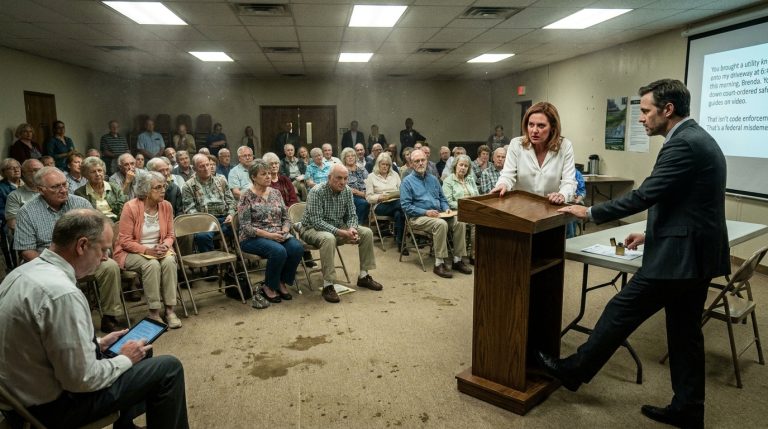
The room was a dense pack of wet wool, low murmurs, and the clinical glare of fluorescent tube lighting. Over two hundred neighbors sat in rows of beige folding chairs, their coats draped over their knees, their breathing creating a soft, collective humidity that clouded the high transoms. In the back, the dull, red recording light of Brenda Walsh’s camera hummed on its tripod.
At the front table, Karen Miller sat behind her small brass gavel. Her knuckles were pale, her fingers clutching a stack of typed meeting agendas. But as Jack moved down the center aisle, his boots leaving a faint, damp trail on the linoleum, her eyes locked onto the manila folder tucking under his arm.
Jack did not take a seat. He walked directly to the wooden podium, his thumb tracing the rough, unfinished grain of the oak stand. The hall went utterly quiet, a heavy, expectant silence that seemed to press against the plaster walls.
“This meeting will come to order,” Karen said, her voice tight, dry, and pitched slightly too high. She did not strike the block. “Mr. Caldwell, you are not on the scheduled agenda for presentation.”
“The bylaws,” Jack said, his voice dropping into the quiet, unhurried rhythm of a master mason laying his first course, “state that any pre-existing lot owner within the Peterson Vestry boundaries may present architectural disputes directly to the assembly if the committee fails to produce a quorum.” He opened the folder. The paper inside was dry, but it held the distinct, chalky scent of old archiving vaults. He laid the first document flat—the unredacted, original master blueprint. “This is the Model-B Covenant, signed by the developer ten years before the first stucco was poured.”
Karen’s face lost its color, the blotches of red on her neck turning a dull, bruised purple. She stood up, her chair scraping against the floor with a sharp, metallic shriek. “That document is an obsolete draft. It holds no legal standing under the current architectural review guidelines.”
“It holds the only standing,” Arthur Kensington’s voice boomed from the third row. He stood up slowly, his fingers steepling over his cane. “Because the current guidelines were never ratified by an elected committee. The Weyland-Prestige Ledger, which we have uploaded to the public county portal as of forty minutes ago, shows that every single architectural fine levied against Lot One, Lot Twelve, and Lot Forty-Four was routed directly to an escrow account controlled by Rick Peterson. Your brother, Karen.”
A low, vibrating rumble went through the crowd—not of anger yet, but of a massive, collective realization. The Rodriguez family leaned forward, Mrs. Rodriguez’s hand resting on her husband’s sleeve. Eleanor Vance sat in the front row, her green wool gloves clutched to her chest, her eyes fixed on the blueprint projected onto the screen behind the podium.
“You are disrupting a private administrative proceeding,” Karen hissed, her hand finally reaching for the gavel, but her fingers shook, the brass head clicking against the wood without force. “This is slander. The lien against your property is a statutory debt.”
“The lien,” Jack said, his gaze locking onto hers with a quiet, absolute weight, “is a fraudulent cloud on a title that is explicitly protected by the covenant you tried to hide. I didn’t build a violation, Karen. I completed the design my wife sketched on this land before your development existed. The stones are anchored in the bedrock. Your authority is anchored in a shell company.”
He tapped the screen. The image shifted to the scanned ledger entries—line after line of administrative transfer fees, all marked with the same red stamp, PV-09, routing directly into her brother’s account.
The silence in the hall broke. It didn’t break with a shout, but with the rustle of two hundred people standing up at once, their chairs scraping the floor in a unified, rising tide of resistance. George, the accountant, stood up from the board’s own table, his face slick with sweat, his voice trembling but clear. “I second the motion to dispute,” he whispered. “I second it.”
Karen stood isolated at the long table, the gavel dropping from her hand and rolling off the edge, landing on the linoleum with a dull, hollow click. Her kingdom of beige paper had crumbled, stone by hypocritical stone, beneath the weight of her own ledger.
CHAPTER 8: THE MORTAR OF REMEMBRANCE
The brass gavel lay static on the linoleum floor, its high-polished luster catching the sterile white light of the community hall ceiling. At the front table, Karen Miller did not reach down to retrieve it. Her hands remained flat on the varnished wood, her fingers twitching once, then pressing hard against the grain until her nails lost their color. The heavy, unmoving silence of the room seemed to lock her in place, stripping away the small, paper-built authority she had used to police the borders of their lives.
Jack Caldwell did not watch her leave. He stood at the podium as the collective movement of his neighbors transformed the space behind him from an audience into a quiet, determined swarm. Arthur was already stepping forward to gather the original blueprints of the Model-B Covenant, his hands dry and deliberate as he folded the heavy linen sheets.
“We need to file the certification of nullification before the registry closes at five,” Arthur said, his low baritone cutting through the rustle of winter coats. “The board’s vote is recorded. The Peterson Vestry escrow is legally frozen.”
“I’ll match the registry signatures to the digital database,” Mike added from the desk, his fingers tapping a final, quiet command to close the Oakwood United directory. “The ledger is backed up on three local nodes. They can’t delete the trail.”
Jack nodded slowly. The cold air from the open exit doors had begun to push the stagnant heat from the hall, carrying the faint, clean scent of cedar wood smoke and damp asphalt. He turned his face toward the door, leaving the light and the noise behind. His boots made no sound on the wet sidewalk as he walked back toward his own lot, the storm having passed, leaving only a thin, silver crust of frost on the hemlock needles.
Three weeks later, the silence that returned to the hill was different. It was not the heavy, suffocating emptiness that had occupied the cottage after Sarah was gone, but a quiet that felt supported by the stones beneath his feet.
The afternoon sun was low and pale, casting long, soft-edged shadows across the yard. Jack sat on his wooden bench at the base of the riverstone chimney, his father’s carbon-steel trowel resting across his knee. The blade was clean now, the dried lime mortar scraped away, leaving a smooth, dark patina on the metal that reflected the faint orange of the winter horizon.
Beside him on the grass lay a small, cracked concrete basin—the bird bath he had spent the morning reinforcing with a light, steel-mesh armature and a fresh layer of fine sand-cement. The concrete had dried to a soft, warm gray, the edges rounded and showing the frayed, rustic texture of the wooden mold he had built.
A soft rustle of dry leaves made him look up. Eleanor Vance was walking up the gravel path, her hands tucked deep into the pockets of her worn wool coat. She stood by the garden bed, her gaze drifting from the towering granite blocks of his chimney down to the repaired basin at his feet.
“It looks stronger than it did before, Jack,” she said, her voice quiet but holding a light, resilient warmth that had been missing for years.
“The mesh inside will keep the frost from splitting it again,” Jack replied. He did not stand immediately. He let his thumb brush the rough, cured surface of the cement basin. “A good foundation doesn’t mind the cold.”
“They’re painting the Rodriguez’s front door this weekend,” she said, looking back toward the lower cul-de-sac where the uniform rows of beige stucco seemed less rigid now, broken by the occasional splash of color and the small, human details starting to emerge along the porches. “The new committee approved the blue on the first pass.”
“I know,” Jack said. “I’ve got some spare scaffolding they can use.”
He stood up, lifting the repaired concrete basin with an easy, practiced shift of his weight. It was heavy, but the weight felt balanced, solid, and entirely within his control. He carried it over to the small circle of earth near his walkway where the soil had been cleared, setting it down gently until the base bit deep into the dark, damp earth.
He stepped back, his raw, stone-roughened hand resting on the smooth granite of the chimney’s corner block. The stone felt warm to the touch, having absorbed the pale light of the setting sun throughout the afternoon. Above them, a thin, steady plume of white smoke rose from the flue, drifting straight up into the clear blue winter sky, carrying the scent of dry birch and ancient earth over the clean borders of the reclaimed community.