The Concrete Wall of Oak Ridge: How a Retired Marine Turned a Petty HOA Tyrant’s Weapon Against Her
CHAPTER 1: THE FIRST VOLLEY
The gray wool of my sweatshirt absorbed the crisp morning air as I kept my eyes locked on the interlocking grain of the red oak stack.
The voice behind me carried that distinct, synthetic sweetness that usually preceded a headache.
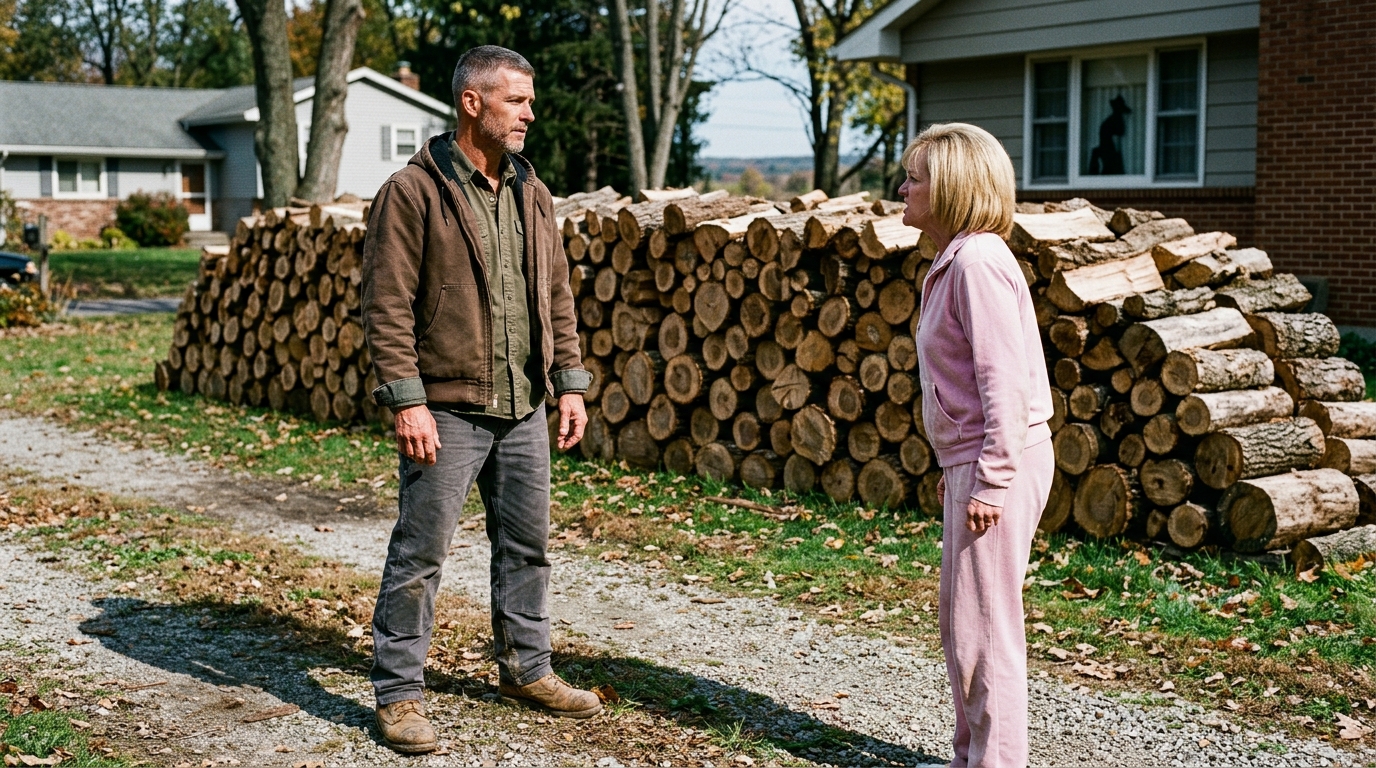
“That pile of dead trees is a blight on this community, Mr. Turner, and it will be gone by Monday.”
I turned around slowly, letting my hands rest flat against my thighs instead of clenching into fists.
Karen stood near the edge of the driveway, encased in a pastel pink tracksuit that seemed to strain against her frame like an over-inflated balloon.
Her blonde hair was stiffly lacquered into a helmet that didn’t move even as a sharp autumn gust swept down the cul-de-sac.
“Did you hear me?” she snapped, stepping closer with her chin jutted out. “The fine starts at one hundred dollars a day, and they accumulate fast.”
Twenty years of Marine Corps discipline kept my breathing slow and measured while she waited for a flinch.
I looked past her puffed face to the four-cord wall of white and red oak I had spent weeks cutting, seasoning, and stacking with absolute geometric precision.
It wasn’t a pile of dead trees; it was a fortress of self-sufficiency born from the safety-mandated removal of two diseased backyard giants.
“I heard you,” I said, my voice dropping into a flat, quiet register.
I gave her a single, slow nod, letting silence do the heavy lifting.
She blinked, clearly expecting a shouting match or a panicked denial, before huffing in frustration and turning on her squeaking sneakers to march back across the street.
The quiet suburban morning felt heavy, tainted by the bitter taste of an unnecessary fight.
Inside the kitchen, Sarah stood by the counter with a mug of coffee, her brow furrowed as she watched through the window.
“What was that all about?” she asked softly when I pushed the back door open.
“That was Karen,” I said, unzipping my sweatshirt to let the cool draft fade. “She wants the wood gone by Monday.”
Sarah set her mug down with a sharp clink against the laminate counter.
We hadn’t moved to Oak Ridge Estates to trade the chaotic noise of base housing for a suburban dictatorship.
We wanted a quiet forever home where the loudest sound was birdsong in the undeveloped woods behind our half-acre lot.
Instead, we had run headfirst into a neighborhood tyrant who treated her small sliver of authority like a general’s baton.
I walked over to the small desk in the corner of the den where the thick spiral-bound CC&R booklet sat gathering dust under a stack of mail.
If she wanted to play a game of rules and regulations, I was more than willing to check the playbook.
CHAPTER 2: THE PAPER TRAIL
Two days later, the mailbox yielded a thick, certified envelope that smelled faintly of bureaucratic vinegar.
I signed for it with the stubby yellow pencil the mail carrier offered, nodding once before carrying the heavy package back to the kitchen table.
Inside sat a fresh violation notice stamped in angry red ink, complete with a grainy, poorly angled photograph of my wood pile taken from the street.
Karen had not waited for her own arbitrary weekend deadline to expire before tacking on another hundred-dollar penalty.
Across the kitchen, Sarah stared out the window toward the empty cul-de-sac.
“She’s doubling down,” Sarah said, her voice tight with suppressed anxiety. “If we pay this, it never ends.”
“We aren’t paying it,” I replied, pulling a fresh legal notepad and a black pen toward me.
I took my camera out to the backyard, ignoring the biting chill of the wind, and began a systematic photographic survey of the property.
I shot wide angles to prove the wood’s minimal visibility from the road, then macro close-ups of the tight, professional stacking grain.
From there, I took a quiet two-hour walk through the neighborhood with the camera hidden deep inside my coat pocket.
Karen’s own front yard offered an immediate contradiction to her strict aesthetic rules.
Faded, chipped garden gnomes huddled near a cracked, algae-stained birdbath that violated half a dozen HOA clauses.
Two doors down, the treasurer’s house sported peeling paint, while a rusty basketball hoop leaned against a neighboring driveway.
Rules in Oak Ridge Estates were apparently applied with a selective sieve rather than a uniform standard.
Back at the desk, I called three local firewood suppliers before dialing a specialty lumber mill downtown.
The gray-bearded mill owner listened to my detailed description of the split white and red oak before letting out a low whistle.
“Son, that’s not just firewood,” the old man growled through the receiver. “Seasoned oak like that, cut square and clean, is prime stock for furniture makers and custom smoking barrels.”
He offered to write a formal appraisal for a small fee, and when it arrived via email twenty-four hours later, the final valuation sat at just over twenty-two thousand dollars.
Karen was threatening to seize and destroy an asset worth more than a mid-range kitchen overhaul.
The paper trail was no longer a defense mechanism; it was a loaded weapon waiting for the right trigger.
CHAPTER 3: BUILDING THE ALLIANCE
The front door of George Henderson’s house smelled faintly of old pipe tobacco and decades of printed paper.
George held a warm ceramic mug in one hand as he waved me into the cluttered study.
“I saw her drop that second notice in your box, son,” George muttered, leaning back into a worn leather armchair. “Karen doesn’t know how to step back once her teeth are set.”
I laid out the photocopies of the violation letters across his reading table, alongside the list of selective neighborhood infractions.
“She’s running this place like a warden,” I said, keeping my tone even. “And nobody has challenged her because they’re isolated.”
George tapped the stem of unlit briar against his thumb.
“Ten years of running roughshod over young families,” he said, staring at the floorboards. “She drove out the Millers’ friends over a swing set color last summer.”
That name—the Millers—triggered a tactical opening.
Three doors down, Tim and Jessica Miller had spent months nursing a quiet grievance over a two-hundred-dollar sidewalk chalk fine.
I left George’s study with a map of past grievances and walked down the sidewalk under the afternoon glare.
Tim answered on the second knock, his shoulders tense and defensive until he saw my empty hands.
“I’m not asking you to start a war,” I said quietly, keeping my voice level on their front porch. “I’m just cataloging the pattern of harassment.”
Jessica stepped up behind her husband, her fingers clutching the edge of the screen door.
“She called our daughters’ drawings a community blight,” Jessica whispered, her voice tight. “We just paid it to keep the peace.”
“Peace isn’t paying extortion,” I replied, handing them a blank contact card. “It’s gathering facts.”
Three days later, a text pinged on my phone from an unknown local number.
“We want to talk,” it read, setting the meeting point at a neutral park bench outside the subdivision.
The coalition was no longer a silent theory; it was a growing record of shared abuse.
CHAPTER 4: THE LEGAL BROADSIDE
Dave Rosser’s voice over the phone line crackled with professional satisfaction.
“Jack, this is absolute gold,” the former JAG captain said, reviewing the files I had transmitted. “She threatened a property lien over an unlisted asset while practicing selective enforcement. We aren’t just defending your yard; we’re breaking her command chain.”
Within forty-eight hours, Dave and I finalized a comprehensive notice of dispute and formal cease-and-desist package.
Instead of mailing it solely to Karen, we addressed certified copies directly to every single member of the HOA board and the property management corporate office.
The document dismantled her vague nuisance claims clause by clause, appending the certified appraisal proving the wood’s twenty-two-thousand-dollar value.
It explicitly warned that any tampering with the property would be treated as criminal trespass and felony theft.
More importantly, Dave cited state fiduciary statutes, putting the remaining board members on direct notice of personal civil liability if they continued backing Karen’s personal vendetta.
A few days later, the green postal delivery return receipts trickled back into my mailbox one by one.
The shockwave had been delivered to their doorsteps.
Karen’s centralized control depended entirely on keeping the other board members blind to her procedural overreach.
Now, they held the evidence in their hands, and the silence from across the street grew deafening.
CHAPTER 5: THE CLUBHOUSE TRIAL
Karen stood at the front of the packed room, her navy blue pantsuit stiff as she waved my legal notice like a flag of betrayal.
“Mr. Turner has refused community standards and threatened us with frivolous legal action,” she announced, her voice dripping with calculated outrage.
She skipped past the appraisal value completely, painting the wood stack as a rotting, pest-ridden hazard.
Murmurs rippled through the rows of folding chairs where neighbors sat clutching coffee cups and watching nervously.
I waited until her manufactured speech hit its peak before standing up from the front row.
“May I share the rest of the facts?” I asked, stepping forward with a single USB drive in hand.
Karen tried to bang her gavel down again, but Arthur, sitting beside her on the board, reached out and arrested her wrist.
“Let him speak, Karen,” Arthur muttered, his face dark.
I plugged the drive into the projector console, and the first slide flashed onto the screen behind them.
It wasn’t her distorted, grainy photo, but a pristine, high-definition image of the white oak wall standing clean and orderly in the sunlight.
“This is the hazard,” I said quietly, letting the silence settle over the room.
I clicked to the next slide—a side-by-side comparison showing Karen’s chipped garden gnomes and cracked algae-stained birdbath.
Gasps filled the room as the sheer hypocrisy of her selective enforcement lit up the projector screen.
Slide after slide exposed unprosecuted violations belonging to board members, contrasting sharply with her swift weaponization of rules against newcomers.
When I finally flashed the twenty-two-thousand-dollar certified appraisal onto the board wall, a collective shockwave silenced the room.
Karen’s face drained of color as she realized her petty bullying had targeted a major private asset.
Tim Miller stood up from the back, his hands shaking as he recounted the sidewalk chalk fine.
George Henderson followed, detailing a decade of intimidation that left the board staring down an abyss of personal liability.
Karen sat frozen and isolated as her decade-long reign of petty tyranny crumbled under the weight of documented reality.
CHAPTER 6: THE FINAL COLLAPSE
A battered flatbed truck sat idling by the curb, its heavy hydraulic grapple crane hissing in the sub-freezing air while two burly workers stood frozen by the cab.
Karen stood wrapped in a heavy trench coat near the edge of the driveway, pointing frantically toward the white oak stack.
“Get that claw attached right now,” she shrieked, her voice cracking in the cold morning air. “Remove this garbage immediately!”
I stepped down the porch steps with my boots hitting the gravel in a slow, measured cadence.
“Gentlemen,” I said, pitching my voice to carry over the engine rumble without raising the volume. “You are on private property, and that wood is a certified asset valued at twenty-two thousand dollars.”
The workers exchanged panicked glances, stepping away from the hydraulic controls.
“She told us it was a standard junk removal job,” the driver muttered, his hands hovering over his jacket pockets.
“She is lying,” I replied smoothly, holding up the laminated copy of the legal notice and appraisal. “A cease-and-desist has been served, and attaching that crane to my property constitutes felony grand theft.”
Karen rushed forward, her face twisted in absolute fury as she abandoned all pretense of civic decorum.
“He is lying!” she screamed, lunging toward the officer who had just stepped out of the newly arrived patrol car. “Arrest him right now! I am the president of this association!”
The senior officer held up a hand, his expression carved from stone as he took the binder from my hands.
“Ma’am, step back from the vehicle,” the officer ordered, his eyes scanning the certified delivery receipts and the police report copy. “We received a direct call regarding an attempted property seizure under an active legal injunction.”
“Don’t you dare tell me to step back!” Karen shrieked, stabbing a finger into the officer’s chest. “I run this neighborhood! I will ruin all of you!”
The flashing lights caught every twitch of her enraged face, perfectly broadcasting her self-destruction to the neighborhood windows where curtains twitched open one by one.
The officer’s patience snapped instantly, cuffs clicking sharply as he grabbed her arm and guided her against the hood of her Lexus.
“Karen, you are placing yourself under arrest for obstruction and interference,” the officer announced over the hum of the truck.
The two workers scrambled back into their cab, throwing the flatbed into reverse before the cruiser doors even fully shut.
As the truck sped away and Karen was led into the back of the squad car in sputtering disgrace, the neighborhood fell utterly silent.
Three months later, the “For Sale” sign went up on her lawn, and she packed her belongings into a moving van under a cloud of permanent exile.
Arthur took over the board, rewriting the bylaws to ensure transparent community governance and throwing out the old tyranny for good.
That winter, a steady crackle of firewood warmed the backyard air as George Henderson, the Millers, and I sat around the fire pit sharing coffee.
I set my ceramic mug down on the weathered wooden arm of my chair, listening to the quiet laughter echoing through the trees.
The sanctuary we had searched for was finally restored, built not on luck or easy silence, but on the unyielding common sense of an everyman who refused to break.