The Sunday Recipe: A Billionaire’s Quietest Rescue and the Fragile Rebuilding of a Shattered Life
CHAPTER 1: The Silence of the Loop
The air in the penthouse was sanitized, scrubbed of all scent and stray noise. It felt less like a home and more like an observatory where the stars had gone cold. Jessica gripped the edge of the granite island, her knuckles white, feeling the chill of the stone seep into her skin. It was a beautiful, punishing place to wait for a death that didn’t want to be caught.
Mrs. Chen moved with the ghost-like efficiency of someone who had long ago stopped expecting joy. She placed a silver tray on the counter—scrambled eggs, triangles of toast, orange juice that looked synthetic under the recessed lighting. It was breakfast, but it lacked the one ingredient that turned food into fuel: the belief that it would be eaten.
“She doesn’t speak,” Mrs. Chen murmured, her voice thin and frayed like a ribbon caught in a door. “Not since the car, not since the house became so quiet.”
Jessica watched the tray. She thought of her own childhood, the suffocating stillness that follows a funeral, the way the world keeps spinning while your own personal sun has been extinguished. You don’t starve because you aren’t hungry. You starve because eating feels like a betrayal of the person who is no longer there to share the meal.
“Does he come up?” Jessica asked, nodding toward the ceiling, toward the man who owned everything in this room but clearly nothing that mattered.
“He tries,” Mrs. Chen whispered. “He reads, he begs, he offers the world on a silver platter. But she looks through him. She’s already halfway to where her mother went.”
A heavy step thudded on the ceiling—James Oliver, the man whose face was etched into the lines of the business pages, now a man defined by the lines of his own grief. The kitchen door swung open, and he entered, his suit sharp enough to cut the air, his eyes two hollowed-out caves of exhaustion.
He didn’t acknowledge her presence as he poured coffee. He simply stared at the lake, his silhouette framed against the vast, grey, unmoving water. The silence here wasn’t just an absence of sound; it was a physical weight, pressing against Jessica’s ribs.
“You’re the new one,” he said, his voice a rasp, not a question.
“Yes,” Jessica said, keeping her tone low, guarded, reflecting the brittle stillness of the room. “I’m here for Sophie.”
He turned, and for a fleeting, jagged second, she saw it—not the billionaire, not the icon, but a father who had reached into the dark and found nothing but his own empty fingers. Then, the mask clicked back into place, cold and impenetrable.
“Don’t expect a miracle,” he said, and the way he said it suggested he had stopped believing in them long ago.
As he walked out, leaving the scent of stale espresso and expensive cologne in his wake, Jessica felt a familiar, cold prickle at the back of her neck. Something was missing in this house. Not a person. A soul. And as she looked at the untouched tray, she realized the decoy secret wasn’t the tragedy itself—it was the idea that Sophie was just grieving. She wasn’t grieving. She was waiting for a signal that it was time to leave.
And the door to the stairs, leading up to the silent girl, felt like the edge of a precipice.
CHAPTER 2: The Untouched Tray
Jessica did not move for a long time. The kitchen felt larger now, the stainless steel surfaces reflecting her own image back at her—too young, too hopeful, and utterly out of her depth. She looked at the tray Mrs. Chen had prepared: scrambled eggs, now cooling into a rubbery, pale yellow, and toast that was rapidly losing its warmth. It was a perfectly nutritional, perfectly logical, and perfectly useless offering.
She picked up the tray. The weight of it was negligible, yet it felt like she was carrying a leaden burden toward a funeral pyre.
As she climbed the stairs, the architecture of the penthouse betrayed its purpose. It was designed for display, for light, for the grand impression of a life lived at the summit of the world. But here, on the second floor, the light seemed to dampen, filtering through frosted glass into a dim, muted hallway. She stopped outside Sophie’s door. It was ajar, showing only a sliver of the room’s pale blue interior—a tomb-like stillness that made the hair on her arms stand up.
She pushed the door open.
Sophie sat on the floor, her back against the bed frame. Her knees were pulled to her chest, her small arms wrapped around them so tightly that her knuckles were white. She was staring at the wall, at a framed photograph of a woman whose smile seemed to mock the current emptiness.
Jessica’s mind involuntarily flickered to a memory: the smell of wilted lilies at her mother’s burial, the way the damp earth had clung to the soles of her shoes. The phantom weight of that day pressed into her lungs. She had been seven, just like Sophie was almost, and she had realized then that the world was a machine that chewed up everything you loved and kept on humming without a stutter.
She set the tray on the low dresser near the door. She didn’t approach. She didn’t speak. She simply pulled a small, velvet-covered chair to the center of the room, sat down, and allowed herself to become part of the furniture.
“I don’t expect you to eat,” Jessica whispered, her voice barely rising above the hum of the climate control. “I’m just here to make sure you aren’t alone while you look at the wall.”
Sophie’s eyes did not move. They were fixed on a spot of light reflecting off the floor.
“My mama liked that shade of blue,” Jessica continued, eyes wandering to the walls. “She used to say it was the color of the sky right before it snows. Quiet. Waiting for something to change.”
Silence. It was thick, heavy, and demanded submission.
Jessica took a breath. She needed to plant a seed, something to bridge the gap between this sterile, high-altitude sorrow and the reality of human existence. She reached into her pocket, not for a tool or a toy, but for a small, worn stone she had carried since she was a child—a piece of granite smoothed by a creek near her mother’s grave. She placed it on the floor, sliding it with the tip of her shoe until it rested halfway between her and the girl.
“I keep this,” Jessica said, watching for any shift in the girl’s posture. “It reminds me that even things as hard as stone can be softened if you wait long enough for the water to pass over them.”
Sophie’s eyelids flickered. It was the smallest of movements, a tectonic shift in a landscape of frozen despair. Her head tilted, just a fraction, in the direction of the stone.
“Mrs. Chen says you like stars,” Jessica said, pivoting, testing the waters. “I used to trace them on my ceiling until my fingers ached.”
Still, no word. But Sophie’s breathing changed—a shallow, ragged inhalation that signaled a struggle. She was fighting, but not against hunger. She was fighting to stay silent, to keep the walls of her solitude intact.
Jessica stood up slowly, her knees popping in the quiet room. She left the tray on the dresser. She didn’t press, didn’t plead, didn’t offer the false cheer that had clearly failed the specialists before her. She backed toward the door, feeling the weight of James’s expectations pressing against the wood from the other side.
“I’ll be back,” Jessica said at the doorway. “Not because I’m supposed to. But because I’m curious about those stars.”
As she slipped into the hallway and pulled the door shut, she felt the cold air of the landing hit her face. Downstairs, she heard the low, rhythmic thud of James’s pacing. He was waiting for a report of a victory, and he was going to be disappointed. But as she descended the stairs, she didn’t feel like a failure. She felt like a scout in unknown territory. The girl was still there, physically and mentally, and the silence was beginning to crack, even if only by a millimeter.
She reached the kitchen. Mrs. Chen was staring at the window, her hands wringing a tea towel.
“Nothing?” the older woman asked.
Jessica looked at the empty, pristine counter. “The tray is full. But the girl? She’s listening.”
“Listening to what?”
“To the fact that I’m not trying to fix her.”
Jessica turned back to the kitchen, her hands needing work to keep the phantom of her own mother’s funeral from pulling her under. She picked up a damp cloth and began to scrub the granite, though it was already perfect. The friction was a comfort. She had to stay grounded, because tomorrow, she would have to find a way to make the silence feel less like a prison and more like a conversation.
CHAPTER 3: The Weight of the Suit
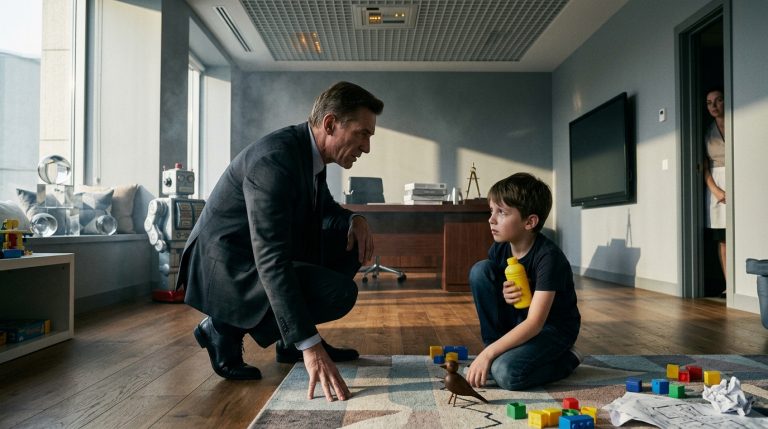
James didn’t move. He stood at the edge of the kitchen, his silhouette carved out against the harsh, bright LEDs of the hallway. He was dressed in a charcoal suit, the fabric stiff and pressed with such precision it seemed incapable of ever wrinkling, even under the strain of grief. He held a tablet in his hand—not looking at it, but using it as a shield, a thin rectangle of glass and circuit that defined his current existence: data-driven, insulated, and deeply, profoundly lonely.
Jessica felt the cloth in her hands, damp and soapy. She finished the last stroke on the granite, a final, unnecessary polishing of a surface that had seen no real life in months. She didn’t turn around immediately, choosing to let the silence sit between them, acknowledging the friction that had been building since she first arrived.
“Mrs. Chen said you were in Sophie’s room,” James said. His voice was not accusatory, but it possessed a jagged edge of territorial anxiety. “She also said you didn’t try to feed her.”
Jessica turned then, laying the cloth on the edge of the sink. She took a breath, letting the stale air of the high-rise settle into her lungs. “She isn’t hungry for food, Mr. Oliver. She’s hungry for something else. If I shove a spoon toward her face, I’m just another doctor in a white coat. Another person trying to bypass her reality.”
James stepped forward, the heels of his shoes clicking sharply against the tile. It was a rhythmic, aggressive sound. He stopped a few feet away, his jaw tight enough that a muscle pulsed beneath his temple. “My daughter is fading. Every day that passes without proper nutrition, she becomes a statistical tragedy. I hired you because you were supposed to be different. Because your background suggested you understood… loss.”
“I do,” Jessica said, her voice steady. She didn’t flinch. She saw the way his fingers gripped the tablet—the knuckles white, the way the tendons strained. It was a desperate, clawing grip. “But loss isn’t a medical condition you can solve with a balanced diet. You’re trying to treat her as if she’s broken, and in doing so, you’re treating her like she’s already gone.”
James looked away, his gaze drifting to the window. The city lights were beginning to twinkle below, millions of points of light in a sea of darkness, each representing a life that moved in a rhythm he no longer recognized. “I am keeping her safe,” he insisted, though the words lacked conviction. They sounded like a script he had rehearsed to keep the nightmares at bay.
Jessica felt a strange, chilling insight. He wasn’t just grieving for his wife; he was grieving for the control he had lost. His wealth, the sheer magnitude of his influence, had provided him the illusion that he could buffer himself and his daughter against the sharp edges of the world. Now, faced with a three-year-old who refused to follow the logic of his design, he was unraveling.
“Safety isn’t the same as living,” Jessica said softly. “You’re surrounding her with white walls and specialists, hoping that if you create a sterile enough environment, the pain won’t be able to breathe. But grief is like a weed, Mr. Oliver. You can’t suffocate it by depriving it of air. You have to let it grow, let it show its thorns, so you can eventually prune it back.”
James turned back to her, his eyes narrowed. For a moment, the performative rigidity of his posture flickered. He looked tired—not just sleepy, but bone-weary, as if his very skeleton were tired of supporting the weight of his suit and his status. “And what do you suggest I do? Just watch her waste away?”
“No,” Jessica replied. “I suggest you let her be a child again. Forget the nutrition charts. Forget the schedule for a moment. Just go into that room and stop being the ‘Billionaire Father.’ Be the man who lost his wife, too. If you’re afraid, show her. Maybe that’s the only way she’ll know it’s okay to be afraid herself.”
James stared at her. The silence stretched, filled only by the low hum of the building’s life support systems. It was a moment of supreme vulnerability, a crack in the foundation of his curated world. He opened his mouth as if to argue, to reassert his authority, but the words died in his throat. He looked down at the tablet in his hand, then clicked it off, the screen going black, transforming it from a source of information into a useless piece of dark glass.
“You’re overstepping,” he muttered, though there was no heat in it.
“I’m here to do a job,” Jessica replied, picking up the cloth again and folding it neatly. “And I don’t take shortcuts.”
He watched her for a second longer, an unreadable expression crossing his features, before he pivoted and walked back toward the stairs. His stride wasn’t as precise as it had been. He stumbled, just a hair, on the first step, catching himself on the banister with a sharp, metallic ring. He didn’t look back.
Jessica stood in the kitchen, the silence rushing back in to fill the space he had vacated. She felt the chill of the room again, the fading texture of the life he was trying to preserve. She knew, with a certainty that settled deep in her marrow, that they were approaching a crossroads. Tomorrow, she would have to push harder. She would have to force the issue of the routine, the food, the very air they were breathing.
She turned off the kitchen lights, leaving the room in a soft, grey dusk. The penthouse felt less like a fortress now and more like a waiting room. She climbed the stairs, the carpet muffling her footsteps, her heart beating in time with the quiet, suffocating pulse of the house. She knew what was coming. She just hoped they were all prepared to survive it.
CHAPTER 4: The Frequency of Memory
Jessica stepped across the threshold of the nursery, the door clicking softly shut behind her. The room was a museum of a happy childhood, preserved in amber. Every doll was seated at a precise, calculated angle; every plush animal had been arranged to face the center of the rug, as if waiting for a tea party that would never begin. It was a suffocating, perfect display—the kind of room that a grieving parent keeps clean, desperate to avoid disturbing the dust that might contain the last scent of a ghost.
Sophie remained in her spot by the bed, her small frame curled into a tight, defensive knot. She hadn’t moved since Jessica had left. The light from the setting sun slanted through the window, catching a fine layer of dust dancing in the air—the only movement in the room.
Jessica walked over to the velvet chair she’d occupied hours earlier, but she didn’t sit. She caught sight of something near the corner of the dollhouse. It was a small, wooden rabbit with one ear chewed and missing its painted eye. It was out of place, wedged behind the ornate, multi-story structure as if it had been discarded or perhaps hidden. It was a relic of chaos in a room defined by order.
She reached down, her fingers grazing the rough wood. It smelled faintly of old fabric and, surprisingly, lemon polish.
“I remember this one,” Jessica whispered, her back to Sophie. She didn’t look at the girl. She kept her focus on the rabbit, feeling the weight of the moment. “I had a bear that lost his nose. I thought if I hid him, maybe the fact that he was broken wouldn’t be so obvious. Like if I didn’t see the hole, the hole didn’t exist.”
She heard a rustle of fabric behind her. Sophie was moving—not much, just a shift of weight against the bed frame.
“He’s not broken,” Sophie’s voice was so faint it sounded like a tremor in the floorboards. “He’s just resting.”
Jessica smiled, a sad, slow curvature of her lips. She turned around, keeping her movements fluid and unthreatening. Sophie was looking at the rabbit now, her eyes wider than they had been, the hollow, vacant expression momentarily replaced by a flicker of protective instinct.
“Resting is important,” Jessica agreed. She held the rabbit out by its one good ear, dangling it in the mid-afternoon light. “But sometimes, when things rest for too long, they forget how to be part of the world. They get dusty. They lose their shine.”
She walked forward, slow and deliberate, and sat on the rug, a safe distance from the girl. She placed the rabbit on the floor between them. It was a breach of the room’s rigid, sterile architecture.
“My mama used to tell me that everything carries a frequency,” Jessica said, watching Sophie’s eyes lock onto the rabbit. “The walls, the floor, the toys. Everything remembers the laughter that happened here. Your room isn’t a tomb, Sophie. It’s a radio. It’s still playing the song of when you were happy.”
Sophie’s lip trembled. She reached out, her fingers hovering inches from the wooden rabbit before she pulled them back, as if she were afraid that touching it would release a memory too painful to bear. “It doesn’t play anymore. It’s just quiet.”
“Quiet is just another kind of song,” Jessica said. “It’s the song of waiting.”
She didn’t offer a meal. She didn’t offer comfort. She simply sat there, inviting the girl to acknowledge the existence of something—anything—outside of her own internal blackout. Jessica felt the sharp, cold pressure of the room. This was the decoy, she realized. The room, the toys, the order—it was all a shell, a decoy construct designed to make Sophie believe she could live in the past. But beneath that, there was something much more fragile: the realization that the past was gone, and the future was a terrifying, empty void.
“Do you want to know how I started eating again?” Jessica asked, her voice dropping to a conversational cadence.
Sophie looked up, her gaze finally meeting Jessica’s. There was no judgment in those eyes, only a profound, bottomless curiosity. “How?”
“I didn’t do it because I was hungry. I did it because I realized that if I disappeared, all the stories my mama told me would disappear, too. She gave them to me, and if I didn’t keep them going, she would have died a second time.”
Sophie looked down at her own knees. Her hands were trembling. “I have stories,” she whispered.
“I know you do,” Jessica replied. “But they’re getting dusty. Just like this rabbit.”
The air in the room seemed to shift. The tension, usually sharp and metallic, softened. Sophie picked up the rabbit, her thumb brushing over the empty socket where the eye had been. She didn’t say anything, but the way she held it—pressed against her chest, tucked into the fold of her sweater—told Jessica everything. The connection had been made. It wasn’t a breakthrough, not yet. It was a bridge.
Jessica stood up, her joints aching from the strain of the floor. She left the rabbit with Sophie and backed toward the door. She knew she had done enough for one day. If she pushed now, she risked snapping the thread.
As she reached the hallway, she looked back once. Sophie was staring at the rabbit, her posture slightly less rigid, the knot of her anxiety beginning to loosen just enough to allow the light to touch her face.
Jessica pulled the door shut, leaving Sophie in the blue-tinted twilight. She felt a surge of exhaustion, the kind that comes from walking a tightrope in the dark. She walked to the stairs, hearing the muffled silence of the penthouse waiting for her. She had planted a seed, but the soil was rocky. And downstairs, James was waiting, his world of cold steel and data-driven grief a constant, unyielding pressure. She would have to navigate him next.
CHAPTER 5: The Sizzle of Home
The darkness was not merely an absence of light; it was a physical weight, thick and suffocating. Jessica froze on the landing. The high-rise, usually humming with the quiet, expensive pulse of regulated climate and automated systems, had gone deathly still. The sudden lack of the air conditioning’s constant drone felt like a vacuum.
She didn’t panic. She moved by instinct, her hand tracing the smooth, cool wood of the wainscoting as she navigated toward the kitchen. She needed to be near the source, near the kitchen where the simple, honest tools of life were kept.
A moment later, the building’s emergency lights sputtered to life—a dim, sickly amber glow that turned the sterile hallways into something out of a dream. It was a flickering, jaundice-colored light that cast long, distorted shadows against the walls. Jessica hurried into the kitchen.
Mrs. Chen was already there, clutching a lantern she’d pulled from a service closet. Her face was stark white in the orange light.
“The grid is down,” Mrs. Chen whispered. “Mr. Oliver is downstairs in the study, trying to override the security systems.”
Jessica didn’t listen to the rest. She was already at the stove, pulling out the cast-iron skillet. The power failure was an interruption, yes, but it was also an opportunity. It stripped away the thin veil of technological safety that James relied on.
She turned to the cabinets. She grabbed the butter, the bread, the sharp cheddar she’d set aside earlier. She wasn’t going to wait for the grid to return to normal. She lit a small gas burner with a striker, the blue-orange flame blooming with a sharp, crisp hiss.
“What are you doing?” Mrs. Chen asked, her voice trembling.
“I’m making something that doesn’t require an app or a doctor’s approval,” Jessica said, her voice focused, grounded. “I’m making something that smells like a Sunday morning.”
She dropped a knob of butter into the pan. It hissed and popped, the scent of melting fat immediately cutting through the sterile, dust-heavy air of the penthouse.
She moved with an urgency that felt like a rhythm. She assembled the sandwich. It was a crude, beautiful thing—the bread thick and uneven, the cheese layered with a rough hand. As she pressed it into the skillet, the sizzle became a defiant sound, a sharp, organic crackle that seemed to demand attention.
She didn’t wait for permission. She grabbed the plate, took the lantern from Mrs. Chen’s trembling hand, and headed back to the stairs. The elevator was dead, so she took the steps, the iron railing cold and solid beneath her palm. Every floor she climbed felt like she was leaving the world of machines behind.
When she reached the second floor, the air felt different. The darkness had crept into the nursery, but the door was wide open. Sophie was standing in the center of the room, the wooden rabbit clutched tightly in her hand. She looked tiny, a silhouette of frailty against the backdrop of the large, unlit windows.
“Sophie?” Jessica whispered.
The girl didn’t turn. “Everything stopped,” she said, her voice small. “The lights, the house. It’s just like when Mommy went away.”
The realization hit Jessica like a blow to the gut. The power failure was a bridge to the very trauma she was trying to heal.
“The house is just resting, Sophie,” Jessica said, stepping into the room. She held the plate out. The scent of the grilled cheese—toasted, buttery, and warm—wafted through the stagnant air. “But I’m not. I’m here.”
She set the plate on the floor, the only thing in the room that held any warmth. She sat down, pulling the lantern closer so the light bathed them both in a soft, honeyed glow.
“It’s not perfect,” Jessica said, picking up a piece of the bread and breaking it. The crust cracked audibly. “But it’s real. And sometimes, when the world stops moving, all you can do is hold onto something that’s still warm.”
Sophie stared at the sandwich. Her chest was rising and falling in quick, jagged intervals. She was at a precipice, staring down at a choice she had been avoiding for weeks. The power was out, the house was silent, and the comfort of her father’s expensive solutions had vanished. She was alone with her grief, and for the first time, she was being offered a path that didn’t involve medicine or charts.
Jessica didn’t reach out. She didn’t prompt. She just held the warm piece of bread in her hand, the butter staining her fingertips, and waited. The seconds stretched, a slow, agonizing extension of time where the entire world seemed to hang in the balance.
Then, Sophie took a step forward. Her bare feet touched the rug, the sound barely a whisper. She knelt, her eyes fixed on the plate, and reached out.
As she touched the bread, the building’s main power grid suddenly surged back to life. The overhead lights flared on with a blinding, sterile brilliance, instantly washing away the intimacy of the lantern light. The sudden return of the hum—the HVAC, the security systems, the refrigerators—was a jarring, intrusive noise.
Sophie flinched, pulling her hand back as if burned. The moment of vulnerability shattered. She stood up, her face a mask of sudden, cold withdrawal, and retreated back to the corner of the room, clutching the rabbit to her chest.
Jessica remained on the floor, the plate of cooling grilled cheese a silent testament to the failure of her intrusion. She had pushed too hard, and the house had fought back. The security of the machine had returned, and with it, the walls had slammed back into place.
CHAPTER 6: The Breaking Point
The hum of the HVAC system, once a mere background noise, now sounded like a mockery. Jessica stayed on the floor, her knees aching against the plush, expensive carpet. Sophie was still in the corner, her back pressed hard against the wall, her eyes fixed on Jessica with a mixture of betrayal and fear. The plate, with its jagged, hand-torn pieces of grilled cheese, sat between them like a failed peace offering in a war no one else was truly fighting.
The door to the nursery creaked open. James stood there, his hair slightly disheveled, his breathing heavy as if he had run up the stairs. He looked at the room, at the light, at the plate on the floor, and finally at Jessica. His face was a map of exhausted frustration.
“I heard the power surge,” he said, his voice hard, tempered by a raw edge of panic. “I saw the monitors go dark. What happened here?”
Jessica didn’t look up immediately. She took a slow, steadying breath, trying to push down the rising tide of her own frustration. “I tried to reach her, James. In the dark. For a moment, it was working.”
“Working?” James stepped into the room, his presence dwarfing the nursery’s fragile, curated scale. He walked toward Sophie, but stopped when he saw her flinch. “Look at her. She’s terrified. You didn’t reach her, you pushed her.”
“I pushed her toward reality!” Jessica stood up, her movements stiff. “This room—this whole penthouse—it’s a pressure cooker of nostalgia and grief. You think you’re keeping her safe by surrounding her with these relics, but all you’re doing is showing her that there’s no place for her here unless she stays exactly as she was before the accident.”
James’s jaw tightened. “I am keeping her alive.”
“Are you?” Jessica countered, stepping toward him, her voice lowered, intense. “Because every time you walk into this room, you look at her like she’s a museum piece. You aren’t grieving with her, James. You’re managing her. You’re managing your loss. And she sees it. She’s three, not stupid. She knows that if she gets better, if she moves on, she’s abandoning the only version of herself that you seem to recognize.”
James recoiled as if she had struck him. He looked at Sophie, really looked at her, for the first time since he’d entered. The girl was shaking. The wooden rabbit in her hand looked like a weapon held against a world she didn’t want to inhabit.
“That’s not true,” James whispered, but the conviction was leaking out of him.
“Isn’t it?” Jessica pressed, her voice trembling now with the weight of the months she’d spent observing the cold, sterile distance between father and daughter. “When was the last time you sat on the floor with her and just cried? When was the last time you let her see that you were just as lost as she is? You spend your life behind that desk, working, as if you can build a wall high enough to keep the grief out. But all you’ve done is build a cage.”
James turned toward his daughter, his eyes wet. He took a hesitant, clumsy step toward her, then stopped. He seemed to realize, in that singular, agonizing moment, that he had no idea how to touch her without the structure of his own self-defense mechanisms.
Sophie made a sound—a soft, keening noise that was the auditory equivalent of a glass shattering. She scrambled to her feet, dropping the rabbit, and ran toward the door, bypassing her father entirely. She didn’t head for the stairs; she fled toward the back of the hallway, toward the small, rarely used solarium that overlooked the lake.
“Sophie!” James cried out, the desperation in his voice stripping away the last of his composed veneer. He turned to follow, but Jessica caught his arm.
“Let her go,” Jessica commanded. Her hand was firm on his sleeve. “She needs to see that you aren’t going to pull her back into the cage. If you chase her, you’re just the warden again.”
James stood frozen, his hand outstretched toward the empty hallway. He looked shattered, his posture sagging, the sharp charcoal edges of his suit suddenly seeming to hang loose on his frame. He looked at Jessica, and for the first time, he didn’t see an employee, or a caregiver, or a solution. He saw the only other person in this house who understood the architecture of their collective collapse.
“I don’t know how to stop,” he confessed, his voice barely audible, thick with the terrifying realization of his own helplessness. “I feel like if I stop moving, if I stop managing, if I stop… building, I’ll just fall apart. And if I fall apart, who’s going to be left for her?”
“You will,” Jessica said, her voice softening, though the urgency remained. “The man who’s left behind will be the father she actually needs. Not the one who buys her toys to replace the sunlight.”
She left him there, standing in the middle of the nursery, and walked toward the solarium. The silence of the house had returned, but it felt different now—thinner, frayed at the edges. She knew they were approaching the end of this current configuration. The walls were coming down, and for the first time, she had no idea what would be left when the dust finally settled.
CHAPTER 7: The Night of Truth
Jessica moved through the corridor, her own pulse the only sound in the vast, echoing space of the penthouse. The solarium, usually a place of manicured greenery and warmth, felt abandoned. The glass walls stood as translucent barriers between the interior warmth and the infinite, dark expanse of the lake.
Sophie was curled into a wicker chair, her frame silhouetted against the vast, starless sky. She wasn’t crying anymore. The silence emanating from her was absolute—a sharp, cutting stillness that made the air feel thin.
Jessica approached slowly, stopping near the edge of the rug. She didn’t sit. She didn’t hover. She just existed in the space, acknowledging the girl’s need for distance.
“It’s cold out here,” Jessica said, her voice soft, devoid of the frantic energy that usually defined the household’s interactions.
Sophie turned her head slowly. Her eyes were rimmed in red, but they were clear now, stripped of the haze of dissociation. “He thinks he can fix it with locks,” Sophie said, her voice devoid of any childhood cadence. “He thinks if he stays close enough, he can stop the world from taking me, too.”
The clarity of the statement struck Jessica like a physical blow. Sophie wasn’t just grieving; she was observing. She was watching her father’s desperate, frantic attempts to control the uncontrollable, and she understood them for what they were: a manifestation of terror.
“He’s afraid, Sophie,” Jessica replied, taking a step closer. “When you lose something as big as a mother, the world starts to look like a place where everything you touch is destined to break. He isn’t trying to cage you. He’s trying to build a shelter for the only piece of the sun he has left.”
“But it’s dark in here,” Sophie whispered, gesturing to the expanse of the room. “The shelter is dark.”
Jessica moved then, stepping into the radius of the wicker chair. She knelt, bringing herself to eye level with the girl. She reached out, her hand hovering for a moment before she rested it gently on Sophie’s small, cold hand.
“That’s why I’m here,” Jessica said. “To remind him that he doesn’t need to be the sun. He just needs to be a light. And sometimes, the smallest candle is better than the brightest spotlight because it doesn’t burn the people you’re trying to see.”
The connection was stark, immediate. Sophie didn’t pull away. She leaned in, a fraction of an inch, her gaze searching Jessica’s face. In that moment, the decoy secret—the idea that this was just a struggle over food or a child’s stubbornness—dissolved. The reality was much more painful, and much more human. It was a shared, desperate effort to navigate a reality that had shifted overnight.
“If I eat,” Sophie said, the question hanging in the air, “will I have to be the girl he wants me to be? The one who smiles for the cameras and goes to the parties and forgets that Mommy isn’t there?”
“No,” Jessica answered, her voice firm. “You’ll be the girl who remembers. You’ll be the girl who carries her mother’s stories and keeps them alive by living your own. You won’t be a replacement. You’ll be a continuation.”
A long silence followed. Outside, the lake groaned—the sound of ice shifting in the depths. Jessica felt the weight of her own past, the echoes of her own mother’s voice, and realized that she was not just teaching Sophie; she was being taught. She was learning that healing wasn’t about returning to the state before the fracture. It was about allowing the crack to exist, to become part of the structure, and finding the strength to keep standing despite it.
Sophie let out a long, ragged breath. Her shoulders dropped, the tension that had held her in a rigid cage for months finally draining away. She looked at the glass, out toward the dark, turbulent water.
“He’s still standing in the nursery,” Sophie said, a small, knowing hint of a smile touching her lips. “He’s waiting for me to come back.”
“He is,” Jessica said.
“He needs to know that it’s okay,” Sophie whispered. “That I’m not leaving.”
“Then let’s tell him.”
Jessica stood, helping Sophie up. The girl’s hand was still gripped in hers, a steadying, grounding weight. They walked back toward the nursery, the floorboards silent under their feet. The penthouse no longer felt like a tomb; it felt like a home in transition, a place where the air was finally beginning to circulate.
As they reached the nursery door, they saw him. James was sitting on the floor where Jessica had been, his back against the bed, his head in his hands. He looked smaller, less like the titan of industry and more like a man who had finally stopped fighting the tide.
Sophie didn’t hesitate. She walked into the room, her hand slipping from Jessica’s. She stopped before her father, standing still in the center of the room. James looked up, his eyes widening as he saw her. The desperation in his face vanished, replaced by an expression of pure, unadulterated awe.
He didn’t grab her. He didn’t pull her into his arms. He simply reached out a hand, palm up, and waited.
Sophie took it.
The air in the room didn’t change—the furniture remained, the silence remained, the weight of the past remained—but the friction was gone. The cage had opened. Jessica stood in the doorway, watching them, feeling the profound, quiet relief of a job that had finally, against all odds, begun to heal its own wound. The truth was still there, looming in the background, but for tonight, for this moment, they were simply present. Together.
CHAPTER 8: The Sunday Ritual
The sun rose over the Chicago skyline in a wash of pale, bruised lavender, casting long, thin shadows across the kitchen floor. It was Sunday. The air inside the penthouse felt different, no longer pressurized or scrubbed of oxygen. It was simply quiet, the kind of quiet that suggested a long, deep sleep had finally come to an end.
Jessica was already at the counter, the familiar weight of the cast-iron skillet in her hand. She moved with a purpose that felt less like a job and more like a rhythm. Beside her, on a sturdy, custom-made step stool, Sophie stood. The little girl’s hair was messy, her eyes bright with a spark that hadn’t been there weeks ago.
“More butter,” Sophie whispered, her hand hovering over the golden stick.
Jessica smiled, nodding. “Just a bit. It’s for the edges.”
The sizzle, when it came, was a warm, welcoming sound. It wasn’t the sound of a crisis or a confrontation; it was the sound of a ritual being reclaimed.
James entered the kitchen a few moments later. He wasn’t wearing his suit. He was in a simple sweater, his hair rumpled, his face showing the honest, unvarnished exhaustion of a man who had spent the night sleeping in a chair beside his daughter’s bed. He stopped in the doorway, watching them. The sight of him—unprotected, stripped of the charcoal armor—was the final piece of the collapse Jessica had been waiting for.
He walked over, not to the coffee pot, but to the stool. He placed a hand on Sophie’s shoulder, a gentle, grounded touch that anchored them both.
“It smells like… home,” he said, his voice thick.
“It’s the butter,” Sophie said, matter-of-factly. “Jessica says it’s the secret.”
James looked at Jessica. In the morning light, the lines around his eyes were visible, deep and telling, but the hollow, desperate emptiness that had characterized his gaze since the accident was gone. He looked like a man who had finally put down a heavy, invisible stone he’d been carrying for a lifetime.
“The secret,” James repeated softly, “is that I didn’t think I could survive the silence. I thought the money, the doctors, the schedules—they were the only things keeping the walls from falling in.”
“The walls were the problem,” Jessica said, plating the golden-brown triangles of bread. “You were trying to keep the world out, but all you did was lock the grief inside with you.”
James nodded, a slow, solemn movement. “I realize that now. Every time I looked at her, I saw a reminder of what I couldn’t protect. And I couldn’t bear to see her look at me and see my failure.”
Sophie turned on her stool, her small hand reaching out to touch his cheek. “You didn’t fail, Daddy. You were just scared. I was scared, too.”
The revelation of the core truth—the realization that James’s wealth and control were not manifestations of strength, but barriers of fear—had finally been laid bare. It wasn’t a sudden explosion; it was a slow, agonizingly honest unpacking. He had built his world to be impenetrable, and in doing so, had created a vacuum that nearly took his daughter.
They moved to the kitchen table. They sat in the bright, unfiltered sunlight, the remnants of the cold, metallic decor feeling suddenly insignificant.
James picked up a piece of the grilled cheese. He took a bite, chewed, and sighed. The simple, honest flavor of the food seemed to break the last of his resistance. He laughed, a short, choked sound that turned into a genuine, if rusty, smile.
“We need to talk about what comes next,” James said, his voice finally clear. “Not the medical plans. Not the schedules. Just… what we want our lives to look like.”
“We want Sundays,” Sophie chirped, dipping her toast into a small bowl of soup. “And we want to go to the park.”
“And we want to remember,” Jessica added, watching as James reached across the table and took Sophie’s hand.
The denouement was slow. The pacing of the house had shifted, the frantic, high-frequency energy of the past weeks settling into a manageable, human rhythm. Jessica looked around the kitchen. She saw the coffee pot, the granite counters, the sleek, expensive lines of the room, and she realized they were just objects now, not symbols of a life she had to manage.
The Payoff was there, in the way James’s grip on his daughter’s hand was no longer desperate, but firm and steady. Poetic justice, in a sense: the man who had tried to buy safety with his immense fortune had been saved by the simplest, most mundane act of love—a child deciding to eat a piece of bread.
The cool-down settled in. Jessica watched as James, for the first time, began to talk about his wife. Not as a ghost, but as a person. He shared a story about a trip they’d taken to the coast, about how she’d hated the sand but loved the sound of the ocean. He didn’t hide his tears. He let them fall, and Sophie, instead of turning away or withdrawing, leaned into him.
Symbolic closure came when Sophie reached for the wooden rabbit she’d brought to the table. She placed it in the center of the surface, right beside the plate. It was worn, broken, and imperfect, but it sat there with a quiet, stubborn dignity.
“We keep him,” she stated.
“We keep him,” James agreed.
As the morning progressed, the city below continued its relentless, fast-paced march, but inside the penthouse, time had slowed to a human crawl. Jessica looked at the two of them—the father and the daughter—and realized that the arc of their healing was finally complete. They hadn’t returned to who they were before, and they wouldn’t have to. They had become something new: a family that knew how to acknowledge the cracks, how to be honest about the pain, and how to find the courage to begin again, one Sunday at a time.
Jessica leaned back, the warmth of the coffee cup in her hands, and watched the sunlight move across the floor. For the first time, the penthouse was truly, undeniably a home.