The Weight of the Engine: A Bus Driver’s Quiet Resistance Against a Gilded Cage
CHAPTER 1: THE IDLE
The smell of the bus was the smell of my life: dry diesel, stale upholstery, and the iron-scent of a thousand early mornings. It was a workspace that didn’t ask for a tie or a smile. It only asked for attention. If you ignored the engine’s rattle, it died. If you ignored the kids, they drifted.
I leaned into the dash, tapping the temperature gauge. The needle was hovering in the gray, stubborn as a mule. Outside, the world was a study in desaturated colors—concrete, sky, and the brown, dead leaves of a late-autumn rot. I liked it that way. In the gray, you saw the details. You saw the way a kid’s shoelace was perpetually untied, or the specific way the light died in a boy’s eyes before he even reached the seat.
“Theo,” a voice clipped through the open door.
I didn’t turn around right away. I finished wiping a smudge of grease from the ignition switch. Mrs. Gable, the principal, stood on the bottom step, her shoes looking tragically thin against the cold metal. She was a good woman, but she lived in a world of budget reports and donor lunches—a world that had nothing to do with the asphalt and the stop signs.
“It’s not a choice, Theo,” she said, her breath fogging in the air. “The lottery picked you. It’s expected. The district expects you there.”
I looked at the sun visor. Taped there, corner-curled and yellowed, was the picture Sam had drawn: a crooked school bus, a dog, and a crude, shaky outline of a man behind a wheel. It held the gravity of a legal document in my life.
“I’m a driver, Mrs. Gable,” I said, my voice steady, scratching against the silence of the empty bus. “I don’t belong in a ballroom. The suit is a farce, and the guests are a distraction.”
“The guests are the reason this school stays open,” she countered, her tone sharpening, the pragmatism of a woman protecting a sinking ship. “Adeline Frost is the primary donor. She’s watching the staff. She’s looking for… stability.”
Stability. That was the word they used when they meant control.
I looked out the windshield at the yard across the street. The golden retriever was there, waiting. He didn’t care about donors or gala tickets. He cared about the rhythm of the route.
“I’ll go,” I said, the words feeling like rust falling from an old gate. “But tell them one thing. Don’t expect a show.”
As she turned and left, I felt the air shift. Something was wrong. I looked back at the visor, at Sam’s drawing. The way the dog looked at the bus—it wasn’t a pet looking at a master. It was a sentry. For the first time, I noticed the way Sam had drawn the fence lines—thick, heavy, closing in.
My gut, usually a reliable barometer for the road, tightened. It wasn’t just the gala. It was the way the air felt when her name was spoken.
I gripped the keys. I turned the ignition. The engine groaned, then fired, the vibration rattling my teeth. I had a route to run. I had forty lives to check on, and one, in particular, who was staring out a window, waiting for the only honest thing in his world to roll by. I pulled away from the curb, the heavy, rusted machine groaning into motion, and I left the principal’s concern behind in the dust. I was heading into the gray, but for the first time, I felt like the gray was closing in on me.
CHAPTER 2: THE PAPER TRAIL
The diesel engine’s rattle smoothed out into a rhythmic thrum as I pulled away from the school curb, but the vibration in my steering wheel felt different now. It felt like a tremor. Mrs. Gable’s words—Adeline Frost is looking for stability—stuck in my throat like dry grit. I wasn’t just a driver anymore; in her eyes, I was being positioned as a potential asset in a game I didn’t want to play.
I steered the heavy chassis through the familiar grid of the neighborhood. The rust-stained fenders caught the morning light, glinting a dull, oxidized orange. I knew every pothole on this route, every cracked sidewalk, every house where a kid waited with a backpack clutched to their chest. These were my coordinates, my world of gray, and I protected them with a singular, quiet focus.
As I made the turn onto Maple Street, the routine took over. I let the air brakes hiss, the sound sharp and biting in the crisp air. I slowed, my eyes scanning the yard across the way. The golden retriever was there, a blur of warmth against the winter-bitten grass, galloping toward the fence. I tapped the horn—a short, polite chirp.
In the rearview mirror, I saw Sam. He was in his usual spot, third row, right-hand side. He hadn’t moved. His face was pressed against the glass, eyes locked onto the dog, but as I glanced at him, I noticed a subtle shift in his posture. He wasn’t just looking at the dog; he was watching the rearview mirror, watching me.
A flash of recognition passed between us—a silent acknowledgment that today felt heavier than the rest.
I finished the run, the rhythm of picking up and dropping off forty lives helping to ground the spike of adrenaline Mrs. Gable had planted. By the time I returned to the terminal and cut the ignition, my hands were steady. I grabbed my thermos and climbed out, the air hitting me like a physical wall.
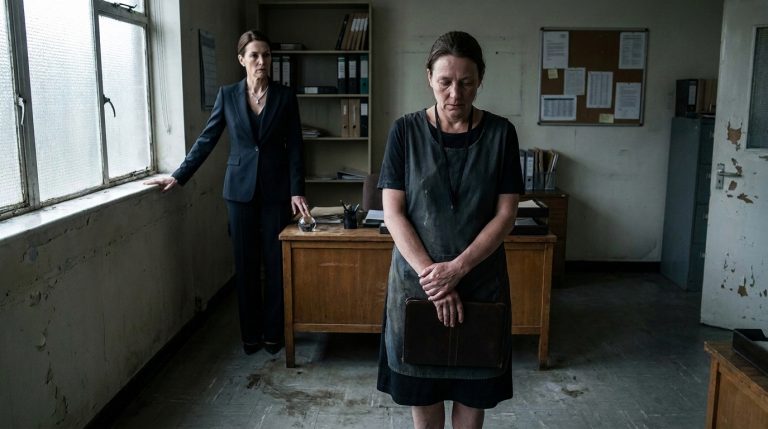
I went back to the office to drop off the daily logbook. Mrs. Gable was gone, but her desk was a wreck of frantic paperwork. I went to set the log down and noticed something out of place. Tucked under a heavy, brass paperweight—the kind that held more ego than paper—was a corner of a glossy, high-end corporate letterhead. It didn’t belong in the school’s budget reports.
I shouldn’t have looked. It was a violation of the invisible code I lived by. But the name Frost Industries peeked out, alongside a paragraph circled in red ink: Logistical access to district transit routes for infrastructure evaluation.
Infrastructure evaluation.
My gut tightened. That wasn’t about school buses. That was about the land, the geography of the route, the proximity to the Frost estate. I pulled my hand back as if the paper were hot. They weren’t just circling the mother; they were looking at the very map I traveled every single day.
I backed away from the desk, the silence of the office suddenly suffocating. I walked out into the cold, my boots crunching on the gravel. The iron smell of the yard seemed sharper, more aggressive. I climbed back into the bus, not to drive, but to sit. I needed the space. I needed the anonymity of the rusted metal.
I looked at the drawing on the visor again. The fence lines Sam had drawn—I realized then that they weren’t just fences. They were obstacles. He was drawing the world as he saw it: trapped, gated, and closed in.
I leaned my head against the cold, unyielding metal of the steering wheel. The board members weren’t just looking for a man to manage the money; they were looking to hollow out the life around the boy. And I had just been handed a ticket to the center of their spotlight.
I heard the door hinges creak. My heart did a slow, heavy thud against my ribs. I turned, expecting the principal, but it was just the empty terminal, the wind rattling the corrugated tin siding. I wasn’t alone, though. I was being watched by the implications of that letterhead, by the heavy quiet of the bus, and by the realization that my silence—my gray—was about to be invaded by a force that didn’t know how to see, only how to consume.
I reached up and touched the folded paper on the visor. We’re friends, Sam, I thought, the vow hardening in my chest. And friends don’t let the fences close in.
I started the engine again, not because I had to, but to break the silence. I needed to move, even if I was just circling the drain.
CHAPTER 3: THE COST OF THE CHARADE
The suit wasn’t just ill-fitting; it was a foreign object, a second skin of synthetic charcoal that didn’t know how to breathe. I stood in my bedroom, the floorboards groaning under my feet—a familiar sound, a comfort—while I wrestled with the collar. My hands, calloused and accustomed to the thick, vibrating grip of the bus wheel, felt clumsy against the delicate buttons.
Lily was in the next room, humming a song she’d learned in school. The contrast between her simple, honest melody and the cold, sharp reality of the evening ahead of me was a physical weight. I had to look the part. If I was going to navigate the ballroom, I couldn’t look like a man who spent his mornings scraping frost off a windshield.
I checked my reflection. A stranger looked back. The suit lacked the patina of hard work. There were no oil stains, no fraying cuffs, no history. It was clean, flat, and entirely unearned. I felt like an imposter in my own life, a man wearing a costume to a play where the stakes weren’t theatrical, but corporate.
I thought about the letterhead again. Infrastructure evaluation.
They were going to be there tonight. The board members. The men who ruffed Sam’s hair and called him “champ” while their eyes scanned the room for a profit margin. They were coming for the land, coming for the control, and they were using the promise of a “stable” father figure—someone like me—to lure Adeline into a trap she was already too tired to see.
I checked my watch. Time to go.
The drive to the hotel was a journey into a different city. The streets smoothed out, the lighting turned from the harsh, flickering sodium-vapor of the terminal to the warm, amber glow of privilege. The hotel was a monolith of marble and glass, a structure that felt like it had been built to shut out the rest of the world.
I pulled my old, reliable sedan into the valet lane, the engine’s rattle sounding like a war drum against the silent, polished finish of the luxury cars surrounding me. I stepped out, the cold air biting at the thin material of the suit. I didn’t wait for the valet to rush over. I left the keys, straightened my shoulders, and walked toward the entrance.
The lobby was a cathedral of curated excess. Everything was quiet, calculated, and expensive. I moved through the space, my gait still set to the stride of a man who worked for a living, purposeful and measured. I didn’t belong here, and I knew it. That was my only advantage. They would be looking for a man who wanted to be one of them. They wouldn’t be looking for a man who was already looking for the exits.
I reached the ballroom doors. The sound behind them was a low, undulating hum—the sound of three hundred people performing the art of the deal. I adjusted my cuffs.
I wasn’t here to win a prize. I wasn’t here to be the man Sam chose, or the man Adeline needed. I was here to look at the board members. I was here to see if the men who had circled that boy were the same ones who had signed that letterhead.
I pushed the doors open.
The warmth hit me first, followed by the smell of expensive perfume and sharp, cold ambition. The room was a sea of black ties and silk, but my eyes didn’t drift to the stage or the CEO. I kept my vision low, scanning the periphery, looking for the tell-tale sign of a suit that looked as synthetic and cold as mine.
I moved to the side, away from the center, finding a corner where the shadows were deep and the view was clear. I grabbed a glass of water from a passing tray, the crystal cool against my palm. I was in the gray, waiting for the iron to spark.
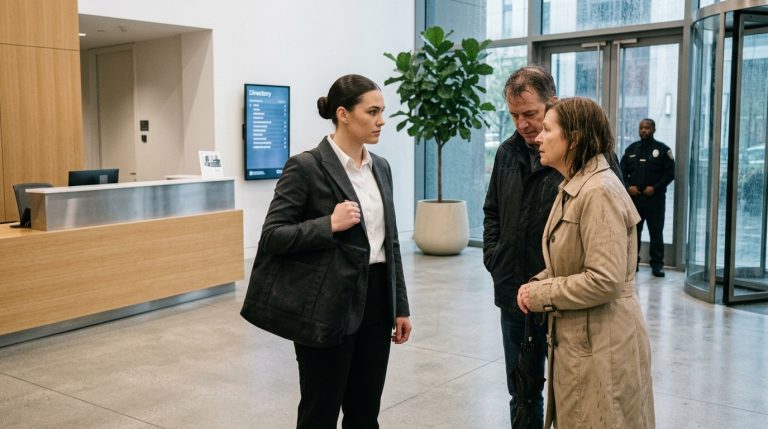
Across the room, standing near the stage, I saw a group of three men. They weren’t smiling at the crowd. They were watching the room with a cold, analytical precision. And there, standing in the center of their focus, was the nanny, Pilar, and behind her, the small, hunched figure of Sam, looking like a ghost in the machine.
They were already moving. The siege had begun.
CHAPTER 4: THE BALLROOM SHADOWS
I held the glass of water until the condensation made my grip slick. My eyes were fixed on the group near the stage. The three men—I’d noticed them earlier, in the periphery of my own memory, likely from the grainy photos in the district office files—were moving with the synchronized fluidity of a predatory unit. They weren’t just standing near Sam; they were creating a physical barrier, a slow-motion tightening of the circle that excluded the rest of the room.
The memory hit me then, a phantom weight in my chest. I saw my father, years ago, sitting at our kitchen table after his firm had been gutted in an acquisition. He had been silent, too—a heavy, hollowed-out quiet that felt like he was erasing himself from his own house to save us from the sight of his collapse. Watching Sam now, with his small frame hunched against the opulent backdrop of the ballroom, I felt that same, suffocating recognition. The boy wasn’t just grieving a father; he was witnessing the same mechanical destruction of his world by the very people standing over him.
I set the water glass down on a nearby side table. I had to move. If I stayed in the corner, I was just a spectator. If I moved, I became a variable.
I stepped out of the shadow. The movement was quiet, practiced. I didn’t head straight for them—that would be a tactical error—but instead drifted toward the perimeter of the stage, keeping my eyes on the floor, adjusting my tie as if I were a man looking for the buffet.
“He doesn’t seem to respond to the usual tactics, does he?”
The voice came from behind me, clipped and thin. I didn’t turn my head immediately, just adjusted my gait to catch a glimpse of the speaker in the reflection of a nearby floor-to-ceiling mirror. It was one of the men from the group, a man with a jawline as sharp and unyielding as a gate hinge. He wasn’t talking to me, but he was talking loud enough to be heard.
“The mother is the bottleneck,” another voice replied. A taller man, wearing a pin-striped suit that looked like it cost more than my bus, leaned down, pretending to whisper something into the other man’s ear. “If we can prove she’s incapable of managing the heir’s ‘condition,’ the board will trigger the protective trust clause. We don’t need her consent then. We just need the signature.”
The blood in my veins turned to cold iron. They weren’t just after the patents. They were after the custody. They were going to use Sam’s silence to declare Adeline unfit, to seize the company, and to turn the boy into a prop for their own board meetings.
I stopped walking. I was ten feet away, hidden by the massive, decorative floral arrangements that smelled faintly of rotting lilies.
“And the boy?” the sharp-jawed one asked, his voice devoid of anything resembling warmth. “He’s still recording, isn’t he? We need to make sure he doesn’t—”
He stopped. He’d seen me.
The reflection in the glass flickered as he turned. His gaze landed on me—not as a person, but as an obstruction. I didn’t look away. I didn’t smile, and I didn’t pull back into the shadows. I just stood there, the weight of the rented suit suddenly feeling like armor.
“Something wrong, friend?” he asked. The word friend sounded like a slur.
I stepped out from behind the flowers. My boots hit the polished marble with a dull, heavy thud that seemed to echo through the silence of the immediate area. I looked him in the eye, and for a moment, the entire room seemed to flatten into a single, dangerous plane.
“Just looking for a exit,” I said. My voice was low, devoid of the performative charm they were using to hunt. “Crowds like this tend to suffocate.”
He looked me up and down, dismissing me in a heartbeat, his eyes scanning for the tell-tale signs of a threat. He didn’t see one. He saw a man in a cheap suit, a man who didn’t know the protocol, a man who was, in his estimation, entirely invisible.
“The exits are marked, sir,” he said, turning his back on me with deliberate, practiced arrogance. “I suggest you use one. It’s a private function.”
I watched him walk back toward the group, toward Sam. I reached into my pocket, my fingers brushing against the rough, folded edge of the drawing Sam had given me months ago. It felt like a warning. The fences were closing in, and they were tighter than I had realized. I didn’t leave. I moved closer to the stage, looking for a way to bridge the gap before they moved to the next phase of their play. I had to get to Sam. I had to let him know he wasn’t alone in the room.
CHAPTER 5: THE DECISION AT THE STAGE
The wet chill of the champagne soaked through the cheap, synthetic fabric of my rented trousers, a shock that jolted my nerves back into a state of heightened, jagged readiness. A waiter, his face a mask of practiced apology, stammered something about being “terribly sorry,” his hands trembling as he reached for the stained cloth of my sleeve.
“Don’t,” I snapped, the word biting sharper than I intended.
I took a half-step back, my eyes darting toward the stage. The sharp-jawed man had stopped walking. He was looking in my direction, not because of the spill, but because of the movement—a subtle, predatory shift in the room’s atmosphere. He was checking his surroundings, a habit of men who consider themselves the architects of the environment. I needed to vanish, or at least, blend back into the wallpaper.
I stepped away from the waiter, my movements heavy, calculated. I crossed to the edge of the stage curtains, where the shadows pooled into a deep, velvety dark. From here, I could see them clearly: the three men were closing the gap on Sam. Pilar, the nanny, looked rattled, her posture hesitant, her eyes darting between the men and the front of the stage where Adeline stood, her back turned as she greeted a donor.
I couldn’t just stand here.
The strategy they were discussing—the “protective trust clause”—it was an immediate, structural threat. They didn’t just want the company; they wanted to strip the boy of his mother’s protection by leveraging his own silence. They were framing his trauma as a liability.
I noticed something then, a detail that had been hidden in plain sight. One of the men, the tall one in the pinstripe, wasn’t just talking. He was holding a small, metallic device in his hand, partially obscured by his palm. It wasn’t a phone. It was a digital recorder, angled toward Sam.
They weren’t just observing him; they were collecting him.
A wave of cold, righteous anger washed over me, the kind that had nothing to do with the suit I wore or the room I stood in. It was the same feeling I got when I saw a kid on my bus being cornered by a bully. My hand curled into a fist, the callouses rubbing against the palm. I had to intervene, but a scene here would only play into their hands. They wanted a disruption; they wanted an excuse to label the people in Adeline’s orbit as “unstable” or “violent.”
I watched as the tall man reached out to ruffle Sam’s hair.
“Looking a bit quiet today, champ,” he said, his voice carrying over the music. “Cat got your tongue?”
Sam didn’t blink. He stared straight ahead, his eyes fixed on a point somewhere behind the stage curtains. But I saw his hand—it was trembling, a slight, rhythmic twitch against the fabric of his blazer.
I took a breath. I wouldn’t disrupt. I would distract.
I looked at the light rig above the stage. A heavy, industrial-grade spotlight was angled down, its cable running along the floor, exposed and vulnerable. A simple trip, a jar to the connection, would plunge the stage area into darkness, forcing a pause, scattering the circle, and pulling the focus away from the boy.
I moved, my boots silent on the carpet. I felt the friction of the room—the air, the heat, the smell of money—and I ignored it. I was a driver. I knew how to navigate hazards. I kept my eyes on the cable. I was halfway to the rig when the sharp-jawed man’s head snapped around, his eyes locking onto mine with the intensity of a bloodhound. He didn’t know what I was planning, but he knew I was moving with intent.
He whispered something to the man with the recorder.
The taller one didn’t look at me. He just shifted his position, effectively blocking the path to the cable.
They were faster than me. They were smarter than I had anticipated. The game had shifted. I wasn’t just observing the siege anymore; I was part of the board, and they were already moving to take me off it. I realized then that my presence tonight hadn’t gone unnoticed by the “architects.” They had been waiting for me to make a move.
I stopped, my body freezing in the middle of the crowded room. I had forced them to acknowledge me, and in doing so, I had lost the one thing I possessed: invisibility. I looked at Sam, and for the briefest of seconds, our eyes met. There was no fear in his expression—just a terrible, calm understanding. He knew.
The man with the recorder stepped toward me, his smile a thin, surgical line. “You’re lost, aren’t you, Mr. Marsh?”
He knew my name. The trap wasn’t just closing; it had already been sprung.
CHAPTER 6: THE BREACH
The man’s smile didn’t touch his eyes. It was a professional, practiced expression, the kind used by technicians before they dismantle a faulty machine. He took another step forward, closing the space until I could smell the sharp, metallic tang of his cologne—something designed to project authority and sterile cleanliness.
“You’re a long way from the bus terminal, Mr. Marsh,” he said, his voice a low, modulated hum that didn’t drift to the surrounding guests. He held the recorder slightly lower, but his thumb remained poised over the button. “I imagine you’re feeling a bit out of your depth. People who don’t know the rules usually do.”
I held my ground, though every muscle in my legs was coiled for a quick, defensive pivot. I didn’t look at his eyes; I looked at his hands, watching for the tension in his fingers. The ballroom was still humming around us, a oblivious, gilded ocean of ignorance. They were all dancing on the surface, while beneath them, the floor was being systematically cut away.
“I know the rules,” I said, my voice steady, scratching against the polished veneer of his composure. “They usually involve not cornering a child in a room full of people.”
The man chuckled—a dry, humorless sound. “That’s the romantic version. The reality is much more efficient. We’re simply evaluating the viability of the Frost estate’s current management. And right now, the primary variable is this child’s… unfortunate lack of communication.”
He nodded toward Sam, who was standing perfectly still, his small hands balled into fists. Pilar, the nanny, was looking at me with a mix of terror and desperate hope. She was a bridge, and she was breaking under the strain.
“He’s not a variable,” I said, stepping between the man and the boy. The move was instinctive, a reflex born of six years of shielding those kids from the worst of the morning’s chill. “He’s a person. And if you think you’re going to use a recorder to frame his silence as incompetence, you’re not just wrong—you’re failing at the only thing that matters.”
“Which is?” he asked, tilting his head.
“He sees you,” I said. “He’s been watching you for a year and a half. He knows exactly what you are.”
The man’s expression darkened. The surgical smile faltered, replaced by a cold, hard focus that radiated a sudden, palpable threat. He reached out, his hand gripping my elbow—a hard, squeezing pressure that felt like the jaw of a clamp.
“You’re a nuisance, Theo,” he said, the mask of professional courtesy dropping entirely. “And nuisances are easily cleared from the road.”
He started to steer me away from the stage, toward the service doors. I felt the physical leverage he was applying, the weight of the corporate apparatus behind his grip. This was the failure I had been bracing for—the moment where my refusal to play the game became the very thing that pulled the curtain back.
But I didn’t pull away. I let him lead, gauging the distance to the service corridor. I needed to separate them from Sam.
As we passed the edge of the stage, I saw Adeline turn. She caught sight of me being led away, her eyes widening. For a second, the gala’s careful choreography shattered. She started to move toward us, her hand reaching out, but the sharp-jawed man—the leader of their little pack—stepped into her path, whispering something that caused her to stop, her face pale, her gaze locking onto her son.
They weren’t just taking me; they were isolating the family, piece by piece.
We reached the service threshold. The air here was cooler, smelling of grease and industrial cleaning agents—a sharp, welcome contrast to the cloying perfume of the ballroom. As soon as we cleared the doorway, the man shoved me against the corrugated metal wall. The impact was dull and sickening.
“This,” he hissed, his face inches from mine, “is where you stop. You go home to your daughter, you drive your bus, and you forget you ever saw us. If you don’t, the district is going to find a very good reason to terminate your contract. And trust me, you won’t be driving anyone anywhere after that.”
I looked at him, feeling the cold metal of the wall through the thin suit jacket. I wasn’t just a bus driver anymore. I was a witness. And witnesses were the one thing they couldn’t control.
“You talk about the road like you own it,” I said, breathing hard. “But you’ve never driven it. You don’t know what it’s like to look at a kid and realize they know more about you than you know about yourself.”
I shifted my weight, shifting my center of gravity, and felt the iron-hard determination settle in my bones. I wasn’t going home. I was just getting started.
CHAPTER 7: THE SOVEREIGN PROTECTOR
I didn’t try to struggle. I didn’t try to push him off. I let the man’s grip define the situation, let him feel the tension of a body that was used to the grinding resistance of a heavy engine. He was counting on me to be a civilian, someone who would panic or plead. He wasn’t counting on a man who spent his life watching the way things break.
“You think you’re protecting him,” the man sneered, his face a mask of patronizing pity. “But you’re just accelerating the inevitable. Once the board sees his reaction to tonight—the confusion, the trauma—the petition for guardianship will be signed by morning. You aren’t a shield, Marsh. You’re the reason he’s going to lose everything.”
I looked past him, through the glass of the service door, into the quiet, industrial gloom of the back corridor. I didn’t see a threat. I saw a path.
“You’re working off a script,” I said, my voice low and dangerously even. “You think you’ve got the board, the lawyers, and the leverage. But you forgot the most basic rule of the road: you never assume the cargo is staying put.”
I slammed my forehead into the bridge of his nose—a short, sharp, sickening thud that sent him reeling backward. He staggered, his grip on my elbow snapping, and I didn’t wait for him to recover. I drove my shoulder into his chest, forcing him back until his head hit the metal door frame. He went down, his legs folding like wet cardboard.
I didn’t stick around to watch him bleed. I turned and ran, not back toward the ballroom, but deeper into the belly of the hotel, toward the loading docks. If they were going to play this with corporate tactics, I’d counter with the only thing they didn’t understand: the ground level.
I burst out onto the loading dock, the night air hitting me like a physical blow. The concrete was cold, slick with a fine mist of rain. I needed to get to Adeline, but not here. Not with the board surrounding her. I needed to pull her into the only space they couldn’t control: the public record.
I sprinted toward the parking area, my suit torn, my breath coming in jagged, rhythmic gasps. I saw my car, sitting alone under a flickering mercury-vapor light, a splash of rust in a sea of luxury. I reached it, fumbling for the keys, when the headlights of a black SUV swept across the pavement, pinning me in the beam.
It wasn’t the board. It was Pilar.
The SUV slid to a stop, the passenger door swinging open. Pilar was inside, her face white, her eyes wide with a frantic, desperate intensity. “Get in,” she hissed. “Adeline found the recorder. She knows. She’s meeting us at the Maple Street stop—the old one.”
I paused, hand on the door handle. It felt too clean, too fast. “How?”
“She saw you go out,” Pilar said, her voice trembling. “She realized they were following you. She’s not playing their game anymore. Get in, Theo! We have to get to the boy before they realize you’re gone.”
I looked back at the hotel, the monolith glowing in the distance. The board members were probably already realizing their enforcer hadn’t returned. If I went with Pilar, I was committing to a confrontation I wasn’t sure I could win. If I stayed, I was leaving the family to the wolves.
I jumped into the passenger seat, the smell of leather and expensive plastic a jarring shift from the grease and diesel of my own vehicle. As we peeled away from the curb, I looked at the side mirror. A shadow detached itself from the hotel entrance—the sharp-jawed man, nursing his nose, pulling his phone from his pocket.
The game had entered the final, frantic minutes. The “protective trust” was being triggered, the board was mobilizing, and we were racing toward the only place where the truth mattered.
“They’re not just going to let us leave,” I said, looking at the road ahead, the darkness stretching out like an unlit highway.
“They won’t have to,” Pilar said, her eyes fixed on the dash. “Adeline isn’t going to the lawyers. She’s going to the press. She’s releasing the patents. She’s burning the whole house down.”
The realization settled in my chest, heavy and inevitable. She wasn’t just defending her son; she was destroying the board’s motive. The patent release would tank the company’s value, rendering the board’s takeover worthless overnight. It was the ultimate, scorched-earth defensive measure.
I leaned back, my heart hammering against my ribs. We were driving toward a fire, but for the first time since the gala began, I felt the air clearing. The gray was fading, and in its place, the hard, unvarnished truth was finally surfacing. We were almost there.
CHAPTER 8: THE FINAL GEAR
The SUV handled the curves of the secondary roads with a heavy, mechanical stability, but inside the cabin, the air was thick with the scent of ozone and cold sweat. I watched the gray silhouettes of suburban homes slide past the window, each one a closed door, a private boundary. Pilar gripped the leather-wrapped steering wheel, her knuckles showing pale white under the dim instrument lights. We didn’t speak. The time for tactical calculations had passed; the road was narrowing to a single point.
When the vehicle finally shuddered to a halt at the corner of Maple Street, the headlights cut through the misty rain, illuminating the familiar rusted chain-link fence of the golden retriever’s yard. The dog was there, standing perfectly still at the perimeter, a silent sentinel wrapped in the damp dark. A few yards away, Adeline’s unpolished sedan was idling, its exhaust piping a low, pale plume into the chill air. Adeline was standing outside the driver’s side, her coat pulled tight around her, holding Sam close against her flank. The boy looked remarkably small against the vast, dark backdrop of the empty street.
I opened the passenger door, the hinges groaning against the wet cold, and stepped out onto the gravel. The iron-scent of the winter earth rose to meet me. Before I could even close the door, the aggressive sweep of high beams cut through the mist from behind us. The black corporate sedan from the gala pulled up with a harsh crunch of stone, its brakes squealing with a high-pitched, metallic complaint.
The sharp-jawed man stepped out of the driver’s side. A white handkerchief was pressed to his nose, stained with a dark, blooming flower of blood, but his eyes were entirely devoid of heat. They were steady, cold, and transactional. In his left hand, he carried a heavy leather folder; in his right, the small digital recorder, its red indicator light pulsing like a miniature heartbeat. Two other men in tailored overcoats stepped out behind him, forming a wall of dark wool and calculated posture.
“It’s over, Adeline,” the sharp-jawed man said, his voice carrying clearly over the idle of the engines, stripped of all ballroom courtesy. “The board has executed the emergency trust provision. I have the signed injunction right here. The boy’s psychological instability has been publically demonstrated tonight. Your refusal to secure a stable household is documented. Custody and corporate voting rights revert to the management committee effectively immediately.”
Adeline didn’t flinch, but her grip on Sam’s shoulder tightened, her fingers sinking into the fabric of his miniature blazer. “You built this entire charade,” she said, her voice thin but unyielding as iron. “The suitors, the pressure, the threats. You wanted to use my son to lock down the logistics patents.”
“It’s simple infrastructure,” the man replied, stepping closer, his boots grinding the dry gravel into dust. He raised the recorder, angling it toward Sam. “The boy cannot speak. He cannot participate. He is a legal void under the terms of your late husband’s trust. We are simply filling that void with corporate governance.”
I stepped forward, my boots making a deliberate, heavy sound that drew the attention of the two overcoated men. I stood between them and the child, my frame blocking the path. “He isn’t a void,” I said, the words rough and grounded. “And he’s not silent because he’s broken. He’s silent because he knows exactly who you are.”
The sharp-jawed man let out a short, wet breath through his damaged nose. “His medical records say otherwise, driver. His silence is a pathology. It’s the evidence we need.”
“No,” a small, clear voice broke through the hum of the idling engines.
The sound was a physical shock. The two board members stepped back instinctively. The sharp-jawed man froze, the recorder held mid-air.
Sam stepped out from behind his mother’s coat. His brown eyes were fixed directly on the sharp-jawed man, completely steady, carrying the weight of a maturity no six-year-old should possess.
“My dad didn’t fall,” Sam said, each word articulated with absolute, devastating precision. The voice was small, but it filled the empty street completely. “You stood in his office. You told him you would break the trucks. You told him the routes belonged to the committee. I was under the desk. I heard the paper rip when he told you to leave.”
The silence that followed was absolute, save for the rhythmic clicking of the digital recorder in the man’s hand, still capturing every syllable. The anti-expository barrier had shattered; the truth wasn’t a puzzle anymore, it was a matter of record.
“He didn’t speak to you because you were the ones who broke his father,” I said, looking the sharp-jawed man dead in the eye. “His silence wasn’t a sickness. It was a refusal to negotiate with the people who killed his peace. And you just recorded the entire confession on your own device.”
Adeline stepped forward, her face pale but her expression cast in stone. “The patent filings were transferred to the public domain ten minutes ago via the terminal in Pilar’s car. The logistics infrastructure is open-source now. There is no company left to take over. The valuation is gone.”
The leather folder in the man’s hand seemed to grow visibly heavier. The two men behind him exchanged a quick, panicked glance, their calculated posture dissolving into the nervous shifting of corporate employees realizing the ground had vanished beneath them. The sharp-jawed man slowly lowered the recorder, his face turning an ash-gray under the pale streetlights. The legal papers, the trust clauses, the strategic maneuvers—they were all just dead wood now, stripped of their power by an open-source filing and a boy who had finally chosen to use his weight.
Without a word, the sharp-jawed man turned, his movements stiff and awkward, and climbed back into the sedan. The doors slammed shut, a sequence of dull, heavy reports, and the vehicle backed down the road, its taillights bleeding a long, crimson stain into the wet asphalt until the dark swallowed it completely.
The morning sun didn’t rise with a dramatic flare; it arrived as a slow, gradual thinning of the gray, the light turning the color of weathered zinc.
I sat in the driver’s seat of the ’08 International, the engine turned off, the terminal around me quiet. The smell of dry diesel and old vinyl was a comfort, a reminder of the gravity of routine. I reached up and carefully pulled the yellowed, corner-curled drawing down from the sun visor. The top left edge had begun to tear from the constant vibration of the route.
I reached into my toolbox, pulled out a roll of heavy black electrical tape, and tore off a tiny, precise strip. With calloused fingers, I smoothed the tape over the tear, reinforcing the paper, binding the yellowed margins back together until the structure was sound again. It was a small piece of maintenance, but it felt like the only thing that mattered.
“Theo,” a voice called from the steps.
I looked up. Sam was standing on the bottom step, his backpack slung over one shoulder, his small boots clean. Behind him, standing on the gravel of the terminal lot, Adeline was waiting in her plain jeans, her hands in her pockets, the wind catching the edges of her hair. There were no assistants, no drivers, no corporate filters. Just a mother waiting for the bus to finish its run.
Sam walked down the aisle, his steps rhythmic against the ribbed rubber flooring. He stopped at the third row, right-hand side, then turned and looked at me, a soft, small smile breaking the solemnity of his face.
“Morning, partner,” I said, my voice warm against the early chill of the cab.
“Morning, Theo,” he said clearly, his voice steady as he took his seat by the window. “The dog is going to be waiting.”
I nodded, my chest tightening with a deep, quiet resonance that had nothing to do with the wealth of the world outside this metal frame. I reached out, turned the key, and let the heavy engine roar to life, its familiar, rhythmic vibration settling into the floorboards, ready for the road ahead.