The Architect of Silence: How a Single Red Streak Toppled a Suburban Empire of Petty Tyranny
CHAPTER 1: The Crimson Threshold
The morning air tasted like wet iron and cheap solvents. It was a sensory betrayal. I looked down at the mug in my hand, then back at the barn door. The red paint—a violent, glossy scar against the silver-gray history of the chestnut—was still tacky to the touch.
I didn’t yell. I didn’t even drop the mug. I set it down on the porch railing with a precision that bordered on surgical. My heart rate hadn’t spiked. If anything, it had slowed, settling into that familiar, metronomic rhythm I hadn’t tapped into since the last time a piece of shrapnel had hummed past my ear in the desert.
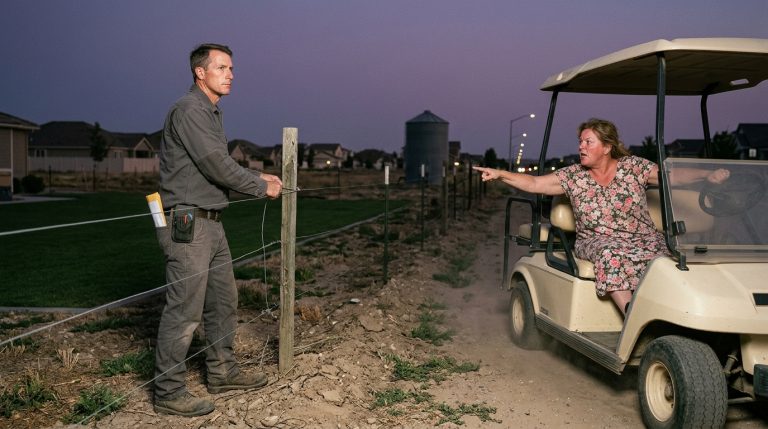
Karen was still there, perched on her golf cart, her face flushed with a self-satisfaction that turned my stomach. She looked like a child who had just finger-painted on the walls of a cathedral, waiting for the applause.
“You should be thanking me,” she wheezed, her breath hitching with an exertion that was almost comical.
I took the first step off the porch. The gravel crunched under my boots, a sound that seemed amplified in the pre-dawn stillness. My eyes were fixed on the handle of the golf cart, the way her knuckles were white against the pink steering wheel, the way the spray can rested on the seat beside her like a loaded weapon.
“Thirty seconds,” I said. My voice wasn’t loud. It wasn’t angry. It was a flat, dead thing. “You have thirty seconds to clear this property.”
She scoffed, a rattling, ugly sound that echoed off the barn siding. “Is that a threat, Mr. Miller? Because I have the bylaws, and I have the HOA board, and I have every right—”
“Twenty-five seconds.”
I didn’t break stride. I didn’t reach for anything. I didn’t need to. I was measuring the distance, calculating the trajectory of her exit, noticing the way her eyes darted to the side—not out of fear of me, but out of a sudden, dawning realization that the rules she used as a shield were no longer functioning as a barrier.
The air felt colder, sharper. I looked at the red paint again, noticing the way it pooled in the fine, hand-adzed grooves of the wood. It wasn’t just vandalism. It was an intrusion into the one place where I had finally learned how to breathe.
“You don’t get it, do you?” I continued, stopping ten feet from the golf cart. I kept my hands visible, relaxed, but my posture was a steel rod. “You’ve been playing a game of chicken, Karen. You thought I was a civilian who’d tire out.”
She sneered, but there was a flicker of something new in her eyes. It wasn’t guilt. It was the frantic, trapped confusion of a predator finding itself inside the cage.
“I am the president of this association,” she snapped, though her hand went to the ignition of the cart.
“You’re a trespasser,” I corrected. “And you have fifteen seconds left.”
As the silence stretched, I saw something that stopped me cold. Tucked into the side pocket of the golf cart, half-hidden by a stack of meeting notices, was a familiar document—a survey map of the estate lots, circled in heavy black marker. My property. The lines weren’t just showing boundaries; they were showing parcel divisions. My barn wasn’t in the way of a zoning rule. It was in the way of a development plan.
My phone, resting in my pocket, vibrated. It was a notification from the camera I’d hidden in the oak tree. The feed was active. The evidence was being archived.
She turned the key. The electric motor hummed to life, a pathetic, high-pitched whine. She shot me one last look—a mixture of venom and pure, unadulterated shock that I wasn’t flinching—and peeled away down the gravel road, the golf cart tires spitting rocks into the grass.
I didn’t watch her go. I turned back to the door. The red paint was already starting to skim over in the cool air, setting permanently into the century-old grain. I pulled my phone out, opened the archive, and hit save.
This wasn’t a skirmish. This was a war of documentation, and I had just found the first missing piece of the puzzle.
CHAPTER 2: The Geometry of Defiance
The crimson smear was already tacky, a thick, synthetic scab forming over the hundred-year-old history of the chestnut beams. I touched the edge of the paint—it didn’t smudge; it clung, eager to bond with the wood. My fingertips came away stained with a chemical, artificial red that seemed to vibrate against the natural silver-gray of the barn.
The silence that followed Karen’s retreat wasn’t the peace I had come to the countryside to find. It was a vacuum, waiting to be filled.
My pulse was steady, counting off seconds like a metronome. I could still feel the phantom weight of a Kevlar vest, the familiar, suffocating heat of a blast suit. In the field, we didn’t waste time on righteous anger. You didn’t curse the device that was trying to kill you; you analyzed its triggers, you mapped its proximity, and you found the shunt that would render it inert. Karen had just turned my barn into a live site, and the “device” was her entire bureaucratic infrastructure.
I walked back inside, the grit of the gravel driveway biting through my socks. Sarah was standing in the kitchen, her eyes wide, reflecting the morning light that spilled through the window. She had heard the golf cart, the screech of tires, the aggressive silence that had followed.
“Jack?” Her voice was a frayed thread. She was gripping her robe at the throat, her knuckles white. “What was that? Was that her?”
I didn’t answer immediately. I crossed to the kitchen island, opened the drawer, and pulled out my notepad. The pen felt right in my hand—weighted, reliable.
“She tried to paint the barn, Sarah,” I said, my voice as level as a surveyor’s line.
“She what? Why?”
“Because it’s a tactic,” I muttered, more to myself than her.
A memory flared, sharp and intrusive: the smell of burning copper and the absolute stillness of a street in Fallujah. I had been staring at a pile of wires inside a discarded fruit crate, my hands steady, my mind stripping away the noise of the world until only the mechanics of the threat remained. That was the headspace I was in now. Karen’s paint wasn’t just vandalism. It was a marker. A way to stake a claim on a property that she had clearly identified as a target.
I moved to the laptop, my movements fluid, efficient. The camera feed from the oak tree was still running, the high-definition video showing the barn door in crisp, unforgiving detail. I didn’t look for the vandalism; I looked for the behavior. I watched the way she had parked the golf cart—not randomly, but at an angle that gave her a clear line of sight to the property markers. She had been precise. Calculating.
“You’re not going to call the sheriff, are you?” Sarah asked, moving closer, her gaze flickering to the screen. “You’re doing that thing again. The… the ‘fix-it’ look.”
“I am calling the sheriff,” I said, finally looking up. My eyes felt dry, focused. “But that’s for the record. The record is how you win in a court of law. To win on the ground, I need to know why she’s so obsessed with this specific barn.”
I opened the folder on my desktop labeled Oak Creek Estates: Public Records. I pulled up the digitized plat maps I had downloaded months ago when the mailbox “violation” first started. I expanded the view, zooming into the coordinates of our ten acres.
There, hidden under the layers of property lines and utility easements, was the anomaly. The barn sat at the confluence of three different parcel segments—segments that had been quiet for years, but were suddenly listed under a holding company called Crestline Development.
A cold, sharp realization settled in my chest. This wasn’t about trim colors. This wasn’t about “aesthetic integrity.” The barn was the pivot point for a land acquisition that would make the surrounding HOA homes irrelevant. By forcing me to modify the barn, by creating a paper trail of “code violations” and “non-compliance,” she was systematically lowering the property’s valuation, creating a trail of documentation that would make a forced sale or a legal takeover look like a standard administrative procedure.
I stood up, the chair scraping harshly against the floorboards. I felt a surge of cold adrenaline. The “device” was clear now. She wasn’t just a neighbor with a binder; she was an operative for a development firm, using the HOA as a front to clear the land for the next big track-home expansion.
“Sarah,” I said, my tone shifting, losing the last remnants of civilian softness. “Get the binder.”
“The binder?”
“The four-inch one. The one with the clear sleeves.”
She looked at me, seeing something in my face that made her go very still. She didn’t ask again. She knew that look—the look that meant the war had stopped being a hypothetical and had become a professional, tactical necessity.
I walked to the front window. The morning sun was climbing, lighting up the barn door. It was a beautiful, ancient thing, and now, it was also a shield. I wasn’t going to let her strip away the history or the land. I had spent twelve years dealing with people who wanted to blow things up. I knew exactly how to dismantle a threat that relied on bureaucracy and intimidation.
I sat down at the table and began to outline the timeline.
Violation 1: The Mailbox. Goal: Establish non-compliance.
Violation 2: The Grass. Goal: Establish neglect.
Violation 3: The Barn Door. Goal: Destruction of original structural integrity.
The logic was perfect. It was elegant. And it was exactly what I needed to trigger a counter-offensive that would leave her infrastructure in ruins. I wasn’t just a veteran, and I wasn’t just a homeowner. I was the person who was going to systematically dismantle her petty kingdom, one certified letter at a time.
I opened the email client. The sheriff would get the video. But first, the lawyer. I needed someone who knew the difference between a neighborhood dispute and a racketeering operation.
The silence of the house felt heavy, like the seconds before a controlled detonation. I took a deep breath, the smell of my coffee now mingling with the lingering, sharp scent of the paint that had drifted in through the screen. Everything was in place. The perimeter was secure. The target was acquired.
I started to type, my fingers moving with the rhythmic, deliberate pace of a man who knew that in the end, truth wasn’t just a moral concept. Truth was a weapon, and I was going to sharpen it until it cut.
CHAPTER 3: The Soil and the Shadow
The screen of the laptop flickered, casting a pale, sterile glow over the kitchen table. My reflection was ghosted in the dark glass, eyes narrowed, jaw set—a face I hadn’t truly seen since the days of checking minefields. I finished the draft of the email to Jessica Riley. I didn’t mince words. I laid out the timeline, the photos of the survey maps, and the connection to Crestline Development. I hit send, the sound of the digital transmission feeling oddly loud in the quiet house.
Outside, the wind picked up, rattling the screen door—a thin, reedy sound that normally wouldn’t bother me. Tonight, it felt like an alert.
“Binder’s ready,” Sarah said, her voice softer now, grounded by the routine of the task. She set the thick, four-inch folder onto the table. It was heavy, a collection of grievances and evidence that felt more like a weapon than a simple record.
I pushed away from the table. The “fix-it” mode was still fully engaged, but the static in my head was organizing into a clear, sharp signal. If Karen was working for Crestline, she wouldn’t stop at a single act of vandalism. She would need to see the result of her work. She would need to verify if the pressure was working, if the “target” was showing signs of buckling. She’d be back, or she’d send someone to check the status of the “compliance.”
I grabbed a heavy-duty flashlight from the mudroom. “I’m going to check the barn perimeter.”
“Jack, it’s pitch black out there.”
“Exactly,” I replied.
I stepped out onto the porch. The air was colder now, the kind of biting, sharp chill that smelled of coming rain. I didn’t take the direct path to the barn. I circled wide, my feet avoiding the gravel, moving with the silent, deliberate grace I had perfected on patrols. My boots were soft on the grass, my breathing steady and shallow.
When I reached the barn, the red paint on the door looked darker in the moonlight, a viscous, ugly stain. I ignored it. My focus shifted to the foundation. If they wanted this land, they needed more than an aesthetic complaint; they needed a reason to condemn the structures. They needed a liability.
I knelt in the dirt, the damp earth cold against my knees. I swept the beam of the flashlight across the base of the post-and-beam construction. My eyes weren’t looking for rot; they were looking for disturbance.
The light caught something that didn’t belong. A small, neatly circular hole, bored into the soil just inches from the foundation pillar. I lowered the beam. It was about an inch wide, a professional-looking penetration. I pulled a pocketknife from my belt and carefully scraped at the edge of the hole. The soil didn’t feel natural. It had been tamped down, but there was a strange, oily residue on the blade—a faint, chemical tang that mirrored the smell of the spray paint.
My pulse skipped a beat, not from fear, but from the grim satisfaction of a puzzle clicking into place. They weren’t just vandalizing the aesthetics. They were testing the soil density, or perhaps planting a localized drainage-impairing agent to force the barn into structural instability. It was subtle. It was slow. And it was exactly the kind of thing a developer would do to build a case for “condemnation.”
I didn’t touch it further. I backed away, my mind cataloging the discovery. This was no longer a neighbor dispute; this was industrial sabotage.
As I straightened, a faint sound drifted from the gravel road—the rhythmic, low-frequency hum of a golf cart.
My heart locked into a steady, predatory rhythm. I moved into the deep shadow of the oak tree, pulling my silhouette against the rough, dark bark. The golf cart didn’t have its lights on. It was a creeping, silent shadow, hugging the edge of the creek line, slowly approaching my driveway.
Karen.
She wasn’t just here to gloat. She was here to document the “damage,” to snap photos of the paint, to confirm that the “softening” of the property was underway.
I waited, my hand hovering near my phone, ready to record. I didn’t want a confrontation yet. I needed her to confirm her role, to speak the truth when she thought she was alone in the dark. I watched the silhouette of the golf cart stop near the barn. A figure stepped out—not the familiar, bloated form of Karen, but someone leaner, more precise in their movements. They held a camera with a long, professional lens.
The air in my lungs turned to ice. It wasn’t just Karen. She was coordinating with someone else, an outside consultant, someone who knew how to frame a scene to make a barn look like a hazard.
I watched them step toward the door. They reached out, tracing the red paint with a gloved finger, then pulled out a tablet to log the observation. I stood perfectly still, my presence erased by the darkness. This was the opening I needed. I had the lab report, I had the history of harassment, and now, I had proof of coordinated, industrial-scale site reconnaissance.
The figure turned, the moonlight catching their face for a split second—a man in a dark hoodie, his features sharp and unrecognizable. He snapped a photo of the base of the foundation, right where I’d found the soil disruption.
They were building the case. And I was standing right there, holding the keys to the kingdom.
I didn’t move. I didn’t breathe. I watched as they lingered, their movements methodical, devoid of the petty, emotional malice Karen brought to the table. This was professional. This was the cold, calculated engine of corporate development, using a local pawn to mask their tracks.
They eventually moved back to the cart, the motor sparking to life with a quiet, efficient whine. As they pulled away, I stepped out from the shadow of the oak. I didn’t chase them. I walked to the foundation, snapped a picture of the exact spot where they had been, and then walked back toward the house.
The war had shifted. It was no longer a battle of wills; it was a battle of information. I had the binder. I had the soil sample. And now, I had the visual confirmation of a secondary, more dangerous player in the game.
I entered the house, the warmth of the interior hitting me like a physical barrier. Sarah looked up from the table, her eyes searching mine.
“Jack?”
“They’re coming for the foundation, Sarah,” I said, my voice quiet, a hard, brittle edge to it. “And they’re not working alone.”
I sat back down at the table and opened the binder to the very last page. I took out a pen and wrote a single word: Crestline.
The silence returned to the kitchen, but it was different now. It was the silence of a staging area. The prep was over. The counter-intelligence phase had begun. And for the first time in years, the sense of purpose I felt was absolute.
CHAPTER 4: The Paper Trail of Architects
The name Crestline stared back at me from the page. It wasn’t just a corporate entity; it was a ghost. I leaned back in the chair, the wood groaning slightly under the weight of my shift. The silence in the house had changed. It was no longer the empty, waiting silence of a sanctuary; it was the humming, charged silence of a command post.
I stood up and walked to the window. Outside, the night was a deep, velvet black, punctuated by the faint, distant lights of the suburban sprawl that was slowly creeping toward our fence line. Those lights represented the world Karen served. A world of uniformity, of measured lawns, of strict adherence to the invisible codes that kept people from seeing what was actually happening beneath their feet.
I didn’t turn on the kitchen lights. I preferred the dark; it kept my eyes adjusted for movement. I went to the file cabinet in the corner of the mudroom—a sturdy, steel unit I had salvaged from a closing government office years ago. I pulled the drawer open. The click of the metal was soft, precise. I didn’t need to fumble; I knew exactly where the folder was.
I pulled out the county clerk records I had gathered weeks ago. I spread them across the kitchen island, aligning them with the survey maps. I needed to find the money trail. If Crestline was behind this, they had to be funding the HOA’s administrative costs, the “legal fees” Karen kept racking up to intimidate the residents.
My finger traced the line of the most recent HOA tax filing. There, buried in the fine print of a sub-account, was a series of transfers from an entity called “Vantage Capital Management.” I pulled up the search bar on my laptop, the screen lighting up my face in a pale, clinical blue. I typed in the name.
They were a holding firm specializing in “distressed property reclamation.”
The pieces clicked into place with the cold, satisfying finality of a bolt-action rifle. Karen wasn’t just a neighbor who liked rules. She was a paid asset. She created the volatility—the fines, the harassment, the “aesthetic” instability—that Vantage Capital needed to justify their buyouts. It was a classic pincer movement: use a local figurehead to agitate the property owners until they were exhausted, broke, or both, then move in with a “generous” offer to take the land off their hands.
My barn was the keystone. If they could get me to strip the timber, to “renovate” it according to their approved, flimsy materials, they would effectively be removing the only historical landmark that prevented this ten-acre plot from being rezoned as a standard residential development. It was an industrial-scale land-clearing operation, dressed up in a pink sweatshirt and a golf cart.
A heavy, low thud came from the front of the house. I froze.
It wasn’t a knock. It was the sound of a heavy object hitting the porch.
I didn’t move toward the door. I moved toward the hallway where I kept the emergency kit—the one that had nothing to do with explosives and everything to do with home security. My movements were automatic. I reached the hallway, pressed my back against the wall, and waited.
The silence that followed was long, drawn-out. No footsteps. No whispers. Just the wind, rattling the siding of the house.
I waited ten seconds, twenty. The tactical instinct, once dormant, was fully alert. I moved toward the door, my eyes scanning the floor for any shadow beneath the frame. I looked through the peephole. The porch was empty.
I reached for the lock, my movements slow and deliberate. I eased the door open just enough to see the porch. A small, brown paper package sat on the welcome mat. I didn’t reach for it. I crouched, using the edge of the door to shield my body as I scanned the area. The lawn was empty. The gravel driveway was undisturbed.
I reached out with a heavy leather glove and pulled the package toward me, then brought it inside. I set it on the table. It was wrapped in heavy, industrial-grade tape. I didn’t use my hands. I used a pair of kitchen shears to cut the tape, my eyes watching for any sign of a trigger mechanism.
Inside was a single, laminated printout. It was a property appraisal. My property. But the valuation was listed as “Condemned: Subject to imminent domain restructure due to code violation non-compliance.”
It wasn’t a threat. It was a deadline.
I stared at the paper. They weren’t waiting for the fine-heavy attrition to work anymore. They were moving to the next phase. They were going to try to force a condemnation based on the “structural instability” they had been probing for all night.
I felt a grim, dark humor rise in my chest. They wanted a code-violation fight? They wanted to talk about structure?
I picked up the phone. I didn’t call the sheriff. I called Jessica Riley. She answered on the second ring, her voice clear and alert, as if she had been waiting for the call.
“Miller,” she said. “I assume you have something for me.”
“I have the name of the bankroller,” I said, my voice steady, cold. “And I have evidence of illegal soil tampering to induce structural failure. We aren’t just filing for vandalism, Jessica. We’re filing for conspiracy.”
She was silent for a heartbeat. Then, I heard the faint, sharp sound of her taking a breath. “That changes everything. That moves this from a civil dispute to a criminal enterprise. Do you have the physical evidence?”
“I have the sample,” I said, looking at the oily residue still on the blade of the knife I’d left on the counter. “And I have the audit trail. They’re coming for the property, Jessica. And I think they’re planning to do it by Friday.”
“Then we don’t have time to be polite,” she said. “I’ll draft the motion for an immediate injunction. You get the evidence to the lab. We’re not going to court to defend the property. We’re going to court to seize their books.”
I hung up. I looked at the appraisal on the table, then at the barn door through the window. The crimson paint still shimmered in the dark.
I was going to keep that door. And I was going to use it as the centerpiece of the largest legal explosion this community had ever seen. The “fix-it” mode was no longer just about the house. It was about dismantling the entire architecture of their corruption.
I went to the mudroom, checked the security feed, and sat down to wait. The night was young, and I had a lot of work to do.
CHAPTER 5: The Siege of Aesthetics
The kitchen remained silent, save for the hum of the refrigerator, which seemed louder than it had been a moment ago. I stood by the island, the single word Crestline still staring up at me from the binder like a coiled snake. The sense of purpose that had settled over me was cold and heavy. It wasn’t the thrill of victory; it was the focused, singular intent of a man who had identified the breach and was now moving to seal it.
I crossed to the mudroom and pulled my heavy work jacket from the peg. It smelled of sawdust and old oil—the scent of the life I’d spent months building here. I didn’t put it on. Instead, I reached into the deep, zippered pocket and pulled out a small, ruggedized micro-recorder. I checked the batteries, the small green light blinking with steady, mechanical assurance.
Outside, the darkness was absolute. I walked toward the mudroom door, my hand resting on the handle, but I didn’t turn it. I waited.
The house suddenly lurched.
It wasn’t a physical movement, but a loss of stability. The interior lights—the soft, yellow glow from the kitchen and the hallway—flickered violently and then died. The silence that rushed back in was profound, heavy with the weight of the sudden, unnatural void. The refrigerator’s hum ceased. The digital clock on the oven turned into a black, dead slate.
A power outage. But it wasn’t just my house. I looked through the window. The entire length of Oak Creek Estates, usually a glowing string of suburban conformity, was gone.
“Jack?” Sarah’s voice came from the living room, sharp with sudden, instinctive alarm.
“Stay inside,” I said, my voice low and steady. “Do not open any doors.”
I didn’t wait for her to argue. I pushed the door open and stepped out into the night. The air was colder than it had been, the wind picking up, rattling the dry leaves against the porch steps. I had anticipated a legal fight, a war of motions and discovery, but this—this was a direct tactical probe.
I didn’t head for the barn. I knew they wanted to draw me there, to see if I was guarding the “evidence” they thought I was hiding. Instead, I moved toward the junction box at the edge of the property, the one that fed the entire estate’s grid. If someone wanted to create a blind spot, they would have to hit the breaker directly.
My feet moved over the familiar terrain, my eyes adjusted to the starlight. As I approached the junction box, I saw the silhouette of a vehicle parked just beyond the tree line—a nondescript SUV with its lights killed. A man stood by the box, his hands moving with the practiced efficiency of a technician. He wasn’t a neighbor, and he certainly wasn’t from the power company.
He was holding a tablet, the faint, flickering light illuminating his face—the same face I’d seen in the shadow of the barn just hours before. The contractor.
I didn’t rush. I moved into the brush, closing the distance until I was within earshot. I could hear the soft, rhythmic clicking of the breakers being tested, the sound amplified by the sudden, dead quiet of the neighborhood.
“Grid is isolated,” the man said into a headset, his voice clipped and professional. “Property line is clear. We have a thirty-minute window before the automated systems ping the utility provider.”
“Copy,” a voice crackled back through the earpiece. “Secure the barn entrance. If the target attempts to interfere, disable him. We need that structure condemned before the board meeting on Friday.”
Condemned.
They weren’t just probing. They were escalating. If they could get the “structural integrity” notice filed in the next forty-eight hours, they would have the legal pretext to bypass the homeowners’ association entirely and trigger a state-level inspection.
I didn’t wait for him to finish the call. I stepped out from the brush, my shadow looming large against the junction box. “You’re off-site, buddy.”
The man jumped, his hand dropping instinctively to his belt. He didn’t pull a weapon, but the way he shifted his weight told me everything I needed to know. He was trained. He was dangerous.
“Mr. Miller,” he said, his voice not missing a beat. “You’re trespassing on utility property.”
“I’m on my own land,” I said, stepping closer, my posture relaxed but ready. I had the micro-recorder tucked into my palm, the button depressed. “And you’re currently in the middle of a criminal act. I have you on camera. I have you on tape. And the sheriff is already en route.”
It was a lie, a strategic bluff. But it was a damn good one.
He paused, his eyes narrowing as he weighed the risk. He looked toward the house, then back at me. He had a job to do, but he was a professional; he knew when the objective was no longer worth the liability.
“You think you’re protecting something special, Miller,” he said, his voice dropping to a low, mocking register. “But you’re just in the way of progress. By Friday, this entire field will be a construction zone. You’ll be lucky to get the market value for the scrap metal in that barn.”
“We’ll see,” I said.
He didn’t pull a weapon. He didn’t even argue. He simply closed the junction box, the metal clicking with a hollow, final sound. He turned and walked toward the SUV, his movements smooth, undisturbed. He knew he didn’t need to fight me tonight. He had the power grid, he had the timeline, and he had the developers breathing down his neck.
As the SUV pulled away, the lights of the neighborhood flickered back to life, one by one—a slow, artificial sunrise that revealed the quiet, pristine lawns of a community that had no idea how close it was to being erased.
I stood in the dark, my breath coming in shallow, controlled bursts. I had held them off, but the warning was clear. They were pushing for the climax of their plan. Friday.
I walked back toward the house. The barn door was still there, the red paint a silent, defiant mark against the wood. It was time to stop playing the victim of the HOA. It was time to become the architect of their downfall. I had forty-eight hours.
I walked into the kitchen, the lights now humming again, the familiar warmth of home feeling like a battlefield I had successfully defended. Sarah was waiting, her face etched with concern.
“What happened?” she asked.
“They’re not just vandals, Sarah,” I said, my voice hard, my mind already calculating the final, decisive move. “They’re a corporation. And Friday is the deadline.”
I sat back down at the table and opened the binder to the very first page. I took my pen, and this time, I didn’t write notes. I began to map the final, tactical strike that would burn their entire operation to the ground.
CHAPTER 6: The Poisoned Foundation
The morning light was thin and gray, a stark contrast to the charged atmosphere inside the house. I had spent the last several hours in the study, surrounded by the physical manifestation of my life here: the tools, the maps, the growing mountain of records. The phone sat on the desk, a silent, potential grenade.
At eight o’clock sharp, a courier arrived. I saw him pull up from the security monitor—a nondescript van, not the usual delivery service. I walked to the front door, my movements efficient. The courier didn’t speak; he just handed me a padded envelope with a signature line, then walked back to his vehicle without a glance at the house.
I took the envelope to the kitchen table. It was heavy, sealed with industrial-strength adhesive. I used my knife to slice it open, the sound of the blade against the cardboard feeling like a sudden, jarring rip in the morning silence.
Inside was the report from Specs.
I sat down, pulled the pages out, and began to read. The lab analysis wasn’t just a breakdown of the soil sample; it was a map of intent. Specs had identified the substance as a high-concentration, proprietary herbicide—the kind that wasn’t available to the public. It was designed to target mature root systems, specifically oak and chestnut, and it was meant to be slow-acting. It would degrade the soil stability over time, creating a “natural” collapse in the foundation of any structure built on the property.
They weren’t just guessing. They were weaponizing the landscape itself.
The weight of the report felt absolute. I looked at the photos of the molecular structure, the diagrams showing how the chemical would have leached into the earth under my barn. It was cold. It was professional. It was evidence of an intent to destroy that went far beyond mere property disputes.
My phone rang. The screen flickered with an unknown number, but I knew who it was. I hit the speakerphone.
“Miller,” the voice was cool, detached. It was the man from the SUV. “You seem to be under the impression that you have leverage. I’m calling to tell you that you’re mistaken.”
“I have the chemical analysis of your ‘drainage maintenance,'” I said, my voice steady, the cold calm of the field taking over. “I have the soil samples. I have the identity of your contractors. And I have the email trail linking Vantage Capital to the HOA.”
There was a pause on the other end, long and deliberate. “You’re an interesting man, Jack. But you’re dealing with a company that has a legal department larger than your entire hometown. You think you can stop a multimillion-dollar project with a binder and a grudge?”
“I think I can stop it because you’re not as careful as you think you are,” I replied. “You bypassed utility security. You trespassed on my property to apply restricted chemicals. And you’ve been coordinating with a person who has already admitted to criminal vandalism.”
“That was Karen’s project,” he said, dismissing her with a coldness that made my skin crawl. “She was a liability we were already prepared to cut loose. If you want to pursue legal action against her, feel free. But you’re not touching us.”
“I’m not pursuing legal action against her,” I said, my gaze shifting to the window, watching the edge of the woods where they had been parked. “I’m pursuing a RICO complaint against your firm. And when the state finds out about the environmental contamination of a creek line protected under federal oversight, you won’t be talking about market value. You’ll be talking about cleanup costs that will bankrupt your entire regional division.”
The man went silent. The confidence in his voice wavered, just for a second. That was the crack. The tactical advantage had shifted.
“You’re playing a dangerous game, Miller,” he said, but the edge was gone, replaced by a forced, brittle authority. “You might want to rethink your position before Friday’s board meeting.”
“I’ll be there,” I said. “And I’ll bring the evidence.”
I disconnected the call. The silence that filled the kitchen was different now. It was no longer the silence of uncertainty; it was the silence of a countdown.
I stood up and went to the mudroom. I needed to prep the final sequence. I had forty-eight hours to make sure that when I walked into that clubhouse, the trap I had spent weeks setting would spring with total, unavoidable force.
I began gathering the files—the binder, the lab reports, the photos of the soil degradation, the archived forum posts. I arranged them into clear, distinct folders. Each one was a brick, and by the time I was finished, I would have built a wall that not even the most expensive corporate lawyers could climb over.
As I worked, I looked toward the barn. The red paint was fading slightly, the elements already beginning to break it down. But the structure was still there, sturdy, resilient, and ready for the final, decisive movement of the battle.
Friday was coming, and I was ready for it.
CHAPTER 7: The Clubhouse Gambit
The binder was heavy—a physical weight of four hundred pages of evidence, affidavits, and lab reports. It felt like lead against my side as I moved from the mudroom into the evening air. The transition from the warm, quiet interior of the house to the cold, biting wind of the driveway was sharp, almost jarring. My eyes immediately began their sweep, the old, ingrained rhythm of the EOD technician: check the perimeter, scan for anomalies, watch the sightlines.
The clubhouse was only two hundred yards away, a low-slung, sterile building that looked more like an administrative bunker than a community center. Tonight, the parking lot was flooded with cars, a sea of sedans and SUVs parked with a precision that seemed aggressive.
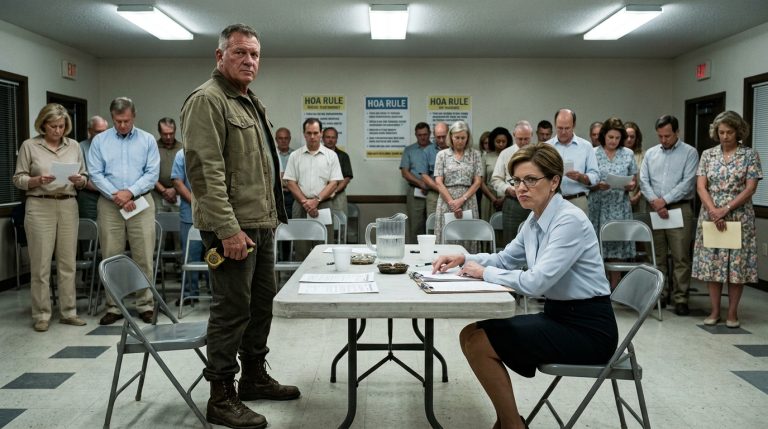
I didn’t take the sidewalk. I stayed to the shadows of the landscaped hedges, moving with the measured, quiet pace of a shadow. My mind was already in the room, predicting the layout: Karen at the head table, flanked by her two board cronies, Barb and Gary. They would have the agenda set, the narrative pre-scripted to force a final, overwhelming vote of “compliance” against my barn.
A flash of memory interrupted my focus—the dusty, claustrophobic streets of a village in the Al Anbar province, where we had waited for an extraction point to clear. The same cold, detached precision I’d used then was what I needed now. I wasn’t there to argue. I wasn’t there to appeal. I was there to execute a forced exit.
As I reached the rear entrance of the clubhouse, I heard the muffled, rhythmic thumping of a gavel. Karen. She was already starting.
I didn’t enter through the back door. I moved to the side window, the one that looked directly onto the head table. Through the glass, the scene was a tableau of choreographed power. Karen was standing, her face a mask of performative outrage, gesturing toward an empty chair at the front—my chair.
“Mr. Miller has chosen not to attend,” she said, her voice amplified by the room’s speakers, dripping with manufactured pity. “He has demonstrated a clear, consistent disregard for the aesthetic integrity of Oak Creek Estates. I move for an immediate vote on the condemnation of the primary barn structure on Lot One.”
Barb and Gary nodded in unison, like marionettes.
My hand moved to the handle of the side door. I didn’t hesitate. I turned it, the latch yielding with a quiet, metal-on-metal click that was drowned out by the murmur of the room.
The interior hit me with a blast of heat and the smell of stale coffee and industrial carpet cleaner. I walked down the side aisle, my boots heavy on the floor. The conversations at the nearby tables died away, a ripple of silence that spread outward from me like a shockwave.
Karen stopped mid-gesture. Her eyes, magnified by the glare of the room’s lights, locked onto me. The smug satisfaction drained from her face, replaced by a sudden, frantic flicker of panic.
“Mr. Miller,” she began, her voice gaining an octave. “This is a private meeting. You are not on the agenda.”
I didn’t say a word. I kept walking, the binder tucked under my arm like a tactical manual. I felt every eye in the room on me—the Garcas, the Hendersons, George, Eleanor—all of them waiting for the outcome of the gamble.
I reached the head table. I didn’t stop until I was standing directly in front of her. The contrast between us was absolute: she, vibrating with the fragile, artificial energy of her own ego; and I, a static, immovable presence.
“You’re right, Karen,” I said, my voice cutting through the hum of the air conditioning. “I’m not on the agenda. But the evidence of the Crestline Development conspiracy is.”
I slammed the binder onto the table. The sound was like a gunshot in the sterile room.
The weight of the paper—the lab reports, the soil analysis, the audit trail of the Vantage Capital transfers—hit the table with a finality that made the glasses rattle.
“You aren’t here to protect the neighborhood,” I continued, my gaze shifting to Barb and Gary, who were looking at the binder as if it were a bomb. “You’re here to liquidate it. You’ve been poisoning the foundation of my home, and you’ve been doing it on the payroll of a firm that treats your ‘aesthetic integrity’ as nothing more than a leverage point for a forced buyout.”
Karen reached for the binder, her hands trembling. “This is… this is a lie. These are private documents. You had no right—”
“I have every right,” I said, my voice growing colder, more precise. “I have the police report for the vandalism. I have the signed statement from the contractor you hired to sabotage the foundation. And I have the transfer records showing that your ‘fine revenue’ was being funneled directly into a holding company for Vantage Capital.”
I looked around the room. The silence was absolute now. The veneer of “community” had cracked, revealing the ugly, industrial reality beneath.
“If you vote to condemn my barn tonight,” I said, turning back to the board, “you aren’t voting on a color palette. You’re voting to become co-conspirators in a RICO-level land fraud case. I have already filed the preliminary injunction. Every single one of you will be personally named in the discovery phase.”
Karen made a sound, a sharp, gasping intake of air. She tried to reach for the gavel, her face a blotchy, panicked mess.
“Order!” she shrieked. “We have a motion on the floor! Vote!”
But no one moved. The room was static, suspended in the moment before the collapse. George stood up, his face grim, his gaze fixed on the binder. He picked up the first few pages—the lab reports, the chemical analysis. He began to read them aloud, his voice gaining strength, echoing off the walls.
Karen looked at Barb. Barb looked at Gary. And then, slowly, one by one, the board members backed away from the table, leaving Karen alone with the weight of the evidence.
The gavel dropped from her hand, clattering onto the table. It was a small, hollow sound, but in the silence of the room, it felt like the fall of a kingdom.
I didn’t look at her again. I turned toward the crowd. The trap hadn’t just sprung; it had reshaped the entire battlefield. The fight was over.
Now came the cleanup.
CHAPTER 8: The Architecture of Aftermath
The gavel lay where it had fallen, a small, dark shape on the laminate table. The silence in the room was no longer the heavy, pre-detonation tension of the past hour; it was the hollow, echoing quiet of a space that had been emptied of its purpose. Karen stood behind the head table, her face a ruin of frantic, uncoordinated tics. She looked, for the first time, not like a president, but like a passenger watching a wreck she had steered into a wall.
Barb and Gary had retreated to the far side of the room, their posture slumped, eyes fixed on their shoes. They were no longer board members; they were witnesses to their own complicity.
I walked to the table and picked up the binder. It felt lighter now—as if the burden of proof, once so heavy, had been transferred into the cold, clinical hands of the justice system. I didn’t look at Karen. I didn’t need to. The defeat was already written into the lines of her face, the way her shoulders had finally surrendered the rigid, false posture of her authority.
“The board is dissolved,” George said, his voice ringing clearly across the room. He didn’t raise his hand; he didn’t ask for permission. He was simply stating a reality that had already arrived. “We are forming an interim committee to freeze all HOA accounts and initiate a forensic audit of the Vantage Capital transfers. Anyone who wishes to assist, stay.”
The room began to stir. The Hendersons, the Garcias, and a dozen other neighbors who had sat in silence for years began to stand, their movements slow and deliberate. They were reclaiming the room, reclaiming the community.
Karen made a small, pathetic sound—a dry, wheezing gasp—and turned toward the exit. She didn’t look back. She didn’t try to justify her actions. She simply walked out of the clubhouse, a woman who had built a kingdom on the assumption that fear would be enough to keep the walls from falling. As she reached the glass doors, she paused, her silhouette framed against the dark parking lot. She seemed small, stripped of the pink sweatshirt, the binder, and the golf cart. She was just a person, and she was leaving with nothing.
I followed her out onto the porch, the night air cool and cleansing. I watched as she climbed into her sedan, her hands shaking so violently that she dropped her keys twice before finding the ignition. She didn’t turn to look at the clubhouse. She simply drove away, her taillights disappearing into the darkness of the suburban streets—streets she had once claimed to govern, but which would now continue on, indifferent to her departure.
I leaned against the clubhouse railing and exhaled, a long, slow breath that carried the last of the adrenaline out of my system. The weight of the past weeks—the dossiers, the cameras, the soil samples, the sleepless nights spent calibrating my response—began to ebb.
George walked out onto the porch a few minutes later, holding a small piece of wood. He walked over to me and handed it over. It was a fragment of the chestnut, chipped from the door during the initial vandalism.
“We cleaned it,” he said softly. “Eleanor spent all night working on it. It’s not much, but it’s yours.”
I took the fragment. The wood was warm, the surface smooth, the deep, ancient grain of the chestnut still visible beneath the slight, lingering ghost of the red stain. It was a reminder—a permanent scar that would never fully fade, but one that was now a part of the history of the house, not its definition.
“Thank you, George,” I said.
“We owe you, Jack,” he replied. “For the peace.”
I walked back toward my property, the path feeling different under my feet. The barn stood in the distance, a massive, quiet silhouette against the stars. It was no longer a target. It was a monument.
I reached the barn door and placed the fragment back into the small, handcrafted frame Elias had built. The repair was invisible, but I knew where the piece was. I knew the history it carried.
Sarah was waiting on the porch, a soft light glowing from the house behind her. She walked down to meet me, her hand sliding into mine. We stood there for a long time, watching the night shift. The crickets had started their song, a steady, rhythmic chorus that filled the silence.
The battle was over. The land was secure. And the quiet, which had been so fragile and elusive, was finally ours to keep. It wasn’t the silence of an empty, defenseless space anymore; it was the quiet of a boundary that had been defended and would, henceforth, be respected. I looked at the barn, then at the house, then at Sarah.
I had come here looking for a place to hide from the noise of a world that had tried to tear me apart. Instead, I had found that peace wasn’t something you found; it was something you engineered. It was the result of a precise, disciplined commitment to the truth, and a willingness to stand in the breach when everything you valued was under fire.
I wasn’t a veteran anymore, not in the way the world defined it. I was just a man, finally standing on his own ten acres, with the ground beneath his feet held firm and the sky above, quiet and deep, wide open.