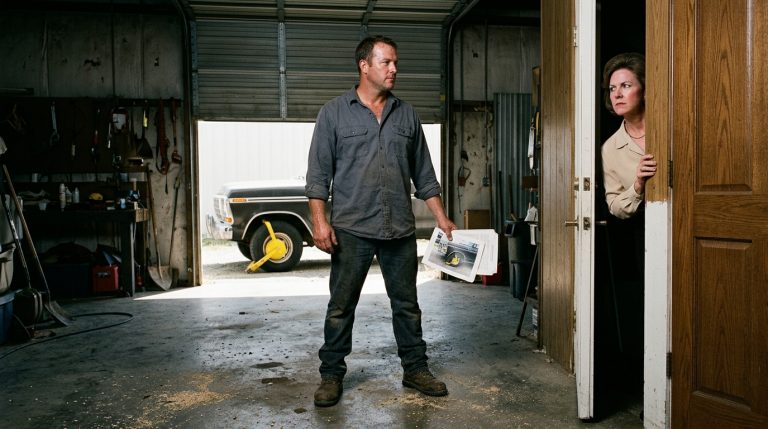
The Iron Landlord: How a Retired Engineer Dismantled a Tyrannical HOA with a Forty-Year-Old Map
CHAPTER 1: THE EDGE OF THE LAWN
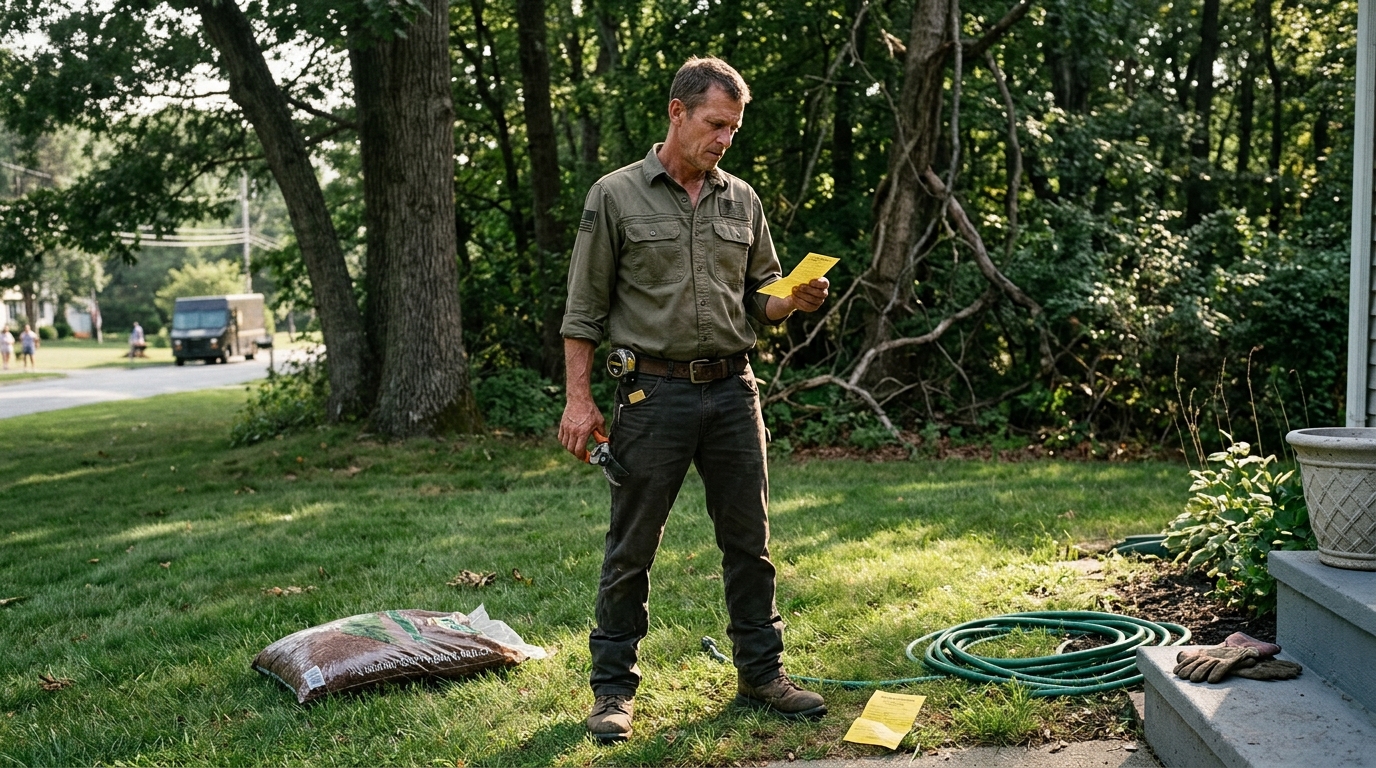
The clipboard rattled against the brass buckle of my work belt before I even had time to set down my pruning shears.
“This isn’t a request, Mr. Davies,” Karen Miller said, her voice carrying that sharp, practiced pitch reserved for corporate middle managers. “This is a notification of compulsory eminent domain for community improvement.”
I didn’t reach for the paper. My fingers stayed wrapped around the wooden handles of the shears, the steel blades still warm from trimming the hydrangeas along my front porch. Beyond her beige pantsuit, the thick timber of my five-acre wood lot stood dark and undisturbed in the late afternoon heat. Ten years of oak growth, purchased on a separate deed after twenty years in the Army Corps of Engineers, reduced to a crudely sketched box labeled Oakwood Bluffs Recreational Complex.
“My wood lot isn’t part of the HOA covenants, Karen,” I said, keeping my breathing measured. “It was bought under a separate parcel number.”
She let out a short, nasal sniff and adjusted her grip on the board. “A procedural technicality our legal counsel is already rectifying. The original developer intended all adjacent acreage to be integrated. We’re simply correcting an oversight.”
I pulled my brass Zippo from my pocket—the one stamped with the Corps castle emblem—and ran my thumb over the cold metal edge. Clack. The lid flipped back and snapped shut in a single motion.
“There is no oversight,” I said. “And you don’t have an easement across my grass.”
“We have the authority of the board, Jack,” she snapped, stepping half an inch closer to my property line, her low heels sinking into the turf. “You’re holding back property values for three hundred homes. Be reasonable, or this gets expensive.”
She turned on her heel and marched down the driveway toward her sedan, leaving the paper fluttering on the grass where she’d dropped it. I didn’t bend down to pick it up immediately. I just watched her brake lights flash red at the stop sign, thumbing the cold brass lighter as the quiet rustle of the oak trees filled the silence again.
CHAPTER 2: THE PAPERWORK SIEGE
I didn’t pick up her crude map until the exhaust fumes from her sedan faded down Primrose Lane.
When I brought it inside, I smoothed the wrinkled corner flat on the kitchen table, right beside my fresh mug of black coffee. The paper was cheap, lightweight stock, bearing an unaligned logo that looked like it had been clipped from an old newsletter. No surveyor’s stamp. No seal from the county registrar. Just a arrogant line drawn across my woods in red ballpoint ink.
The retaliatory strike arrived seven days later.
It was a bright yellow envelope tucked into my door frame—a fifty-dollar citation for improper turf height. I pulled my tape measure from my belt, walked straight to the patch of grass pictured in Karen’s grainy attachment, and snapped the blade down to the soil. Three and a quarter inches. The covenants stated a three-inch maximum, but the photo had been snapped at twilight, less than twelve hours before my scheduled weekly lawn service.
I didn’t call the board office to argue. Instead, I opened a clean, hard-backed binder, slid the yellow citation inside, and wrote a check for fifty dollars. Beside it, I clipped my landscaper’s timestamped invoice and three high-resolution photos of the measuring tape held against the turf.
Three days later, a second yellow slip appeared in the mailbox: seventy-five dollars for unapproved refuge container placement. The infraction photo showed my black rolling bin resting eighteen inches outside the garage footprint at 8:15 p.m. on collection night—fifteen minutes past her arbitrary curfew. I had been sitting in the bleachers at Leo’s Little League game when she took it.
I paid that one too.
By the third week, the yellow slips were arriving every forty-eight hours. Sixty dollars for a hairline fracture in the concrete driveway. Forty dollars for a political yard sign supporting the school board, posted forty-eight hours prior to the approved display window. One hundred dollars for a dark oil drip on the garage concrete, captured while the overhead door was raised for twenty minutes to air out my lawnmower.
Every notice was drafted in Karen’s flowery, passive-aggressive prose, framed as a deeply painful necessity for the collective good of Oakwood Bluffs.
I didn’t burn the slips, and I didn’t lose my temper. I opened a spreadsheet on my desktop, logging every violation code, every timestamp, every check number, and every photographic discrepancy. Each frivolous fine was a deliberate piece of bait, and she was filling my binder with undeniable proof of targeted harassment.
The real escalation came at the quarterly meeting in the basement of the public library.
Sarah sat beside me in the back row, her fingers locked tightly around my wrist as Karen stepped up to the podium. Karen wore a bright turquoise jacket, her eyes sweeping over the fifty gathered neighbors like a general addressing a timid garrison.
“Under new business,” Karen announced, her voice echoing off the cheap acoustic ceiling tiles, “we must address our community enhancement initiative. We have a rare opportunity to modernize our amenities with a multi-sport court.”
She paused, leaning both hands heavy against the wooden lectern, letting her gaze drift toward the back row.
“Regrettably,” she continued, dropping her voice into an exaggerated tone of community concern, “progress is being stalled by an isolated pocket of resistance. One homeowner who insists on placing personal selfishness above the recreation of our children.”
A few board members nodded along. Mr. Henderson, a retired electrician sitting three rows ahead of us, stiffened in his seat and narrowed his eyes at the podium, but kept his mouth shut.
I didn’t stand up. I didn’t interrupt her. A public shouting match would only give her the emotional reaction she was fishing for. I just reached into my jacket pocket, felt the solid brass weight of my Zippo, and let the silence settle.
When the meeting adjourned, Sarah’s hand was still tight on my arm as we walked out into the cool night air of the parking lot. “What’s the play, Jack?” she asked quietly. “She’s turning the whole street against us.”
“She thinks she’s fighting a homeowner,” I said, opening the truck door for her. “She’s about to find out she’s fighting an engineer. Tomorrow, I’m requesting the full financial audit.”
CHAPTER 3: THE PHANTOM PARCEL
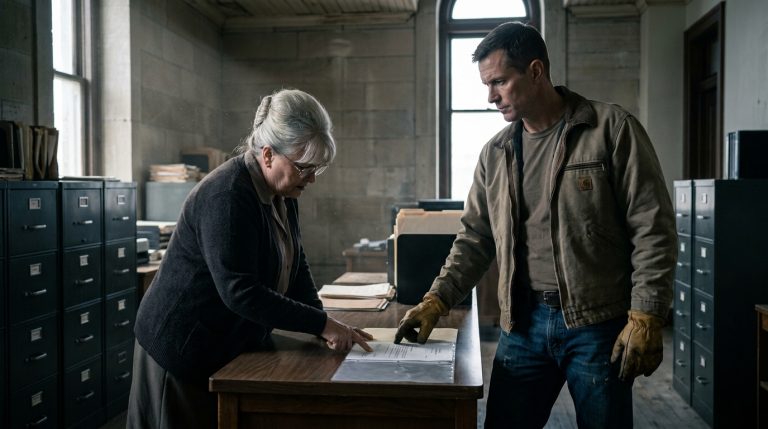
The clerk, a woman named Martha with half-moon spectacles resting on a beaded chain, set the heavy cardboard cylinder onto the oak viewing table with a dull thud.
“Oakwood Bluffs Subdivision, 1978,” she said, untying the faded velvet ribbon. “Haven’t pulled this roll in five years.”
The paper crackled like dried corn husks as we unrolled it across the wood, anchoring the four curling corners with heavy brass paperweights. I flattened my palm over Lot 42—my home—and traced the dark ink perimeter of my five-acre wood lot directly behind it. The boundary line was sharp, clear, and distinctly marked as a separate parcel number.
“That’s mine,” I said, thumbing my brass Zippo inside my jacket pocket. “Separate deed. No connection to the residential covenants.”
“Looks clean,” Martha agreed, peering over my shoulder. “Parcel B-402 was never folded into the residential master plan.”
I nodded, but my eyes didn’t stop at my property line. I let my fingertips trace the thin parallel lines representing Primrose Lane, Oakwood Circle, and Willow Creek Drive—the asphalt network running through all three hundred homes in the subdivision.
At the bottom corner of every municipal plat map, there is a dedicated legal block. It’s where the original developer signs away ownership of the paved streets, explicitly granting title and maintenance authority to either the county or a registered homeowners association.
I leaned closer, scanning the bottom right margin.
The box was there. The legal title heading—Dedication of Public and Common Roadways—was crisply printed in bold block lettering.
Below it lay completely blank white space.
No notary stamp. No signatures from the developers. No record of transfer to the county, and zero language assigning title to the Oakwood Bluffs Board of Directors.
“Martha,” I said, my voice barely above a whisper. “Look at this dedication box.”
She bent down, her spectacles sliding to the tip of her nose. She traced the blank margin with her index finger once, twice, and then let out a low, quiet whistle.
“Well, I’ll be,” she murmured. “The developer paved the roads and walked away without signing them over to anyone. They’re phantom land.”
For forty years, Karen Miller and her predecessors had been issuing parking tickets, enforcing speed limits, and threatening homeowners with towing notices on asphalt the association didn’t legally own. Every single dollar of member dues spent on paving, snowplowing, and maintenance over four decades had been poured into a legal void.
The whole board wasn’t just built on a misunderstanding. It was sitting on a forty-year-old sinkhole, and I was holding the map.
CHAPTER 4: THE LEGAL BAIT
Dave leaned back until his leather office chair groaned under his weight. He took off his wire-rimmed glasses, pinched the bridge of his nose, and stared down at the map for ten silent seconds.
“Jack,” he said, his voice dropping into that calm, flat cadence he used before cross-examining a hostile witness in court martial hearings. “You’re telling me they’ve been levying assessments for asphalt resurfacing on roads they don’t hold title to?”
“Since 1978,” I said. “And Karen just signed a contract for five thousand dollars in preliminary architectural engineering for my wood lot.”
Dave picked up my heavy black binder, flipping through the neat plastic sleeves containing Karen’s violation notices, my canceled checks, and her typed letters. A slow, razor-thin smile spread across his jaw.
“She’s acting under color of authority she doesn’t possess,” Dave said, tapping his fountain pen against the brass corner of my lighter. “If we hit her with a lawsuit today, her board attorney will read this map, panic, and advise them to settle quietly. She gets to bow out gracefully due to ‘administrative oversights.'”
“No graceful exits,” I said. “She tried to seize private land and bullied an eighty-year-old widow over garden ornaments. I want her on record.”
“Then we don’t sue yet,” Dave replied, sliding a yellow legal pad toward him. “We send a routine inquiry on my firm’s letterhead. Very polite. Very neutral.”
He uncapped his pen and began scratching out lines of dense legal prose.
“We frame it as a simple title verification for insurance purposes,” Dave explained without looking up. “We ask the board to produce their deed or recorded easement for Primrose Lane. If she were smart, she’d pass it to a real real-estate lawyer who would tell her to shut up. But Karen won’t do that.”
“Because asking for help breaks the illusion,” I said.
“Exactly,” Dave said, signing his name at the bottom of the draft with a firm flourish. “Her ego won’t let her admit she doesn’t hold the deed. She’s going to double down in writing.”
Eight days later, the white envelope bearing Dave’s law firm logo was returned to my mailbox, accompanied by a formal two-page response typed on official HOA stationary.
Karen had signed it in thick blue ink with an extravagant, sweeping flourish across the bottom line.
Please be advised, her letter read, that the Oakwood Bluffs Homeowners Association holds unquestionable and exclusive jurisdiction over all common areas, which explicitly includes the entirety of our community’s road network.
She had attached ten years of municipal paving invoices to prove their “continuous, undisputed management” of the asphalt.
Dave called me the second I scanned the page and emailed it to his desk. His laugh came through the speaker loud and dry.
“She gave us the whole farm, Jack,” Dave said. “She just committed in writing to managing land she doesn’t own, and sent us the receipts showing she spent member funds to do it. Now we let her take the next step.”
CHAPTER 5: THE SURVEY STANDOFF
The driver’s door opened with a dull mechanical click. Two men in neon-orange safety vests stepped onto the pavement, unloading yellow aluminum tripods and laser measuring devices from the rear doors.
I walked down my front slope before their boots touched the turf, holding a fresh copy of my recorded deed in one hand and a wooden stake bearing a crisp red warning sign in the other.
“Morning, fellas,” I said, my voice carrying clean over the idle rumble of their diesel engine. “Can I help you find an address?”
The older surveyor adjusted a faded baseball cap, checking a clipboard clipped with a blue work order. “Oakwood Bluffs Board requested a boundary stakeout for the new recreational complex right through these oaks.”
“There’s been a miscommunication,” I said, extending the deed toward him. “You’re standing on Parcel B-402. Private deed, held under my name, explicitly excluded from the HOA map.”
The surveyor looked from the paper to the dense tree line, his brow furrowing as he scanned the legal description.
“Mrs. Miller told our dispatch this was unassigned common grounds,” he said, turning to his assistant. “She gave us a signed board authorization.”
“Mrs. Miller doesn’t own this dirt,” I said, tapping the wooden sign stake against the soil. “If you set equipment past this tree line, it’s criminal trespass. I don’t want to involve the sheriff’s department on a Tuesday morning, but I will.”
The older man didn’t argue. He pulled a heavy radio from his belt, dialed a number, and spoke briefly to his office dispatcher before snapping the antenna down.
“We’re packing it up,” he told his partner. “We don’t do property line disputes.”
I watched them roll their tripods back into the van, drive down the street, and disappear around the bend. Up in my front window, the small digital camera mounted on its tripod clicked quietly, recording every second of their retreat.
By seven o’clock that evening, the sixty-second video clip was uploaded directly to the neighborhood’s unofficial social media page, captioned simply: HOA-hired survey crew turned away from private deeded property.
The comment thread exploded within twenty minutes.
Wait, I thought he was just being stubborn, typed Mrs. Gable, the widow from down the street. Is the board using our dues to survey private land?
By nine o’clock, my living room was packed. Mrs. Gable sat on the sofa, clutching her purse, alongside Mr. Henderson, the retired electrician, and Frank, the quiet board member who had grown tired of Karen’s unilateral decisions.
I laid the enlarged county plat map flat across the coffee table, right beside Karen’s signed letter claiming full jurisdiction over the streets.
“She’s been fining us for street parking,” Mr. Henderson grunted, his heavy fist coming down gently on the armrest. “She threatened to tow my son’s pickup last Thanksgiving.”
“She couldn’t tow a bicycle off Primrose Lane,” I said flatly. “She doesn’t own the asphalt.”
Frank stared at the blank dedication block on the map printout, his face pale under the living room light. “The annual budget vote is on Thursday at the library,” he murmured. “She’s calling for a special assessment vote to fund the tennis courts.”
“Let her call for it,” I said, flipping open my brass Zippo with a sharp metallic snap. “We’ll be there to second the motion.”
CHAPTER 6: THE PUBLIC TRIBUNAL
Karen tapped the microphone twice, the hollow screech echoing over ninety gathered neighbors.
“We come to the centerpiece of our community vision,” she declared, her eyes sweeping past the front rows. “The special assessment vote to acquire and construct our new multi-sport complex.”
I stepped forward, pressing the talk button on the aisle microphone before she could click her slide deck forward.
“Point of order, Mrs. Miller,” I said, my voice steady and projection-trained. “Before we vote on a special assessment, we need clarification on the board’s legal authority over Primrose Lane.”
Karen’s knuckles turned white against the edges of the wooden lectern. “Mr. Davies, this is an improper disruption. The board’s jurisdiction over common areas is settled policy.”
“It isn’t settled,” I said, holding up a certified document. “I have here a copy of your signed letter from October seventeenth, asserting unquestionable and exclusive board ownership over all subdivision roadways.”
“Which is entirely accurate—”
“Then explain why the 1978 master plat map recorded with the county clerk has a completely blank dedication block,” I interrupted, as Mr. Miller switched the projector input from the back row.
The cheesy digital rendering of the tennis courts vanished from the wall screen, replaced by a ten-foot projection of the original county blueprint. The red laser pointer circled the empty, un-signed white box under Dedication of Common Roadways.
Gasps rippled across the room. Neighbors leaned out of their chairs, squinting at the wall.
“This is a fraudulent distraction!” Karen shouted, slamming her palm onto the podium, her voice cracking under the strain. “The board has maintained those roads for forty years! That constitutes legal ownership!”
“It constitutes spending member funds on property you don’t own,” Dave Sterling called out from the third row, standing up in his charcoal suit. “My name is Dave Sterling, property attorney. Under state statute, exercising municipal authority and levying fines on un-dedicated land without title is ultra vires—completely illegal. You’ve exposed every homeowner here to massive financial liability.”
Karen’s face drained of color. She looked to her left and right, but her two fellow board members were staring blankly at the table, refusing to make eye contact.
“I move for an immediate vote of no confidence,” Frank said into his table microphone, stepping out from behind the board desk.
“Seconded!” Mr. Henderson called out from the middle aisle.
“All in favor?” Frank called into the mic.
Eighty hands shot into the air in a single, unified motion.
Karen didn’t wait for the formal count. She snatched her leather binder, practically ran down the side aisle, and let the heavy rear doors slam shut behind her.
The quiet returned to my front porch by five o’clock the following evening.
The white no-trespassing sign sat in the garage corner, no longer needed. Across the street, Mrs. Gable was out on her lawn, proudly placing four brightly painted garden gnomes right along her front flowerbed. Down on Oakwood Circle, the faint, rhythmic thump of a basketball bouncing off a backboard drifted through the oak trees—the Miller kid, practicing without a stopwatch or a threat of a fine.
I sat on the top porch step, holding my brass Zippo. I flipped the lid back, thumbed the wheel, and watched the small yellow flame burn steady against the cool autumn breeze before snapping it shut.
My five acres stood tall, dark, and silent behind the house, exactly as they were meant to be.