The Weight of Concrete and Ash: How a Quiet Engineer Engineered a Silent Trap for Overreaching Authority
CHAPTER 1: The First Silt
The wood of the bridge was cold enough to bite through the heavy denim of a work glove, but the heat came from somewhere deeper, a slow, low-burning friction behind the ribs.
He didn’t touch the bag immediately. It rested precisely in the center of the span—a swollen, black polyethylene shape that caught the watery gray light of dawn, sagging slightly where something heavy and irregular pressed against the inner lining. A thin, iridescent trickle had already begun to worm its way across the graying planks, cutting a dark, oily scar through the overnight frost before dripping silently into the swift, amber current below.
Twenty paces away, half-swallowed by the dense shadow of the wild hazel hedge, a figure stood motionless.
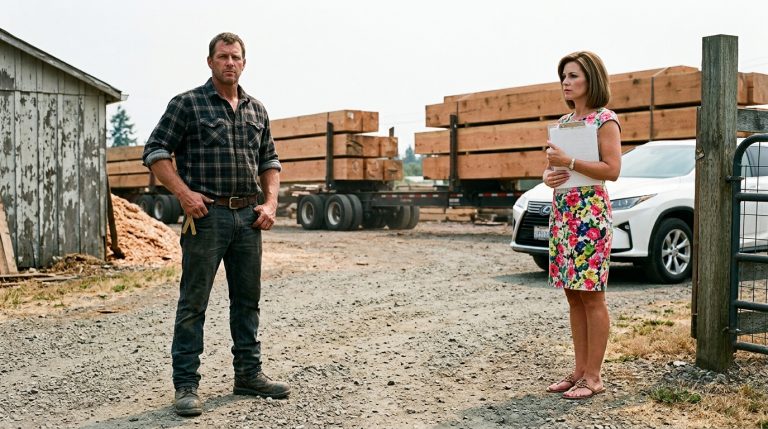
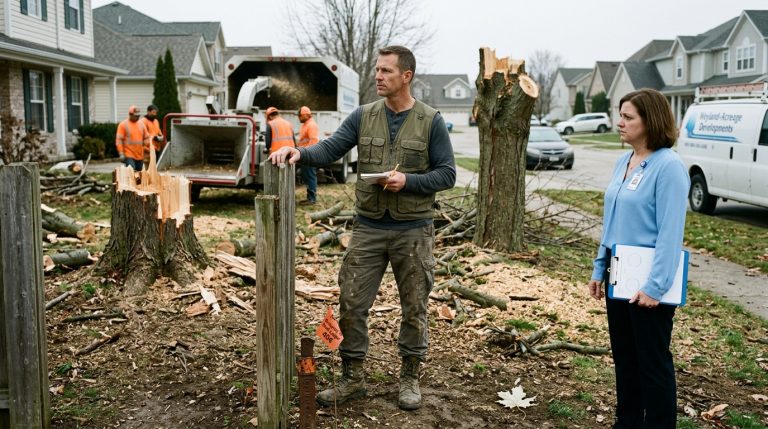
The silence here was never empty. It carried the steady, rhythmic roar of the creek chewing at the limestone banks, the heavy drip of condensation from the needle-laden boughs of white pine, and now, the faint, deliberate squeak of a boot sole shifting against gravel. Karen hadn’t bothered to mask her approach. She wore her self-appointed authority like an ill-fitting wool coat, rigid at the shoulders, her chin tilted upward toward a horizon only she seemed capable of perceiving.
The air smelled of damp earth and cheap artificial lavender, a sharp intrusion against the clean rot of the forest floor.
Without raising his voice, or shifting his weight from the ball of his left foot, he looked past the swelling trash bag to where her silhouette cut against the gray brush. The motion-activated trail camera mounted high on the cedar post—its lens dark, its internal hard drive quietly humming with every micro-adjustment of the morning fog—blinked once with a faint, amber pulse. She had never noticed it. To her, the world was built entirely of things that bent to her commentary.
The bag shifted, a dull thud of shifting masonry echoing against the wooden underpinnings as the current below pulled at the bridge’s stone footings.
“You missed a spot,” she said, her voice carrying across the water with the practiced clarity of an HOA treasurer reading from an agenda. “The community standards committee requires unobstructed transit. That eyesore isn’t doing anyone any favors.”
The internal monologue was a cold calculus of angles and risk, weighing the tensile strength of the weathered cedar against the sudden, violent torque of the chemical leak eating into the grain. He kept his hands flat against his thighs, fingers curled inside the canvas pockets, feeling the blunt edge of a brass plumb bob he’d carried since his grandfather’s funeral.
The water below didn’t care about her clipboard. It rushed over the submerged limestone, cold, black, and indifferent to the names people carved into the trees along its banks. But as he looked down at the dark stain spreading across his grandfather’s lumber, a familiar, heavy realization settled into his chest: the bag on the bridge wasn’t the cleanup. It was the anchor dropping.
CHAPTER 2: The Paper Trail of Shadows
The oil slick did not disperse; it thinned into a dull, shimmering rainbow that clung stubbornly to the grain of the white oak planks.
He didn’t move away from the spot. The cold of the iron bolts seemed to travel upward through the soles of his heavy rubber boots, grounding him in the absolute stillness of the valley. Across the creek, where the shadow of the white pine stretched long and skeletal over the damp brush, Karen remained planted like a fence post driven too deep into frozen ground. She hadn’t walked away. Her arms remained locked across her chest, her chin tilted up with that irritating, defensive stiffness that belonged to people who had never once had to fix what they broke.
A sharp gust of wind off the water carried the chemical stench right into the back of his throat—a foul mixture of synthetic resin and industrial solvent that made his eyes water.
The memory hit without warning, sharp and unbidden: his father, thirty years younger, standing in almost this exact spot with a claw hammer in his hand, cursing softly as a spring flood tore three feet of mud away from the eastern abutment. “You build for what stays, son,” his father had said, wiping grease from his forehead with a stained flannel sleeve. “Not for what passes through.”
Karen’s boots crunched against the gravel path on the far bank, breaking the rhythm of the water.
“You’re making a record of your own stubbornness, Harper,” she called out, her voice pitching slightly to carry over the rush of the creek. She took two steps down the slope, her white sneakers bright and aggressively clean against the dark mud. “The zoning board has a file an inch thick on that crossing. You can stare at a bag of trash all morning, but it doesn’t change the fact that public safety supersedes your grandfather’s old paperwork.”
He kept his gaze fixed on the iridescent puddle at his feet. He didn’t turn his head. He didn’t give her the pivot of the shoulders she was fishing for. In the military, they called it holding the line of sight—denying the adversary the psychological validation of a reaction.
“It’s private property, Karen,” he said, his voice level, dropped into the lower register where it mixed easily with the ambient drone of the river.
“Property lines end where public welfare begins,” she snapped back instantly, stepping onto the very edge of the approach. Her heel tested the stability of the wood, pressing down as if she expected the structure to groan or yield under her weight.
It didn’t. The steel trusses he had slid beneath the belly two summers ago held firm, absorbing her test without a single shiver of vibration.
Her mouth tightened into a hard, white line. She had expected a shouting match. She had prepared her counterarguments, the rehearsed vocabulary of community rights and environmental negligence she likely practiced in front of her bathroom mirror. When the silence stretched out, heavy and absolute, it rattled her composure more than a curse word would have.
“You’ll be hearing from the county health inspector,” she said, her voice losing its crisp edge, replaced by a thin, brittle edge of frustration. “And if you think ignoring my emails to the HOA board is going to protect you from the fines, you’re deeply mistaken.”
She turned on her heel with a sharp, theatrical snap, her nylon jacket swishing against the brush as she marched back up the embankment toward the gravel road where her sedan was parked. The engine roared to life a moment later, tires spitting loose stone against the culvert before the sound faded into the distance.
He waited until the last hum of the exhaust died away before he moved.
He crouched beside the black trash bag, ignoring the sour sting in his nostrils, and slipped a gloved hand beneath the heavy, shifting bulk. He didn’t tear it open yet. Not here. Not while the morning was still young and the shadows were long. Instead, he hoisted the dead weight into the bed of his truck, feeling the suspension dip in protest under the load of broken drywall and concrete shards.
The county GIS maps were sitting on the passenger seat of his cab, folded open to parcel 44-B.
He climbed into the cab, the vinyl seat cold against his back, and smoothed out the creases of the plat map against the steering wheel. The red boundary lines of the subdivision formed a neat, geometric horseshoe around the western ridge, stopping precisely twenty feet short of his eastern fence line. There was no overlap. There was no shared easement. The legal separation was as clean and sharp as a cut wire.
Yet Karen was operating with absolute, unwavering conviction. People didn’t invent jurisdictions out of thin air unless they had a reason—or unless someone behind them was whispering the instructions.
He reached for the center console, flipped open the logbook where he tracked timber maintenance and weather patterns, and picked up a pen. Under today’s date, he wrote a single line: First tangible load deposited. Bolt-cutter marks on the gate posts. Chain of custody initiated.
There was a deeper layer beneath her petty administrative threats. People who fought over property lines usually wanted the dirt; people who fought over a bridge wanted the isolation. He started the truck engine, letting the diesel idle until the heater began to push a dry, metallic warmth against his knees. It was time to pull the county records on the zoning permits filed for the subdivision’s recent expansion upstream. If Karen was screaming about runoff protection, it usually meant someone upstream had something buried in the floodplain they didn’t want the water to uncover.
CHAPTER 3: The Escalation of Weight
The diesel engine’s low vibration hummed through the floorboards of the cab, rattling the plastic casing of the instrument panel until a minor electrical short cut the auxiliary dash light.
He reached down instinctively, his fingers finding the fuse box beneath the steering column. A faint scent of hot copper and dust rose from the panel as he pulled the blown fuse, sliding a replacement blade into place with a sharp, mechanical click. The cab plunged back into amber illumination. He didn’t rush the process. Out here, letting urgency dictate movement was how structural mistakes happened—whether pouring concrete in freezing rain or wrenching a bolt past its torque limit.
He shifted the truck into drive, turning the wheel hard to swing the heavy pickup around in the narrow dirt turn-around.
The tires crunched over the damp gravel, spitting small stones against the iron culvert as he rolled backward down the access lane toward the bridge. The bag of debris he had loaded earlier sat dead and unyielding in the truck bed, shifting against the rubber bed liner with a dull, wet thud every time the suspension flexed.
When he reached the bridge approach, the morning light had fully broken through the canopy of the white pines, casting long, sharp shadows across the newly washed oak planks. The oil slick had thinned into a pale, greasy film near the northern piling, but the smell of industrial solvent lingered, hanging heavily in the cold draft coming off the water.
He cut the engine. The sudden silence was absolute, save for the steady, unbothered rush of the creek below.
Stepping out of the cab, he walked to the rear of the truck and untied the canvas tarp he used to keep the bed clean. The second load—the one Karen had hinted at during her morning lecture—wasn’t far off. People like her didn’t stop at a single test run; they treated boundary-pushing like an escalating scale. If the first bag met with passive acceptance, the next step would be heavier, more permanent, and harder to ignore.
He grabbed a pair of heavy leather work gloves from the toolbox, tugging them onto his hands until the seams stretched tight across his knuckles.
Before he could lift the bag out to transfer it to the municipal transfer station container in town, a sharp crack echoed from the eastern tree line—the distinct sound of a dried oak branch snapping beneath a heavy tread.
He didn’t jerk his head around. He turned slowly, his weight balanced evenly over his boots, eyes scanning the shadowed perimeter where the ferns met the dense blackberry briars.
A gray-coated spaniel broke through the underbrush first, sniffing eagerly at the damp earth before pausing to lift its snout toward the scent of the chemical spill. A moment later, an older man in a faded canvas hunting jacket stepped into the clearing—Tom Miller, who owned the old apple orchard half a mile up the ridge. Tom’s hands were shoved deep into his pockets, his weather-beaten face set in a heavy, troubled frown.
“Morning, Harper,” Tom said, his voice raspy from decades of breathing orchard dust and morning mist. He stopped ten paces short of the bridge, keeping his boots planted firmly on the public side of the property line.
“Tom,” he acknowledged, keeping his hands relaxed at his sides. “Quiet morning.”
“Was,” Tom muttered, glancing pointedly at the black bag resting in the back of the truck. He kicked a loose pebble with the toe of his rubber boot, watching it bounce down the embankment toward the water. “Word travels fast down at the feed store this early. Karen’s been on the phone since six. Telling anyone who’ll listen that you’ve got an illegal runoff hazard sitting right over the main drainage vector.”
The internal calculation was instantaneous. The narrative was shifting faster than the physical evidence could accumulate. She wasn’t just complaining to the HOA board anymore; she was poisoning the well in the wider township, building a pre-emptive defense in the court of public opinion before anyone even looked at the property titles.
“It’s construction waste someone dumped on my crossing,” he said evenly, his voice refusing to climb into defensiveness. “I’m hauling it out now.”
Tom sighed, pulling one hand out of his pocket to rub the back of his neck. “She’s got folks believing it, son. People don’t look at maps anymore; they look at whoever speaks the loudest. My grandfather used to say an accusation travels on a fast horse while the truth walks behind with a heavy pack.”
“Let it walk,” he replied, his gaze shifting back to the dark stain on the bridge planks. “The pack gets heavier the further it goes, but it doesn’t lose its footing.”
Tom studied him for a long moment, a faint glimmer of respect crossing his tired eyes. He knew the history of the land; he remembered when the grandfather had hauled the first heavy beams out of this valley with a team of mules.
“Just watch your step, Harper,” Tom said quietly, turning back toward the trail. “She’s got the board wrapped around her finger, and the county commissioners hate paperwork. If she forces an inspection based on a fabricated health hazard, you’re going to need more than words to push back.”
The old man didn’t wait for an answer. He whistled for the spaniel, and the two of them melted back into the gray shadows of the orchard trail, leaving behind the smell of damp wool and wet dog.
He walked back to the truck, gripped the heavy polyethylene edges of the trash bag, and heaved it over his shoulder, feeling the dead, shifting weight of the concrete chunks press against his spine. The physical labor was honest, grounding, and entirely predictable—unlike the shifting, formless shadows Karen was casting across the township.
As he tossed the bag into the secure storage shed behind the timber frame, a cold, calculated clarity settled over him. The time for passive documentation was ending. If she wanted a battle over the integrity of the bridge, he would give her an engineering lesson she couldn’t argue with—one written in high-definition infrared and undeniable metadata.
CHAPTER 4: The Community Theater
The heavy oak door of the storage shed clicked shut with a solid, dry thud, locking the debris safely behind a padlock that had been greased and fitted by his own hands.
He didn’t linger by the shed. The weight of Tom Miller’s warning still hung in the air like pre-storm humidity, pressing down against the ridge. If Karen was already holding court at the feed store and planting seeds of doubt among old acquaintances, letting her control the narrative space downtown unchecked was a tactical error. The community center meeting was set for seven that evening—an informal gathering where the HOA board traditionally reviewed seasonal landscaping budgets, but one that Karen had weaponized into a tribunal.
The drive into town was a study in desaturation. The asphalt of the county road cut through gray stubble fields and dense thickets of naked maples, their branches slick with a persistent mist that refused to turn into proper rain.
He parked the truck in the gravel lot behind the municipal annex, deliberately avoiding the designated residential stalls closer to the entrance. Stepping out onto the damp stone, he adjusted the collar of his canvas jacket against the raw wind blowing off the river valley. The air tasted of coal smoke and wet tarmac.
Inside the community center, the atmosphere smelled of stale coffee, floor wax, and the quiet, nervous tension of a room bracing for an argument.
The folding chairs arranged in concentric semi-circles were mostly full. Faces turned as he pushed through the double doors, a collective ripple of hushed whispers passing through the rows like dry grass shifting under a sudden gust. Near the front row, seated directly beneath the corkboard displaying county zoning notices, Karen held court. She wore a tailored charcoal blazer with an acrylic HOA visitor badge pinned precisely over her left breast pocket, her posture stiff and authoritative.
He didn’t take a seat near the front. He walked down the center aisle with measured, deliberate strides, his boots clicking rhythmically against the scuffed linoleum floor, and took an empty metal chair near the back exit, keeping his field of vision wide.
On the low stage at the front of the room, the board chairman—a retired accountant named Henderson whose hands trembled slightly as he shuffled a stack of agendas—cleared his throat.
“We’ll call this session to order,” Henderson said, his voice echoing off the acoustic ceiling tiles. “Before we move to the standard maintenance votes, we have an open floor item regarding neighborhood infrastructure and environmental integrity submitted by the auxiliary planning committee.”
Henderson didn’t look back toward the aisle. He didn’t have to.
Karen stood up before the chairman even finished the sentence. She didn’t use a microphone, but she didn’t need one; her voice possessed that sharp, piercing timbre common to people accustomed to commanding rooms they didn’t own.
“Thank you, Chairman Henderson,” Karen began, turning to face the seated crowd with a solemn, burdened expression, like a magistrate delivering a difficult verdict. “I bring this forward not out of personal grievance, but out of absolute necessity for our shared watershed. As many of you know, the access bridge spanning the northern creek—a structure currently claimed under private exemption—has become an active hazard to our collective safety and environmental health.”
A murmur rippled through the middle rows. Several heads nodded in synchrony.
“We have documented runoff violations, chemical leaking containers, and deliberate blockages of emergency transit vectors,” Karen continued, her hand gesturing toward a manila folder resting on the podium. “When individual stewardship fails to meet community standards, the community has a moral obligation to step in. We cannot allow a single resistant property owner to endanger the ecological balance of the entire valley.”
The internal calculus was clean, cold, and entirely devoid of anger. She was building her Layer 1 argument in real-time—framing private defense as public negligence.
He kept his hands folded flat over his knees, his breathing slow and even. He didn’t interrupt. He let her paint the picture in broad, dramatic strokes, watching how the neighbors in the second and third rows leaned in, absorbing the urgency of her fiction. In a war of perception, letting the adversary overextend their claims before presenting the physical data was the only way to ensure the collapse was absolute.
Henderson looked out over the crowd, his eyes finally finding the lone figure sitting near the back exit. “Mr. Harper,” the chairman said, his voice tight with discomfort. “You’ve heard the concerns raised by the committee. Do you have anything to offer regarding the state of the crossing?”
All eyes in the room swung toward the back. The silence became thick, heavy with the expectation of an outburst, a shouting match, a loss of control that would validate every word Karen had spoken.
He stood up slowly, giving the movement the deliberate weight of an engineer stepping onto a testing platform.
“The bridge is private access, governed by recorded county title and protected under state watershed statutes,” he said, his voice dropping into that steady, unyielding register that cut cleanly through the room without a single raised decibel. “It carries no public easement. It poses no hazard to anyone who stays off it.”
Karen spun around, her face flushing a mottled pink. “It’s an ecological disaster area, and everyone here knows it!” she snapped, her professional composure cracking at the edges.
“If there’s an ecological hazard on private property,” he continued, ignoring her interruption entirely and locking his gaze on the chairman, “the proper venue isn’t an HOA committee meeting. It’s the county environmental protection office. And as of yesterday, they have been fully briefed on every item deposited across those planks.”
The room went dead silent. The word environmental protection office dropped onto the linoleum like a lead weight.
Karen’s mouth opened to retort, but the words caught in her throat as she saw the sudden, uneasy shift in Chairman Henderson’s posture. The board members weren’t nodding anymore; they were staring at Karen with sudden, cold realization that her unauthorized crusade had just dragged the entire association into legal crosshairs far beyond their jurisdiction.
He didn’t wait for them to untangle the silence. He turned, pushed open the heavy double doors at the back of the hall, and walked out into the cool, steady mist of the evening, leaving them alone with the shadow of what was coming.
CHAPTER 5: The Architects CounterMove
The mist had thickened into a low-hanging drizzle by the time the truck tires crunched back onto the gravel drive of the homestead.
The headlights swept across the tall pines, cutting sharp, yellow beams through the wet dark before dying with a soft ping of cooling metal. He didn’t rush to get out of the cab. The cabin was warm, smelling faintly of old upholstery and dry canvas, but outside, the cold damp of the valley pressed against the glass like an uninvited guest. He sat for a moment with his hands resting on the rubber-coated steering wheel, reviewing the cadence of Henderson’s expression back at the community hall. The chairman was rattled. When bureaucratic machinery touches real legal friction, it tends to seize up.
Opening the door, he stepped down into the mud, his boots sinking an inch before hitting the firm stone sub-base.
The first priority wasn’t rest; it was data integrity. The multi-angle trail cameras mounted around the bridge operated on solar-trickle panels backed by lithium cells, but heavy canopy cover and three days of continuous mist could drop voltage levels if the auxiliary arrays weren’t checked.
He walked around to the side of the tool shed, retrieving a heavy-duty aluminum ladder and a Pelican case containing maintenance gear, spare memory cards, and a digital multimeter. Carrying the equipment down the darkened path toward the river, the steady, rhythmic roar of the creek grew louder, masking the sound of his footsteps against the wet needles.
The bridge emerged from the gloom like a dark spine, its newly secured iron bolts glistening with condensation.
He climbed the aluminum ladder propped against the western cedar trunk, his movements economic and precise. The infrared housing on the upper lens blinked a faint, reassuring green as his fingers brushed the casing. He popped the secure latch, ejected the high-capacity micro-SD card from the primary housing, and slid a fresh, formatted card into the slot, pocketing the old one with its compressed digital record of the past seventy-two hours.
A sudden, paranoid thought brushed against the edge of his concentration—the unverified blind spot beneath the western stone abutment where the current undercut the bank. Had he angled the lower lens wide enough to cover the footing?
He checked the live-feed monitor clipped to his belt, tethered via local encrypted Wi-Fi to the camera array. The screen flickered to life, displaying four crisp, split-screen feeds of the bridge: the north approach, the center span, the southern gate post, and the low-water line. Everything was sharp, illuminated by the faint red glow of night-vision diodes. The blind spot didn’t exist; every square inch of the crossing was mapped in unblinking pixels.
He descended the ladder, folding it compactly and securing it to the side of the utility shed before walking back to the workbench in his workshop.
The workshop smelled of pine shavings, cutting oil, and old iron. Beneath the harsh glare of a single overhead fluorescent tube, he plugged the micro-SD card into the card reader connected to his ruggedized laptop. The screen flooded with rows of timestamped files—hundreds of gigabytes of metadata logging every shift in light, every falling branch, and every movement along the property boundary.
He pulled up the video directory from two nights prior, skipping past hours of empty wind-swept frames until the motion-trigger tag flashed red.
The footage accelerated on-screen with crisp, terrifying clarity. The low fog rolled over the water as Karen stepped into the frame, her reflective HOA badge swinging from her jacket pocket. The sequence of her dragging the heavy tarp, bracing her foot against the gate post, and snapping the lock with long-handled red bolt-cutters played out in cold, unedited real time. There was no hesitation in her posture, no accidental clumsiness—just the methodical, entitled destruction of private infrastructure by someone convinced the law was whatever she wished it to be.
He paused the frame right as her face turned toward the camera sensor, her mouth set in a hard, triumphant line.
Beside the laptop sat the phone number Samuel Brewer had given him weeks ago. He didn’t pick up the phone yet. Evidence without context is just noise; evidence backed by unbroken chain-of-custody logs and environmental violation reports is a lever that can move a mountain. But looking at the screen, a sharper realization took hold: Karen wasn’t acting alone because she hated clutter. The sheer volume of commercial-grade concrete and insulation she had dumped required a vehicle with heavy load capacity—something larger than a sedan. Someone else was hauling the debris to her staging area, and she was using the bridge as a convenient dumping sink to clear their balance sheets.
The decoy secret—the petty neighborhood feud over aesthetics and community standards—was officially collapsing under the weight of the digital record. But the core truth—what was actually buried beneath the subdivision’s new construction site upstream—was still waiting for the water to rise.
CHAPTER 6: The Midnight Breach
The fluorescent tube hummed overhead, casting a harsh, sterile light across the grease-stained surface of the workbench.
He didn’t close the laptop. The paused image of Karen’s face—contorted into that hardened, triumphant grimace as she gripped the red-handled bolt-cutters—remained frozen on the screen, illuminated by the blue glare of the display. The digital clock in the corner of the taskbar ticked past midnight. Out in the valley, the fog had grown thick enough to swallow the lower branches of the white pines, turning the woods into a silent, lightless void where sound traveled heavy and muffled.
A low, metallic ping broke the quiet—the local Wi-Fi receiver on his desk registering a motion alert from the western cedar camera array.
He didn’t flinch. His fingers hovered over the mouse, then moved deliberately to minimize the video directory and pull up the live quad-split feed. On quadrant three, the low-water line camera flickered as infrared diodes engaged, cutting through the dense bank of mist.
A figure emerged from the shadow of the blackberry briars.
Karen moved with the careless, unhurried stride of someone who believed she owned the night just as thoroughly as she claimed the daylight. A reflective HOA badge swung rhythmically from her jacket pocket, catching the faint amber pulse of the trail sensor. Behind her, scraping against the damp gravel with a dull, abrasive screech, came a heavy blue industrial tarp loaded down with a fresh shipment of rigid construction waste.
He stood up from the wooden stool, his joints popping softly in the quiet air.
He didn’t grab a weapon. He didn’t need one. He reached across the workbench and picked up his heavy canvas jacket, sliding his arms into the sleeves before lifting a portable, battery-powered floodlight and an encrypted secondary recorder. In the military, you didn’t ambush an adversary who was actively engineering their own undoing; you let them finish building the trap so the walls would close entirely on their own terms.
Stepping out of the workshop door, the cold night air hit his lungs like ice water.
The mist tasted of damp earth and creosote. He moved down the path toward the bridge with absolute economy of motion, keeping his boots silent against the wet pine needles. Every step was calculated, measured against the steady roar of the creek below.
As he reached the edge of the tree line, the sharp, metallic crunch of wire snapping rang out across the water.
Karen had reached the gate. The red-handled bolt-cutters were already braced against the light steel padlock his grandfather had fitted decades ago. With a sharp, decisive heave of her shoulder, she severed the shackle. The broken iron half-clattered against the wooden planks with a hollow clang, rolling two feet before coming to rest against the base of the railing.
“There,” she muttered aloud, her voice carrying clearly through the damp air, sharp with exhausted triumph. “Let the engineer explain this to the zoning board.”
She grabbed the edge of the blue tarp, heaving a massive collection of broken drywall and concrete chunks toward the center of the span. A cloud of fine, white gypsum dust billowed upward, catching the infrared beam of the overhead camera before settling into the dark water below.
He didn’t step out of the shadows yet. He let her haul the second load forward, let her plant her boots firmly on the scarred planks, and let her reach down to adjust the folds of the tarp.
The digital timer on his secondary recorder blinked green, logging every second of the destruction with an unbroken chain of custody that no lawyer in the county could dismantle. The decoy secret—the petty neighborhood theater of environmental code enforcement—was about to shatter entirely against the hard, unyielding reality of the evidence being burned onto the flash memory.
He stepped out from beneath the canopy, the beam of the portable floodlight clicking on with a blinding, absolute glare that pinned her against the center of the bridge.
CHAPTER 7: The Courtroom Reckoning
The glare of the floodlight cut through the damp valley fog like an executioner’s blade, casting Karen’s elongated shadow sharply against the weathered cedar railing.
She froze mid-motion, one gloved hand still clawed into the edge of the blue industrial tarp, her mouth slightly open. For a fraction of a second, the self-appointed authority she wore like invisible armor seemed to flicker and die under the cold, unblinking beam of the lens. The secondary recorder in his hand hummed softly, logging every tick of the timestamp, capturing the exact micro-second her absolute certainty collided with the unyielding weight of physical proof.
She didn’t run. People who believe their own administrative mythologies never run; they double down.
“You’re trespassing on public improvement work,” she hissed, her voice cracking slightly as she jerked her hand back from the tarp, trying to regain her vertical posture. “The county has authorized this cleanup. You’re obstructing community welfare.”
“The county doesn’t pave with broken drywall, Karen,” he said, his voice dropping into that low, steady register that refused to offer her the friction of a shouting match. He didn’t move toward her; he held his position at the head of the approach, trapping her between the light and the dark water below. “And they certainly don’t use red-handled bolt cutters to sever private locks.”
Her eyes darted sideways toward the dark void of the creek, then back to the glowing green indicator of the digital recorder. The realization didn’t hit her as a sudden explosion; it settled into her posture slowly, like wet concrete hardening in a mold.
Three days later, the small county courtroom smelled of floor wax, damp wool, and the nervous sweat of fifty onlookers packed shoulder-to-shoulder on the wooden benches.
Judge Halverson sat behind the elevated oak bench, his expression set in lines of deep, judicial exhaustion as he turned the pages of the heavy binder Samuel Brewer had placed before him. The first page displayed high-resolution steel frames of Karen dragging the tarp across the bridge; the next showed the precise moment the lock shattered under her boot.
“You’re the engineer who worked on the river reinforcement project overseas, aren’t you?” Judge Halverson asked, looking up from the dossier to fix his gaze on the aisle.
“Yes, your honor,” he answered quietly.
The judge nodded once, a subtle gesture of baseline credibility, before turning his stern eyes toward the defense table where Karen sat rigid, her fingers twisting the hem of her blouse into tight, pale knots. Her attorney leaned in to whisper advice, but she shoved his hand away, her jaw set in defiant denial.
“These figures are entirely exaggerated,” her attorney stammered, standing up to adjust his tie. “My client was merely executing community oversight for watershed protection.”
Samuel Brewer didn’t even stand. He simply slid a single printed manifest across the polished mahogany of the evidence table. “Those aren’t estimates, counselor. Those are the itemized commercial hauling invoices matching the serial numbers found on the drywall and insulation. They trace directly back to a municipal site cleanup subcontracted three weeks ago—a contract managed by the subdivision’s development fund.”
The courtroom fell dead silent. The decoy secret—the idea that Karen was acting out of mere neighborhood nuisance—fractured instantly, revealing the jagged edge of the true commercial cover-up beneath. She wasn’t just dumping trash; she was laundering surplus construction debris from a profitable municipal contract onto a private watershed to pad someone else’s balance sheet, using her self-righteous committee status as a smoke screen.
Judge Halverson closed the binder with a sharp thud that echoed off the high ceiling.
“Ma’am,” the judge said, his voice dropping into a low, level authority that brooked zero argument. “You didn’t act out of civic duty. You acted with calculated, deliberate disregard for property rights, environmental law, and the safety of this community.”
Karen’s face drained of color, her breath hitching in her throat as the weight of the absolute truth finally collapsed every defense she had spent months constructing.
CHAPTER 8: The Cleansed Current
The silence in the courtroom following Judge Halverson’s ruling did not break with a gasp or an outcry; it settled like cold dust over the wooden benches.
Karen sat motionless at the defense table, her fingers frozen around the crumpled hem of her blouse. The administrative mythology she had constructed over years—the clipboard, the self-printed badges, the weaponized HOA notices—had evaporated under the weight of the hard metadata and commercial manifests. When her attorney quietly packed his leather briefcase and stood up to step away from the table, she didn’t look at him. Her eyes remained fixed on the polished mahogany grain of the surface, staring at the empty space where the photographic evidence frames had rested.
Judge Halverson’s gavel came down with a sharp, heavy crack that finalized the reckoning.
“The court orders immediate restitution,” the judge announced, his voice steady and low. “One hundred forty-eight thousand dollars in structural damages to the private bridge and surrounding property, alongside full financial responsibility for all environmental mitigation fees and watershed restoration. Furthermore, the subdivision’s development fund is subjected to a comprehensive compliance audit for illegal commercial dumping practices.”
The legal machinery had turned, slow and grinding, and it had left nothing of her fabricated narrative standing.
Two days later, county crews rolled down the gravel access road at sunrise, their heavy-duty yellow trucks rumbling past the tree line with safety gear and industrial containers. Standing at the edge of the bridge, he watched as the workers began the methodical work of clearing the remaining debris Karen had forced onto the planks. Shards of tile, rusted nails, and insulation fibers were collected and bagged with professional precision.
The physical cleanup of the land felt like a wound being dressed after a long, slow fever.
By afternoon, the environmental restoration team arrived with water-testing kits, lowering samplers into the amber current beneath the wooden spans to verify that the chemical solvent leaking from the discarded containers had not penetrated the lower limestone shelf. The readings came back clean; the rapid flow of the creek had diluted the initial toxin before it could poison the core watershed.
As the county engineers set to work replacing the scarred oak planks and reinforcing the bolt joints Karen had tried to compromise, neighbors began to drift down the ridge path.
Tom Miller arrived first, carrying a thermos of hot coffee and a spare wrench, nodding silently as he stepped onto the bridge. Other residents from the valley followed, some bringing work gloves, others simply standing quietly to help rake the scattered brush along the embankment. There were no grand speeches, no theatrical apologies. They simply stepped in, recognizing that the integrity of the land belonged to those who maintained it rather than those who sought to rule it.
By late afternoon, the heavy trucks had pulled away, their red taillights disappearing into the gathering dusk of the valley.
He walked the length of the bridge alone as the sun dipped below the western ridge, washing the sky in deep bands of gold and burnt orange. The newly laid cedar planks felt firm and true beneath the soles of his boots, carrying no trace of the friction, the noise, or the malice that had tried to tear them apart.
He paused at the exact center of the span, resting his palm flat against the smooth, oiled grain of the restored railing. The wood was warm from the lingering daylight. Down below, the creek rushed over the limestone bed with a steady, unbothered rhythm, cutting cleanly through the dark.
His grandfather had built the bones of this crossing to outlast storms and men alike; his father had taught him that what a man builds when no one is watching defines the measure of his endurance. Looking out over the quiet pines and the undisturbed current, the heavy tension that had gripped his chest for months finally uncoiled. The noise had faded back into the dark, leaving behind only the wind, the water, and a bridge that stood stronger than ever.