The Legacy of the Maples: A Veteran’s Battle Against the HOA That Destroyed Four Generations of History
CHAPTER 1: THE ASHCOLORED DAWN
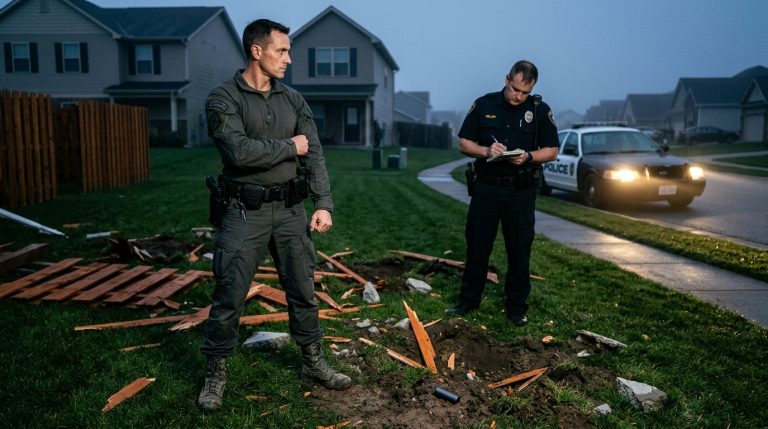
The air smelled of raw sap and uncombusted diesel, a sharp, green blood-scent that hung thick in the damp morning. Marcus did not look at Karen. Instead, his eyes were locked on the wet, yellow-white heartwood of the fallen maple branch near his boot. The wood was still bleeding, weeping sticky moisture into the pale, trampled grass. A century of slow, quiet growth had been reduced to a heap of wet sawdust in under two hours.
His fingers, calloused from years of maintaining military machinery, tightened around the handle of a chipped ceramic mug. The coffee inside had gone cold, a stagnant dark circle reflecting the flat, overcast sky. He felt the frayed cuff of his old green flannel shirt brushing his wrist, a familiar, comforting texture that now felt entirely inadequate against the sudden, hollow exposure of his yard.
“Compliance with what, Karen?” His voice was low, devoid of the sharp edge he had used in the desert, but vibrating with a heavy, rhythmic gravity. He stepped forward, the damp soil yielding slightly under his weight.
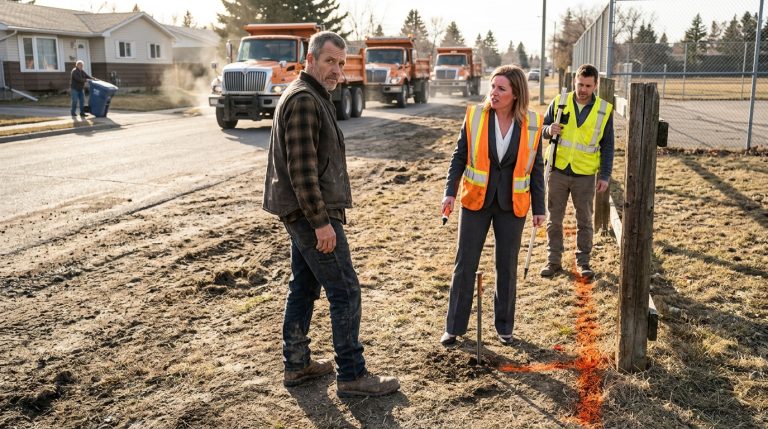
Behind her, the orange-vested crew was already throwing the smaller limbs into the gaping steel mouth of a wood chipper. The machine let out a mechanical shriek, a metallic roar that seemed to vibrate directly in Marcus’s teeth. The contrast was stark: the bright, unnatural plastic of the safety vests against the deep, muted mosses of the ancient bark.
Karen clutched her plastic clipboard closer to her chest, her fingers leaving pale, circular imprints on the cheap blue backing. The laminated HOA badge pinned to her collar jiggled with her quick, shallow breaths. “Section fourteen, subsection C,” she muttered, her eyes darting briefly to the raw stumps before settling back on Marcus with a hard, defensive squint. “Mr. Henderson’s television signal was degraded. We have a duty to the community’s infrastructure, Marcus. You received the warning.”
A warning. He thought of the gray pile of bulk mail sitting on his kitchen counter, forgotten between shifts. But it wouldn’t have mattered. No piece of paper had the right to slice through four generations of shade. He felt a soft, trembling touch on his elbow. Sarah had stepped onto the grass beside him, her eyes wide, reflecting the naked, empty space where the maple’s lower canopy used to filter the morning light. A single tear cut a clean path through the pale dust on her cheek.
Marcus looked back at Karen, his gaze dropping to the edge of the clipboard where a small, handwritten notation was scribbled in blue ink: 12 Patriot Way – Special Levy pending.
It wasn’t just a correction of branches. It was a calculated harvest.
“You’re going to want to keep that clipboard close, Karen,” Marcus said softly, his voice barely rising above the low rumble of the idling truck. He reached down, picking up a single, pale leaf that had drifted onto his boot, its edges already curling, dry and papery in his palm. “Because you’ve just rewritten the boundaries of this neighborhood. And I don’t think you realize how deep these roots actually go.”
CHAPTER 2: THE GATHERING OF WRECKAGE
The leaf in Marcus’s hand felt impossibly thin, a scrap of dry parchment whose veins had already begun to stiffen and gray. Under his thumb, the main rib of the leaf split with a tiny, dry click—a minute fracture that seemed to echo in the sudden silence left by the wood chipper’s low, grumbling idle. Karen did not answer him. She took a half-step backward, her heels sinking into the soft, unmapped earth of the common area buffer, her clipboard shifting like a buckler. She turned, her cheap polyester blouse rustling as she walked toward her driveway down the street, her posture rigid, refusing to look back at the ruin she had authorized.
Sarah’s fingers remained anchored to Marcus’s flannel sleeve, her grip tight enough to strain the seams. Her breathing was shallow, a quiet, rhythmic hitching in the damp air. “Marcus,” she whispered, her voice carrying the flat, hollow tone of someone looking at a home after a fire. “The sunlight. It’s too bright. It shouldn’t be this bright here.”
He looked up. She was right. Without the massive, interlacing canopy of the sugar maples to soften the morning sky, the light fell raw and naked across the front porch. The porch swing, usually kept in a cool, emerald twilight by the ancient branches, sat in a harsh, unshadowed glare that exposed every peeling flake of gray paint along its armrests. The world felt smaller. Exposed.
“We leave it for now,” Marcus said, his voice flat, grounding. He didn’t let the anger rise to his face; he kept it low, a cold weight in his gut, stabilizing his posture. “We don’t clear the branches. We don’t touch the wood.”
“Marcus?”
“If you clean up a crime scene, Sarah, you’re doing the defense’s work for them.” He gently placed his hand over hers, feeling the coldness of her knuckles before gently guiding her back toward the steps. “Go inside. Make a pot of tea. Use the chipped blue mugs. I’m going to make the call.”
He didn’t wait for her to agree. He stood on the porch, watching her retreat behind the screen door, its rusty spring letting out a familiar, melancholic whine. He pulled his phone from his pocket, his thumb hovering over the screen. He scrolled past the generic contacts of the neighborhood until he reached a name he hadn’t dialed in three years: Ben Carter.
The phone rang twice before a gravel-dry voice cut through the static. “Marcus. It’s been a minute. You still working that old lathe in your garage?”
“Ben,” Marcus said, his eyes scanning the road. A white utility van was pulling onto the far curb three houses down. On its side panel, a fading blue decal was partially obscured by road grime, but Marcus’s eyes, trained to notice anomalies in the field, caught the sharp, blocky lettering: Weyland-Acreage Developments. The name sat in the back of his mind, a cold, dry seed of memory he couldn’t quite place. “I need you at the house. I’ve got five casualties. Oak and maple.”
There was a long pause on the other end, the sound of a heavy diesel engine starting in Ben’s background. “The veterans’ registry said you had a historic plot. Those are the ones your grandfather put in, right?”
“Yeah,” Marcus said, his thumb tracking the cracked glaze of his coffee mug. “The HOA brought a crew. They topped them. Severed the main limbs.”
“I’ll be there in twenty,” Ben said, and the line went dead.
Marcus didn’t move from the porch. He sat on the top step, his knees drawn up, watching the gray dust motes dance in the unfamiliar, glaring shafts of sunlight that now pierced the space where the canopy had been. He waited, his mind slowly sorting the details, calculating the weight of the timber, the age of the rings, and the quiet, stubborn persistence of the soil beneath his boots.
CHAPTER 3: THE GATHERING OF WRECKAGE
The hum of the approaching diesel engine grew from a low, gravelly vibration in Marcus’s chest to a defined rattle as Ben Carter’s heavy-duty pickup rounded the curve of Patriot Way. The truck was a workhorse, its forest-green paint faded by years of sun exposure and scratched by low-hanging branches, matching the quiet utility of its owner. It pulled up to the curb, the tires crunching softly against the loose gravel and wood-chips that littered the edge of Marcus’s lawn.
Marcus stood up from the wooden step, his knees making a dry, cracking sound that seemed to mimic the splintered oak limbs scattered across the grass. He walked down the porch steps, the boards slightly warped beneath his work boots, until he reached the perimeter of his property. Ben turned off the ignition. The engine died with a heavy, metallic shudder, leaving a sudden, ringing silence in the newly opened street.
Ben climbed down from the cab. He was wearing an old, oil-stained canvas vest over a faded flannel shirt, his gray hair tucked under a grease-smeared cap. He didn’t offer a handshake; instead, his gaze swept over the yard, his eyes narrowing as he took in the sheer scale of the botanical carnage. He let out a slow, quiet breath through his teeth, his jaw tightening under a silver stubble.
“They didn’t just trim them, Marcus,” Ben said, his voice carrying the dry, raspy texture of a man who spent his life outdoors. “They butchered them. This is high-impact topping. No licensed professional would ever bring a bar that close to the main trunk.”
Marcus leaned his shoulder against the fence post, feeling the rough, splintered grain of the cedar through his sleeve. “Can they survive it?”
“Survival is a relative term for a centennial oak,” Ben replied, stepping onto the grass. He bent down near the base of the largest stump, his rough, leather-like hands gently tracing the jagged, torn edge of the bark where a massive branch had been crudely ripped away instead of sliced clean. “The vascular system of a tree this size is delicate. When you open a wound this wide, you’re inviting rot, beetles, and fungal decay. It’s a slow leak. They’ve effectively put a clock on them.”
He stood back up, reaching into his pocket to retrieve a brass caliper and a pocket ledger. “We need to document every single cut. Every tear in the bark, the diameter of the severed limbs, the percentage of the canopy lost. If this goes to court, the HOA will try to argue this was routine maintenance. We have to prove the anatomical destruction.”
Marcus watched as Ben began his methodical work, moving from one mutilated giant to the next with the silent precision of an engineer surveying structural damage. He took out his own small notebook, the pages yellowed and soft at the corners, and began recording the measurements Ben called out.
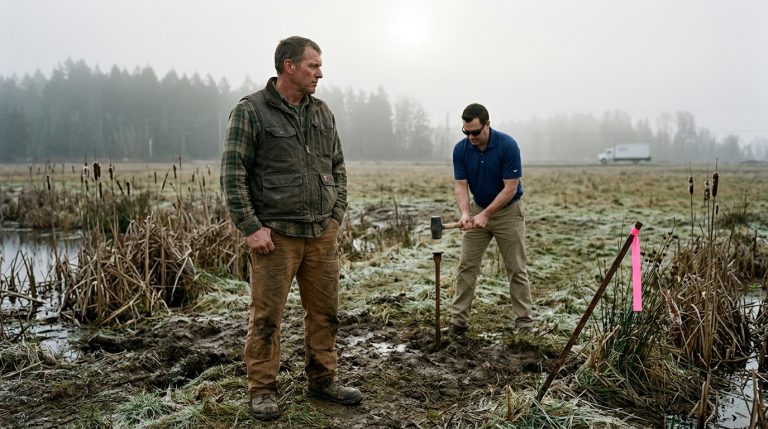
As they moved toward the western boundary of the plot, Marcus’s eye caught a physical discrepancy near the roots of the second sugar maple. The earth had been disturbed, the dark, damp soil freshly turned up, mixed with shards of old, rotted survey stakes that had been buried deep. A piece of rusted iron—a corner of an old property marker—was visible, protruding slightly from the clay. Beside it lay a discarded plastic survey flag, its faded orange surface stamped with a series of clean, blocky digits: Re-Survey ID: Deed Ledger 404.
Marcus stared at the marker, a strange, quiet friction settling in his chest. It was a detail that didn’t fit. The HOA bylaws claimed the buffer zone extended ten feet into his property, but this rusted iron stake sat nearly fifteen feet from the curb, well within the boundary his grandfather had always claimed was theirs alone.
“Ben,” Marcus said, pointing to the rusted iron with the tip of his pencil. “Look at this. Where did they measure from when they set the compliance lines?”
Ben walked over, squinting down at the exposed metal. He tapped it with the toe of his boot. “That’s old-boundary iron. It’s been here a long time. If they used the new utility easements to justify the cutting, they’ve crossed over the historical deed lines.”
Marcus felt the weight of the observation settle. The battle was shifting from the branches down into the very dirt they grew from. He carefully wrote the numbers from the survey flag into his notebook, his handwriting small and precise.
“Get the appraisal in writing, Ben,” Marcus said, his voice flat and steady as he looked back at the house down the street where Karen’s curtains flickered. “The whole thing. Every penny of the loss.”
“You’ll have it by Thursday,” Ben said, closing his ledger with a soft slap. “But be ready, Marcus. People like her don’t back down over trees. They only understand when the fence starts moving back toward them.”
Marcus nodded slowly, the dry wind rustling the remaining leaves overhead with a hollow, whispering sound that felt like an omen.
CHAPTER 4: THE SILENT COALITION
The rumble of Ben Carter’s diesel engine grew distant, fading into a dull hum before leaving the street entirely. Marcus remained still, standing by the exposed iron surveyor’s stake. His fingers tightened around his pencil, the raw pine wood of its casing warm against his palm. Down the block, the suburban silence was thin, brittle as dead leaves. The glare of the sun, no longer filtered by the century-old maples, felt hot and heavy against the back of his neck, a sharp, uninvited pressure.
He looked down at the paper. Deed Ledger 404. The numbers were neatly aligned in his notebook, but they felt like a foreign language. He turned back toward his home. The gravel of the path crunched flat beneath his boots, a rhythmic, grinding sound that matched the slow rotation of his thoughts.
As he stepped onto the porch, the screen door swung open with a quiet, metal scrape. Sarah stood there, holding two mugs of dark tea. The blue ceramic of the mugs was worn, small chips near the rims exposing the gray clay beneath. Her face was still pale, but the initial shock in her eyes had settled into something firmer, a quiet, protective wall.
“He’s gone?” she asked, handing him one of the mugs. The heat radiated through his calloused fingers, a slow, deep warmth that counterbalanced the cool, damp breeze rolling over the butchered lawn.
“He’s working on the appraisal,” Marcus said, taking a slow sip. The tea was bitter, earthy. “And we found something else. The old boundary stake. It doesn’t line up with the HOA’s easement lines. Not even close.”
Sarah looked out over the front lawn, her eyes tracing the raw, yellow wounds on the trunks. “They didn’t just take the branches, did they? They wanted the ground.”
“They wanted us to fold,” Marcus said softly. “But they made a mistake. They treated this like a transaction. They didn’t calculate the weight.”
He felt the heavy vibration of a vehicle idling nearby. A small, rusty sedan pulled up to the far curb, its suspension squeaking on the uneven asphalt. An elderly woman, Mrs. Diaz, climbed out from the driver’s side, her floral sweater slightly frayed at the wrists, her hand clutching a faded canvas bag. Behind her, a young couple, the Millers, walked slowly down the sidewalk, their toddler balanced on Tom Miller’s hip. Their faces were quiet, carrying the same tired, defensive expression Marcus had seen on soldiers returning from a hard watch.
They didn’t walk across the manicured grass. They stuck to the paved driveway, as if afraid that stepping on the lawn would trigger another violation notice.
“Marcus,” Mrs. Diaz said, her voice small but carrying a thin, steady thread of steel. Her fingers adjusted the strap of her canvas bag. “The neighborhood is talking. Everyone saw what she did to your maples. She’s… she’s sent another warning to the Millers about their fence.”
Tom Miller stepped onto the lower porch step, his flannel shirt worn thin at the elbows. He didn’t look at Marcus; his eyes were locked on the raw stumps. “She’s fining us two hundred a month for the swing set. Says the cedar isn’t an approved composite plastic. We can’t pay it, Marcus. Not this month.”
Marcus looked at the small group assembled on his steps. The light was fading now, casting long, gray shadows through the empty spaces where the canopy used to be. The sun was slipping behind the roofs, leaving a pale, amber glow that softened the sharp edges of the street.
“Come inside,” Marcus said, opening the screen door wide. The hinge let out a long, rusty sigh. “The tea is hot, and the kitchen table is clear. We’re going to read the book.”
They filed in silently, their shoes leaving faint, dusty marks on the worn oak floorboards of the hallway. The kitchen smelled of cinnamon and old wood. Sarah set down the blue mugs on the table, where the thick, leather-bound volume of the HOA covenants, conditions, and restrictions lay open. The pages were yellowed, the edges soft from years of handling, but the ink was clear.
Marcus sat at the head of the table, his hand resting on the paper where he had written Deed Ledger 404. He didn’t offer a speech. He didn’t raise his voice. He simply pointed to the text of the bylaws.
“She thinks she’s protecting the value,” Marcus said, his eyes scanning the faces of his neighbors. “But she’s using a ledger that doesn’t belong to her. We’re going to request every contract, every fine, and every penny they’ve taken from this street. And we’re going to do it together.”
Tom Miller looked up, his hand resting on his wife’s shoulder. “Can we stop her?”
“We don’t have to stop her,” Marcus said, his voice flat, carry-over tension settling like iron. “We just have to let the weight of her own rules drag her down.”
CHAPTER 5: THE LEDGERS SHADOW
The transition from a quiet agreement over cold tea to the cold reality of bureaucratic warfare was marked by the steady, rhythmic click of Sarah’s old keyboard. For three days, the kitchen table remained buried under stacks of crisp white paper—eight identical, certified records requests, each bearing the name of a different household on Patriot Way. Marcus watched the mail carrier’s truck pause at their curb on the fourth morning, its tires throwing up dry gravel as it stopped to collect the certified envelopes. The red flag on the mailbox went down with a sharp, metallic clink.
Then came the silence. A statutory ten-day countdown that stretched the tension across the street like a wire pulled too tight.
On the eleventh morning, the response arrived not in a box of records, but in a single, flat manila envelope. Marcus sat at his workbench in the garage, the smell of machine oil and sawdust dry in the air, as he slid a brass letter opener through the paper seal. The letter inside was brief, printed on heavy, cream-colored bond paper bearing the gold embossed seal of the Oak Haven Estates Homeowners Association.
Request Denied: Overly broad and burdensome.
Marcus did not let his breathing change. He laid the paper flat on his scarred pine workbench, his thumb tracking the sharp, black ink of Karen Peters’ signature. Beside it lay an old, green-bound ledger he had pulled from his grandfather’s military chest—the original land survey logs from 1982.
The garage door was partially open, letting in a thin sliver of the overcast morning light. A soft shadow fell across the concrete floor. Marcus looked up to see Chloe, the young paralegal from down the street, standing in the opening. Her fingers were tucked into the pockets of her worn denim jacket, her posture tense against the autumn chill.
“They stonewalled us,” she said, her voice dropping into the quiet space between them. “I saw the mail truck go by Mrs. Diaz’s place too. Identical letters?”
“Identical,” Marcus said, turning the letter so she could see the clean, smug print. “They didn’t even vary the formatting.”
Chloe stepped closer, her boots making a dry, scraping sound on the concrete. She reached into her bag and pulled out a small, portable scanner and a heavily annotated copy of the state’s property statutes. “They think that’s the end of it. They think we don’t know that the law doesn’t recognize ‘burdensome’ as a legal exemption for property owners. We file the petition to compel. But Marcus… while we wait for the court date, we don’t have to sit on our hands.”
“What are you thinking?”
“The management company’s off-site storage,” she whispered, her eyes darting toward the open street. “Under state law, since they denied the request, we have the right to request a physical inspection of the active files at their primary office. They can’t refuse a walk-in during business hours. I have a friend who works the desk at the county archives. She told me where the historical physical files for Oak Haven are kept. It’s the old municipal basement on Third Street.”
Marcus stood up, the legs of his wooden stool scraping the floor. “We go now. Before they have time to sanitize the folders.”
The drive to the municipal building was silent, the heater in Marcus’s truck whistling softly through the dashboard vents. The physical transition from the quiet, oak-shaded suburb to the gray, concrete blocks of the county seat felt like entering a different territory. The air in the municipal basement was cold, smelling of floor wax, damp masonry, and the sweet, decaying scent of sixty-year-old paper.
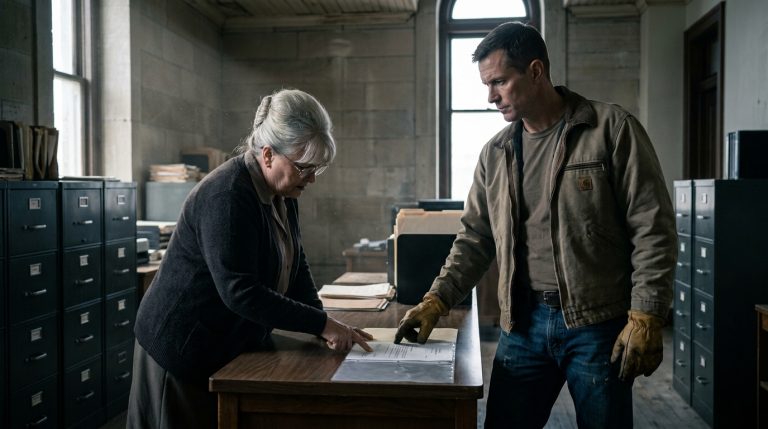
A single fluorescent bulb flickered overhead, casting a pale, yellow glare over the long rows of green steel filing cabinets. Chloe moved with practiced efficiency, her fingers trailing along the rusted label holders until she stopped at a drawer marked Oak Haven Charter – 1982-1988.
She pulled the drawer. It opened with a heavy, metallic groan that echoed off the damp concrete walls.
Marcus stood watch at the end of the aisle, his eyes fixed on the heavy wooden door that led back to the main lobby. The silence in the basement was deep, broken only by the dry rustle of Chloe flipping through manila folders.
“Marcus,” she called out, her voice tight, reduced to a dry whisper. “Look at this.”
He walked back down the narrow aisle, the space between the steel cabinets so narrow his shoulders brushed the cold metal. Chloe had spread a thick, faded ledger across the top of the cabinet. It was the original development folder for the neighborhood, its cover stamped with the name Weyland-Acreage Developments.
Inside, tucked between tax assessment sheets, was a blue-lined blueprint of the original plot layouts. But what caught Marcus’s eye wasn’t the layout. It was a physical discrepancy—a clean, white rectangle of paper pasted directly over the corner of the map where Patriot Way met the old county road.
Marcus leaned down, his eyes narrowing. In the pale, flickering light, he could see the edge of the patch was slightly raised, the glue dried and brittle with age. He gently ran his thumb along the edge. The paper was thicker than the surrounding blueprint, a different stock entirely. Beneath the lifting corner of the patch, a partial stamp was visible: Deed Ledger 404 – Rejected.
“It’s a patch,” Marcus whispered, his finger holding the dry paper back just enough to see the original, faded ink lines beneath. “They covered the original survey lines. Why?”
Chloe’s hand shook slightly as she pointed to a document clipped to the back of the ledger. It was a copy of a 1982 quitclaim deed, the signatures faded to a dull, watery brown. “Because the original deed transfer for this entire sector was flagged as incomplete. The developer never acquired the ancestral plots. They just… wrote over them in the master charter.”
Before Marcus could answer, the heavy wooden door at the end of the hall let out a sharp, echoing click as the latch turned. A shadow stretched across the damp concrete floor of the aisle.
“Who’s down here?” a dry, authoritative voice called out from the darkness.
Marcus immediately let the paper patch fall back into place, his hand dropping to his side, his posture resetting into a calm, immovable block as a figure stepped into the pale yellow light.
CHAPTER 6: THE COURTROOM SIEVE
The silhouette on the concrete stretched toward Marcus’s boots, the long head of the shadow warping across a damp seam in the masonry. Marcus did not slide his hands toward his pockets, nor did he shift his weight. He remained locked in place like a cedar fence post, his thumb still resting near the lifted, papery edge of the Weyland-Acreage blueprint.
The door at the end of the aisle creaked further open, its rusted spring screaming in the cold basement air. A man in a grease-stained brown service uniform stepped into the pale yellow wash of the flickering bulb, carrying a heavy iron ring of keys that jingled like loose change. He stopped, blinking against the dust motes, his eyes settling on Chloe’s portable scanner and then on Marcus’s face.
“Municipal offices are closed for the shift, folks,” the man said, his voice flat, carrying the gravel of a lifelong bureaucrat who had spent too many winters in drafty storage rooms. “You aren’t supposed to be back behind the partition.”
Marcus slowly let his fingers slide off the edge of the ledger, allowing the yellowed paper of the patch to settle back over Deed Ledger 404. He turned, his shoulder brushing the cold, rusted corner of the green steel filing cabinet. The scent of ancient, decaying wood-pulp was thick in his throat, dry as ash.
“We were authorized for physical inspection of the active files,” Marcus said, his voice quiet, holding the steady, rhythmic cadence of a man who had negotiated supply lines in high-tension zones. “The clerk upstairs stamped the entry log at nine.”
The man looked at the heavy leather volume on the desk, then at the keys in his hand. He let out a long, wheezing breath that smelled faintly of peppermint and cheap tobacco. “Well, she didn’t tell me. And the county judge is sitting on a special petition hearing in fifteen minutes. If you’ve got business with the Oak Haven filings, they’re already hauling the certified copies up to Courtroom 3B. You’re looking at the ghost files.”
Chloe’s chest hitched, her fingers tightening around the strap of her bag. She didn’t look at Marcus, but her shoulder pressed slightly against his flannel sleeve—a silent, urgent signal. The courthouse.
“Then we’re in the wrong room,” Marcus said calmly. He closed the drawer of the cabinet with a slow, deliberate push, the steel tracks grinding one last time before clicking shut. He gestured for Chloe to precede him down the narrow, dark aisle, his eyes never leaving the security guard’s face until they reached the exit.
The transition from the damp, silent cellar to the second-story courtroom was a blur of gray granite steps and the soft, rhythmic squeak of damp leather soles on polished linoleum. The courthouse smelled different—of ammonia, wet umbrellas, and the sharp, dry ozone of old radiators.
In Courtroom 3B, the air was dense with the low-grade hum of suburban legal warfare. Karen Peters sat at the defense table, her posture rigid as a filing cabinet, her cheap polyester blazer rustling every time she turned to whisper to the young, pale lawyer beside her. Her clipboard was gone, replaced by a thick, blue-backed legal binder that she tapped continuously with a manicured nail.
Marcus sat in the back row of the wooden spectator benches, the varnish of the pine seat sticky against his trousers. Sarah sat to his right, her fingers interlaced with his, her skin cold but her grip unyielding.
The judge, a woman named Avery with sharp, tired eyes and gray hair pulled into a tight bun, didn’t look at the gallery. She flipped through a stack of white papers, her spectacles sliding down the bridge of her nose.
“In the matter of the Petition to Compel,” Judge Avery said, her voice dry as salt. “Mr. Thorne has requested the release of the complete board minutes and vendor logs for Oak Haven Estates. The Association claims the request is a fishing expedition designed to harass. Mr. Miller, you represent the petitioner. I’m listening.”
David Miller stepped to the podium, his leather briefcase sitting flat on the mahogany rail. He didn’t raise his voice. He didn’t use the grand gestures of a television lawyer. Instead, he reached into his folder and pulled out a single sheet of paper—the physical duplicate of the record-inspection refusal Karen had signed.
“Your Honor,” Miller said, his voice smooth as oil. “It is not a fishing expedition when the fish are already flopping on the deck. The HOA bylaws, specifically Article Eight, require a signed architectural review form for any modification of private deeded property. The Association entered my client’s land, destroyed five century-old trees, and then billed him for the privilege—all without a single signature on file. We aren’t asking for secrets; we are asking for the legally required record of their own authority.”
Karen’s lawyer stood up, his voice cracking slightly in the high-ceilinged room. “Your Honor, the common area buffer zone—”
“The buffer zone,” Judge Avery interrupted, her eyes snapping up from her desk to lock directly onto the young attorney, “is defined by the deeds. Mr. Miller, do you have the deed on file?”
David Miller smiled—a cold, thin movement of his lips that didn’t reach his eyes. “We do, Your Honor. And we also have the physical evidence that the survey stakes were moved forty-eight hours before the cutting.”
From the back row, Marcus watched Karen’s hands freeze on the binder. She didn’t look back, but the muscles in her neck tightened, a small, rhythmic twitch starting under her ear.
“The petition is granted,” Judge Avery said, the wooden gavel falling with a sharp, dry clack that echoed like a rifle shot in the quiet room. “The Association has forty-eight hours to produce the complete unedited minutes, or I will authorize a sheriff’s deputy to supervise the recovery from your office personally. Next case.”
Marcus let out his breath, the cold weight in his chest shifting slightly, leaving a raw, hollow space behind. The first wall of her fortress had just turned to sand.
CHAPTER 7: THE FINAL ROLL CALL
The heavy oak door of Courtroom 3B swung shut with a soft, pressurized sigh that cut off the hum of the gallery. Marcus stood on the wide granite landing, the coldness of the stone steps vibrating faintly through the thick soles of his boots. The shadow of the massive window frame fell across his shoulders, the light filtering through the grime-streaked glass pale and yellow, like dried pine needles. His hand remained wrapped around the soft, worn leather strap of Sarah’s bag, feeling the faint, reassuring warmth of her skin through her sleeve as she stepped down beside him.
They did not speak as they crossed the marble lobby, the quiet clicking of Chloe’s heels on the polished floor the only sound in the high-arched corridor. The tension had shifted; it was no longer a dull, static ache in Marcus’s chest but a cold, active focus, a calculation of space and timing.
“The clubhouse,” Chloe whispered, her fingers smoothing a crease in the photocopy of the 1982 Quitclaim deed she had tucked under her arm. “The board is meeting there in thirty minutes to ratify the special levies. If we don’t present this before they sign the municipal assessment roll, the county clerk will lock in the tax lien automatically.”
Marcus looked at the small, square watch on his wrist, its scratched crystal reflecting the pale light. “We have enough time. But we don’t enter from the main lobby. We use the side door by the mechanical room. The board keeps the old ledger records in the metal storage locker behind the dais.”
The drive back to Oak Haven Estates was quiet, the sky overhead a flat, desaturated sheet of gray. As Marcus turned his truck onto Patriot Way, his eyes caught the faded red-and-white shield of a surveyor’s stake sitting near the curb of Mrs. Diaz’s garden—a physical marker of the false line that had justified the destruction of his family’s maples. The soil around it was dry, crumbling into dusty gray clumps in the autumn wind.
They pulled up behind the community clubhouse, a low, beige building wrapped in artificial siding that rattled softly under the gusts. Marcus stepped out, the damp smell of rotting leaves and wet asphalt thick in his throat. He led the way along the gravel path, his boots sinking slightly into the soft earth until they reached the gray metal utility door. He pressed his palm against the cold iron handle. It was unlocked, the latch releasing with a dry, metallic pop.
Inside, the air smelled of stale coffee, industrial floor cleaner, and the dry, warm dust of baseboard heaters. The low, nasal hum of Karen Peters’ voice carried through the thin sheetrock of the partition wall, her words muffled but rhythmic, like the ticking of a grandfather clock.
“…section fourteen, subsection C, paragraph two,” she was saying, the dry rustle of her clipboard backing her words. “The non-compliance fees must be compiled into the quarterly treasury statement. If the home at twelve Patriot Way remains unresolved, the special levy—”
Marcus pushed the wooden door leading to the main meeting room open. The hinge let out a short, clean creak that silenced the room instantly.
Karen sat at the center of the folding table on the raised platform, her plastic binder open, her fingers frozen over a stack of blue-bordered certificates. To her left, Glenn, the retired insurance salesman, sat with his chin resting in his hands, his face pale under the harsh glare of the bare fluorescent tubes. Martha, her secretary, had her hands poised over her laptop, her fingers trembling slightly over the keyboard.
The forty or so neighbors gathered in the folding chairs turned in unison, their faces carrying a mixture of exhaustion and sudden, sharp attention. Mrs. Diaz was there, her hands folded over her old canvas bag; Tom Miller sat near the front, his shoulders square under his faded denim jacket.
“This is a closed administrative session, Mr. Thorne,” Karen said, her voice dropping into a flat, defensive register. She clutched the laminated ID badge on her collar, her knuckles turning the same yellow-white color as the paper on her desk. “If you do not have an approved agenda slot, you are out of order.”
Marcus walked down the center aisle, his steps slow, deliberate, carrying the physical weight of his decades in the field. He did not look at the gallery. His eyes were locked on the paper binder under Karen’s hand.
“The county court just granted the petition, Karen,” Marcus said, his voice quiet but filling the hollow room completely. He laid his green-bound notebook flat on the edge of the dais, the worn leather of its cover matching the dark finish of the wood. “The unedited minutes. The real files. We have them.”
“The board’s decisions are protected under the business judgment rule,” her lawyer, who had just entered from the rear door, stammered, his hand reaching for his briefcase. “You have no standing—”
“We have the Quitclaim from nineteen eighty-two,” Chloe said, stepping forward, her fingers placing the faded photocopy directly over Karen’s open binder. The white page, marked with the stamp of the Weyland-Acreage forgery, sat like a cold stone between them. “The master charter of this association was built on a rejected deed. The land at twelve Patriot Way was never legally incorporated into the common buffer. Your bylaws have zero jurisdiction over his plot, Karen. You had no authority to cut those trees. And you had no authority to levy a single dime against any family on this street.”
Silence fell over the room—a deep, physical stillness so absolute that the hum of the fluorescent ballast overhead seemed to grow louder, vibrating in the dry air.
Karen looked down at the photocopy, her eyes tracking the fading brown signatures, the clean, blocky digits of Deed Ledger 404 staring back at her. Her face did not flush; instead, the color drained from her cheeks, leaving her skin looking like old, dry wax under the blue-white light. Her mouth opened slightly, but no sound came out—only a dry, clicking breath.
“You’re done, Karen,” Marcus said softly, his hand resting on the green cover of his notebook. “The sheriff is already on his way to secure the ledger files. You can hand over the keys now. Or we can let them open the lockers for us.”
Glenn was the first to move, his chair scraping backward against the linoleum with a sharp, echoing shriek as he stood up, his hands raised as if to detach himself from the very wood of the table.
CHAPTER 8: REPLANTING THE LEGACY
The shriek of Glenn’s metal chair sliding across the linoleum didn’t just break the silence—it shattered the entire illusion of the Oak Haven Estates board. He stood half-hunched, his hands outstretched as if the heavy wood of the dais had suddenly grown scalding hot. “I didn’t sign off on any forgery,” he muttered, his voice cracking into a thin, desperate whisper. “Karen said the boundary adjustments were standard. She said the legal team in Texas vetted the land allocation.”
Marcus didn’t answer him. He stood perfectly still at the base of the platform, the weight of his posture grounding the small space between the dais and the front row of spectator chairs. From this close, he could hear the quick, dry rattle of Karen’s breath. The laminated badge on her blouse trembled, a tiny white plastic square vibrating against the gray polyester of her collar.
She didn’t look at Glenn. She didn’t look at her lawyer, who was silently closing his leather briefcase, his eyes already fixed on the exit door behind the stage. Her gaze was locked on the photocopy of the 1982 Quitclaim. Under the harsh, flickering glare of the fluorescent tubes, her fingers twitched, twice, reaching toward the paper before falling back onto her lap.
“The board…” Karen whispered, her voice stripped of its bureaucratic cadence, leaving it thin, dry, and raspy. “The board had a duty. To keep the community standard. If we let one boundary slip, the whole map falls apart.”
“The map was never yours to draw, Karen,” Marcus said softly. He didn’t raise his voice, but the words carried a deep, resonant finality that settled over the folding chairs like dust. “My grandfather didn’t plant those oaks to shade an easement. He planted them to anchor this soil. You used a stolen ledger to clear a path for your husband’s trucks.”
The door at the back of the clubhouse opened with a heavy, double-click. Two county sheriff’s deputies stepped onto the linoleum, their dark utility belts jingling softly in the quiet. The crowd parted without a word, thirty families turning their heads in silence as the deputies walked toward the stage. One of them, a tall officer with tired eyes, held up a blue-bordered court order.
“Mrs. Peters,” the officer said, his voice flat and professional. “We have an order to secure the administrative and financial records of the association, including all digital ledger systems under the name of Frank Peters and Compliance Solutions LLC. Please step away from the table.”
Karen didn’t argue. She didn’t reach for her clipboard. She rose slowly, her knees stiff, her movements empty of the administrative importance she had carried for a decade. As she stepped down from the dais, her heel caught on the bottom step, a brief, clumsy stumble that no one moved to correct. Her eyes met Marcus’s for a fraction of a second—a hollow, vacant gaze that held no anger, no defense, only the sudden, stark realization of absolute ruin. She walked past him, her shoulder brushing his flannel sleeve, smelling faintly of stale hairspray and damp paper, before disappearing through the back exit into the gray, misty afternoon.
The cool wind of Saturday morning carried the clean, sharp scent of turned earth and river water.
The street was alive with a quiet, industrious hum. Marcus stood near the edge of his property, his boots sinking slightly into the dark, wet loam where the raw, jagged stumps of the centennial maples still remained. He had left them there—grizzled, scarred sentinels that would always mark the boundary of what had been defended. But beside them, the ground had been opened.
A flatbed truck from a specialty nursery sat idling at the curb, its tires coated in red clay. In the bed, supported by a heavy steel cage and burlap-wrapped root balls, was a twenty-foot red oak, its branches thick with healthy, dormant buds.
“Ready on the crane, Marcus?” Ben Carter called out from the side of the truck, his leather gloves worn white at the knuckles as he secured the nylon lifting straps around the trunk.
“Ready, Ben,” Marcus said, his hand resting on his son’s shoulder.
Tom Miller walked up the driveway, a silver spade balanced on his shoulder, his boots caked in fresh mud. Behind him, Mrs. Diaz was walking slowly down the sidewalk, carrying a tray of small, steaming cups of lemon tea, her face bright in the soft morning light. Her prize-winning rose bushes had already been returned to her yard, their roots settled deep into the soil she had almost lost.
Together, they guided the massive tree down into the opened earth. The heavy thud of the root ball settling into the clay vibrated through the soles of Marcus’s boots, a solid, grounding impact that felt like a pulse returning to the street.
Marcus knelt down in the damp grass, his hands—scarred and calloused from a lifetime of labor—digging into the cold earth. He began scooping the rich, dark soil back over the roots, his fingers feeling the grit and friction of the ground his grandfather had cleared a century ago. He didn’t look up when the beaten-down sedan rumbled down the street, its back seat piled high with taped cardboard boxes.
Through the window of the passing car, he caught a fleeting glimpse of Karen’s face—a silent, empty mask staring straight ahead, the moving truck following close behind her as she left the neighborhood for the last time.
Marcus didn’t smile. He didn’t wave. He simply tamped the soil down around the base of the young oak with the flat of his hand, feeling the solid, cool resistance of the earth beneath his palm. The wind rustled through the young branches above, a soft, promising murmur that sounded like the beginning of a long, quiet peace.