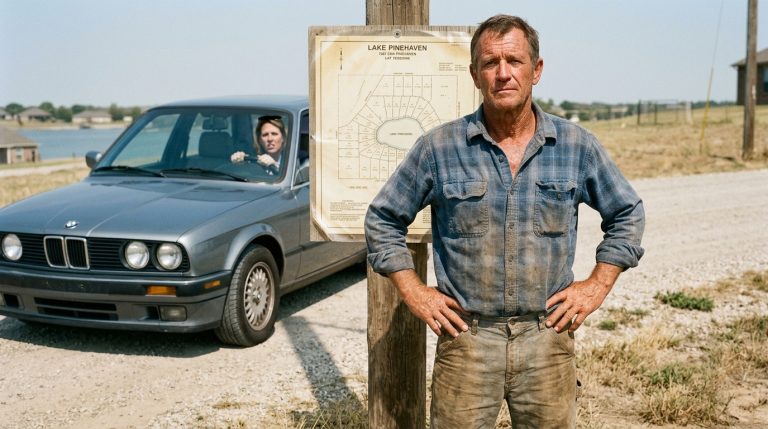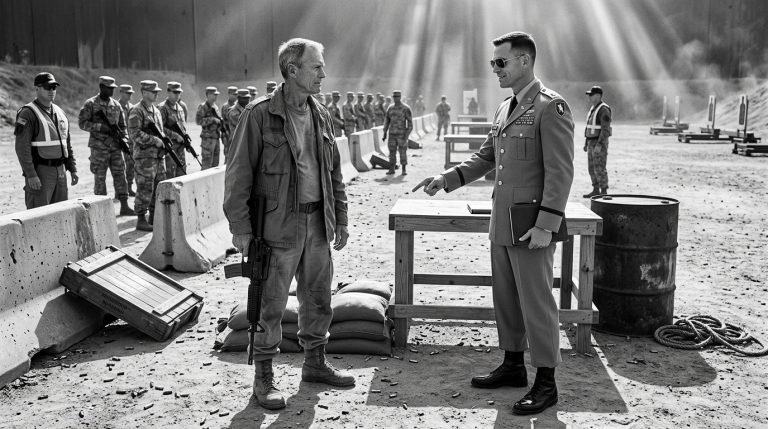
A Veteran of Architecture and War, Major Jack Travis Wages a Silent Siege Against Corrupt Bureaucracy.
CHAPTER 1: THE SHADOW ON THE PORCH
The phone grew heavy in my hand, a leaden weight that seemed to pull at my wrist. Outside, the North Carolina sun was doing its best to turn the forest floor into a gold-flecked sanctuary, but the light felt different now. It felt exposed.
Karen Bishop’s voice still echoed in the back of my skull—syrupy, weaponized, and utterly devoid of the grace that this cabin deserved. She had invoked the board, the lean, the foreclosure. She had used words like compliance and remediation as if they were tactical maneuvers.
I set the phone down on the rough-hewn cedar of the porch railing. My fingers traced the grain. Sarah’s hands had touched this same wood, sanding it until it was smooth enough for a wine glass to sit without wobbling. We had built this place to be our final stronghold, a monument to a life of service that we both desperately wanted to forget.
The silence of the woods, which had been my balm for years, suddenly felt thin. It was a tactical disadvantage.
I looked toward the adjacent property line. Through the thicket of hickory and pine, I could just make out the pristine, beige-sided monotony of the Blackwood Ridge development. It looked like a scab on the earth, a collection of boxes designed to keep the wind out and the status quo in. Karen Bishop sat in the middle of it, clutching her clipboard like a scepter, convinced that her little fiefdom was the center of the world.
She thought she was dealing with a retired major who wanted nothing more than to watch the sunset and age in peace. She was wrong. She was dealing with the man who had overseen the construction of bridges under mortar fire.
I walked inside. The air was cool, smelling of aged cedar and the ghost of Sarah’s perfume. On the mantel, the campaign cover sat with its brim slightly canted, a relic that held the weight of twenty-five years. I didn’t touch it, but I could feel it staring at me.
I walked to the desk, pulled out the legal pad, and looked at the blank, white expanse. My hand, usually steady enough to handle high-tension cables, didn’t tremble. It didn’t reach for a pen to write a letter of protest. It reached for a pen to draft an offensive.
I wrote two words at the top of the page: Operation Enduring.
I stopped. The ink bloomed into the paper, a dark, deliberate stain. The house was quiet, but the air felt pressurized, vibrating with a static charge. I scanned the room, looking for the usual comfort, but my eyes caught something odd. The edge of the rug near the fireplace was curled up, just a fraction of an inch—something I would have smoothed over a hundred times in the last month.
I hadn’t touched it.
I stood still, letting my eyes track the length of the floorboards. The dust was undisturbed, yet there was a faint, almost imperceptible drag mark near the baseboard. Someone had been here.
CHAPTER 2: THE PERIMETER BREACH
The drag mark was small—a faint, superficial gouge in the reclaimed oak that caught the dying light of the sun. To anyone else, it might have been the scuff of a heavy boot, an accidental slip during the minor chaos of daily life. To me, it was a flashing red light. I had spent twenty-five years looking at terrain, not as a landscape, but as a series of vulnerabilities. I knew this room. I knew the way the dust settled in the corners of my desk, the specific geometry of every piece of furniture Sarah and I had placed.
I hadn’t moved that rug.
My breathing slowed, dropping into the rhythmic, measured cadence I used before a breach. My heart rate stayed flat, a skill drilled into me until it was muscle memory. I didn’t reach for a weapon—I didn’t keep firearms in the house, a rule Sarah had set when we moved in, one I had honored long after she was gone—but I reached for the weight of my own presence. I became a statue, listening to the house.
The cabin groaned as the temperature dropped outside. The pines tapped against the west window, a hollow, rhythmic sound. But beneath it, there was a faint, discordant vibration in the floorboards.
I moved. I didn’t stomp; I flowed. I crossed the room with the silence of a shadow, my hand hovering near the edge of the fireplace mantle. I gripped the corner of the stone, the rough texture biting into my palm. I was scanning for the intruder, not with panic, but with the cold, surgical curiosity of an engineer inspecting a failed structure.
I reached the doorway to the loft—the window seat, Sarah’s reading nook. I peered around the frame, my eyes adjusting to the dimness of the upper level. Nothing. No shadow, no movement, just the scent of cedar and the faint, bitter smell of something else—machine oil.
A cold spike of adrenaline pierced the calm. That smell didn’t belong in the cabin. It belonged to the heavy-duty power tools used for landscaping, the kind of equipment Karen’s “remedial” crews would use to tear up a landscape.
I descended the stairs, my boots hitting the steps with deliberate precision. My mind raced through the causality: if someone had been inside, they hadn’t come for the valuables. They hadn’t touched the laptop on the desk, nor the heavy oak filing cabinet that held the deed. They had been looking at the floor. They had been checking the stability of the foundation, or perhaps mapping the layout of the internal structure.
I stepped onto the front porch, the cool mountain air hitting my skin. The sun had dipped below the ridge, leaving the world in a bruised, violet twilight. My truck was parked where I had left it. I walked around the perimeter of the cabin, my eyes locked on the dirt. There, near the foundation, were the prints. Not footprints—tread marks. A heavy-duty, treaded tire, like a piece of landscaping equipment, had been driven right up to the porch steps.
They were testing the structural integrity, or perhaps searching for a way to classify the house as “unsafe” to bolster their legal fiction of a violation.
My fury, which had been a low, manageable hum, sharpened into a crystalline point. Karen Bishop wasn’t just using the law; she was using the environment as a weapon. She was scouting.
I went back inside and locked the door, but I didn’t just turn the deadbolt. I pushed the heavy, reclaimed oak dining table, a massive piece I had built with Mike years ago, until it was jammed against the frame. It was overkill, irrational even, but it felt right.
I sat back down at the desk, but I didn’t reach for the legal pad. I reached for the digital camera I kept in the top drawer. I didn’t care about the HOA meeting tonight. I needed to document the breach. I spent the next two hours in the dark, my eyes straining to catch any shift in the shadows outside, listening to the forest. Every sound—a snapping twig, the wind, the distant hoot of an owl—became a tactical input.
I was no longer the retired Major sitting in his monument. I was the engineer, and the enemy had just given me the exact map of their intentions. They weren’t going to wait for the law to take its course. They were going to try to force the collapse of the house, and in doing so, they had provided me with the first evidence of their malice: physical trespass.
I stood up and walked to the window, watching the dark line of trees. The woods were no longer a sanctuary; they were a firing line. If they wanted a war, I would give them one that would break their HOA, their developer, and their precious status quo into dust. I picked up my phone, but I didn’t call the police. That was for citizens who still believed the system was on their side.
I dialed Ben Carter. He picked up on the first ring, his voice sharp with focus. “Major? It’s late.”
“Ben,” I said, my voice steady. “They breached the perimeter. And I have the photos to prove it.”
CHAPTER 3: THE BATTLE OF THE BINDERS
Ben’s voice crackled through the phone, thin and jagged in the quiet of the cabin. “Send me the photos, Major. And don’t touch anything else. If they breached the property line, that’s not just a violation of your privacy. That’s a potential tort if we can link it to the board’s intent.”
“I’m already on it,” I said, my gaze fixed on the dark, impenetrable line of the treeline. The adrenaline was still there, a cold current running beneath my skin, but my mind had shifted into the slow, steady rhythm of the engineer. I was no longer seeing a cabin; I was seeing a system that had been compromised.
I hung up and moved the dining table back to its original position. Moving it had been an instinctive, almost primal response—the need to fortify. But as I slid the oak across the floor, the screech of the wood against the grain sounded too loud, too desperate. I stopped. I wasn’t an insurgent in a bunker. I was a professional operating within a framework, and the only way to destroy them was to out-think them on their own turf.
I spent the next three hours in the glow of the desk lamp, the light casting long, harsh shadows that sliced the room into geometric grids. I didn’t reach for the camera again. I reached for the boxes of files—the raw data of Blackwood Ridge. I had already spent days scouring the CCRs, but now I had a different lens. I wasn’t looking for violations anymore; I was looking for the connective tissue between the association’s maintenance logs and the property boundaries.
I pulled out the ledger I’d requested—the one detailing the ‘remedial’ landscaping fees. It was a dense, tedious document filled with line items that read like a fantasy novel of bureaucratic waste.
August 12: Soil stabilization, South Perimeter. $1,200.
August 15: Grading and drainage, North Access. $850.
I traced the dates with the tip of my fountain pen, the nib scratching against the paper. The ‘North Access’ mentioned in the log didn’t exist as a designated maintenance zone according to the original site plan I had retrieved from the county office. I pulled the master site plan, unrolling it across the oak table, the edges curling against my weight.
I laid the maintenance log beside the map. My pen hovered over the coordinates. There was a discrepancy. The ‘North Access’ where they claimed to have performed ‘grading and drainage’ was the exact point where the utility easement intersected with my twenty-acre buffer. If they had been grading there, they hadn’t been performing maintenance—they had been scouting, digging, or perhaps preparing a staging ground.
The room felt suddenly, intensely small. The smell of cedar, which had been a comfort, now felt like the smell of a box I was slowly being sealed into. I felt the weight of the house around me, the heavy beams and the stone fireplace Sarah had loved. They weren’t just attacking a man; they were attacking the physical manifestation of my life.
I leaned back, the chair groaning under me. My eyes scanned the wall where I had pinned the photos of the development. The beige houses, the manicured turfs—they looked like a digital render, lacking depth, lacking soul. My cabin, with its dark, natural cedar, felt like a shadow against that artificial light.
I wasn’t just fighting for the land. I was fighting for the reality of it.
I picked up the fountain pen again. My hand was steady now, the tremor of anger replaced by the cold, precise focus of a man who knows exactly where the enemy’s spine is located. I began to map the maintenance logs against the physical property lines, creating a visual timeline of their movements. Every time they claimed to be doing ‘remedial landscaping,’ I could now cross-reference it with the physical evidence of their trespassing.
The discovery was a small one, buried in the middle of a dry, technical ledger, but it was the first crack in their armor. They hadn’t been careful. They had assumed that nobody would ever look closely enough to compare a spreadsheet to a survey map.
I caught myself holding my breath. The silence of the cabin was total, the kind of stillness that allows you to hear the settling of the floorboards, the ticking of the clock. I felt a strange sense of clarity. Karen Bishop might have the board, the gavel, and the sycophants, but she didn’t have the discipline. She was playing a game of power; I was playing a game of attrition.
I stood up and went to the kitchen, the floorboards cold beneath my feet. I poured a glass of water, the sound of the tap harsh in the silence. I stared out the window at the ridge. The darkness was absolute, a void that felt like it was pressing against the glass.
They thought they were surrounding me. They didn’t realize that in surrounding me, they had put themselves within my range. I finished the water and looked at my reflection in the window—a face lined with the years, eyes that had seen too much to be intimidated by a woman with a clipboard.
I walked back to the desk. There was still a long night ahead, and a hell of a lot more paper to burn through. My tactical plan was coming together, a slow, methodical construction of a trap. I would let them keep moving, let them keep digging their trenches, while I quietly mapped every inch of their advance.
Tomorrow, I would meet with Ben, and I would show him that this wasn’t just a dispute over landscaping. This was a documented case of calculated, systematic land-testing. The war wasn’t coming, and it wasn’t here. It was being built, piece by piece, document by document, on this desk.
I sat down and picked up the ledger again. The game was mine to lose.
CHAPTER 4: THE STRATEGY OF THE SHADOWS
The silence of the cabin was no longer empty. It was pressurized, heavy with the weight of the secrets I had pulled from the HOA’s ledger. I stared at the map until the lines blurred, my mind tracing the intersection of the utility easement and the northern boundary of my property. It wasn’t just a survey error. It was a calculated encroachment.
I stood up, the chair scraping against the floor—a jarring, metallic sound that seemed to slice through the night air. I walked to the window, the glass cold against my forehead. The darkness outside was absolute, a void that mirrored the blank space in the HOA’s documentation. They had been sloppy. They had assumed that an old man with a background in engineering wouldn’t have the stomach for a war of attrition, or perhaps they simply believed that enough bureaucratic noise would eventually drown out the truth.
They were wrong.
I turned back to the desk, my eyes landing on a small, yellowed piece of paper taped to the corner of the workspace: a copy of the original diner napkin where Sarah and I had sketched the layout of the fireplace. It was the heart of this house—the reason we had built it in the first place. The memory hit me with the sudden, sharp intensity of a phantom limb. I could see her hands, covered in drywall dust, pointing at the sketch. ‘Make sure it’s sturdy enough to last, Jack,’ she had whispered. ‘This is where we grow old.’
The memory wasn’t a distraction; it was fuel. It hardened the resolve that had been growing over the last forty-eight hours. I picked up the fountain pen again. My movements were no longer rushed. I was operating within the structure of a campaign. I pulled the legal binder that Ben had left with me, the pages thick with interrogatories and production requests.
I began to draft the response to their motion to dismiss. I didn’t write it as a lawyer would. I wrote it as an engineer writing a post-action report for a failed project. Every point I made was anchored in physical evidence—the GPS coordinates of the encroaching ‘maintenance’, the site plans, the ledger discrepancies. I wasn’t just filing a legal motion; I was constructing a trap.
The hours ticked by. The clock on the wall was a slow, steady pulse, counting down the time until I could get these documents into Ben’s hands. By the time the first grey light of dawn began to bleed through the pines, I had finished the draft. It was cold, precise, and entirely devoid of the emotional language they had tried to use against me.
I gathered the documents, my fingers lingering on the edges of the pages. This was the opening salvo. They wanted a battle of attrition? I would give them a war of record. I would force them to account for every cent, every hour, and every square inch of earth they had attempted to claim.
I heard the rumble of a truck down the road—the neighbor, Tom, heading out early to the workshop. It was a reminder that the world was beginning to stir, that the conflict I was managing in the dark would soon break into the light of day. I didn’t feel tired. I felt a strange, detached kind of energy, the same feeling I used to get when the plans for a new bridge finally checked out, when the physics of the thing were sound, and all that remained was the execution.
I walked to the kitchen and made a pot of coffee, the aroma filling the room, a small, grounding detail in a morning that felt like a threshold. I stood by the window, the mug warm in my hands, and watched the sunrise strike the peaks of the mountains. The light was harsh, revealing the imperfections in the world, the scuffs on the wood, the wear on the walls.
I didn’t mind. I knew the house. I knew the land. And now, I knew the enemy.
The phone buzzed on the desk, a short, sharp vibration. It was a text from Mike. ‘Checking in, Dad. Hope you slept.’
I didn’t answer. There was no time for reassurance. I had a courier to prepare, and a lawyer to meet. I walked back to the desk, the floorboards silent beneath my feet. The map was still spread out, the lines and coordinates staring up at me. The trap was set. Now, I just had to wait for them to walk into it.
I picked up the binder, the weight of it comforting in my grip. This wasn’t just paper. It was the future of the cabin. It was the memory of Sarah. And it was the end of Karen Bishop’s reign, whether she realized it yet or not. I headed for the door, the cool morning air waiting for me on the other side. The work was just beginning.
CHAPTER 5: THE STORM BREAKS
The sky didn’t darken gradually; it bruised, turning a sickly, impossible shade of violet that seemed to suck the oxygen from the air. I had one foot out the door, the heavy binder pressed against my chest, when the wind hit—a sudden, percussive blast that smelled of pine needles and wet iron. It wasn’t just a mountain squall. It was an assault.
I stepped back, the door groaning as the pressure differential tried to pull it from my grip. I slammed the deadbolt home. The cabin, which had been a fortress of intellectual coldness moments ago, now felt like a fragile shell against the encroaching chaos. Thunder rolled across the ridge, a deep, tectonic rumble that vibrated through the floorboards and up into my boots.
This was the complication I hadn’t mapped. The roads to the valley, the narrow, winding ribbons of asphalt that I needed to navigate to reach Ben’s office, were notorious for flash flooding. If the mountain decided to wash them out, I wouldn’t be delivering my counter-offensive today. I would be stranded, and time—precious, calibrated time—would be bleeding away while the HOA tightened their grip on the jurisdiction argument.
I set the binder on the dining table and walked to the mudroom. I pulled on my waterproof gear, the heavy, rubberized fabric stiff and smelling of long-term storage. I wasn’t going to let a storm dictate the tempo of this war. If the roads were blocked, I would find a way around, or I would wait them out in the muck, but I wouldn’t stay in this house while the enemy was actively maneuvering.
I stepped back out onto the porch. The world was a blur of motion. The hickory trees were whipping back and forth like tortured things, their limbs straining against the gale. I descended the steps, my boots sinking into the saturated earth. Every step was a tactical calculation. The path to the truck was slick, the clay turned to a treacherous, slick paste.
I reached the truck and hauled myself into the cab, the metal cold and biting against my palms. I cranked the engine, the roar of the V8 a defiant counter-point to the thunder. I didn’t wait for the windows to clear. I shifted into four-wheel drive and pulled away, the tires churning through the mud.
The journey was a masterclass in controlled chaos. The wipers were useless against the deluge, and the road ahead was a nightmare of fallen branches and rising water. I drove by memory, tracing the familiar curves of the mountain road, my eyes locked on the narrow, illuminated corridor in front of me. I felt the truck slide, the rear end kicking out as a section of the shoulder gave way, but I held the wheel steady, letting the physics of the machine work for me.
There was a singular, terrifying moment where the road simply disappeared—a wall of runoff surging across the pavement. I didn’t brake. To stop was to surrender to the current. I accelerated, the truck surging forward, the chassis shuddering as the water crested the hood. For a heartbeat, the world was nothing but sound and spray, a weightless suspension in the middle of a flood. Then, the tires found the grip of the road on the other side, and I was through.
My heart was a metronome, ticking off the seconds of my survival. I pulled to the side of the road, the engine idling, the rain drumming a relentless, metallic rhythm against the roof. My hands were shaking, not from fear, but from the raw, kinetic exertion of the drive. I looked over at the passenger seat where the binder sat, bone-dry and untouched.
The storm was a distraction, a test of my resolve. It was a physical manifestation of the pressure Karen and her board were exerting—a chaotic, unthinking force that wanted to sweep me off the road and erase me from the landscape. But I was still here. The truck was still running.
I wiped the condensation from the glass. The road ahead looked clearer now, the worst of the deluge passing. I realized then that this was the strategy: they were trying to make the process itself so agonizing, so treacherous, that I would eventually tire and turn back. They were counting on the weather, the bureaucracy, the intimidation to do their heavy lifting.
They hadn’t factored in the fact that I had spent my life building things that were designed to withstand exactly this kind of force. I shifted the truck back into gear. Ben was waiting, the evidence was secure, and the court case was still standing. I pulled back onto the road, my speed increasing, my focus narrow and unwavering.
The storm hadn’t stopped me. It had just washed away the pretense of being a ‘retired homeowner.’ There was no longer any ambiguity in my mind. I wasn’t just defending a cabin; I was conducting an operation, and every mile I put between me and the ridge was a step closer to the end of their authority.
I kept my eyes on the road, watching the way the headlights cut through the rain. The target was in sight.
CHAPTER 6: THE DISCOVERY OF THE DECOY
Ben’s office was a tomb of paper. Stacks of files leaned precariously against the walls, held in place by the sheer gravity of litigation. The air was thick with the stale scent of pepperoni and the sharp, chemical tang of fresh toner. I dropped the heavy binder onto his desk, the thud resonating in the cramped space.
Ben didn’t look up immediately. He was hunched over his computer, his glasses sliding down the bridge of his nose, his eyes scanning a spreadsheet that looked like a jagged tooth line of red ink. He looked haggard, the kind of exhaustion that only comes from staring at numbers until they start to lie to you.
“Major,” he muttered, not breaking his gaze. “You timed this perfectly. I was just about to lose my mind.”
I leaned against the desk, my hands still feeling the residual vibration of the truck’s steering wheel. “The storm slowed me down, but the evidence stayed dry. What are we looking at?”
Ben finally pushed his chair back, the casters shrieking against the worn carpet. He turned the monitor toward me. It was a ledger of the HOA’s reserve funds, the money that was supposed to be set aside for major infrastructure projects—roof replacements, road paving, clubhouse repairs.
“I tracked the last three years of transfers to the general contractor they used for your ‘remedial’ landscaping,” Ben said, his finger tracing a column of figures. “Look at the timing, Jack. Every time the HOA board voted on a special assessment, a ‘maintenance’ payment was triggered within forty-eight hours. It’s too clean. It’s not just bad accounting; it’s a rotation.”
I stared at the numbers. They were cold, indifferent, and utterly damning. They didn’t just point to incompetence; they pointed to a revolving door where the board members were essentially paying themselves with the community’s money under the guise of remedial work.
“So, the developer, Marcus Thorne,” I began, the realization settling into my chest with the weight of a stone. “He isn’t just trying to acquire my land to build luxury estates. He’s the one providing the infrastructure bids that justify the assessments. He’s the architect of the robbery.”
Ben nodded, a grim smile touching his lips. “He’s the parasite. Karen is just the host. If we can prove that Thorne was manipulating the assessment schedules to force homeowners into financial distress, we can tie him directly to the RICO conspiracy. He’s not just a consultant; he’s a co-conspirator.”
The pieces of the puzzle clicked together with a jarring, mechanical finality. I thought back to the maintenance logs I had analyzed the night before. The ‘North Access’ grading, the ‘Soil Stabilization’ that never happened—it wasn’t just a way to harass me. It was a way to inflate the invoices, to generate a paper trail that justified the massive drain of the community’s reserve funds.
It was the perfect decoy. By focusing on the ‘standardization’ of the community and the ‘violation’ of the Major’s cabin, they had created a narrative of aesthetic control that masked a much more mundane, much greedier crime. They weren’t just petty tyrants; they were small-time grifters operating on a suburban scale.
“We need the original bids,” I said, my voice barely a whisper in the cramped office. “If the bids themselves are fraudulent—if they were never intended to be fulfilled—then the entire assessment process is built on a foundation of felony fraud.”
Ben opened a side drawer and pulled out a manila folder, the edges dog-eared and worn. “I already subpoenaed the bid registry from the regional office. It’s coming in on Monday. But Jack, there’s a catch. If we bring this to the court, the insurance company will pull their defense of the board immediately. We won’t be suing a corporation anymore. We’ll be suing individuals who know their houses, their savings, and their lives are on the line.”
“That’s exactly where I want them,” I replied.
The weight of the situation was no longer a burden; it was a weapon. I stood up, the chair pushing back with a hollow rasp. I could see the end of this now, the trajectory of the law pulling us toward a final, inevitable collision. There would be no more maneuvering in the shadows, no more quiet documentation.
I looked at Ben. He looked as tired as I felt, but there was a fierce, hungry light in his eyes. He wasn’t just a lawyer anymore; he was a man who had caught the scent of blood in the water.
“Get the registry,” I said, my voice steady, the tone of a command. “When it arrives, we don’t just file a motion. We blow the doors off. We expose the bid-rigging, we link Thorne, and we let the board see exactly what their ‘President’ has been buying with their money.”
I walked toward the door, my hand resting on the frame. The storm had passed, leaving behind a silence that felt cleansed, purified. The legal process was a grinding, miserable business, but for the first time, it felt like it was finally, truly moving.
I stepped out into the hallway, the smell of pizza and toner fading behind me. The world outside was cold, hard, and indifferent, just the way I liked it. The enemy had built their house on a foundation of paper, and I had finally found the match.
CHAPTER 7: THE TRIBUNAL OF BLACKWOOD RIDGE
The air in the clubhouse was thick with the scent of floor wax and the stale, nervous sweat of a hundred people trapped in a room with a collapsing ceiling. I stood at the front, the hum of Ben’s projector the only sound until he clicked the final slide into place. The images were clear: the fraudulent bid registries, the internal emails between Karen and Marcus Thorne, and the damning timeline of reserve fund transfers that lined up, day for day, with the bogus ‘remedial’ landscaping fees.
Karen didn’t look at the screen. She was staring at her own hands, which were locked tightly in her lap. The vibrant purple of her pantsuit, once a symbol of her iron-fisted authority, now looked garish and ridiculous in the sterile fluorescent light. The room was deathly quiet, the kind of stillness that precedes a landslide.
“These are not accusations,” Ben’s voice was calm, clinical, the tone of a surgeon performing a necessary amputation. “These are the public records of your own HOA. The question remains: where did the fifteen thousand dollars for the South Perimeter project go, if not to the contractor who never existed?”
A murmur of disbelief rippled through the crowd. I watched the faces of the homeowners—Mrs. Gable, the Millers, the contractor with the van. Their initial confusion was burning away, replaced by a cold, sharp anger. They weren’t just neighbors anymore; they were a jury.
Karen finally looked up. Her face was a mask of terror, the smug certainty that had defined her reign for years replaced by a frantic, darting look around the room. She was looking for an exit, a gesture of support, a friendly face—and finding nothing but the collective, heavy weight of a hundred stares.
“This is a smear campaign,” she stammered, her voice thin, lacking the resonance of her former power. She reached for the gavel on the table, her knuckles white, but her hand was shaking so violently that the wooden head clattered against the plastic surface. “This is unauthorized. Major Travis is trying to seize control of our community for his own profit.”
“Major Travis is trying to get his home back from a fraud,” Ben countered, his voice cutting through her static. “We are asking for an immediate vote of no confidence. If you vote to keep the current board, you are effectively endorsing the financial mismanagement of your own reserves. The choice is yours.”
I watched as Tom, the mechanic, slowly stood up. He didn’t look at Karen. He looked at the room. “I’ve seen enough,” he said, his voice deep and deliberate. “I move for the immediate removal of the president and the board. Effective now.”
The silence shattered. A roar of agreement filled the room, a chaotic, angry sound that seemed to rattle the very fixtures of the clubhouse. People were on their feet, the folding chairs clattering against the floor. Karen was shrinking back in her chair, the light from the projector catching the sheen of perspiration on her forehead. She looked small. She looked finite.
I watched her, and for a fleeting second, I saw it—the truth beneath the malice. She wasn’t a mastermind. She was a woman who had gambled the community’s money on a developer’s promise of a ‘luxury’ payday, a way to cover the massive, hidden debts of her own life. She had been desperate, and in her desperation, she had weaponized the only tool she had: the HOA.
The revelation hit me with the force of a physical blow, grounding my rage. She wasn’t a monster. She was a small, broken person who had tried to build a kingdom on a shifting foundation of debt and lies.
The vote was a formality, a rapid-fire succession of hands shooting into the air. It was a total, crushing repudiation. Within moments, the room was a blur of movement. The interim board members—Tom, Mrs. Gable, the Millers—were already stepping forward, their expressions set with the grim, practical purpose of a cleanup crew.
Karen had abandoned her post. She was walking toward the side door, her movements jerky and uncoordinated. I stepped into her path.
She stopped, her eyes meeting mine. For a second, there was no hostility—just a raw, naked fear. She realized that I wasn’t there to gloat. I was just there, a man who had defended his home and had won.
“It was never about the landscaping,” I said, my voice quiet, barely audible over the din of the room.
She didn’t answer. She turned away and pushed through the door into the night, her silhouette vanishing into the darkness of the parking lot. I stood there for a moment, the weight of the binder in my hand suddenly feeling less like a weapon and more like a tool. The conflict was resolved. The bureaucracy was broken.
I looked at Ben, who was already busy gathering his files, his movements efficient and satisfied. I looked at the room, at the people who were finally beginning to breathe again. I had done it. I had protected the monument. I had reclaimed the territory.
I walked toward the exit, the air outside smelling of wet asphalt and cooling earth. The war was over, but the quiet that followed felt deeper, more profound than anything I had ever known. I stood on the threshold, watching the last of the lights in the clubhouse flicker. My work here was done.
CHAPTER 8: THE MONUMENT AT REST
The drive back up the ridge was the quietest I had ever taken. The storm clouds had shredded, leaving a bruised, high-altitude sky that was rapidly filling with the first few pinpricks of starlight. Below, the valley glowed with the soft, artificial amber of the Blackwood Ridge development, but up here, at the edge of the timberline, the world was raw and unadorned.
I pulled the truck to a stop in the gravel turnaround and sat for a long moment, the engine ticking as it cooled in the damp night air. The cabin stood before me, a silhouette against the dark expanse of the woods. It looked different now. It didn’t look like a stronghold, and it didn’t look like a command center. It just looked like home.
I climbed out and walked to the porch, my boots crunching on the wet stone. I reached into my pocket and pulled out the set of keys, the metal biting into my palm—a grounding, tactile reminder of everything I had been fighting for. I unlocked the door and stepped inside, the familiar scent of cedar and old books greeting me like a long-absent friend.
I didn’t turn on the lights. I walked to the stone fireplace, the heart of the structure. I knelt and gathered the dry kindling I had set aside hours ago. My hands, which had been steady during the legal battle, felt a sudden, fleeting tremor. It wasn’t fear. It was the simple, overwhelming relief of a man who has put down a heavy pack after a long march.
I struck a match. The flame flared, casting long, jumping shadows across the pine walls. I fed the fire until it caught, the wood hissing and spitting, the warmth beginning to radiate outward. I sat back on my heels, watching the light play across the mantel, where the photo of Sarah and me sat undisturbed.
In the quiet, the reality of Karen’s downfall felt less like a triumph and more like a necessary correction of gravity. She had tried to turn the world into a ledger, to value the land by the uniformity of its siding and the square footage of its lawn. She had failed because she had never understood the weight of the thing she was trying to manipulate. She hadn’t seen the hours of sanding, the sweat of the frame-raising, the way the stone of this fireplace had been chosen one by one by Sarah.
I reached out and ran my hand along the surface of the mantle, my fingers catching on a small, rough spot in the wood that had been there since the day we built it. I had meant to sand it down for years, but I never did. It was a part of the house, a testament to the fact that we were human, and this place was ours.
The legal victory was absolute. The lean was gone, the covenants were officially null and void for my twenty acres, and the HOA was currently undergoing a painful, public transformation under Tom and the others. The threat was neutralized. But as I sat there, the heat of the fire soaking into my bones, I realized the victory wasn’t just in the paperwork. It was in the fact that I was still sitting here.
I thought about Karen, somewhere out there in the dark, stripped of her position, her finances, and the illusion of her importance. I didn’t feel the sharp, cutting edge of hatred anymore. I just felt a distant, hollow pity. She had chased a dream of status and had ended up losing the only thing that mattered: a place to call her own.
I stood up and walked to the wall, to the small section of the frame where I had noticed the gouge during the breach—the mark of the intruder. I knelt and took a piece of sandpaper from my workbench, the grit rough against my skin. I began to work on the wood, a slow, methodical rhythm, sanding until the mark was gone and the wood was smooth and natural once more.
It was a small repair, but it felt monumental. I was closing the breach.
I stepped back, looking at the wall. The cabin was whole again. I walked to the loft, to the window seat Sarah had designed. I sat down, the moonlight spilling over my shoulders, illuminating the pages of the open book she had left there years ago. I didn’t pick it up. I just looked at it, feeling the quiet pulse of the house, the way it breathed with the wind outside.
I had come back from the wars, and I had come back from the boardroom. I had held the line. And now, for the first time in a long time, the only mission left was to exist in the peace I had earned.
I looked out at the valley one last time. The lights of the development seemed smaller now, less imposing, a mere speck in the vast, ancient darkness of the mountain range. I wasn’t an engineer anymore, and I wasn’t a soldier. I was a man in his home, and for the first time in my life, that was more than enough. I closed my eyes, the warmth of the fire finally reaching into the deepest, coldest part of my chest, and for the first time in weeks, I let myself breathe.