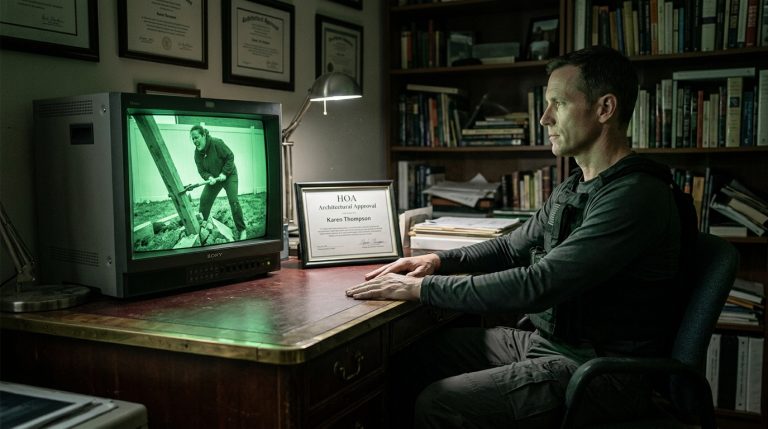
The Measured Line: How an Engineer Took Down the Neighborhood Tyrant
CHAPTER 1: THE GRAVEL LINE
The crisp October air smelled of damp pine and cut red oak, but the shadow standing on my path smelled of stale lavender perfume and unearned authority.
Karen Miller stood with her slippered feet planted on the crushed rock at the edge of my ten acres. Behind her, Herb fumbled with the bridge of his wire-rimmed glasses, shifting his weight like a man waiting for a storm to blow past.
“That pile of wood is a blight on this community,” Karen said, her voice piercing the quiet afternoon. “If you don’t remove it, I will.”
Thirty feet behind me sat four cords of seasoned oak, split cleanly and stacked with three decades of Army Corps of Engineers precision. That timber wasn’t a decorative choice; it was four tons of winter security for my wife and me.
I rolled a small brass pocket scale between my knuckles, the cold metal anchoring my hands as I looked her over.
“The wood is neatly stacked, Karen,” I said, keeping my tone flat. “It sits sixty feet inside my boundary line and well clear of any shared access.”
“I don’t care where you think your line is,” she snapped, stepping forward until the hem of her floral mumu brushed the weeds along the driveway edge. “I am the president of the Harmony Creek HOA. The covenants prohibit unseemly accumulations of debris.”
Herb nodded once, a nervous, involuntary twitch of his neck.
I knew the two hundred and forty-seven pages of covenants by heart; I’d spent three nights studying them before signing the closing papers. My ten-acre plot was grandfathered land, intersecting their master-planned subdivision at only one small triangular easement down by the main road.
“You’re standing on my property right now,” I said, pointing down the gravel track toward the identical beige houses of the cul-de-sac. “Your authority stops two hundred yards that way.”
Her face flushed a deep, mottled crimson.
“You have seven days to clear that monstrosity, or the hundred-dollar-a-day fines begin,” she spat, spittle landing on the dry dirt between us. “We’ll see how your private property argument holds up when we place a lien on your home.”
She turned on her heel, her fuzzy slippers kicking up small clouds of dust as she marched toward the road with Herb trailing in her wake.
I didn’t answer. I just thumbed the brass scale in my palm, noting a dark, greasy smudge on the gravel right where she’d been standing—a fresh drop of industrial hydraulic fluid that had no business being on a residential footway.
CHAPTER 2: BLUEPRINTS AND IRON PINS
The hydraulic fluid had seeped an inch deep into the crushed limestone. A residential lawnmower doesn’t leak industrial-grade fluid in a concentrated puddle like that; a commercial flatbed truck with a hydraulic crane does.
I walked back up to the house, the cold autumn wind whipping through the pines behind my four cords of oak. Sarah was at the kitchen counter, her hands wrapped around a mug of coffee, her eyes wide as the back door latched behind me.
“Mark, what did she say?” her voice was thin, carrying that tight, anxious strain I hated hearing. “Is she really going to fine us?”
“She can try,” I said, kicking my boots off by the mat. “I’m going to my office.”
I unrolled the county survey plat across my desk, pinning the corners down with a heavy brass paperweight and my trusty slide rule. The ink on the legal document was faded, but the survey lines from thirty years ago were crisp: Lot 1 was ten acres of grandfathered timber, explicitly carved out of the original township grant long before the Harmony Creek Homeowners Association bought the adjacent farmland.
My eyes followed the perimeter line down to the southern border. There it was—a tiny shaded triangle near the county road labeled Partial Covenant Area A. That fifty-foot concession was made by the previous owner purely for sewer hookup rights, sitting a full six hundred feet south of my woodpile.
I pulled out my phone and dialed the county surveyor’s main line. The clerk answered on the third ring, her voice dry and bureaucratic.
“County Surveyor’s office, this is Martha.”
“This is Mark Jennings at 1280 Old Mill Road,” I said, setting the brass scale down on the plat map. “I need an official boundary restake on my northern property line. My neighbor is asserting jurisdiction over non-covenanted land.”
“We can have a crew out Thursday morning at eight, Mr. Jennings,” she replied, keying it into the system. “Standard fee applies for placing certified iron pins.”
“Make it Thursday,” I said. “And make sure the survey team brings a sworn notarized certificate.”
I spent the next two days in quiet calculation. On Wednesday evening, under the shadow of dusk, I carried a step ladder and a camouflage-patterned trail camera out to the mature oak tree forty feet from the firewood stack. I strapped the housing twelve feet up the trunk, tilting the lens down to cover the entire gravel approach and the four cords of oak.
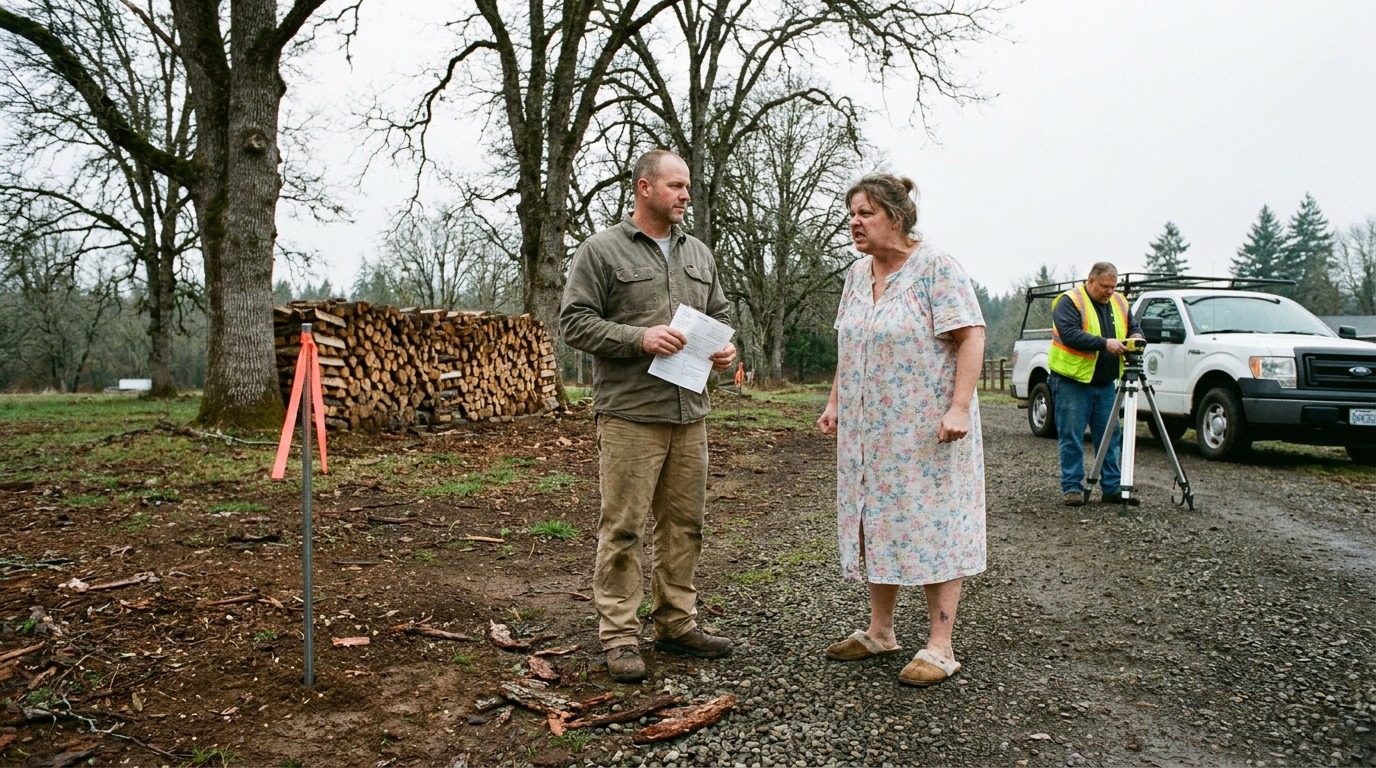
By Thursday morning at eight sharp, a white county pickup truck pulled up the long driveway, its yellow beacon flashing against the overcast sky. Bill Carlson, a thickset surveyor in a high-visibility vest, stepped out and unloaded a total station tripod from the truck bed.
“Mr. Jennings?” Bill called out, adjusting his baseball cap. “Let’s find your corners.”
We were ten minutes into sighting the original brass markers when a sharp screen-door slam echoed across the road. Karen marched across the property line, her floral mumu trailing in the damp grass, her fuzzy slippers thumping heavily against the dirt.
“What do you think you’re doing on this property?” she barked at Bill, ignoring me entirely. “I am the president of the Harmony Creek Homeowners Association, and this area is under active violation enforcement.”
Bill didn’t even lift his eye from the sight lens. “County survey, ma’am. Mr. Jennings ordered a certified boundary verification.”
“This survey is invalid!” Karen spat, her face going a dangerous shade of purple as she jabbed a finger toward my woodpile. “The HOA boundary includes that entire timber line! You have no right to set markers here!”
Bill stepped back from his equipment, taking off his cap to wipe his forehead with a quiet, practiced patience. “Ma’am, with all due respect, county plat maps don’t care about your bylaws. The iron pins go where the legal deed puts them.”
He picked up a heavy sledgehammer and a two-foot steel pin wrapped in bright orange surveyor’s tape. With three heavy, metallic strikes that echoed through the quiet woods—CLANG, CLANG, CLANG—he drove the pin deep into the earth, exactly ten feet north of my firewood stack.
Karen stood paralyzed on the gravel edge, her mouth open in silent fury as Bill tied the neon flag to the steel head. The bright orange tape fluttered in the breeze, a glaring, official line in the dirt that severed her authority right in front of her eyes.
She didn’t utter another word; she spun around, her slippers skidding on the loose rock, and slammed her front door hard enough to rattle her own porch lights.
Bill handed me the signed receipt and a temporary boundary certificate. “She’s going to be a problem, Mr. Jennings.”
“She’s already a problem, Bill,” I said, looking at the orange flag fluttering over my wood. “Now she’s just a trespassing one.”
CHAPTER 3: THE MIDNIGHT HEIST
The orange flag fluttered against the grey sky, but my eyes dropped to the gravel beneath it.
Where four cords of red oak had stood stacked ten feet high just twelve hours ago, there was nothing. Only raw dirt, scattered bark fragments, and fresh gouges in the earth where heavy outriggers had dug into the mud.
I knelt in the damp soil. Right at the edge of the tire tracks lay a crumpled white paper receipt. I smoothed it against my thigh: a commercial firewood delivery manifest, stamped with a local supplier’s logo and marked Paid in Cash.
I didn’t yell. I didn’t rush across the road to slam on Karen’s front door. I pulled my step ladder out from behind the shed, carried it to the mature oak, and unlatched the camouflage trail camera twelve feet up the trunk.
Back in my office, the laptop screen glowed in the quiet room. I slotted the SD card into the drive, my fingers steady as the video files loaded.
The file timestamp read 2:13 AM.
The ghostly green infrared footage lit up the screen. A flatbed truck with an articulated hydraulic boom backed down my driveway, its engine running quiet.
The passenger door swung open. A figure stepped into the frame wearing a bright, neon-pink tracksuit that practically glowed under the infrared night vision.
It was Karen.
She gestured with a heavy battery lantern, waving the truck closer to the woodpile. Ron, her husband, climbed out of the driver’s side, his shoulders hunched as two men in work clothes hopped off the back bed.
For forty-five minutes, the camera recorded every movement. The hydraulic arm clamped down on my red oak, lifting half-ton bundles directly onto the flatbed. Karen stood by the rear bumper, checking off a clipboard and barking silent orders into the dark.
At 2:58 AM, Karen turned toward the tree line. She looked directly into the camera lens, pulled down her visor, and let a slow, arrogant smile spread across her face before climbing back into the cab.
She thought the darkness covered her. She thought my grandfathered land was just another backyard she could bully into submission.
I clicked Save, copied the uncompressed video files to three separate thumb drives, and uploaded a backup to my secure cloud storage.
I picked up my phone and dialed Dave Ramirez’s office line.
“Ramirez,” his voice came through, crisp and sharp.
“Dave,” I said, thumbing the cold brass pocket scale on my desk. “She took the bait. I’ve got four faces, a commercial flatbed, and a signed delivery receipt.”
“Tell me you have it on high-def,” Dave said, the sound of a desk chair swiveling through the speaker.
“Infrared, 1080p, and timestamped,” I replied. “She smiled right at the lens.”
“That’s not a civil dispute anymore, Mark,” Dave said, his tone dropping into low, lethal calculation. “That’s felony grand theft and criminal trespass. Don’t touch a single piece of evidence on that ground.”
CHAPTER 4: THE DETECTIVES OFFICE
Detective Miller tapped her pen twice on her notepad, her sharp eyes flicking from my certified survey map to the silver drive resting between us.
“You’re telling me an HOA president brought a flatbed crane onto your private property at two in the morning?” she asked, her tone dry but attentive. “Over a firewood dispute?”
I pushed the thumb drive across the Formica surface. “The footage speaks for itself, Detective. Timestamped, high-definition, and shot from twelve feet up a mature oak.”
She slotted the drive into her laptop. I watched her face as the video played—the ghostly green glow reflecting in her glasses as the flatbed backed down my gravel path, the hydraulic arm swinging wide, and Karen in her bright pink tracksuit waving directions with a heavy battery lantern.
When the clip reached 2:58 AM—where Karen turned directly toward the tree line, pulled down her visor, and grinned right into the infrared lens—Detective Miller leaned back, letting out a low whistle.
“She knew what she was doing,” Miller said, pausing the frame right on Karen’s smirk. “And this survey report confirms the timber was stacked ten feet inside your deeded property line?”
“Beyond any doubt,” I replied, placing the notarized county boundary document beside her keyboard. “She was served a formal notice of non-jurisdiction forty-eight hours before she brought that truck onto my land.”
Detective Miller pulled a fresh incident form from her drawer, her pen moving with fast, practiced strokes.
“Mr. Jennings, this isn’t a civil boundary disagreement anymore,” she said, looking up with a cold, professional focus. “Value of four cords of seasoned red oak, plus equipment usage and trespassing—this crosses straight into felony grand theft.”
I pulled the crumpled commercial delivery slip from my pocket and laid it beside the survey. “Her husband operates a side business supplying commercial accounts. That slip dropped out of the truck bed during the haul.”
Miller stared at the cash receipt, her eyebrows rising slightly before she pinned it under a paperweight. “So she wasn’t just clearing what she called ‘debris.’ She was harvesting your winter heat to supply her own pipeline.”
“That’s the logical conclusion,” I said, my voice level.
“I’m issuing a warrant for grand theft and criminal trespass against Karen Miller and Ron Miller,” Detective Miller said, closing her notebook with a heavy snap. “And I’ll be having a very long chat with the tree service contractor who brought that boom truck onto your land.”
I stood up, adjusting my jacket. “Thank you, Detective. My lawyer will be filing the civil suit by noon.”
“Tell your lawyer to get in line, Mr. Jennings,” she said, a faint, iron grin touching her lips. “The county prosecutor is going to want the first crack at her.”
CHAPTER 5: THE CLUBHOUSE RECKONING
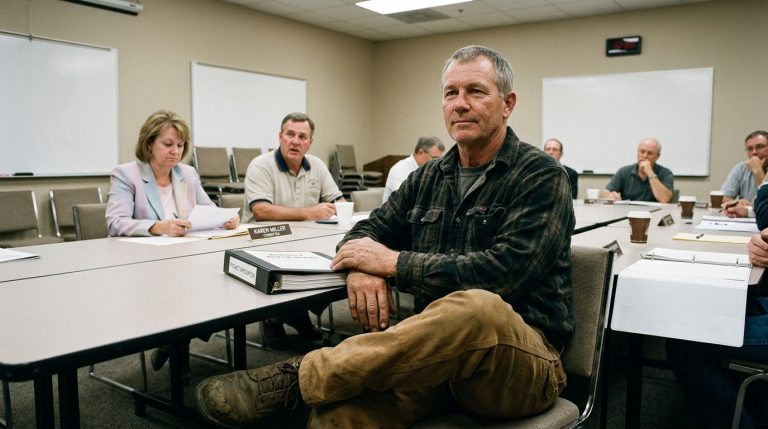
Over a hundred homeowners crammed into the folding metal chairs, their voices humming in an angry, restless chorus. At the long table up front, Frank the treasurer sat wiping cold sweat from his bald head, flanked by two pale board members.
Karen’s chair in the center was empty.
Frank rapped a wooden gavel against the Formica table. “This emergency meeting of the Harmony Creek Homeowners Association will come to order—”
“Where’s Karen?” a man in the third row shouted, standing up. “Why isn’t she up there answering for the police cars at her house?”
Frank’s throat twitched as he gripped the microphone. “Ms. Miller has been advised by her legal counsel not to attend. As there is active litigation, the board cannot comment on specific property disputes—”
Dave stepped into the center aisle, unrolling a portable projection screen with a crisp, metallic snap. “We aren’t here to ask for your comments, Frank. We’re here to present evidence of criminal conversion using HOA authority.”
“You are out of order, sir!” Frank’s voice cracked as he pointed a trembling finger. “This is a private board session!”
George Henderson stood up from his seat near the door, his weary face set like flint. “Let the man speak, Frank. We pay dues here.”
A chorus of shouts erupted across the room—Maria Sanchez clapping her hands loudly, neighbors standing up to drown out Frank’s gavel. The board lost control of the room in five seconds flat.
I plugged the projector into Dave’s laptop. The room lights clicked off, and a beam of white light cut through the dark, hitting the screen with a stark, ghostly image.
The night-vision footage lit up the entire clubhouse wall.
Gasps rippled through the crowd as the boom truck backed down my driveway. The room went dead silent as Karen stepped into the frame, her bright pink tracksuit glowing under the infrared lens while she barked orders to the crew loading my four cords of red oak.
And then came the moment at 2:58 AM—where Karen turned, pulled down her visor, and grinned right into the camera.
“Oh, you violent thief!” Maria yelled from the front row.
“Is that where our fine money goes?” George called out, stepping toward the table. “Hiring commercial rigs to steal from property owners?”
Frank slumped back in his chair, his hands covering his eyes as the entire room descended into a roar of furious demands.
“I move for the immediate removal of Karen Miller as president for cause!” George shouted over the noise.
“Second!” Maria called out.
Every single hand in the room shot into the air. In the cold light of her own hubris projected on the wall, Karen’s six-year reign of petty terror vanished in a single unanimous vote.
CHAPTER 6: THE DEFIANT STACK
The rough bark gripped my work gloves as I set the split oak flush against the corner post.
Beside me, George Henderson lifted a heavy wedge of oak from the flatbed trailer, sliding it into the lower row with practiced rhythm. A few yards away, Maria Sanchez laughed while setting down a thermos of hot coffee on the hood of my truck.
The new stack stood six feet tall and thirty feet long—six cords of dense, cured timber paid for directly by the insurance settlement Dave secured from the board.
The financial restitution was complete. Every dollar spent on the county survey, the legal filing fees, and the replacement wood had been wired directly into my account, with a substantial personal payout forced from Karen and Ron’s assets to avoid a civil jury trial.
Across the gravel road, a red-and-white For Sale sign stood hammered into the manicured front lawn of Karen’s house.
The plea deal had stripped away her remaining bluster. Two hundred hours of mandatory community service along the county highway in a high-visibility vest left little room for holding court over neighborhood trim colors or lawn gnomes.
George wiped his brow with the back of his sleeve, looking up at the bright orange survey flag still fluttering from the steel pin Bill Carlson had driven into the dirt.
“New bylaws passed the committee this morning,” George said, leaning against the trailer gate. “We scrubbed every vague line about ‘unseemly accumulations’ and subjective aesthetics. Property owners handle their own land now.”
“That’s how it should have been from day one, George,” I said, thumbing the cold brass scale in my pocket before sliding it away for good.
Sarah walked down the porch steps, carrying a tray of mugs into the crisp air. She handed one to George, then stepped beside me, resting her hand lightly against my arm as we looked over the neat, solid wall of wood.
The timber was stacked ten feet inside my deeded line, solid, balanced, and untouched.
I took a sip of the warm tea, feeling the quiet autumn calm settle over the ten acres of land I’d earned with twenty years of service. The boundary was marked, the rules were clear, and the winter heat was secure.