A Sovereign Defense: The Calculated Dismantling of a Suburban Tyrant and the Reclamation of Quiet Territory
CHAPTER 1: THE THRESHOLD
The sunlight hitting the edge of my woods felt brittle, like thin glass waiting to shatter. Karen Miller stood on the property line, her beige pantsuit cutting a sterile, inorganic silhouette against the vibrant, chaotic green of the trees I had fought ten years to protect. She didn’t look like a threat; she looked like a clerical error, a stout woman wielding a plastic-cased clipboard like a badge of absolute authority.
“This isn’t a request, Mr. Davies,” she said. The tone was rehearsed, slick with the kind of self-satisfaction that usually preceded a corporate downsizing. “This is a notification of compulsory eminent domain for community improvement.”
I stayed perfectly still. My hands were at my sides, fingers slightly curled—not in aggression, but in a practiced, mechanical neutrality. Twenty years in the Army Corps of Engineers had taught me that when a bulldozer is coming for your life, you don’t scream at the driver. You look for the hydraulic line. You wait for the moment the operator overextends their reach.
“The board has finalized the site plan,” she continued, her eyes darting past me, toward the five acres of dense woodland that had served as my family’s lungs for a decade. She held up the clipboard. “Future site: Oakwood Bluffs Recreational Complex. Tennis courts, a clubhouse, a proper community hub. You’ll be compensated at market value, of course, once the legal paperwork clears the county.”
She stepped forward, her heel sinking into the soft, unkempt soil of my lawn. It was an intrusion. A breach of perimeter.
I didn’t take the clipboard. I looked at the crudely drawn map pinned to the front, where my woods—a distinct, separate parcel with its own deed—had been rebranded as common land by a few strokes of a marker.
“My woods are not part of the HOA, Karen,” I said. My voice was a flat, low hum, devoid of the heat I actually felt burning in my gut. “They were purchased as a separate parcel. They aren’t subject to your covenants, your boards, or your tennis courts.”
She sniffed, a sharp, dismissive sound that reminded me of dry leaves being crushed underfoot. “A procedural technicality. Our counsel has advised that the original developer’s intent was for all adjacent land to be incorporated. We are simply correcting an oversight.”
She didn’t look at me when she said it; she looked through me, already picturing the concrete slab she wanted to pour over my memories. She was confident, her movements jerky and clipped, vibrating with the frantic, petty energy of someone who had recently discovered how to use a stamp of authority and was desperate to use it on everything in sight.
I felt the cold, familiar clarity settling over me. The knot of anger tightened, but I used it. It became fuel, sharpening my focus, stripping away the noise. She was trying to frame theft as progress, and in doing so, she had exposed her intent.
“The legal counsel you’re using,” I asked, my voice steady, “have they actually verified the deed for this parcel?”
“The board’s decision is final, Mr. Davies,” she snapped, stepping further onto my grass, her presence a jarring, artificial stain on the morning. “I suggest you prepare for the surveyors.”
She turned to walk away, her back rigid, clearly expecting me to fold. She didn’t notice the way I stepped back, adjusting my stance to watch her go. She had just declared war, and she had done it without checking the terrain.
As she marched back toward her vehicle, she stopped and turned, looking back at the trees. “It’s for the betterment of the community, Jack. You should be thanking me.”
I didn’t answer. I just watched her until the car door slammed shut, my mind already running the logistics of the coming siege. But as I turned back toward the house, I caught a glimpse of my daughter’s wooden fort tucked into the edge of the tree line. Something was off. One of the support beams, which I’d personally reinforced just last week, was hanging at an unnatural, jagged angle, as if something heavy had slammed into it in the night.
CHAPTER 2: THE COMMAND CENTER
The splintered wood of the fort’s support beam felt cold and serrated against my fingertips. I didn’t reach for a light. I didn’t call out for Sarah. I stood in the deep, encroaching dusk of the woods, my eyes adjusting to the grey light, my mind shifting gears from the indignation of the morning to a colder, more disciplined frequency.
Someone had been here. Not a surveyor, not a neighborhood kid—this was deliberate. The wood had been snapped with clean, high-velocity pressure. It was a message, a blunt-force reminder that the perimeter I had spent a decade securing was now porous. I pulled my hand back, rubbing the grit of raw timber against my thumb. A soldier knows the difference between a random accident and a tactical probe. This was the latter.
I walked back to the house, my stride measured, my eyes scanning the leaf litter for boot prints or discarded equipment. I found nothing. The woods remained stubbornly, hauntingly silent, as if the trees themselves were keeping secrets.
Inside, the house was a sanctuary of soft light and the distant, muffled sound of the television from the den. I didn’t go to my family. I went straight to my study. The room smelled of old paper and the sharp, metallic tang of the laser printer. I locked the door behind me—a habit, a relic of years spent in offices where information was the only currency that mattered.
My desk was a map of the coming engagement. I pulled out the blank, heavy-stock ledger I had purchased that afternoon. I opened it to the first page.
17:42 hours: Physical breach detected at north-west perimeter, fort structure compromised.
I wrote the entry with a fountain pen, the ink biting into the paper. It felt primitive, yet permanent. I didn’t need a digital file that could be hacked or monitored by whatever systems the HOA might be running. I needed a paper trail.
I took out the documentation Karen had thrust at me—the crudely drawn map, the HOA letterhead—and spread them out under the halogen desk lamp. The light was harsh, casting long, stark shadows across the table. I studied her handwriting. The loops in her ‘g’s and ‘y’s were overly decorative, an affectation of confidence. It was the handwriting of someone who loved the act of signing her name more than she understood the responsibility of the position.
I began to draft the formal response. My fingers hovered over the keyboard, but I stopped. No. Digital communication was too fast, too ephemeral. If I was going to send a notice, it needed to be a physical artifact—something that would force them to handle it, read it, and file it.
I drafted the letter by hand first.
To the Oakwood Bluffs Homeowners Association Board of Directors: Re: Property Boundary Dispute and Notice of Trespass. Regarding the recent notification of eminent domain, be advised that the parcel identified as the ‘Oakwood Bluffs Recreational Complex’ remains, as per the attached property survey, outside the jurisdiction of your covenants.
I paused, staring at the words. Attached. I didn’t have the survey yet. I would have to pull the records tomorrow. But the intimidation of the request was the point. I needed to see how they would react to being challenged with the same bureaucratic gravity they used to fine people for the height of their grass.
I sat back, the chair groaning under my weight. My reflection in the dark window looked like a stranger—tight-lipped, eyes narrowed, the face I had worn when briefing commanders on the structural integrity of bridge deployments in contested territory. I realized then that I wasn’t just defending a plot of land. I was defending the idea of myself as someone who couldn’t be moved, who couldn’t be bought, and who certainly couldn’t be intimidated by a woman in a beige pantsuit.
But as I looked at the splintered wood still wedged in my palm—a piece of debris I had pocketed—I felt the first prickle of doubt. If I won this, if I broke her, what would be left of the peace I’d come here to find? The house was silent, save for the hum of the hard drive. I turned off the lamp, letting the room plunge into darkness, and listened to the wind rattling the windowpane. I was building a fortress of paper and law, but I knew the truth: once you go to war, the sanctuary is already gone.
CHAPTER 3: THE DOSSIER
The morning light did not bring clarity; it brought the harsh reality of the paper mountain I had invited into my home. The air in the study was stagnant, smelling of hot toner and the stale coffee I had abandoned three hours ago. Outside, the world was waking up—the rhythmic hum of leaf blowers, the distant chime of an ice cream truck—but inside, time had flattened. I was surrounded by the fragmented, redacted life of the Oakwood Bluffs Homeowners Association.
I leaned over the desk, my back aching from the long night of excavation. My eyes were bloodshot, tracing the same lines of the “summarized budget” for the third time. It was a document designed to be looked at, not analyzed. Rows of generic categories—”Maintenance,” “Community Enhancement,” “Administrative Support”—were devoid of itemized substance.
Karen had sent this to me as a deterrent. She wanted me to see the bulk of the paperwork and decide that the effort of resistance was not worth the cost. She had miscalculated. She had assumed I was a civilian who saw paperwork as a barrier, not an engineer who saw it as a blueprint of failure.
I dragged a fresh stack of bank statements toward the center of the desk, pulling the ledger I had started the night before into position. My process was deliberate, an exercise in forensic patience. I took a high-lighter and began to map the flow of capital, tracing every recurring payment.
Payment: 10/12/2025. Miller and Associates. Amount: $2,450. Description: Consulting Services.
I circled it. There was no address for this “firm.” No tax ID. I cross-referenced the date with the meeting minutes from October, searching for any mention of a vote or a proposal regarding consulting. The minutes were a vacuum. Nothing. I looked for the next payment to the same entity. November: $2,100. December: $3,500. The numbers were rising, an escalating extraction of funds that had no justification in the board’s own records.
My finger tapped the desk in a slow, rhythmic pulse. The discrepancy wasn’t just in the numbers; it was in the friction between the expense and the lack of corresponding physical reality. If this consulting firm were real, there would be reports, designs, or physical outcomes on the property. My five acres, and the streets leading to them, remained untouched by any “consultant.”
I stood up, the chair scraping sharply against the hardwood, and walked to the window. My reflection was ghost-like, a silhouette against the morning sun. I looked at the edge of the woods. The fort was still there, a tilted, broken monument to the breach. I wasn’t just investigating a crime; I was tracking an infection.
I returned to the desk and pulled out a different folder—the one containing the contractor invoices for road maintenance. I laid them out side-by-side with the consulting fees. The dates of the maintenance checks—asphalt patching, snow clearing—rarely aligned with the consulting payments. It was as if Karen were running two parallel operations: one for the community to see, and one that lived entirely in the ledger, siphoning cash into the void of “Miller and Associates.”
I felt a cold thrill of precision. This was the hydraulic line. It wasn’t the tennis court. The tennis court was the cover, the shiny, provocative goal she dangled in front of the neighborhood to justify the increase in assessments and the tightening of control. The real goal, the thing she was protecting with her life, was the administrative bypass she had constructed within the budget.
I picked up the phone. I didn’t call the police. I didn’t call a journalist. I called Dave Sterling. He answered on the second ring, his voice crisp and already alert, as if he lived in a state of perpetual readiness.
“Jack,” he said. “Tell me you found it.”
“I found the pattern,” I replied, my voice raspy from disuse. “She’s not just a petty tyrant, Dave. She’s an embezzler. She’s paying a shell company for ‘consulting’ that doesn’t exist, and she’s doing it without board approval.”
“Keep it contained,” Dave warned, his tone shifting into the professional register. “We don’t go to the authorities yet. If we reveal what we have prematurely, she’ll scrub the files. We need the original bank records, not the sanitized versions she’s handing out. I’ll draft a demand for the full audit trail. If she refuses, we have the grounds for a court order.”
“She’ll refuse,” I said, looking at the redacted minutes on my desk. “She’s too arrogant to think I’ll take this to a judge.”
“Then we wait for her to overplay her hand,” Dave said. “Stay quiet, Jack. Don’t let her know you’re looking at the money. Keep the focus on the land dispute. Let her think she’s winning the war on the surface.”
I hung up. The silence of the study reclaimed me, heavy and suffocating. I stared at the ledger, the columns of numbers now representing the lifeblood of her deception. I had the leverage, but as I stood there, I realized the cost. I was spending my days in this dark room, dissecting the rot of a neighborhood I was supposed to be enjoying with my children. The rigidity of my own focus was starting to mirror the very control I sought to dismantle. I was becoming as methodical, as obsessed, and as closed-off as Karen herself. I tucked the folder away, but the weight of it remained, a physical burden pressing down on the desk, on the room, and on the quiet promise of the life I had built here.
CHAPTER 4: THE ARCHIVES
The silence of the county records office was not the peaceful, restorative silence of my woods. It was a dense, sterile quiet that smelled of high-density shelving, industrial adhesive, and the slow, inevitable decay of paper. I stood before the intake counter, my fingers brushing the cool, scuffed laminate. Behind the glass, a clerk with spectacles thick as paperweights stared at me with the weary indifference of a woman who had spent thirty years watching people hunt for things they weren’t supposed to find.
“I need the master plat for Oakwood Bluffs,” I said. My voice sounded too loud in the dead air. “Original filing. Late 1970s.”
She didn’t look up immediately. She tapped a few keys on a terminal that looked like a relic from a museum. “The master plat is restricted to on-site viewing. You’ll need a request form. Reason for inquiry?”
“Property line verification,” I said, leaning in. “Historical easement review.”
It was a professional lie, a piece of jargon I’d picked up from Dave. She finally looked up, her expression unchanging, and slid a form through the narrow slot. I filled it out with a precision that bordered on aggressive, my pen digging into the carbon paper. Every keystroke, every signature was an act of intent.
I was led into the back room, a labyrinth of metal rows that seemed to stretch into the gloom. The air here was climate-controlled, a cold, biting draft that made the hair on my arms stand up. I felt like an intruder in a tomb. When the clerk returned with a long, leather-bound tube, the weight of the document felt significant in my hands. It was the physical manifestation of forty years of assumption.
I set the tube on a long, sun-bleached table and carefully untied the ribbon. The paper was brittle, yellowed at the edges, and creaked like dry bone as I unrolled it. My heart rate, usually steady as a metronome, began to climb. I flattened the corners with a pair of paperweights provided by the office.
There it was. The blue-inked skeleton of my neighborhood.
I traced the layout with my eyes, moving from the main entrance toward Primrose Lane. I felt the familiar thrill of the hunt, the same feeling I used to get when checking the schematics of a construction site for a structural vulnerability. I found my own lot, number 42, and the distinct, unnumbered block of woods behind it—the five acres that had defined my life for a decade.
Then, I looked at the roads.
I traced the line of Primrose Lane, my nail scratching gently against the surface. My breath hitched. On any other plat I had ever seen, there would be a formal legal dedication block here—a small rectangle of text signed by the developer and notarized, officially handing the land over to the public or the municipality.
It was empty.
I looked at the edges of the drawing, checking for notes, amendments, or sub-labels. Nothing. Just the lines of the pavement, the names of the streets, and a void where the law should have anchored them. I pulled out my phone, resisting the urge to photograph it immediately. I didn’t want to alert the clerk. I stood there for a long time, the silence of the room pressing against my ears.
If the developer had never dedicated these roads, then they were orphans. They existed in a legal limbo, a strip of private property that everyone treated as public utility because nobody had bothered to check the map. Karen hadn’t been stealing my land; she had been acting like a queen of a ghost kingdom.
I reached into my pocket and touched the splintered piece of wood from the fort. The physical reality of the neighborhood—my fence, the HOA’s lawn height mandates, the tennis court proposal—suddenly felt flimsy, a stage set built on sand.
A sudden sound—the clatter of a cart in the aisle behind me—shattered my focus. I jumped, my hand reflexively covering the plat. The clerk was pushing a stack of files toward a nearby desk, her gaze fixed on the floor. I held my breath, waiting for her to look at me, to ask why my heart was hammering loud enough to hear. She didn’t. She turned a corner and vanished back into the stacks.
I pulled out my phone. This time, I didn’t hesitate. I aligned the lens, the screen glowing like a beacon in the dim light, and took a series of high-resolution shots. Each snap of the camera felt like a gavel strike.
As I rolled the map back into the tube, I realized the transition I had made. I was no longer a homeowner fighting a petty administrative battle. I was a man dismantling a foundation. I walked out of the archives, my boots clicking rhythmically against the polished concrete, feeling the weight of the phone in my pocket. It held the truth, and once that truth was released, the orderly, manicured life of Oakwood Bluffs would never look the same. The “betterment of the community” was a lie, and I was the one who had finally found the crack in the wall.
CHAPTER 5: THE JAG PROTOCOL
The tires of my truck crunched over the gravel of Dave Sterling’s parking lot, the sound harsh and irregular in the midday heat. I didn’t step out immediately. I sat behind the wheel, staring at the brick facade of his practice. It was a modest building, tucked away from the main thoroughfare—the kind of place where people brought problems that were too sharp or too heavy for the average mediator to handle.
I checked my phone one last time. The images of the plat map were crisp, the damning absence of the dedication block glowing on the screen. It felt heavy in my palm, a lead weight of truth that was rapidly altering my own internal architecture. The obsession I’d felt back in my study had transmuted into something tighter, more directional. I wasn’t just investigating; I was weaponizing the facts.
I stepped out, the air humid and smelling of dry asphalt and pine. As I walked toward the entrance, I caught myself checking the rearview mirror—a vestige of military habits I hadn’t exercised in years. I was anticipating interference, a reaction to the breach. Karen didn’t know what I knew yet, but the breach at my fort and the quiet surveillance I’d sensed around the neighborhood suggested the vacuum of her power was already starting to pull at the edges of my security.
Dave met me in the lobby. He was dressed in a suit that looked as sharp as a razor, his tie knotted with an austerity that matched his eyes. He didn’t offer a pleasantry. He reached for the phone in my hand with a look of predatory curiosity.
“Show me,” he said.
We walked into the conference room, a space dominated by a table so polished it held the distorted reflection of the overhead lights. I placed the phone down, the screen locked on the image of the plat. Dave spent a long minute in silence, his finger hovering just above the glass, tracing the lines of the subdivision like he was reading an EKG.
“The roads are orphans,” he whispered, a smile touching his lips—not a kind smile, but the look of a man who had just found a fatal flaw in an opponent’s structural design. “Jack, do you understand what this does to her authority? It’s not just a land dispute anymore. It’s an invalidation of every act, every fine, every directive the HOA has issued under the current board.”
“I have the proof,” I said, my voice sounding flat, resonant in the small room. “What’s the next move?”
“The next move is the bait,” Dave said, pacing the length of the table. “We don’t go to the press. We don’t go to the homeowners yet. If we do that, she plays the victim, claims it’s a clerical error, and starts shredding the trail. We force her to commit to a lie in writing. We draft a formal inquiry from my office, citing the ‘ambiguity’ of the ownership. We ask for the deed. We ask for the record of dedication.”
“She’ll refuse,” I noted. “She’ll bluster. She’ll claim it’s settled history.”
“Exactly,” Dave said, his eyes locking onto mine. “And when she puts that refusal on formal HOA letterhead, she’s signing her own eviction. We don’t need to win in court today. We need her to build the trap herself. The more she defends the lie, the tighter the knot gets.”
I looked down at the table. My own reflection was visible in the mahogany—a man I barely recognized, his jaw set in a line of permanent tension. I remembered, suddenly and with jarring clarity, a bridge-load test I’d overseen in Iraq. We had pushed a span past its maximum capacity, watching for the first hairline fracture, the first sign of buckling. The math had been perfect, but the structural integrity had been compromised by unseen stress.
I was doing the same thing here. I was stressing the architecture of Oakwood Bluffs until the fracture appeared.
“She thinks this is a fight about tennis courts,” Dave continued, his voice dropping to a low, intense register. “She thinks she can steamroll you with a few letters and fines. She doesn’t know she’s standing on a sinkhole.”
I stood up, the chair scraping against the floorboards. “Send the letter. Give her a deadline.”
“Five business days,” Dave said, his voice hard. “Long enough for her to get arrogant, short enough to keep the pressure mounting.”
I walked to the door, the weight of the plan settling into my shoulders. Outside, the world of the neighborhood—my kids, the trees, the quiet—felt further away than ever. I was operating in a space of cold, mechanical logic, a space where I was finally the one in control. But as I opened the door to the sweltering heat of the parking lot, I wondered if I was actually the one pulling the trigger, or if I was simply letting the momentum of the collapse carry me toward a point where I wouldn’t be able to stop. The blueprint for the dismantling was ready. All I had to do now was watch her walk into the center of it.
CHAPTER 6: THE PERIMETER
The white van was already idling on the curb when I pulled into my driveway, its engine a low, vibrating hum that seemed to disturb the quiet of the morning. Two men in neon-yellow vests were unloading a tripod and a bundle of stakes, their movements efficient, practiced, and—to my eyes—entirely predatory. They weren’t just contractors; they were the physical manifestation of Karen’s ego, an invasive species she had deployed to mark her territory.
My heart was a cold, rhythmic hammer against my ribs. I didn’t rush. I sat in my truck for a heartbeat, watching them. They moved with the casual confidence of people who believed they were backed by the full weight of the law. They didn’t know they were operating in a void, an orphan zone that had no master.
I stepped out of the truck, the gravel crunching beneath my boots. The morning air was sharp, biting at my skin. As I walked across the lawn toward them, I could feel the subtle shifts in my own posture—the tightening of my shoulders, the controlled, heavy cadence of a soldier approaching a line of engagement. The paranoia I had been harboring for weeks—the sense that I was being watched from behind the neighbor’s curtains, the feeling that every move I made in my own home was being cataloged—now crystallized into a singular, tactical focus.
The older surveyor, a man with sun-weathered skin and eyes that looked bored with the entire world, glanced up as I approached. He set down the tripod and wiped his brow.
“Morning,” he said, his voice clipped. “Just staking out the markers for the HOA project.”
“I’m afraid you’re mistaken,” I said. My voice was steady, perfectly modulated—the same voice I used to use when informing a contractor that their materials failed the stress test. “This is private property. It is not, and has never been, part of the HOA’s common area.”
The man sighed, a sound of profound annoyance. He’d clearly had this conversation before, or he was simply tired of dealing with homeowners who didn’t want their view ruined by a tennis court. “Look, sir, we’ve got a work order from the HOA board. They hold the jurisdiction. My instructions are to mark the survey lines for the recreational site.”
“Your work order is based on a false premise,” I said, stepping into his personal space, just enough to be felt but not enough to be an assault. I pulled the rolled-up copy of the county plat map from my jacket. I didn’t unroll it fully, just enough to show him the seal and the header. “The roads in this development were never dedicated to the HOA. There is no deed. If you place a single stake on this ground, you are not acting under the authority of a community board. You are committing trespass on private property.”
The surveyor froze. He looked at the map, then back at me, his gaze sharpening. He wasn’t stupid; he was just an employee, and he knew the smell of a legal liability when it was shoved under his nose. He took the paper from me, his fingers brushing the surface with a sudden, cautious respect.
“I don’t have time for this,” he muttered, though his tone had lost its edge. He looked back at his partner, who was standing by the van, a stake held like a weapon. “Wait up,” he signaled to him.
I didn’t move. I stood my ground, my eyes scanning the street. Mrs. Gable’s house, two doors down, had a curtain twitching. Someone else was watching. Karen had spent months building an atmosphere of fear, a panopticon of HOA compliance, and now, I was the one breaking the seal.
The surveyor pulled his phone from his vest and walked a few paces away. I couldn’t hear the conversation, but I could see the way he held the device—stiff, anxious. He looked back at me three times, his expression evolving from annoyance to realization to fear. He hung up and walked back, his face a tight mask of professional distance.
“We’re pulling the gear,” he said, not meeting my eyes.
“Smart choice,” I said.
They packed the truck with a frantic efficiency, the metallic clatter of the tripod legs echoing down the street like gunfire. I stood on the edge of the woods, my hand resting on a tree trunk. The bark was rough, anchoring me to the earth. When they finally pulled away, the silence that rushed back in felt different—not empty, but expectant.
I turned and walked to the nearest tree, pulling a ‘No Trespassing’ sign from my bag. I hammered it into the wood, the rhythmic thwack-thwack-thwack of the metal against the trunk vibrating through my arm. It was a declaration, a physical barrier I was erecting to replace the legal one I had spent all morning fighting to prove. I wasn’t just defending my land anymore; I was reclaiming the space. I looked toward the neighborhood—toward the houses where my neighbors were watching—and felt, for the first time, that the tide wasn’t just turning. It was accelerating.
CHAPTER 7: THE PUBLIC TRIBUNAL
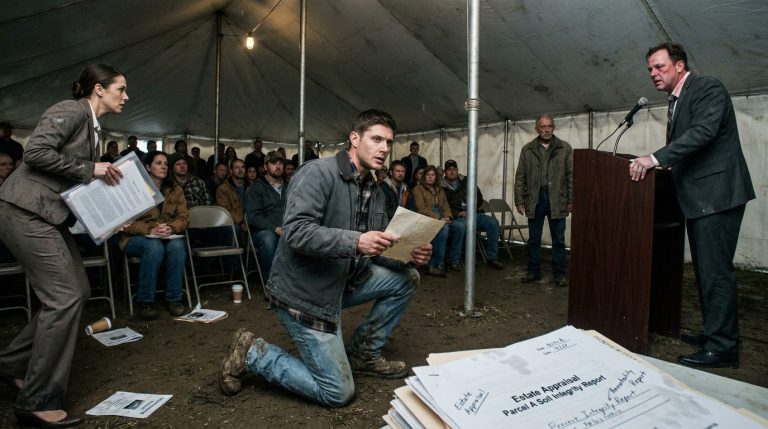
The community center room was stifling, the air thick with the scent of floor wax and the low-frequency hum of a packed crowd. Usually, these meetings were the domain of the disengaged, a handful of retirees nodding off through budget reports. Tonight, the chairs were packed to the back walls. The tension was not just palpable; it was a physical weight, pressing in from all sides. I stood at the rear, Sarah beside me, her hand gripping my forearm with a steady, grounding pressure.
Karen Miller stood at the podium. She was radiant, dressed in a sharp, floral-print dress that commanded the room. She looked down at the agenda, her posture impeccable, the very picture of organized authority. Behind her, the projector displayed a slick, polished rendering of her proposed recreational complex—green spaces, pristine tennis courts, and a clubhouse that looked like something out of a real estate magazine.
“As you can see,” Karen began, her voice smooth and resonant, “the community enhancement project represents the natural evolution of Oakwood Bluffs. It maximizes our land potential, secures our property values, and fulfills the original vision of this neighborhood.”
She spoke with the confidence of someone who hadn’t considered the possibility of a flaw in her logic. A few of her allies on the board, seated at the long table to her left, nodded like metronomes. The rest of the room remained silent, a sea of watchful, uncertain faces. I felt the phone in my pocket, the images of the plat map a dormant force. Dave was sitting two rows ahead, his presence a dark, reassuring anchor.
“The board has navigated the minor procedural hurdles,” Karen said, her eyes sweeping over the crowd, stopping for a fraction of a second on me. She didn’t blink. “We are ready to move forward. The budget is sound, the legal requirements are fulfilled, and the path to a more vibrant community is clear.”
The arrogance was stunning. It wasn’t just a lie; it was a performance. I waited, counting the seconds. She had been given the opportunity to present, and now, she would be forced to account for her reality.
When she finished, the room remained quiet, the weight of the moment hanging heavy. She gestured to the floor. “Are there any questions before we move to the vote?”
I didn’t wait. I stepped forward, my movement decisive. The room seemed to shift, the attention of a hundred people swiveling toward me. Karen’s smile faltered, just for a heartbeat, before hardening into something brittle.
“Mr. Davies,” she said, her voice dropping into a register of practiced annoyance. “I assume you have something constructive to contribute.”
“I have a question about the ‘procedural hurdles’ you mentioned, Karen,” I said. My voice was calm, projected with the steady discipline I had learned in a dozen boardrooms. “You’ve claimed exclusive jurisdiction over the road network for years. My question is simple: where is the deed? Show us the legal instrument that transferred ownership of our streets from the developer to this association.”
The silence in the room became absolute. The humming of the projector seemed to amplify in the quiet.
“Mr. Davies, this has been discussed,” Karen started, her voice sharpening. “The association maintains the roads. That practice is established by precedent.”
“Precedent is not title,” I said, stepping closer to the aisle. “I spent the morning at the county archives. I pulled the master plat. The developer never dedicated these roads. They are orphaned parcels. You aren’t maintaining common property; you’re managing land you have no legal claim to.”
A collective murmur erupted, a low, buzzing sound of confusion and realization. Karen’s face drained of color, her poise fracturing. She reached for the podium, her knuckles white.
“That is a baseless assertion,” she snapped. “We have the support of our counsel—”
“Mr. Miller,” I said, looking toward the back.
He didn’t wait. He switched the projector input. The slick rendering of the tennis court vanished, replaced by the stark, grainy, but undeniable black-and-white lines of the master plat. He used a laser pointer to circle the blank space where the dedication should have been.
“Look,” he said to the room. “The legal foundation for every fine, every maintenance assessment, and every threat the board has issued for the last forty years is missing. It never existed.”
The room exploded. People weren’t just whispering; they were standing, pointing, demanding answers. Karen looked as if she were drowning. She looked at her fellow board members, who were already pulling their chairs back, distancing themselves from the podium. She had been the hammer, and now she was the nail. I watched her, and for the first time, I didn’t feel anger. I felt the cold, hard clarity of a structure collapsing under its own weight. She had built a kingdom on a phantom, and in the sudden, blinding light of the truth, there was nowhere left for her to stand.
CHAPTER 8: THE CLEARING
The night air outside the community center was crisp, biting into my skin and rinsing away the stifling, fluorescent heat of the meeting room. Behind me, the building was a hive of frantic motion—voices raised in arguments, the clatter of chairs, the sound of the entire neighborhood suddenly grappling with the vacuum left by the board’s implosion. I didn’t turn back. I walked toward my truck, my footsteps heavy on the asphalt.
Sarah caught up to me near the perimeter of the lot, her hand slipping into mine. Her touch was warm, a steady anchor in a world that felt fundamentally altered. She didn’t say anything, but the way she leaned against me was a question I wasn’t ready to answer.
“It’s over, Jack,” she whispered.
“The dispute is,” I said, my voice sounding foreign to my own ears.
We drove home in a silence that felt different than the one I’d nurtured in my study. It wasn’t the silence of tactical planning; it was the quiet of a vacuum. For months, I had been the soldier, the architect of this dismantling. I had lived in a headspace of maneuvers, leverage, and cold, calculated strikes. Now, with the map exposed and the tyrant dethroned, there was no more adversary to calibrate against.
We pulled into the driveway, the house sitting dark and still under the moonlight. I walked around to the back of the property, toward the five acres that had been the epicenter of the entire war. The woods were a wall of shadow, silent and imposing. I walked the trail Sarah and I had carved years ago, the path familiar beneath my boots.
I stopped at the edge of the fort. It was still tilted, the wood splintered, a testament to the night someone had dared to violate this space. I knelt, my hands brushing the soft, damp earth. I spent a long time there, not thinking about HOA bylaws, not calculating risks, but just feeling the texture of the soil.
I realized then that my desire for this land, for this “sanctuary,” had been as rigid as Karen’s desire for control. I had viewed this place as a buffer, a fortress I had to hold against the world. I had isolated myself, turning my home into a defensive perimeter, and in my obsession with keeping the neighborhood out, I had nearly lost the very peace I was trying to protect.
I reached into my bag and pulled out the hammer I’d kept since the morning. I spent the next hour working in the quiet, the only sound the rhythmic strike of the tool against the wood. I reinforced the frame of the fort, replacing the snapped beam with a sturdier piece of cedar. I worked with a slow, meditative precision, letting the physical labor smooth out the sharp edges of the last few months.
When I finished, I sat back on my heels, breathing hard, the sweat cooling on my brow. Sarah was standing at the edge of the tree line, a silhouette in the soft light. She walked over, sitting beside me, and we watched the moon rise over the canopy.
“The new board called,” she said softly. “They’re asking for help with the transition. They want someone who understands the documents.”
I looked at the wood in my hands—the repair I had made. It was a small thing, a simple act of maintenance. It was the antithesis of the destruction I had unleashed on the board. I had spent months tearing down, and now, I was being asked to build back up.
“I don’t want to be the soldier anymore,” I said, the admission catching in my throat.
“You don’t have to be,” she replied.
I realized then that the final truth wasn’t about the roads, or the corruption, or the hollow power of the HOA. It was about me. I had finally achieved the “buffer” I wanted, but it wasn’t the land itself—it was the people around me, the neighborhood I had finally been forced to engage with. The rigid control I’d tried to maintain over my life had been the real target all along.
I stood up, brushing the dirt from my knees. I looked at the dark, deep forest one last time. It was just woods. The walls I had erected to protect them were gone, and in their place, there was just the quiet, cooling air and the promise of a night where I didn’t have to monitor a perimeter. We walked back toward the house, the path solid beneath our feet, moving out of the shadows and into the soft, unmanaged light of a life that was finally, truly, our own.