The Iron Perimeter: A Chronicle of Friction and Sovereign Concrete in Oakmont Creek
CHAPTER 1: THE SIDEWALK ENCROACHMENT
“Those toxic swamp barrels have to go and they have to go now or the fines will be the least of your worries.”
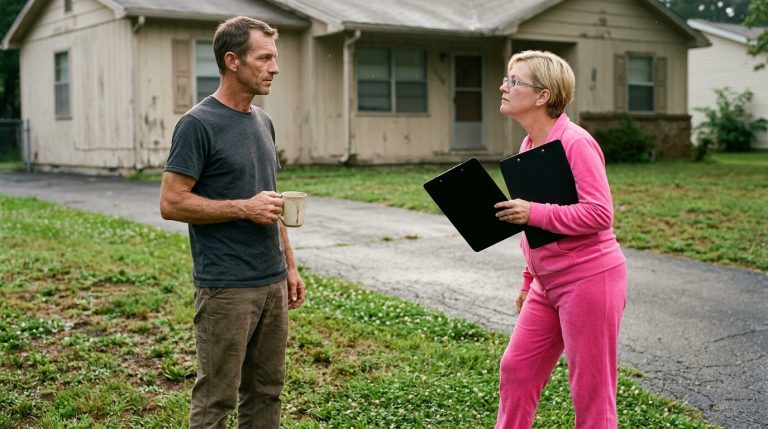
The voice had the raw, flat scrap of rusted shears crossing in dry grass. Mark Davies did not drop his trowel. He stayed low against the dark, iron-smelling loam of the raised bed, his fingers caked in the thick grey-brown earth of the Oakmont Creek cul-de-sac. He let three seconds tick past in the heavy mid-afternoon heat—long enough to check the tension in his own shoulders, long enough to catalog the specific, dry scrape of leather shoes on the edge of his aggregate concrete sidewalk.
When he stood, the heat hit his neck like a wet wool blanket. Karen Smith was planted exactly six inches inside the public easement line. Her arms were crossed over a garish floral print top that look like bruised hydrangeas, her weight settled into the heels of her white orthopedic sneakers. Her chest was pushed forward, a fleshy monument to municipal overreach. She wasn’t looking at him; her eyes were locked onto the two fifty-five gallon food-grade polyethylene barrels tucked behind the climbing jasmine trellis.
“I’ve already filed a formal complaint with county mosquito control,” she said. Her chin lifted, the skin tightening over her jaw with a theatrical weight that reminded Mark of the lower-level supply colonels he’d handled outside Fallujah. “They’re sending an officer. You are harboring a public nuisance, Mr. Davies. A breeding ground for West Nile. You’re endangering this entire block.”
Mark wiped his palms against the rough denim of his thighs. The soil left long, charcoal-colored streaks down the fabric. His mind, trained by twenty-two years of mechanical logistics and ordnance disposal in the Army Corps of Engineers, didn’t register anger. It mapped the geometry of the lawn. It calculated the width of the sidewalk. It measured the distance between her floral shirt and the sterile, green plastic of his harvesting system.
“The barrels are sealed, Karen,” he said. His voice was level, thin, completely devoid of the defensive volume she was clearly balancing her weight against. “The inlets are double-screened with one-sixteenth-inch stainless steel mesh. Marine sealant around the collars. There’s no standing water.”
“It’s stagnant,” she snapped, her face flushing the dull color of raw brick. “It’s an unapproved exterior modification. It ruins the harmonious aesthetic of the lane. In this community, a formal report means an automatic review. You’ll see how clean they are when the county vector truck rolls in here.”
She turned on her heel, the rubber soles of her shoes squeaking against the dry concrete. Mark watched the stiff line of her shoulders until she cleared his property line. He did not call after her. He looked down at his hands, where the dark soil had already begun to dry into a fine, gray crust in the creases of his knuckles. The war had arrived on his perimeter, and it smelled like old zinc and sun-baked plastic.
CHAPTER 2: THE PAPERWORK RECONNAISSANCE
The latch clicked home with a clean, low-frequency thud that vibrated through the hollow-core timber of the front door. Mark didn’t move his hand from the brass knob for four full seconds. Through the solid wood, the street outside felt deceptively empty, the heavy silence of the neighborhood settling back over the lawn like fine dust after a mortar round. The aggregate concrete sidewalk outside was clear, but the small patch of turf where Karen’s white sneakers had pressed into the sod remained slightly indented—a temporary physical record of encroachment.
Sarah was standing three feet back in the entry hallway, her fingers hooked into the hem of her faded denim apron. The knuckles were white against the cloth. Her eyes, usually calculated and sharp from hours aligning grids on a digital canvas, were wide, fixed entirely on the line of his jaw.
“She’s already documenting it,” Sarah said. Her voice didn’t rise; it had the thin, dry quality of paper stored in an attic. “I watched her from the kitchen window, Mark. She had her phone out before she reached the curb. She wasn’t just taking photos of the jasmine trellis. She was angling the lens down toward the foundation.”
Mark turned slowly, his boots leaving faint, gray crusts of dried loam on the linoleum mat. “Let her photograph the foundation. The French drain drops four inches over a twelve-foot run. It’s built to municipal drainage spec, not neighborhood whim.”
“You don’t know how she handles the committee,” she whispered, her hand dropping from her apron to touch the cool, painted drywall of the partition. “She doesn’t use municipal specs. She uses the billing cycle.”
Mark didn’t answer. He walked past her, the iron-scented dirt on his jeans brushing against the doorframe, and headed down the short utility corridor that led into the garage. The air inside the workshop was cooler, smelling faintly of dry zinc, WD-40, and the old iron shavings accumulated in the threads of his bench vise. He pulled the overhead chain on the fluorescent shop light; the tube sputtered twice before settling into a hard, white hum that flickered against the rafters.
On the corner of the heavy plywood workbench, next to a stack of sterile brass spigots and an unrolled grease rag, sat a thick, gray plastic accordion file. It was labeled Property Acquisition: Oakmont Creek. Mark flipped the plastic latch, the click sharp in the enclosed concrete space. He drew out a fresh legal pad, its yellow pages clean and cross-ruled, and a heavy black ink pen with a scratched barrel.
At the top of the grid, he wrote: PROJECT HA — LOGISTICS AND EVIDENCE CHRONOLOGY.
His fingers, still rough with caked earth, left a faint smudge on the top margin. Beneath the header, he entered the exact time of the sidewalk confrontation: 14:32. K. Smith issued verbal injunction. Allegation: Vector hazard (West Nile / Zika). Threat matrix: County inspection.
As he went to slide the file back into the sleeve, his thumb caught on the edge of a white commercial envelope slipped into the back partition—something left behind during the closing three years ago. He pulled it out. The return address was printed in a faint, dry gray ink that looked like it had been run through a failing laser printer: Prestige Lawn and Garden — Commercial Maintenance and Grading.
Mark frowned slightly, his thumb tracing the coarse texture of the cheap paper. There was no correspondence inside, only a blank, tri-fold estimate sheet with a faded watermark showing an stylized interlocking ‘GW’ at the bottom of the page. He didn’t recognize the logo, nor did he remember a commercial outfit clearing the lot before the foundation was poured. The neighborhood had been turned over by the developer as a clean slate.
He laid the envelope flat on the workbench under the weight of a rusty iron bench dog. The friction of the metal against the paper made a dry, scraping sound.
Sarah’s reflection crossed the greasy glass of the garage window as she stepped down into the workspace. She didn’t look at the legal pad. She looked at his hands, which were already moving methodically, organizing the manufacturer specifications for the 1/16th-inch stainless mesh screens.
“We have ten days before the county board processes the notice,” Mark said, his voice dropping into the flat, rhythmic cadence he used when calculating clearance radii for heavy transport. “That gives us exactly forty-eight hours to secure the physical baseline before the vector truck arrives.”
“And if the baseline isn’t what they want to see?” Sarah asked, her hand resting on the cold iron handle of the drill press.
Mark didn’t look up from the grid paper. “The engineering doesn’t care what she wants to see. The engineering only registers the seal.”
CHAPTER 3: THE TECHNICAL EXAMINATION
The pencil lead snapped clean against the grid paper. Mark didn’t reach for the sharpener. He left the broken graphite core sitting precisely inside the three-quarter-inch margin he had drawn for the overflow port dimensions. The vibration that broke it wasn’t a structural failure of the bench; it was a rhythmic, low-frequency diesel thrum transmitting up through the uninsulated four-inch slab of the garage floor.
Sarah’s forearm remained braced against the cold, iron column of the drill press, her gaze shifting instantly toward the closed bay doors. The metallic rumble outside deepened, air brakes hissing with the dry, sand-scraped cough of a heavy vehicle settling into the turn of the cul-de-sac.
“He’s exactly forty-eight hours early,” Sarah said. Her words were sparse, timed to the decelerating stroke of the engine outside.
Mark stood up from the stool, the iron-hinged joints of the seat giving a short, dry squeal as his weight unweighted. “Early means the paperwork hasn’t cleared the county clerk’s log. It’s an informal escalation.”
He walked to the side pass-through door, his work boots clicking over the concrete perimeter where the foundation met the perimeter studs. When he pulled the latch back, the dry heat of the asphalt rolled into the garage, thick with the smell of parched clay and the bitter stink of warm oil from the idling truck.
A white municipal pickup with the faded gray seal of the County Vector and Abatement Department was backed up against the aggregate curb line. Karen Smith was already waiting on the sidewalk boundary, her posture braced like an iron post, her fingers pointing toward the side path where the jasmine trellis cast a thin, latticed shadow over the green plastic barrels.
A man in a crisp, stiff khaki uniform swung down from the cab. He didn’t carry a clipboard; he had a heavy leather tool pouch slung low on his hip, the steel corners of a sample box catching the harsh glare of the high sun. His name tag, stamped in black lettering into a strip of brushed aluminum, read D. Miller.
“Officer Miller,” Karen’s voice cut through the diesel idle, high and dry as parched shale. “The installation is completely unmonitored. We have elderly residents within forty yards of these drums. With the current West Nile notices out from the state, this kind of structural negligence is an immediate neighborhood hazard.”
Mark didn’t walk out to the grass line to meet them. He stayed on the concrete threshold of his workshop, his thumbs hooked loosely in his belt loops, his eyes tracking the officer’s movements.
Miller didn’t look at Karen. He gave a single, professional nod to Mark, his boots stepping off the public asphalt and onto the dry, red-tinted mulch of the garden border. “Mark Davies?”
“Correct,” Mark said. “System is open for evaluation.”
Karen followed two steps behind the officer, her white sneakers crunching over the dried bark. “I want the chemical log checked. There’s no evidence of legal larvicide deployment in the residential files.”
Miller knelt by the first fifty-five-gallon drum, his khaki trousers straining against his knees. He didn’t pull a chemical strip; he took a small, bright inspection mirror from his hip pouch and ran it along the lower seam where the brass ball valve threaded into the reinforced plastic collar. He tapped the iron ring clamp securing the top cap. The metal gave a short, high-pitched ping—the distinct tone of high-tensile steel under heavy torque.
“One-sixteenth stainless steel mesh,” Miller muttered, his finger tracing the clean, unoxidized edge of the screen where Mark had struck the marine sealant. He leaned in closer, his breathing steady against the plastic wall. “No sag in the center. The gauge is standard municipal vector barrier.”
“The rules state all standing water must be treated,” Karen said, her hand coming down onto the top of the trellis with enough force to drop two dried jasmine leaves onto the mulch. “The visual presence of the water constitutes the violation.”
Miller clicked his inspection mirror back into its leather housing. He stood up slowly, the iron buckles of his gear bag rattling as he straightened his spine. He turned his head to look at the bird bath sitting twenty feet away in the center of Karen’s own lawn—a weathered concrete basin where the surface of the grey water was perfectly still, filmed over with a thin, iridescent layer of organic scum.
“Stagnant water requires an open surface for larval respiration, ma’am,” Miller said, his voice dropping into the flat, rehearsed rhythm of a state official delivering a code reading. “This system is a closed mechanical volume. There’s no entry profile for vectors. The installation matches the standards outlined under the state conservation code.”
He turned back to Mark, his gaze resting for a second on the dry streaks of loam on Mark’s jeans. “Clean work on the French drain. The grade is correct.”
Karen’s jaw didn’t drop; it locked. The skin around her mouth turned the chalky, yellowish color of old wax. “The Homeowners Association covenant supersedes generic state recommendations on aesthetic modifications, officer. The fine schedule has already been initialized.”
Miller reached into his top pocket, drawing out a small, carbon-sheet pad. He didn’t write an injunction. He scrawled three digits onto the top voucher, ripped the yellow copy off with a sharp, paper friction sound, and extended it toward Mark. “Report filed as unfounded. System meets county sanitation code.”
He walked back toward the truck, his boots leaving clean, shallow oval depressions in the dry earth. Karen remained on the sod line, her shadow falling short and crooked across the jasmine bed. Her eyes stayed on the yellow slip of paper in Mark’s hand.
CHAPTER 4: THE OUTPOST RECONNAISSANCE
The white municipal truck pulled away with a long, metallic exhale of its air brakes, leaving the smell of sulfur and unburned diesel trapped under the canopy of the water oaks. Karen did not move immediately. She stood on the edge of the property line, her leather pocketbook clutched against her rib cage like an armored plate, her face fixed in the rigid, greyish cast of a standard concrete barrier. Her eyes dropped once more to the yellow carbon paper in Mark’s hand before she spun on her orthopedic soles, her departure tracked by the dry, high-pitched scrape of rubber against the grit-streaked pavement.
Mark watched the sharp rotation of her shoulders until her shadow vanished behind the neat, six-foot panels of her cedar privacy fence. He folded the yellow municipal slip twice, the paper dry and stiff against his calloused thumbs, and slipped it into the small watch pocket of his denim trousers.
“She’s heading toward the northern cul-de-sac,” Sarah said, stepping down onto the mulch border. Her hand was cold where it briefly brushed the sleeve of his flannel shirt. “She always walks that loop when she’s writing notes for the Friday courier.”
“Let her write,” Mark said. “The county code baseline is logged now. She’s out of administrative levers on vector safety.”
He turned away from the jasmine trellis and began walking down the edge of the curb line, his boots measuring the distance with a steady, military stride. The sun was at its zenith, baking the asphalt until a faint, oily shimmer rose from the dead ends of the lane. Two hundred yards down, the aggregate sidewalk terminated at a low, three-foot retaining wall built of rough-cut river stone and weathered red mortar.
George Henderson was kneeling in the dirt behind the wall, a pair of ancient, iron-handled pruning shears in his right hand. The metal blades were dark with age, pitted by rust where the protective oil had worn away years ago. He didn’t look up when Mark’s boots ground into the fine gravel along the shoulder, but the rhythmic snip-snap of the iron blades cutting through dead geranium stems slowed.
“Saw the white truck,” George muttered, his voice containing the gravelly rasp of a man who spent his mornings breathing dry topsoil. “Miller’s a straight shooter. Doesn’t take to the clipboard generals.”
Mark rested his forearms on the top tier of the river stone. The rock was hot, holding the heat of three hours of direct light, the dry grit biting into the skin of his wrists. “He closed the log. Unfounded.”
George finally lowered the shears, the iron blades clicking against a buried fragment of slate. He shifted his knees on his rubber pad, his faded denim trousers stiff with dried mud. “Doesn’t mean she stops, son. She just changes the section number. Last year she spent three months trying to find a clause to regulate the height of my birdbath. Said it violated the ‘harmonious water feature’ sub-section.”
Mark’s gaze drifted past George’s shoulder toward the rows of small, painted ceramic figures nestled between the boxwoods. A dozen gnomes stood in silent formation, their pointed hats faded by UV exposure, their tiny shovels chipped at the edges. But it wasn’t the gnomes that caught his attention. On the lower edge of the concrete birdbath basin, half-buried under the dry leaf mulch, was a small, rectangular metal tag fixed with two pop rivets.
Mark leaned slightly over the wall, his eyes narrowing as he read the small, stamped zinc letters: Property Infrastructure Asset — Managed by Gary Wilson Corporation.
A subtle chill crossed the back of his neck, completely detached from the ambient heat of the lane. He didn’t point to the tag. He kept his posture loose, his elbows planted on the warm stone.
“George,” Mark said quietly, his voice dropping into the low, transactional register he used when interviewing local contractors in the logistics branch. “When you paid that three-hundred-dollar citation last year, who signed the receipt ledger? Was it the full board?”
George spat a dry piece of grass onto the soil. “Just her signature on the HOA stationery. But the check had to be endorsed to the corporate clearing account. Frank handled the deposit slip, but the invoice tracking form had a different letterhead. Cheap stuff. Looked like it came from an office supply store.”
Mark nodded slowly, his fingers tracing a line of dried mortar on the retaining wall. The iron shears in George’s hand caught the light again, their pitted surfaces showing the long, slow wear of friction against the earth. The baseline wasn’t just about lawn ornaments or rain collection; the perimeter of Oakmont Creek had structural layers that weren’t listed in the standard closing folder.
CHAPTER 5: THE DIGITAL LEDGER
“Cheap stuff. Looked like it came from an office supply store.”
George’s voice died against the hot river stone, but the vibration of his words hung in the thick, humid airspace between their properties. Mark didn’t change his posture. His forearms remained locked against the top tier of the wall, his skin gathering dust from the parched mortar. His eyes stayed fixed on the metal plate riveted to the base of the birdbath. Gary Wilson Corporation. The letters were shallowly stamped, already showing lines of red oxidation where the winter rains had pooled in the grooves of the zinc.
He drew his phone from his shirt pocket. The screen was warm, grease-filmed from his thumb. He did not pull up a search engine; he opened the private network application he had established forty-eight hours prior—the encrypted local directory he had titled Oakmont Civic Resource.
“The courier notice isn’t coming by mail tomorrow,” Mark said, his voice flat, rhythmic, matching the dull clack of George’s shears as the old man set them back into the dirt. “She’s bypassing the postal route. She dropped three envelopes directly into the paper tubes on the west loop ten minutes ago.”
George wiped his sleeve across a forehead lined with dry, grey soil. “She’s running the short-turn clock. If the board logs the violation before the weekend, the daily accrual starts at midnight Sunday.”
“Not if the repository shows the pattern first,” Mark replied.
He pushed off from the stone wall, his boots crunching systematically through the parched grass as he moved back toward his own driveway. The heat from the asphalt radiated straight through the thick rubber soles of his boots. Inside the garage, the air was still holding the smell of dry zinc and old iron shavings. Sarah was sitting at the corner assembly desk, a small, enterprise-grade laptop open in front of her. The blue light from the display caught the sharp lines of her cheekbones, highlighting a thin bead of sweat at her temple.
“The forum just took seven new entries from the southern crest,” Sarah said without looking up from the glass panel. Her fingers were flying over the mechanical keys, each strike giving a dry, hollow click. “They aren’t just complaints anymore, Mark. They’re scanning the paperwork. Three separate households uploaded notices issued under Section 7.14 within the last twenty minutes.”
Mark stepped behind her shoulder, his boots leaving a faint trace of red clay on the concrete floor. He leaned down, his eyes scanning the dense columns of the database she had compiled. The spreadsheet was organized like a logistics manifest: date, parcel number, fine code, signatory.
At the bottom of the newest entry—a hundred-dollar citation issued to a property on Oak Street for an unapproved temporary recreational structure—was a scanned thumbnail of the invoice sheet. Mark tapped the glass. “Zoom in on the ledger prefix.”
The image expanded, the pixels smoothing out under the high-resolution render. The text was printed in a cheap, unaligned dot-matrix format, but the character string at the header didn’t match the standard city tax codes or the regional municipal references. It read: ARC-REG-GWC-094.
“GWC,” Sarah whispered, her fingers pausing over the keyboard. “That’s not the HOA general account designation. The general ledger uses the Oakmont Creek residential prefix.”
“It’s the anchor noun from the birdbath tag,” Mark said, his voice dropping an octave into the dry, surgical tone he reserved for identifying overlapping target profiles. “She’s not using the association’s internal accounting system to generate the fine collection tracking. She’s routing the administrative filings through a secondary corporate entity before Frank even sees the monthly balance sheets.”
He reached down and grabbed the legal pad from the workbench, his thumb catching the edge of the cheap envelope from Prestige Lawn and Garden that still lay under the iron bench dog. The stylized interlocking ‘GW’ watermark on the paper perfectly matched the font configuration of the ‘GWC’ prefix on the scanned screen.
The data was no longer a collection of isolated neighborhood friction points. It was an operating grid. Thirty distinct properties, thirty individual aesthetic penalties, all tracked by a commercial system that had no legal standing inside the community covenant.
Sarah turned her head, the frame of her glasses catching the white light of the fluorescent tube above. “If we publish this to the forum now, she’ll invoke the confidentiality clause under Section 4. They can freeze the data access before the emergency meeting.”
Mark picked up the heavy black ink pen, his fingers tightening against the scratched barrel until the plastic gave a micro-second creak. “We don’t publish to the lane. We pack the dossier for the interdiction line. If the accountant doesn’t know his name is on the secondary clearing ledger, he’s about to find out how much the friction costs.”
CHAPTER 6: THE INTERDICTION LETTER
The heavy black ink left a thick, wet line across the yellow grid paper before Mark pulled the tip free. He didn’t drop the pen back into the tray. He held the scratched plastic barrel tight against his knuckle, feeling the tiny ridge of the injection mold seam press into his calloused skin.
Outside the high garage window, the atmospheric pressure shifted. A sudden, hot gust of wind swept low off the oak canopy, rattling the loose corrugated sheet at the peak of the roofline and driving a fine, pale layer of silica dust under the weather stripping of the bay door. The grit settled across the open folders with a dry, microscopic hiss, dusting the black lettering of the Prestige Lawn and Garden envelope.
Mark squinted through the rising haze of the shop, his throat catching on the dry air. He reached out with his left hand, his shirt sleeve dragging across the layout table to cover the active database ledger before the grit could foul the keys. “The front is moving faster than the regional forecast. If the wind stays north, it clears the dust out of the lower ditches by five.”
Sarah pulled her chin down into the collar of her linen blouse, shielding her eyes from the sudden draft. Her hand went out to secure the laptop screen, tilting it down until the blue glare shrank into a thin horizontal slit against the workbench. “Frank won’t be checking the general ledger on a Friday evening, Mark. He logs out of the city server by four-thirty.”
“He isn’t getting a digital notification,” Mark said. His boots pivot on the concrete, grinding the fresh silica into the floor with a distinct, heavy grating sound. “He’s getting a direct delivery before the ink sets.”
He moved to the wall phone mounted beside the bench vise, his hand catching the black plastic receiver. The cord was coiled tight, coated in a layer of old shop film that felt tacky against his palm. He punched a short ten-digit sequence from memory. The internal line hummed with the dry, rhythmic clicking of a long-distance routing switch before a low, gravelly voice broke the static.
“Davies,” Ben Carter said on the other end. The connection had the raw, compressed edge of a field line. “Tell me you haven’t touched the barrels.”
“The county cleared the hardware three hours ago,” Mark said, his jaw tightening as he balanced his weight against the tool rack. “Miller signed off on the mesh gauge. But the file path changed. She’s running the tracking codes under a private registration label. GWC-094.”
There was a long silence on the line, broken only by the thin, metallic scratch of a fountain pen moving over heavy stock on Ben’s desk three hundred miles away. “Gary Wilson’s corporate charter. She’s using the architectural committee’s standard notice forms to generate liabilities that don’t sit on the association’s central balance sheet. If Frank isn’t cross-referencing the citation numbers with the banking escrow, he’s carrying the structural liability for a fraud charge.”
“We need the boundary line established by morning,” Mark said.
“It’s already drafted,” Ben replied, the sound of his breathing flat and dry through the speaker. “The cease-and-desist doesn’t target the committee room. It targets the individual chairs. I’m invoking Bylaw 15.04. If the corporate entity initializes a lien action under bad-faith definitions and fails the evidentiary standard, the structural defense fees revert entirely to the personal accounts of the directors. Frank’s an accountant; he knows what an unmitigated loss looks like on a personal tax schedule.”
Mark watched the dust devils twist through the parched grass outside the side door. The light was changing, turning the desaturated color of old zinc as the storm front pushed the sun behind the horizon. The strategy was no longer defensive maintenance; it was a physical containment line.
He hung up the receiver, the plastic clicking into the cradle with a heavy, final snap. He turned back to the workbench, his thumb catching the edge of the yellow pad where the ledger lines were now lightly coated in the gray dust of the valley floor. The target coordinates were locked, and the paperwork was already rolling down the lane.
CHAPTER 7: THE CLUBHOUSE DEPOSITION
The plastic receiver hit the cradle with a dry, mechanical crack that cut through the steady hiss of the dust storm outside. Mark didn’t let his hand fall to his side. He kept his fingers resting against the grooved surface of the casing for the duration of a single breath, registering the cold, structural weight of the hardware. The silica dust, driven under the garage bay door by the northern wind, lay in a thin, pale shroud over the legal pad, turning the black ink line he had drawn into a gray, textured ridge.
Sarah stood up from the assembly desk, the rubber feet of her laptop scraping against the plywood as she closed the screen. The white light above flickered once, hummed, and stabilized, casting a flat glare across the room. “The certified courier packets were logged at Frank’s address six minutes ago,” she said, her voice dropping into a clean, unhurried rhythm. “The digital tracking shows the confirmation signature is already registered.”
“Then the transition matrix is live,” Mark said.
He walked to the side drawer of the tool chest, the heavy steel rollers giving a dull, low-frequency hum as he pulled it open. He didn’t take out an ordinance clearance tool; he lifted a thick, buckram-bound binder out of the tray. The cover was scarred, the corners worn down to the grey structural fiberboard by years of field transport. Inside, forty separate pages of scanned ledgers, field photos, and certified corporate filings were secured under three high-tensile steel rings. He snapped the binder shut, the metal jaws closing with a sharp, heavy clack that sounded like a dry rifle bolt home in the chamber.
He walked through the pass-through door without changing his boots, stepping straight out onto the aggregate stone driveway. The wind had dropped, leaving the high summer heat to settle back over the cul-de-sac like dry iron filings. George Henderson was already waiting by the curb, his old canvas work coat buttoned to the throat despite the temperature, his weathered hands tucked deep into pockets lined with grit. Behind him, three more shapes moved across the dry asphalt of the lane—residents from the southern loop, their boots leaving light dust prints against the aggregate.
The walk to the community clubhouse was executed in silence, a steady, measured march that took exactly six minutes. The heat from the pavement rose through the thick soles of Mark’s boots, smelling of parched asphalt and cooked earth. When he pushed the heavy oak double doors of the assembly hall open, the cool, stale air of the interior hit him—an atmosphere heavy with the smell of floor wax and old paper.
The room was already at capacity. Over fifty residents sat in rows of folding iron chairs, the metal frames creaking under their weight. At the long folding table at the front of the room, the three directors sat under the glare of three exposed spotlights. Frank, the accountant, looked gray, his white short-sleeve shirt damp at the armpits, his eyes fixed entirely on the thick white page of Ben Carter’s letter that lay open before him. Mary sat to his left, her hands folded over a stenographer’s pad, her chin tucked tight.
Karen Smith occupied the center seat. Her shoulders were set like a concrete revetment, her fingers dug into the edge of the faux-wood table until her knuckles turned a mottled, bloodless white.
“This assembly is strictly limited to the verification of seasonal capital allocations,” Karen said, her voice thin, dry, scraping against the plaster walls of the hall like a broken blade. “The compliance files under Section 7 are handled by executive review. The chair does not recognize unauthorized agenda modifications.”
Mark didn’t wait for an invitation to the podium. He marched straight down the center aisle, his heavy work boots striking the linoleum floor with an unyielding, rhythmic thump. He placed the buckram binder flat onto the wood speaker shelf with a solid, echoing thud.
“The chair doesn’t have an option on recognition,” Mark said, his voice flat, dry, carrying to the back wall without the aid of the microphone. “Frank has already reviewed the corporate registration tracking. Under Bylaw 15.04, the personal liability protocol is initialized the moment the bad-faith lien notice is logged into the county record.”
Frank cleared his throat, a wet, nervous rattle that made Mary look up from her pad. He didn’t look at Karen. He looked down at the paper, his thumb twitching against the margin. “The… the document from Carter’s firm is legally binding on the individual seats, Karen. The audit trail listed under the Gary Wilson Corporation prefix matches the landscaping disbursement files from the third quarter.”
Karen’s head snapped toward him, the skin of her neck tightening into hard, vertical cords. “The Prestige Lawn and Garden contract was approved by a majority block vote two terms ago. The documentation is closed.”
“The contract was routed to an unregistered family corporation,” Mark said, opening the binder. The heavy paper pages rattled as he turned them to the center ledger layout. “Gary Wilson is your first cousin. The billing records show a thirty percent inflation over standard local grading rates, with four hundred dollars a month routed directly into an administrative account held under your maiden name.”
A low, heavy murmur rolled through the iron chairs behind him, a sound like gravel shifting under a rising tide. Karen stood up slowly, her chair scraping backward until the steel legs bit into the linoleum with a piercing shriek. Her face had turned the dark, dangerous color of rusted iron, her hand trembling as she pointed a finger directly at the binder.
“This is an illegal acquisition of private corporate records,” she hissed, her voice cracking under the weight of the room. “The association rules protect the board from targeted harassment by non-compliant residents.”
“The rules protect the membership from asset diversion,” Mark countered, his fingers locking onto the edges of the wood podium. “The motion for an independent structural audit has already been seconded by George Henderson. The vote is live on the floor.”
Frank looked out at the sea of pale, determined faces filling the hall. He raised his right hand three inches above the table, his fingers shaking as he caught Mary’s eyes. Mary didn’t speak; she simply lifted her own hand, her face setting into the hard, quiet line of an old schoolteacher who had finally seen the ledger balance.
“The motion passes,” Frank whispered, his voice dying into the heavy, silent air of the clubhouse. “Two to one.”
Karen did not speak. She grabbed her leather pocketbook from the table, her shoulder striking the edge of the partition wall as she marched toward the side exit. The door slammed behind her with a dull, echoing thud that shook the plaster dust from the trim, leaving the room perfectly still under the white glare of the lights.
CHAPTER 8: THE FINAL RESIDUAL RECOVERY
The heavy oak exit door settled into its steel frame with a dull, shuddering boom that vibrated straight through the floorboards and into the iron frames of the folding chairs. Plaster dust, fine and bone-white, drifted down from the crown molding, settling onto the dark wood surface of the podium like ground ash. Mark didn’t release his grip on the binder edge. He stood perfectly still, his thumbs tracing the rough buckram texture of the binder cover as the echo of the latch died out into the room.
The silence that followed was dense, holding the metallic smell of ancient dust and cold sweat. Frank sat at the long table, his hand resting on the open folder of Bylaw 15.04, his fingers tracing the legal text as if checking the depth of a deep scratch in metal. Mary simply set her pen down. The plastic barrel made a soft, final tap against her lined pad.
“The independent auditor will require access to the safe-deposit key on Monday morning,” Mark said, his voice flat, dropping the procedural cadence for a quiet, measured delivery.
Frank didn’t look up, but his chin bobbed in a single, short movement. “The accounts are held under the primary sub-ledger, Mark. The documentation for Prestige Lawn and Garden is already flagged. It’s all there in the system log. The receipts… they match the transfer slips from the Gary Wilson Corporation accounts exactly.”
Mark closed the binder, the iron rings clicking shut with a cold, solid sound. He lifted the volume and stepped down from the podium, his work boots grinding the loose plaster dust into the linoleum as he headed toward the main aisle. George Henderson met him at the third row, his faded canvas jacket rustling as he pulled his hands from his pockets.
“The wind outside has completely dropped,” George said, his raspy voice low. “The air is clear all the way down the northern cul-de-sac.”
“Then the clearance is complete,” Mark replied.
They walked out together, the heavy entrance doors swinging shut behind them with a soft hiss of the hydraulic arms. The evening air had cooled, the sharp smell of rain-wet clay cutting through the parched odor of the asphalt lane. A soft, steady summer drizzle was beginning to fall, the tiny drops turning the gray dust on the sidewalk into small, dark dots of mud.
When Mark reached his front yard, the two green fifty-five-gallon drums stood clean and silent behind the jasmine trellis. The water from the downspout was already trickling into the inlet mesh with a low, metallic gurgle—a steady, functional rhythm that filled the small space behind the brick wall.
He didn’t head inside the house. He walked into the garage workshop, the air still smelling of old iron shavings and dry zinc. On the corner of the workbench, the iron bench dog still held the cheap envelope from Prestige Lawn and Garden flat against the plywood. Mark pulled the metal pin free, the iron giving a brief, high scrape against the wood before he dropped it into the tool drawer. He picked up the envelope, folded it once, and tossed it into the metal waste bin beneath the table.
He reached for the broken pencil he had left on the grid paper in Chapter 3. With a pocketknife he drew from his watch pocket, he slowly pared away the split cedar casing, his thumb pushing the blade with practiced, micro-second movements until the fresh graphite core emerged, sharp and dark. He laid the tool back down next to the layout pad, his fingers catching a trace of the clean oil on the blade.
Through the open side pass-through door, the sound of the rain against the plastic walls of the barrels steadied into a continuous, soothing patter. The lawn was absorbing the moisture, the dry, red-tinted mulch turning dark and heavy under the eaves. Mark sat down on the high stool, his boots resting flat against the steel ring base as he pulled the yellow pad back into the center of the light. The perimeter was secure. The boundaries were redrawn. The small patch of earth under his hands was quiet, and the water was running clean through the grid.