The Quiet Suburban Line: How One Hardworking Engineer Protected His Yard From an HOA Tyrant
CHAPTER 1: THE INTRUSION ON THE LAWN
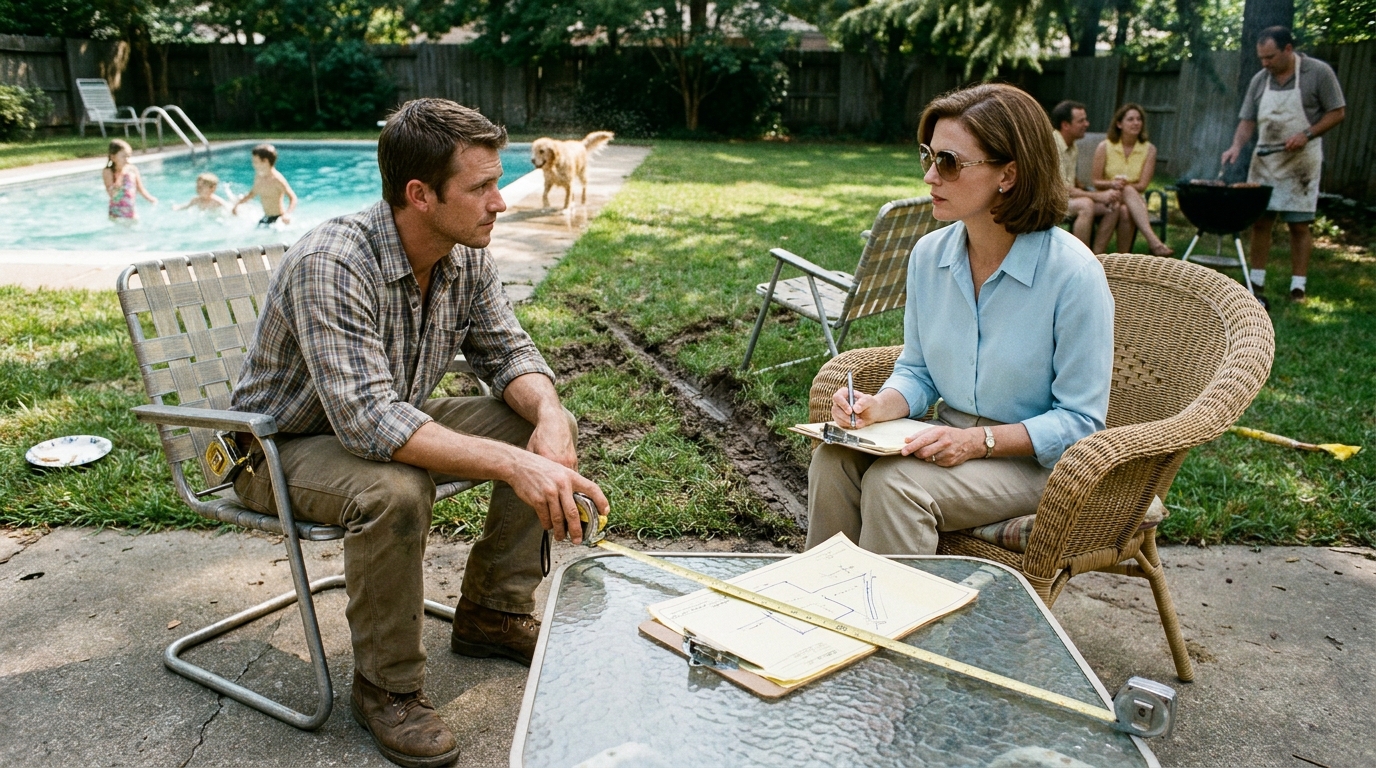
I stood on my back porch holding a cold mug of black coffee, watching a total stranger flip hot dogs on my grill while three kids cannonballed into my pool.
The heat off the concrete patio radiated through the soles of my work boots. A silver Honda Civic sat parked directly on the Bermuda grass I had spent three Saturdays fertilizing, its rear tires sunken two inches into the sod. I adjusted my grip on my steel measuring tape, thumb pressing hard against the cold metal lock button until the skin turned white.
“Hey buddy,” the man at the grill called out, wiping grease onto a mustard-stained apron that belonged to me. “You got any Dijon inside, or just this cheap yellow stuff?”
I didn’t answer. I stepped off the porch, the wet grass squeaking under my boots, and walked straight toward the center of the yard. Near the wooden fence, a woman rinsed mud off a golden retriever using my hose, letting the runoff pool around my flowerbeds.
Karen Thompson stood near the patio table, an oversized aluminum clipboard tucked under her arm like a tactical shield. Her khaki capris were pressed sharp, and her oversized sunglasses reflected the bright morning sun as she handed paper plates to a couple sitting in my lawn chairs.
“Karen,” I said, keeping my voice level as I stopped three feet away. “What is this?”
She didn’t flinch. She adjusted her clipboard, tapping a pen against the metal clasp. “Oh, Jake. Good, you’re awake. We’re holding the annual Cascadia Hills Summer Social.”
“This is my yard,” I said, pointing the end of the steel measuring tape toward the boundary fence. “My property line ends at the timber post. You have twenty people standing on land I pay county taxes on.”
“Well, maps can be misleading, Jake,” she said, flicking her wrist casually. “The original master plan marks this green corridor as shared recreational space. Besides, you weren’t using it anyway.”
“The county clerk’s office has the plat recorded under my deed,” I said.
She smiled, a tight, practiced expression that didn’t reach her eyes, and tapped the top paper on her clipboard—a yellowed land document marred by fresh, hand-drawn blue ink lines that cut straight through my lot. “The HOA board interprets the physical layout for the good of the community. We need to maintain harmony, Jake. You wouldn’t want to be unneighborly.”
I looked at the blue ink on the paper, then at the deep tire ruts in my lawn. I didn’t raise my voice. I hooked the measuring tape back onto my leather belt, turned around, and walked back into the house.
CHAPTER 2: THE LINE ON THE PAPER
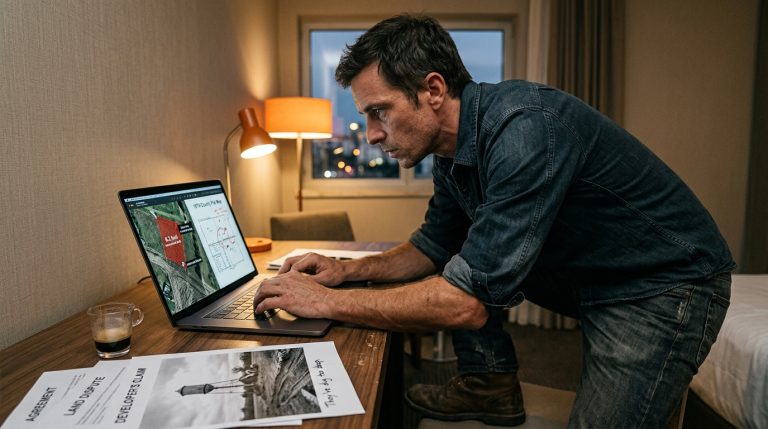
My hand rested on the cool Formica kitchen counter beside my open cell phone screen, the bright glare of the county recorder’s GIS map cutting through the dim morning light.
Outside, the thump of a volleyball hitting my back fence rattled the glass panes. I zoomed in on Parcel 408-B. The heavy red line drawn by the city surveyor four years ago was crystal clear, terminating twenty feet past the pool apron at the line of Douglas firs.
My index finger traced the digital boundary, then tapped the contact card for my cousin Thomas. I pressed the phone to my ear, listening to the muffled bass of a lawnmower outside my window.
“Yeah,” Tank answered on the third ring. His voice sounded like gravel grinding in a cement mixer. “Tell me you’re calling about the smoker.”
“Tank,” I said, leaning back against the counter and looking at a fresh streak of yellow mud on my kitchen tile. “How many bikes are coming to the wedding next month?”
“Fifty, maybe sixty if the Charleston chapter rolls in,” he said. A heavy metallic clink echoed over the line, followed by the scrape of a wrench. “Why? Venue backed out again. Owner got skittish when he heard the word ‘club’.”
“My yard is flat,” I said. “It’s got a six-inch concrete slab behind the garage, three hundred feet of grass, and a twenty-foot wide side gate.”
The line went dead silent for two seconds. “Jake. You live in one of those places with the matching mailboxes and the ladies who measure grass with a ruler.”
“I do,” I said. “And right now, there’s a guy named Greg sitting in my lawn chair eating my mustard. The HOA president told me my property is public parkland because she drew a blue line on a piece of paper.”
A low, rumbling laugh shook the speaker. “Darla’s gonna lose her mind. She’s been crying for three weeks because the country club wanted five grand extra just to park the Harleys near the clubhouse.”
“Tell her she can build a stage on the patio,” I said. “Just bring your people.”
“We’ll bring the generator too,” Tank said, his tone shifting from amused to deadly quiet. “You sure about this, cousin? My boys don’t do quiet acoustic sets.”
“I’m counting on it,” I said.
I hung up, grabbed my coffee mug, and walked back out onto the deck. Karen was sitting at my glass table, her clipboard open as she carefully filed a yellowed document into a leather binder.
I didn’t say a word about the bikes. I just pulled a lawn chair across the concrete—the metal legs screeching loudly against the stone—and sat down right across from her.
CHAPTER 3: THE CALL TO THE SOUTHERN SONS
Sitting in the metal lawn chair, watching Karen’s pen stop mid-air over her leather binder, I unclipped the steel measuring tape from my belt and set it flat on the glass tabletop between us.
“I’m hosting an event here next month,” I said, my voice steady enough to draw her eyes up from the paperwork.
Karen adjusted her oversized sunglasses, resting her forearms on the edge of her binder. “All neighborhood gatherings require sixty days’ written notice to the board, Jake. You know the bylaws.”
“It’s not a neighborhood gathering,” I replied, tapping the brass end of the tape against the glass. “It’s a private wedding. In my backyard.”
She let out a short, dry laugh, pulling her pen back to sign the corner of a form. “This space is currently classified under community oversight pending the boundary review. No large permits will be issued.”
“I don’t need an HOA permit to use land deeded to my mortgage,” I said. “And the caterers are bringing their own power.”
Karen’s posture stiffened, her spine going rigid against the wicker chair back. “What kind of caterers?”
“A wedding party,” I said, leaning forward just enough to shadow her page. “Fifty motorcycles. Live stage on the concrete pad. Food trucks parked along the driveway.”
A thin red line flared along her neck above her collar. “You wouldn’t dare bring a gang into Cascadia Hills. The noise violations alone—”
“—start at ten in the evening,” I cut in. “The ceremony ends at seven. Every bike will be off the street before the streetlights click on.”
She snapped the leather binder shut, the metal rings clicking like a trap closing. “I will have towing enforcement at the gate the moment a single commercial vehicle touches the curb.”
“They’re parking on my grass,” I said, pointing toward the tire ruts left by the Honda Civic. “You established the precedent this morning, Karen. Shared space means anyone can park here. Right?”
She stared at me in silence, her hand gripping the edge of the binder so tightly her knuckles turned white against the dark leather.
CHAPTER 4: THE GATHERING OF THUNDER
Standing by the open side gate, the deep rumble of twin-v twin engines vibrating through the soles of my boots, I watched forty chrome-laden motorcycles turn into the cul-de-sac in tight, disciplined double formation.
The thunder echoed off the neatly painted garage doors of Cascadia Hills, shaking the decorative glass lanterns hanging from the neighbor’s porch. Kids spilled out onto the sidewalk, coffee mugs in hand, while older couples brought folding lawn chairs out onto their driveways to watch the parade roll past.
Tank led the line on his blacked-out Road Glide, pulling smoothly through my open double gate and coming to a stop on the concrete pad behind the house.
He kicked down the kickstand, killed the ignition, and pulled off his helmet. “Told you we’d fit,” he grunted, slinging a massive arm over my shoulder.
Behind him, Darla swung off her seat in a floor-length white dress paired with a black leather jacket, her eyes scanning the strung outdoor lights and the wooden stage Tank’s crew had assembled the night before. “Jake,” she said, pulling a clipboard from her saddlebag with a grin. “This yard is absolute perfection.”
From across the fence line, a sudden metallic clatter cut through the idling engines.
Karen stood on her back patio, her hands trembling as she held a pair of binoculars to her eyes, furiously typing numbers into her phone. Within three minutes, she was marching along the property line, her khaki capris brushing against the overgrown shrubs.
“This is an unpermitted commercial assembly,” Karen shouted over the murmur of the crowd, pointing a rigid finger at Tank. “I have already alerted municipal code enforcement and county dispatch.”
Tank didn’t even turn around. He unstrapped a cooler from his rear rack, set it on the grass, and popped the tab on a sparkling water. “Pleased to meet you too, ma’am. Wedding starts in twenty.”
Karen glared at the sea of leather jackets filling my lawn, her chest heaving as she backed away toward the side of my house. She didn’t head for the street—she slipped behind the utility shed where the main circuit breaker panel sat mounted against the brick foundation.
CHAPTER 5: THE SPARK AT THE BREAKER BOX
Rounding the corner of the brick foundation, catching Karen with both hands locked onto the heavy iron handle of the main electrical breaker box, I watched the yard behind me plunge into sudden darkness as the stage speakers died mid-chord.
A heavy crowbar lay on the grass at her feet, its rusted wedge covered in scraped green paint from the panel latch she had just sheared off.
“I warned you, Jake,” Karen said, her chin lifted high as she smoothed her capris with trembling fingers. “This unauthorized hazard ends now. Safety standards permit me to neutralize unsafe grid draws.”
“Ma’am,” a calm, deep voice cut through the shadows behind her.
Chief Miller, the local fire marshal whom Tank had invited as a guest, stepped past the utility shed. He wore a crisp dress uniform, his eyes resting squarely on the iron crowbar laying on the turf.
“Did you just tamper with a private residential service entrance?” Miller asked, his hands resting on his belt.
Karen’s mouth opened, her composure cracking for the first fraction of a second. She gestured wildly toward the stage equipment. “They are pulling commercial wattage on a residential line! It’s a fire threat!”
“I checked the permit and load meters twenty minutes ago,” Miller replied, stepping closer to inspect the shattered latch. “Their setup runs entirely off a muffled Honda generator parked on the driveway. The only line you cut was this home’s domestic breaker.”
He pulled his radio from his shoulder strap and keyed the mic. “Dispatch, I have a deliberate utility tampering incident at 408 Cascadia Hills Drive. Send a patrol unit to document.”
Karen backed away two steps, her boots slipping on the wet turf. She reached for her clipboard on the patio table, but Miller placed a heavy hand over the yellowed maps inside, holding them flat against the stone.
“You’ll want to leave those right there, ma’am,” Miller said quietly as red and blue lights began to flash through the trees at the end of the cul-de-sac.
CHAPTER 6: THE QUIET AFTER THE STORM
Standing at the edge of the patio, watching the moving truck ramp drop onto the asphalt in front of Karen’s vacant house, I unclipped the steel measuring tape from my belt and slid it into my pocket for the last time.
The morning air smelled clean, free of exhaust fumes or cheap hot dogs. Across the cul-de-sac, two movers lifted a roll of artificial turf onto the tailgate while Karen stood on her front porch, her hands empty of clipboard and pen, silently signing a release form for the driver.
The emergency HOA board meeting three weeks prior had dismantled her entire apparatus in under an hour. When the fire marshal presented the criminal summons for utility tampering, the audit committee demanded access to the board’s physical file cabinet.
There, hidden behind the legitimate 1988 county surveys, lay the altered maps—fresh blue ink cutting through private boundaries to expand the so-called “community green space.”
The real reality surfaced when the county auditor reviewed the records: Karen had re-zoned those parcels on paper to apply for a municipal green-space maintenance grant, channeling ten thousand dollars in annual municipal funds straight into an administrative management account she controlled.
Darla had stepped into the room holding forty signed proxies from the neighborhood. The vote to remove Karen as board president passed unanimously before the second item on the agenda could even be read.
Darla, now the elected HOA president, officially repealed thirty-four pages of restrictions by her second day in office. Decorative lawn ornaments returned to front gardens, work vans parked in driveways without threats of towing, and the acoustic restrictions vanished entirely.
A soft breeze rustled through the Douglas firs at the back of my yard. The tire ruts in the Bermuda grass had been filled with topsoil, fresh green shoots already breaking through the dark earth along the timber post line.
I sat down in the metal chair on my back porch, unfastened the cap of a thermos, and poured hot coffee into a ceramic mug. The cul-de-sac was completely quiet, save for the distant sound of a lawnmower two streets over.
I took a slow sip, resting my boots against the concrete edge, and enjoyed the silent, undisturbed space that was entirely my own.