The Cost of an Inch: How Cold Calculus and Paper Trails Turned a Developer’s Overreach into a Reinforced Legacy
CHAPTER 1: The Weight of an Absence
The notification didn’t ring; it simply appeared, a quiet pixelated intrusion six thousand miles away from forty acres of apricots and stubborn walnut trees.
I sat at the small walnut desk of the Lisbon hotel, a half-cold cup of espresso cooling beside my laptop. The consulting meeting had ended ten minutes prior—three hours of corporate restructuring talk that had left my tongue tasting like dry paper. Then Carl’s message landed. Carl, who owned the adjoining vineyard and possessed a vocabulary strictly limited to necessities. If Carl sent a text, something had stopped breathing or started leaking.
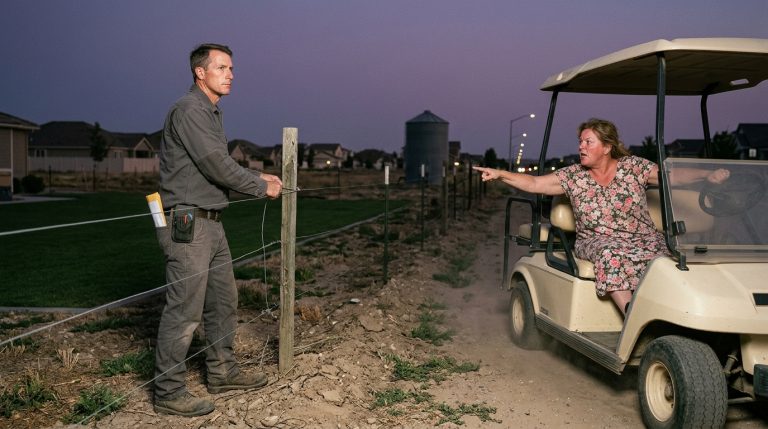
The photo loaded in horizontal slices. First, the bleached soil of the upper corner. Second, the wide, brutal tracks of heavy machinery cutting deep arcs across the property line. Third, a coil of orange temporary construction fencing strung up like caution tape around a crime scene. And fourth—nothing. The sky was just there, empty and exposed, where the old water tower had anchored the horizon since my grandfather wore a denim jacket that actually fit him.
My chest tightened, a sharp, cold contraction that had nothing to do with grief and everything to do with mechanics.
That tower wasn’t decorative. It was an iron lung for the irrigation system. Without it to buffer the pressure and hold a reserve against July’s thermal spikes, the pumps down in the orchard would cook themselves within forty-eight hours of heavy drawing. Every valve, buried line, and pressure regulator depended on that ugly, rust-red cylinder sitting precisely where it had stood before the subdivision of two hundred identical beige houses ever crawled up to my northern fence.
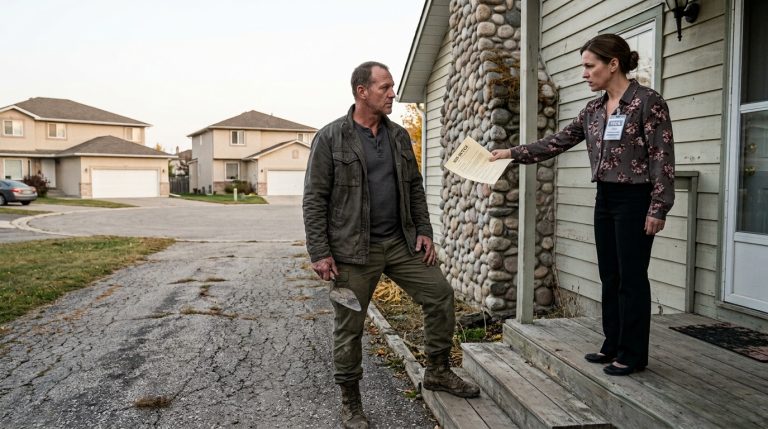
The operations manager, a man named Mark with crisp polo shirts and a smile that smelled like litigation, had stopped by my porch three weeks before I flew out. He had leaned against my doorframe, gesturing toward the horizon with a clean hand, and asked if I’d consider moving the structure because it clashed with the community aesthetic.
I had looked past him at the sea of cookie-cutter roofs bleeding over the ridge and told him no. Politely. Too politely.
Now, staring at the empty space on my phone, the silence of the hotel room felt heavy, coated in the dust of a distance I couldn’t cross until my contract finished. My fingers hovered over the keyboard, tempted to dial the local county office right then, but the impulse died before it reached my throat. Anger was a fuel that burned fast and left the engine seized.
Instead, I locked the phone screen, placed it face down on the wood, and watched the faint reflection of the city lights outside my window smear across the dark glass. They had bet three weeks and six thousand miles would buy them enough time to make the erasure permanent.
They forgot that a machine doesn’t care how far away its owner is, and neither does a deed.
CHAPTER 2: The Paper Trail
The phone’s reflection dissolved into the gray glow of the laptop screen as I picked it back up, the glass still warm from the bad Wi-Fi connection. Six thousand miles of open ocean and stubborn dry continent lay between this desk and the upper corner of the orchard, but distance was only a variable in an equation, not a full stop.
I didn’t reach for the phone to call the developer. Shouting across time zones to a site manager named Mark would accomplish nothing more than burning calories and tipping my hand. If you want to move a mountain, you don’t yell at it; you look for the deed to the dirt it’s sitting on.
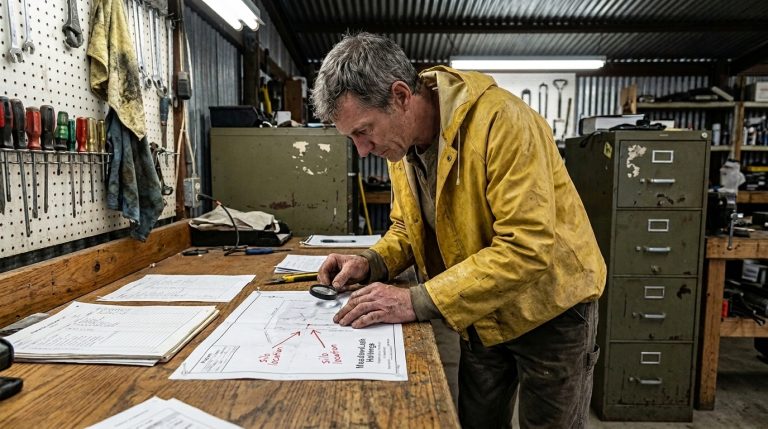
My fingers moved across the keyboard, pulling up the digital vault where every scan of my grandfather’s records lived. There it was: the original 1974 county plat map, scanned at high resolution, showing every legal coordinate, every recorded easement, and the exact placement of the forty-acre boundary. I opened a second window—the county assessor’s live interactive GIS portal—and overlaid the modern aerial boundary lines over the historical survey points.
The discrepancy wasn’t subtle once you knew where to look.
The developer’s new subdivision map—the one Mark had casually referenced in his warning—showed an expanded utility corridor slicing twenty feet into the western edge of my property. It was a neat trick of digital drafting. They had taken a standard ten-foot maintenance easement and mathematically inflated it on paper, turning a narrow right-of-way into a paved highway for their heavy equipment. A shiny new map drawn in some civil engineering office three counties away, designed to rewrite forty years of rusted iron and concrete footings.
I pulled up a blank document and began drafting an email to Daniel Rey, the surveyor I’d worked with two years back when we squared off against the county over a culvert placement. Daniel didn’t waste words, and he didn’t scare easily. He was the kind of man who looked at a fence line and saw a math problem waiting to be solved.
“Daniel,” I typed, keeping the tone flat, clinical, and devoid of the hot ash still sitting in my chest. “I need a boots-on-the-ground verification of the northwest quadrant. Specifically the upper corner where the agricultural storage infrastructure used to sit. The developer has expanded their footprint. I need a certified boundary retracement tied directly to the original 1974 county pins, not their new subdivision monuments.”
I attached the historical plat and the developer’s revised GIS overlay.
Before hitting send, I opened a separate chat window to Laura Chan. Laura specialized in civil hydraulic infrastructure and agricultural water systems. If you tear down a load-bearing pressure vessel that regulates forty acres of drip lines and old-growth fruit trees, you haven’t just committed a minor trespass; you’ve disrupted a pressurized mechanical ecosystem.
“Laura,” I wrote, attaching Carl’s grainy, sliced-together photo of the empty dirt. “If an unauthorized third party removes an operational, load-bearing irrigation water tower built to 1970s agricultural standards, what does current county code require for a like-for-like replacement under modern structural and seismic mandates?”
The reply wouldn’t come for hours—the time difference ensured that—but setting the pieces in motion felt like dropping anchor in a storm.
I closed the laptop lid halfway, letting the fan hum softly in the quiet Lisbon night. Down below, the streetcars clattered over cobblestones, a rhythmic, mechanical grinding that sounded entirely too much like a caterpillar grader chewing through dry Northern California clay. They thought they had cleared an obstacle. They had simply provided the friction needed to start the machinery on my end.
CHAPTER 3: The Ground Truth
The screen flickered awake under my palm before the laptop fan had even finished winding down. A push notification slid across the corner of the monitor: an attachment from Northern California.
Daniel Rey didn’t waste bandwidth. His message consisted of two files and a single sentence: Pins are still where they were dropped in seventy-four, but the dirt remembers what the paper tries to hide.
I opened the primary file. It was a digital field report containing high-resolution GPS coordinate logs, ground-penetrating radar cross-sections, and stitched panoramic photographs of the upper northwest quadrant of my forty acres. The screen filled with crisp, uncompromising data points. Daniel had set up his base station over the original iron survey monuments buried deep beneath the baked clay, shooting vectors across the entire zone where the water tower’s concrete footings used to anchor the earth.
The numbers were absolute. The outer edge of the tower’s concrete base had sat precisely six point two feet inside my legal property line. It hadn’t grazed the easement. It hadn’t flirted with the boundary. It had been anchored safely within my land, well away from the ten-foot maintenance corridor the developers claimed they needed to widen.
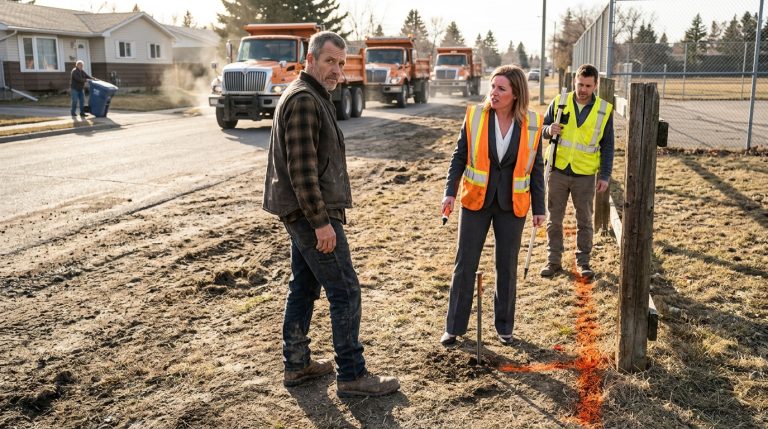
Yet, right beside where those legacy footings belonged, the panoramic photos showed raw, bleeding subsoil. Massive crawler-treads—the distinct, wide-lugged prints of a Caterpillar D6 or similar heavy grader—had carved deep, fresh grooves across the boundary line, biting a full six feet deep into my property. The machines hadn’t just accidentally clipped the corner; they had rolled right over the property line as if the boundary fence were an invisible suggestion.
A sharp, intrusive memory flickered behind my eyes: my grandfather standing over that exact spot thirty years ago, wrenching a galvanized bypass valve open with grease-stained hands, muttering about how men who build houses on paper always forget that water obeys gravity, not zoning laws.
I leaned back in the creaking hotel chair, the wood groaning under my weight, and clicked open the second document: Laura Chan’s preliminary engineering assessment.
Laura worked fast when she smelled structural bad faith. Her report wasn’t just a casual estimate; it was a comprehensive reconstruction schedule built around current county code and modern industrial mandates. Steel prices had climbed thirty percent over the past three years. Seismic reinforcement requirements for elevated agricultural tanks had been rewritten twice since the nineties. And because the original system had used a custom-welded carbon steel tank sitting on heavy-gauge lattice legs, a like-for-like replacement under current codes required certified galvanized steel, thicker structural members, engineered wind-load calculations, and updated seismic tie-downs.
The bottom-line figure scrolled onto my screen, and despite myself, a dry, humorless sound escaped my throat—part breath, part laugh.
The cost to replace that ugly, rust-red tower under modern mandates was nearly triple what the developer probably budgeted for their entire subdivision landscaping package. It wasn’t just a minor property dispute anymore. It was an expensive, unbudgeted liability sitting squarely in their path.
My phone buzzed against the wooden desk, vibrating hard enough to skid an inch across the surface. It was an email notification from Marcus Holloway, the local attorney I had retained back home. Marcus had reviewed the initial survey data I forwarded him forty-eight hours ago.
His message was short: We have enough to draft the formal demand packet. Send me Laura’s engineering numbers and Daniel’s certified plats. Let’s see how much they like paying for concrete twice.
I selected both files, attached them to a new reply, and hit send. The digital packet zipped across the Atlantic in a fraction of a second, landing on a desk in California while the sun was still sinking over the Pacific. I closed the laptop fully this time, the sharp snap echoing in the empty hotel room. They had wanted more elbow room for their access road. Now they were going to get a very expensive lesson in geometry.
CHAPTER 4: The Leverage Package
Marcus Holloway’s office smelled of stale coffee, old calfskin law books, and the unmistakable metallic tang of toner from a heavy-duty copy machine running overtime in the back room. Outside the tinted glass windows, the afternoon glare beat down on the asphalt of the county seat, shimmering off parked pickup trucks like heat lightning over dry stubble.
Marcus didn’t look up immediately when I walked in, though my flight from Lisbon had touched down barely four hours prior. He was running a thick thumb down the margin of Daniel Rey’s certified boundary plat, his eyes fixed on the red-inked coordinates marking the exact six-foot intrusion inside my western fence line.
“Survey is bulletproof,” Marcus murmured, his voice flat and level, like dry cedar. “Daniel didn’t guess. He tied every pin back to the seventy-four benchmark. If we walk into a courtroom with this, the judge won’t even need to squint.”
He slid a second set of documents across the desk—Laura Chan’s engineering breakdown for the modern replacement structure. The numbers stared up from the page in crisp, black type: seismic upgrades, heavy-gauge galvanized steel columns, custom wind-load reinforcements, and code-mandated safety margins. It was a masterpiece of expensive inevitability.
“And the developer’s insurance carrier?” I asked, dropping my canvas travel bag by the door.
Marcus reached for a thick manila envelope bearing the logo of a corporate underwriting firm out of Sacramento. He tapped it twice with a scarred knuckle. “That’s where things stopped looking like a routine boundary error and started looking like a paper trail written by someone who forgot to check who owned the dirt.”
He pulled out a stack of printed digital logs—crew sheets, equipment logs, and dispatch tickets requisitioned directly from the subcontractor tasked with clearing the grading corridor. Most of it was standard operational noise: fuel usage, haul times, machinery hours. But halfway down the third page, a highlighted line item stood out against the white paper like a grease stain on linen.
Work Instruction 44-B: Clear all vertical obstructions within designated grading corridor prior to compaction.
No boundary verification. No title search. No notation that the towering mass of rust-red steel sitting at the edge of the property might belong to a neighboring parcel that wasn’t part of their master plan. Just a blanket, corporate-mandated order to flatten anything standing in the way of a wider access road, written by someone sitting in an air-conditioned site trailer who assumed distance and absence would insulate them from the friction of reality.
I traced the line with my finger, feeling the slight grain of the cheap printer paper. “They didn’t make a mistake,” I said quietly. “They just decided my absence meant nobody was home.”
“Which makes our position legally airtight,” Marcus replied, leaning back in his leather chair as it creaked in protest. “It moves us past a simple property dispute and straight into intentional destruction and gross negligence. We aren’t just asking them to patch a fence. We’re handing this directly to their underwriters. When an insurance carrier sees a subcontractor operating under instructions to ignore boundary lines entirely, their risk department doesn’t fight—they calculate exposure.”
He closed the folder with a deliberate, heavy snap that cut through the low hum of the office air conditioning.
“We don’t file in court tomorrow,” Marcus continued, locking eyes with me across the desk. “We package Daniel’s survey, Laura’s engineering cost schedule, and these work logs into a formal demand letter. We send it straight to their corporate office and copy their insurance carrier’s claims adjuster. We give them forty-eight hours to acknowledge liability and agree to escrow the full replacement cost. No drawn-out depositions, no mediation circles.”
I stood up, resting my palms against the cool edge of the oak desk, feeling the solid, unyielding weight of the wood beneath my hands. The dust of Lisbon felt a million miles away now, burned off by the dry, uncompromising air of the valley.
“Make the number high enough that they feel it,” I said. “And make sure the escrow terms require them to fund the rebuild before they touch another inch of dirt near my line.”
Marcus gave a slow, dry nod, the faint ghost of a smile touching the corners of his mouth. “Consider it done. Let’s see how much they like paying for concrete twice.”
CHAPTER 5: The Escrow Agreement
The office air conditioning shuddered, blowing a thin sheet of dust across the edge of Marcus Holloway’s desk as the printer in the hallway began its rhythmic, mechanical thumping. It didn’t take forty-eight hours for the insurance carrier’s risk assessment team to realize they were looking down the barrel of an unvarnished liability.
When you hand an insurance adjuster a certified GPS boundary retracement showing a six-foot trespass, paired with an engineering code-compliance estimate and a subcontractor work log explicitly ordering the destruction of vertical objects without title checks, the math changes very quickly. Litigation defense costs money; unmitigated corporate gross negligence costs everything.
Marcus’s desk phone chimed, cutting through the hum of the hallway printer. He didn’t rush to pick it up. He let it ring twice, leaning back in his leather chair with his hands laced across his stomach, watching the red message light pulse in the dim light of the late afternoon.
“That’ll be Miller,” Marcus said quietly, referencing the senior claims adjuster for the developer’s underwriting syndicate out of Sacramento. “He spent the last three days pulling crew logs and talking to their field supervisor. He knows as well as we do that if this hits a public docket, the subcontractor’s error voids any indemnity protection the developer tried to write into their sub-contracts.”
He reached out and punched the speaker button.
A tinny, filtered voice filled the room, carrying the flat, hurried cadence of a man who had spent his entire week trying to plug leaks in a sinking ship. “Marcus. We’ve reviewed the package you submitted with the engineering schedules and the subcontractor work instructions.”
“And?” Marcus’s voice was like gravel rolling down a dry creek bed—devoid of emotion, entirely transactional.
“And my principals are prepared to avoid the procedural overhead,” Miller said, clearing his throat on the other end of the line. “We aren’t contesting the logistics. The carrier will agree to fund the full reconstruction amount directly into an escrow account. Code-compliant, structural grade, seismic tier. Plus compensation for the three-week agricultural stress sustained by the irrigation grid while the pressure buffer was offline.”
I sat across the desk, my hands flat against the cold wood, feeling the absolute stillness of the room. There was no argument. No negotiation over fractions of a percentage. When the paper trail is heavy enough, even corporate defense attorneys stop pretending they can bend geometry.
“Escrow funded in full, verified by Laura Chan’s engineering specifications, before a single yard of dirt is moved back near my line,” Marcus stated, his tone leaving zero room for creative interpretation.
“Agreed,” Miller sighed on the other end. “Just get the release signatures back to my office by Friday morning.”
Marcus tapped the speaker button, cutting the connection with a sharp click. The room fell back into silence, save for the low rumble of a truck shifting gears out on the highway. He looked up at me across the desk, a faint, dry crease forming at the corner of his eye.
“Well,” Marcus said, sliding a final settlement agreement across the oak surface. “It turns out asphalt and heavy machinery are expensive when you forget to check who owns the dirt underneath them.”
I picked up the heavy metal pen resting beside the folder, the cool brass barrel biting into my palm. The fight wasn’t a loud spectacle of shouting matches or courtroom drama; it was cold arithmetic, precise measurements, and documents that didn’t care how many beige houses they built down the road. I signed my name at the bottom of the page, the scratch of the nib sounding sharp and clear in the quiet room.
CHAPTER 6: The Hum of Iron
The gravel road crunched beneath the truck tires as I turned onto the property access lane, the dust billowing in a thick, golden plume behind the tailgate. Three weeks ago, this corner of the valley had been scarred by caterpillar tracks and bounded by cheap orange plastic mesh. Today, the temporary fencing was gone, replaced by something far more permanent.
The truck rolled to a stop near the upper northwest corner of the orchard. I stepped out, the dry Northern California heat hitting my face like an open oven door, carrying the scent of baked earth, dry grass, and hot galvanized steel.
There, anchored to a fresh, thick concrete pad that smelled of damp aggregate and curing lime, stood the new tower. Four heavy steel anchor bolts, thick as a man’s wrist, projected upward from the foundation like metallic teeth, biting deep into the base plates of the structure. It was taller than the old rusted tank my grandfather had bolted together in the seventies, its galvanized surface gleaming under the late afternoon sun with a sharp, uncompromising silver glare. The support legs were thicker, engineered to modern wind-load specs; the welds were clean and seamless.
Nearby, a small crew from Laura Chan’s engineering outfit was finishing up the final calibration of the digital pressure sensors wired into the base manifold. One of the technicians looked up, wiping sweat from his forehead with the back of a forearm, and waved a hand toward the tank.
“Smart phone integration is live,” the technician called out over the idling hum of a utility van. “You can check your static pressure and tank levels from anywhere in the world now. Don’t even have to climb the ladder unless you’re servicing the intake valve.”
I walked past the concrete pad, my boots crunching over the hard-packed dirt, and looked down at the property boundary line. Daniel Rey’s team had been just as thorough. Set deep into the concrete collars along the western edge were heavy brass boundary markers, polished to a dull gold finish and stamped with county registration numbers. They sat dead-center where the legal survey dictated, impossible to move, impossible to misinterpret. Anyone walking near that corner now could see the exact line where private ownership met the world.
A few yards further out, where the developer’s grading corridor used to encroach, the heavy equipment tracks were entirely gone. The access road had been quietly rerouted by the contractor’s field crews, curving a wide, respectful arc several feet away from my western boundary. The project manager, Mark, hadn’t come back to my porch to talk about visual consistency or community aesthetics. Funny how a six-figure escrow funded by an insurance carrier’s risk department tends to cure a developer’s aesthetic concerns.
I stood there in the quiet of the late afternoon, listening to the steady, rhythmic thrum of the deep-well pumps down in the orchard. The system was balanced. The pressure was holding steady. The water was climbing the galvanized riser pipes to fill the tank, ready for whatever thermal spikes July decided to throw at the walnut trees.
I reached into my pocket and pulled out my phone, unlocking the screen. A clean, minimalist application interface displayed a real-time digital gauge: Pressure: 62 PSI. Tank Level: 84%. System Status: Optimal. No guesswork. No climbing rusted ladders in the blistering heat just to see if the lines were holding.
A quiet, settling satisfaction washed over me—not anger, and certainly not cheap revenge. It was the simple, grounded feeling that comes when someone tries to erase your line and ends up paying to make it brighter, stronger, and impossible to ignore.
I slipped the phone back into my pocket, leaned against the truck door, and looked up as the last rays of the sun caught the top of the new steel tank, turning the galvanized metal into a blinding point of light against the dry, open sky. The pumps hummed on. The boundary held. The work was done.