The Price of Quiet: A Hardworking Everyman’s Uncompromising Stand Against Suburban Entitlement
CHAPTER 1: THE UNWANTED PASSENGER
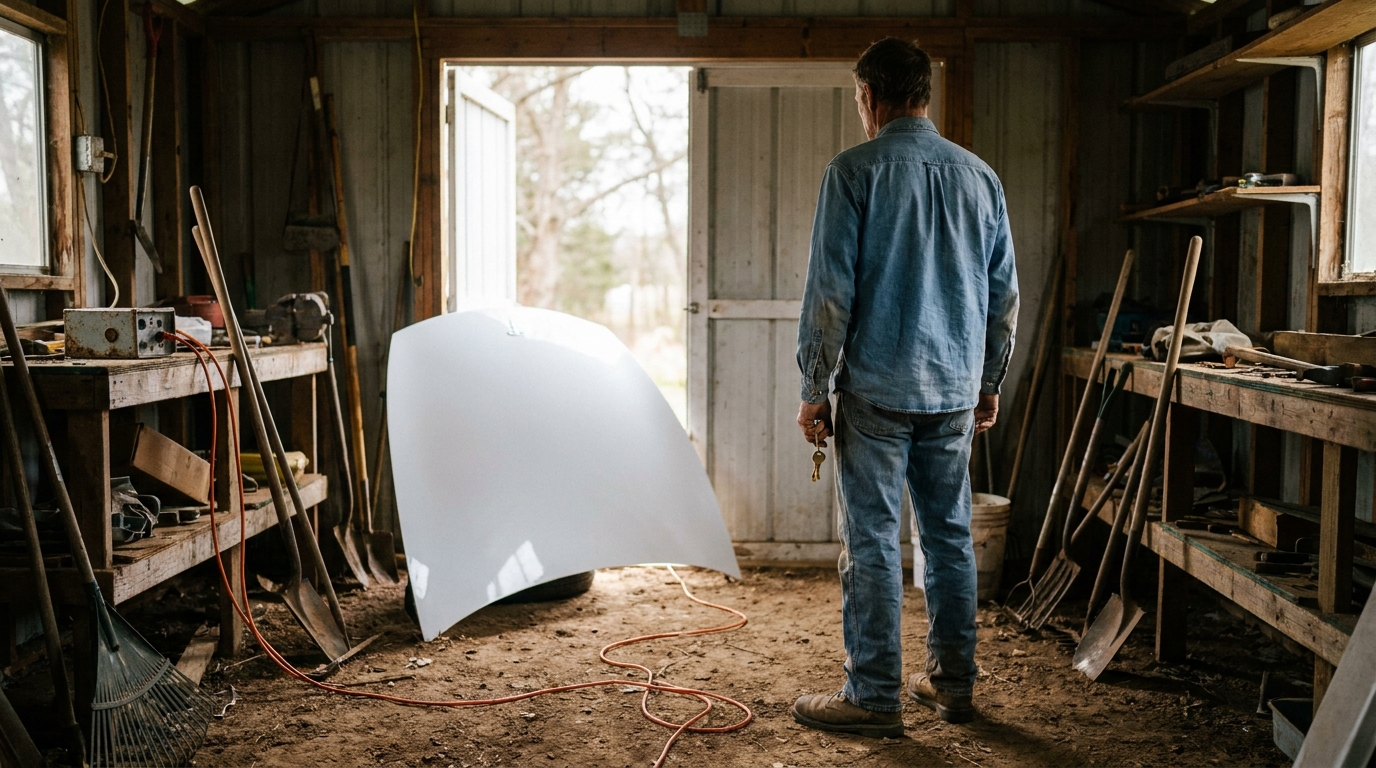
The morning mist was still thick enough to cling to my flannel shirt as I unlatched the wooden door of my backyard shed.
I just needed my heavy steel rake to clear the damp leaves along the drainage ditch.
Instead, the door bumped hard against something cold, smooth, and entirely alien.
I pushed the hinge wider, the rusted metal groaning in the cool air, and stared into the gloom of the open bay.
The white, gleaming hood of a Tesla Model Y was wedged six inches past my threshold, sitting silent and humming like an overgrown appliance.
An heavy-duty orange extension cord ran straight from its front grille, slithered across the dirt floor, and plugged directly into the dual-socket junction box mounted beside my workbench.
I stood there for three full seconds, the brass key on my lanyard biting into the palm of my right hand as I squeezed it tightly.
My electric meter on the side of the house wasn’t just ticking; the glass wheel was spinning fast enough to blur.
I followed the bright orange cord back toward the fence.
It snaked through a gap in the rotting cedar pickets, dragged through a patch of brown, heat-scorched lawn along the property line, and disappeared into Karen’s manicured hydrangeas next door.
I didn’t yell, and I didn’t reach for my phone.
I walked over to the wall, gripped the heavy rubber boot of the extension cord, and ripped it free from my wall outlet with one sharp pull.
The low hum inside the shed died instantly, replaced only by the quiet dripping of moisture from the eaves.
By noon, I was standing at the edge of her pristine gravel driveway, watching her snap heavy steel clippers against her prize-winning rose bushes.
She wore oversized dark sunglasses and a wide-brimmed sun hat, moving with the practiced precision of someone who believed the cul-de-sac was her personal estate.
“Karen,” I said, my voice flat, keeping my boots firmly planted on the edge of the asphalt. “Why was your car plugged into my shed breaker this morning?”
She didn’t miss a beat with the shears, the blades biting through a thick green stem with a sharp crunch.
“Oh, that,” she said, sweeping a stray leaf off her apron without looking up. “You weren’t using the voltage, Arthur. It’s sitting right there.”
“It’s my private panel,” I said, turning the brass key over in my pocket. “You’re pulling power off my bill.”
She stopped then, resting the heavy shears against her hip as she pulled down her sunglasses with one manicured finger.
“Don’t be dramatic over a few kilowatts,” she said, her voice dropping into that smooth, practiced tone she used at the HOA board meetings. “My electrician looked over the property line last month. Your auxiliary line handles sustained current draw much better than my garage panel.”
She gave me a tight, brief smile that didn’t reach her eyes, then turned back to the roses.
“Honestly, Arthur, you should be glad someone is putting that unkempt line to productive use.”
I stared at the back of her sun hat, feeling the dry heat radiating off the driveway pavement against my work boots.
There was no point in arguing with someone who mistook theft for a community service.
“Don’t run the cord across my line again, Karen,” I said quietly.
She didn’t answer, the steady clack-clack of her shears filling the air before I even turned my back to walk home.
CHAPTER 2: REVERSE CURRENT
The basement smelled of damp concrete and dusty cedar, illuminated only by the harsh glare of a single bare bulb hanging above the panel.
I set the brass key on top of the gray breaker box and let out a long, slow breath.
A buddy of mine down at the county grid had laid out the schematics over a couple of lukewarm coffees three hours ago.
It wasn’t rocket science, just simple electromagnetic feedback.
If you flip the secondary winding on a transformer loop and bypass the standard unidirectional diode in the auxiliary junction box, the meter keeps spinning forward, but the load runs backward.
To her car’s onboard computer, the green charging ring on her dashboard would light up as pretty as a Christmas tree.
It would show an active 240-volt connection, humming happily through the night.
In reality, the modified loop would be slowly leeching juice directly out of her lithium battery cells, pulling power back into my secondary grounding rod.
I adjusted the secondary breaker switch until the internal copper spring clicked hard against the casing.
A faint, high-pitched whine echoed through the copper conduit running up through the floorboards—a silent, steady siphon waiting for its bait.
I snapped the steel door of the breaker box shut, slid the brass key back into my pocket, and went upstairs to wait.
By midnight, I was sitting at the dark kitchen table, the cool glass of an unopened bottle of amber lager resting against my knuckles.
Outside, the street was dead quiet except for the periodic rustle of wind through the maple trees.
At 12:14 AM, a tall, shadowy figure carrying a heavy coiled line cut across the dew-slicked grass of my back lawn.
Karen moved with a quiet, practiced stealth, dragging the orange cord behind her like a trainer leading a stubborn dog.
She reached the shed, lifted the latch without a sound, and pushed the heavy rubber head into the modified wall outlet.
A sharp, digital chirp drifted across the dark yard as the Tesla’s headlights flashed twice in response.
Karen stepped back, smoothed her silk robe over her hips, and patted the white hood of her car with a satisfied, possessive tap.
She turned and marched back toward her fence with her head held high, the smug walk of a woman convinced she’d outsmarted the whole world for free.
I didn’t smile, and I didn’t drink the beer.
I just watched the orange cord lying in the wet grass, carrying twenty-five kilowatts of her battery power straight into the dirt.
At 7:15 the next morning, I was sitting on my front porch, lacing up my heavy work boots.
The morning air shattered like glass.
A high, shrill scream ripped across the quiet cul-de-sac, followed immediately by the violent slamming of a luxury car door.
“Two percent!” her voice echoed off the concrete driveways, laced with pure, unadulterated panic. “It was plugged in all night!”
I tied the double knot on my left boot, pulled the leather taut, and looked over the porch railing just as her garage door rattled violently to the top of its tracks.
CHAPTER 3: THE ESCALATION PHASE
Her voice was shrill enough to cut straight through the morning traffic noise down on the main road.
“I don’t care if there’s no service light!” she barked into the receiver, her oversized dark sunglasses slipping slightly down her nose. “The entire battery was drained by a faulty, illegal setup next door! I want a flatbed tow truck here now!”
I slowly stood up, smoothed down my denim work shirt, and walked toward the property line.
By mid-afternoon, the neighborhood rumor mill had already done three full laps around the cul-de-sac.
Dennis, her quiet husband who spent his weekends silently pressure-washing their spotless driveway, stood near the fence line holding a pair of garden shears he wasn’t using.
“Arthur,” Dennis muttered, glancing over his shoulder toward their front door before looking at me. “Karen’s saying your shed wiring threw a reverse surge. Said it spiked her onboard computer.”
“My shed doesn’t have a surge capacity, Dennis,” I said, rolling the brass key lanyard around my pointer finger. “Your wife pulled an extension cord onto my land.”
“Yeah, well—” Dennis rubbed the back of his neck, his eyes darting back to his porch. “She called the city utility inspector. Said you’ve got an unauthorized sub-panel feeding off the main junction without a permit.”
I looked down at the fence line between us, right where the yellow, scorched patch of grass stretched across the property boundary.
Layer 1 was slipping right into plain view: Karen wasn’t just plugging in for free juice; she was using my auxiliary line to disguise a major, unpermitted tap in her own home workshop.
If the inspector came out, she figured he’d hit my unmetered shed first before ever looking at her main breaker.
“Let her call whoever she wants,” I said softly.
That evening, I didn’t drink coffee on the porch.
I mounted a small, black motion-activated lens high inside the shadow of the shed’s rafters, positioning the night-vision camera directly over the wall outlet.
At 2:45 AM, the silent alert buzzed twice against my nightstand.
I sat up, tapped the screen, and watched the high-definition feed render in real-time.
Karen was crouched inside my doorway in a fleece jacket, her hands trembling slightly as she tried to force a heavy, modified three-prong plug back into my socket.
The infrared light caught every detail—her face tight with desperation, the bright white lettering of her initials permanent-marked right across the orange rubber cord, and her boots planted firmly on my property floor.
She didn’t know the camera was recording, and she certainly didn’t know the reverse circuit was already pulling another ten percent right out of her reserve.
I saved the video file, synced it to a flash drive, and tucked it into my shirt pocket.
CHAPTER 4: PUBLIC RECKONING
The autumn afternoon sun glinted off the polished white hood of Karen’s Tesla, parked dead-center under the banner that read SUSTAINABLE CUL-DE-SAC: LEADING BY EXAMPLE.
Karen stood beside the driver’s door in a bright teal blazer, gesturing broadly with a microphone in her hand as twenty neighbors sat on folding chairs.
“True environmental leadership isn’t just about personal choices,” she announced, her voice booming through the small PA speaker. “It’s about utilizing every neighborhood resource to its absolute maximum efficiency.”
I walked directly up the center aisle, setting the portable projector onto a folding table thirty feet from her display.
“If we’re talking about neighborhood resources, Karen,” I called out, my voice easily cutting through the quiet hum of the crowd. “Maybe we should look at where your charge came from at three in the morning.”
Karen’s smile froze instantly, her jaw tightening as her eyes locked onto the black lens pointing straight toward the white backdrop behind her car.
“Arthur, this is a scheduled committee presentation,” she said, her voice dropping an octave as she gripped the microphone harder. “If you have administrative complaints, submit them to the board during normal hours.”
I didn’t answer. I plugged the short cable into the flash drive in my pocket and flipped the power toggle on the projector.
A bright beam of white light sliced through the shade of the pavilion, throwing a crisp, twelve-foot image onto the canvas banner behind her.
The night-vision feed opened in brutal infrared clarity: Karen, crouched on her knees inside my damp shed floor, jamming the heavy orange extension cord into my wall panel.
The crowd went dead silent, three board members leaning forward in their lawn chairs as the video looped.
“That’s an AI video edit!” Karen yelled, her voice cracking as she pointed a manicured finger at the screen. “He’s sabotaged my vehicle and now he’s distributing edited footage to defame me!”
I tapped the remote once, zooming the lens straight into the thick rubber boot of the cord on the screen.
Bold, black permanent marker letters wrapped around the orange casing, glowing clear in the frame: PROPERTY OF KAREN – LOT 14.
“You wrote your initials on it six months ago when you borrowed my pressure washer, Karen,” I said, rolling the brass key lanyard in my hand. “Unless someone else stole your cord, your jacket, and your car to charge off my breaker.”
Beside her, Dennis slowly looked down at his shoes, unzipping his windbreaker and stepping two paces back into the crowd, completely disowning the stage.
The HOA president cleared his throat loudly, standing up from his folding chair with a look of pale, uncomfortable realization.
Karen glared across the thirty feet of grass at me, her chest heaving as the polite mask she’d worn for years completely shattered in front of every family on the block.
CHAPTER 5: NIGHTFALL SABOTAGE
The smell of scorched copper and melted plastic filled the narrow wooden bay, thick enough to make my throat burn.
A shadowy figure backed away through the doorway, dropping a pair of insulated wire snips onto the damp dirt floor with a heavy metallic clatter.
“You brought this on yourself, Arthur!” Karen rasped, her voice trembling with a terrifying, erratic pitch as she stumbled backward into the yard. “You rigged an illegal setup! You destroyed my reputation at the fair!”
She grabbed the edge of the open breaker door, pulling hard to tear the sub-panel casing directly off the wall studs.
I stepped forward, my work boots crunching over the shattered plastic cover, and pinned the steel flashlight beam straight onto her face.
“Step away from the box, Karen,” I said, my voice dead calm as I pulled my cell phone from my shirt pocket with my free hand. “You’re touching a live high-voltage feed.”
She didn’t run. Instead, she doubled down, her face contorting into an unhinged sneer as she lunged toward the main line running out through the rear wall.
“I’ll tell them you attacked me in the dark!” she shrieked, grasping at the thick black conduit. “I’ll tell the police you set an electric trap on your property!”
A sharp, deafening POP echoed off the cedar rafters as the main house breaker finally tripped, plunging the yard into pitch blackness except for the tight circle of light from my flashlight.
From the driveway next door, two blue strobing lights cut through the night mist as a county patrol cruiser rolled quietly into the cul-de-sac, followed immediately by the red glow of a utility emergency response vehicle.
Dennis had finally drawn his line in the sand—he was standing on the curb with his hands jammed deep into his pockets, having called the emergency dispatch the moment Karen had grabbed the wire cutters from their garage.
The deputy rounded the corner of the fence with his hand resting on his sidearm belt, taking in the scene in one swift glance: Karen on her knees beside my panel, holding the damaged wire cutters, and the burned extension cord trailing straight back across her property line.
“Ma’am, keep your hands where I can see them and step away from the structure,” the deputy ordered, his voice crisp and completely devoid of neighborhood politeness.
Karen scrambled to her feet, smoothing her torn sleeve as she pointed a shaking finger at me. “Officer, arrest him! He’s running an unlicensed electrical hazard that almost killed me!”
The utility inspector stepped past the deputy, shone his heavy spotlight directly onto the fence line, and stopped dead in his tracks at the scorched yellow patch of grass.
“Deputy,” the inspector called out, his voice grim as he knelt down by the fence line. “She didn’t just plug in here. She routed an unmetered feed into her main panel to hide a major code violation on her own house. It’s a localized grid threat.”
Karen froze, her mouth opening, but no words came out as the deputy stepped forward and grabbed her wrist.
CHAPTER 6: QUIET GROUND
The diesel engine roared as the steel bed tilted, dragging the car up the ramp with a sharp metallic clank that echoed down the street.
Across the lawn, Dennis was slowly loading cardboard packing boxes into the back of his pickup truck, his shoulders slouched in the pale morning light.
He paused, wiped his forehead with the back of his hand, and walked over to the low cedar fence dividing our yards.
“Arthur,” Dennis said quietly, resting his forearm on the top rail. “Inspector signed off on the citation package an hour ago. She’s looking at unauthorized utility tampering, reckless endangerment, and criminal trespass.”
I took a slow sip of the coffee, feeling the heat anchor my hands in the cool air.
“How’s the house wiring?” I asked.
Dennis let out a dry, weary breath. “City slapped a red tag on the main panel. We have to tear out the entire basement sub-feed before the bank will even let us list the property.”
He reached into his pocket, pulled out a spare brass key attached to a small green tag, and set it carefully on top of the fence post between us.
“She won’t be coming back here,” Dennis added, his voice flat with the quiet relief of a man who had finally stopped defending the indefensible. “We’re moving out toward her sister’s place in the county once the legal hearing wraps up next month.”
“Take care of yourself, Dennis,” I said.
He gave a brief, tight nod, turned back toward his truck, and slammed the tailgate shut.
I stood up, walked down the wooden steps, and headed down the narrow gravel path toward the backyard shed.
The morning dew glistened on the grass, clean and undisturbed along the entire length of the fence line.
I opened the heavy wooden door, stepping into the quiet bay where the smell of fresh cedar wood completely replaced the lingering scent of scorched copper.
A brand-new 200-amp steel junction box sat mounted flush against the main wall stud, capped with a heavy, industrial-grade deadbolt latch.
I pulled the brass key lanyard from my pocket, fitted the key into the tumbler, and turned it until the lock clicked firmly into place.
I picked up my steel rake from the corner, rested it over my shoulder, and walked back out into the quiet yard under the clear morning sky.