The Sovereign of Eleanor’s Grove: How a Retired Federal Judge Dismantled an Unhinged HOA Empire
CHAPTER 1: THE GRAVEL LINE
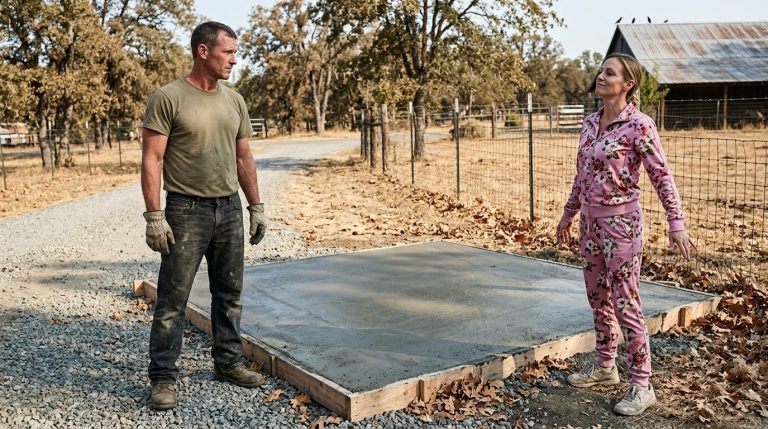
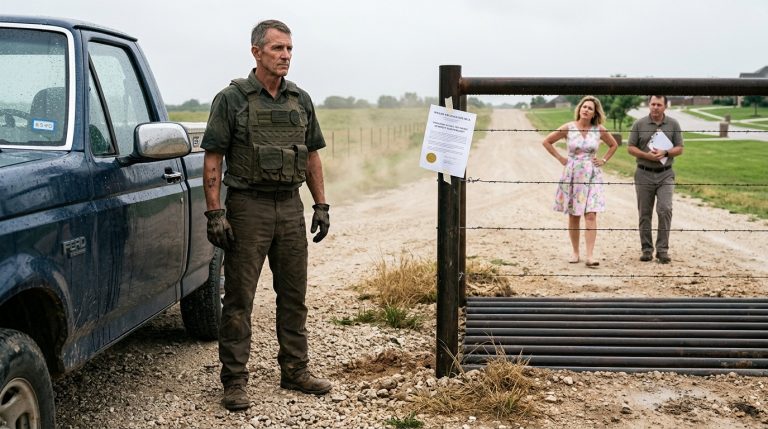
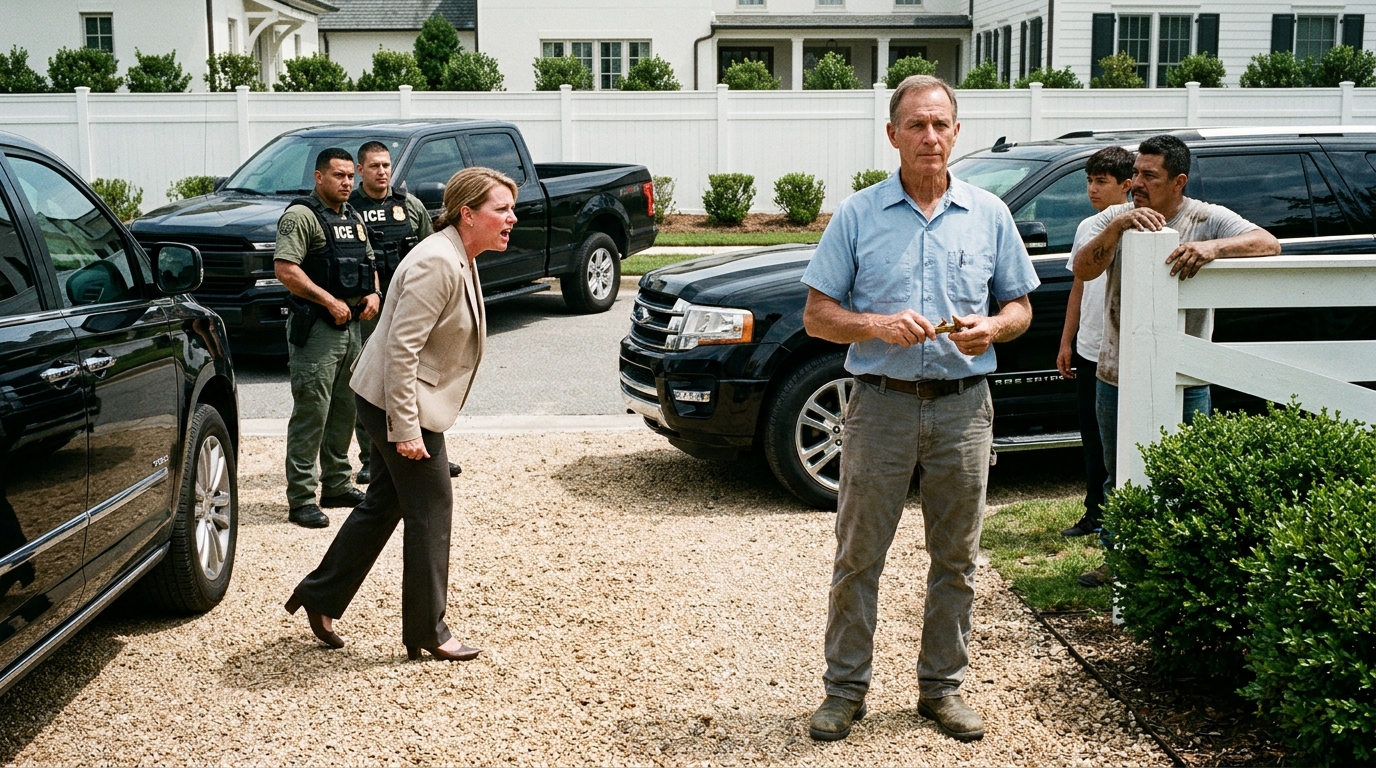
The two black SUVs sitting on my manicured gravel didn’t belong in Eleanor’s Grove, but Karen stood beside them like she owned the federal government.
She crossed her arms over her beige suit jacket, her heels digging into the fresh stone of my driveway as two armed ICE agents questioned Hector against the whitewashed fence. Hector didn’t look up; his hands stayed resting on the top rail, his knuckles dark with orchard dirt. His son, a kid who had just secured a state university scholarship for agricultural science, stood three paces to his left with a federal officer’s hand resting near his sidearm.
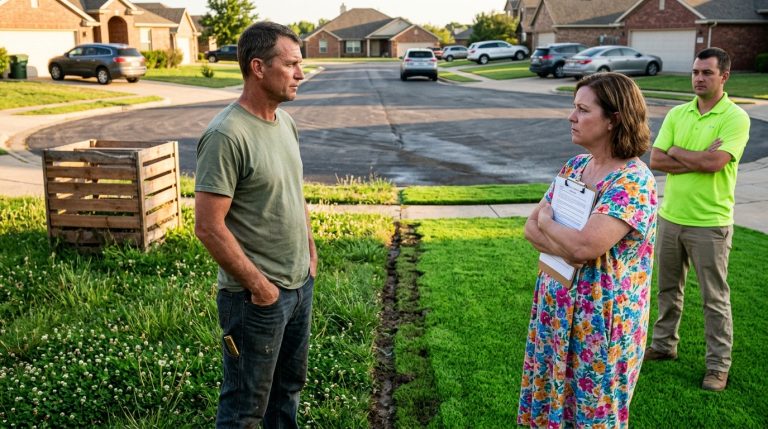
“Your problem, Mr. Thorne,” Karen said, her voice dropping into that syrupy tone people use when they think a piece of paper makes them king, “is that you bring these people into our community.”
I didn’t yell. Thirty years on the federal bench teaches you that shouting is what people do right before they lose. Instead, I pulled a brass pocket caliper from my work shirt, thumbing the worn adjustment wheel until the tiny steel jaws clicked shut in the palm of my hand.
“These men are legal residents, Karen,” I said, keeping my voice level enough to cut through the idle rumble of the SUV engines. “And you just committed a very costly mistake.”
“Oh, please,” she scoffed, stepping closer until I could smell her stale hairspray. “I have the full authority of the Oak Haven Homeowners Association behind me. I’m protecting our property values. You’ll be hearing from our legal counsel.”
I turned away from her before she could finish her sentence, walking straight past her toward the lead agent. Agent Diaz had his tactical notebook out, his pen hovering over a half-filled line, his eyes showing the dull fatigue of a man who realized three minutes ago he was being used as a personal collection agency.
“Agent Diaz,” I said, holding my hands visible at my sides as I stopped four feet out. “I’m Marcus Thorne. I own this property, and I employ these men.”
Diaz didn’t lower his pad, but his brow hitched slightly at the title. “Sir, we received a verified report of undocumented labor on this commercial operation.”
“The report wasn’t verified, Agent. It was malicious.” I reached into the open cab of my Ford, pulling a heavy waterproof folio from behind the driver’s seat and dropping it into his open hand. “Passports, H-2A documentation, I-9 compliance forms, and lawful permanent residency cards. Page three contains Mr. Garcia’s green card, active since 1998.”
Diaz flipped the tabbed plastic sleeves. His thumb stopped on Hector’s file, his eyes scanning the state seal on the certified copies. He closed the book with a heavy snap and looked over my shoulder at Karen, whose beige suit was practically vibrating under the midday sun.
“Ma’am,” Diaz said, his voice dropping an octave into pure federal irritation. “Step back from my vehicle.”
“I am the HOA president!” she shouted, her voice cracking as she took an aggressive step toward the fender. “I made the call!”
“And you made a false report to a federal agency,” Diaz replied, backing her off with a single raised palm. He turned back to his subordinate. “Uncuff him. We’re done here.”
The mechanical click of the steel cuffs opening echoed across the quiet gravel. Hector rubbed his wrists, stepping back toward the fence line while Diaz handed my folio back over the hood.
“Look into Title 18, Section 1001, Judge,” Diaz muttered under his breath as he opened his driver’s door. “Have a good afternoon.”
The SUVs backed out in a cloud of dust, leaving Karen standing alone at the boundary line where my farm met the paved road of her subdivision. Her face was red, the fake composure entirely gone.
“This isn’t over,” she hissed, her fingers twitching against her handbag. “I will ruin you.”
I thumbed the brass caliper in my pocket, feeling the cold metal press against my palm. “No, Karen. You just opened discovery.”
CHAPTER 2: PAPERWORK AS A WEAPON
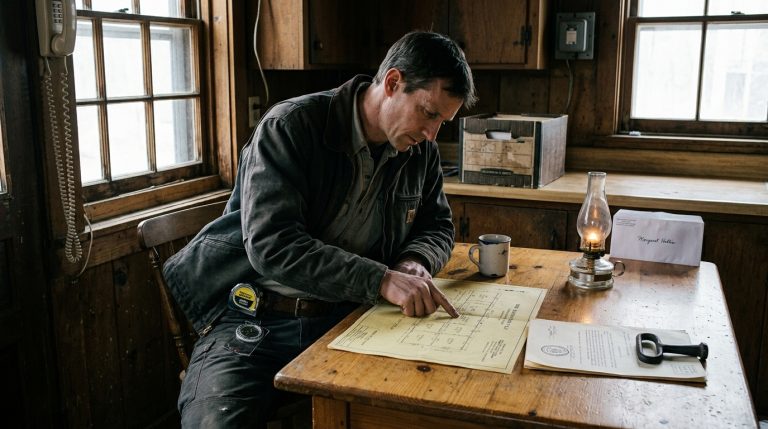
I stood at the edge of the long oak dining table, the white envelope of the certified letter resting under my left palm while my right thumb traced the worn, notched jaws of my brass pocket caliper.
The heavy cream paper stock inside bore the official emblem of the Oak Haven Estates Homeowners Association. It was signed by Karen in thick, blue felt-tip ink. The charge was five thousand dollars, levied as a “special emergency assessment” for costs incurred due to emergency services and community safety enforcement on an adjacent property.
She was trying to bill me for the federal raid she had called on my own men.
Underneath the main assessment sat three smaller green slips. A two-hundred-dollar fine for an unauthorized commercial truck—my farm’s delivery van. A three-hundred-dollar fine for olfactory nuisance regarding organic compost. And a two-hundred-dollar penalty for a cluster of yellow dandelions blooming within ten feet of the HOA fence line.
It was a bureaucratic machine gun, fired blind to see what would force a surrender.
I dropped the caliper onto the table with a soft metallic clink, pulled my legal pad closer, and picked up a pen. Thirty years of reviewing motions teaches you that tyrants always leave footprints in their own rules; they rely on their targets being too exhausted to read the fine print.
The first response went to their registered corporate agent and the state attorney general’s office. I attached my property deed and the official county plat map, proving Eleanor’s Grove was a separate parcel that merely shared a boundary line. Attempting to collect an assessment on a non-member property wasn’t just an administrative error; it was attempted fraud.
For the three minor fines, I didn’t pay a dime.
Instead, I invoked Article 8, Section 4 of their own bylaws, demanding an individual, formal appeal hearing before the Architectural Review Committee for every single notice. Three separate notices meant three separate hearings, complete with required written findings, recorded minutes, and advance notice postings.
Then I drafted the final letter, citing Bylaw 14.7—the clause guaranteeing any homeowner the absolute right to inspect the association’s general ledgers, bank statements, and vendor contracts for the last three fiscal years.
I walked the certified letter to the post office myself, ensuring the return receipt was stamped with today’s date. The clock was officially ticking: under state law, they had thirty days to comply or face court-ordered disclosure.
My phone chimed on the seat of the truck as I pulled back onto the gravel drive. It was Ben Carter, my former federal clerk, now a junior partner with an appetite for corporate discovery.
“Marcus,” Ben’s voice came through the speaker, crisp and entirely unbothered by the late hour. “I filed the preliminary notice. But something’s off about their vendor filings. I pulled the corporate registry for Evergreen Solutions—the outfit listed for their road and landscape work.”
“What did you find?” I asked, idling near the whitewashed fence.
“There’s no state tax ID, no liability insurance on file, and the mailing address is a PO Box in the next county,” Ben said. “Somebody’s cutting checks to a ghost.”
I looked toward the HOA line, where the streetlights of Oak Haven were just beginning to flicker on in neat, silent rows. “Keep digging, Ben. People who build empires out of petty fines always hide the ledger.”
CHAPTER 3: THE NEIGHBORS RAMP
I sat on Arthur Vance’s front porch, holding a lukewarm mug of black coffee while looking at a crude wooden wheelchair ramp that had been hacked apart with a hand saw.
Arthur’s hands shook as he set his own cup down on the small wicker table between us. He had served in Korea, but right now his eyes were fixed on the splintered pine boards near his driveway like he was looking at a crime scene.
“She said the composite material wasn’t on the pre-approved vendor list,” Arthur whispered, his throat working hard to get the words out. “My wife couldn’t steep down those concrete steps anymore, Marcus. The fines were fifty dollars a day until I took it down myself.”
I set my mug beside his and pulled my brass caliper from my pocket, opening the steel jaws until the fine metal scale caught the morning light. “Who told you to use the composite contractor, Arthur?”
“The HOA office,” he said, swallowing dryly. “They gave me a brochure for a company called Evergreen. Said if I used anyone else, it was an unauthorized modification.”
There it was again. The same name Ben had pulled from the state registry—a ghost company collecting checks for work that either didn’t exist or was weaponized to force compliance.
“They’re draining you on purpose,” I said, my voice dropping into that heavy, deliberate register I used when laying out a case for a jury. “It isn’t about property values or composite wood. It’s about isolation.”
“I don’t have the money for a lawyer, Judge,” Arthur muttered, looking down at his knuckles. “None of us do. The Millers down the road are about to list their place because of the fines on their kids’ swing set.”
“You don’t need a lawyer, Arthur,” I replied, tapping the brass caliper against the wooden armrest. “You need a quorum.”
I stood up, stepping off the porch to inspect the jagged cut where the ramp had been severed. The cuts weren’t professional; they were rushed, meant to inflict humiliation rather than uphold a standard.
By six o’clock that evening, eight neighbors were sitting around the long oak table in my dining room. Dave, a Marine veteran with a flag pole dispute, sat near the head of the table, his jaw set as he flipped through a copy of the HOA bylaws I had highlighted in yellow.
“Under Article 5, Section 3,” I told the room, pointing to the open page, “ten percent of the homeowners can force a special meeting. That’s twenty signatures. We don’t ask Karen for permission. We demand the floor, and we demand an independent audit.”
Dave looked up from the page, his eyes locking onto mine. “And if she refuses to run the meeting?”
“Then we record her refusal,” I said, “and hand it directly to a state judge.”
CHAPTER 4: THE PAPER TRAIL
I stood at a folding metal podium in the packed Oak Haven clubhouse, adjusting the tilt of a digital projector while smoothing a stack of bank ledger printouts with my right hand.
The room smelled of damp coats and cheap coffee. Over sixty residents packed the folding chairs, while Dave stood near the double doors in his Marine Corps dress blues, his posture quiet and unyielding.
Karen sat at the head table, her fingers tapping a furious rhythm against a wooden gavel. “This meeting was called under false pretenses! The board will not be held hostage by a non-member!”
“Under Robert’s Rules of Order, Section 23,” I said, my voice cutting cleanly through her shouting, “a point of order regarding financial compliance takes precedence over board remarks. And under the petition signed by fifty-seven registered homeowners, this body has convened a special session.”
I clicked the remote in my palm. The white screen behind me illuminated with a single ledger line: Evergreen Solutions LLC — $214,000.00.
A murmur rippled across the rows. Arthur Vance leaned forward in the second row, his jaw tight as he stared at the figures.
“For three years,” I continued, pacing slowly behind the podium, “this community has paid over two hundred thousand dollars for landscaping and asphalt repair to Evergreen Solutions. But state corporate filings show no active tax license, no physical address, and no employees.”
“It’s a third-party contractor!” Karen slammed the gavel down, the wooden strike ringing out like a small gunshot. “You have no right to question board operations! You are out of order!”
“I’m not out of order, Karen,” I said quietly. I clicked the remote again. “I’m reading from the preliminary subpoena returns.”
The second slide projected a bank signature card. At the bottom rested a clear cursive signature above a maiden name: Karen Miller.
The room went dead silent. The two board members sitting to Karen’s left recoiled slightly, their eyes darting between the screen and her face.
“Evergreen Solutions isn’t a contractor,” I said, dropping my brass caliper onto the podium with a sharp, heavy clink. “It’s a shell account registered under your maiden name. The money you fined from Arthur, from the Millers, and from every family in this room was deposited directly into your personal account.”
Karen’s face drained of color, her mouth opening and closing as she gripped the gavel so hard her knuckles turned white.
“This isn’t an HOA dispute anymore,” I added, turning to look directly at her. “This is felony embezzlement.”
CHAPTER 5: THE ASSEMBLY STANDARD
I stood near the podium as a sea of hands shot into the air to pass the motion, my right hand resting firmly on the stack of signed audit petitions.
Karen sprang from her seat, knocking her wooden chair backward onto the carpet with a dull thud. “This vote is illegal!” she screamed, her face flushed dark crimson as she pointed a trembling finger at the crowd. “I am calling the county sheriff! You are trespassing on private HOA property, every single one of you!”
“The clubhouse belongs to the homeowners, Karen,” Dave called out from the back doors, his arms crossed over his dress blues. “We pay the dues. You just spent them.”
She snatched her handbag off the table, shoving past the two stunned board members who sat motionless in their seats. “You think a retired judge scares me?” she spat, turning at the double doors. “I’ll have this whole room served with restraining orders by morning!”
She slammed the doors so hard the glass panes rattled in their frames.
I didn’t run after her. I turned back to the podium, picking up my brass caliper and slipping it into my shirt pocket. “Dave, take the minutes and record the vote tallies. Arthur, secure the corporate ledger copies in my truck.”
By eleven o’clock the next morning, three dark blue federal sedans pulled down the paved access road of Oak Haven Estates. They didn’t turn toward Eleanor’s Grove. They drove straight up Karen’s driveway, parking behind her luxury SUV.
I stood by my whitewashed fence with Hector, watching through my binoculars as three agents in sharp suits walked up her front porch steps. Agent Diaz’s referral to the U.S. Attorney’s office had moved with silent, bureaucratic speed; federal wire fraud and making false statements to a federal officer tend to prioritize a file.
Karen opened the door in a floral housecoat, her hair unstyled. When the lead agent presented the federal search warrant, her hands dropped to her sides, her posture collapsing into the exact same hesitation Hector’s son had shown when her false report brought the SUVs to my farm.
Box after box of bank files, hard drives, and personal laptops were carried out to the street in plain view of four neighbors standing on Arthur’s porch.
“She tried to drive the land values down,” Ben’s voice came through my earpiece as I watched them load the trunk of the lead sedan. “We pulled the zoning filings, Marcus. Her shell company was quietly filing option contracts on the defaulted parcels around your farm. She was planning to sell the whole tract to a commercial developer once she forced enough foreclosures.”
I pulled the brass caliper from my pocket, setting the jaw measurement to zero with a quiet steel click. “She wanted a kingdom,” I said softly, “and built it out of cardboard.”
CHAPTER 6: THE QUIET GROUND
I leaned my shoulder against the rear wheel of my John Deere tractor at Eleanor’s Grove, watching a white moving truck roll slowly down the access road toward the main highway.
The truck paused at the intersection near my whitewashed fence. Through the dusty side window of the sedan tailing behind it, I saw Karen sitting in the passenger seat. She didn’t have her hair spray or beige suit jackets anymore; she just wore a plain grey blouse, her eyes staring straight ahead at the asphalt.
She had taken a plea deal on three counts of wire fraud and making false statements to a federal agency. Her house had been liquidated under court order to cover six hundred thousand dollars in HOA restitution. The kingdom built on fines and fake contractors was completely gone.
I didn’t wave, and I didn’t smile. I simply stood by the tractor, holding her gaze for three seconds until the sedan accelerated and turned onto the county highway, leaving a faint cloud of road dust that settled quietly into the ditch.
Hector walked up from the lower orchard, holding a wooden crate filled with dark red heirloom tomatoes. He set the crate down on the tractor’s side step, wiping his forehead with the back of his sleeve.
“The soil held up well this season, Judge,” Hector said, pointing toward the newly grafted pear trees along the north boundary line. “His son came back from the university early to help with the irrigation pump.”
“It’s good ground, Hector,” I said.
I reached into my shirt pocket, pulled out the brass caliper, and checked the jaw alignment against a fresh graft seam on the nearest branch. The steel rule clicked shut, exactly flush at zero point zero.
Across the road, I could hear the clean ring of a cordless drill. Arthur Vance was on his front porch, screwing down the final composite plank of a wide, low-incline wheelchair ramp. His wife sat in a lawn chair nearby, her hands resting in her lap as she watched him work in the afternoon sun.
Dave walked down his driveway toward my gate, carrying two cold bottles of sweet tea. He didn’t say anything about the HOA or the court orders; he just set one bottle on the tractor fender and looked out across thirty acres of quiet, working land.
I took a sip of the tea, felt the cool glass in my hand, and turned back to the orchard rows. The storm was over, and the soil was ours to tend.