The Weight of Salt and Iron: How a Suburban Crusade Against a Decorated Veteran Collapsed Under Federal Law
CHAPTER 1: THE FIRST NOTICE ON CONCRETE
The diesel exhaust hung low in the Riverside Meadows cul-de-sac, thick and grey against the pale morning light. It was barely seven o’clock, the hour when the neighborhood usually breathed in a quiet, undisturbed stillness before the daily commute. Instead, the sharp, hollow click of heels struck the driveway like a metronome of manufactured crisis.
Karen Whitmore did not look at the water sparkling beyond the manicured lawns, nor did she acknowledge the seabirds wheeling overhead. Her attention was anchored entirely to a laminated clipboard and a steel measuring tape dangling from her wrist like a shackle.
She stopped three feet from the bow of the twenty-five-foot Navy patrol vessel, her expression tight and devoid of warmth. Without a word of greeting or a nod toward the deployment bag still heavy on Jake’s shoulder, she pressed a bright orange sticker directly onto the gray-painted aluminum hull. The adhesive hissed faintly as it bonded to the metal.
“Section twelve-paragraph C of the community covenants,” Karen said, her voice clipped, carrying the practiced monotone of an insurance investigator reading a liability waiver. “Commercial and military-grade assets are strictly prohibited in residential driveways. You have until Friday to remove it, Commander, or the association initiates towing procedures and additional non-compliance penalties.”
Jake did not move. He stared down at the violation notice, its neon hue clashing violently with the flat, utilitarian gray of the vessel. The boat was more than fiberglass and welded steel; it was the physical anchor of fifteen years of service, bought with saved pay and patched together with his teenage daughter Emma on alternating weekends to quiet the static of a broken marriage.
“This is federal property registered under department guidelines,” Jake said, his voice low, steadying the sudden spike of adrenaline that came from a decade of reading hostile room dynamics. “It sits on a privately owned residential driveway with full municipal easement clearance.”
Karen didn’t blink. She adjusted her grip on the clipboard, her eyes scanning the exterior of the cabin as if searching for structural flaws in the superstructure. “This is a private association governed by binding legal contracts, not a naval base. Community standards apply to everyone equally. Pay the five hundred dollar fine by Friday, or face escalating liens.”
She turned on her heel, the sharp click-clack resuming its rhythmic retreat down the pavement without waiting for a rebuttal. She walked with the absolute, unyielding posture of someone who believed the rules were an extension of her own will.
Jake stood alone in the cold morning air, watching her silhouette recede toward the end of the cul-de-sac. He looked down at the orange sticker, noting the precise placement over a welded seam. It was an intentional placement, meant to irritate, meant to provoke a misstep.
He pulled out his phone, his thumb moving smoothly over the glass to bring up a direct contact saved under legal assistance, but as the screen illuminated his face, a sudden shadow fell across the driveway from the side gate—a quiet, metallic rattle of loose gravel that didn’t belong to the morning wind.
CHAPTER 2: THE LEGAL FOUNDATION OF PREEMPTION
The side gate creaked open just an inch, admitting a draught of damp October air that smelled faintly of rotting leaves and stagnant lake water. Jake didn’t flinch. His hand, resting near his deployment bag, didn’t reach for a weapon he no longer carried; instead, his fingers curled into the stiff canvas strap, measuring the weight and balance of the bag against an unexpected intrusion.
A shadow shifted against the red-brick facade of the house, followed by the soft, deliberate scuff of rubber-soled shoes on stone. A moment later, Bob Fletcher stepped into the clear morning light, his posture carrying the unmistakable, squared-off stiffness of a retired Marine who still woke up at 0500 hours whether he had a reason to or not. He held a steaming travel mug in one hand, the lid venting a thin wisp of white steam into the freezing air.
“You missed a spot on the starboard quarter,” Bob said, nodding toward the boat trailer. His voice was a low gravel rasp, weathered by decades of salt air and too many years of dealing with institutional idiocy. “Karen’s been up since dawn. Saw her pacing the length of the cul-de-sac three times with that clipboard of hers like she was charting artillery coordinates.”
Jake let out a slow, measured breath, the tension in his shoulders easing just a fraction as he recognized the face. “She left a souvenir,” Jake said, gesturing with his chin toward the orange infraction slapped across the welded aluminum seam. “Claims commercial and military-grade assets violate section twelve-paragraph C.”
Bob walked over, stopping two paces short of the trailer. He squinted at the bright, cheap vinyl of the sticker, then spat a dry, humorless laugh that sounded like gravel shifting under a boot heel. “Section twelve. Right. That’s the catch-all clause the previous board put in to keep people from parking broken-down box trucks and commercial cement mixers in the middle of a family subdivision. It was never written for a decommissioned twenty-five-foot patrol boat with a clear municipal easement grant.”
“She knows that,” Jake said, his eyes narrowing as he scanned the empty street beyond Bob’s shoulder. “Or she doesn’t care. Either way, she’s treating this driveway like her own private sector kingdom.”
“She thinks she’s untouchable because nobody’s ever pushed back,” Bob said, taking a slow sip from his mug. “Since the builder handed over the HOA reins three years ago, she’s turned the association into a personal fiefdom. She measures grass with an actual tailor’s tape, Jake. I watched her measure Mrs. Henderson’s Kentucky bluegrass down to the quarter-inch last month. But my boat trailer? Sits right out in the open year-round. You know why she never bothered me?”
“Because you’re loud and you know every structural loophole in the bylaws,” Jake answered.
“Because I threatened to audit the landscaping contractor she hired three years ago—her cousin’s firm out of Oakhaven,” Bob muttered, his eyes glinting with a hard, sharp intelligence. “She backs down the second someone shows teeth. But you’re fresh meat. A guy coming off a deployment, dealing with a divorce, living alone with a teenager on the weekends. She figured you’d just pay the five hundred bucks and make the boat disappear to keep the peace.”
Jake looked back at the orange sticker. The adhesive was already curing in the cold air, locking the bright warning onto the federal paint scheme. “I’m not paying a dime, and the boat isn’t moving. I called Sarah Lucy down at Navy legal assistance twenty minutes ago while you were sneaking around my side gate.”
Bob raised an eyebrow, a faint, approving smirk breaking through the weathered lines around his mouth. “And what did Navy legal have to say about our local dictator?”
“Federal preemption,” Jake said flatly. “Constitutional bedrock. Federal statutes and property rights regarding decommissioned military assets supersede local homeowners association covenants when those covenants conflict with federal oversight or veterans’ accommodations. Sarah’s pulling the precedent files right now. By noon, we’ll have official documentation flooding her inbox that renders her little orange sticker legally null and void.”
“Careful,” Bob warned, stepping closer and lowering his voice as a distant car door slammed down the street. “Karen doesn’t just fold when she’s wrong. She doubles down. She’s got an insurance background—worked claims investigation for ten years before she ‘retired’ to play suburban general. She knows how to manipulate paperwork, twist municipal codes, and weaponize every little bureaucratic loophole until you’re drowning in certified letters and code enforcement visits. If you hit her with federal preemption, she won’t back down. She’ll find a way to make your life a living hell just to protect her ego.”
“Let her try,” Jake said, the coldness in his tone matching the metallic glint of the hull. “I’ve handled worse than an insurance adjuster with a clipboard.”
Before Bob could reply, the sharp, aggressive click of designer heels returned, echoing up the asphalt with unmistakable intent. Karen was marching back down the cul-de-sac, flanked by a folded sheaf of papers and a face pulled taut into an expression of bureaucratic vengeance.
Jake watched her approach, feeling the slow, rhythmic build of tension settle into his muscles. The paperwork in her hand wasn’t a warning; it was an escalation. And as she stepped onto the apron of his driveway, her eyes locked on his with the frantic, wired energy of someone who had already committed to a war she couldn’t afford to lose.
CHAPTER 3: ESCALATION AT THE FRONT PORCH
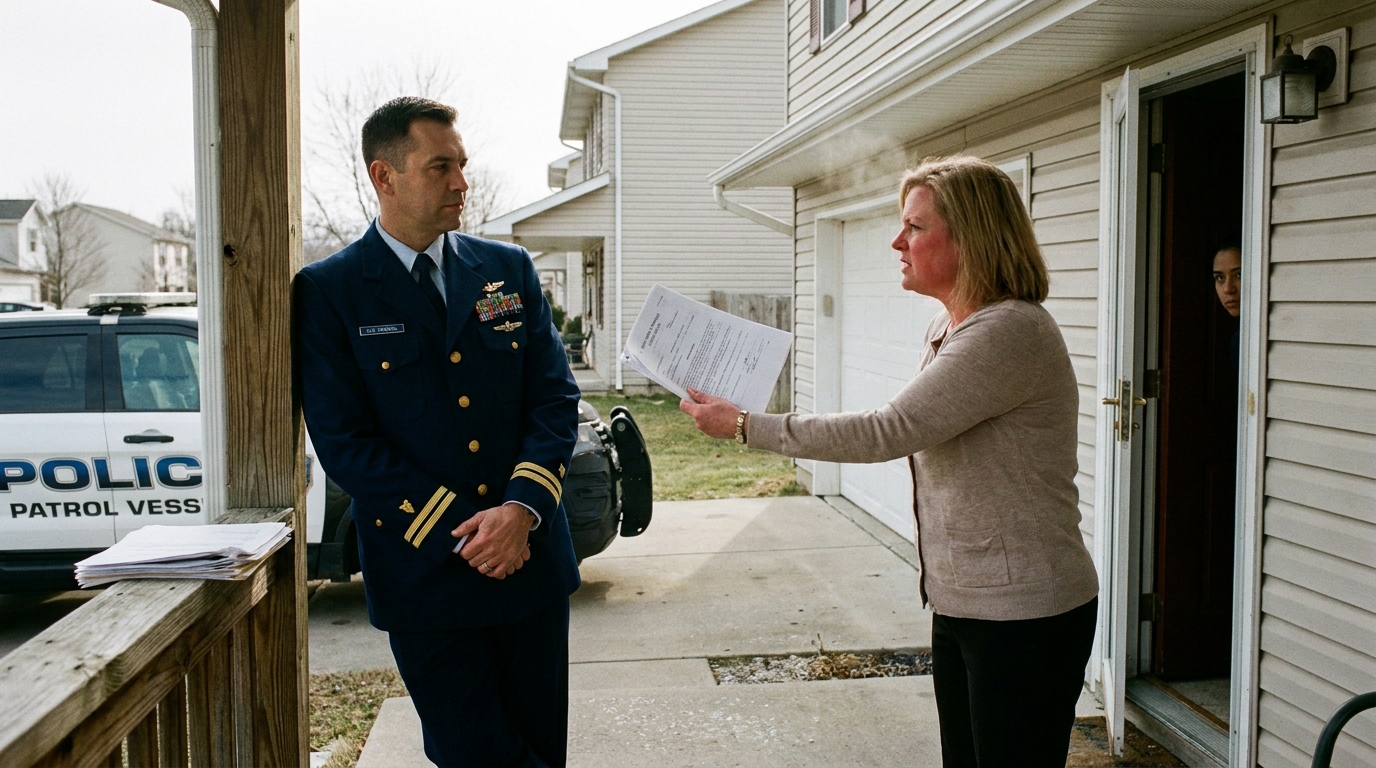
The heels struck the concrete with a sharp, hollow resonance that cut through the crisp morning air. Karen Whitmore did not pause at the edge of the driveway; she marched directly toward the porch steps, her posture rigid and her clipboard held against her chest like a breastplate. Behind her, Bob Fletcher gave a low, warning grunt, stepping back into the shadow of the side gate without making a sound, leaving Jake alone to meet the approach.
Karen stopped two feet from the threshold, her face flushed with the kind of frantic energy that came from spending the early hours drafting grievances. She didn’t look at the patrol boat this time; her gaze locked directly onto Jake with an aggressive, unblinking glare.
“You received the first notice,” Karen said, her voice tight, clipped, and devoid of any pretense of neighborhood diplomacy. Without waiting for an acknowledgment, she lifted a fresh sheaf of papers from her clipboard and extended them as if serving a summons. “Since you’ve chosen to ignore the initial warning regarding commercial non-compliance, I am issuing three additional citations. Effective immediately.”
Jake didn’t reach for the papers. He leaned slightly against the wooden porch pillar, keeping his hands loose at his sides, his weight balanced evenly. The scent of her aggressive, floral perfume cut through the diesel fumes lingering from the morning traffic.
“Citations for what, Karen?” Jake asked, his voice low and level, designed to force her to project her frustration across the open space. “The boat hasn’t moved an inch.”
“Section eighteen for noise ordinance disruption during morning maintenance prep,” she recited sharply, tapping a freshly printed sheet with a manicured nail. “Section twenty-two regarding property value degradation standards, and an addendum under the community aesthetic guidelines concerning unauthorized utilitarian structures in plain view. I don’t care what your military friends over the phone told you about preemption. This is a private community development, not a federal base. Private contracts supersede whatever bureaucratic loopholes you think you can exploit.”
She stood there on the porch with absolute, unyielding conviction, entirely convinced that her laminated rules held more weight than constitutional bedrock. It was the absolute confidence of someone who had weaponized a minor administrative position for so long that she believed her word was municipal law.
“You’ve been busy this morning,” Jake said, his eyes scanning the pages she waved in the air. “Going door-to-door before most people have finished their coffee?”
“Seventeen families signed my petition this morning,” Karen retorted, her chin lifting as she brandished the papers like evidence in a high-profile trial. “The neighborhood has spoken. We will not have military vehicles and the instability they bring disrupting our property values and our safety. Pay the fines, remove the vessel by Friday, or the association will initiate emergency legal proceedings to seize and tow the property at your expense.”
The mention of safety and instability hung heavily in the cold air, triggering a cold, sharp memory of deployment briefings where threat assessments were handled with clinical detachment. Jake looked past her shoulder toward the cul-de-sac. Down the street, the front door of the corner house remained shut, but a flutter of movement at a window confirmed they were being watched.
“Seventeen families,” Jake repeated, his tone flat. “That’s interesting, considering half the addresses on your last compliance sheet belong to vacant lots or homes currently up for estate probate.”
Karen’s eye twitched—a microscopic, involuntary micro-expression that lasted barely a fraction of a second, but it was enough. The absolute rigidity of her posture wavered for a single beat before she slammed the new notices down onto the wooden porch railing.
“Do not question my administrative records, Commander,” she snapped, her voice rising to a sharp edge. “You are dealing with a binding legal contract, and you are entirely out of your depth.”
She spun on her heel, the sharp click of her heels resuming as she marched back down the concrete apron, her shoulders hunched with a sudden, defensive tension that hadn’t been there when she arrived. She didn’t look back as she reached the pavement, her stride turning into a hurried retreat toward the end of the cul-de-sac.
Jake watched her go, his mind calculating the micro-shift in her expression. The momentary crack in her composure wasn’t about a disputed signature on a petition. It was something deeper, something tied directly to the paperwork she clutched so desperately. He picked up the stack of fresh citations from the railing, noting the immaculate formatting—too immaculate, printed on heavy-weight bond paper that an ordinary volunteer HOA president wouldn’t stock in bulk unless she was printing them by the boxload.
From across the street, the front door of Maria Santos’s house clicked open an inch, revealing a pair of dark, observant eyes watching the retreat of Riverside Meadows’ self-appointed general with quiet, analytical precision.
CHAPTER 4: THE INSPECTION AND THE INSURANCE THREAT
The weight of the new citations remained on the railing where Karen had abandoned them. Jake picked up the top sheet, feeling the dense, commercial-grade texture of the paper between his fingers. It wasn’t standard office copy stock; it was a heavy, specialized bond typically used for corporate legal filings or formal auditing reports—supplies ordered in bulk through institutional accounts.
From across the cul-de-sac, the front door of Maria Santos’s house clicked open, and the legal secretary walked down her driveway with measured, unhurried steps, carrying a leather portfolio tucked under one arm. She crossed the asphalt toward Jake’s driveway, her eyes fixed on the papers in his hand.
“She’s escalating past local covenants,” Maria said quietly as she reached the bottom of the porch steps. Her voice was steady, conditioned by years of reviewing contracts and corporate filings. “When an HOA president starts printing citations on high-yield corporate bond paper instead of standard association templates, it usually means two things: she’s using administrative resources for personal vendettas, or she’s trying to manufacture a paper trail that looks legitimate enough to survive an independent audit.”
Jake handed her the stack of notices. Maria scanned the headers, her fingers tracing the margin alignment and the specific font codes printed along the footer.
“These aren’t standard board-approved forms,” Maria noted, a thin, knowing smile touching the corner of her mouth. “They’re formatted using the exact same software template my firm uses for corporate compliance warnings. More importantly, Section eighteen and Section twenty-two don’t even exist in the amendments the neighborhood voted on two years ago. She’s fabricating bylaws on the fly.”
“She claimed seventeen families signed a petition this morning,” Jake said, leaning against the pillar. “Though half those addresses belong to vacant lots.”
“Because there aren’t seventeen families backing her,” Maria said, looking up from the documents with sharp clarity. “She’s running scared. Last week, when I requested the annual association budget breakdown for a routine review, Karen panicked. She delayed releasing the ledger for three days, claiming a ‘system migration.’ But financial ledgers don’t migrate themselves. I caught a glimpse of a vendor payout to an entity called Oak Ridge Maintenance—a firm that doesn’t exist anywhere in the county registry, yet they’ve been drawing four figures a month from association dues.”
Before Jake could respond, the rumble of a heavy engine broke the quiet morning air. A white municipal sedan bearing city seals turned into the cul-de-sac, slowing down before nosing directly into the apron of Jake’s driveway. The vehicle came to a halt inches from the boat trailer, and a tired-looking man in a high-visibility vest stepped out, carrying an official inspection clipboard and looking profoundly apologetic.
“Morning,” the inspector said, shutting the car door with a dull thud. He walked around the bow of the patrol vessel, running a hand over the edge of his vest as he stared up at the painted naval registry numbers. “You Commander Thornfield?”
“That’s right,” Jake replied, stepping down from the porch. “Let me guess—Karen Whitmore filed a municipal code violation claiming an abandoned commercial vehicle has been sitting on private property without registration.”
The inspector let out a long, weary sigh, pulling a printed complaint form from his clipboard. “Three times this week, actually. Said it’s a hazardous commercial obstruction posing a direct safety risk to local traffic.” He tapped the side of the hull where the United States Navy insignia was clearly stenciled in industrial gray. “Sir, I have to ask… is she serious? This is a federally registered military asset with active municipal easement clearance.”
“She doesn’t think federal rules apply to her neighborhood,” Jake said, reaching into his pocket and handing over the official documentation packet Sarah Lucy had forwarded from Navy legal.
The inspector took the paperwork, scanned it for five seconds, and pulled out his radio phone with a grim shake of his head. He dialed a direct line, his voice cutting sharply across the quiet driveway as he addressed his office. “This is Inspector Rodriguez. Close out complaint number four-zero-two on Riverside Drive. The vehicle in question is federal military property… Yes, I’m looking at the documentation right now. No, I cannot issue a citation… Because it’s the United States Navy, ma’am. Yes, I’m sure.”
He clicked the phone off and handed the papers back to Jake, his expression a mix of frustration and exhaustion. “I apologize for wasting your time, Commander. That woman has been calling our office twice a day demanding a tow truck. But I’d watch my back if I were you. When code enforcement shuts her down, she’s going to find another angle.”
As Rodriguez climbed back into his municipal sedan and backed out of the cul-de-sac, Jake’s cell phone buzzed in his pocket. He pulled it out. The caller ID displayed an insurance agency out of Oakhaven.
He answered on the second ring. “Jake Thornfield.”
“Commander, this is Marcus Vance with regional property insurance,” a sharp, corporate voice came through the speaker. “I’m calling regarding an urgent inquiry we received this morning concerning your property address. A policyholder named Karen Whitmore contacted our underwriting department claiming your driveway is being used to store hazardous military materials and tactical weapons, and she’s demanding that we either reclassify your neighborhood premium tier or drop your homeowner coverage entirely for maintaining a dangerous hazard.”
Jake exchanged a sharp glance with Maria Santos, whose eyes narrowed as she caught the drift of the conversation.
“It’s a decommissioned patrol boat, Mr. Vance,” Jake said evenly, his voice dropping into a low, tactical register. “There are no hazardous materials or weapons on board.”
“I figured as much,” the agent replied, sounding equally unimpressed by the morning’s disruptions. “But under state regulations, filing false hazard claims to manipulate insurance coverage across a municipal zone borders on insurance fraud. If she keeps pushing this through corporate channels, our legal department is going to have to issue a formal cease-and-desist for tortious interference.”
“Keep a record of every communication she sends you,” Jake said quietly. “You’re going to need it.”
He hung up the phone and looked at Maria, the pieces locking into place with the precision of a mechanical breech. Karen wasn’t just fighting a petty turf war over boat parking. She was systematically burning every administrative bridge she could find, forcing crisis after crisis, because the alternative—letting an independent forensic audit touch the association’s financial ledgers—was a collapse she could not survive.
CHAPTER 5: THE EMERGENCY MEETING BREAKDOWN
The community center was less a hall and more a glorified metal shed where spare pool chlorinator buckets and broken folding loungers rusted in the damp corner. By six o’clock, the fluorescent overhead tubes hummed with a harsh, flickering glare, casting cold light over fifteen folding chairs arranged in neat, hostile rows facing a makeshift wooden podium.
Karen Whitmore stood behind the podium before a blown-up poster board featuring glossy photographs of Jake’s patrol boat parked in the driveway. She wore a severe charcoal business suit, her hair pulled back into a tight chignon that emphasized the sharp angles of her jaw. As Jake stepped through the double doors, accompanied by Maria Santos and Bob Fletcher, the low murmur of the gathered neighbors cut off abruptly.
“Thank you all for attending this emergency safety assembly,” Karen began, her voice carrying a sharp, manufactured resonance that echoed off the corrugated metal walls. She didn’t wait for people to settle; she leaned into the microphone, pointing a slender finger at the photographic evidence of the hull. “We are facing an unprecedented institutional threat to our property values and domestic peace. Unregulated military hardware and personnel trained for combat operations have no place parked in residential driveways.”
Bob Fletcher let out a dry, deliberate cough from the second row, the sound carrying enough heavy iron to rattle the air. “Karen, what exactly do you think is going to happen?” Bob asked, his voice flat and unyielding. “Is the boat going to fire a missile at the mailboxes?”
“This is not a joke, Robert,” Karen snapped, her eyes flashing with a thin, brittle panic that she quickly masked behind corporate authority. “Military personnel are conditioned for violence. Having weapons of war parked twenty feet from our front doors sends a silent signal that this association condones aggression.”
The room fell dead silent. A heavy, suffocating tension settled over the folding chairs, the kind of stillness that precedes a structural fracture.
Maria Santos stood up from her seat in the third row, her movements deliberate and unhurried. She didn’t raise her voice; she let her legal secretary training do the work. “Karen, you are publicly accusing a decorated veteran of threatening community safety based solely on his service record. Under federal housing guidelines and state statutes, inciting discrimination against protected military personnel isn’t just a violation of association bylaws—it’s actionable civil rights infringement.”
Karen’s hands gripped the edges of the podium so hard her knuckles turned the color of bleached bone. “I am protecting our property values and insurance stability,” she fired back, her voice climbing an octave. “Military families bring instability, deployments, trauma, and liabilities that normal residents shouldn’t have to subsidize. This community was built for peaceful civilians, not military camps.”
The back door of the hall swung open with a sharp bang, letting in a gust of cold evening air. Mrs. Henderson, holding her young son’s hand, took two steps inside, stared at the podium with absolute disbelief, and shook her head. “We moved here because it was supposed to be a neighborhood,” she said, her voice trembling with quiet indignation. “This isn’t a neighborhood anymore. This is an interrogation room.”
Without waiting for a response, the Hendersons turned around and walked out into the parking lot. Within seconds, three more families stood up from the folding chairs, following them into the cool dusk. The front rows emptied out in a quiet, cascading wave of rejection, leaving Karen standing behind her podium facing a half-empty room of silent, watchful neighbors.
Jake watched her from the shadows near the entrance. The panic in her eyes was no longer hidden; it leaked through the polished veneer, a desperate realization that her manufactured crisis was collapsing under its own weight. She had tried to build a wall of public outrage to shield her financial ledgers, but the wall was cracking down the middle, exposing the hollow, rotting core beneath.
CHAPTER 6: THE FORENSIC DISCOVERY AND THE BRIBE
The kitchen table in Jake’s house was buried beneath a chaotic mosaic of bank statements, certified vendor invoices, and county property records. The overhead pendant light cast a harsh, yellow glow over the paper landscape, highlighting the tiny numeric columns that Maria Santos had spent the last forty-eight hours analyzing with clinical precision.
Maria traced a line of red ink down a ledger page, her breath hitching slightly in the quiet room. “Look at this entry from November of two years ago,” she said, her voice dropping into a low, focused hum. “A routing deposit of twelve thousand dollars authorized under ’emergency grounds maintenance.’ But when you cross-reference the county clerk’s public works database, no municipal permits were issued for Riverside Meadows during that quarter. The money didn’t go to landscaping.”
Jake leaned over the table, his eyes tracking the alphanumeric string. “Where did it go?”
” straight into an LLC registered in Oakhaven under the name Oak Ridge Holdings,” Maria replied, looking up with a hard, sharp glint in her eyes. “An entity with no physical office, no registered employees, and a postal box address that traces directly back to a private holding account managed exclusively by Karen Whitmore. She wasn’t just inflating the maintenance budget; she was bleeding the association dry to cover personal debts.”
Before Jake could answer, a sharp, authoritative knock rapped against the front door—three measured impacts that carried the unmistakable crispness of a professional delivery.
Jake walked through the dim hallway, keeping his movements measured. He opened the heavy wooden door just enough to clear the threshold. Standing on the porch was Karen herself, stripped of her clipboard and her usual rigid posture. Her hair was slightly disheveled, and her expensive designer suit looked rumpled, as if she had spent the last two hours driving through the rain without a destination. In her hand, she clutched a heavy white envelope and a folded cashier’s check.
“We need to talk, Commander,” Karen said, her voice lacking its usual aggressive snap, replaced by a thin, frantic edge. She didn’t wait for an invitation; she stepped closer to the door frame, her eyes darting nervously toward the interior hallway. “This has gone far enough. The inspections, the complaints, the friction—it’s entirely unnecessary.”
Jake didn’t move an inch, blocking the entrance with his shoulder against the door jamb. “You’re standing on private property, Karen, after filing three false municipal complaints and a federal report against a naval officer. You don’t get to dictate terms.”
She pressed the envelope forward, her fingers trembling slightly against the crisp paper. Inside, the corner of a cashier’s check peeked out, displaying a five-figure numerical value. “Ten thousand dollars,” she whispered fiercely, leaning in so her voice wouldn’t carry across the cul-de-sac. “Cashier’s check, drawn on an independent account. Take the money, drop the inquiries with the association, and tell Agent Wells that the harassment claims and zoning disputes were just a misunderstanding—a localized neighbor disagreement that got out of hand. We can make the whole thing go away before it ruins both of us.”
Jake looked down at the check, then back up into her eyes, watching the desperate, cornered panic fluttering beneath her manufactured composure. She thought she was executing a tactical settlement, buying her way out of an administrative inconvenience, entirely blind to the federal net tightening around her embezzlement records.
“Karen,” Jake said, his voice entirely flat, cold, and loud enough to echo off the porch ceiling where a hidden recording device lay primed. “Are you attempting to offer financial compensation in exchange for obstructing an active federal investigation?”
Her face drained of what little color remained, her lips parting in a silent gasp as the weight of the words finally struck home.
CHAPTER 7: THE VANDALISM AND THE FINAL REPORT
The corrosive smell of solvent bit into the back of Jake’s throat before he even cleared the front steps. It was a vicious, chemical burn—heavy, sweet, and suffocatingly sharp—cutting through the damp autumn air like an open wound.
Jake moved fast, his boots hitting the concrete apron with calculated momentum. The motion-activated security floodlights above the garage flickered on, washing the driveway in a stark, glaring white. The beam illuminated a glistening, dark streak carved vertically down the port side of the patrol boat’s aluminum hull. Where the industrial gray paint had met the liquid agent, the surface was already bubbling, blistered and scorched into raw, dull metal as the acid stripped away the layers of military-grade coating.
From the shadows near the side gate, the faint scuff of a hurried shoe against gravel gave away the retreat. Jake didn’t chase; he pivoted instantly toward the security camera mounted under the eaves, his eyes tracking the wide-angle lens adjusted to capture the entire apron.
The security system’s hard drive had logged the exact sequence twenty minutes prior. A figure in a dark trench coat crossing the perimeter at two-fifteen in the morning, carrying a clear glass bottle with a rusted cap, pouring the solvent with deliberate, venomous precision before dropping the empty container into the municipal trash bin at the curb.
Within an hour of the morning light, Special Agent Wells stood beside the scarred hull, her boots crunching lightly on the fine grit of the driveway. She wore a tailored wool trench coat, her expression grim as she watched a crime scene technician lift fingerprints from the discarded bottle and bag a crumpled Home Depot receipt retrieved from the bottom of Jake’s bin.
“She crossed the line from bureaucratic harassment and financial embezzlement straight into destruction of federal property,” Agent Wells said, her voice low and steady as she jotted notes in a black binder. “The chemical damage on this hull pushes the threshold into a serious felony enhancement. Vandalizing a registered military asset as part of an ongoing intimidation campaign gives the federal prosecutor everything needed to bypass local delays.”
“She didn’t just target the boat,” Jake said, his eyes fixed on the blistered paint. “She thought destroying the physical symbol would erase the financial audit Maria pulled together.”
“It won’t,” Wells replied crisply, snapping her binder shut. “In fact, it accelerates the timeline. We have her on mail fraud, false reporting to federal law enforcement, attempted bribery on your front porch tape, and now property destruction. Her lawyer won’t be able to file enough motions to keep her out of an arraignment hearing by the end of the week.”
As Wells walked back toward her unmarked sedan, the neighborhood around them stirred with quiet tension. Across the street, Maria Santos watched from her porch, her leather portfolio clutched tightly against her chest like an anchor. The walls were closing in, and Karen’s desperate gambit had left her entirely exposed.
CHAPTER 8: THE FALL OF THE PRESIDENCY AND THE QUIET SHORE
The fluorescent lights of the community center buzzed with the same harsh intensity as the night of the failed assembly, but the atmosphere had transformed entirely. Every folding chair was occupied. Neighbors who had previously locked their doors and ignored the escalating conflict now filled the aisles, standing shoulder to shoulder against the aluminum walls. Local news cameras hummed near the back entrance, their red tally lights glowing steadily in the gloom.
Jake stood near the front row beside Bob Fletcher and Maria Santos, his eyes fixed on the double doors as they swung open.
Karen Whitmore walked in, flanked not by an entourage of compliant volunteers, but by two federal marshals whose dark suits and measured steps carried an absolute, inescapable finality. She wore the same charcoal business suit she had worn during her opening ambush, but the fabric appeared limp, the sharp creases lost to the exhaustion of an arraignment processed in a federal holding cell earlier that morning. In her hands, she clutched a cardboard box containing her personal desk files, her knuckles white against the cardboard.
The room fell into an absolute, suffocating silence. Even the camera shutters stopped clicking.
Special Agent Wells stepped up to the wooden podium, setting a thin leather folder down on the scarred wood. She didn’t look at Karen; she addressed the packed room with the calm, measured authority of a federal officer closing an open case.
“Citizens of Riverside Meadows,” Agent Wells began, her voice carrying clearly off the metal ceiling. “As of this morning, federal indictments have been formally executed against Karen Whitmore. The charges encompass multiple felony counts: systemic mail fraud totaling over one hundred and twenty-seven thousand dollars in embezzled association funds, the filing of false federal and municipal emergency reports, civil rights violations targeting protected military families, and the intentional destruction of federal property.”
A low murmur rippled through the rows of folding chairs, a wave of collective realization that swept away the last lingering doubts of the neighborhood.
Karen stopped three feet from the front row, her jaw locked into a rigid, defiant line. Her eyes darted across the crowd, searching for a single sympathetic face among the dozens of neighbors she had governed through intimidation and manufactured crisis. Finding none, she turned her gaze toward Jake, her voice rising with a frantic, bitter edge that broke the silence.
“You think this is a victory,” Karen spat, her voice cracking slightly under the pressure of the courtroom reality closing in around her. “You think hiding behind federal preemption and military status makes you clever. This neighborhood was peaceful until you brought your floating scrap metal and your combat baggage into a civil community. You destroyed everything I built to keep property values stable and secure.”
She took a step forward, but the marshal to her right shifted imperceptibly, his hand hovering near his belt, halting her movement.
Maria Santos stepped out from the aisle, holding the comprehensive forensic ledger she had spent weeks compiling. She didn’t raise her voice; she spoke with the cold, irrefutable precision of accounting logic. “You didn’t build stability, Karen. You built a shell corporation named Oak Ridge Holdings to siphon association dues into your own private accounts. Every fake violation notice, every manufactured security crisis, and every attack on military families was just a smoke screen to distract us from auditing your three-year embezzlement scheme. The financial insolvency was yours, and the exposure was entirely self-inflicted.”
Karen stared at Maria, her defiance fracturing instantly. The microscopic twitch in her eye returned, followed by a pale, ash-white pallor as she realized the absolute depth of the paper trail she had failed to conceal. Her shoulders slumped, the rigid posture that had defined her reign of terror finally collapsing under the weight of undeniable truth.
The federal marshals moved in unison, gently taking her by the elbows and guiding her back toward the exit doors. Karen did not scream, nor did she issue another threat; she walked out into the autumn sunlight in absolute silence, her cardboard box held awkwardly against her chest as the heavy metal doors swung shut behind her.
Bob Fletcher let out a slow, rumbling breath, raised his weathered hands, and began to clap.
It started as a single, deliberate strike of palm against palm, echoing sharply off the metal walls. Within a second, Maria joined in, then Mrs. Henderson, then the entire room rose to their feet in a cascading wave of sound. The applause swelled, rolling across the folding chairs and out through the open doors into the parking lot, lasting for nearly two full minutes as the community washed away the final remnants of the past three years.
When the applause finally settled, Bob Fletcher stepped up to the podium, clearing his throat with a raspy chuckle. “Emergency motion to dissolve the current board and elect new leadership,” Bob announced, his voice booming over the microphone.
“Seconded,” shouted a dozen voices simultaneously from the back.
The vote was unanimous: forty-seven in favor, zero opposed. Bob Fletcher was elected association president by acclamation, with Maria Santos stepping in as treasurer. Within ten minutes, the new board drafted its first official resolution—the implementation of strict term limits, mandatory independent financial audits, and an explicit, immutable charter protecting military families and veterans from association overreach.
The crowd slowly dispersed into the cool evening air, the atmosphere light and unburdened by the tension that had choked the cul-de-sac for months.
Jake walked back down the pavement toward his driveway as the sun dipped below the horizon, painting the sky in deep shades of amber and slate. The air smelled of woodsmoke drifting from a neighbor’s chimney and the clean, crisp scent of lake water undisturbed by artificial friction.
He stopped at the edge of his concrete apron. The patrol boat sat quietly under the fading light. The scorched, blistered streak of aluminum where the chemical solvent had bitten into the hull was still visible, a permanent scar of the conflict that had tested the bounds of the property line.
From the open garage, Emma stepped out carrying a fresh can of industrial-grade primer and a small brush, her college applications tucked safely inside the house. She walked over to the hull, ran a hand gently over the scarred metal, and looked up at her father with a steady, assured smile.
“We have enough gray left in the locker to patch the seam,” Emma said, her voice carrying the calm certainty of someone who knew exactly where she stood. “We can fix it right down to the primer.”
Jake took the brush from her hand, dipping the bristles into the cool, metallic paint. Together, father and daughter set to work on the hull, moving with the rhythmic, synchronized precision of a crew that had weathered the storm and returned safely to shore. The quiet rhythm of the brushstrokes blended into the evening, sealing the metal against the salt air, leaving the road ahead wide, open, and entirely at peace.