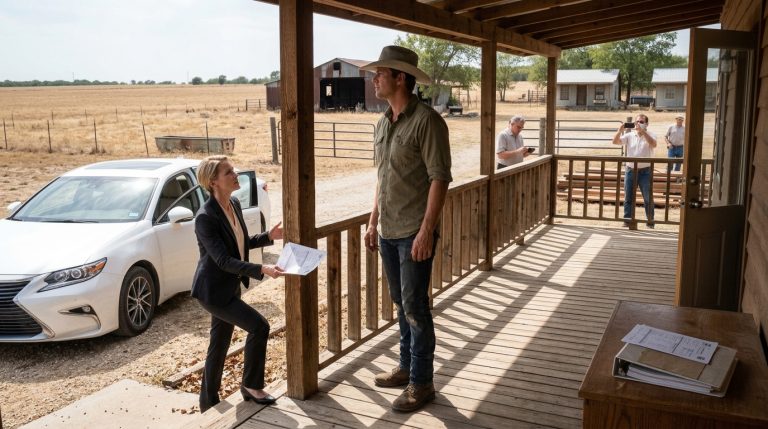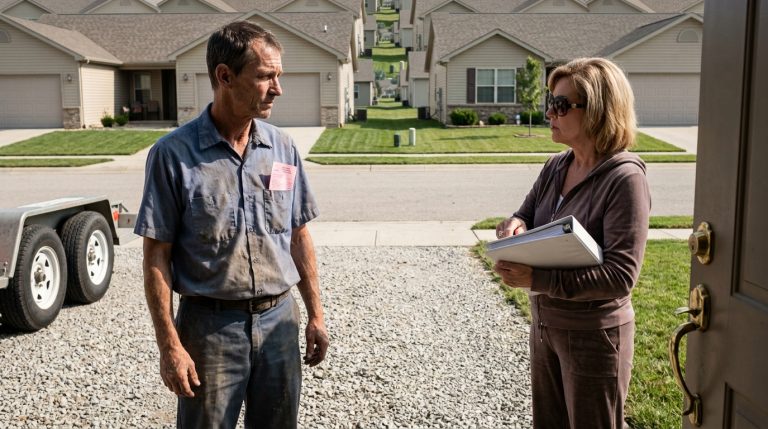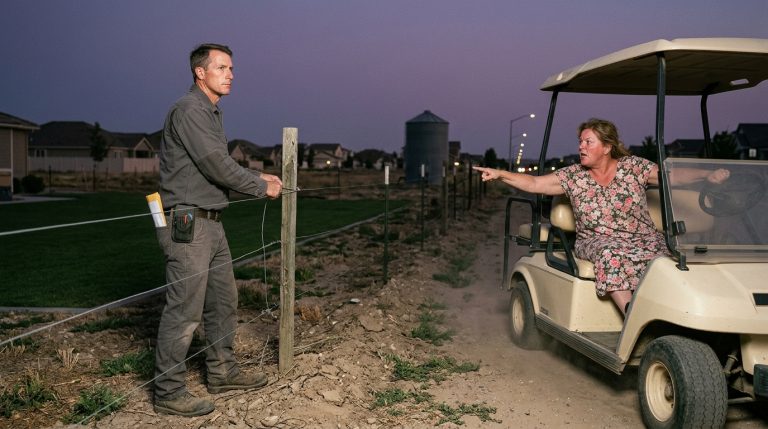
Gritty Texas Wind Carves Through Broken Fences As Retired Veterans Stand Their Ground Against Suburban Tyranny
CHAPTER 1: IRON AGAINST RUST
The heavy iron wrench slipped slightly against the galvanized bolt, scraping my knuckles against the cold metal framework. I didn’t curse; twenty-four years in military communications taught me that waste air only breeds mistakes.
“That monstrosity has to be dismantled by Friday or the fines will start at five hundred dollars a day.”
The voice cut through the dry Texas air like a dull saw. I kept my weight planted on my left boot, slowly turning the wrench another quarter-turn before straightening my back.
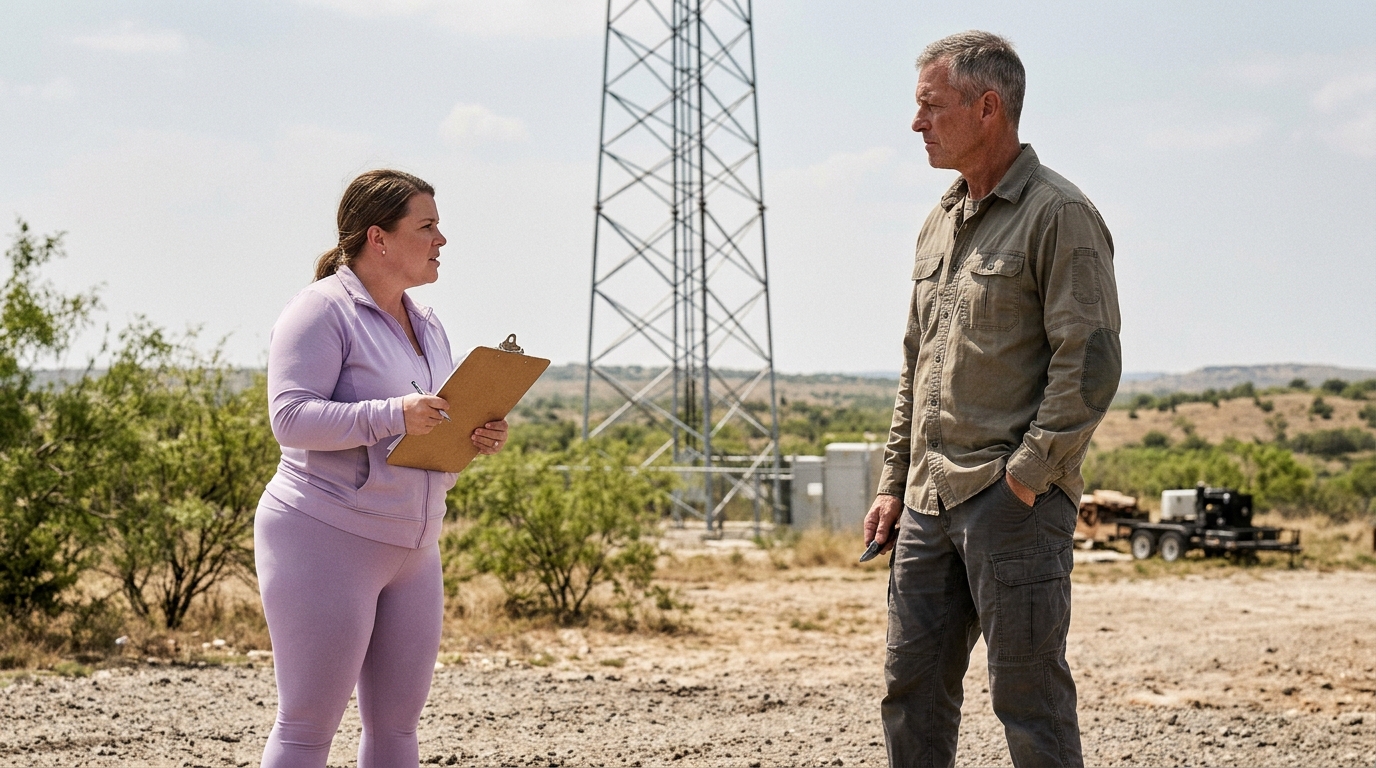
She stood at the edge of my newly graded gravel, shaped like an angry pear squeezed into pastel athletic wear. A clipboard served as her shield, clutched tight against a chest swelling with unearned authority.
“Mr. Corigan,” she spat out, her small eyes darting up the forty-five-foot aluminum lattice rising above my half-acre lot. “I will lean this house so fast your head will spin.”
I reached into my pocket, my thumb finding the familiar, worn metal ridges of my scarred pocketknife. I didn’t flip the blade open; I just rolled it back and forth against my calloused palm, feeling the steady weight of it ground me against the rising heat in my chest.
“Afternoon, ma’am,” I said, my voice flat and dry as the dust around our boots. “Jack Corigan. I just moved the boxes in yesterday.”
“Karen Miller,” she replied, not bothering to look at my outstretched hand. “President of the Harmony Creek Homeowners Association.”
She tore a crisp sheet from her clipboard and thrust it toward my chest. It listed article four, section B, paragraph three of the private covenants, demanding immediate removal of all external structures.
“You agreed to these rules when you bought the deed,” she hissed, stepping closer with a sour scent of artificial lavender and sunblock. “Our neighbors value an uncluttered skyline. That metal eyesore comes down, or you pay.”
I looked past her shoulder toward the empty ranch land bordering the property line, listening to the dry rattle of mesquite branches in the wind. The nearest neighbor’s roof was a hundred yards away, hidden behind thick oak trunks.
“It’s a standard tower for my equipment,” I said quietly, keeping my fingers moving over the steel handle in my pocket. “Built safe, anchored deep.”
“I don’t care what it’s for,” Miller snapped, turning her heels hard into the crushed gravel. “Friday at five o’clock. Every bolt, every wire, or the fines begin.”
She climbed into her electric golf cart, stamped with an aggressive serif font across the side panel, and rolled away without a backward glance. The silence returned, heavy and thick with dust. I looked back up at the steel tower gleaming in the harsh afternoon light, knowing no government paper was going to save me this time. I had to dig through the dirt myself.
CHAPTER 2: SILENCE ON FREQUENCY
The office still smelled of fresh drywall primer and cardboard dust. I dropped the heavy brass handle of the front window latch into place, locking out the hum of distant mowing equipment.
The envelope on the oak desk was thin, cheap paper with a machine-printed return address from the Harmony Creek maintenance shed.
I didn’t reach for my phone or dial any federal bureau numbers. Those wires were cut by my own hand when I chose to play this game by local dirt rules.
Instead, I unfolded the beige document with the tip of my pocketknife blade, letting the steel edge slide through the folded crease.
Inside sat a preliminary billing schedule detailing retroactive administrative penalties for unapproved aluminum structures.
Five hundred dollars a day, stacking like cordwood from the moment Karen’s pastel tracksuit left my gravel.
Beneath that sheet lay a stray stack of older community papers left behind by the previous owner, yellowed at the margins and smelling of old basements.
I flipped past the approved color palettes for exterior paint and the restrictions on decorative lawn ornaments until my thumb caught on a handwritten margin note.
It was a line item from three years prior regarding reserve fund allocations for perimeter fencing repairs that never actually happened.
The numbers didn’t balance across the quarterly ledgers.
The maintenance account showed a five-figure deficit masked by vague landscaping charges.
“Looking for loopholes, Sergeant?”
My son Ben stood in the doorway, holding a mug of lukewarm coffee with both hands, his eyes fixed on the ledger spread across the wood.
“Not looking for loopholes,” I said, closing the blade with a crisp click that echoed off the bare walls. “Just following where the paper trail gets muddy.”
Ben set the ceramic mug down on the edge of the desk, the dark liquid sloshing slightly against the rim.
“Karen’s got the entire board wrapped around her finger,” he said, leaning his hip against the corner of the heavy oak. “Slate and the others just sign whatever she drops in front of them without reading the fine print.”
“That’s because a rubber stamp is easier than thinking,” I replied, pulling a blank legal pad toward me. “A man who spends twenty-four years tracing broken signal relays learns one thing above all else. Every lie leaves a static hum if you listen close enough to the wiring.”
I picked up a graphite pencil and wrote down three specific dates from the old maintenance invoices where funds were shifted without a quorum vote.
The paper didn’t offer federal protection or legal shields, but it gave me something better.
It gave me leverage built out of their own sloppiness.
“Where are you going with this?” Ben asked, watching the graphite move across the page.
“To find out why a woman who treats a subdivision like a military garrison is so desperate for five hundred dollars a day,” I said, setting the pencil down. “Grab your jacket. We’re taking a walk before the sun hits the tree line.”
CHAPTER 3: COFFEE AND CONCRETE
The sidewalks in Harmony Creek were poured thick, wide enough for two golf carts to pass without a wheel touching the lawn.
Yet nobody was walking them.
The front windows of the colonial-style homes remained dark behind shut shutters, reflecting the sinking sun like blind eyes.
A young father two blocks down was kneeling by a plastic stroller, frantically tightening a wheel nut with a pair of pliers while glancing nervously over his shoulder toward the corner.
I slowed my pace, keeping my boots on the center of the gray concrete.
“Wheel giving you trouble?” I asked, my voice carrying flat across the clipped zoysia grass.
The man flinched, his wrench slipping and scraping against the hubcap with a sharp metallic ping.
“Just routine maintenance,” he muttered, keeping his eyes glued to the plastic frame without looking up. “Everything’s within the approved manual guidelines.”
“Manual doesn’t say anything about a friendly hello,” I said, stopping a few feet away.
“Manual says a lot of things if you get the monthly newsletter,” the man whispered back, his jaw tight as he wiped grease on his jeans. “We got a warning yesterday because our garden hose wasn’t rolled into the designated green plastic housing. Twenty-five dollars for a stray loop of rubber.”
I felt the familiar cold weight of my pocketknife shifting inside my jacket pocket against my ribs.
The system wasn’t built to maintain a neighborhood; it was built to keep people small.
“Rules only hold weight if you agree to carry them,” I said quietly.
The father finally looked up, his eyes bloodshot and tired, scanning the empty street before dropping his gaze back to the ground.
“Easy for you to say, Mr. Corigan,” he replied, standing up and brushing the dust off his knees. “You’ve got a military pension and a forty-foot tower. The rest of us just want to make our mortgage payments without getting a pink slip in the mailbox every Friday.”
He grabbed the stroller handle and wheeled it sharply up his driveway, disappearing behind a heavy oak door that clicked shut with a definitive thud.
I didn’t answer him.
There was no point arguing fear with a man standing knee-deep in it.
I turned my back on the manicured row of houses and headed toward the older section of the development, where the asphalt cracked and the trees grew wilder.
If the rest of the street was too terrified to look up from their concrete, I needed a man who had spent his life staring straight down the barrel of worse things than an angry HOA president.
CHAPTER 4: THE MARINE NEXT DOOR
The door swung back without hesitation, revealing a wiry man with close-cropped gray hair and eyes that swept my silhouette before recognizing my face.
“Corigan,” Marcus said, stepping back to clear the threshold. “Dave mentioned you were trading paint with the neighborhood committee. Come inside before the mosquitoes draft behind you.”
The living room smelled of gun oil and old paper.
A radio console sat quietly in the corner, its dial unlit.
Marcus poured two glasses of iced tea from a plastic pitcher, handing me one with a hand bearing faint white scars across the knuckles.
“She tried the same trick with my flagpole three years back,” Marcus said, lowering himself into a scarred leather recliner. “Sent a certified letter claiming it violated vertical symmetry codes. Wanted it down by Wednesday.”
I took a slow sip of the cold tea, letting the ice settle against my teeth.
“What did you tell her?”
“Told her to bring a hacksaw and try her luck,” Marcus replied, a dry, humorless smirk touching the corner of his mouth. “She never showed up with the saw. Just sent more paper. People like that don’t know how to handle a pushback because they’ve spent twenty years practicing how to bully people who fold at the first raised voice.”
I pulled the folded maintenance ledger from my jacket pocket and dropped it onto the low wooden coffee table between us.
“Paper is all she’s got left,” I said, tapping the corner of the ledger. “Or at least, whatever paper she hasn’t burned covering up the missing funds in the common account.”
Marcus leaned forward, his eyes narrowing as he scanned the handwritten numbers I had marked earlier that evening.
“You found a deficit?”
“More than a deficit,” I replied. “Five-figure gaps masked as landscaping fees while everyday residents are getting billed twenty-five dollars for a crooked welcome mat. She isn’t just protecting property values. She’s running a toll booth.”
Marcus let out a low whistle, shaking his head slowly as he picked up the paper by the edge.
“If this goes public, the entire board implodes,” he said, looking up at me with a hard, assessing stare. “And she knows it. Which means by tomorrow morning, she isn’t just going to send another warning letter. She’s going to come looking for a fight.”
CHAPTER 5: DIRT UNDER FINGERNAILS
The morning sun hadn’t yet burned the dew off the high grass when I turned my truck down the lane toward Sarah Beth Cummings’s property.
Her yard stood out from the uniform green of Harmony Creek like a splash of oil on a clean kitchen floor.
Heirloom roses climbed ancient wooden trellises, spilling deep crimsons and pale yellows over the weathered picket fence.
Kneeling near the base of a towering tea rose bush, Mrs. Cummings was working the soil with a small hand trowel, her knuckles gray with damp earth.
“Careful where you drop your boots, Mr. Corigan,” she said without looking up, her voice steady and sharp as a pruning blade. “Karen spent twenty minutes yesterday telling me these bushes violate the subdivision line-of-sight clearance code.”
“Line of sight to what?” I asked, stepping lightly over the stone border. “An empty stretch of pasture?”
“To her ego,” Mrs. Cummings muttered, snapping a dead leaf off a stem with a crisp, dry pop. “She measured every stalk with a yellow tape measure, shouting over the hedge about property values. As if forty years of cultivating prize-winning blooms lowers anybody’s equity.”
I crouched down beside her, picking up a handful of dark, rich compost and letting it slide back through my fingers.
“She’s running scared, Mrs. Cummings,” I said quietly. “The ledger numbers don’t add up. She’s squeezing everyone in this zip code because her own accounts are coming up short.”
The old woman stopped digging, her trowel freezing halfway into the dirt.
She turned her head, her sharp eyes studying my face with a look that had outlasted three different HOA presidents and two property developer bankruptcies.
“People don’t fight a tyrant with spreadsheets alone, Sergeant,” she said, her fingers tightening around the wooden handle. “They fight when they realize they’re locked in the same cage. You got a plan to open the door, or are we just trading stories over the fence?”
“We’re opening it Wednesday night at the community clubhouse,” I replied, standing up and brushing the loose soil from my palms. “Bring your shears and bring your neighbors. It’s time someone audited the warden.”
CHAPTER 6: THE KANGAROO COURT
The long folding table at the front of the room was bare except for a pitcher of tap water and Karen’s leather folio.
She sat in the center seat, flanked by Gerald Slate, who was nervously shuffling a stack of blank index cards, and Beatrice Little, whose fingers gripped the edge of the laminate table so hard her knuckles looked like polished bone.
There were no other residents in the chairs.
This was meant to be a quiet execution, scheduled precisely to avoid witnesses.
“Mr. Corigan,” Karen began, her voice dripping with the synthetic sweetness of a grocery store clerk reading a recall notice. “We are here to finalize the disposition of your unapproved structure.”
I didn’t take a seat in the empty rows facing them.
Instead, I walked straight up to the edge of the long table, the rubber bottom of my toolbox hitting the wood with a solid, definitive thud that made Beatrice jump.
“Not disposing of anything today, Mrs. Miller,” I said, resting my hand on the metal latch of the box.
“This is an official board hearing,” Gerald interjected, puffing his chest out behind his thick glasses. “You were ordered to bring proof of compliance or a removal schedule. Where is your paperwork?”
“Paperwork is right here,” I replied, flipping the twin latches open with a pair of sharp clicks.
I didn’t pull out federal law briefs or complex legal statutes.
I pulled out the three-year maintenance ledger I had salvaged from the back shelf of my office, its dog-eared pages stained with coffee rings and marginalia.
“I found a curious line item under common area landscaping from last November,” I said, sliding the open ledger across the table toward Karen’s hands. “Fourteen thousand dollars allocated for fence repairs that never happened on a street with no perimeter fence.”
Karen’s pastel jacket seemed to tighten around her shoulders as her eyes dropped to the ink.
“That is internal administrative business,” she snapped, her voice losing its measured cadence as a bright red flush crept up her neck. “You have no right to review association accounting without a formal request filed thirty days in advance.”
“Accountability doesn’t need a thirty-day waiting period when the numbers don’t balance,” I said, leaning my weight against the table edge. “Especially when those missing funds match the exact total of the retroactive fines you’ve been slamming onto families over welcome mats and stroller wheels.”
Beatrice Little stared down at the ledger numbers, her lips trembling slightly as she pulled her hands back from the table.
Gerald looked frantically toward Karen, waiting for a cue that wasn’t coming.
“This meeting is adjourned,” Karen hissed, standing up so fast her metal chair scraped against the linoleum with a shriek. “You are trespassing on private community property, and I am calling the county sheriff right now.”
“Go ahead and dial,” I said, my voice dropping into the steady, flat register of a man who had seen worse bluffs on a flight line. “Tell them you’re calling from a meeting where the books don’t match the bank.”
CHAPTER 7: FRACTURED LEDGER LINES
The afternoon sun was filtering through the dense canopy of heirloom rose bushes when the first folding chairs began to fill along the back lawn.
Thirty residents stood in tight clusters, holding paper cups of lemonade while casting nervous glances toward the paved street.
Sarah Beth Cummings stood on her back porch steps, tapping a silver spoon against a ceramic mug until the quiet murmur of the crowd settled into a heavy stillness.
“We didn’t come here to complain about weeds or mailboxes today,” Mrs. Cummings said, her voice cutting clean through the warm air. “We came here because the books don’t match the reality.”
I stepped forward into the center of the grass, holding the open ledger under one arm.
“Last night, the board tried to push through another round of penalties while locking the doors to the public,” I said, looking out across the familiar faces of neighbors who had spent months dodging fines. “They claimed the rules were for everyone. But the fourteen thousand dollars missing from our maintenance reserve didn’t go toward landscaping or paving.”
A low murmur rolled through the crowd like wind through dry brush.
Mr. Garcia, holding his toddler son against his hip, took a half-step forward from the edge of the patio.
“Where did the money go?” he asked, his voice sharp with disbelief.
“It went toward covering holes in accounts that only Karen and her inner circle had access to,” I replied, pulling the petition papers from my back pocket and laying them across the weathered wooden table. “They’ve been billing us for phantom repairs while pocketing the difference. If we want our neighborhood back, we don’t need a lawyer or an act of Congress. We just need forty signatures on a recall petition.”
Marcus Thorne didn’t wait for a speech.
He pulled a heavy black ink pen from his shirt pocket, laid the paper flat against the wood of the patio table, and signed his name with hard, deliberate strokes.
Within seconds, the clipboard was surrounded by a tight cluster of neighbors passing the pen from hand to hand, the scratch of ink on paper drowning out the distant hum of traffic on the main road.
CHAPTER 8: SHADOWS ON ASPHALT
The pastel pink vehicle rolled to a stop right at the edge of Mrs. Cummings’s stone border, its electric motor humming like an angry hornet.
Karen Miller sat rigid behind the narrow steering column, her small eyes darting across the cluster of thirty neighbors holding coffee cups and ink-stained clipboards.
“What is the meaning of this assembly?” Karen demanded, her voice shrill as she stood up on the rubber floor mat. “Unapproved neighborhood gatherings on private residential property violate section nine of the community covenants.”
Nobody moved.
Mr. Garcia didn’t look down at his shoes this time; he simply kept his hand steady on the stroller handle and stared straight at the windshield.
“There’s no unapproved gathering here, Karen,” Marcus Thorne said, stepping out from the shade of the rose trellis with the heavy stack of signed papers tucked under his arm. “Just a few folks taking a look at the community ledger you forgot to balance.”
Karen’s face went from pale porcelain to a deep, bruised plum.
“You have no authority,” she snapped, her hands gripping the plastic steering rim so hard her knuckles turned bloodless. “I am the president of this association, and I demand those papers be handed over immediately.”
“You were the president about twenty signatures ago,” I said, walking out from the porch steps and stopping five feet short of her front bumper. “The recall petition cleared the forty-percent threshold twenty minutes before you pulled your cart onto the grass.”
She stared at the papers, her breath coming in short, ragged gasps as the reality of the numbers hit her.
Without her ledger and without her unearned fines, she was just an angry woman in a pastel tracksuit standing in the dirt.
“This isn’t over,” she hissed, her voice cracking as she wrenched the steering wheel hard around. “I’ll have every single one of you fined until you lose your deeds.”
The cart spun backward on the loose gravel, spitting small stones against the fence before speeding down the asphalt toward her empty house.
CHAPTER 9: THE CORNERED RAT
The cruiser door clicked open, and a young deputy stepped out onto the asphalt, his hand resting casually near his belt as he took in the crowd of neighbors standing shoulder-to-shoulder by the rose beds.
Before the officer could take two steps, the electric motor whined loudly up the pavement.
Karen’s golf cart slammed to a halt right behind the police vehicle, her clipboard shaking violently in her left hand as she jumped down onto the street.
“Officer, thank God you’re here,” Karen cried out, her voice pitching high and shrill as she rushed toward the cruiser. “I am Karen Miller, president of the association. This man and his mob are conducting an illegal occupation of private property.”
The deputy blinked, looking from Karen’s flushed, frantic face to the calm group of homeowners standing quietly on the grass.
“Ma’am, I received a dispatch about a dispute,” the deputy began, adjusting his hat brim. “You need to step back behind the line.”
“I will not step back!” Karen shrieked, slamming her clipboard down against the hood of the cruiser with a sharp plastic crack. “They are forging documents, they are trespassing, and they are threatening the stability of this entire community! You need to arrest them right now!”
She was foaming at the edges, refusing to yield an inch, doubling down on her authority because she had nowhere left to run.
Marcus Thorne stepped forward from the garden border, holding out a single folded sheet of paper.
“Officer,” Marcus said evenly, his voice cutting through her hysterics. “Nobody’s trespassing. But we do have an official, forty-percent signed homeowner petition recalling this board for missing funds and fraudulent penalty levies.”
The deputy looked at the signature stack, then back at Karen, whose breathing came in ragged, furious gasps as she realized the last of her leverage had just dissolved into the Texas dust.
CHAPTER 10: DUST SETTLES LOW
The desktop in my study was clear of binders, legal briefs, and old municipal ledgers.
The missing maintenance funds had already been accounted for in the interim board’s emergency audit, tracing directly back to unrecorded cash deposits that Karen had used to pad her personal utility bills.
Her house at the end of the cul-de-sac sat dark, a weathered “For Sale” sign planted firmly in the middle of the zoysia grass where her golf cart used to idle.
She hadn’t fought the recall vote or contested the audit; she had simply packed her pasteled wardrobe into the back of a sedan and vanished before the weekend news could settle.
“Dad,” Ben called out softly from the doorway, holding two mugs of black coffee. “Local net is checking in on forty meters.”
I took the ceramic mug from his hand, feeling the familiar warmth against my palms.
I sat down in the wooden swivel chair, adjusting the VFO dial until the static cleared into a clean, crisp carrier wave.
Across the state and down the coast, voices of operators were passing routine check-ins without interference or threat of arbitrary fines.
The neighborhood outside was quiet.
A basketball hoop stood unbothered near the curb down the street, and a bright ring of sidewalk chalk drawn by toddlers remained bright under the streetlights.
There were no more warning notices taped to doors.
There was no more artificial fear dictating how high a man could build his antenna or how a woman could plant her roses.
The tower stood tall against the dark blue sky, its slender frame cutting straight through the wind, serving its purpose without apology.
I keyed the microphone, leaning close to the element.
“Whiskey Five Juliet Juliet Charlie, monitoring and secure from Harmony Creek,” I spoke into the ether.
The speaker crackled with a solid, five-by-nine return signal, steady and clear in the quiet night.
All was well.