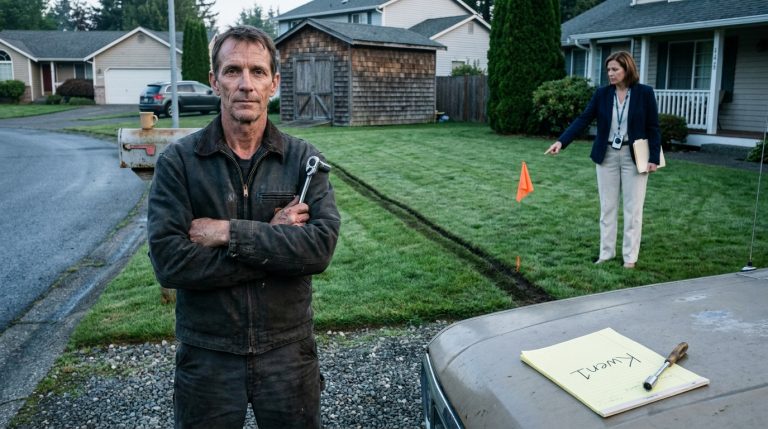
The Frontier Boundary: How One Man Took Down an Entitled Mountain HOA
CHAPTER 1: THE COUNTEROFFENSIVE
The certified letter sat on my worktable, right next to a spread of snowmobile spark plugs and a rag slick with oil.
Five thousand dollars for “unauthorized motorized vehicle operation and community disturbance.” Signed by Patricia Morrison, President of the White Fish Highlands Homeowners Association.
I didn’t curse. I picked up my heavy brass torque wrench, feeling the chill of the metal against my palm, and slowly turned it over once. Twice.
My phone speaker squawked as Dennis Chun’s voice filled the cabin. “It’s pure theater, Marcus. They have zero legal jurisdiction over your 300 acres. You didn’t sign a master deed, and old logger Bill never encumbered the parcel.”
“She thinks if she throws enough legal-sounding words at me, I’ll back off my own dirt,” I said, setting the wrench down with a dull thud on the workbench. “How do we stop her from stepping on my land?”
“We stop playing defensive,” Dennis said. His keyboard clacked in rapid rhythm. “I’m filing a formal notice of criminal trespass and intent to sue for civil harassment with the flathead county clerk today. But if you want to crush this, we need to pull every public document on White Fish Highlands.”
“What are we looking for?”
“Where their jurisdiction actually ends—and where their money is actually going.”
I looked out the workshop window toward the timberline, where fresh snow dusted the pine branches along my eastern trail. Patricia was operating on pure audacity, used to bending suburban retirees to her will with threat of fines and stern notices.
She had brought city entitlement into the Montana woods, assuming a guy in greasy work boots wouldn’t know how to read a county plat map.
“Send me the county registry portal link,” I said, wiping my thumbs on a rag. “I spent fifteen years analyzing software data structures in Seattle. Let’s see how well her paper trail holds up.”
“I’ll email the parcel files now,” Dennis said. “Don’t engage her if she comes back on the snowmobile. Let the paper do the biting.”
I hung up, pulled my laptop onto the grease-stained counter, and opened the county public records database.
CHAPTER 2: THE PAPERWORK TRAIL
The land registry interface loaded line by line, mapping out the township grid with cold, unemotional precision.
I zoomed into Section 14, where my 300 acres lay outlined in thick black boundary markers. Next to it sat the White Fish Highlands subdivision—a neatly carved grid of fifty two-acre lots, isolated entirely to the eastern valley floor.
I clicked the tax parcel overlay.
The HOA’s master deed covered exactly forty-eight acres of residential zoning and two dedicated access roads. Not a single square foot of my forest, my ridge, or my trail system touched their legal boundary.
Yet when I pulled up the public filings for the White Fish Highlands Association, Article 4 listed a “Special Assessment Fee” levied on all fifty homeowners: $1,200 annually per household for “Regional Forest and Snowmobile Trail Network Management.”
Sixty thousand dollars a year collected from retirees for maintaining trails they didn’t own.
My cell phone buzzed against the laminate counter. I tapped the speaker button without looking up from the parcel maps. “I’m looking at their 990 tax forms right now, Dennis.”
“What did you find?” Dennis asked.
“Patricia’s board collects sixty grand every January to maintain my trails,” I said, tracing the cursor along my western boundary line. “Old logger Bill never charged them a dime. He just let people ride. They’ve been accounting for my dirt as an association asset for over a decade.”
“That’s not just overreach, Marcus,” Dennis said, his tone sharpening. “If she’s collecting association funds to maintain private land without an easement, she’s misrepresenting corporate assets to her own homeowners. It’s a breach of fiduciary duty.”
“It gets worse.” I opened the land assessment ledger from three years ago. “There’s a line item for ‘Trail Infrastructure Infrastructure Upgrades’—twenty-five thousand dollars paid out to a local LLC called Peak Boundary Services.”
I ran the business entity search through the Montana Secretary of State database.
The registered agent for Peak Boundary Services was Patricia Morrison.
I set my hands flat on the desk, the cool surface grounding the hard spike of anger in my chest. She wasn’t just an entitled neighbor with a clipboard and expensive sunglasses. She was using my property to justify a private slush fund, and my arrival with a clear title had just put a massive hole in her accounting.
“Dennis, pull the county road commission files for my western line,” I said, my voice dropping into a quiet, deliberate rhythm. “I want to know who owns the access gate where my trail meets the municipal forest.”
“Checking now,” Dennis replied, keying through the system. “Why? What’s at the western line?”
“I’m going to take a ride out there before dark,” I said, looking out the window as the first evening shadows stretched across the snow. “If she’s collecting money for trail maintenance, I want to see what she actually built on my land.”
I closed the laptop, grabbed my heavy coat, and picked up the brass wrench from the counter, slipping it into my deep coat pocket out of pure habit before heading out to the snowmobile.
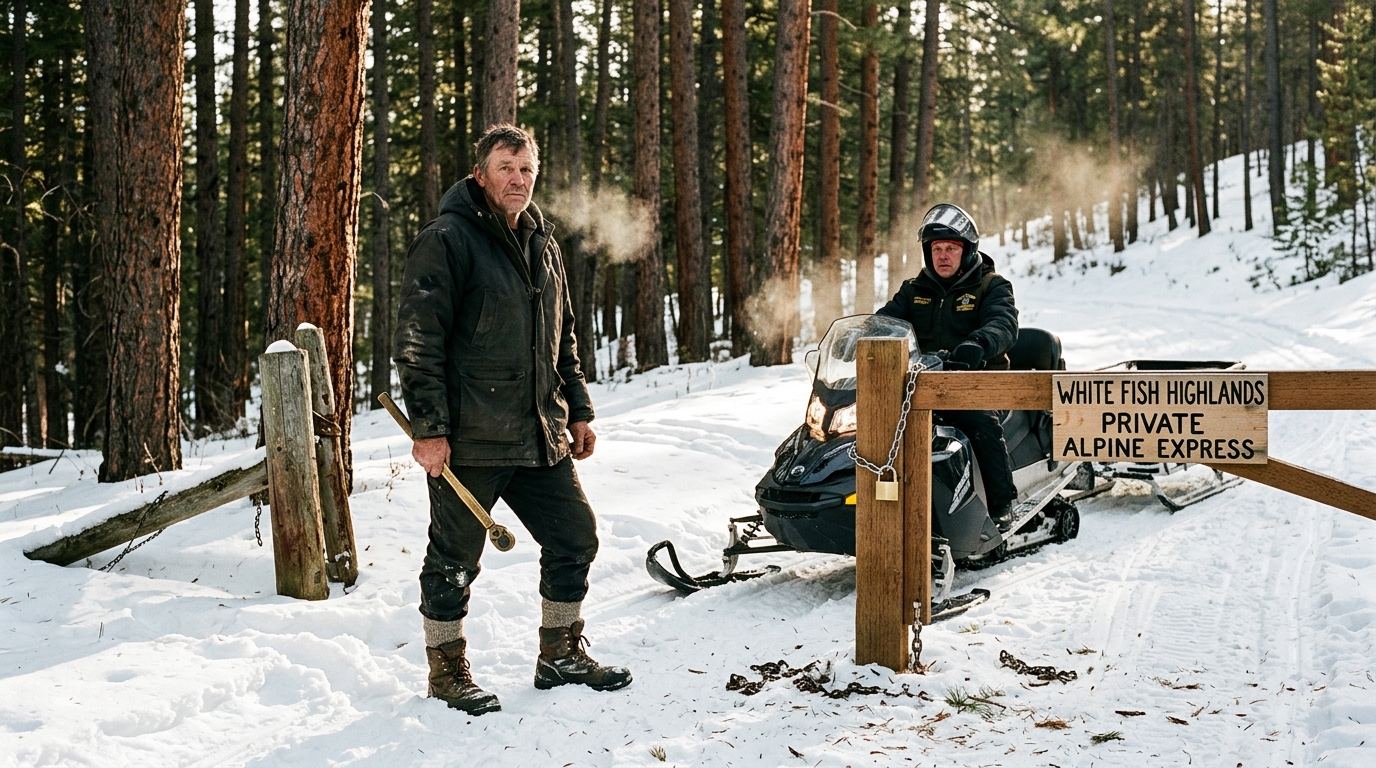
CHAPTER 3: THE WESTERN ACCESS GATE
The steel bar didn’t budge under my weight.
Someone had secured the ancient logging barrier with a heavy chain, and locked into that chain was a brand-new, polished brass padlock. It stood out like a sore thumb against the rusted iron and weathered pine posts.
I reached out and touched the casing. The tumblers were clean, completely free of the road salt and grime that coated every other piece of metal in this county.
I pulled the heavy brass torque wrench from my coat pocket and tapped the metal body of the lock. A dull chime echoed out into the quiet forest.
Footprints led from the access gate straight onto my trail network. Deep, wide tracks carved by heavy, high-horsepower machines—not cross-country skis, and certainly not standard trail sleds. These were commercial utility rigs, carrying heavy loads.
A laminated sign was stapled directly into the trunk of a ponderosa pine on my side of the fence line:
WHITE FISH HIGHLANDS PRIVATE ALPINE EXPRESS. PERMITTED VEHICLES ONLY. VIOLATORS FINED $500.
I stared at the sign for a long beat.
Patricia hadn’t just banned me from using my own land to protect her quiet neighborhood atmosphere. She had leased access to my forest to outside commercial tour operators, turning my private trails into an unpermitted backcountry enterprise.
The sound of a two-stroke engine droned in the distance, growing louder from the direction of the municipal road.
I didn’t move from the gate. I stood in knee-deep powder, letting the torque wrench hang low in my right hand as a dark blue snowmobile hauling a passenger sled rounded the bend.
The driver wore a commercial guide vest over his heavy parka. He pulled up to the gate, idling the engine, and stared at me through a dark helmet visor.
“Gate’s restricted,” he called out over the rumble of the exhaust. “HOA business only.”
“This gate sits on Section 14,” I said, my voice cutting cleanly through the cold air. “Who gave you the key?”
The driver flipped up his visor, revealing a tired, middle-aged guy with red-rimmed eyes. “White Fish Highlands Association. We run evening tours through the upper ridge. Look, pal, I just drive the route.”
“Patricia Morrison?”
“Yeah, Mrs. Morrison,” he said, taking a tight breath that fogged in the air. “She handles the land permits. Now if you don’t mind step—”
“I own Section 14,” I said. “All three hundred acres. And there is no land permit.”
The driver went motionless. His gaze dropped from my face down to the heavy brass wrench resting against my thigh, then back up to the steel chain holding his route shut.
CHAPTER 4: FORMAL CONFRONTATION
I pulled open the double doors and walked into the warmth of the hall.
Thirty homeowners sat in padded folding chairs, facing a raised wooden table where Patricia Morrison presided behind a microphone. She wore a tailored cream sweater, her hands neatly folded over a stack of agenda sheets.
“—and we expect the snow grooming costs to align with our seasonal projections,” Patricia was saying into the mic, her voice smooth and practiced.
The heavy wooden doors clicked shut behind me. Heads turned along the back rows.
Patricia didn’t pause her sentence, but her gaze locked onto my work coat and muddy boots. Her sharp blue eyes narrowed behind gold-rimmed reading glasses, her jaw tightening just enough to pull the muscles in her neck taut.
I walked down the center aisle, the rubber soles of my boots squeaking softly against the polished floorboards.
“Mr. Anakis,” Patricia said, tapping her pen against the microphone, creating a low electronic pop that bounced off the rafters. “This is a closed meeting for homeowners in good standing. You are not a member of this association.”
“I know,” I said, stopping five feet from her table. I laid the Manila folder flat on the linen tablecloth right in front of her water glass. “That’s why we need to talk about Section 14.”
A murmur rippled through the front row of retirees. An older man in a flannel shirt leaned forward, squinting at the folder.
“Security will escort you off the premises if you disrupt our proceedings,” Patricia said, keeping her tone measured, though a faint twitch caught the corner of her left eyelid. “You’ve already received our notice regarding illegal snowmobile usage.”
“You mean the five-thousand-dollar fine?” I asked, my voice carrying easily across the silent room. “The one issued by an association that owns zero acres of the land my trails sit on?”
“Article Seven gives this board stewardship over all regional community corridors—”
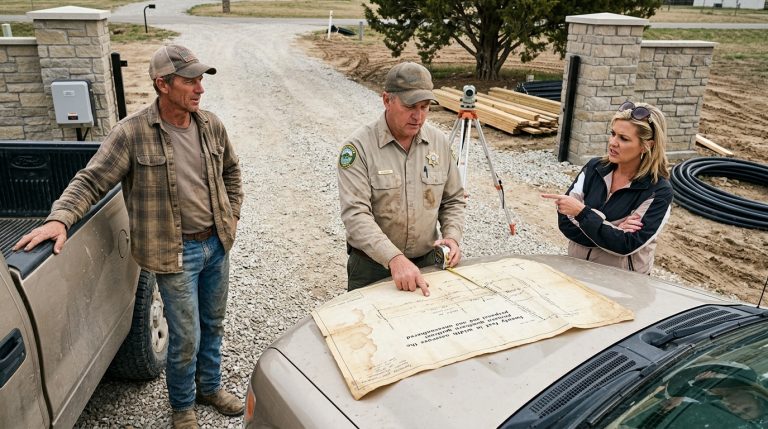
“Article Seven applies to forty-eight acres of residential lots down in the valley floor,” I cut in, flipping the folder open with one finger. I slid a blue-lined county plat map across the table. “Here is the Flathead County land registry deed. My three hundred acres are unencumbered. No easements. No HOA covenants.”
Patricia didn’t look down at the paper. She kept her chin high, staring directly through me. “Decades of public trail use establish prescriptive access rights, Mr. Anakis. Our legal counsel—”
“Your legal counsel didn’t file an easement because they know it’s private dirt,” I said. I pulled out a second sheet—a printout from the Secretary of State’s corporate registry—and laid it over the map. “And I don’t think your homeowners know about Peak Boundary Services LLC.”
The room went dead silent.
The older man in the flannel shirt stood up slightly from his chair. “What’s Peak Boundary?”
Patricia’s fingers clenched around her pen so hard the plastic creaked. “This is entirely out of order—”
“Peak Boundary Services is the entity receiving twenty-five thousand dollars a year from your HOA dues for trail upkeep,” I said, turning to face the crowd of thirty neighbors. “And the registered owner of that LLC is sitting right behind that microphone.”
A sharp gasp went around the room. Patricia slammed her palm flat against the table, the microphone shuddering in its stand.
“This meeting is adjourned!” she barked, her voice cracking off its polished shell for the first time. “Clear the room immediately!”
Nobody moved. Every pair of eyes in that hall shifted from the paper on the table straight to her flushed face.
I closed my folder, tucking it back under my arm. “My western boundary gate gets locked tomorrow morning. My key. My rules.”
CHAPTER 5: THE PAPER TRAP
PRIVATE PROPERTY. NO TRESPASSING. ALL COMMERCIAL PERMITS REVOKED BY LEGAL OWNER.
I backed up two steps in the knee-deep powder, letting the impact driver hang by my side as the exhaust of my snowmobile idled nearby.
Along the five-mile perimeter, I had spent the morning installing heavy-duty steel gates, heavy logging chains, and high-visibility property markers every fifty yards.
To top it off, I set up motion-activated trail cameras linked directly to my satellite internet, angled straight at the gate latches.
A crunch of boots in the snow sounded behind me.
I turned slowly. Dennis Chun stepped out from the passenger side of his four-wheel-drive pickup, wrapping his heavy scarf tighter against the biting wind. He held a signed court document tucked inside a plastic sleeve.
“The Flathead County Sheriff’s office just served the formal cease-and-desist on Patricia,” Dennis said, his breath pluming white. “Along with a notice of intent to seek damages for unpermitted commercial trespass.”
“How did she take it?” I asked, setting the impact driver on the snowmobile rack.
“She tried to claim to the deputy that Section 14 falls under a municipal prescriptive easement,” Dennis said, shaking his head with a dry chuckle. “Deputy Kowalski didn’t buy it. She reminded Patricia that without a recorded court order establishing a prescriptive right, driving commercial sleds onto your land is plain old criminal trespass.”
“She won’t stop with a warning,” I said. “Not when twenty-five grand of tour money is tied to this route.”
“That’s why I brought this,” Dennis said, handing me the plastic sleeve. “It’s an emergency temporary restraining order application. The moment she or any of her commercial operators cut one of these chains, we file it instantly with Judge Vance. A judge in this county does not appreciate suburban board presidents treating private acreage like their personal golf course.”
I took the paper, feeling the crispness of the seal through the plastic.
In the forest around us, the silence was absolute—no engines, no tour sleds, no uninvited skiers shouting about HOA rules. Just 300 acres of quiet woods under my sole control.
My phone chimed in my inner pocket. A motion alert from Trail Camera Three at the main access point.
I pulled out the screen. The image showed Patricia standing right at the newly installed gate, wearing her designer jacket, staring directly into the camera lens with her jaw clenched so tight the line of her throat looked carved from stone.
She didn’t try to cut the chain. She didn’t touch the lock. She just held up her phone, took a photo of my warning sign, and walked back to her snowmobile.
“She’s backing into a corner,” I said, showing the screen to Dennis.
“Good,” Dennis said, squinting at the image. “Cornered people make sloppy mistakes. And sloppy mistakes end up on court dockets.”
CHAPTER 6: DESPERATE RETALIATION
Dennis leaned back in his leather chair, holding the warm sheets up to the light.
“They’re asking District Court for an ex parte temporary restraining order,” Dennis said, tracing his thumb down the legal pleading. “They’re claiming your gates constitute a public nuisance and an immediate threat to emergency winter response access.”
I pulled my brass torque wrench out of my coat pocket, resting it upright on Dennis’s desk like a heavy metal paperweight. “Emergency winter response access? My trails lead straight into a mountain box canyon.”
“It doesn’t matter if it’s true, Marcus,” Dennis said, turning to page six. “It matters that Patricia lied under oath in an affidavit. She swore to the judge that the HOA holds an implied public easement maintained continuously at community expense for twenty years.”
“She swore to that?”
“Signed and notarized yesterday afternoon,” Dennis confirmed, tapping the signature line. “She’s trying to force a judge to sign an emergency order opening your gates before we can file our formal response.”
I reached across the desk, pulled the affidavit toward me, and scanned the text. Patricia’s signature sat right at the bottom in neat blue ink.
“She just walked straight into a trap,” I said, setting my hands flat on the desk. “If she swore under penalty of perjury that the HOA spent community funds maintaining my trails for twenty years, where are the receipts?”
“In her Peak Boundary Services bank accounts,” Dennis said, a slow, cold smile spreading across his face. “Which we now have full legal standing to subpoena.”
The office door rattled as Deputy Sarah Kowalski stepped inside, shaking snow off her wide-brimmed hat. She held a clipboard under her arm, her boots leaving damp tracks on the rug.
“Mr. Anakis,” Deputy Kowalski said, nodding curtly. “Patricia Morrison just called dispatch. She reported that you’re currently obstructing a county emergency road with steel gates.”
“It’s a private logging path on Section 14, Deputy,” I said, pointing to the plat maps spread across the desk. “Dennis was just reviewing her sworn affidavit.”
Deputy Kowalski walked over, set her clipboard down, and glanced at the court filing. “I drove out to your western line twenty minutes ago to check the call. Your gates are five hundred yards inside your marked boundary. No county roads anywhere near them.”
She turned to Dennis. “I’m filing an official incident report stating the call was a false report to law enforcement. If she tries using the sheriff’s office as her personal enforcement arm again, I’m citing her.”
Dennis picked up his pen and began drafting a counter-motion. “We’re filing a notice of fraud upon the court in two hours. Once Judge Vance sees Kowalski’s report alongside the county plat maps, Patricia’s injunction isn’t just going to get denied—she’s going to get summoned for a show-cause hearing.”
I picked up the heavy brass wrench from the desk, feeling the cold weight settle into my palm.
“She wanted to use the legal system to bully me off my land,” I said, looking out the frosted window toward the courthouse down the street. “Let’s see how she handles it when the system turns around and bites back.”
CHAPTER 7: THE FINANCIAL UNRAVELING
“Counselor,” Judge Vance said, his gravelly voice cutting through the quiet courtroom as he addressed Patricia’s attorney. “Explain to me how your client’s association spent sixty thousand dollars of homeowner dues on trail grooming for Section 14 when the county record clearly shows Section 14 is private property.”
Patricia sat three feet away at the defense table, her hands clenched so tightly in her lap that her knuckles showed pale through her skin. Her attorney cleared his throat, adjusting his tie.
“Your Honor, the association acted under the long-standing belief that a prescriptive easement existed—”
“A belief?” Judge Vance cut in, slamming the folder flat against his bench. “Mrs. Morrison signed a sworn affidavit in this court forty-eight hours ago stating under penalty of perjury that public maintenance funds were disbursed to Peak Boundary Services LLC for contracted trail maintenance.”
Dennis Chun stood up beside me, tapping a set of certified bank records against his palm. “We have the subpoenaed financial records for Peak Boundary Services, Your Honor. Over three years, one hundred and eighty thousand dollars was transferred from the White Fish Highlands HOA bank account into Peak Boundary’s account. Zero dollars were spent on trail equipment or labor.”
A quiet hum of voices broke out from the spectator gallery behind us. Several White Fish Highlands homeowners who had showed up to watch the hearing leaned together, whispering heatedly.
“Mr. Chun,” Judge Vance said, leaning forward. “Where did those funds go?”
“Directly to personal credit card payments, luxury travel, and lease payments on a high-end snowmobile registered personally to Mrs. Morrison,” Dennis said, placing the certified ledger on the clerk’s desk.
Patricia’s face drained of color. She stood up abruptly, her chair legs screeching against the polished floorboards. “That money was compensation for administrative oversight! The board approved those payments!”
“The board consisted of you, your husband, and a vacant seat, Mrs. Morrison,” Dennis said quietly, turning to face her. “You never disclosed your ownership of Peak Boundary to the homeowners.”
“Sit down, Mrs. Morrison,” Judge Vance ordered, his voice stern as thunder. “You are in a court of law, not a board meeting.”
Patricia dropped back into her chair, her shoulder trembling as she looked toward the gallery. The very neighbors she had bullied with threat of fines were staring back at her with open coldness.
“The temporary restraining order against Mr. Anakis is denied with prejudice,” Judge Vance ruled, signing the order with a sharp strike of his pen. “Furthermore, this court is referring these financial records to the Flathead County Prosecutor for formal review of grand larceny and perjury.”
I looked at Patricia. The unearned authority she had worn like armor for weeks was completely shattered, leaving behind nothing but the stark, ugly reality of her own actions.
CHAPTER 8: ABSOLUTE BOUNDARY
The workshop door stood propped open to the crisp afternoon air. Outside, the pine trees held heavy blankets of fresh snow, silent and undisturbed across the ridge.
I set the brass torque wrench down on the clean rag covering my workbench.
My phone rang once on the counter. I picked it up and pressed speaker.
“It’s done, Marcus,” Dennis Chun said, his tone relaxed and light. “The county prosecutor formally filed indictments this morning. Grand larceny and perjury charges against Patricia Morrison. She turned herself in with her attorney an hour ago.”
“And the association?” I asked, wiping grease from my knuckles.
“The homeowners held an emergency recall vote last night,” Dennis said. “Disbanded the entire board, canceled all invalid bylaws, and elected a new representative who called me personally to apologize. They’re issuing a formal retraction of that five-thousand-dollar fine.”
“They don’t owe me an apology,” I said, looking out the open door toward the timberline. “They just need to keep their sleds on their own forty-eight acres.”
“They know,” Dennis chuckled. “Nobody’s crossing Section 14 again. You’ve got your three hundred acres back, fully locked and clear.”
“Thanks for the work, Dennis.”
“Enjoy the quiet, Marcus.”
I hung up and set the phone back on the shelf.
Across the yard, the steel gates sat solidly at the edge of the forest trail, their high-visibility boundary markers standing clear against the white snow. The illegal locks were gone, replaced by my own steel padlocks, and the forest had returned to the peaceful sanctuary I’d bought three months ago.
I picked up a mug of black coffee, stepping out into the snow-covered driveway. The mountain air was sharp, free of exhaust fumes or shouting board presidents.
I took a slow sip, feeling the warmth spread through my chest as I looked out over three hundred acres of quiet, unbroken woods.
My land. My rules.