The Frozen Grave: A Mother’s Reckoning and the Unmaking of a Forty-Year Lie
CHAPTER 1: THE HAUNTED AISLE
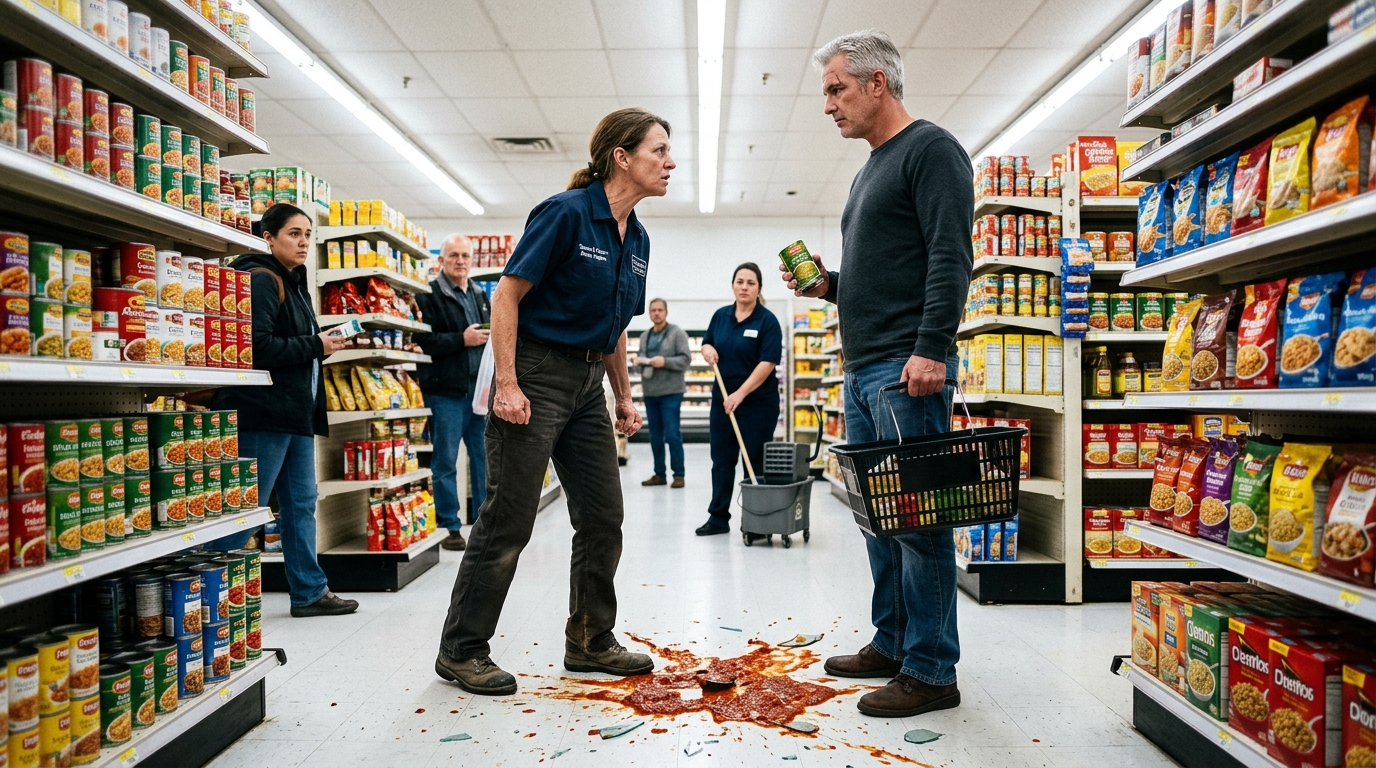
The glass jar hit the white linoleum with a heavy, wet pop. Red sauce spread across the tile like paint, splashing the hem of my trousers, but my fingers stayed locked in the empty space where the jar had just been.
Three feet away, a man with silver hair that refused to lie flat was turning a tin of split pea soup over in his palms. He didn’t look up at the noise. He just cleared his throat—a dry, double-beat cough that had drifted through the floorboards of our hallway every winter morning for forty-one years.
“Thomas,” I said. The word was thick, dry, scraping against my throat like gravel.
The man stopped rotating the tin. His broad shoulders gave a small, distinct hitch, the left side rising slightly higher than the right because of the old injury from the roof ladder. He turned slowly, his face coming into the harsh glare of the grocery store fluorescent tubes. The scar across his right eyebrow was white, jagged, and exactly where it had been since the summer of 1985.
“Thomas, it’s me,” I said, stepping over the red puddle. My knees felt hollow, the joints clicking against each other as I moved. “It’s Eleanor.”
The man looked at my face, then down at my shoes, then back to my eyes. His expression was flat, smooth, like a freshly sanded piece of pine. There wasn’t a twitch in his jaw. There wasn’t a flash of blood beneath his skin.
“I’m sorry, ma’am,” he said. His voice was a low, gravelly baritone, the exact weight that used to fill the empty seat in my kitchen. “You’ve got me mistaken for someone else. My name is Daniel. Daniel Brooks.”
“Don’t do this,” I whispered, reaching out. My hand hovered an inch from his gray flannel sleeve. “The crooked pinky on your left hand. The mole by your collarbone. I know the man I lived with.”
He pulled his arm back, his basket swinging between us like a barrier. “You need to calm down, lady. I don’t know you. You’re obviously going through something hard, but I’ve got to get home.”
He didn’t run. He walked toward the front registers with a measured, heavy stride, his boots thudding against the linoleum in a rhythm I could have picked out of a crowd of ten thousand. I stood by the broken glass, my chest tightening until the air in the store tasted like tin.
An employee with a mop was already moving toward the mess, murmuring something about an accident, but I didn’t look at him. I followed the gray flannel shirt through the exit doors, out into the blinding glare of the afternoon sun, my fingers digging into the leather of my purse until the stitches began to give way.
CHAPTER 2: MIDNIGHT CONSPIRACIES
The engine cut out, leaving a heavy, ringing silence in the driveway. Forty minutes had dragged by like shards of glass scraping through a gears-box, every tick of the wall clock a small hammer against my temples. I didn’t move to open the deadbolt. Lucas had his own key, a brass one he’d kept since he was seventeen, and when the latch clicked open, he didn’t knock. He just shoved the wood aside with his shoulder, breathing hard, his flannel jacket smelling of stale truck tobacco and damp earth.
He found me exactly where I had been sitting, surrounded by forty-one years of gloss-finish memories spread out under the low glare of the yellow table lamp.
“Mom,” Lucas said. He didn’t take off his boots. He stepped onto the linoleum, his jaw tight, his eyes instantly darting down to the grid of photographs. “What are you doing to yourself? It’s almost four in the morning.”
I didn’t answer with words. I took my phone from the edge of the wood, unlocked the screen, and slid the smooth glass across the table until it knocked against his thumb. The screen showed the pale green house. It showed the man with the lopsided laugh balancing the brown paper grocery bags while two small children hung from his waist.
Lucas didn’t pick the phone up. He just looked down at it, his face catching the overhead light, and for three seconds, the color drained from his skin until he looked as gray as the limestone at the cemetery. His throat moved in a hard, visible swallow.
“He looks like Dad,” Lucas muttered, his voice dropping into a flat, defensive register. He rubbed the back of his neck, his knuckles cracking loudly in the small kitchen. “People look like people, Mom. It happens. You’re seeing things because you haven’t been sleeping.”
“Look at the left hand, Lucas.” My voice was too quiet, even to me. It carried the cold weight of a cellar floor. “Look at the pinky finger. The one he snapped fixing your grandmother’s roof. Look at the way he presses the bills flat with his thumb before he puts them in his pocket.”
Lucas stepped back, his boot heel squeaking on the tile. He wouldn’t look at my eyes. He looked at the old photo album from our beach trip five years ago, where Thomas had the exact same mole near his collarbone.
“Mom, we buried him,” Lucas said, his words coming faster now, defensive, the tone an adult uses when they think a toddler is throwing a tantrum. “You were sitting right next to me at the service. The casket was closed because the state troopers said the impact—”
“Did you see the body, Lucas?”
The question cut through his sentence like a butcher’s knife through tallow. He stopped, his mouth half-open, his fingers twitching against the seam of his jeans.
“They told us it was better this way,” he whispered.
“I asked you a question.” I stood up, my palms flat against the Formica table, leaning forward until the heat of the lamp was right between us. “Did you look inside that box?”
Lucas turned his face toward the dark living room, his shoulders dropping two inches as if the roof had just settled onto his back. “Dad didn’t die in that car, Mom.”
The confession didn’t bounce off the walls. It just sank into the floorboards, heavy and toxic.
“He had another family,” Lucas said to the dark corner of the room, the words spilling out in a hurried, desperate scramble. “Over twenty years down in the county line. A woman named Claudia. He begged me not to tell you when I found out three years ago at the office. He said if you found out, you’d take the marina supply business, the accounts, everything he spent his life building.”
“Everything we built,” I corrected. My hand slipped into my pocket, my fingers brushing against the stiff, cold edges of Thomas’s old leather wallet.
“He wanted out, Mom,” Lucas snapped, his voice suddenly sharpening with an ugly, defensive edge as he turned back to face me. “He said it was easier this way. If he faked it, the business assets and the accounts passed straight to me automatically. I was supposed to handle it. I was going to give you an allowance every month, make sure the house bills were paid so you didn’t have to worry about a thing.”
An allowance. Like a child who couldn’t be trusted with the grocery money.
“And the stranger in the ground?” I asked.
“A guy from the shelters,” Lucas muttered, his eyes dropping back to the linoleum. “Terminal. No family but a niece who wanted the payout. Dad used his own truck, his own ID. They staged the fire by the ravine. It was clean. It was supposed to be over.”
I looked at my son—the boy I had stayed up with through scarlet fever, the man whose college tuition had been paid out of the very business he had carved up like a carcass behind my back.
“Get your keys,” I said, my voice dropping back into that flat, quiet absolute.
“Mom, please—”
“Get your keys, Lucas. We’re going to that house. I want you to look at him while I’m standing next to you.”
CHAPTER 3: THE COLD TRACKER
The heater in Lucas’s truck rumbled with a dry, dusty rattle, doing nothing to cut the chill settling deep into my bones. Outside, the sky was changing from coal-black to a pale, bruised blue. Lucas kept his hands high on the steering wheel, his thumbs tapping against the worn plastic in a frantic, uneven rhythm that betrayed his absolute terror.
“We shouldn’t be here, Mom,” he muttered, his breath fogging the corner of the glass. “If he sees us—if she looks out that window—it messes everything up.”
“Shut the engine off, Lucas.”
I didn’t turn my head to look at him. My eyes were fixed on the pale green house across the street. The windchimes near their porch shifted in the dawn draft, casting tiny, erratic shadows against the siding. A simple, ordinary life was waking up behind those windows, paid for with forty-one years of my silence.
The truck engine sputtered and died. I reached into my coat pocket, my fingers tracking the stiff, cracked edges of Thomas’s old leather wallet. Inside it was a duplicate set of keys to the marina supply warehouse, found deep within a velvet cufflinks box he thought I’d never open. The brass edges bit into my palm, a solid, cold piece of reality.
“He leaves at exactly 6:45,” I said, breaking the silence. “He doesn’t use the highway. He takes the back roads because he likes the drive.”
Lucas let out a ragged breath, his forehead dropping against the cold rim of the wheel. “You’ve been tracking him. For how long?”
“Long enough to know you’ve been calling him every Tuesday night after nine.”
My son stiffened, his tapping fingers freezing instantly against the plastic. He didn’t deny it. He couldn’t. I had spent the last three days meticulously printing the digital log summaries from our shared family plan, highlighting the duplicate numbers that suddenly came alive the week after we stood by a closed casket.
“I was trying to keep it stable,” Lucas whispered, his voice cracking slightly as he finally looked at me. “He was going to transfer the last warehouse deed over next month. If you blow this up now, the state takes everything. The fraud charges alone will wipe out the accounts.”
“The accounts he stole from me.”
A low movement across the street cut our conversation short. The front door of the green house swung inward. The man stepped out onto the porch, buttoning a thick brown work jacket, his silver hair catching the first true ray of morning light. He looked entirely at peace, checking the sky for rain before turning back to catch the travel mug his new woman handed through the doorway.
Lucas reached for the ignition key, his forearm trembling under the fabric of his jacket. “Mom, he’s coming toward the car. We have to go.”
“Stay exactly where you are,” I said, my voice hardening.
Thomas walked to the white sedan parked at the curb, his boots thudding against the asphalt with that same slight, left-side hitch I had known for decades. He didn’t look left or right. He adjusted his side mirror, backed out smoothly, and drove right past our truck. Through the glass, I saw his jaw set in a relaxed hum.
He didn’t notice us. He didn’t notice the son who helped bury his ghost, or the wife who was currently calculating the exact weight of his downfall.
“Drive me downtown, Lucas,” I said, watching the white sedan disappear around the corner. “We have an appointment with a private investigator who knows exactly how to read a double ledger.”
CHAPTER 4: THE LOCKED DESK
The warehouse smelled exactly as it had for forty years—a suffocating mixture of grease, raw fiberglass resin, and stale river water. Dust motes danced in the long shafts of light cutting through the high corrugated plastic panels overhead. Lucas stayed two steps behind me, his work boots dragging against the concrete, his hands buried deep in his pockets to hide the visible trembling.
“Mom, we shouldn’t be doing this,” he muttered, his voice echoing thinly against the rows of metal racking stacked with brass props and outboard parts. “If the office manager comes back from lunch early—”
“She won’t,” I said, without looking back. My thumb rubbed the cold brass edge of the old emergency key. “She takes her lunch at the diner down the road until exactly one. Your father established that routine twenty years ago. I see you kept it.”
We reached the small paneled office at the back of the bay. The frosted glass door was dark, the gold lettering reading T. & L. Brooks Supply looking scratched and weathered. My hand didn’t shake as I inserted the key. The cylinder was stiff, resisting for a second before giving way with a dry, mechanical snap that sounded like a small bone breaking.
Inside, the desk was cluttered with duplicate bills and shipping manifests. Lucas stepped toward the metal filing cabinet in the corner, his mouth opening to speak, but I stopped him with a single raised hand. I didn’t care about the filing cabinets; those were the records meant for the accountant.
I sat down in the swivel chair that used to belong to my husband. The green vinyl was split across the seat, patched with black duct tape that caught the heat of my thigh. I pulled the small digital recorder from my purse, placing it squarely on the blotter between us, right next to the printed mobile phone logs.
“Sit down, Lucas,” I said, tapping the black plastic recorder. “We’re going to discuss the signature on the bank transfer from last October. The one where three hundred thousand dollars left the business account two days before the accident.”
Lucas collapsed into the wooden side chair, his face slick with sweat despite the draft coming from the main bay. He looked at the recorder, his eyes wide, his breathing coming in shallow, ragged gaps.
“Dad did that himself, Mom,” he said, his voice dropping into a desperate, defensive pitch. “He had the password. He told me he was just moving his half to a secure routing number so you wouldn’t have to deal with the commercial taxes during the probate.”
“He used your terminal, Lucas. The IP address on the transfer log matches the computer six inches from your left elbow.” I leaned forward, my knuckles pressing into the wood. “You didn’t just look the other way. You clicked the button.”
The silence that followed was suffocating, broken only by the rhythmic hum of the old refrigerator in the corner. Lucas dropped his head into his hands, his fingers knotting into his hair.
“He said he was leaving anyway,” he whispered into his palms. “He said if I didn’t help him clear the cash, he’d sell the entire property to an out-of-state developer and leave us both with nothing. I had to protect the business, Mom. I did it for the family.”
“You did it for yourself.” I stood up, retrieving the recorder and dropping it back into my purse along with the documents. “That’s exactly what the district attorney needs to hear.”
CHAPTER 5: CHECKMATE ON CONCRETE
The windchimes above the porch clattered into each other, a hollow metallic noise that did nothing to mask the rhythmic thump of a spade hitting dirt in the backyard. I didn’t wait for Lucas. He stayed slumped in the passenger seat of his truck down the street, his face buried in his hands, entirely broken by the recordings currently sitting with the county prosecutor.
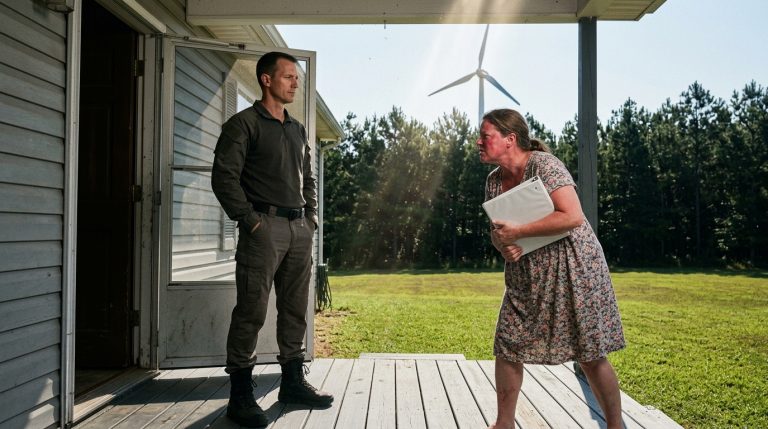
I walked down the narrow gravel driveway, my boots crunching deliberately against the small stones. The woman from before—Claudia—was sitting on a wicker bench by the back steps, a basket of wet laundry resting at her feet. She looked up, her forehead creasing with a polite, neighborly confusion.
“Can I help you?” she asked, her hand pausing on a folded white sheet.
“I’m here to see Daniel,” I said. My voice didn’t rise. It carried the exact flat, deadweight tone of a ledger being closed. “It’s about his previous business assets.”
Before she could stand, Thomas stepped out from behind the tool shed, a rusted trowel balanced in his right hand. His silver hair was damp with sweat, his sleeves rolled tight against his forearms. He stopped dead when his eyes hit my face, the muscles along his jaw locking so hard the skin turned white around his old eyebrow scar.
“Eleanor,” he whispered. The trowel slipped from his grip, thudding into the soft turf.
“You need to take these,” I said, stepping across the concrete patio to slide a heavy manila envelope onto the plastic garden table between us. “These are the frozen transaction records from the corporate routing number. The district attorney accepted the filing two hours ago.”
Thomas didn’t reach for the paper. He took a long step backward, his boots tracking black garden mud across the gray concrete, his eyes darting frantically toward the house behind me as if looking for a physical escape route.
“What did you do?” his voice cracked, the baritone losing its smooth, arrogant timber. “What did you tell them?”
“I told them the truth, Thomas. Every single word of it.” I turned slightly, looking directly at Claudia, whose fingers were now clutching her sweater so tightly her knuckles looked like ivory. “The man you’re living with isn’t Daniel Brooks. He’s Thomas Brooks. My legal husband of forty-one years. The grandfather your kids are playing with spent the last six months letting me believe he was ashes in an oak box.”
“Daniel?” Claudia’s voice was barely a squeak. She stood up, the laundry basket tipping over, spilling damp towels across the concrete. “What is she talking about? Your wife died in the hospital after the factory fire.”
“She’s lying, Claudia! She’s unhinged!” Thomas erupted, his face turning an ugly, mottled purple as he took a predatory step toward the table, his fingers curling into tight fists. “She’s been harassing me since the grocery store. I don’t know this woman. Get off my property before I call the local sheriff to have you dragged out of here!”
The audacity of his demand hit me like a cold wave, but it didn’t stir a single drop of anger. It just settled into a deep, solid clarity. He was still trying to use the social politeness of a quiet neighborhood to hide his theft.
“The sheriff is already on his way, Thomas,” I said, pointing toward the end of the driveway where the high-pitched yelp of the local cruisers finally broke over the tree line. “And they aren’t coming for me.”
CHAPTER 6: THE UNMARKED REST
The legal mechanics had moved with an icy, indifferent momentum after the squad cars left the pale green house. Thomas never stood before a jury. The midnight phone call from the county medical officer had been entirely procedural, a flat voice informing me that the inmate listed as Brooks had collapsed from a massive cardiac event at exactly 5:20 a.m. He died while his attorneys were still trying to locate a loophole in the multi-state fraud filings.
“There won’t be a viewing,” I had told the administrator before they could finish checking the boxes on the standard next-of-kin form. “Cremate him. Scatter the remnants over the water outside the county line. No marker.”
Lucas had accepted the plea arrangement three days later, his signature on the asset forfeiture documents shaking so violently the ink splattered across the notary’s desk. The court had methodically dismantled the false accounts under the name Brooks, routing the frozen funds back into the original corporate ledger where my name sat as sole remaining director. The house on the quiet street went to an estate clearing firm, its pale green paint already peeling under the damp river wind.
I walked through the iron gates of the municipal cemetery, the wet grass squeaking against the rubber soles of my boots. The morning sun was a thin, watery disk behind the gray clouds, providing no warmth to the marble headstones stretching in neat, silent rows across the hill.
I stopped at the granite marker that still bore my family name. Beneath the polished stone, an unknown person lay in a closed vault—a man whose real life had been bartered away for a handful of cash and a staged accident by a ravine.
I reached into my pocket and pulled out Thomas’s old leather wallet. The edges were worn down to the gray thread, the leather smelling faintly of old tobacco and the cedar drawer where he used to keep it. I dropped it onto the damp earth right at the base of the stone. It didn’t feel like a sacrifice. It didn’t feel like an act of anger. It was simply the final return of a piece of property that no longer had a place in my house.
“You can keep his name,” I said to the quiet grass. “The man who owned it never existed anyway.”
I turned my back on the stone and walked toward the gravel path where my car was parked. The air was clearing, the heavy fog breaking apart against the tops of the pine trees as the town woke up below.
Back in my kitchen, the yellow table lamp was turned off. I set my car keys on the counter, filled the copper kettle with fresh water from the tap, and stood by the window to watch the morning traffic move down the main road. The house was completely quiet, but for the first time in six months, the silence didn’t feel like an empty space. It felt like room to breathe.
CHAPTER 6: THE UNRAVELING AND FINAL JUDGMENT
He froze when he saw me standing on the porch. The polite smile he held for strangers vanished, replaced by a sudden, jagged tightening around his mouth.
“Eleanor,” he rasped, his eyes darting past my shoulder toward the empty street. “What are you doing here? You can’t be here.”
I didn’t step back. I handed him the heavy white envelope containing the formal county court injunctions and freeze orders.
“You should read those,” I said. “Every account opened under Daniel Brooks is frozen as of nine o’clock this morning.”
His hand shook so badly he nearly dropped his mug. He ripped the top flap open, his eyes scanning the court stamp at the top of the document. “You went to the state? Are you crazy? I did this so we wouldn’t have to destroy everything in a messy split!”
“You didn’t do it for us, Thomas,” I said, my voice steady and cold as stone. “You did it for yourself. And Lucas helped you.”
Claudia stepped into the hallway behind him, holding a laundry basket. She looked between the two of us, her eyebrows drawing together in confusion. “Daniel? Who is this woman? Why is she talking about Lucas?”
Thomas turned toward her, waving his hand in a desperate, dismissive arc. “Go inside, Claudia. It’s just a mistake with the marina business—”
“He isn’t Daniel,” I said directly to her, raising my voice over his. “His name is Thomas Vance. We were married forty-one years ago, and six months ago, he paid a dying man’s family so he could hide behind a tombstone.”
Claudia stopped dead. The laundry basket slipped from her hands, thudding onto the rug. “What?”
“Ask him about his crooked pinky,” I said. “Ask him why his son is sitting in a county holding cell right now for notarizing stolen wire transfers.”
Thomas swung back toward me, his jaw clenching, his face turning a dark, mottled red. He took an aggressive step onto the porch mat, jabbing a finger inches from my face. “You ruined our son’s life over a grudge! He was just protecting his inheritance! You greedy, crazy old—”
The distant wail of a siren cut him off mid-sentence.
Two white-and-blue patrol cars turned onto Willow Street, their light bars flashing silently against the trees as they pulled up behind my sedan. Two uniformed officers stepped out onto the curb, accompanied by a plainclothes detective holding a leather warrant folder.
Thomas’s mouth stayed open, but no words came out. The rage in his eyes collapsed into sheer, panicked disbelief as the detective walked up the porch steps.
“Thomas Vance, also known as Daniel Brooks?” the detective asked, checking the photograph pinned to the warrant.
Thomas took a involuntary step backward toward the threshold, his heel catching on the doorframe. “There’s been a mistake—I’m a business owner, my lawyer—”
“Turn around and put your hands behind your back,” the officer instructed plainly.
Claudia backed away into the foyer, covering her mouth with both hands as the handcuffs clicked shut around Thomas’s wrists. He didn’t look at her. He looked back at me as they turned him toward the steps, his face pale, his knees buckled under his own weight.
“Eleanor, please!” he shouted, his voice cracking as they led him down the walkway. “Forty-one years! You can’t just leave it like this!”
“Forty-one years ended six months ago,” I said to his back. “When you put a stranger in your grave.”
I watched the patrol car door slam shut. I didn’t cheer, and I didn’t cry. I simply walked down the porch steps, sat in my car, and waited until the sirens faded entirely into the city noise.
Two weeks later, the sun streamed bright and clear through my kitchen window.
The photo albums were closed and neatly stacked on the bookshelf where they belonged. The duplicate keys were gone, surrendered to the court trustee who was liquidating the warehouse assets to restore my frozen accounts. Lucas had taken his plea deal, and for the first time in three years, the lies in our family had been cleared out like old cobwebs.
I stood at the stove, pouring boiling water into a single white ceramic mug. The house was quiet, but it was no longer heavy.
I set the kettle down, picked up my tea, and walked out onto the back porch. I sat in the sun, took a quiet sip, and looked out over my garden, completely in control of my own life once again.