The Quiet Daughter’s Ledger: How an Overlooked Artist Rewrote Her Family’s Corrupt Legacy
CHAPTER 1: COLD TEA AND CARDBOARD
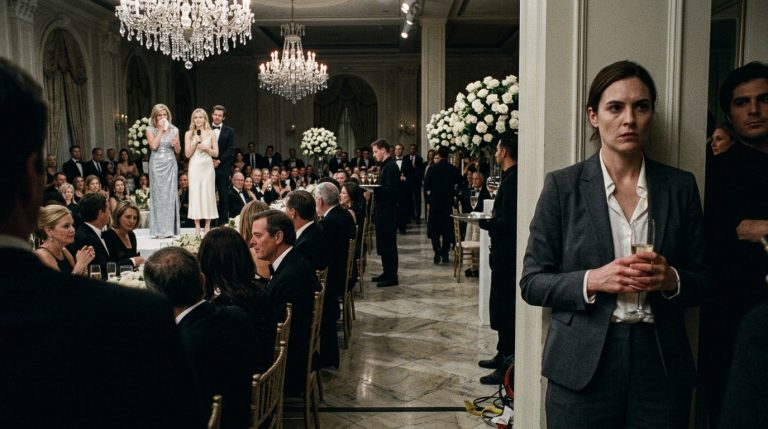
The gold foil on the invitation didn’t make the cold tea taste any better, but the folding chair beneath me was the real insult.
Every other seat at the three-quarter-ton oak table was padded in deep, green velvet. Mine was gray aluminum, cold enough to bite through the wool of my trousers. At the head of the table, Mis swirled a glass of yellow wine, her diamonds catching the low glare of the chandelier.
—Anelise still paints, bless her heart, Mis said, her voice dropping into that performative rhythm she used for charity luncheons. She brought some pieces along. I think you should all see the little things she makes on cardboard.
The laughter around the table was soft, rehearsed, and perfectly timed. Isolda reached into her leather handbag, her pearls clinking against the mahogany as she pulled out a creased flyer. It was the announcement from the warehouse walk five years ago, the ink faded, the paper cheap.
—Look at this, Isolda murmured, passing it down toward my cousins. That sketch of a woman on an Amazon box. We called it the cardboard Madonna.
I didn’t blink. My thumb pressed against the heavy, unpolished silver pocket watch in my pocket, feeling the cold, deeply scratched monogram of my father’s initials. I didn’t reach for the wine. I didn’t offer the polite, self-deprecating chuckle they were waiting for to clear the air.
My fourteen-year-old niece, Laya, looked up from her phone, her brow furrowing as she squinted at the seating chart.
—Why does your invitation say hobbyist, Aunt Anelise? Everyone else has a partner or a title.
—Because roles are decided before we sit down, Laya, I said.
Devon Lang, sitting to Isolda’s right, shifted a stack of heavy linen documents, his eyes darting toward the molding on the ceiling. He hadn’t looked at my face once since the salads were cleared.
Mis slid a thin, white envelope across the polished wood. It slid past the silver salt cellars, stopping an inch from my lukewarm cup.
—Mom thought you should have the official copy tonight, Mis said, leaning forward so the scent of her expensive rose perfume crossed the gap between us. Art isn’t exactly an asset, Anelise. You understand.
I flipped the flap with one finger. The text inside was clean serif, bolded and underlined near the bottom: Non-financial beneficiary. Anelise Drew may receive personal memorabilia as agreed upon. No land. No equity. No share of the timber leases in Lane County. Just the right to ask permission before taking my own old brushes out of the attic.
I slid the paper back into the envelope. The room had already moved on to discussing the winter layout for the foundation’s garden, the forks scraping against the china with uniform precision. They thought the silence was an acceptance of the perimeter they’d drawn around me.
They didn’t know I was simply counting the seats.
CHAPTER 2: THE INK ON THE BLOTTER
The iron latch of the study door cooled against the palm of my right hand as I slipped inside, leaving the dining room’s rehearsed laughter behind the heavy oak paneling.
The air in my father’s old sanctuary smelled of aged sheepskin and lemon wax, a stagnant vault untouched by the high-society circus currently taking place down the hall. I moved without a sound across the faded Persian rug, my eyes adjusting to the dim amber spill from the single desk lamp left burning.
This room had always been off-limits during family functions, a rule Isolda enforced to keep the “business of the legacy” private from the hired help and the family black sheep. But rules only work when people are afraid of the consequences.
I stopped at the edge of the massive mahogany desk. My eyes swept the leather surface, cataloging the familiar brass letter opener, the stack of unread maritime journals, and the heavy crystal inkwell that had sat empty since the day we buried him.
Then I saw it.
Sitting directly on the rim of the green leather desk blotter was a fresh, unblemished smudge of bright blue ballpoint ink. It hadn’t fully dried; the center of the streak still caught the lamp light with a faint, wet sheen.
My father had been dead for two years, and he had never allowed a cheap ballpoint pen in this room.
I leaned closer, the silver pocket watch heavy in my trousers as it ticked against my thigh. The shadow from my shoulder fell across a shallow indentation in the leather just above the ink smudge. Someone had been using this desk tonight, pressing hard against a document, using a ballpoint pen with the exact same blue ink that had written my name card on that folding chair.
Devon Lang’s fumbled greeting in the hallway suddenly snapped into focus. The twitching hand, the sweat on his forehead—he hadn’t just been nervous to see me. He had just come out of this room.
The drawer beneath the blotter was locked, its brass keyhole lined with fresh scratch marks where someone had been in a hurry. I didn’t need a key. I picked up the heavy brass letter opener, its edge notched from decades of splitting legal briefs, and wedged it into the seam of the mahogany drawer.
The wood groaned, a sharp, splintering crack that sounded like a gunshot in the dead silence of the study.
I pulled the drawer open. Inside lay a single sheet of carbon copy paper, discarded and crumpled into the back corner, its blue chemical lines reflecting the exact layout of the revised estate draft Mis had handed me at the table.
I smoothed the paper flat against the desk. At the bottom of the page, beneath the bolded line designating me as a non-financial beneficiary, was my father’s signature.
Except the ink wasn’t faded black fountain pen. It was a perfect, pressurized imitation, traced in the same cheap blue ballpoint that was currently smudging the leather blotter.
The estate plan hadn’t been revised before he died. It was being rewritten right now, down the hall, while the Chardonnay was being poured.
The door behind me creaked, the lock rattling as a shadow cut across the threshold.

CHAPTER 3: WINDING THE CLOCK
The weight of the brass letter opener balanced perfectly between my fingers as I turned toward the doorway, catching the slight rasp of leather shoes on the threshold.
Devon Lang stood frozen in the frame, his expensive silk tie slightly askew, his face the color of skim milk. His chest rose and fell in shallow, jagged hitches, his right eye twitching as he looked from my hands to the pried-open mahogany drawer.
—You shouldn’t be in here, Anelise, Devon said, his voice a dry rattle that lacked any of the courtroom authority he tried to project. This is a private family archive.
I didn’t lower the brass blade. Instead, I reached into my coat pocket with my left hand and pulled out my father’s unpolished silver pocket watch. I began to turn the stem, the slow, rhythmic click-click-click echoing off the wood panels like an absolute deadline.
—A private archive for current fabrications, Devon? I asked.
He took a step back, his knuckles whitening as he gripped the edge of the door frame, a single bead of sweat tracking through the heavy powder on his cheek. He tried to straighten his posture, attempting to lean into the institutional weight of the Grant name, but the twitch in his hand betrayed him.
—Your mother authorized the standard asset reallocation, he stammered, his eyes darting toward the crumpled carbon copy beneath my palm. It’s entirely within probate guidelines.
—My father died two years ago, I said, the watch continuing its mechanical cadence between us. This blue ink on his blotter hasn’t even set. You forged his signature tonight, Devon.
He opened his mouth to deliver a standard legal redirection, but the words caught in his throat as I stepped forward, the heavy brass opener clicking sharply against the silver casing of the watch. The sheer audacity of his entitlement was structural, a shield built on the assumption that I would protect the family name out of sheer habit.
—We did what was necessary to protect the legacy, Devon whispered, his composure completely fracturing as he looked down the empty hallway behind him. You don’t know the liabilities we are carrying.
—I know the routing numbers, Devon. I know exactly what you’ve been signing.
He didn’t reply, his breath catching as the sound of footsteps signaled someone approaching from the dining hall.
CHAPTER 4: THE EXPOSED LEDGER
The smooth edge of the carbon paper scraped against my coat lining as I stepped back into the dining room light, leaving Devon Lang frozen in the dark of the study.
The chandelier’s crystal glare hit my eyes, but my focus remained locked on the head of the long mahogany table. Isolda was adjusting her silk scarf, her manicured fingers smoothing the silk with a rehearsed grace that completely ignored the tension vibrating through the room.
—Did you find what you were looking for, Anelise? Mis asked, her tone dripping with that sharp, prep-school condescension as she swirled the last of her white wine. Or were you just looking for a better seat?
I didn’t answer her. I walked past the collapsible aluminum chair and stood directly behind my mother’s padded velvet throne.
Isolda reached into her burgundy leather handbag, pulling out an old-fashioned checkbook initialed in faded gold foil. With a deliberate, theatrical flourish, she tore out a bank draft and slid it onto the silver tray held by the waiting server.
—Make sure the donation clears tonight, Isolda murmured to the man, her voice carries across the quiet table like a command. The foundation’s gala leaves no room for delayed accounts.
As the server turned, I rested my elbow casually on the high back of her chair, my eyes locking instantly onto the numbers stamped on the leftover leather check stub. My chest didn’t tighten; my heart maintained its steady, everyday rhythm.
I didn’t need a secure agency phone to verify the digits. My mind had held those twelve specific numbers for three long weeks, ever since the federal probe filings vanished from public record.
The routing sequence ended in 4182.
It was the exact marker for a defunct shell company registered to a phantom foundation out of Nevada—a dead corporation built for laundering live cash under the guise of family charity.
Mis observed my gaze, her smirk suddenly hardening into a tight, defensive line as her knuckles went white around the stem of her glass. She leaned across the table, weaponizing her institutional status like a club.
—You shouldn’t be staring at things above your tax bracket, Anelise. Stick to your cardboard drawings.
I smiled, my thumb tracing the cold monogrammed casing of my father’s pocket watch inside my pocket.
—The account you just drew from, Mother, I said, my voice low but perfectly level in the sudden silence. The routing number ends in 4182. Do you want to tell the rest of the family who actually signs for that Nevada trust?
Isolda’s fork clattered sharply against her porcelain plate.
CHAPTER 5: THE GLASS SHATTERED
The cold outdoor breeze struck my jaw as the family moved onto the stone terrace, the twilight casting long indigo shadows across the manicured boxwood hedges.
Mis stood near the temporary bar cart, her fingers trembling slightly against the rim of her fresh cocktail glass. She cleared her throat, lifting the crystal into the fading light to address the gathered cousins and board members who had drifted outside to escape the dining room’s sudden freeze.
—To legacies, Mis announced, her voice pitched high to mask the vibration under her breath. The ones we inherit, and the ones we preserve when others lack the capacity to carry them.
—And to knowing which signatures are actually legal in probate court, I said, stepping directly into the center of the terrace lights.
The polite murmurs died instantly. A silver fork clattered against a plate near the balustrade, the sound sharp and heavy in the sudden stillness.
I reached into my wool coat lining, pulled out the crumpled blue carbon paper from my father’s desk, and smoothed it flat right on top of the glass bar cart.
—One of these is the original estate map we all agreed on before Dad passed, I said, looking straight at Isolda as she stepped out through the French doors. The other is a copy Devon Lang traced forty-five minutes ago inside the study using a ballpoint pen.
Isolda’s jaw tightened, her usual performative smile vanishing into a thin, pale seam. Mis took a sharp step forward, her chin snapping up as her eyes blazed with desperate, unearned entitlement.
—You are a broke, ungrateful hobbyist drawing on grocery boxes, Anelise—Mis hissed, her voice dropping the high-society filter entirely. You have no right to question our father’s legal counsel or his foundation’s accounts.
—The foundation’s routing number ends in 4182, Mis, I said, my voice cutting cleanly through her tantrum. It’s tied to a defunct shell entity in Nevada used for moving unverified political capital under Dad’s name.
Devon Lang appeared in the doorway behind Isolda, his face completely gray as he clutched a linen handkerchief to his wet forehead. He looked at the carbon paper on the glass, then at the silent ring of family members, and didn’t utter a single syllable of defense.
Mis’s face contorted with absolute rage, her fingers clenching around her glass until the knuckles went white, but she didn’t back down. She leaned in, her entitlement hardening into an unyielding wall.
—You think you’ve won something with a scrap of paper? Mis spat, her chest heaving as she glared at me. You are nothing in this city without this name, and we will bury you under enough litigation to ensure no one ever looks at your little canvases again.
I didn’t answer. I simply reached into my pocket, my thumb resting flat against the cold metal casing of my father’s ticking watch.
CHAPTER 6: THE CANVAS ON THE BOX
The heavy morning rain drummed against the warehouse skylight as I sat across from the open packing box, the dull gray light filtering through the dust motes of my new downtown studio.
The state attorney general’s office had finalized the formal asset freezes at dawn. The morning news scroll at the local diner had already run the quiet, unvarnished update: the Grant family trust was under full receivership, Devon Lang’s license was permanently suspended pending indictment, and Mis’s desperate attempts to leverage social connections had collapsed entirely under the weight of the bank records I left on that stone terrace.
I didn’t watch the broadcast. I didn’t need to. Common sense dictated the ending the moment the truth was forced into full view. Entitlement always shatters when the rules apply equally.
I reached down into the cardboard container Clara, the longtime estate housekeeper, had delivered to my door the previous afternoon. My fingers brushed past old art supplies until they hit the rough, thick surface of the original sketch—the woman drawn in dark charcoal on the side of an old shipping box during that freezing winter after my father passed.
Tucked into the corner of the frame was his worn, brown leather courtroom ID wallet. I opened it with a quiet flick of my thumb. The paper inside was yellowed at the edges, carrying his unmistakable, blocky handwriting.
Keep going until they have no choice but to see you.
I didn’t feel a sudden rush of dramatic vindication or a cinematic burst of relief. What settled over the room was simply a heavy, hard-earned silence. The family name wasn’t something I carried as armor anymore; it was just an empty envelope I had finally left behind.
I lifted the piece of cardboard out of the box and placed it gently against the easel by the window. The abstract lines of navy and ochre on the wall behind it caught the cool Oregon morning light, the colors steady and anchored.
I picked up a wide wooden frame from the worktable, aligned the corners with the edges of the box, and drove a single iron brad into the wood with a small, flat-headed hammer.
The metallic click echoed clearly through the quiet room, final and clean.