A Retired Combat Engineer Transforms a Petty HOA President’s Federal Threat Into the Ultimate Downfall
CHAPTER 1: THE FLORAL MUUMUU
The gnats buzzed around the sweat-darkened brim of my hat, but I didn’t swat at them. I kept my weight evenly distributed on the balls of my boots, hands resting loose at my sides.
“That’s not a pond, Sergeant. That’s a federal crime scene, and I’m the one who reported it.”
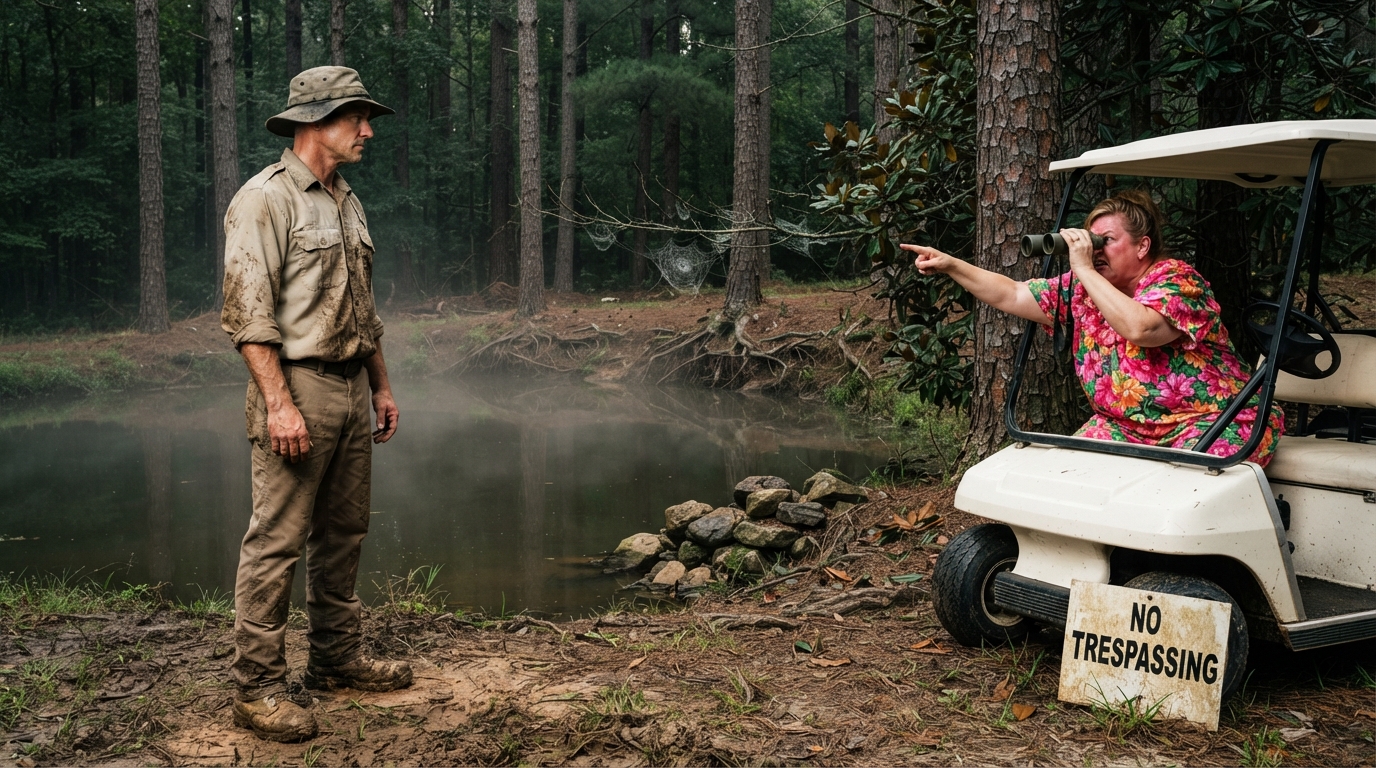
Karen Miller stood squarely on my property line, her floral print muumuu stretched taut across her chest like a garrison flag in a gale. Her face was flushed the color of a fresh brick, set in that greasy smirk of absolute, unearned authority she wore like body armor.
She pointed a stubby, manicured finger past the line of Georgia pines straight toward the water. The bullfrogs had gone dead silent. The surface of the half-acre kidney bean basin didn’t ripple a fraction of an inch under her accusation.
I didn’t reach for the 3-inch binder of county permits sitting on my kitchen table. That folder didn’t exist in my pocket today; I had to rely strictly on the unyielding slope of the ground and the silent engineering of the spring-fed basin.
“Karen,” I said, my voice scraping out low and flat, stripped of any friendly neighbor veneer. “You’re standing on private timberland without an invitation. Take two steps back across the property line.”
Her smirk hitched, just for a micro-second, before she doubled down on her posture. “You’ll be hearing from the marshals soon enough, Marcus. You can’t just alter wetlands without paying the toll.”
She turned on the heel of her sensible walking shoe, marched back to her idling golf cart, and spat a cloud of blue exhaust into the heavy air. I watched her tires tear a fresh rut into the gravel before I let out a slow, measured breath through my nose.
CHAPTER 2: THE BUREAUCRATIC NOTICE
The white paper sat in the center of the wood grain.
The heavy federal seal stamped at the top didn’t look like an HOA warning slip printed on a cheap home copier.
It carried the stark black-and-white authority of the Savannah District of the US Army Corps of Engineers.
Sarah stood by the sink, her hands paused on the edge of the basin while she watched me pick up the envelope without a single tremor in my fingers.
“Marcus, what does it say?”
I unfolded the thick stock paper with clean, sharp military creases.
“It means someone filed a formal citizen complaint,” I said, keeping my voice lower than the hum of the refrigerator. “They are claiming an unauthorized discharge of fill material into a protected wetland.”
The words on the page laid out the threat of massive fines and a mandated order to tear down the very ecosystem I had spent months grading by hand.
Without my 3-inch binder of permits—now permanently stripped from my defenses—I had nothing to hand over except my own boots and the hard facts of the land.
My mind began categorizing the terrain, calculating the exact drainage flow of the spring-fed basin against the federal definitions of palustrine emergent zones.
“They haven’t found us guilty of anything yet,” I told her, my eyes scanning the compliance officer’s direct office number listed at the bottom. “This is just an inspection notice.”
I picked up the landline receiver, dialed the direct extension for compliance, and waited through the dull administrative rings.
A tired, professional voice picked up on the second ring.
“Compliance Division, Henderson speaking.”
“Mr. Henderson,” I said, leaning my weight against the edge of the counter. “This is Marcus Thorne. I received your notice regarding the property off Cypress Creek.”
There was a brief pause of rustling paper on the other end.
“Ah, yes. The citizen complaint about unauthorized fill work.”
“I’d like to schedule that site visit for next Tuesday at 1000 hours,” I replied, staring through the window at the quiet water of the pond. “I’ll have fresh coffee waiting, and we can walk the property lines together.”
CHAPTER 3: THE INSPECTION PROTOCOL
Mr. Henderson stepped out from the passenger side with a tired, professional roll of his shoulders, carrying a clipboard under his arm.
Dr. Evans emerged from behind the steering wheel, her eyes immediately scanning the tree line and the natural grade of the rolling timberland.
“Morning, Sergeant,” Henderson said, taking a cardboard cup from my hand. “Let’s go have a look at this federal crime scene.”
We walked down the gentle slope together, stepping over pine needles and damp earth toward the open basin of the pond.
In the distance, parked just past the property boundary on the neighbor’s turf, a garish flash of floral print caught the morning sun through the foliage.
Karen sat in her official patrol golf cart, her binoculars locked directly on our movements with unblinking hostility.
Dr. Evans ignored her entirely, walking straight to the water’s edge and kneeling by the shallows to inspect the native plantings and littoral zone growth.
“The grading is clean,” Dr. Evans noted, running a gloved hand through the clear water above the sandy bottom. “This isn’t wetland destruction; it’s an active ecological enhancement.”
Henderson made a sharp note on his clipboard, his gaze drifting across the shallow creek toward the dense brush on the opposite bank.
“The paperwork matches the layout,” Henderson said, turning his back to Karen’s distant vantage point. “We’ll pull a standard soil core sample near the boundary line just to clear the record.”
CHAPTER 4: THE MAGENTA SAMPLE
“Smell that?” Dr. Evans knelt lower into the damp undergrowth, her gloved fingers brushing past overgrown roots to expose the mouth of the white plastic tube. “Chlorine. Heavy levels of it.”
Mr. Henderson dropped his clipboard against his thigh, his professional fatigue vanishing instantly as he stepped down the slick bank beside her.
He pulled a small field testing vial from his vest pocket, scooped a precise amount of water directly from the pipe’s outflow, and squeezed three drops of testing reagent into the liquid.
The clear water in the vial instantly flashed a violent, fluorescent shade of magenta.
“Well, I’ll be,” Henderson muttered, holding the glowing tube against the natural green backdrop of the woods. “That’s not stormwater runoff.”
He stood up slowly, his eyes tracing the uphill path of the buried line straight across the shallow stream toward the perfectly manicured lawn on the opposite side.
In the center of that pristine green expanse sat a large, crystal-clear swimming pool reflecting the bright autumn sky.
“Sergeant Thorne,” Henderson said, his voice dropping into a hard, official cadence. “Does your neighbor’s pool feature an active backwash discharge line?”
Across the creek, the golf cart had stopped moving.
Karen stood up from the vinyl seat, pressing her phone hard against her ear while her eyes darted frantically toward our group.
CHAPTER 5: THE NOCONFIDENCE VOTE
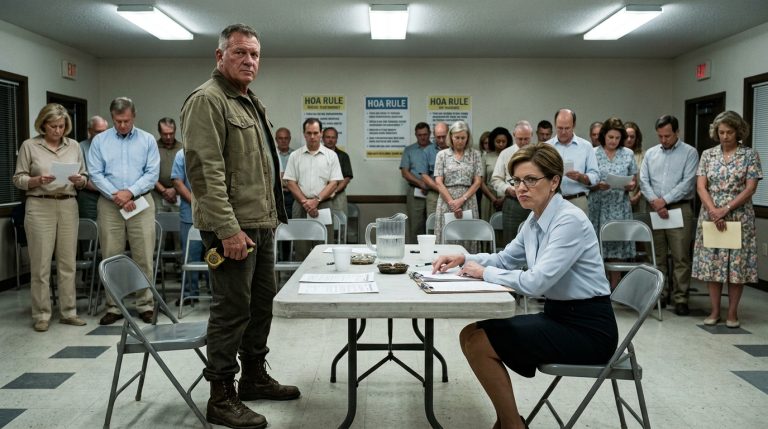
The beige walls of the hall closed in around the folding chairs like a pressure chamber.
Art Donaldson stood up from the front row, his jacket unbuttoned as he placed a single stack of papers on the podium.
“This isn’t about property values or minor yard maintenance,” Art said, his voice carrying clearly over the murmur of the crowd. “This is about a pattern of harassment built on hypocrisy.”
Karen slammed her palm against the edge of the wooden table, her face darkening to a deep maroon.
“He mounted a personal vendetta against me because I dared to enforce the covenants!” she shouted, her finger shaking as she pointed straight at my chest.
She doubled down with a frantic, desperate counter-move, claiming the federal violation report was nothing more than a forged conspiracy orchestrated by a disgruntled neighbor.
I sat quietly in the middle row, my hands resting flat on my knees, watching her unspool without offering a single word.
The crowd didn’t flinch at her outrage; they just stared at her with cold, exhausted silence.
Art turned directly to the interim board members and tapped the corner of the USACE compliance document.
“Mrs. Miller used her position to issue bogus fines while she dumped toxic pool water directly into a protected creek,” Art stated, letting the words drop like lead weights. “The federal government cleared the sergeant’s pond completely.”
Tom, the interim president, picked up the ballot box with a heavy sigh.
“Let’s call the vote,” Tom said, his hands steady.
CHAPTER 6: THE SILVER MIRROR
The heavy machinery on the neighboring property sat motionless, its metal arms parked awkwardly over a landscape of deep mud trenches and ripped-up sod.
Karen’s golf cart remained locked inside her garage, gathering dust alongside the empty promises of her fallen regime.
The for-sale sign planted near her front curb had stood through months of weathering, bearing the heavy price cut of a home burdened by mandatory environmental disclosure laws.
Sarah stepped out onto the back porch, holding two heavy ceramic mugs of coffee and setting them down on the wooden bench I had built near the water’s edge.
“The new board is already rewriting the covenants,” Sarah said, sitting down beside me and pulling her flannel jacket tighter against the autumn chill. “Art says they’re taking out every single restriction about mailbox colors and garden gnome heights.”
I watched a great blue heron glide in low over the tree line, its long legs dropping down to touch the shallows with barely a ripple.
“Good,” I said, the remaining tension leaving my shoulders like air hissing from a sealed valve. “A community shouldn’t need an army to keep the peace.”
The federal violation file was closed, the exorbitant remediation bills were her burden alone, and the neighborhood had finally found its footing without a dictator in a floral muumuu.
There were no more threatening notices in the mailbox, no more patrols inspecting my property line, and no more bureaucratic battles to fight.
I picked up my coffee mug, feeling the steady, warm weight of it against my palms.
The water in the basin reflected the first bright stars prickling through the deep indigo sky, calm and clear as glass.
I put my arm around my wife, leaned back against the wood, and let the quiet settle deep into my bones.