The Granite Line: How a Single Federal Easement Broke a Luxury Neighborhood’s Monopoly on the Shoreline
CHAPTER 1: The Morning Stillness and the Warning Sign
The air off Clearwater Lake tasted of wet cedar and cold iron. Daniel Carter did not rush his breathing. Years of standing watch across deserts where the wind carried grit instead of pine had taught him that motion without purpose was just noise. He stood three paces back from the western fence line, his palms resting against the top rail of cedar that his grandfather had notched by hand forty years ago.
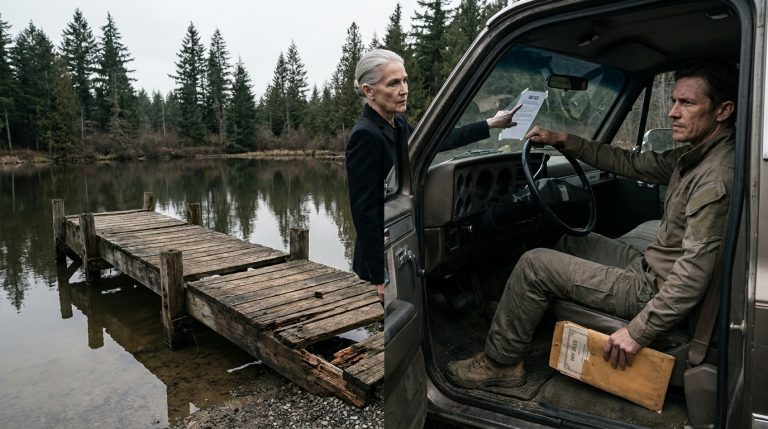
Below the bluff, the water was slate gray, flat enough to mirror the bruised underside of the dawn clouds. The only sound was the rhythmic slap of the old wooden dock shifting against its anchor posts, a low, familiar groan that had marked every summer of his childhood.
Then came the mechanical whine.
It was not the high-pitched buzz of a hobbyist quadcopter skimming the reeds for a weekend snapshot. It had weight to it—a heavy, calculated drone cutting low over the tree line where the state highway dissolved into the private gravel of Lakeshore Estates. Daniel didn’t look up immediately. He watched the shadow of the quadcopter glide across the damp grass of the pasture, a small, dark crosshair moving purposefully toward the shoreline boundary.
When he finally raised his chin, the machine was hovering fifty feet above the water, its twin camera lenses locked directly on the stretch of untouched beach that belonged exclusively to the ranch.
“They’re early,” Daniel murmured, his voice dry in the morning air.
He didn’t wave this time. He let his gaze track the machine as it adjusted its pitch, holding station with the stubborn persistence of someone who believed observation gave them ownership. Across the lake, framed by the skeletal remains of the cedar groves the developers had cleared three years prior, the multi-story glass facades of Lakeshore Estates caught the first harsh glare of the sun. The new houses looked like monuments dropped onto the earth by people who measured value by square footage rather than soil depth.
A flash of chrome broke the gray of the access road.
A glossy black SUV cleared the tree line, its tires kicking up a dry rooster tail of gravel that settled thickly over the wild ferns. It didn’t brake for the washboard ruts. It took the bumps with the arrogant suspension of a vehicle engineered for city asphalt, decelerating only when it slammed to a halt ten yards from the western gate.
The door swung open with a heavy, Germanic thud.
Elaine Mercer stepped out, her polished leather boots touching the mud as if the earth were expected to apologize for being damp. She wore a tailored wool blazer the color of wet slate and sunglasses that reflected the entire expanse of the lake back at him. Under one arm, she tucked a heavy leather-bound portfolio—not a folder for casual notes, but an instrument of administration.
Daniel didn’t move from the fence line. He waited, his fingers curling slightly around the weathered cedar grain, feeling the microscopic splinters beneath his skin.
Elaine walked with a straight, military posture that lacked all military grace; it was the stiffness of someone who had never taken an order in her life, only delivered them. She stopped five feet from the rusted wire barrier, tilted her chin over the rim of her sunglasses, and surveyed the sixty-two acres of open pasture with the clinical eye of an appraiser looking at a cracked foundation.
“Mr. Carter,” she said, her voice smooth, carrying the practiced cadence of a broker addressing a difficult client at a closing table. “I was hoping I’d find you out here before the contractors arrived.”
Daniel kept his weight balanced evenly on both boots. The drone overhead dipped slightly, its rotors chopping the air into a sharper rhythm.
“The road ends here, Ms. Mercer,” Daniel said quietly. “Everything past this post is private property.”
Elaine offered a thin, tight smile that never reached the dark glass of her lenses. She adjusted the portfolio under her arm, her diamond ring catching the pale morning light.
“Property is an interesting word,” she replied, taking a slow step closer to the boundary wire. “Especially when it sits like a dead weight in the middle of a multi-million-dollar community enhancement zone. We sent the final notice three days ago.”
“I burn junk mail,” Daniel said.
Her smile didn’t break, but the muscles around her jaw tightened into a hard, white line. She lifted her hand, pointing not at him, but at the empty stretch of shoreline where the cedar trees opened up to the water.
“You’re holding onto dirt that doesn’t want you,” Elaine said, her tone dropping into a low, persuasive hum. “The board has already approved the marina access permits. The regional council knows what’s coming. You can fight the district for six months in civil court, or you can let us incorporate the frontage now—on terms that will make you very comfortable.”
Daniel looked past her shoulder. Down the gravel road, two heavy diesel engines were idling into view, their low exhaust notes vibrating through the soles of his boots.
He didn’t answer her. Instead, his eyes dropped to the steel combination lock hanging from the gate’s primary chain—the lock he had inspected twice before dawn, and which now possessed a faint, fresh scratch across its brass shackle that hadn’t been there the night before.
CHAPTER 2: The Glossy Envelope and the Expansion Blueprint
The scratch on the brass shackle was clean. It wasn’t the slow, weathered pitting of salt air or the accidental bite of a heavy chain rubbing against stone; it was bright, raw metal exposed just hours ago by a hardened edge.
Daniel didn’t reach out to touch it. He kept his hands dead still on the weathered cedar top rail, his gaze fixed on the reflection of his own face warped across the curved surface of Elaine Mercer’s designer sunglasses. In that warped glass, he looked smaller than he was—compressed, distorted, framed as an obstacle rather than a man standing on his own land.
Elaine didn’t blink. She shifted the leather portfolio slightly, the gold clasp clicking with a dull, expensive sound that carried over the low idle of the diesel engines idling down the road.
“You’re making a mathematical error, Mr. Carter,” she said, her voice dropping an octave, smoothing out into the deliberate cadence of someone accustomed to negotiating buyouts over lukewarm Chardonnay. “This fence, this grass, these old cedar trees—they’re depreciating assets. To you, maybe they’re memories. To the district, they’re a bottleneck. A twenty-million-dollar resort development doesn’t stop because someone wants to preserve a cow pasture.”
A sudden memory cut through the hum of the distant idling trucks—his grandfather sitting on the porch steps in the late summer of ninety-eight, a whetstone resting on his thigh, sliding the blade of a weathered Buck knife back and forth with a rhythmic, unhurried hiss. They’ll call it progress, Dan, his grandfather had said without looking up from the steel. Progress is just a fancy word for someone else wanting what you built.
Daniel let the memory dissolve back into the cold iron air. He didn’t blink.
“My grandfather didn’t raise cattle here to make the neighbors’ view more picturesque, Ms. Mercer,” Daniel said, his voice flat, stripped of any conversational warmth. “He raised them because the ground was paid for.”
“Paid for,” Elaine echoed, a faint, dry chuckle escaping her throat. She shifted her weight, her polished leather boots sinking a fraction of an inch into the wet pasture mud. “Nothing is ever truly paid for in a municipality like this. Maintenance, zoning compliance, environmental alignment—these things cost. And when an entire community decides to elevate its standard of living, the outliers don’t get to stand in the middle of the road with a stop sign.”
She reached into the leather portfolio with her free hand, her acrylic fingernails clicking against heavy stock paper. She pulled out a thick, glossy envelope stamped with the deep blue and silver crest of the Lakeshore Estates Homeowners Association. It wasn’t handed to him; it was placed deliberately on the top rail of the cedar fence, precisely two inches from his left hand, like a summons left on a windshield.
“Read it,” she said, her tone hardening just enough to show the wire beneath the silk. “It outlines the district’s preliminary acquisition framework for the western half-mile. We aren’t asking for a handshake anymore, Mr. Carter. We’re offering a formal transition period before the county planning commission reviews the utility easements.”
Daniel didn’t look down at the envelope. He looked past her shoulder, tracking the movement of a maintenance truck as it crept slowly down the gravel road, its amber strobe light flashing silent, rhythmic pulses against the gray morning fog.
“You skipped a step,” Daniel said quietly.
Elaine paused, her fingers lingering on the flap of the portfolio. “Excuse me?”
“You had your surveyors out here on Tuesday,” Daniel said, his voice level, measuring each word against the distant thrum of the diesel engines. “You had a quadcopter scanning the ridge yesterday morning. And today you’re standing at my gate talking about utility easements.” He finally tilted his head, his eyes locking onto the dark glass of her lenses. “You didn’t check the county deed registry before you drew up those blueprints, did you?”
For the space of a heartbeat, the smug, administrative certainty in Elaine’s posture flickered. It wasn’t fear—not yet. It was the sudden, sharp irritation of an executive whose assistant had failed to cross a minor bookkeeping t. Her jaw tightened, the skin beneath her makeup going taut.
“The district’s legal counsel has reviewed every parcel plat within a three-mile radius,” Elaine said, her voice sharpening, losing its smooth corporate glide. “We know exactly whose name is on the tax rolls. And we know that thirty years of agricultural neglect doesn’t grant immunity from local zoning enhancement.”
“Tax rolls aren’t land titles,” Daniel said. He reached down slowly, his fingers brushing the rough grain of the cedar rail, stopping just short of the glossy envelope. “And local zoning doesn’t reach past a federal covenant.”
Elaine’s smile didn’t return; it dropped entirely, replaced by a cold, transactional stare. She stepped back, pulling her wool blazer tight against the damp lake wind.
“Keep the mail, Mr. Carter,” she said, her voice cutting through the rising wind like a dry leaf scraping across asphalt. “You’ll need something to read while the county changes your mind.”
She turned on her heel with practiced military precision, her boots crunching sharply into the gravel as she walked back toward the black SUV. The door slammed home with that same heavy, Germanic thud. A second later, the vehicle lurched forward, its tires spinning once in the loose gravel before biting into the ruts, kicking up a dirty gray cloud that settled slowly over the wild ferns along the fence line.
Daniel stood alone in the silence that followed.
The heavy diesel trucks down the road revved their engines, shifting gears as they prepared to move closer to the property line. The air smelled of burnt fuel and damp earth. Without looking down, Daniel finally reached out, picked up the glossy envelope, and slid it into the inner pocket of his jacket without breaking the seal.
He turned away from the gate, his boots crunching steadily against the frozen ruts of the road as he walked back toward the house, leaving the fresh scratch on the brass lock to catch the cold morning light.
CHAPTER 3: Administrative Friction and the Drones Over the Water
The envelope felt dense in his pocket, a stiff block of pressed fiber pressing against his ribs as Daniel crossed the threshold of the back porch. The screen door gave its familiar, high-pitched squeak—the same dry whine of rusted wire and old pine that had signaled his return every summer since he was seven years old. He didn’t drop the latch behind him. He let the door swing back against its frame, listening to the hollow echo fade into the quiet dimness of the kitchen.
The house smelled of old cedar, dry parchment, and the lingering, bitter trace of yesterday’s black coffee. Dust motes drifted lazily through the shaft of pale morning light cutting across the worn linoleum floor.
Daniel pulled the envelope from his jacket and laid it flat on the wooden kitchen table. He didn’t tear it open. Instead, he unhooked his field jacket, tossed it over the back of a straight-backed wooden chair, and walked over to the small, multipaned window that looked out over the northern pasture.
Outside, the mist was burning off the grass, leaving the ground a dull, saturated green. But the quiet didn’t hold.
A high, thin whine cut through the morning air—steeper and sharper than the heavy diesel engines idling down by the gate. Daniel narrowed his eyes, tracking the tree line along the western ridge where the tall cedar groves met the property line.
A second quadcopter, smaller and sleeker than the one from earlier that morning, crested the canopy. It didn’t hover at a distance this time. It dipped low, sliding sideways on a stiff gust of lake wind before stabilizing directly above the orchard point, its carbon-fiber rotors buzzing like an angry hornet trapped against a windowpane. The camera gimbal whirred, clicking twice as it adjusted its focal length, tilting straight down toward the tool shed and the open stretch of grass leading toward the dock.
Daniel didn’t flinch. His reflection in the window glass was steady, his expression carved out of the same stubborn patience he had practiced during long nights on perimeter watch. They weren’t just probing the boundaries anymore. They were mapping coordinates, searching for an administrative wedge—a rusted vehicle, an outbuilding code infraction, an unpermitted fuel drum—anything the district could weaponize before the county planning board convened.
He turned away from the window, walked over to the counter, and picked up the landline receiver.
The dial tone was clear and steady. He didn’t call the county sheriff, and he didn’t call the local township office. He dialed a direct, ten-digit number scrawled inside the back cover of a weathered ledger sitting beside the breadbox—the direct line for the regional land conservation bureau’s regional compliance division.
The phone rang twice before a dry, efficient voice answered. “Compliance. District Four.”
“This is Daniel Carter,” he said, keeping his voice low, measured, and completely devoid of urgency. “Clearwater Lake Ranch, parcel four-zero-two.”
A rustle of paper crackled over the line. “Go ahead, Mr. Carter.”
“We have unauthorized aerial surveillance operating below five hundred feet over a registered conservation zone,” Daniel said, his gaze fixed on the small black dot buzzing against the pale sky outside the kitchen window. “And I have a formal notification from the Lakeshore Estates Homeowners Association claiming an upcoming utility easement modification across the protected shoreline.”
There was a brief pause on the line, followed by the rhythmic, distinct clack of computer keys.
“An easement modification?” the compliance officer asked, her tone sharpening instantly. “On a Class A federal buffer zone?”
“That’s what the paper says,” Daniel replied. “They’re preparing to move heavy equipment past the western gate by the end of the week.”
Another pause, longer this time. The rhythmic clicking stopped. “Mr. Carter, are there physical markers or boundary notices posted along that frontage?”
“Four iron stakes and two cedar boundary posts, all stamped with federal registry numbers,” Daniel said, watching the quadcopter abruptly tilt its nose upward and streak back toward the luxury rooftops across the lake like a retreating scout. “They’re well aware of where the line is.”
“Keep your documentation ready,” the officer said sharply, the bureaucratic detachment vanishing from her voice. “If they cross that line with a single blade of steel before our field inspectors review the plat, the association isn’t looking at a zoning violation. They’re looking at a federal injunction.”
“Understood,” Daniel said.
He set the receiver back down on its cradle, the plastic click sounding loud in the quiet kitchen. He walked back to the table, stared down at the unopened blue-and-silver envelope bearing Elaine Mercer’s seal, and picked it up. This time, he slid his thumb beneath the heavy paper flap and tore it cleanly open.
CHAPTER 4: The County Records Room and the 1978 Document
The receiver clicked home, the plastic tongue snapping into its cradle with a dry, hollow echo that seemed to linger in the empty kitchen. Daniel didn’t move away from the table immediately. His fingers rested on the edge of the blue-and-silver envelope, feeling the stiff, high-grade bond paper that masked an eviction notice behind corporate styling.
He didn’t need to read the rest of Elaine’s paperwork to know the structure of their assault. The drones, the survey flags, the whispered rumors at the bait shop—they were all designed to create a baseline of administrative friction, wearing down a lone landowner through paper cuts until the property line felt indefensible. But friction required a surface to grind against.
Daniel pulled his hand away, hooked his field jacket back over his shoulders, and stepped out the back door, letting the screen latch with a sharp, heavy slap.
The air outside had lost the heavy frost of dawn, replaced by the damp, flat chill of mid-morning. He didn’t head for the trucks or the tool shed. He walked straight past the rusted water pump toward his truck—a faded green Ford pickup whose bed still carried a coil of heavy wire and a box of galvanized staples. The engine turned over on the second rotation, coughing a brief plume of blue exhaust into the cedar-scented air before settling into a deep, steady idle.
Twenty minutes later, the truck’s tires hummed against the paved county road, trading the dirt and ruts of the ranch for the damp asphalt leading toward the municipal seat.
The county clerk’s office occupied the ground floor of a red-brick building constructed during the Eisenhower administration. Inside, the air smelled permanently of floor wax, damp wool, and yellowed paper stored too long in metal cabinets. A solitary ceiling fan turned lazily overhead, its blades cutting the thick air with a rhythmic, soft whoosh.
Mrs. Gable sat behind the high oak counter, her bifocals balanced low on the bridge of her nose as she stamped a stack of property deeds with mechanical precision. Thump. Thump. Thump.
“Morning, Dan,” she said without looking up from the red ink pad. “Your grandfather used to sit right over there on that bench when he was waiting on water rights renewals. Brought peppermints for the girls in seventy-six.”
“I remember,” Daniel said, resting his palms on the polished oak barrier. “I’m not here for water rights today, Mrs. Gable. I need to pull the original baseline maps and easement filings for parcel four-zero-two.”
The stamping stopped. Mrs. Gable lifted her chin, peering over her lenses with eyes that had seen three generations of county boundary disputes settle into either handshakes or court judgments.
“Parcel four-zero-two,” she murmured, her fingers already sliding across the keyboard of a terminal that looked older than the desk it sat on. “That’s the entire southern and western lake frontage. The old Carter ranch. You looking for the primary deed transfer from seventy-eight?”
“The deed and everything attached to it,” Daniel said. “Specifically the environmental attachments.”
She typed a short sequence, hit the enter key with a decisive clack, and watched the amber monochrome screen flicker. A slow, thin smile touched the corners of her mouth.
“Thought so,” she said, turning away from the terminal toward the towering wall of metal filing cabinets behind her. “Most folks down in the new subdivisions think a deed is just a boundary line and a tax figure. They forget what the old men wrote into the margins when the lake was still mostly cedar swamp and dairy farms.”
She walked down the narrow aisle between the rows of grey steel, her rubber-soled shoes squeaking softly against the linoleum. After a moment, she pulled a heavy, manila-colored accordion folder tied with faded cotton string and carried it back to the counter.
Daniel untied the string. The contents didn’t smell like modern office paper; they smelled of dry air, aged cotton fiber, and faint hints of pipe tobacco. On top rested a hand-drawn topographical survey executed in black ink and colored pencil, dated October 14, 1978. Below it lay the primary deed transfer bearing his grandfather’s block-letter signature, clean and unhurried.
And beneath that sat the document he had come for: a federal conservation easement agreement, stamped with the seal of the United States Department of Agriculture and countersigned by the regional water resources board.
Daniel leaned over the counter, his eyes tracking the dense paragraphs of legal prose. The restrictions weren’t vague guidelines or polite suggestions. They were absolute covenants running with the land. Every foot of the shoreline extending fifty yards inland was classified as a permanent non-disturbance ecological buffer. No structures, no commercial docks, no mechanized grading, no utility alterations. Any intentional breach triggered an automatic federal environmental review, bypassing local municipal zoning boards entirely and vesting enforcement authority directly in regional federal marshals and environmental protection officers.
As he turned the page, a loose index card slipped from the back of the folder and fluttered onto the counter.
It wasn’t part of the official county filing. It was an index card covered in his grandfather’s familiar, heavy handwriting, penned with a fountain pen that had bled slightly into the cheap cardstock.
If they ever pave the ridge, the note read simply, remind them that water always finds the lowest grade before the concrete sets.
Daniel stared at the ink for a long moment, the quiet of the records room pressing in around him like a physical presence. The pieces clicked into place—not just the legal framework, but the deliberate, calculated patience his grandfather had built into the very dirt of the ranch. The HOA thought they were fighting a single stubborn landowner over a scenic view. They didn’t realize they were trying to tear down a legal trap set forty years before any of them ever bought a lot on the lake.
He looked up at Mrs. Gable, who was watching him quietly from behind her bifocals.
“Need copies certified, Dan?” she asked softly.
“Every page,” Daniel said, sliding the index card back into the fold of the easement. “And I’ll take two extra certified copies stamped by the clerk’s office today.”
Mrs. Gable nodded, took the folder, and walked back toward the heavy glass-front copier, the rhythmic click of the machine starting up a low, mechanical hum that echoed against the brick walls.
Daniel stood by the counter, his hand resting on the smooth wood, feeling the cold weight of the documents inside his jacket. Outside the window, a delivery truck rumbled past on the main street, its tires throwing a fine spray of mist against the curb. The paperwork was secure. The trap was primed. All that remained was to wait for them to step across the line.
CHAPTER 5: The Sound of the Bolt Cutters and the First Blade of Earth
The heavy glass door of the county clerk’s office swung shut behind him, cutting off the rhythmic, mechanical thump of Mrs. Gable’s date stamp and replacing it with the sharp, flat hiss of tires on wet asphalt. Daniel walked down the concrete steps, his hand sliding inside his jacket to feel the stiff, rectangular bulk of the certified manila envelope pressing against his chest.
The truck was parked fifty feet down the curb, its faded green hood coated in a fine, silver film of morning mist. He climbed in, dropped the envelope onto the passenger seat beside a coil of galvanized wire, and turned the ignition. The old six-cylinder engine caught immediately, vibrating through the floorboards with a familiar, mechanical pulse.
He didn’t head straight back to the ranch. Instead, he took the long loop around the perimeter ridge—the high gravel road that skirted the elevated boundary where the old agricultural land bled into the newly paved residential expansion of Lakeshore Estates.
From up here, the geography of the conflict was laid out like an engineering drawing. Below him, nestled against the curve of Clearwater Lake, sat the sprawling multi-million-dollar footprints of the district’s modern homes, their glass-walled balconies and manicured lawns spilling down toward the water. And right beside them, cutting a sharp, stubborn wedge of green into the manicured shore, lay the sixty-two acres of the Carter ranch—untouched, dense with aging cedar, and completely outside the association’s perimeter control.
As he slowed the truck near the northern crest, a sudden gust of wind swept up from the lake, carrying a distinct, heavy scent: the sharp, acrid reek of hot diesel exhaust mingled with the raw, sappy smell of freshly splintered pine.
Daniel cut the engine.
The sudden silence inside the cab was absolute, broken only by the faint ticking of the cooling exhaust manifold. Through the windshield, down where the gravel track met the ranch’s primary western access gate, something had changed in the landscape.
A low-boy flatbed trailer was parked sideways across the road, its dual axles sinking slightly into the mud. Two heavy-duty pickup trucks bearing the blue-and-silver seal of Lakeshore Estates flanked the trailer, their hazard lights flashing intermittent amber pulses against the dark green foliage of the cedar grove. A dozen men in high-visibility vests and hard hats were milling around the bed of the truck, untying canvas straps and dragging heavy aluminum fencing panels onto the grass.
And standing right at the front of the gate, framed by the cold iron rails of the fence Daniel’s grandfather had welded in seventy-nine, was Elaine Mercer.
She wasn’t holding a portfolio today. In her right hand, she gripped a pair of heavy, red-handled bolt cutters, the twenty-four-inch steel jaws gleaming with greasy newness under the slate-gray sky. She didn’t look like a real estate broker anymore; she looked like an expediter who had grown entirely out of patience with the slow grind of administrative paperwork.
Daniel pushed open the truck door, his boots hitting the gravel with a measured, heavy thud. He didn’t rush. He walked around the hood of the Ford, keeping his movements deliberate and unhurried, staying fifty paces back while the scene unfolded below.
At the gate, Elaine didn’t hesitate. She stepped right up to the primary chain linking the two iron support posts—the heavy galvanized chain secured by a solid brass padlock that Daniel had inspected just forty-eight hours earlier. She looped the jaws of the bolt cutters around the middle link, planted her polished boot against the vertical post for leverage, and threw her weight onto the handles.
The steel didn’t bend; it sheared.
The crack was sharp and metallic, echoing off the sloping hillside like a small-caliber rifle shot. The broken chain whipped back against the post, and the brass padlock tumbled into the weeds with a dull, hollow thump.
Elaine tossed the heavy bolt cutters onto the bed of the nearest utility truck without looking back, her voice carrying clearly up the slope to where Daniel stood watching.
“Tear it down,” she told the crew supervisor, gesturing toward the interior pasture road with a clean, sweeping motion of her hand. “The resort construction starts right here. Get the primary blade on the slope before noon.”
The heavy diesel engine of a yellow utility bulldozer idled to life down by the tree line, its exhaust coughing a thick gray cloud into the damp air as the machine’s tracks bit into the earth, beginning their slow, inevitable roll toward the protected shoreline below. Daniel watched the blade drop an inch into the soil, biting into ground that hadn’t felt the weight of a machine in four decades. He reached inside his jacket, his fingers brushing the certified federal easement papers, and let out a long, quiet breath.
The trap was sprung. All they had to do now was dig.
CHAPTER 6: The Three Agency Trucks at the Gate
The deep, metallic groan of the bulldozer’s tracks vibrating through the loose topsoil was not a sound that belonged on the ranch. It was an intrusion—a mechanical scraping that tore through the quiet stillness of the cedar grove like an uninvited blade.
Daniel didn’t rush. He stood beside the driver’s side door of his Ford pickup, his hand resting on the weathered steel frame while the yellow machine pushed its first major wedge of earth down the sloping incline toward the water line. The dark, damp soil rolled away from the steel cutting edge, exposing matted roots and stones that hadn’t seen the air since his grandfather cleared the lower pasture back in the late seventies.
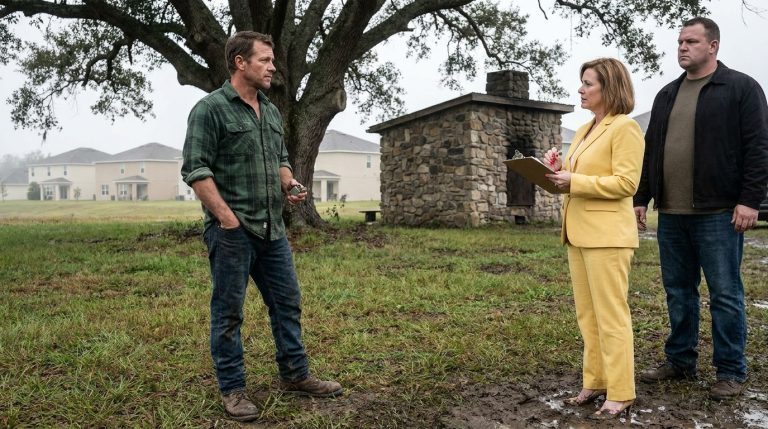
Down at the gate, Elaine Mercer stood with her clipboard pressed against her wool blazer, her head tilted up slightly as she conferred with the primary site supervisor. Even from fifty yards away, her posture radiated the absolute, untroubled certainty of a woman who believed administrative momentum was an unstoppable force. To her, every tree pushed aside and every foot of graded earth was another nail driven into the coffin of an obstinate landowner’s resistance.
Daniel pulled his gaze away from the grading operation and reached back into the cab of the truck. His fingers wrapped around the heavy, certified manila envelope containing the 1978 federal conservation easement filings and the stamped county clerk copies. He slid the dossier into his inner jacket pocket, feeling its reassuring thickness against his ribs, before stepping fully out onto the gravel road.
He didn’t walk down to confront them. Confrontation at the point of a shovel was a tactical error; it invited shouting matches, localized police reports, and delays that favored the party with deeper financial reserves. Instead, he walked fifty paces north, toward the secondary maintenance track that intersected the ridge—the exact point where the older drainage culverts met the public utility right-of-way.
As he reached the junction, a sudden memory surfaced—sharp and unbidden—of his grandfather standing on this exact patch of gravel during the spring thaw of eighty-four, pointing a calloused finger down toward the lake while the high water lapped just inches below the pasture line. A smart man doesn’t build walls against water or law, Dan, his grandfather had said, wiping grease from a tractor wrench. You just make sure the grade points where it’s supposed to.
The distant rumble of incoming engines cut through the hum of the idling bulldozer.
Daniel stopped, turning his head toward the public gravel road. It wasn’t the heavy, throaty diesel of another construction flatbed or the whir of a utility van. It was a staggered, authoritative cadence—three distinct vehicles moving in a synchronized line, taking the washboard ruts with the heavy, unhurried suspension of municipal and state enforcement units.
The lead vehicle was a clean, white Ford Explorer bearing the dark green emblem of the regional environmental conservation authority. Right behind it rolled a heavy-duty pickup marked with the silver-and-blue striping of the state water resources bureau, its amber light bar dark but visible against the overcast sky. Bringing up the rear was a county sheriff’s department cruiser, its tires crunching heavily into the loose gravel as the trio slowed and formed a rolling blockade across the association’s access route.
Down at the gate, the bulldozer’s engine sputtered and dropped to an idle.
The abrupt silence was heavier than the noise had been. The machine’s tracks stopped rolling, a thick cloud of blue-gray exhaust hanging suspended in the damp air above the torn earth. The crewmen paused mid-motion, shovels and measuring tapes dangling from their hands as they turned to look up the road.
Elaine Mercer lowered her clipboard. For the first time since she had stepped out of her black SUV that morning, her rigid posture fractionally altered. She smoothed the front of her blazer with a sharp, automatic motion, adjusted her sunglasses, and began walking briskly up the slope toward the newly arrived convoy.
Daniel didn’t move from his position by the culvert. He stood with his hands tucked loosely into his jacket pockets, his fingers resting against the cold paper of the federal easement dossier, watching the doors of the lead conservation vehicle swing open.
The lead inspector—a tall, weathered man in a canvas field jacket with a heavy leather holster and an agency badge pinned to his chest—stepped out onto the gravel. He didn’t look at Elaine. He didn’t look at the workers. His eyes swept past the parked SUVs, tracked the raw, thirty-yard scar the bulldozer had just carved across the bluff, and locked onto the federal boundary markers posted along the cedar line.
The trap had closed its first jaw. All that remained was for the teeth to bite.
CHAPTER 7: The StopWork Order and the Orange Seizure Tags
The silence left in the wake of the dying bulldozer engine felt thick, almost physical, settling over the torn earth of the bluff like a heavy wet blanket. Daniel didn’t rush his steps as he walked down from the culvert junction, keeping his pace steady and unhurried against the loose gravel.
Down at the gate, the lead inspector—badge gleaming silver against the dark canvas of his field jacket—did not wait for Elaine Mercer to reach him. He took three deliberate strides across the crushed rock, his boots grinding a dry rhythm into the dirt, and held up a gloved hand to halt her approach.
“Step back, ma’am,” the inspector said, his voice flat, carrying the absolute authority of a man accustomed to jurisdictional lines that did not bend for local property values.
Elaine stopped ten feet short, her heels sinking an eighth of an inch into the soft mud. Her sunglasses mirrored the dual amber lights of the state water truck idling behind the convoy, but her jaw was rigid, the skin around her mouth pulled tight into a thin, white line.
“There seems to be an administrative oversight here,” Elaine said, her tone smooth and practiced, though a faint edge of metallic strain rasped beneath the words. “This entire access road falls under the district maintenance charter for Lakeshore Estates. We have site permits filed with the county utility commission.”
The inspector didn’t pull out a clipboard. He reached into his inner pocket with a measured, slow movement and withdrew a thick, laminated parcel map secured with heavy brass grommets. He unrolled it across the hood of the nearest association pickup, anchoring the corners with his palms.
“County utility commissions don’t issue variances over federal land,” the inspector said, his finger tapping sharply against a red-bordered grid line that cut straight through the middle of the grading site. “Parcel four-zero-two is bound by a permanent non-disturbance covenant under the Federal Clean Shoreline Act of nineteen seventy-eight. Every cubic yard of topsoil your machine just pushed down that slope is an unauthorized federal violation.”
A murmur rippled through the group of construction workers standing near the flatbed trailer. The primary equipment operator, a thick-set man in a faded canvas Carhartt jacket, stepped back from the controls of the idling bulldozer and wiped a greasy palm across his forehead, his eyes darting from Elaine to the inspector’s badge.
Elaine didn’t look at the workers. She stepped closer to the hood of the truck, her acrylic fingernails clicking against the metal edge of the bumper.
“That easement was filed by a private individual decades ago,” she said, her voice dropping into a sharp, transactional register. “The association represents ninety-eight property owners whose views and infrastructure depend on maintaining this corridor. A local zoning adjustment can easily—”
“This isn’t a zoning adjustment, ma’am,” the inspector interrupted, his voice dropping an octave, completely stripping away any conversational pretense. He turned his head slightly, signaling to the second officer standing by the state water resources pickup. “This is an active environmental degradation event on protected federal property.”
The second officer unclipped a heavy ring of bright orange plastic tags from his belt and walked past them toward the tracks of the yellow bulldozer. Without a word, he looped the thick plastic strap around the machine’s primary hydraulic control lever, cinched the locking buckle tight, and stamped the metal seal with an official agency crimp. The bold black lettering across the bright orange field was unmistakable: SEIZED AS EVIDENCE. FEDERAL PROPERTY VIOLATION. DO NOT REMOVE.
Daniel reached the edge of the gathering, stopping ten paces back near the rusted wire fence. He kept his hands inside his jacket, his fingers resting over the certified copies of the 1978 easement dossier.
Elaine turned her head sharply, her dark lenses finally locking onto Daniel standing quietly by the boundary post. For a fraction of a second, the immaculate corporate armor cracked, revealing the sudden, bitter realization of a strategist who had just realized she was playing a game with rules she had never bothered to read.
“You knew,” she said, her voice dropping into a low, venomous hiss that barely carried over the idling engines of the sheriff’s cruiser.
Daniel didn’t smile. He didn’t offer a defense, a smirk, or a warning. He simply met her gaze through the cold morning air, letting the heavy silence of the sixty-acre ranch speak for itself.
The lead inspector pulled a multi-page document from his canvas pocket, stamped it with a heavy red ink seal, and stepped forward to press it firmly into Elaine’s hands.
“Stop-work order,” the inspector said flatly. “All machinery, trailers, and grading equipment remain on-site pending a full environmental damage assessment by the regional bureau. If anything on this property is moved before a federal magistrate reviews the filings, the liability won’t just rest on the association. It’ll rest on your desk.”
He turned on his heel, leaving Elaine standing alone in the gravel with the red-stamped papers clutched tightly in her fingers, while the orange seizure tags fluttered softly in the cold lake wind.
CHAPTER 8: The Emergency Clubhouse Meeting and the Shift in the Room
The orange plastic tag on the bulldozer’s hydraulic arm fluttered once, snapping sharply in the late afternoon draft before the stillness closed back over the bluff. Daniel did not stay to watch the association trucks load their gear or see Elaine Mercer climb back into her black SUV with the red-stamped stop-work order clutched in her hand. He turned his truck around, the tires crunching over the raw earth, and drove back toward the ranch house.
By nightfall, however, the shockwaves of the federal shutdown had bypassed the gravel road and hit the heart of Lakeshore Estates.
The emergency assembly called by the homeowners association board was scheduled for seven o’clock at the community clubhouse—a sprawling, glass-fronted structure perched on a manicured point overlooking the eastern bay of Clearwater Lake. Even from the perimeter fence line three hundred yards away, the rows of luxury cars parked haphazardly along the paved association driveways signaled an unprecedented level of panic.
Daniel didn’t attend the meeting. He didn’t need to sit in the folding chairs or listen to the rising tide of voices echoing through the vaulted timber-frame ceiling. Instead, he stood on his own back porch, a mug of black coffee cooling in his hand, watching the pinpricks of light move behind the frosted glass windows of the clubhouse across the water.
Inside that room, the administrative fiction was unraveling.
According to Tom from the bait shop—who had slipped away early and called from his truck—the meeting had turned volatile within ten minutes. Elaine Mercer had taken the podium to assure the residents that the federal stop-work order was merely a procedural delay, a minor zoning miscommunication that the district’s legal team would resolve by the end of the week. But confidence among homeowners who had invested half a million dollars apiece into waterfront properties is a fragile commodity.
The moment a retired corporate attorney from the third row stood up and read aloud the section numbers of the 1978 federal conservation easement—copies of which had mysteriously appeared in several mailboxes along the street—the room shifted.
The questions hadn’t been about landscaping or property values anymore. They were targeted, sharp, and financial. Who had authorized the survey work without checking the primary title attachments? Why had the board pushed forward with a multi-million-dollar resort expansion plan on land explicitly marked as a federal non-disturbance buffer? And most importantly, who was going to pay for the six-figure environmental restoration fines now dangling over the association’s corporate charter?
Elaine’s defense had reportedly fractured under the weight of the silence that followed. There were no villain speeches, no dramatic declarations—just the cold, heavy realization of people who suddenly understood they had been led into a legal trap by an administrator who confused authority with ownership.
Back on the porch, Daniel took a slow sip of his coffee. The liquid was bitter, cooling against his tongue.
The lights across the bay flickered as groups of homeowners began streaming out of the double glass doors, heading back to their expensive SUVs in tight, agitated clusters. The administrative friction the HOA had manufactured to break him was now turning inward, consuming the very board that had created it.
Daniel set his mug down on the wooden porch railing. The lake below was entirely black, flat and unyielding, reflecting the cold light of the stars above the cedar ridge. The first major phase of the pressure had broken against the granite line of his grandfather’s foresight. But he knew corporate structures did not simply vanish overnight when cornered. They regrouped, recalculated, and looked for a flanking route.
He turned, walked back inside the dim kitchen, and locked the heavy wooden door behind him, leaving the dark water to whisper against the shore.
CHAPTER 9: The Slow Grind of Federal Environmental Investigation
The frost on the windowpane of the kitchen was thin and crystalline, feathering out from the lower corners where the old pine frame had warped against fifty winters of lake wind. Daniel stood motionless in the dim light of dawn, his mug of coffee untouched on the counter, watching the heavy gray fog roll in off Clearwater Lake. It swallowed the dock posts one by one, erasing the boundary between water and air until the shoreline looked like an endless, featureless expanse of gray wool.
Down at the gate, three hundred yards away, the seized bulldozer sat like a rusted monument, its orange federal tag hanging limply in the damp morning draft.
The investigation did not move with the speed of a neighborhood dispute; it ground forward with the slow, relentless friction of administrative bureaucracy. Over the next three weeks, the quiet rhythm of the ranch was punctuated by the steady, unannounced arrivals of federal vehicles. Inspectors in heavy rubber boots and orange high-visibility vests tramped down the bluff, dragging measuring chains through the cedar roots, coring soil samples from the scraped earth, and logging every square yard of the disturbed slope.
Daniel accompanied them in silence, his hands shoved deep into his pockets, speaking only when asked a direct question about the historical grade of the pasture.
The findings, when the preliminary field reports finally filtered down through the regional office, were precise and devastating for the association. The thirty-yard gash carved by the bulldozer had compromised an active runoff buffer zone, triggering mandatory environmental remediation costs that were estimated well into six figures. More critically, because the federal easement documents explicitly designated the shoreline as a non-disturbance zone, the liability could not be absorbed by a general insurance policy or written off as a zoning miscalculation. It attached directly to the corporate charter of Lakeshore Estates—and, by extension, to the individual board members who had voted to authorize the project without conducting a secondary title search.
Yet, corporate entities do not surrender simply because an administrative wall stops their progress; they adapt, fracture, and attempt to outlast their opponents through financial attrition.
By the fourth week, the fallout inside the luxury subdivision across the bay had leaked into the county seat. Real estate listings for several multi-million-dollar homes near the waterfront had quietly appeared on digital brokerages, their prices dropping ten percent overnight as word of the impending special assessments spread among the residents. The luxury veneer of Lakeshore Estates was beginning to peel, revealing the raw, jagged panic underneath.
Daniel watched the developments from a distance, refusing to engage with the frantic phone calls and formal letters that occasionally arrived in his mailbox. He knew the pressure was working, but he also knew that Elaine Mercer was not the type of administrator to walk away while her reputation was actively disintegrating. She had built her entire standing in the community on absolute control, and a cornered executive with nothing left to manage is infinitely more dangerous than one operating under rules.
He set his empty coffee mug down in the sink, the ceramic clinking sharply against the metal basin. He pulled his field jacket from the peg by the door, looped his heavy leather work gloves over his belt, and stepped outside into the biting morning air. The fog was finally lifting, burning away under a pale, cold sun that cast long, sharp shadows across the frosted grass of the pasture. There were fences still needing repair along the northern line, and the lake was waiting.
CHAPTER 10: The First Apology at the Bait Shop Counter
The screen door of Tom’s bait shop gave a familiar, high-pitched screech—the same dry whine of old springs and salt-warped pine that had welcomed local fishermen for thirty years. Daniel didn’t let the door slam behind him. He stepped over the scarred wooden threshold, his heavy work boots leaving faint traces of dry mud on the worn linoleum floor.
The shop smelled of stale coffee, lead sinkers, damp nylon netting, and the faint, sweet scent of cedar shavings. A solitary fluorescent tube overhead flickered once before settling into a steady, low hum that vibrated against the rows of plastic-wrapped lures hanging from pegboard walls.
Tom stood behind the plywood counter, a stained ceramic mug in one hand and a rag in the other, wiping down a glass display case filled with copper spoons and old steel hooks. He didn’t look up immediately when the bell rang. But when the footsteps stopped short of the counter, Tom paused his rag, lifted his chin, and looked over the rim of his reading glasses.
For a long moment, neither man spoke. The ambient noise of the highway outside was muted, filtered through double-paned windows that looked out toward the county road.
“Morning, Dan,” Tom said, his voice dropping below its usual commercial register. He set the rag down, reached for a cardboard box of heavy-duty stainless steel hooks, and slid them across the scarred wood toward Daniel’s hands. “Heard you’ve been keeping busy up on the ridge.”
Daniel stepped forward, resting his palms on the edge of the counter. The cold iron of his jacket zipper clicked softly against the wood.
“Fences need mending this time of year,” Daniel said quietly. “Weather’s turning.”
Tom gave a dry, humorless huff of breath, shaking his head as he picked up his mug and took a slow sip of the dark coffee. He stared down at the counter for three heartbeats before looking back up, his eyes meeting Daniel’s with the heavy, uncomfortable candor of a man who realized he had repeated stories he shouldn’t have trusted.
“Looks like you were telling the exact truth about those boundary lines from the start,” Tom said, his voice dropping further, almost confidential. He leaned his forearms against the counter, lowering his voice as if someone might overhear past the rows of empty minnow tanks. “Word’s gotten out about what happened at the association’s emergency meeting last week. Half the folks on the eastern bay are trying to figure out how Elaine and the board managed to approve a resort build over a federal non-disturbance zone without checking a single county record.”
Daniel didn’t smile or nod in vindication. He kept his expression flat, his gaze steady on the bait shop owner. “Paperwork doesn’t care who votes on it, Tom.”
“No,” Tom agreed, tapping a calloused finger against the side of his mug. “It doesn’t. And people around here are finally starting to realize that the noise the HOA was making all summer wasn’t about environmental safety or community standards. It was about finding a way to swallow sixty acres of shoreline before anyone noticed the title was locked.” He reached out, sliding the box of hooks an inch closer. “Should’ve known better than to listen to the gossip when it started dropping in July. Most of the lake front owners are keeping their heads down now, hoping the federal inspectors finish up before the special assessments hit their property taxes.”
Daniel reached down, picked up the box of hooks, and dropped a folded twenty-dollar bill onto the counter. He didn’t wait for change.
“The lake doesn’t care about assessments either,” Daniel said softly.
He turned on his heel, the screen door screeching once more as he pushed back out into the sharp, bright light of the morning, leaving Tom standing alone behind the counter with the quiet realization that the old boundaries of the lake could not be redrawn by a vote.
CHAPTER 11: The Attic Notebook and the Grandfathers Long View
The latch of the screen door clicked shut with a sharp, metallic bite, leaving Daniel standing in the crisp morning air of the county road. He didn’t return immediately to the truck. Instead, he walked the quarter-mile back up the unpaved drive, his boots crunching steadily against the gravel until he reached the heavy timber porch of the main house.
The interior was silent, holding the chill of the early hours. Without unzipping his jacket, Daniel walked straight to the narrow, concealed door in the hallway ceiling and pulled the braided cord. The wooden attic stairs folded down with a soft, groaning slide, kicking up a faint cloud of dry dust motes that danced in the pale shaft of morning light.
He climbed up into the eaves. The attic smelled of aged cedar boards, dry insulation, and decades of accumulated dust—the exact olfactory signature of his childhood. Stacks of old cattle ledgers, rusted iron tools, and canvas grain sacks lined the exposed beams. Moving toward the far gable window where the cold winter light cut through the grime, Daniel stopped at a low wooden chest tucked beneath the rafters.
The lid was unlatched. Inside, resting beneath a pair of heavy leather work gloves and a bundle of faded photographs, lay a small, brown-bound ledger wrapped tightly in weathered twine.
Daniel knelt on the plywood subfloor, his knees popping in the quiet room. He cut the twine with his pocketknife, flipped the stiff cardboard cover open, and turned the yellowed pages until he reached an entry dated October 1978.
The handwriting was heavy and deliberate, pressed hard enough into the paper to leave deep ridges on the reverse side. It wasn’t just a diary; it was a blueprint for survival.
They think land is measured by what you can grow on it today, his grandfather had written, the fountain pen ink slightly feathered where the old man had paused. They don’t see that land is a promise made to tomorrow. Some corporation or local committee will eventually look at this lake and see money where we see water. When they come with their blueprints and their talk of progress, don’t argue with them in the town square. Let them trip over the iron we buried in the paper.
Daniel traced the edge of the ink with his thumb. The federal conservation easement wasn’t a lucky accident of bureaucracy; it had been an intentional, calculated barrier erected forty years before Elaine Mercer ever set foot on the lake. His grandfather had foreseen the pressure of suburban expansion and neutralized it before the first luxury foundation was ever poured.
He turned the page. Pasted directly onto the final sheet was a carbon copy of the original 1978 federal filing, complete with its raised notary seal and the exact coordinates of the non-disturbance buffer. Written across the bottom margin in the same bold, unwavering hand was a final sentence:
The ground remembers who stayed. The rest are just passing through.
Daniel sat back against the heavy wooden beam, the cold draft from the gable window brushing the back of his neck. The physical secret of the decoy marina and the legal trap of the federal easement were no longer separate threads; they were part of a single, unbroken continuity of stewardship. He closed the brown ledger, tucked it carefully inside his jacket pocket beside the modern certified copies, and stood up from the dust. The attic was quiet, but the house below felt anchored—held fast by roots that ran deeper than any association’s charter.
CHAPTER 12: The Sunset Dock and the Permanent Silence of the Lake
The attic stairs folded upward with a muffled, heavy thud, sealing off the dust and old paper of the eaves as Daniel stepped back onto the hallway floor. He didn’t linger in the dim corridor. He walked straight through the kitchen, pushed open the back screen door, and stepped out onto the gravel path leading down toward the shoreline.
The sun was already dipping low behind the cedar ridge across Clearwater Lake, casting a long, amber glow over the surface of the water. The air carried the sharp, clean scent of damp pine needles and cold earth, free of diesel smoke, free of corporate blueprints, and free of the low, threatening hum of survey drones.
Down by the western bluff, the yellow bulldozer sat motionless, its tracks still bound by the weathered orange federal seizure tags that fluttered softly in the evening breeze. The scraped earth of the slope had begun to settle, its raw red clay softened by a light layer of frost and fallen leaves. The regional environmental enforcement agency’s final ruling had landed two days prior: a sweeping administrative settlement that permanently barred any commercial or residential encroachment along the half-mile protected frontage, accompanied by a mandated restoration order funded entirely from the association’s reserve accounts.
Elaine Mercer’s name was entered into the public record not as an innovator of community enhancement, but as the sole authorized signatory held personally liable for the environmental damages—a financial and administrative weight that had already forced her resignation from the association board and her quiet departure from the lake community.
Daniel walked past the silent machine, his boots crunching steadily down the earthen path until he reached the old wooden dock.
The planks were weathered silver, grooved by decades of sun, rain, and ice. During the winter storms, the northern posts had shifted an inch out of alignment, leaving a slight, uneven dip near the outer piling. Daniel set his heavy toolbox down on the weathered boards, unlatched the steel clasps, and pulled out a galvanized framing hammer and a socket wrench.
He knelt on the cold wood, sliding the wrench over the rusted bolt of the primary crossbeam. The metal resisted for a fraction of a second before giving way with a sharp, metallic squeak. He tightened the nut down, locking the joint solid against the post, then tapped a loose nail back flush with the surface of the planking.
The dock gave a low, familiar groan beneath his weight—the exact same sound it had made when his grandfather sat here with a thermos of black coffee thirty years ago.
Across the bay, the multi-story glass houses of Lakeshore Estates stood dark and quiet against the fading orange light. A group of neighborhood children were playing near the rocky point down the shore, their high, clear laughter carrying easily across the still water, untroubled by paperwork, zoning laws, or the ambitions of adults who thought land could be bought out of its history.
Daniel wiped his hands on a rag, stood up, and looked out across the open expanse of the lake. The water was flat, mirror-bright, and entirely wild. The 1978 federal easement papers rested safely in the drawer of the wooden desk inside, but the true defense of the ranch had never been ink or parchment. It was the patience of the ground itself—waiting, enduring, and outlasting every storm that tried to rewrite its boundaries.
The sun slipped below the tree line, leaving the water to settle into a deep, permanent dusk. The ranch was quiet. And the lake remained exactly as it was meant to be.