The Architect of Silence: How a Calculated Maneuver Dismantled a Tyrant’s Suburban Reign of Fear
CHAPTER 1: The Boundary of Control
The wood pile wasn’t just oak; it was a fortress of seasoned, split timber stacked with the kind of geometric precision that defined my life. Thirty feet behind me, it stood as a monument to the coming winter, a solid, unyielding answer to the uncertainty of the seasons. Then came the crunch of expensive, inappropriate footwear on gravel.
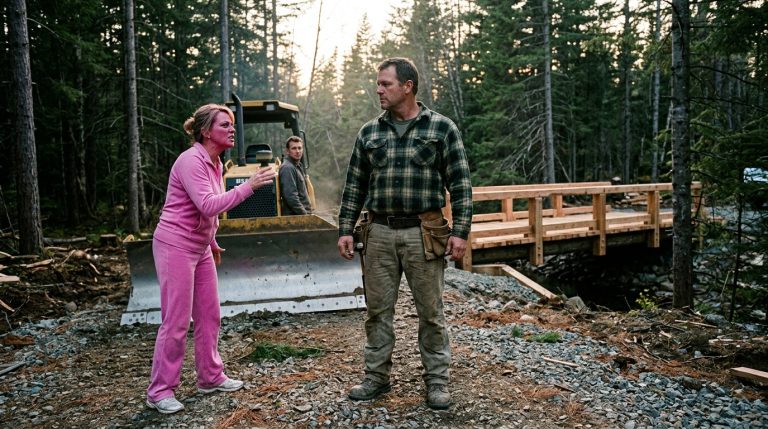
Karen stood at the edge of the path, a fleshy, floral-patterned roadblock in a landscape of quiet, rural independence. Beside her, Herb hovered, a nervous ghost vibrating with the need to be anywhere else. I didn’t reach for my tools. I didn’t raise my voice. I simply stood my ground, my boots biting into the dirt of the ten acres I had secured with twenty years of service.
“That pile is a blight,” Karen stated, her voice oscillating between a whine and a command. Her gaze didn’t scan the wood; it insulted it. She pointed a manicured finger, the nail polished a shade of crimson that seemed to pulse with her agitation. “The covenants are clear. Unseemly accumulations of debris are prohibited. You have seven days to remove it, or the fines begin.”
I took a slow, measured breath. It was the rhythm of a man who had built dams and bridges in places where a decimal point decided who lived and who drowned. My voice, when I finally spoke, was a cold, flat surface. “You are standing on my property, Karen. The HOA’s jurisdiction ends two hundred yards that way, at the intersection by the main road. That wood is nowhere near your line.”
She didn’t blink. She only tightened, her face flushing to a color that signaled a complete rejection of reality. “Don’t you dare talk to me about boundaries, mister. I am the president of this association, and I interpret the rules. You move it, or we place a lien on your house. We will make your life an endless, expensive footnote in our records.”
She turned, her floral mumu straining as she marched back toward the manicured prison of her subdivision, Herb trailing behind like a shadow that had lost its light. I watched them go, the silence returning to the woods, but the air felt charged, metallic. I turned back to the stack of oak. The sunlight caught the rough edges of the split wood, and for the first time, I didn’t see winter fuel. I saw a line in the sand.
As I walked toward the house, a sudden, jarring detail caught my eye—a small, dark smear on the gravel where Karen had been standing. I leaned in, my heart rhythm shifting from calm to a steady, predatory pulse. It was hydraulic fluid, fresh and dark, leaking from somewhere nearby. I looked back at the road, then toward her house. Something was off. A storm was coming, but it wasn’t the weather; it was a mistake she had just made, and I was already calculating the fallout.
CHAPTER 2: The Blueprint of Resistance
I stood in the driveway long after the taillights of Karen’s sedan had faded into the dusk, my eyes locked on the dark, viscous stain near the gravel path. It was an intrusion—a leak from a system that shouldn’t have been on my land in the first place. My mind, usually a clean, geometric grid of structural integrity and load-bearing logic, felt suddenly cluttered with the friction of her pettiness.
I walked back inside, the chill of the autumn evening clinging to my skin. Sarah was standing at the kitchen island, a dish towel gripped in her hands, her eyes searching mine. She didn’t have to ask. The tension in my shoulders, the way I locked the door behind me with a little more force than necessary—it was an external reflection of the internal shift.
“She’s escalating,” Sarah said softly, her voice barely rising above the hum of the refrigerator.
“She’s confused,” I corrected, pulling the three-ring binder from my leather briefcase and placing it on the table with a dull thud. “She thinks this is a dispute about aesthetics. She thinks if she pulls the right levers—fines, threats, the weight of a title—I’ll fold like the others. She doesn’t understand the terrain.”
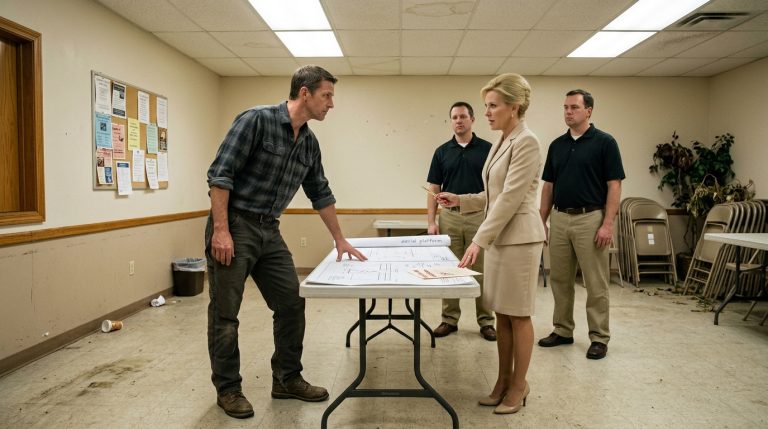
I went to my office, leaving the domestic warmth behind for the cold, organized sanctuary of my command center. The room was dark, save for the pool of light beneath my desk lamp. I spread the CC&Rs and the county plat map out once more. I didn’t see paper; I saw a series of structural weaknesses.
As I traced the boundary lines, a memory—a ghost from a project in the Corps—flickered in the back of my mind. A dam project, years ago, where a small, ignored crack in the concrete had grown under pressure until the entire system began to weep. It was a failure of oversight, a failure to read the material under stress. I gripped my pen, the metal cool against my fingers. I couldn’t afford to be the dam that broke.
I began to cross-reference the HOA’s bylaws with the county tax records. There was a discrepancy. The HOA’s governing document claimed authority over the “Old Mill Road” tract, but the county register’s map—the only map that carried legal weight—showed that the “Partial Covenant Area A” was a limited easement, not a total ownership zone. Karen was acting as if she held a deed to the entire countryside, when in reality, she held nothing more than a poorly drafted contract and a loud voice.
The silence of the house was absolute, yet the room felt loud with the noise of my calculations. I wasn’t just defending a wood pile. I was performing a stress test on a failing system. I noticed an oddity in the fine assessment schedule—the document she had threatened me with. The bank routing number listed for the “HOA Fines Account” didn’t match the public ledger for the community’s registered non-profit. It was an off-book account.
My breath hitched. A simple, petty tyrant wouldn’t have been this careless. This wasn’t just about control; this was about extraction. I looked at the routing number again, my pulse quickening. If that account was personal, the scale of this war had just changed. She wasn’t just trying to “clean up” the neighborhood; she was running an engine of personal profit.
I picked up the phone, my movements deliberate. I needed someone who understood the architecture of financial fraud as well as I understood the architecture of land rights. Dave.
“Mark?” Dave’s voice was weary, the late-night rasp of a man who spent his life arguing with people who didn’t want to listen. “It’s nearly midnight. Tell me you’re calling to discuss the structural integrity of that suspension bridge you promised to build me.”
“I’m calling because the bridge is already built, Dave,” I said, my voice steady. “And I think I just found the structural flaw that’s going to bring the whole thing down. I’ve got the bylaws, and I’ve got the county records. The HOA is running a shadow account. It’s not a regulation issue anymore; it’s a criminal one.”
There was a silence on the other end, long and sharp. When Dave spoke again, the weariness was gone, replaced by the precise, predatory cadence of a lawyer who had just smelled blood. “Send me the copies. Everything. If she’s playing with the money, she’s not just a nuisance. She’s a liability to every single person in that subdivision. We don’t just fight the fine, Mark. We burn the foundation.”
I hung up, the room feeling smaller, tighter. I stepped to the window. Outside, the darkness of the woods was absolute. Somewhere out there, the wood pile sat, a silent witness to a conflict that was no longer about firewood. I felt the weight of the house around me, the responsibility of the land. Karen wanted a war of attrition. She wanted to see who would blink first, who would run out of energy, who would surrender their autonomy to the comfort of compliance.
I checked the trail camera’s signal on my laptop. The infrared feed was clear. The woods were still. I realized then that my previous life—the life where I was just a homeowner, a neighbor, a man enjoying his retirement—was over. I was back in the field. I was looking at a set of blueprints, and I was going to find every single load-bearing weakness in her empire.
I sat back, the cool metal of the desk lamp reflecting in my eyes. The strategy was clear. Draw her in. Let her believe the threat of the lien was working. Let her continue to inflate the “fine” in that shadow account, unaware that every digital entry, every notice, every signature she put to paper was a structural support she was systematically removing from her own life. I wouldn’t rush. Precision requires time, and time was the one thing Karen Miller was about to run out of.
CHAPTER 3: The Infrastructure of Deceit
The dawn didn’t bring light so much as it bled gray across the edge of the woods. I sat in my office chair, the leather having long ago ceased to feel comfortable against my back. My eyes were burning, dry from hours of staring at the flickering spreadsheet I’d built, cross-referencing the HOA’s fine receipts against the community’s actual maintenance costs. The gap wasn’t just a rounding error; it was a canyon.
Every time Karen issued a fine, the money went into a private holding account rather than the association’s general ledger. I stood up, the chair scraping sharply against the hardwood floor—a sound that felt like a gunshot in the stillness of the house. I walked to the window. Across the street, the neighborhood was beginning to stir. I watched George Henderson walk his golden retriever, the dog sniffing at a patch of clover near the sidewalk. For the first time, I looked at the neighborhood and didn’t see a peaceful enclave. I saw a series of victims.
The V-4 edge of my paranoia flickered. Was George’s walk a coincidence, or was he checking to see if I’d complied with the “notice”? I shook the thought away, though it left a bitter residue. My perception was shifting; I was starting to see the invisible lines of Karen’s influence everywhere—the way the mail carrier paused slightly longer at her box, the way the neighborhood kids stayed silent when they rolled their bikes past her property. It was a pressure system, and I was the one moving to disrupt the equilibrium.
I didn’t have time for the psychological weight of the neighborhood’s fear. I had a tactical installation to complete. I grabbed the trail camera from the floor, my fingers brushing the cold, camouflaged plastic of the casing. I checked the lithium batteries—fresh. I checked the SD card—formatted. I stepped out into the biting autumn air, the grass slick with frost.
Walking toward the wood pile, I felt the crunch of gravel beneath my boots, every sound magnified by the quiet. I reached the mature oak tree, the one I had scouted days ago. It was a sentinel, hidden within the canopy of the dense treeline. As I climbed the ladder, I caught a glimpse of movement near the perimeter of Harmony Creek. It was Ron, Karen’s husband, standing on his back deck, smoking a cigarette. He wasn’t looking at me—or so he wanted me to think.
I paused, pressing my body against the rough, lichen-covered bark of the oak. I waited until his gaze drifted toward the sunrise before I began the final installation. I wasn’t just setting a camera; I was establishing a theater of operations. I tilted the lens, ensuring the field of vision covered every square inch of the wood pile and the gravel path. If she wanted a war, she was going to get one, and it would be documented with the clinical coldness of an engineering report.
The camera clicked into place. As I descended, the physical sensation of the tree—the sap on my palms, the rough texture of the bark—grounded me. But when I reached the ground and looked back toward the subdivision, the illusion of peace was gone. Every house, every manicured lawn, every perfectly spaced fence seemed to be an extension of her architecture.
I returned to the house, but I didn’t go back to the office. I went to the kitchen. Sarah was already up, the smell of coffee acting as a temporary sanctuary. She looked at me, her eyes noting the dark circles, the tension in my jaw.
“You’re not eating,” she said, nodding at the toast she’d left on the counter.
“I’m calculating,” I replied, though the words felt hollow. I stared at the coffee mug, my hands steady, even as my mind replayed the routing numbers I’d found earlier. “She’s been siphoning the funds for years, Sarah. Not just from me—from everyone. Every time someone painted a door the wrong shade or left a bike out, she wasn’t just enforcing a rule. She was taxing them.”
“We need to stop this before it goes further, Mark,” she said, her voice firmer now.
“We are,” I said, my gaze hardening. “But the foundation has to be solid. I’m not just going to report her. I’m going to make sure the evidence is so airtight that the board has no choice but to dismantle her from the inside out.”
I left the coffee untouched. I had to get the surveyor’s reports finalized and prepare the formal demand for the board. The plan was moving from a defensive posture to an offensive one, but the cost was becoming clearer by the hour. My home, my sanctuary, was slowly becoming a cockpit of a war I hadn’t asked for, and the silence of the house no longer felt like peace—it felt like the breathless pause before an impact. I turned back to my office, ready to finish the next layer of the trap.
CHAPTER 4: The Midnight Extraction
The first thing I noticed wasn’t the sound, but the change in the air quality. It was a subtle drop in temperature, the kind that happens when a door is left ajar in the dead of night. I walked out of the office, the floorboards cold beneath my feet. I had been planning to sleep for three hours, just enough to clear the mental fog before re-examining the bank routing numbers, but the house felt exposed.
I pulled the curtain back at the kitchen window. The landscape was a monochromatic wash of gray and silver under the moon, but something near the north perimeter caught the light differently. I didn’t reach for my shoes. I reached for the heavy flashlight I kept by the back door and stepped out into the frost.
My breath hitched as I reached the edge of the wood pile. The stack was still there, but it looked… violated. Not gone, not yet, but shifted. A few logs had been tossed aside, the crisp geometry of my precision stacking ruined. My heart thrummed against my ribs, a dull, rhythmic ache. I swept the light across the mud around the base of the pile, and there, deep in the frozen muck, were the tracks. Not just footprints—heavy, deep indentations from a tread pattern I didn’t recognize. These weren’t the scuffs of a curious neighbor or a lost deer. This was the work of a professional, someone comfortable operating in the dark.
I knelt, the damp cold soaking through my trousers instantly. The tracks led away, heading toward the Harmony Creek border. My gaze followed them, a hot, focused anger radiating from my chest. She wasn’t just sending letters anymore. She was testing the perimeter. She was probing for a weakness, an opening, a moment where my guard would be low enough to strike.
I didn’t follow the tracks immediately. That was what she wanted—a reaction, a confrontation, a public spectacle where she could play the victim. I stood up, smoothing the dirt with the toe of my boot to hide my discovery, and turned back to the house. I had to maintain the facade. I had to let her believe that her midnight reconnaissance was undetected.
Back inside, I moved to the garage. I didn’t turn on the light. I felt my way to the locker where the backup SD cards were stored and swapped the unit in the trail camera, just in case they had damaged the one I had already installed. I was working in the dark, my movements fueled by a cold, mechanical necessity. Every step I took was a counter-move in a game that was rapidly accelerating beyond the civil boundaries of an HOA dispute.
By the time I reached the kitchen, the sky was beginning to bruise with the first light of dawn. Sarah was awake, sitting at the table, a cup of tea untouched in front of her. She looked at me, her expression guarded.
“You were out there,” she said.
“They were on the property, Sarah,” I replied, keeping my voice low, stripped of any emotion. “They aren’t just sending notices anymore. They’re coming onto the land.”
She didn’t cry. She didn’t panic. She simply gripped the edge of the table, her knuckles white. “What do we do?”
“We gather the data,” I said, moving to the counter where the legal files were spread out. “We document every inch of the trespass. We build the case so that when we move, we don’t just win—we end it. I’m going to contact the police today, not just as a neighbor, but as a victim of criminal trespass.”
I went back to the office, my mind a churning engine of logistics and legal strategy. I didn’t feel fear. Fear implies a loss of control, and I was in total command of the variables. I opened the file on Karen’s “fine account” again. If she was willing to trespass on my land in the middle of the night, she was desperate. And desperation, in my experience, was the precursor to a fatal, irreversible error.
I looked at the screen, the numbers blurring into a map of her own demise. She was moving resources, liquidating assets, and creating a paper trail that pointed directly to her own greed. I wasn’t just fighting a tyrant; I was documenting the slow, inevitable collapse of her entire world. I reached for the phone to call the county detective, my finger hovering over the dial. The game had reached its second act, and the price of the first act had already been paid in blood and wood. I was ready for the next move.
CHAPTER 5: The Legal Artillery
I didn’t wait for the sun to fully crest the treeline before I picked up the receiver. My finger dialed the number for the county detective’s office—a number I’d committed to memory as if it were a tactical coordinate. The line rang twice, a hollow, rhythmic sound that grated against the early morning silence of my office.
“Detective Miller,” a voice clipped and sharp answered.
“This is Mark Jennings,” I said, my voice as level as a spirit level. “I’m reporting a criminal trespass and attempted theft on my property. My security systems captured the activity.”
The detective’s tone shifted from professional indifference to clinical attention. “Give me the specifics, Mr. Jennings. Did you confront them?”
“No,” I replied, suppressing the urge to mention how close I’d been to the edge of that pile. “I let them believe they were unseen. I have the footage. It shows clear tread marks and a vehicle movement patterns consistent with heavy equipment, likely a contractor’s flatbed. I need an official report filed immediately to establish a timeline.”
As we spoke, the sharp scent of damp earth and frost drifted in through the slightly cracked office window. I was looking at the screen, the bank routing numbers glowing in the dark, when a heavy, rhythmic thudding sounded at my front door. It wasn’t the tentative knock of a neighbor. It was a firm, official rap.
I excused myself from the detective, set the phone on the desk, and walked through the hallway. My heart rate didn’t spike; it simply settled into a steady, predatory rhythm. I opened the door to find a man in a crisp uniform—a county inspector—holding a clipboard.
“Mr. Jennings?” he asked, not looking at me, but at the house structure behind me. “I’m here regarding an anonymous report about a zoning violation on this property. Specifically, an alleged unauthorized structure.”
The V-3 variance hit me with the force of a physical blow. Karen wasn’t just creeping around at night anymore; she was weaponizing the county’s own bureaucracy to force an inspection. If he found the “violation”—the wood pile, or perhaps something else she had fabricated—it would give her the legal cover she needed to seize the land under an emergency order.
“I’m sorry,” I said, stepping onto the porch and closing the door behind me, “I haven’t seen any notice for an inspection.”
“Anonymous tip,” he repeated, his eyes finally meeting mine. They were tired, bored eyes. “We have to follow up. It’s part of the new directive regarding older plots like yours. I need access to the north perimeter.”
This was the pivot point. If I refused, I looked guilty. If I allowed him to proceed, he would likely find the wood pile and, if he was in her pocket, mark it as a “hazard” to justify a forced cleanup. I reached into my pocket, my fingers finding the laminated copy of the certified survey report—the silver bullet.
“I’m happy to cooperate,” I said, a faint, dangerous smile touching my lips. “But I have a certified county survey that defines my property lines as non-covenanted. I’m sure you’d want to verify the boundary with the registry before we document any potential ‘violations’ on land that falls outside your jurisdiction.”
The inspector paused, his pen hovering. The mention of the certified survey changed the dynamic. He wasn’t a pawn in Karen’s game; he was a civil servant who didn’t want to get tangled in a legal disaster. “You have the survey on hand?”
“In my office,” I said. “And I’d be happy to show you, along with the report I’m currently filing with Detective Miller regarding a recent criminal trespass on that exact same boundary.”
The inspector blinked. The mention of a police detective had the intended effect. His posture relaxed, the bureaucratic rigidity softening into a pragmatic neutrality. “If there’s an active police investigation on the boundary, my inspection is redundant. I’ll note the file as ‘pending investigation’.”
He didn’t wait for me to bring out the papers. He tipped his hat, turned on his heel, and retreated to his truck. I watched him pull away, the gravel crunching under his tires. It had been a close call—the kind of improvisation that defined this entire conflict. She was using everything she had, throwing every piece of infrastructure she controlled at me, hoping something would stick. But every time she missed, every time she failed, she was just burning more fuel. I turned back toward the office, the adrenaline of the narrow escape feeding the cold, singular resolve that had become my defining trait. I was ready for the next move.