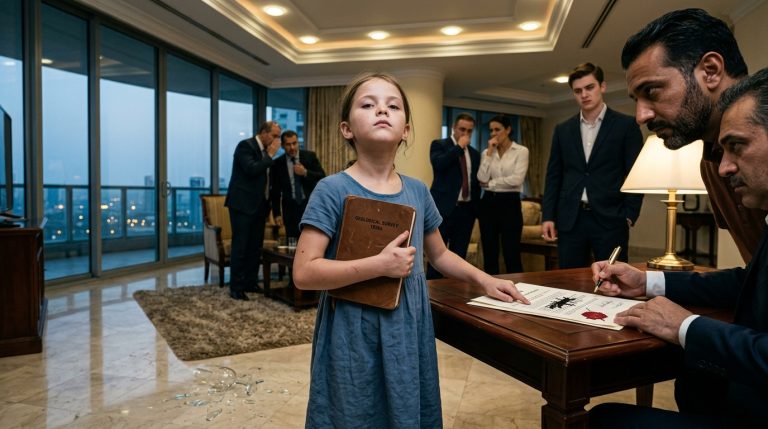
A House Restored: How a Shared Legacy of Courage Transformed a Silent Mansion into a Sanctuary
CHAPTER 1: The Weight of Scraps
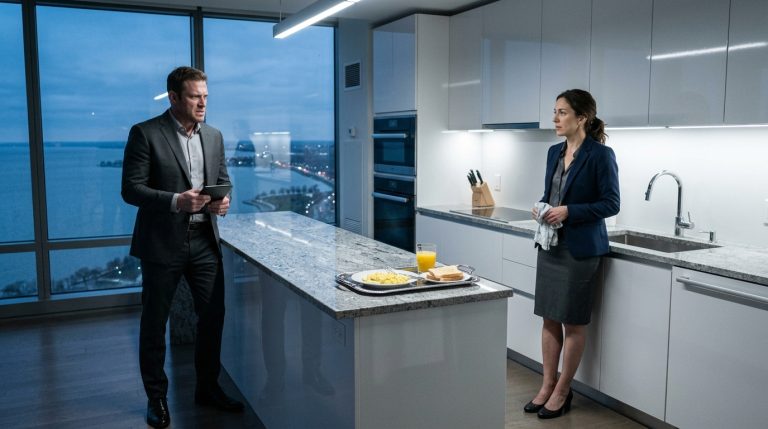
Sophie Miller knew that hunger was a sound. It wasn’t the noise of a grumbling stomach, but the sharp, rhythmic ticking of the grand hallway clock, echoing through the cavernous stainless-steel kitchen of the Blackwell mansion. She pressed herself against the cold, humming metal of the pantry freezer, her breath hitched, her lungs constricted by the fear that Mrs. Petrov, with her iron-heeled shoes, would round the corner at any second.
She had mapped this room like a soldier mapping a battlefield. Her mother, Anna, was upstairs somewhere, turning down 20 guest beds that nobody ever slept in, her cough echoing in the silence. Sophie was 10, but in this house of marble and gold, she felt like a ghost, a small, pale smudge in the corner of a life she didn’t belong to.
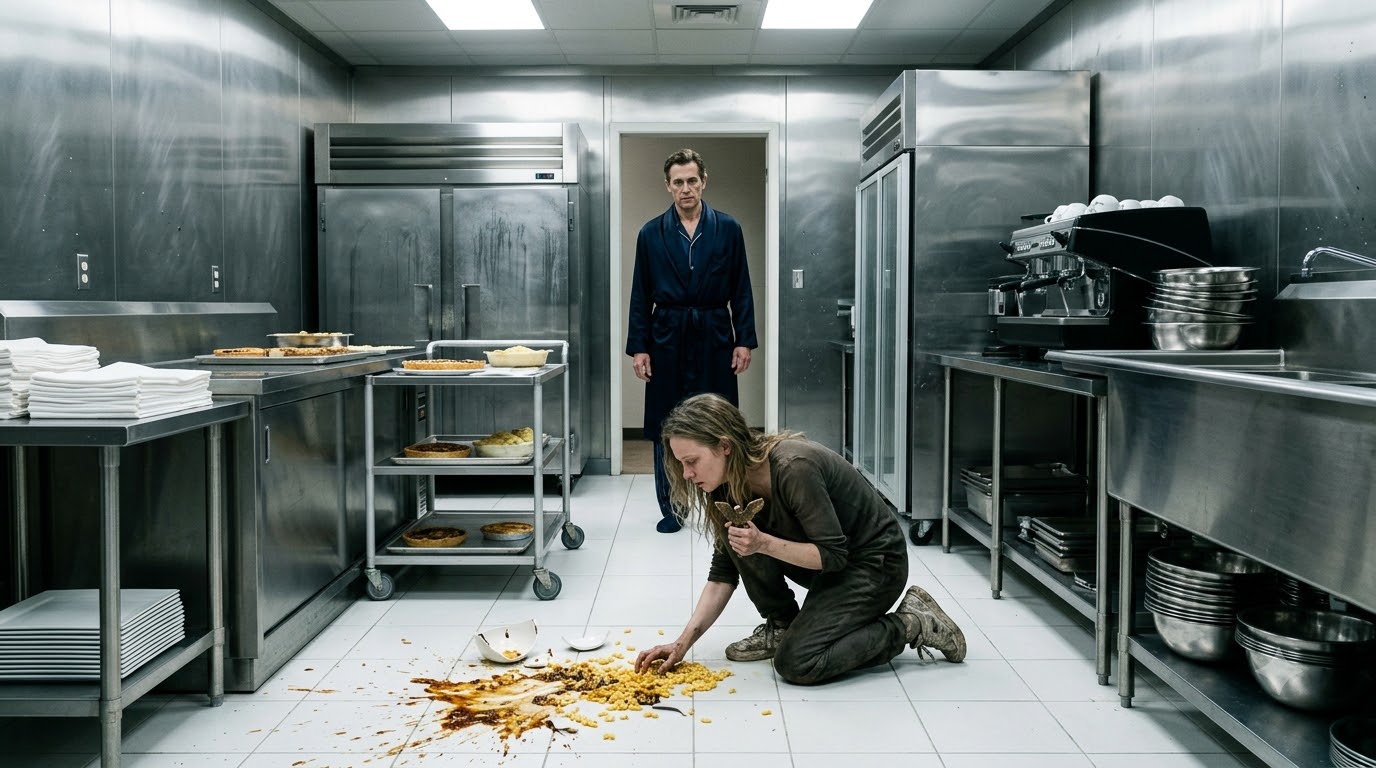
At 9:14 p.m., the kitchen was a cathedral of discarded potential. The staff left the scraps on the catering cart—half-eaten tarts, rubbery potatoes, the dregs of a life lived in excess. Sophie moved. Her feet were silent, ghost-like, drifting across the granite floor that always felt colder than the air. She reached for the bowl of macaroni, the yellow sauce congealing in the artificial light.
Her fingers closed around the porcelain, but the floor shifted. A sound, small and sharp, sliced through the air—the clatter of a bowl hitting tile. The spill looked like a neon wound on the white floor.
The light clicked on.
It wasn’t Mrs. Petrov. It was him. Harrison Blackwell stood in the doorway, a man who looked like he had been sculpted out of the same cold, grey stone as his house. His bathrobe was a deep, midnight blue, and his eyes—the eyes that had built empires—were sunken, tired, and profoundly vacant.
Sophie froze, her small, dirt-streaked hand hovering over the spilled mess. She had nowhere to run. The exit was blocked by the man who owned everything, and her mother’s job hung by a thread that was rapidly fraying. She didn’t look at his face. She looked at the floor, her heart hammering a frantic, uneven rhythm against her ribs.
“Who are you?”
The voice was rough, like gravel shifting under heavy boots. Harrison stepped forward, his leather slippers making no sound on the stone. He didn’t look angry. He looked as if he were trying to remember something he had forgotten a long time ago.
Sophie’s throat closed. She couldn’t say sorry. She couldn’t beg. She simply dropped to her knees, her fingers moving in a frantic, shaking dance as she tried to scoop the pasta back into the broken dish, the cold sauce staining her skin.
“I’ll clean it,” she whispered, her voice barely audible over the hum of the freezer. “Please. I’ll clean it. Don’t tell my mama. Please, sir.”
Harrison didn’t move. He stood over her, a mountain of silk and silver, watching her hands. Then, he did the one thing that broke the silence of the house entirely. He knelt. His knees popped, a dry, fragile sound in the vast kitchen. He looked at the girl, then at the small, bronze pin she had clutched in her other hand, a forgotten piece of history reflecting the dim light, and his gaze sharpened, the emptiness behind his eyes flickering with a sudden, painful recognition.
“Stop,” he said, his voice dropping into a register she hadn’t expected. “Look at me.”
Sophie looked up. The information gap hit her—his expression wasn’t one of judgment, but of a man realizing the house he lived in was built on a foundation he no longer understood.
CHAPTER 2: The Perimeter of Control
The kitchen air was still, heavy with the metallic tang of the industrial freezer and the subtle, sharp scent of floor wax. Harrison remained on his knees, his hands resting on the cool white tile, his silver hair catching the fluorescent hum of the ceiling lights. The silence between him and Sophie was not the empty void he was accustomed to; it was a pressurized chamber, waiting for the first crack.
“Who are you?” he had asked.
Sophie didn’t answer. She couldn’t. She was looking at the pin in her hand, the bronze wings of the eagle catching the light. She was terrified that the man before her—the man who owned the very air she breathed—would see not a child, but a trespasser.
The heavy kitchen door swung open, a sound like a guillotine blade dropping.
Mrs. Petrov stood in the doorway. She was a silhouette of absolute rigidity, her uniform so crisp it seemed to vibrate with stored kinetic energy. Her eyes, thin slits of cold gray, took in the scene: the billionaire in his expensive bathrobe, the spilled orange mess of the macaroni, and the girl, trembling like a leaf in a gale.
“Mr. Blackwell,” Mrs. Petrov said. Her voice was not a question; it was an interruption. “I heard a noise. I assume this… intrusion… is being handled?”
Harrison turned his head slowly. The transition was agonizingly deliberate. He didn’t rise immediately; he kept one hand on the floor, feeling the hard, unyielding reality of his own house. For a decade, he had let this woman govern his domain, letting her turn his life into a quiet, efficient museum. He looked at her, really looked at her, for the first time in years. He noticed the way she stood, not as a servant, but as a warden.
“It is being handled,” Harrison said. His voice was not the broken rasp from earlier; it was the voice that used to command boardrooms and dismantle monopolies.
Mrs. Petrov stepped into the room, the click of her heels sounding like gunfire on the polished stone. She didn’t look at Harrison; she locked her gaze onto Sophie. “I suspected as much. These people, sir—they have no respect for boundaries. I will have the night porters remove her, and I will see to it that her mother is escorted from the premises immediately. There is no room for theft in this house.”
Sophie’s eyes went wide. She started to scramble backward, her knees scraping against the tile. “No,” she gasped, her voice thin. “Please. Mama, she—she didn’t know.”
“Silence,” Mrs. Petrov commanded. She stepped forward, her hand reaching out as if to physically pluck the child from the floor, a movement that was all leverage and malice.
Harrison stood up.
He didn’t do it with a flourish; he did it with the tectonic weight of a man recovering his own territory. He moved between Mrs. Petrov and the girl, his presence suddenly massive, casting a long, dark shadow that effectively quarantined the housekeeper from her prey.
“Mrs. Petrov,” Harrison said, his tone dangerously soft.
The housekeeper stopped. She looked up, her expression flickering with a momentary, uncharacteristic confusion. She had expected compliance; she had expected the hollow man who had spent ten years mourning and signing papers without reading them.
“Sir?”
“You speak of boundaries,” Harrison said, his eyes scanning the room, landing on the stainless-steel cart, the industrial sink, the perfect order she had imposed. “But I find it interesting that you seem to believe you are the one who defines them.”
“I have managed this house for ten years, Mr. Blackwell. I have maintained the standards you requested,” she said, her voice tightening, a subtle tremor of anxiety leaking through the starch.
“And yet,” Harrison continued, his gaze drifting to the bronze pin in Sophie’s hand, “the standards seem to have drifted quite far from the humanity I once expected to find here.”
The atmosphere in the kitchen shifted. The temperature felt like it had dropped ten degrees. Mrs. Petrov adjusted her grip on her apron, her knuckles whitening. The strategy had changed. She realized, in that sharp, sickening second, that the script she had been following for a decade had been rewritten. She pulled her shoulders back, attempting to reclaim her posture of superiority, but the foundation was already cracked.
“If you intend to coddle a thief, sir, that is your prerogative,” Mrs. Petrov said, her tone dripping with manufactured concern. “But it will affect the morale of the entire staff. They work for a standard of excellence. This will be seen as a weakness.”
“Weakness is a matter of perspective, Mrs. Petrov,” Harrison replied, turning his back on her to look at Sophie. He knelt once more, ignoring the protest of his joints. He reached out, his hand open. “Sophie, give me the pin.”
Sophie hesitated. It was the only thing she had. It was her mother’s history, her own shield. But looking into Harrison’s eyes—eyes that were no longer vacant—she felt a strange, terrifying sense of safety. She placed the bronze eagle into his palm.
Harrison inspected it. He felt the weight of it, the cold metal, the history etched into the wings. He stood and held it up, catching the light.
“This is not a trinket,” he said, turning back to the housekeeper. “It is a record of a man who died for his team. A man who understood the value of a single life. And I have spent ten years surrounding myself with people who don’t know the difference between a life and an inventory item.”
Mrs. Petrov opened her mouth to argue, her face flush with a mix of indignation and fear, but Harrison raised a hand.
“You will leave the kitchen, Mrs. Petrov. Now.”
“Sir, the mess—”
“I said leave.”
The command wasn’t loud, but it resonated with such finality that the air itself seemed to recoil. Mrs. Petrov hesitated, her gaze darting between the billionaire and the girl, searching for an opening, a counter-move, a way to salvage her authority. Finding none, she gave a stiff, mechanical nod, her face a mask of barely suppressed rage.
She turned and marched out, her footsteps rhythmic and precise, each one an echo of the order she was losing.
Harrison waited until the door swung shut and the latch clicked home. He looked down at Sophie, who was still kneeling, her face tear-streaked and pale.
“She is gone,” he said. He handed the pin back. “For now.”
Sophie took the pin, clutching it to her chest. Her breath came in shallow, ragged bursts. “She’s going to tell Mama,” she whispered. “She’s going to have us thrown out.”
“No,” Harrison said. He reached over and picked up the discarded cloth he had used earlier. He began wiping the floor, the movement fluid and intentional. “Your mother is an employee of this house, and as such, she is under my protection. And if you are to be in this house, you will not be hiding in the shadows of a freezer.”
He stopped wiping and looked at the girl. “You are hungry. That is a biological fact. It is not a crime. And in this house, we do not treat hunger as a secret to be kept in the dark.”
He stood up, his face set in a line of cold resolve. The ghost was gone. In its place was the man who had built a fortune, and for the first time in ten years, he was ready to put that fortune to work for something that actually mattered.
“Come,” he said, gesturing toward the door that led to the main hall, the path that was strictly forbidden for the staff. “We are going to find your mother. And we are going to have a conversation about the way things are going to change.”
Sophie stood up, her legs feeling like lead. She followed him toward the threshold, the house looming ahead of them like a giant, silent beast. She didn’t know what was waiting behind those doors, but as she gripped the bronze pin, she felt the first, faint stirrings of something she hadn’t felt in a long time.
Hope.
CHAPTER 3: The Ascent Through Shadows
The transition from the kitchen to the main hall was not merely a change in rooms; it was a traversal across a border. Harrison walked with a measured, heavy gait, his robe flowing behind him like the cloak of a specter. Sophie followed, her feet hesitating on the edge of the service entrance. The carpet here was different—deep, midnight blue, so thick it seemed to swallow the sound of her worn-out sneakers.
The air changed, too. The sharp, functional sterility of the kitchen gave way to the stagnant, expensive silence of the manor’s core. It was a space that hadn’t seen the kinetic energy of a child in a decade.
“Stay close,” Harrison murmured. He didn’t look back. His eyes were fixed on the grand staircase, a sweeping artery of dark cherrywood that curled upward into the shadows of the second floor.
Anna followed, her hand white-knuckled as she gripped Sophie’s shoulder. She looked around, her eyes wide, scanning the portraits of ancestors whose stern expressions seemed to track their movement. “Sir,” she whispered, her voice failing to carry across the vast space. “The staff staircase is just down the west hall. We… we don’t have to use the grand entrance.”
Harrison stopped. He turned slowly, the dim light of a crystal wall sconce catching the silver in his hair. He looked at Anna—really looked at her—and saw the remnants of the woman who had sprinted into a burning building to save a cat. He saw the resilience that he had been starving for all these years.
“For ten years,” Harrison said, his voice low, “I have allowed the architecture of this house to dictate who is worthy of walking through its halls. I have allowed a set of rules to turn my home into a mausoleum. You are not staff tonight, Anna. You are my guests. And my guests do not use the service entrance.”
He turned back to the stairs and began the ascent.
Sophie took the first step, her heart drumming a frantic rhythm against her ribs. The wood beneath her feet creaked, a sound so loud in the cavernous room that she flinched. She kept her eyes on the back of Harrison’s robe, watching the way he moved. He climbed with a strange, tentative grace, as if he were trying to recall the feeling of belonging in his own life.
As they reached the landing, the house seemed to press in on them. Every shadow looked like a memory. Sophie looked at the portraits, the faces of people who had been dead long before she was born. They looked down with cold, aristocratic indifference. She felt a phantom chill, a sense that the house itself was aware of them—an intruder’s heartbeat in a space that demanded perfection.
“The Blue Room,” Harrison said, his voice echoing slightly against the high, vaulted ceiling. “It faces the gardens. It’s the quietest part of the house.”
He reached a door at the end of the long, dim hallway—a door painted a pale, soft blue, standing out against the mahogany paneling like a breath of fresh air. He took the brass handle, his fingers lingering on the cold, polished surface. There was a hesitation in his movement, a split second where he looked at the door not as a room, but as a monument to his wife.
Sophie watched him. She saw the way his jaw tightened, the way his shoulders slumped just a fraction of an inch. She didn’t know the name Eleanor, but she could feel the sadness radiating from him, a cold, thick fog that smelled of cedarwood and old paper. It was the same sadness her mother carried, a weight that couldn’t be set down, only dragged through the day.
Harrison pushed the door open.
The room was vast, dominated by a bed that looked like a mountain of white silk and down pillows. The moonlight streamed in through the sheer curtains, turning the floor into a silver-dusted mirror. It was beautiful, but it was empty—an aesthetic perfection that felt almost like a cage.
“It’s…” Sophie’s voice trailed off, lost in the expanse of the room. She felt small. She looked at her own clothes, the worn-out fabric, the dirt-stained sneakers, and she felt like a smudge of ink on a pristine page.
“It is yours for the night,” Harrison said, stepping inside. He didn’t look at the bed. He went straight to the window and adjusted the curtains, his back to them. “The bathroom is through the door on the left. There are fresh clothes in the dresser—my granddaughter’s. They should fit.”
Anna walked into the room, her eyes darting around. She looked like she was waiting for someone to shout, for the house to correct the mistake of their presence. She went to the bed, touching the comforter with a finger that trembled.
“I don’t know how to thank you, sir,” she said, her voice strained. “I don’t know how to—”
“Stop,” Harrison said, turning around. He looked tired again, the sudden energy of the kitchen standoff waning. “There is nothing to thank me for. There is only a lot of time to make up for.”
He walked toward the door, passing them. As he reached the threshold, he stopped and looked back at Sophie. He noticed her fingers were still gripping the bronze pin inside her pocket. He offered a small, ghost of a smile—not a kind one, but a genuine one.
“Sleep, Sophie. We have things to do tomorrow. Real things.”
He left the room, the door closing with a soft, final click.
Sophie stood in the center of the room, listening to the silence of the mansion. It was different from the silence of their apartment. Their silence was small, tight, and filled with the pressure of what they didn’t have. This silence was huge, hollow, and filled with the pressure of everything that had been lost.
She walked over to the dresser, pulling out a drawer. Inside, neat piles of soft, expensive fabric sat waiting. She pulled out a set of pajamas—flannel, patterned with small roses. They were the most beautiful thing she had ever touched.
She turned to look at her mother, who was sitting on the edge of the bed, her face buried in her hands.
“Mama?” Sophie whispered.
Anna looked up. Her eyes were red, but she wasn’t crying anymore. She looked exhausted, her posture slumped under the weight of the last few hours. She looked at the room, then at her daughter, and finally, she gave a slow, deliberate nod.
“We’re going to be okay, Sophie,” she said, though the doubt still lingered in the corners of her eyes like shadows. “We are just going to be okay.”
Sophie moved to the bed, climbing up until she reached the center. The mattress sank, cradling her. It was so soft it felt like she was disappearing. She curled up, pulling the thick, heavy duvet over her head. She held the bronze pin tight, feeling the edges of the eagle’s wings press against her palm.
In the darkness, the house continued to hum, its internal mechanisms ticking away like the heartbeat of a giant. Sophie listened, waiting for the floor to creak, waiting for Mrs. Petrov to appear in the doorway, waiting for the dream to end.
But as the moonlight shifted across the floorboards, she closed her eyes, and for the first time in years, the hunger was gone, replaced by a deep, hollow exhaustion. She drifted into a sleep that felt dangerously like a new beginning.
CHAPTER 4: The Morning Call
The chime rang again, a thin, persistent beep that seemed to vibrate in the very fibers of the silk curtains. Anna sat bolt upright, her heart hammering against her ribs. She was still fully dressed in her maid’s uniform, her body aching from the unfamiliar stiffness of the mattress, but her mind was instantly alert. She looked toward the bed. Sophie was still buried under the duvet, a small, quiet mountain of flannel and down, oblivious to the world that was once again intruding on their safety.
Anna moved with a soft, cautious grace, tiptoeing across the deep-pile carpet. She reached the desk, her fingers hovering over the receiver of the cream-colored phone. It felt like a tether to a reality she wasn’t sure she was ready to rejoin.
“Hello?” she whispered, her voice husky from sleep.
“Mrs. Miller? Anna Miller?” The voice on the other end was male, crisp, and possessed a terrifying, efficient calm.
“Yes. Yes, this is she.”
“Good morning. My name is David Thorne. I am Mr. Harrison Blackwell’s personal counsel.”
Anna leaned against the edge of the desk, her knees feeling suddenly liquid. The weight of the title—counsel—felt heavy, pressing down on her like a physical force. She glanced back at the bed. Sophie hadn’t stirred. “Is… is something wrong, Mr. Thorne? I apologize for the lateness, I—”
“Not at all, Mrs. Miller,” Thorne interrupted, his tone shifting toward a professional softness. “I am merely calling to confirm the logistics for this morning. Mr. Blackwell has arranged for an appointment with Dr. Robert Evans at the Blackwell Mason Clinic. Nine-thirty sharp. A car will be waiting for you and your daughter at the front entrance at nine o’clock.”
Anna tried to parse the information, but her mind felt sluggish, buffered by the warmth of the room and the strange, lingering disbelief of their situation. “The clinic? But… sir, I don’t know how I can—”
“Please, Mrs. Miller,” Thorne said, and this time there was a firmness that brooked no argument. “Do not worry about the arrangements. Everything—the consultation, the follow-up, the treatment plan—is being handled by Mr. Blackwell’s personal office. Your only task is to be at the front door by nine.”
Anna gripped the edge of the desk, her knuckles white. She looked at the polished mahogany, the neat arrangement of stationery, and the sheer, overwhelming generosity of it all. It felt less like help and more like a massive, unstoppable machine being put into motion on their behalf. “Thank you,” she managed, the words feeling small in the vast, silent room. “Please thank Mr. Blackwell.”
“I will relay the message. Have a productive morning, Mrs. Miller.”
The line went dead with a soft, decisive click. Anna held the receiver for a long moment, staring at the wall. She felt a profound sense of vertigo, the kind that came from looking down from a great height.
She turned back to the room. The morning light was gray and thin, filtering through the curtains to illuminate the fine dust motes dancing in the air. She needed to wake Sophie. She needed to wash her face. She needed to prepare for the reality that they were about to be thrust into, a reality where she was not merely a ghost-maid in the hallways, but a guest of the man who owned them all.
She walked to the dresser, looking for the clothes she had carefully folded the night before. As she moved a stack of crisp, white guest towels, she noticed something beneath the blotter of the desk—a small, partially obscured file. It was thin, bound in a dark blue folder. She didn’t mean to look, but her eyes caught the label: Household Expenditure – October Review.
It wasn’t her business. She knew the rules. She was kitchen staff. She was beneath the notice of the main house’s administrative details. But as she reached to move the file, she caught a glimpse of a line item—a discrepancy in the cleaning supply orders that she had personally filled out weeks ago. The numbers didn’t add up. They were inflated, bloated by a margin that made no sense, a margin she had noted in her own logs at the time, only to be told by Mrs. Petrov that she was “mistaken.”
Her breath hitched. She looked at the date. The file was from weeks before she had been caught in the kitchen.
A sharp, sudden knock at the door made her jump. She shoved the file back beneath the blotter, her heart jumping to her throat.
“Who is it?” she asked, her voice cracking.
“It’s Maria, ma’am,” a nervous voice replied from the other side. “I’ve been sent up… with breakfast.”
Anna took a shuddering breath, smoothing the front of her uniform with trembling hands. She walked to the door and opened it just a crack. A young girl, no older than nineteen, stood there pushing a silver cart. She looked terrified, her eyes darting toward the hallway as if she expected Mrs. Petrov to appear out of the woodwork to strike her down.
“Mr. Blackwell… he called the kitchen himself,” the girl whispered, pushing the cart inside as if it were a contraband item. “He said you were to have whatever you wanted.”
As the girl lifted the silver domes, revealing fluffy eggs and bright red strawberries, Anna looked past her toward the hallway. It was empty, but the silence felt different now. It felt guarded, expectant. Mrs. Petrov was out there, somewhere, and Anna had the sinking, visceral realization that their sudden elevation in status had not made them safe—it had merely made them targets.
She turned back to the room, the scent of fresh coffee rising from the cart. She looked at Sophie, who was finally beginning to stir, her blonde hair a tangled mess against the white pillows.
“Sophie,” Anna said, her voice dropping into a whisper. “Wake up. We have to be ready.”
She went to the window and pulled back the curtains. The garden below was vast, stretching out toward the high, wrought-iron gates of the estate. It looked serene, but to Anna, it now looked like a perimeter. She realized then that the house was not just a home—it was a battlefield, and she had just been dragged onto the front lines.
CHAPTER 5: The Clinic of Cold Precision
The drive to the Blackwell Mason Clinic was a blur of gray morning fog and the rhythmic, hypnotic glide of the tires over wet asphalt. Anna sat in the plush leather seat, her hands folded in her lap, trying to ignore the way the fine stitching of the upholstery felt against her skin. Every detail of the car screamed of a world she had only ever polished, never inhabited. Beside her, Sophie was staring out the window, her thumb tracing the edge of the bronze pin hidden in her pocket, her eyes wide with a mixture of awe and residual fear.
The clinic was a monolithic tower of glass and brushed steel that pierced the fog. It was not a place of healing, Anna thought, but a place of management—an industrial center for the preservation of health that operated with the same cold, calculated efficiency as the Blackwell mansion.
When they arrived, there was no waiting. A woman in a charcoal-gray suit was waiting at the sliding glass entrance. She didn’t smile; she simply nodded and guided them toward a private elevator that whisked them up, past the lobby, straight to the high-security floors of the medical wing.
“Mrs. Miller,” the woman said, her voice devoid of inflection. “Dr. Evans is expecting you in Suite 402.”
The suite was a sprawling space of white marble and muted lighting. It smelled not of medicine, but of ozone and something sharp—like ionized air. And there, sitting in a leather chair that looked identical to the ones in Harrison’s study, was Mr. Blackwell himself. He was dressed in a sharp, dark gray suit that made him look younger, more imposing, yet somehow more fragile.
“Harrison,” Anna said, her voice faltering as she stepped into the room.
“Anna. Sophie,” he replied, standing to greet them. He gestured toward a chair near the windows. “Robert will be with us momentarily. He is reviewing your initial records.”
“This is all… it’s a lot, sir,” Anna said, her gaze drifting toward a wall of framed medical certifications. “I don’t know how to be here. I don’t know how to take all of this.”
Harrison sat back down, his fingers steepled. “You are not here to ‘take’ anything, Anna. You are here to rectify a failure of systems. My systems. The fact that you have been working in my house for three years while suffering from an advanced, treatable condition—and doing so while terrified of losing that employment—is a failure I am now personally correcting.”
“But Mrs. Petrov—”
“Mrs. Petrov,” Harrison interrupted, his tone darkening, “is currently managing a household that will soon be undergoing a significant administrative audit. Do not concern yourself with her.”
Anna felt a prickle of cold at the base of her neck. The way he said it—so flat, so final—hinted at a storm gathering within the mansion’s walls. She looked at the door, half-expecting to see the housekeeper’s rigid silhouette, but there was only the sterile, white corridor.
Dr. Robert Evans entered a moment later, a man who moved with the deliberate pace of someone who didn’t believe in time constraints. He held a tablet that glowed with diagnostic charts. He didn’t waste time on pleasantries.
“Anna,” he said, pulling up a chair. “I’ve gone over the data from your previous clinic. The fibrosis is advanced, but the tissue is still responsive. We’re going to initiate a regimen of specialized medication immediately, alongside a series of respiratory therapies that will focus on re-expanding the lung capacity you’ve lost to the scarring.”
As he spoke, he tapped the screen, and a complex diagram of human lungs appeared, the damaged areas highlighted in a haunting, bruised purple. Anna watched, transfixed. It was her own anatomy, mapped out, measured, and labeled as if it were a faulty machine in need of parts.
“Is it… will it work?” she whispered.
“It will stop the progression,” Evans said, his voice tempered. “The reversal depends on your body’s resilience. But you have to be rigorous. You cannot skip these sessions. You cannot work. You cannot subject yourself to the stress of your previous environment. You must rest.”
Anna looked at Harrison. He was watching the doctor with an intensity that suggested he was looking for a guarantee, not a prognosis. She realized then that this wasn’t just about her survival. Harrison was using her health as a vessel for his own redemption. If he could save her, he could prove to himself that he wasn’t just a ghost.
“I understand,” Anna said, her voice steadying. “I’ll do whatever is required.”
“Excellent,” Evans said, standing up. “My nursing staff will walk you through the first phase of the treatment plan. It starts now.”
As Anna followed a nurse toward a side room, she looked back. Harrison was still sitting in the chair, his eyes fixed on the window, his gaze distant.
The room felt suddenly suffocating. Anna felt the weight of the privilege, the weight of the money, and the weight of the secrets hidden in the blue folder she had seen on the desk in the Blue Room. She felt a phantom, clawing sensation at the back of her mind—a suspicion that she and Sophie were merely chess pieces in a game that was far larger and far more dangerous than just the survival of a maid.
She looked at Sophie, who was sitting quietly in the corner, clutching the bronze pin so tightly that her knuckles were white. The child looked small against the backdrop of the high-tech clinic, a tiny, organic piece of life in a world of steel and glass.
Anna stepped into the treatment room, the door closing behind her with a soft, magnetic thud. The silence of the clinic wrapped around her, and for the first time, she felt a profound, bone-deep dread. She was no longer just the maid. She was the guest, the protected, the project.
And as the nurse began to prepare the equipment, the hum of the machines sounded, to Anna’s ears, exactly like a countdown. She looked at her own hands, raw and trembling, and wondered if the price of this recovery would be higher than she could ever afford to pay.
CHAPTER 6: The Anatomy of Theft
The front doors of the Blackwell mansion swung shut with a heavy, final thud that seemed to echo through the entire foyer. Anna stood on the threshold, her legs feeling heavy, the residual exhaustion from the clinic treatment clinging to her limbs like damp wool. Beside her, Sophie was quiet, her hand still tucked into her pocket, fingers curled protectively around the bronze pin.
The house felt different in the late afternoon light. The shadows were longer, reaching out from the corners of the grand hallway like reaching fingers. Anna’s eyes scanned the foyer, looking for a sign—a presence—but there was only the vast, marble-cold silence. Mrs. Petrov was nowhere to be seen, but the air felt heavy with the woman’s absence, as if her strict, iron-willed discipline had been replaced by a suffocating, waiting tension.
“Mama?” Sophie whispered, her voice barely audible.
“Stay close,” Anna murmured, her hand finding the back of Sophie’s neck, guiding her toward the stairs. She didn’t want to go back to the Blue Room, and she didn’t want to go to the kitchen. Her mind was trapped, looping back to the image of the blue folder tucked beneath the blotter in the study—a room Harrison had used for years, a room he had let fall into disrepair, and a room where he clearly had not been paying attention to the details of his own life.
She moved with an urgency that surprised her. She navigated the hall, avoiding the grand entrance and slipping instead toward the study. She knew the layout; she had polished the floors here a thousand times, always moving with head bowed, invisible, a ghost in her own life.
The door to the study was slightly ajar.
She pushed it open, the heavy wood groaning on its hinges. The room was bathed in the orange, dying light of the sun, casting long, bruised shadows across the rows of leather-bound books. Harrison’s desk dominated the space—a sprawling, dark wood monolith that looked like a place where decisions were made that moved the world.
Anna stepped inside, her heart thumping against her ribs like a trapped bird. She gestured for Sophie to stay by the door. “Stay there, honey. Don’t move.”
She moved to the desk. Her hands were trembling, the skin red and raw, a testament to years of scrubbing that had never been enough. She reached the blotter and pulled. The folder was there, exactly as she had remembered it, the edges slightly frayed, the blue paper slick and cold under her touch.
She didn’t just read it; she dissected it.
She saw the inflated costs for linens. She saw the entries for “emergency repair” that had occurred in rooms she personally maintained, rooms that hadn’t been touched in years. The numbers were staggering—thousands of dollars siphoned away, month after month, year after year, all funneled through a company called Prestige Home Solutions.
It wasn’t a mistake. It was a machine.
She felt a sudden, sharp spike of nausea. She had lived in poverty, skipped meals, and watched her daughter grow thin while this woman, this warden of the mansion, had been building a secret fortune on the back of Harrison’s grief. It wasn’t just greed; it was an act of profound, calculated cruelty.
A floorboard creaked behind her.
Anna whirled around, the file clutched to her chest. Mrs. Petrov stood in the doorway.
The housekeeper wasn’t wearing her uniform. She was dressed in a dark, sensible coat, her hair pulled back into a bun so tight it pulled the skin of her forehead taut. She held a set of keys in her hand—the master keys to the house. She looked at Anna, then at the file, and then at the door where Sophie stood, frozen in terror.
“I wondered,” Mrs. Petrov said, her voice terrifyingly calm, “when you would decide to stop being the loyal, invisible maid.”
“This is theft,” Anna said, her voice shaking, but gaining strength with every word. “All of this. You stole from him. You stole from everyone here.”
Mrs. Petrov took a slow, deliberate step into the room. She didn’t look angry; she looked pitying, a expression that cut deeper than any shout. “I managed this house. I kept the life flowing through these veins while he sat in that chair and withered away. If I hadn’t taken, there would be nothing left to manage. You don’t understand the cost of perfection, Anna.”
“Perfection?” Anna hissed, taking a step toward her, the folder held out like a weapon. “You starved a child. You forced us to beg for scraps.”
“You were always a convenient variable,” Mrs. Petrov replied, her eyes narrowing. She took another step, her hand reaching toward the file. “But you are an incompetent one. You think because he bought you a few meals and a doctor’s visit, you are a guest? You are a temporary amusement. And once he realizes you have been snooping into his private affairs—once he realizes that you are no different from the people who have been trying to drain his accounts for years—you will be gone.”
Anna felt the walls of the room closing in. The room felt suddenly like a vacuum. She looked at the door. Sophie was still there, eyes wide, paralyzed.
“I’m not going anywhere,” Anna said, her voice hardening. “And neither are you.”
Mrs. Petrov lunged.
The movement was unexpected, a blur of motion that shattered the silence of the room. She didn’t go for Anna; she went for the file, her fingers curling around the edge of the blue paper. They struggled for a heartbeat, the friction of the paper rasping in the stillness, both of them pulling, the weight of a decade of secrets hanging between them.
The door swung open wider, and a shadow fell across the room.
“Mrs. Petrov.”
Harrison’s voice was like ice, cutting through the fray with surgical precision.
The housekeeper froze, her hand still locked onto the folder. She looked up, her face draining of all color, the mask of cold, bureaucratic authority finally, irrevocably shattered. Harrison stood in the doorway, his eyes dark, his posture that of a man who had finally seen the rot in his own foundations.
“I believe,” Harrison said, stepping into the room, “that we are finished here.”
The air left the study. Anna stood there, breathless, the file held tightly in her hand, the weight of the truth finally exposed in the light of the setting sun. She knew, with a sinking, final certainty, that the peace of the night before was over. The house was no longer a sanctuary; it was a crime scene, and the truth was about to tear it all down.
CHAPTER 7: The Purge of the Warden
The silence that followed Harrison’s entrance was not empty. It was filled with the frantic, ragged sound of Mrs. Petrov’s breathing. She stood paralyzed, her fingers still gripped white-knuckled around the blue file, her posture caught in the mid-motion of a desperate grab. Across from her, Harrison loomed—a figure reclaimed from the dust of his own mansion. His eyes, usually clouded with the dull, gray film of his long-term grief, were now burning with a cold, piercing clarity.
“I said,” Harrison repeated, his voice dropping into a low, resonant register that vibrated through the floorboards, “that we are finished.”
Mrs. Petrov’s jaw tightened. The shock of his sudden mobilization began to ebb, replaced by a defensive, reptilian instinct. She shifted her weight, her gaze flickering toward the door, then back to the man who had been a compliant, sleeping landlord for a decade. She realized, with a jolt of genuine fear, that the man standing before her wasn’t the man she had been stealing from.
“Sir,” she started, her voice sounding thinner, less authoritative than it had minutes ago. “This is a misunderstanding. You don’t understand the complexities of—”
“I understand numbers,” Harrison said, stepping closer. He didn’t raise his voice; he didn’t need to. “I understand what happens when a structure is neglected, and I understand what happens when a parasite decides to become the host. You didn’t manage this house, Mrs. Petrov. You occupied it. You bled it.”
He reached out and took the folder from her hand. The movement was effortless, a simple exertion of will that shattered her remaining composure. Mrs. Petrov stumbled back, her hand flying to her throat. She looked at Anna, who was standing near the door, clutching the edge of a chair for support.
“You,” Mrs. Petrov spat, her eyes turning toward Anna with venomous hatred. “You wretched little servant. You think you’ve won something? You’re a stain on this house. You don’t belong in the light. You belong in the kitchen, scrubbing the grit from the grout until you die.”
Anna didn’t flinch. She felt a strange, detached calm settling over her. The fear was still there, but it was distant now, obscured by the sheer, undeniable reality of the truth they had unearthed. She looked at Harrison, then back to the woman who had held her and her daughter in a state of terrified limbo for years.
“I belong wherever I choose to be,” Anna said, her voice clear and steady. “And I choose to be here, helping a man who actually remembers what it means to be human.”
Harrison turned to the door, his posture still rigid. “George!” he called out.
The head of his security, a man who had spent the last decade guarding a mansion that held only shadows, appeared in the doorway almost instantly. He was a mountain of a man in a dark suit, his face unreadable.
“Sir?”
“Remove Mrs. Petrov,” Harrison ordered. “She is not to touch her belongings. She is not to speak to the staff. Escort her to her quarters, ensure she signs the confession and repayment agreements I have prepared, and then see that she is off these grounds before the sun sets.”
“Yes, sir.”
George moved forward, his presence filling the doorway. Mrs. Petrov looked from the security guard to Harrison, her face gray, the facade of the iron-willed warden collapsing completely. She looked older, smaller—a woman whose entire identity had been constructed on the stolen foundation of someone else’s life.
“You’ll regret this,” she whispered, her voice a brittle, jagged sound. “You have no idea how much this house relies on me. You’ll crumble.”
“I have already crumbled,” Harrison said, his gaze fixed on the rows of books, the leather-bound life he had been living as a tombstone. “I am simply clearing the rubble.”
As George led her away, her footsteps retreating down the long, silent hallway, Harrison turned back to the room. He seemed to deflate, his posture losing the jagged tension that had carried him through the last hour. He walked to the window and looked out at the darkening garden.
Anna moved forward, her hands finally ceasing their trembling. She looked at Harrison, realizing that this purge was not just about the money or the stolen time—it was about his own survival. He had needed this confrontation to wake up from his own exile.
“Is it done?” she asked softly.
Harrison didn’t turn. “The accounts are being frozen. The police have been notified of the embezzlement. But the house…” He gestured toward the room, the silent study that felt suddenly too large, too full of ghosts. “The house will need more than just a purge, Anna. It needs a reason to exist.”
He turned to look at her, and for the first time, the grayness was gone from his eyes, replaced by a deep, weary, but genuine look of gratitude.
“I was going to lose everything,” he confessed, his voice barely a murmur. “Not the money. Not the estate. I was going to lose the ability to remember why I ever built it in the first place.”
Anna walked toward him, the blue file still in her hand—the physical evidence of the rot. She set it on the desk, right in the center, and pushed it away. “The house is just wood and stone, Harrison. It’s what you do with the time that matters. You gave Sophie and me a future. Now, we’re going to help you find yours.”
The room felt heavy with the weight of the moment, the air thick with the settling dust of the decade. Anna looked at her daughter, who was watching them with wide, observant eyes, and then back at the billionaire who stood at the window, staring out at the world as if seeing it for the first time. The purge was complete, but as the last light of day bled into the garden, Anna knew the true work of healing was only just beginning.
CHAPTER 8: The Architecture of Home
The winter sun was sinking low, painting the vast gardens of the Blackwell estate in shades of bruised orange and honeyed gold. Anna stood on the stone terrace, the cold air biting at her cheeks, but she didn’t mind. For the first time in years, the cold didn’t feel like a threat; it felt like a sensation. She turned, her eyes sweeping over the architecture of the house—the dark cherrywood, the sweeping curves, the stone that had once felt like a prison wall—and saw it for what it truly was. It was a space waiting to be inhabited.
Harrison was already there, leaning against the balustrade, his gaze fixed on the horizon where the estate grounds met the dense, darkening woods. He was wearing a wool sweater, his posture relaxed in a way that felt entirely foreign. The sharp, jagged tension of the last month—the confrontation in the study, the legal unraveling of Mrs. Petrov’s empire, the cold, clinical reality of the medical treatments—had softened into a quiet, pervasive hum.
“The new curtains for the East Wing have arrived,” Anna said, her voice steady. She held a small, leather-bound clipboard, the tools of her new life. “And the chef is asking if you and Sophie will be joining him for dinner this evening. He’s prepared that roast you mentioned.”
Harrison turned. He looked at her, and the ghost of the man who had sat in the study for a decade, staring at a photograph of his wife, was gone. There was a lightness in his expression, a softening of the lines around his eyes. “We would be delighted,” he said.
Sophie burst onto the terrace a moment later, her laughter ringing out like bells in the quiet garden. She was clutching the bronze pin, holding it up to the dying light so the wings of the eagle caught the last of the sun. She ran to the stone edge where they stood, her face flushed with the kind of pure, unadulterated joy that had been missing from this house for an eternity.
“Look, Harrison!” she called out, breathless. “It’s all shiny! Like it’s new again.”
Harrison took the pin from her small, sticky hand. He looked at the bronze eagle, its talons clutching a flag, a symbol of a man who had understood the true cost of sacrifice. He felt the cold metal against his thumb, and for the first time, he didn’t see the weight of the past. He saw the potential of the future.
“Your great-uncle would be so proud of you, Sophie,” he said, his voice thick with a sudden, overwhelming emotion he didn’t try to hide.
“Mama says I’m brave like him,” Sophie said, beaming, her eyes bright.
“You are,” Harrison replied, handing the pin back to her with a deliberate, gentle touch. “You both are.”
He looked at Anna. The silence of the mansion, once heavy and suffocating, now felt like an invitation. The rot had been purged. The embezzlement, the cold efficiency, the isolation—it had all been stripped away to reveal the foundation underneath. They had spent the last month dismantling the structures that had defined their pain, replacing the cold, calculated systems of Mrs. Petrov with something that actually mirrored the human experience.
He saw the way Anna stood now—not as a ghost in the hallway, but as the master of the space. She had taken the chaos of the household and organized it into something that breathed. She had treated the clinic with the same care she had applied to the silver in the library, and in doing so, she had helped him rediscover the discipline of living.
“You saved us,” Harrison said to the air between them, his voice barely a murmur.
Anna smiled, a genuine, tired, yet profoundly hopeful expression. She walked to the bench where he was leaning, and for the first time, she sat down beside him. She didn’t look at the house as a structure of wealth; she looked at it as a house of cards that they had somehow managed to turn into a foundation.
“We saved each other, Harrison,” she corrected.
Sophie ran off into the garden, her blonde hair flying behind her, chasing a squirrel toward the trees. The sound of her laughter drifted back to them—a bright, persistent melody that filled the empty spaces of the estate.
They watched her for a long time, the man and the woman, the billionaire and the maid, two people who had been broken by the same silence and had found a way to bridge the distance. The sun finally slipped below the horizon, leaving the world bathed in a cool, indigo dusk. The lights of the mansion began to flicker on one by one, not with the cold, automated precision of the past, but with the warm, uneven glow of a home that was finally, truly, awake.
Harrison breathed in the air, crisp and smelling of turned earth and winter. He looked at his hands—hands that had spent too long holding onto nothing—and then at Anna, who was watching him with a calm, quiet strength. The mystery of the mansion was solved; the secrets had been unearthed and the truth had been spoken. There was nothing left but the living.
“It’s quiet,” Harrison said, listening to the wind in the trees.
“It’s not quiet,” Anna whispered, a smile touching her lips. “It’s peaceful.”
And in the gathering dark, as the house hummed with the warmth of a dinner being prepared and the echo of a child’s laughter in the garden, the mansion stood not as a monument to the past, but as a living, breathing testament to the fact that even the most broken things could, with enough time and enough courage, be put back together again.