A Melody Reborn: The Quiet Symphony of a Daughter’s Promise and a Father’s Forgotten Truth
CHAPTER 1: The Threshold
The morning air at the conservatory was clinical, smelling of lemon oil and dry, heated atmosphere. Lily stood in the lobby, her feet barely touching the polished marble floor. Beside her, Rosa held her hand with a grip that was less about guidance and more about holding on. They were a smudge of dust in a gallery of glass.
Lily reached down, adjusting the strap of the case she had refused to let anyone else carry. It was heavy, a weight that had become an extension of her own spine. The new environment felt too wide, the ceilings too tall, and the light reflected off the walls in sharp, unyielding angles that made her eyes ache. It was nothing like the staff quarters, where the air felt like a worn-in sweater.
“You don’t have to be afraid, Mija,” Rosa murmured, though her own voice sounded thin, stripped of its usual certainty.
Lily looked up. She wasn’t afraid. She was observing. She watched a student walk past, a boy not much older than her, his back rigid, his stride perfectly timed to a metronome only he could hear. He didn’t look at them. He didn’t look at anything except the path ahead.
“I’m not,” Lily said, and for the first time, she felt the small, private truth of it. She didn’t belong here, but the music she carried—the music that had filled that ballroom—wasn’t defined by the walls around her. It was defined by the wood against her chin.
They reached the office of the Director. The door was heavy oak, dark and imposing, with a brass nameplate that caught the light in a way that made it seem to glitter, mockingly. Rosa knocked, a sound so soft it almost vanished into the quiet.
“Come in,” a voice commanded from the other side.
As Rosa pushed the door open, Lily stepped forward, but her boot caught on the corner of the heavy rug. She stumbled, and for a terrifying second, she felt the violin case tilt. She caught it, her breath hitching, but as she did, a small piece of the internal lining near the hinge snagged on a stray thread.
She paused, her fingers ghosting over the edge of the case. Something felt wrong—a tiny, physical discrepancy in the way the velvet interior sat against the base of the wood. It felt thicker there, less like padding and more like paper.
Before she could investigate further, the Director’s eyes, cold and assessing, settled on them. “So,” he said, his gaze shifting from Rosa’s worn shoes to the battered case in Lily’s arms. “This is the child who disrupted the Hargrove Gala.”
Lily didn’t answer. She only stepped fully into the room, her hand pressed firmly against the snag in the violin case, feeling the sharp corner of something hidden beneath the velvet. It wasn’t padding. And the realization, sharp and sudden, sent a tremor through her fingers that had nothing to do with fear.
CHAPTER 2: The Audition of Shadows
Lily’s breath caught in her throat. The snag in the velvet lining wasn’t just a loose thread; it was a physical resistance, a sharp corner of cardstock or folded parchment pressing against the wood of the violin’s body. She didn’t pull away. She moved her thumb just enough to tuck the loose velvet back, feeling the object shift beneath the padding. It was solid, hidden, and entirely out of place.
“I asked you a question, young lady,” the Director said. His voice was like a metronome—perfectly spaced, perfectly devoid of warmth. He remained seated behind his desk, a heavy slab of dark mahogany that seemed to swallow the light.
Rosa shifted beside her. Lily could feel the tension in her mother’s hand, the way her grip tightened, the soft, frantic pulse against Lily’s wrist. “She is… she’s very gifted, sir,” Rosa started, her voice lacking its usual rhythm, sounding like a bird caught in a drafty room. “She doesn’t know the formal ways, but the music—”
“The music is what brought you here,” the Director interrupted, his eyes never leaving Lily. “But we are not a foundation for… curiosity. This is the Metropolitan Conservatory. We train artists. We do not tolerate noise.”
He stood up, his movements precise and economical. He walked around the desk, his shoes making a hollow, tapping sound on the parquet floor that seemed to mock the silence in the room. He stopped in front of Lily, his shadow looming long and thin across her yellow dress.
“Open it,” he said.
Lily hesitated. She looked at Rosa, who gave a nearly imperceptible nod—the kind of nod that signaled survival rather than consent. Lily placed the case on the desk, the wood creaking softly. She flipped the brass latches. They clicked—sharp, metallic echoes that sounded like gunshots in the quiet office.
She opened the lid. The old violin sat nestled in the worn, grey velvet, its varnish dulled by time, the missing string a gaping absence that seemed to draw all the air out of the case.
The Director leaned in. He didn’t touch it. He looked at it with the same distaste he had shown toward them, as if the instrument were an intruder. “A relic,” he murmured. “And a broken one at that. Tell me, child, how do you expect to perform the repertoire with three strings? Do you think the masters wrote their concertos with the expectation of improvisation?”
“I don’t play their songs,” Lily said. Her voice was quiet, but it held a stillness that made the Director blink.
He straightened, a small, thin smile playing on his lips. “How charming. A primitive approach. And yet, if you intend to stay, we must rectify this… inefficiency.” He gestured toward a glass cabinet at the back of the room, filled with instruments that glowed with a sterile, polished light. “That violin is a liability. You will leave it with the registrar. We will issue you a professional-grade instrument that can handle the discipline required here.”
Lily’s heart hammered against her ribs. The violin wasn’t just wood and glue; it was the hum of her father she had never met, the ghost that breathed whenever she pulled the bow across those three remaining strings. To lose it would be to lose the only map she had to the music that didn’t have a name.
“I can’t,” Lily whispered.
“Excuse me?” The Director’s voice dropped, cold and final.
“It’s mine,” she said, her voice growing stronger, a spark of defiance beneath the surface. She reached out, her hand hovering over the instrument. As she did, she felt the hidden object under the velvet again, a sharp corner pushing back against her pressure. It was as if the violin itself was warning her, bracing against the theft.
The Director’s eyes narrowed. He looked at Rosa, then back at Lily, his expression shifting from annoyance to a calculating interest. He wasn’t just seeing a child anymore; he was seeing a problem that needed a specific kind of containment.
“Very well,” he said, stepping back, the shadow of his frame retreating. “Keep your relic. But know this: you will be evaluated at the end of the week. If that instrument fails to meet the standard, it will be confiscated, and you will be returned to whatever life you crawled out of.”
He turned away, moving back to his desk as if they no longer existed. “You are dismissed. The registrar will show you to the practice cells. Do not wander the halls. The other students are here to work, not to be distracted by… novelties.”
Rosa took Lily’s hand, her fingers trembling as she pulled her daughter toward the door. Lily didn’t look back at the Director. She looked at her violin. She closed the case, the latch clicking shut with a finality that felt like the start of a long, cold winter.
As they stepped into the hallway, the light shifted, casting long, dusty beams through the high windows. Lily felt the hidden object—the small, rigid rectangle beneath the lining—dig into her palm one last time. It was a secret. And in this place of glass and steel, it was the only thing she truly owned.
CHAPTER 3: The Audit of Souls
The hallway was a tunnel of polished mahogany and silence, broken only by the rhythmic, intrusive tapping of a registrar’s heels. A woman named Ms. Thorne, dressed in a sharp, charcoal-grey suit that seemed to have been tailored to cut the air, led them with the brisk, soulless efficiency of an automaton.
Rosa walked close behind her, her hand gripping the strap of her bag as if it were an anchor. Lily kept her own hand firmly on the handle of her violin case, her fingers tracing the faint, hard ridge of the hidden paper beneath the lining. Every step they took felt like moving deeper into a vault. The air here was thinner, stripped of the chaotic warmth of the Hargrove estate’s staff quarters, replaced by a scent that reminded Lily of dry, yellowed pages and antiseptic.
“You are to occupy Cell 402,” Ms. Thorne said, not turning back. Her voice was thin, sharp, and perfectly articulated. “It is one of the smaller practice rooms, but it serves for those requiring… remedial attention.”
“Remedial?” Rosa’s voice lacked its usual soft composure, edged with a sudden, sharp protectiveness. “My daughter has been playing since she was three. She does not require remediation.”
Ms. Thorne stopped abruptly. She turned, her face a mask of polite, glacial indifference. She looked at Rosa—not at her face, but at the frayed hem of her uniform, the subtle wear and tear of a life spent in service. “The conservatory measures merit by the rigor of one’s technique, not the passion of one’s history. If she intends to remain here, she will learn to play as we demand, or she will find that the world of professional music is not a home for the sentimental.”
She turned and continued walking, leaving the remark to hang in the stale air. Lily didn’t look at her mother. She focused on the floor, noticing the way the overhead fluorescent lights made the waxed wood shimmer like a frozen lake. She felt the heavy, solid presence of the violin against her side. Remedial. The word felt cold, like a stone in her shoe.
They reached a heavy, steel-reinforced door. Ms. Thorne swiped a keycard, and the lock disengaged with a dull, pneumatic hiss. She gestured inside. It was a windowless box, barely larger than a closet, soundproofed with thick, dull-grey foam that swallowed the sound of their breathing. A single music stand, a wooden stool, and a harsh, angled lamp were the only contents.
“You have two hours,” Ms. Thorne said, checking a thin, silver watch on her wrist. “Practice your scales. The audition is in three days. Do not bother the other students. Their time is valuable.”
She vanished into the corridor, her footsteps fading with alarming speed. The heavy door closed with a soft, final thud.
The silence in the room was absolute—so heavy it pressed against Lily’s eardrums. Rosa stood in the center of the cramped cell, her hands pressed together, her eyes scanning the grey foam walls with a mix of helplessness and quiet fury. She looked small in the artificial light, her dark curls shadowing her eyes.
“Lily,” Rosa started, then stopped. She sighed, a long, ragged sound. “I know this isn’t… I know this feels wrong.”
Lily set her case on the floor. She didn’t look at the stool. She didn’t look at the music stand. She knelt, her knees hitting the hard floor, and clicked open the latches. The sound was too loud in the tiny, deadened room. She lifted the violin, its wood warm and familiar in her hands, a stark contrast to the sterile environment of the cell.
“They want me to play like them,” Lily said, her voice barely a whisper, yet it cut through the room’s oppressive stillness. She looked at the missing string, the jagged, broken end dangling like a reminder. “But they don’t know what the music is for.”
Rosa stepped forward and knelt beside her, placing a hand on Lily’s shoulder. The contact was warm, real, a fragile bridge between the two of them. “What do you mean, Mija?”
Lily didn’t answer with words. She pulled her bow from the compartment. She didn’t bother to adjust the tuning or inspect the bridge. She simply lifted the instrument to her chin. As she moved, her fingers brushed the interior of the case again, feeling the hidden corner of the paper. It was still there, stubborn and waiting.
She began to play. It wasn’t the structured, rigid melody the Director likely expected. It was a low, undulating sound, a minor-key resonance that seemed to vibrate against the grey foam walls. It was the sound of a root pushing through stone, a quiet, persistent growth.
Rosa watched, her expression softening, the lines of anxiety around her mouth smoothing out. She closed her eyes, and for a moment, the cell felt less like a cage and more like a sanctuary.
But as Lily played, the sound hit the walls and died almost instantly. The room was designed to kill vibration, to standardize the output. Lily felt the resistance in her hands—the physical struggle to force a sound that was meant to soar into a space that demanded it be suffocated.
She paused, her breath hitching. She looked at the music stand, then at the door. Somewhere in the corridor, a violin began to play—a piece by Bach, perfectly rendered, mathematically precise, and terrifyingly sterile. It was a machine-like reproduction that felt like a mockery of what Lily held in her hands.
Lily felt a sudden, sharp ache in her chest, a realization that dawned with the clarity of cold water. This wasn’t just a practice room. It was an audition for a life she didn’t want, in a language she didn’t speak. She looked at her mother, who was listening to the perfection in the hall, her brow furrowing with a dawning, painful awareness of the divide.
“They aren’t just teaching,” Lily whispered, her fingers gripping the neck of the violin until her knuckles turned white. “They’re trying to erase it.”
She looked back at the violin. She knew, with a sudden, instinctual certainty, that the paper hidden in the lining was the only thing that could stop them. She just had to find a way to reach it without being seen.
CHAPTER 4: The Script of Echoes
Lily didn’t wait for her mother to turn toward the door. As Rosa paced the small space, the sound of her footsteps muted by the acoustic foam, Lily slid the violin case back into the shadows beneath the stool. She moved with a practiced, feline grace, her eyes darting to the door’s narrow observation slit. It remained dark.
She knelt, pressing her thumb into the soft, fraying velvet lining near the hinge. With a slow, calculated pressure, she worked the stiff cardboard corner until a sliver of yellowed parchment emerged. It wasn’t just paper. It felt like vellum, aged and brittle, vibrating with the slight friction of her touch. She pulled, the sound barely a whisper—a dry, skeletal rasp—as the object slid free.
Her heart hammered against her ribs, a frantic rhythm that threatened to drown out the distant, precise strains of a Bach partita filtering through the ceiling. She quickly tucked the parchment into the waistband of her skirt, covering it with the fabric of her dress.
“Lily?” Rosa asked, pausing near the stool. Her voice was strained, the weariness of a long day finally pulling at her posture. “We have to be careful. If they see you aren’t practicing… if they hear you playing something that isn’t their way…”
“I know, Mama,” Lily said, her voice steadying. She stood up, her hand instinctively hovering over the spot where the paper rested. The texture of it against her skin felt warm, electric. “I’m just… I’m listening to them.”
“Listening?” Rosa moved closer, her brow furrowing. “To what?”
“To how they play,” Lily said. She tilted her head toward the ceiling, where the mechanical, flawless performance continued. “They make it sound like a math problem. But look at the violin.” She gestured toward the instrument lying on the floor. “It doesn’t want to be a machine.”
Rosa looked down at the battered instrument, then back at her daughter. For a second, a flicker of something—recognition, perhaps, or a deep, ancestral fear—passed through her eyes. She leaned in, her voice dropping to a near-silent frequency. “Your father, he used to say that some music isn’t meant to be read. It’s meant to be remembered.”
The words struck Lily with the force of a physical blow. Remembered. She looked at the hidden parchment. She didn’t dare pull it out yet, not with the cameras—the small, black glass eyes in the corners of the ceiling—watching them. But the sensation of the vellum, the rigid, uneven edges, told her everything. It wasn’t a standard sheet of music.
She turned back to the stool, sitting down to pick up the violin. As she held it, she could feel the weight of the secret shifting the balance of her performance. She didn’t play their scales. Instead, she let the bow hover above the strings, exploring the tension, the slight give of the wood.
“Mama,” Lily said, “why did they really bring us here? It wasn’t just because I played at the gala.”
Rosa went still. She walked to the door, checking the hallway, then turned back, her face etched with a newfound, painful clarity. “Mr. Hargrove… he kept asking about the violin. Not about you. Not about me. He wanted to know where the instrument came from. I told him it was your father’s, but he wouldn’t let it go.”
Lily felt a chill slide down her spine. The Director’s coldness, the Registrar’s dismissiveness, the obsession with “remediation”—it was all a cage designed to get to the object in her hands.
“They don’t want me to play,” Lily whispered, her fingers ghosting over the strings. “They want the instrument.”
“We keep it safe,” Rosa said, her voice dropping, trembling with a sudden, fierce protectiveness. “Whatever happens, we keep it safe. If they ask to see it again, if they offer to trade it… you say no. You say it’s all you have.”
Lily nodded. She picked up the bow, and this time, she played. She played a single, long note, a vibration that seemed to reach deep into the hollow body of the violin. She felt the internal resonance change—a slight, sympathetic hum from the secret parchment tucked away in the case. The vellum wasn’t just hiding; it was calling out.
She had to see what was written on it. She had to know if the music it contained was the reason her father had been silenced, and if that same silence was now waiting for her. She looked at the lamp, the harsh, angled light that had been provided for their “practice.”
“I need to work on a passage,” Lily said, her voice loud enough for the hidden microphones to capture. She stood up, moving the lamp so that its beam fell directly onto the shadow-drenched floor near the corner. “Mama, watch the door.”
As Rosa turned to face the corridor, Lily slipped the parchment from her waistband and flattened it against the grey, textured foam of the wall. The markings weren’t standard notes. They were symbols—loops and fractures, lines that seemed to bend and warp in a way that defied the straight staff lines of every book she had ever seen.
It was a map. And as she stared at it, the notes seemed to shift, revealing a hidden melody that mirrored the one she had played in the ballroom—the one that had made the room stop breathing. It wasn’t just a song. It was a signature. And at the bottom of the vellum, in ink that had faded to the color of dried blood, was a name she recognized from the Hargrove foundation literature.
It was her father’s.
Lily felt her pulse quicken. The door rattled. The lock’s pneumatic hiss announced an intruder. She snatched the parchment back, folding it into her palm just as Ms. Thorne stepped into the room, her gaze sweeping the cell with the precision of a predator.
“Time is up,” the registrar said, her eyes flicking toward the violin on the floor. “I trust you have made progress on your scales?”
Lily met her gaze, her hand clenched tight around the vellum. “I’m learning,” she said. “But I think the instrument has more to say than your lessons allow.”
CHAPTER 5: The Weight of Perfection
Ms. Thorne did not leave immediately. She lingered in the doorway, her gaze shifting from Lily’s face to the violin case, then back to the floor where the grey foam seemed to absorb every sound. She seemed to be waiting for something—a tremor in Lily’s hands, a slip in her posture, or perhaps the sudden, desperate apology of a child who knew she was out of her depth.
“Your mother will remain in the waiting area,” Ms. Thorne said, her voice devoid of any inflection. “You are expected to report to the Grand Studio at 0800 tomorrow for the preliminary assessment. If you arrive late, or if you fail to show the discipline required of this institution, your enrollment will be terminated immediately.”
She stepped out, the door’s pneumatic seal clicking into place with a vacuum-like finality that left the small, windowless room feeling even smaller.
Rosa moved instantly, crossing the few feet to Lily. She didn’t speak. She didn’t need to. Her eyes searched Lily’s face, tracing the pale, determined set of her jaw. She reached out, her fingers brushing the fabric of Lily’s dress where the vellum was hidden. A silent, urgent question passed between them, a shared understanding of the danger they had just invited into their lives.
Lily leaned against the foam wall, her heartbeat slowing to a steady, rhythmic thump. She pulled the folded parchment from her waistband and flattened it against the dull grey surface. In the harsh glare of the ceiling lamp, the ink—the dark, dried-blood hue—seemed to pulse.
“Mama,” Lily whispered, “he didn’t just write music. This… these symbols, they aren’t for an orchestra. They’re for the violin. But they’re all wrong. They go off the page. They go into the margins.”
Rosa leaned over, her brow furrowing. She traced the jagged lines, the unconventional, swooping arcs that defied the rigid, four-line staves of every music book she’d ever carried. “Your father… he always said that music was just a way of capturing silence. He said that if you try to hold it too tightly, it dies.”
Lily looked at the violin. She felt the sudden, crushing weight of the conservatory’s expectations. Tomorrow, she would be expected to walk into the Grand Studio and prove her worth by playing something from the standard, sterile repertoire. She would have to strip away the soul of her own playing and replace it with the cold, mechanical precision that Ms. Thorne and the Director demanded.
“If I play their way,” Lily said, her voice thick with the threat of tears, “I lose the map. If I don’t, they take the violin.”
She sat on the floor, the cramped space feeling like a tomb. The memory of the ballroom flooded her mind—the warmth of the crowd, the way the music had risen from her own chest, the feeling of absolute, uncompromised freedom. But then, it distorted. The image shifted, the faces in the audience turning into mirrors—cold, judging, and demanding. The memory became a phantom, an intrusive thought that told her she was a fraud, a child playing with broken toys in a palace of masters.
She shook her head, trying to chase the doubt away. She picked up the violin, but her hands felt heavy, clumsy. The strings seemed to resist her touch, the wood of the body cold and unresponsive.
“They want me to be a machine,” she muttered. She looked at her father’s signature at the bottom of the vellum. It looked different now—more fragile, the ink smudged, as if someone had tried to erase it and failed.
“You are not a machine,” Rosa said, her voice rising, suddenly and intensely clear. She knelt, grabbing Lily’s hands. “You are his daughter. You hear what they cannot. You have to use their language, Mija. You have to learn their scales. But you don’t have to give them your voice.”
Lily looked at the music stand, the blank sheet of staff paper that had been left there like an accusation. “How?”
“We observe,” Rosa said, her eyes darkening. “We see how they move. We listen to how they speak. And we prepare. You practice their way for the assessment, but you keep the map. You keep the secret.”
Lily looked at the vellum one last time, memorizing the strange, warped arcs. The door’s lock groaned, a distant sound of a shift change in the hallway. It was time to leave. She folded the parchment, the paper crisp and familiar against her fingertips, and slid it into the inner lining of her violin case, tucking it deep into the seam where no one would think to look.
She packed the violin, her movements mechanical and precise. As she rose, she felt a strange, chilling awareness. The room—the very air around them—felt watched. She cast a glance toward the small, dark glass of the camera in the corner.
“Let’s go,” she said.
They walked out into the corridor, the fluorescent lights humming overhead. Lily felt the weight of the case in her hand, heavier now, burdened by the secret of the map. She knew that tomorrow, when she walked into the Grand Studio, she wouldn’t just be playing for a seat in a program. She would be playing to protect the only truth her father had left behind.
And as they turned the corner, Lily saw the Director standing at the end of the hall, his silhouette framed by the stark, sterile light of the Grand Studio’s entrance. He was watching them. He wasn’t smiling. He was waiting, like a spider at the center of a web, for the first sign that the game had begun.
CHAPTER 6: The Resonance of Resistance
Lily did not stop walking. She kept her pace measured, matching Rosa’s, her eyes fixed on the point where the hallway merged into the shadow of the music wing. Behind them, the Director remained a fixed, dark silhouette, a specter overseeing his domain. Lily could feel his eyes on the small of her back—an analytical, searching gaze that sought to deconstruct her very gait.
“Don’t look back,” Rosa breathed, her voice a fragile reed of caution. “He wants to see if you’re afraid. Don’t give him the satisfaction.”
Lily nodded, her jaw set. She felt the parchment in the lining of her case like a hot coal. It seemed to pulse with a low, rhythmic heat, as if the notes inscribed upon it were fighting against the suffocating silence of the conservatory’s corridors. She understood now why the Director had insisted on “remediation.” It wasn’t about the skill; it was about the threat. The institution was built on the foundation of structured, predictable sound, and her father’s legacy was a wild, uncontainable storm.
They reached the practice wing, a labyrinth of white-tiled corridors and soundproofed doors. The silence here was deeper, more artificial, like the air in a tomb. Every footstep felt amplified, a betrayal of their presence. They reached Cell 402 again, but as Lily reached for the handle, she stopped.
A faint sound emanated from within—a thin, reedy violin line, struggling through a series of exercises. It was a student, practicing the same piece Lily had heard earlier, but the technique was being pushed to an extreme, unnatural limit. She paused, pressing her ear to the cool metal of the door. The student was repeating a single phrase, over and over, until the melodic meaning was entirely stripped away, leaving only the clinical, jagged skeleton of the notes.
“They’re training them to stop hearing the music,” Lily whispered, a cold clarity washing over her. “They’re training them to only hear the mechanics.”
Rosa looked at her, her expression pained. “That’s why they need you, Lily. Because you hear the rest. You hear the silences between the notes. That’s what your father did, and that’s why they were so afraid of him.”
Lily opened the door. The room was empty—the previous student had left their sheet music on the stand. It was a dense, black-inked score of a standard etude, covered in red-penciled corrections: ‘Tempo strict,’ ‘Remove vibrato,’ ‘Eliminate emotional variance.’
Lily stepped inside, the light of the lamp catching the red markings. She reached out, her finger tracing the aggressive, slanted corrections. It felt like a violent act, a deliberate attempt to lobotomize the melody.
“They aren’t just teaching,” Lily said, her voice dropping into a dangerous, focused calm. “They’re trying to murder the music before it ever gets a chance to breathe.”
She picked up the score and held it over the trash bin in the corner, but stopped. No. That would be an act of rebellion they could track. Instead, she took her own case, unlatched it, and carefully placed the score face-down on the floor, hidden beneath the layer of foam that lined the bottom.
She turned to her mother. “Tomorrow, at the evaluation, they’ll ask me to play something from the repertoire. They’ll expect me to play it exactly like this.” She pointed to the discarded score.
“And if you don’t?” Rosa asked.
“Then I’m gone,” Lily said. “But if I do, I’m just another machine in their factory.” She gripped her violin. “I have to play the etude, but I have to play it in a way that they think is standard, while hiding the true melody beneath the surface. It’s like a secret language, Mama. If you know how to listen, you’ll hear it. If you don’t, it just sounds like… noise.”
She sat on the stool, the old violin feeling heavier than ever. She didn’t begin by practicing the etude. Instead, she played the first three notes of the parchment she had discovered—a sequence of tones that felt like a key turning in a lock. She felt the internal structure of the conservatory’s walls, the acoustic design of the cell, begin to vibrate in sympathy with the sound.
It was a frequency that didn’t belong in a room designed for silence. It was a resonance that demanded to be heard.
Suddenly, a sharp, rhythmic rapping echoed against the door. Lily froze, her bow hovering in the air.
“Open the door,” a voice commanded. It was Ms. Thorne.
Lily signaled to her mother, her eyes wide with urgency. Rosa moved, placing herself between Lily and the door, while Lily quickly slid the violin back into its case, ensuring the seam was perfectly aligned. She stood up, her face a mask of practiced submission.
The door opened. Ms. Thorne stood in the hall, her shadow stretching long and thin across the white tiles. She didn’t look at them; she looked at the music stand, the empty space where the score had been.
“I heard something,” Ms. Thorne said, her gaze narrowing. “An irregularity. A dissonance.”
“I was practicing the etude,” Lily said, her voice steady, the mask of the child prodigy perfectly in place. “I was trying to find the right tempo.”
Ms. Thorne walked into the room, her eyes scanning the floor, the corner, the trash bin. She stopped in front of the music stand, her fingers trailing over the empty wood. “The etude is a test of precision, not interpretation. Do not let me hear any… variations again.”
She leaned in, her face inches from Lily’s. “The Grand Studio is not a place for invention, Lily. It is a place for obedience. Tomorrow, you will play exactly what is on the page. Nothing more. Nothing less. If you fail to demonstrate the necessary discipline, we will not only terminate your contract—we will ensure that your daughter is never allowed to hold an instrument again.”
She turned and left, her footsteps retreating like the ticking of a countdown.
Lily stood in the center of the room, the silence rushing back in to fill the void. She felt a tremor in her hands, a violent, kinetic energy she could barely suppress. She had been warned. The trap was set. But as she looked at her mother, she saw a flicker of something in Rosa’s eyes—a fierce, reflected defiance.
“They’re afraid of us,” Rosa whispered. “They wouldn’t be threatening us if they weren’t terrified of what you can do.”
Lily reached for her case, her fingers brushing the hidden parchment one more time. The game had shifted. She wasn’t just auditioning for a seat in a conservatory; she was playing for the right to exist.
CHAPTER 7: The Archive of Silences
The hallways of the Metropolitan Conservatory at night were not merely empty; they were hollow, a gargantuan shell of stone designed to echo with the ghosts of perfection. Lily moved through the shadows, her violin case held so tightly against her side that the hard corner of the hidden vellum bit into her palm. Behind her, Rosa stepped with a grace born of years of vanishing into the background of wealthy estates.
They were not supposed to be here. The administrative archives, located in the sub-basement where the foundation’s history was kept, were off-limits to students and staff alike. But after the threat from Ms. Thorne, the map in Lily’s head—the strange, fractured notes on the parchment—needed context. The name at the bottom, her father’s name, was a ghost that refused to be silenced.
“The registry room is through the loading dock,” Rosa whispered, her voice barely audible over the hum of the ventilation system. “When I worked in the kitchens at the estate, I heard them talking. They keep the old contracts here. The ones from before the Foundation took over.”
Lily nodded, her eyes scanning the dark, vaulted ceilings. Her senses were sharpened to an agonizing degree. Every creak of the floorboards, every flicker of the fluorescent lights, felt like an alarm. She wondered, with a sudden, sharp spike of paranoia, if the water they drank in the practice cells was designed to dull this very awareness. Her head throbbed—a dull, rhythmic pulse—and for a moment, the architectural lines of the hallway seemed to warp, the angles shifting in sympathy with the fractured notation on her father’s map.
They reached the door—a heavy, steel-clad barrier that looked as if it had been stolen from a vault. It was locked, but the handle was old, the iron rusted and yielding. Lily reached into her pocket. She had spent the last hour in their cell carefully shaping a thin piece of wire from the broken violin string she had kept.
“Watch the hallway,” Lily said, her voice steady.
She knelt, her knees hitting the cold, concrete floor. The friction of the metal against the lock was a physical conversation—a series of clicks and soft scrapes that vibrated up her arm. She closed her eyes, letting her ears guide her. This wasn’t about logic; it was about resonance. She felt the internal pins of the lock settle into place, a microscopic alignment that resonated with the same frequency as the hidden notes on the vellum.
The door clicked open.
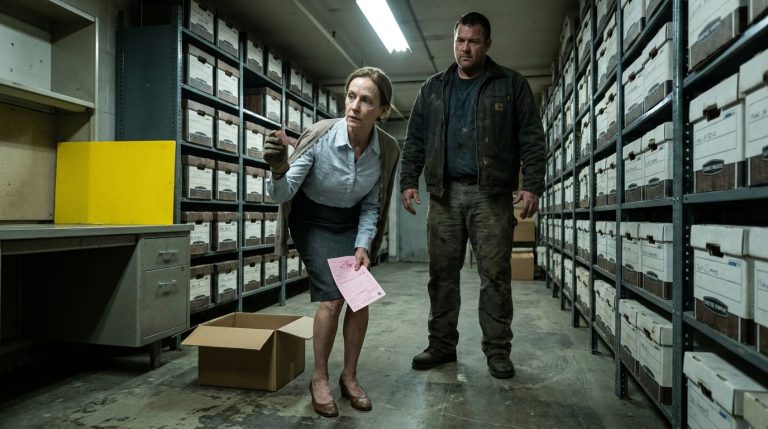
They slipped inside. The archives were a canyon of filing cabinets, towering shelves stacked high with yellowing folders and ledger books. The air was thick with the smell of decay—dry paper, acidic glue, and the lingering, metallic scent of iron.
“Look for his name,” Lily whispered, her hand moving across the row of labels. “Menddees. Elias Menddees.”
They searched for an hour, the silence of the room becoming a weight that seemed to crush the breath from their lungs. Rosa pulled drawer after drawer, her face illuminated by the narrow, flickering beam of a small flashlight.
“Lily,” Rosa said, her voice catching. “Look.”
She held up a thin, blue folder. The label was faded, nearly illegible, but the name was unmistakable: Elias Menddees – Foundation Discrepancy #402.
Lily took the folder, her fingers trembling. Inside was a contract—not a standard performance agreement, but a legal document that bound her father to the Foundation in perpetuity, claiming ownership of every composition he created. And beneath it, a letter, dated two weeks before he died.
It was written to the Director, but it wasn’t a submission. It was a refusal. I cannot give you the anthem, the letter read, the handwriting looping into the same strange, fractured symbols Lily had found on the vellum. It does not belong to the Foundation. It belongs to the silence.
Lily read the words, and the reality of the situation crashed down upon her. Her father hadn’t been a failed musician; he had been a prisoner. The Foundation had stolen his work, rebranded it as their own, and when he had tried to take it back, they had destroyed his career—and eventually, him.
A sudden, sharp sound echoed through the archives—the metallic clack of the heavy door hitting the frame.
“Someone’s here,” Rosa whispered, her face going deathly pale.
Lily shoved the folder into her violin case, right behind the hidden lining where the vellum rested. She grabbed her mother’s hand, pulling her toward the shadows of the back shelves just as the heavy beam of a flashlight cut through the darkness, sweeping across the rows of files like a spotlight.
Footsteps. Slow, deliberate, and heavy. The sound of someone who knew exactly what they were looking for.
“I know you’re in here,” a voice called out. It was the Director. “You have something that belongs to the Foundation. A legacy you were never meant to touch.”
Lily huddled in the darkness, her palm pressed against the violin case. She could feel the notes, the map, the weight of her father’s life, all pulsing against her skin. She had the truth now, but the truth was a weapon, and it had just turned the entire conservatory into a battlefield.
CHAPTER 8: The Disclosure of Echoes
Lily didn’t move. She couldn’t. The beam of the flashlight cut through the dark, dust-filled air like a physical blade, sweeping across the rows of metal cabinets until it locked onto the space between the shelves where they huddled. The light was blinding, clinical, and stripped of any mercy.
“I know you have it,” the Director repeated. His voice wasn’t raised; it was terrifyingly composed, the sound of a man who owned the very air in the basement. “Elias Menddees was a brilliant man, but he was ultimately a tragic one. He thought art could exist outside of authority. He died believing he was protecting something beautiful, when in fact, he was merely protecting his own vanity.”
Rosa stepped out first. She stood between Lily and the light, her shoulders squared, a fragile barrier against the encroaching shadow. “He was a father,” she said, her voice steadying into a blade of its own. “And what he protected was not vanity. It was the only part of himself that you didn’t have the right to claim.”
The Director sighed—a small, dismissive sound that seemed to acknowledge a nuisance rather than an equal. He lowered the flashlight slightly, revealing the sharp, tailored lines of his suit and the icy, detached expression of a man who viewed people as variables in a ledger. “You are trespassing, Rosa. You are an employee who has forgotten her place. Give me the folder, and I will ensure you are escorted out of the building. Keep it, and you will find that the Foundation has a very long reach, and a very short memory for those who defy it.”
Lily watched the Director’s eyes—the way they flickered toward her hand, toward the corner of the blue folder peeking from her case. He wasn’t looking at them; he was looking at the asset.
“The anthem,” Lily whispered, her voice carrying across the archives. “The one you claim you wrote for the Gala. It’s his, isn’t it? Every note of it.”
The Director turned his gaze toward her. A slow, thin smile spread across his face, not of amusement, but of recognition. “It is a product, Lily. It is a synthesis of structure and discipline—the very things you refuse to acknowledge. Your father’s work was chaotic, unrefined, and ultimately unusable. We saved it. We gave it form. We gave it a purpose that his misguided idealism never could.”
“You stole it,” Lily said, her voice rising, the hidden notes on the vellum in her case seeming to vibrate in resonance with her fury. “And now you want the rest of it.”
“I want the closure of a ledger,” the Director said, taking a step forward. His shoes crunched on the grit-covered floor, a sharp, repetitive sound that closed the distance between them. “Give it to me.”
Lily felt the folder, the crisp, old paper inside, and the vellum tucked into the case’s seam. She saw the Director’s reach, the casual, predatory grace of his movement. He wasn’t going to negotiate; he was going to take it. But as he lunged, his hand reaching for the folder, Lily did the only thing her father’s map had taught her—she improvised.
She didn’t run. She didn’t fight. She swung the violin case—not as a weapon, but as a pendulum, smashing it against the side of the metal shelf.
The impact was thunderous. The violin case, filled with the resonance of the hidden parchment, struck the steel at a precise, vibrating angle. The shelf, packed with thousands of folders, shuddered, the metal groaning under the sudden, unbalanced weight.
CRASH.
The entire unit collapsed. A landslide of dusty, decaying records cascaded downward, a wall of paper and iron that slammed into the floor, creating a jagged, impenetrable barricade between them and the Director. The flashlight was knocked from his hand, spinning into the dark, and the basement was plunged into a chaotic, suffocating flurry of flying paper.
“Run!” Rosa screamed, grabbing Lily’s wrist.
They scrambled over the debris, their feet slipping on the slick, aged paper, their breath coming in jagged, desperate gasps. The Director shouted—a muffled, furious sound—but the avalanche of records had buried him, the files of a thousand forgotten contracts muzzling his influence.
They surged toward the loading dock, the dim light of the emergency exit flickering like a dying pulse. They didn’t look back at the ruin of the archives. Lily clutched the case to her chest, the folder and the vellum safe.
They hit the alleyway, the cool, biting air of the night hitting their lungs like an injection of reality. Rain began to fall, a steady, rhythmic tap against the asphalt that sounded like the opening bars of a song. They ran until their legs burned, until the massive, stone-clad walls of the conservatory were nothing more than a silhouette against the city lights.
They didn’t stop until they reached a small, cramped subway station, huddled in the corner of the platform under the shadow of a flickering light.
“We have it,” Rosa gasped, her hands shaking as she touched the folder. “We have the proof.”
Lily looked at the case. She felt the violin inside, the physical manifestation of the notes, the map, and the truth. She knew the Director would follow. She knew the Foundation would stop at nothing to bury this folder in the ashes of the archives.
“It’s not just proof,” Lily whispered, her fingers tracing the edge of the violin case. “It’s a melody. And tomorrow, at the evaluation, I’m not going to play their etude. I’m going to play the anthem as it was meant to be heard—exactly as he wrote it.”
She looked at her mother, her eyes burning with a resolve that felt like iron. The conservatory wanted a machine, but they had awakened a composer. And the next time they met, the silence they had built their empire on would finally, definitively, be broken.
CHAPTER 9: The Restoration of Truth
The Grand Studio was a cavern of velvet and polished gold, designed to project sound with a terrifying, clinical purity. Lily stood in the wings, the heavy, velvet curtain a rough texture against her arm. She could see the panel of judges sitting in the darkness of the hall, their silhouettes rigid, their eyes fixed on the empty chair at the center of the stage. Edward Hargrove sat in the front row, his posture stiff, his presence a silent demand for the performance he had been promised—the performance he thought he had discovered in the hallway of his own estate.
“You can do this,” Rosa whispered, her hands pressing into Lily’s shoulders. The tremor in Rosa’s fingers was a mirror of her own. “Play what he left for you. Not for them.”
Lily nodded. She reached into her case, her fingers finding the seam. She didn’t pull the parchment out; she didn’t need to. She had memorized the fractured, beautiful loops of the music. She had rehearsed the sequence in the silence of their small apartment, in the dark of the archives, until the melody wasn’t just on paper—it was in her marrow.
She stepped onto the stage. The light was harsh, blinding, reflecting off the polished floorboards like a polished mirror. She walked to the center, the violin case swinging by her side. She didn’t look at the judges. She didn’t look at the Director, who stood in the shadows at the side of the stage, his face a mask of cold anticipation.
She sat on the wooden stool. The silence of the room was heavy, expectant, the kind of silence that usually preceded a verdict.
She lifted the violin. It felt alive—the wood warm, the strings taut. She reached for the fine-tuner, the one she had replaced the night before, and gave it a final, infinitesimal turn. The fourth string—the one she had been denied, the one that made the instrument complete—sang with a clear, resonant pitch that shivered through the room.
The Director’s eyes narrowed. He looked at the violin, at the string, and a flicker of recognition crossed his face—a momentary breach in his impenetrable armor.
Lily began to play.
She started with the etude, the piece the conservatory had mandated. She played it with the precision they demanded, the tempo perfectly metronomic, the technical accuracy flawless. She heard the judges stir, the sound of pens scratching on paper, the approval in the air. They were waiting for the finish, for the standard, safe conclusion.
But then, as she reached the bridge of the piece, she allowed a single note to linger—a vibration that carried the exact, mournful frequency of the vellum’s opening bars.
It was a small, subtle divergence, the kind of “error” a technician would dismiss. But to those who knew, it was a question.
She followed it with the second note, then the third, weaving the etude’s rigid structure into the fluid, uncontainable arc of her father’s composition. It was a layering of languages: the conservatory’s dry, academic syntax on the surface, and underneath, the deep, soulful tongue of a man who had refused to be owned.
The scratching of pens in the hall stopped.
Lily closed her eyes. She felt the ballroom again, the way the air had changed. She felt the weight of the archives, the dust and the decay. She poured it all into the violin, the missing fourth string screaming with a clarity that seemed to tear through the sterile, padded walls of the Grand Studio.
The melody escalated, shifting from the etude’s artificiality into a soaring, chaotic masterpiece of memory and grief. It was no longer a performance; it was an act of restoration. She was rebuilding her father’s work in real-time, note by note, in the very heart of the institution that had tried to bury it.
She saw the Director move, his hand reaching for the microphone, his face twisted in a silent, desperate command to stop.
But it was too late. The music had taken hold.
In the front row, Edward Hargrove stood up. He didn’t look at the judges. He didn’t look at the Director. He looked at Lily, his expression a sudden, raw collapse of his carefully maintained composure. He wasn’t listening to a performance; he was hearing a confession.
Lily played the final phrase, the notes rising into a haunting, high-frequency swell that seemed to defy the physical limits of the wood and the hall. The resonance hung in the air, a physical, trembling presence, before she slowly, deliberately, brought the bow to a stop.
The silence that followed wasn’t the sterile, expectant silence of the audition. It was the silence of a held breath, a collective, stunned realization that the world they had constructed around them had just been fundamentally altered.
Lily sat on the stool, her chest heaving, the violin resting against her chin. She opened her eyes. The judges were staring at her, their pens abandoned. The Director stood motionless, the color drained from his face.
She had given them the truth. She had restored the anthem. And in doing so, she had revealed the Foundation for exactly what it was—a house built on stolen echoes.
She stood up, the violin case tucked securely under her arm, and walked toward the wings. She didn’t wait for the verdict. She didn’t need to. She looked at Rosa, who was standing in the shadows, her face radiant with a pride that finally eclipsed the fear, and she knew: the music was free. And for the first time in her life, so was she.
CHAPTER 10: The Unbroken Melody
The silence was not empty; it was a pressurized, breathing thing. For a heartbeat, it seemed as if the very air in the Grand Studio had solidified. Then, the reaction began. It didn’t come from the stage, but from the audience.
A man in the third row stood, his movement jagged and uncoordinated, his hands pressed together. Then another. Then the entire hall—not in the polite, rhythmic applause of a gala, but in a sudden, visceral release of long-held tension. They were weeping. The judges, their pens forgotten, sat like statues, their professional masks completely disintegrated.
The Director remained rooted to the side of the stage, his face a study in utter, hollow defeat. He looked at the audience—the very people he had spent his life manipulating—and saw, for the first time, that he no longer existed in their eyes. He had become an irrelevant ghost in the wake of something real. He turned, his movements stiff and stripped of all command, and walked into the darkness of the wings, his authority dissolving with every step.
Lily didn’t look at him. She looked at Edward Hargrove, who had made his way to the edge of the stage. He didn’t speak. He didn’t try to reclaim the narrative or offer an apology. He simply bowed his head, a gesture of profound, wordless recognition. He looked at the violin—the battered, incomplete instrument that had held the soul of a man he had helped erase—and then at Lily. He turned toward the judges, signaling them with a sharp, final gesture to vacate the stage.
Lily climbed down. She walked through the weeping, cheering crowd, her path clearing as if by instinct. She didn’t seek fame or acknowledgment; she sought the weight of her mother’s hand.
They met at the edge of the lobby, beneath the glass ceiling that now seemed less like a cage and more like a window to the sky. Rosa didn’t say a word. She simply folded Lily into her arms, a long, deep embrace that seemed to last for hours. They stood there as the conservatory—the institution, the prison, the factory of silence—slowly emptied around them.
“We did it, Mija,” Rosa whispered, her voice thick with a relief so deep it bordered on pain.
“He’s free now,” Lily replied, her gaze lingering on the violin case.
Later, they returned to the small, quiet apartment that had been their home before the world of glass and marble had intervened. It was a space of faded wallpaper, mismatched furniture, and the smell of jasmine tea—a sharp, beautiful contrast to the sterile halls of the conservatory.
Lily sat at the kitchen table, the violin case open before her. She took out the vellum, the fractured map of her father’s truth, and laid it out on the scarred wood of the table. Beside it, she placed the instrument.
She took a spool of wire, a needle, and a small, delicate bridge she had carved from a piece of reclaimed oak. With a steady, patient hand, she began to repair the fourth string. It wasn’t the work of a student; it was the work of a daughter reclaiming her inheritance.
The process was slow, rhythmic, and meditative. Each twist of the wire was a conversation with the past, each adjustment of the bridge a correction of a history that had been twisted for too long. As she finished, the string hummed, taut and perfect, a physical bridge between the silence of her father’s loss and the resonance of her own future.
She looked around the room. The apartment was still small, still poor, but it felt vast. The light of the setting sun filtered through the window, catching the dust motes and turning them into floating, golden stars.
“Mama,” Lily said, her voice soft. “Can I play for you?”
Rosa pulled up a chair, her eyes bright and filled with a peace that made the years of struggle seem like a distant, inconsequential dream.
Lily lifted the violin. She didn’t play for the judges. She didn’t play for the Foundation. She played for the silence, for the forgotten, and for the man whose name had finally, truly, been remembered. She played the anthem, but this time, there was no etude, no standard to meet, no authority to satisfy.
The music filled the small apartment, spilling out through the open window and into the cool, night air of the city. It was a song that had no beginning and no end, a melody that belonged to no one but them. And in the heart of the music, Lily finally understood: she hadn’t just played for a seat in a hall. She had played to prove that the most beautiful things in the world cannot be bought, stolen, or standardized. They can only be remembered, and in the remembering, made whole.