A Legacy of Granite: How One Man Dismantled a Suburban Tyranny Using the Weight of Truth
CHAPTER 1: The Invisible Line
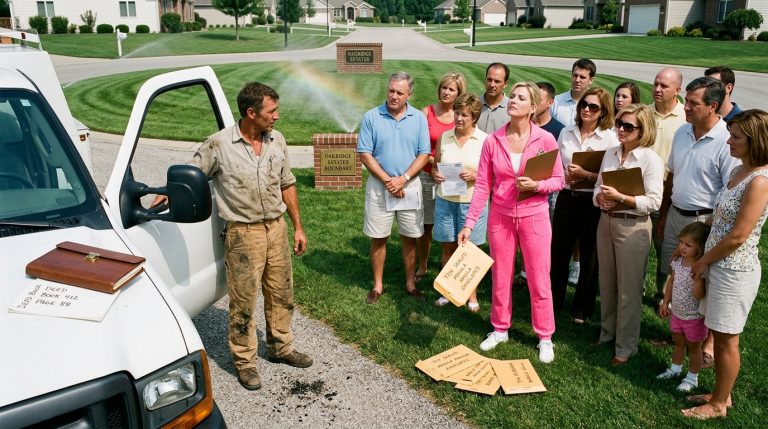
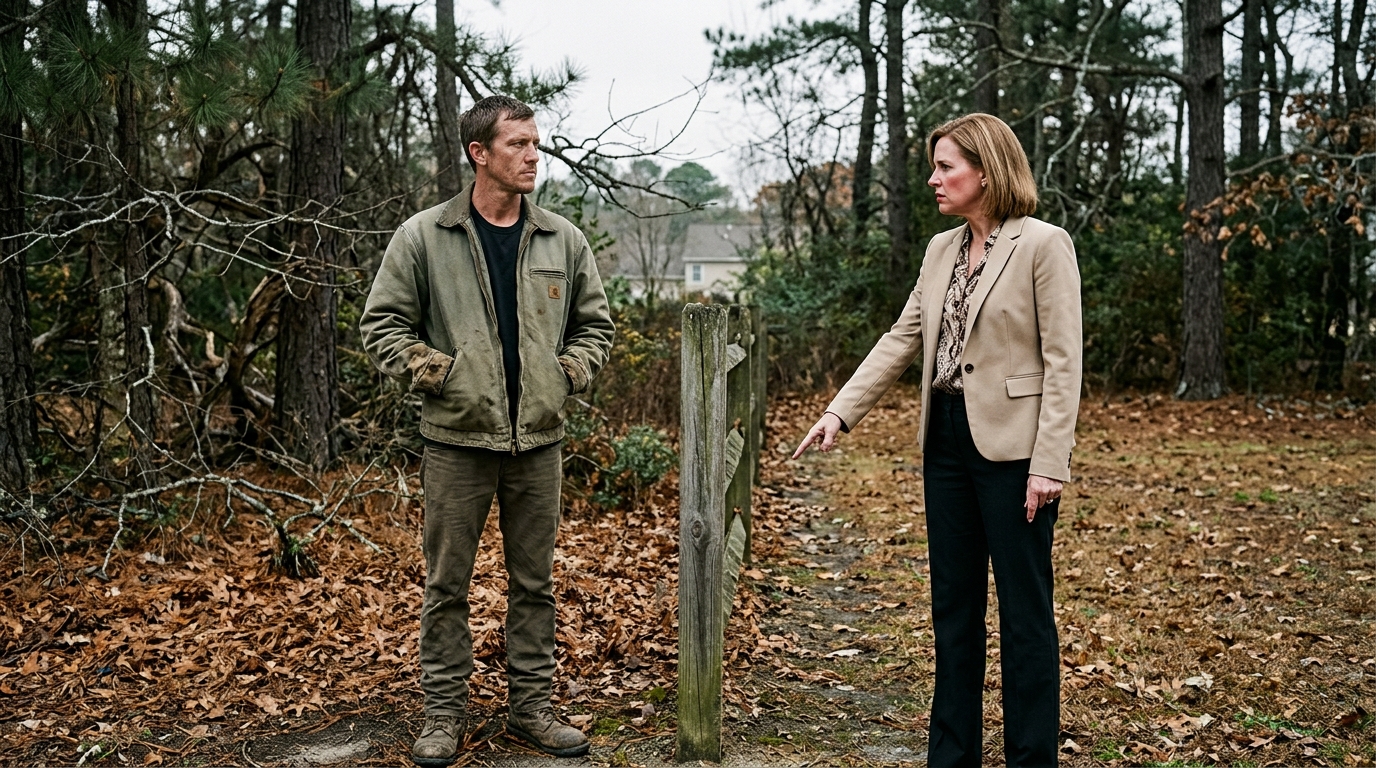
The October wind bit into my neck, colder than the look in Karen Thorne’s eyes. She stood three feet away, on the other side of the property line, her posture as rigid as the fence post I was currently bracing. She was a woman who lived by the rulebook, a creature of manicured hedges and beige exterior paint, and she was currently vibrating with the kind of self-righteous fury that only a suburban tyrant can muster.
“Your grandfather’s legacy is a public nuisance, Mr. Miller,” she spat, her voice tight, bloodless. She pointed a manicured finger toward the hundred acres of timber and overgrown pasture that had been in my family for a century. To her, it wasn’t history. It was an eyesore. “And I will see it dismantled piece by piece if I have to.”
I didn’t move. My hands stayed deep in the pockets of my worn Carhartt jacket, fingers brushing against the cold steel of my knife. I didn’t engage. My sergeant major had taught me that when the enemy is posturing, you don’t give them a target. You give them silence. The quiet stretched between us, thick enough to choke on, and for a fleeting second, I saw it—the flicker of uncertainty in her eyes. The mask slipped. She had expected a shouting match, a defensive sputter, a man pleading for his way of life. Instead, she got the dead-eyed calm of a man who had spent his adult life calculating the structural integrity of bridges under fire.
“The hunting lease,” she pressed, her voice rising as the silence unnerved her. “It’s a violation of the community aesthetic. An ammunition depot next to a residential development is non-negotiable.”
I looked past her, toward the sterile, silent McMansions of Oak Ridge Estates. They were built on land sold off by a desperate farmer, but they didn’t own the horizon. They didn’t own the history. Her threat to dismantle my grandfather’s work wasn’t just a bylaw dispute; it was a declaration of war. She wanted to tame the wildness she couldn’t control.
“You have no jurisdiction here, Karen,” I said, my voice low, steady. “The woods don’t care about your mailbox color.”
She stiffened, her face flushing a mottled, ugly red. She turned sharply, retreating to her electric golf cart—that silent, pathetic harbinger of bureaucratic war. As she drove off, the gravel crunched under her tires, the sound dying quickly into the vastness of the trees.
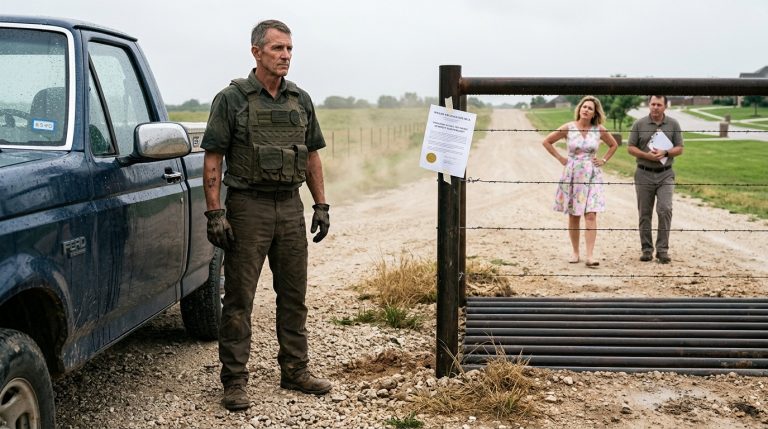
I walked to the property line and stared at the spot where she had stood. There was no fence here, only an invisible line—a line she was determined to cross. I reached into my pocket, pulled out the violation notice she had taped to my gate earlier that morning, and let the wind catch it. It fluttered away, a scrap of useless paper destined for the dirt. She thought she was leading an association; she had no idea she had just declared war on a man who knew exactly how to dismantle a foundation without leaving a trace.
I turned back to the woods. The map was already forming in my head, a complex grid of deeds, survey markers, and legal loopholes. The war had begun, and for the first time in months, I felt perfectly at home.
CHAPTER 2: The Paper Fortress
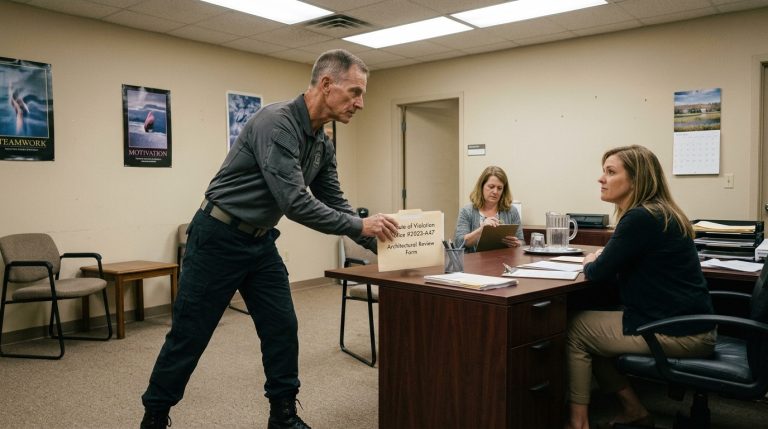
The kitchen was still cold, the air thin with the chill of late October. I sat at the heavy oak dining table, the one my grandfather had built in 1964—a piece of furniture so solid it felt like a part of the house’s bedrock. My fingers traced the grain of the wood, grounding me. Across from me lay the HOA’s “Notice of Covenant Violation,” a thick, cream-colored envelope that mocked the very air it occupied.
I opened it slowly. The paper was expensive, heavy stock, embossed with a gold Oak Ridge Estates logo that screamed unearned authority. It was a masterpiece of legalistic intimidation: Whereas, pursuant to, here and after. It was the language of people who thought they could command the world simply by framing their opinions in bold, centered text.
As I read the demand for a five-hundred-dollar fine, the memory hit me with the sudden, sharp violence of an unexpected flashback. I was back in the desert, staring at a set of blueprints for a forward operating base. I remembered the way my commander had pointed to a critical support beam that had been improperly reinforced. “You don’t need to knock down the whole building, Miller,” he had said, his voice clipped over the sound of the wind. “You just need to find the one stress point where the load bearing fails. The rest of the structure will do the work for you.”
I looked at the fine again. Karen Thorne didn’t know it, but she had just handed me the stress point.
The notice assigned me a property ID number: 4A. It was an administrative fiction, a way for them to slot my hundred acres of ancestral timber into their sterile, manicured database. By assigning me an ID, they were attempting to drag me into their jurisdiction—a classic bureaucratic maneuver designed to create a record, a file, a history of compliance. They wanted me to acknowledge the system by paying the fine, or at the very least, by arguing against it on their terms.
But the moment I touched the paper, I felt a phantom tremor—a warning. It wasn’t just about the fine. It was about the precedent. If I ignored it, the fine would double, then triple. They would slap a lien on my property, a silent, creeping growth of debt that would eventually be impossible to clear without a court-ordered mess. That was their true goal. They didn’t want my compliance; they wanted my silence, followed by my bankruptcy.
I stood up and paced the length of the kitchen. The house was quiet, save for the hum of the old refrigerator and the distant, rhythmic creak of the pines outside. Every corner of this place held a memory of my grandfather—a tool left on a workbench, the specific height of the door frames he’d notched to mark my growth. Karen Thorne wanted to tear this down? She couldn’t even grasp the physics of what she was attacking. She saw the land as a nuisance; she didn’t see the centuries of stewardship that had made the soil beneath her own manicured lawns possible.
I walked to the pantry and retrieved a clean manila folder. I picked up a black Sharpie and wrote two words on the tab: Project Nightingale.
The name came from a half-remembered tactical drill, a maneuver involving a decoy that draws the enemy’s fire while you reposition. Karen thought she was the beautiful, soaring voice of her community. She had no idea that she was singing a song that was going to lead her right into a trap of her own making.
I sat back down and spread the HOA documents out. The contrast was stark. The flimsy, pretentious paper of the HOA’s notice lay against the solid, scarred oak of the table. I wasn’t angry anymore. The initial surge of adrenaline from the fence-line confrontation had burned away, leaving behind the cold, crystalline clarity that comes right before an operation.
My grandfather had always said that the only papers that mattered were the deed to the land and the Constitution. Everything else was just noise. My job now was to turn that noise into a map.
I reached for my phone and dialed a contact I hadn’t used in years—a local clerk at the county records office named Marge. She was a woman who guarded the county’s history like a sentry, and she had an encyclopedic knowledge of every deed, boundary, and easement in the district.
“Marge,” I said when she picked up, her voice a familiar, friendly rasp. “I need to take a look at the history of the Oak Ridge development. And I’m going to need the original plat maps for the entire quadrant.”
“Jack Miller?” Marge chuckled, the sound like dry leaves rubbing together. “Don’t tell me you’re finally selling off that homestead. You know I’d have to file the paperwork for the end of the world if that happened.”
“Not a chance,” I replied, my gaze hardening as I looked at the HOA’s letterhead. “I’m just doing a little bit of structural maintenance. I need to know exactly where their kingdom ends and reality begins.”
The silence on the other end was telling. Marge knew the reputation of Oak Ridge Estates. “Sounds like you’re going for the whole enchilada, Jack. I’ll have the microfilm ready. But be warned, those developers were very good at hiding their tracks.”
“They were good at hiding them,” I said, putting the notice back in the folder. “But they weren’t good at deleting them. Nothing is ever truly gone when it’s been recorded.”
I hung up and looked out the window. The sun was dipping below the tree line, casting long, bruised purple shadows across the fields. The air was turning brittle, promising frost. It was a night for planning. I had the stress point, I had the folder, and I had the motivation. The war wouldn’t be fought with lawnmowers or screaming matches at the property line. It would be fought in the archives, in the ink, and in the cold, hard logic of the law. And by the time I was finished, Karen Thorne would realize that her paper fortress had been built on a foundation of sand.
CHAPTER 3: The Archives
The air inside the county records office felt different than the air on my porch. It was dense, filtered through decades of paper decay—a unique, dry combination of lignin, binding glue, and the faint, metallic ozone of the microfilm machines buzzing in the corner like mechanical insects. It was a library of ownership, a temple of titles. To anyone else, it was a boring government basement. To me, it felt like the armory.
I pushed open the heavy glass door, the hinges protesting with a shrill, rhythmic squeak that echoed in the quiet lobby. Marge was behind the high counter, her glasses perched precariously on the end of her nose. She looked up, a slow, knowing smile crinkling the corners of her eyes. She’d seen men like me before—men who walked in with a grievance and walked out with a map of the battlefield.
“Jack Miller,” she greeted, her voice a friendly, rasping scrape against the stillness. “I see you didn’t decide to sell the homestead after all.”
“Just the opposite, Marge,” I replied, resting my hands on the cool, worn surface of the counter. “I’m in the middle of a border dispute. I need everything you’ve got on the Oak Ridge Estates development. Plat maps, original articles of incorporation, the whole history of parcel 4A and the adjacent 5B.”
Marge raised an eyebrow, a flicker of professional curiosity lighting up her expression. She slid a thick, yellowing request form across the counter. “That’s a lot of paper, Jack. That development has been a thorn in the county’s side since they broke ground. Seems like every time someone wants to move a fence, they come in here quoting their own bylaws like they’re the Supreme Court.”
“That’s exactly what I’m here to correct,” I said, filling out the form with deliberate, steady strokes.
“Going for the whole enchilada, huh?” she asked, glancing at the form.
“I’m just drawing the maps, Marge.”
She disappeared into the stacks, the sound of her footsteps retreating into the labyrinth of shelves. I took the time to observe the room. It was remarkably unchanged since my grandfather had brought me here when I was ten. The same oversized, leather-bound books, the same smell of history. In a world that was constantly erasing itself—tearing down old barns, paving over fields, rebranding “public land” as “exclusive green space”—this room was the only place where the truth stayed put.
When Marge returned, she was pushing a metal cart burdened with a stack of files that looked like they hadn’t been touched in a decade. “Here’s your history, Jack. The original plat maps are on the microfilm back there, but the paper files should give you the chain of custody.”
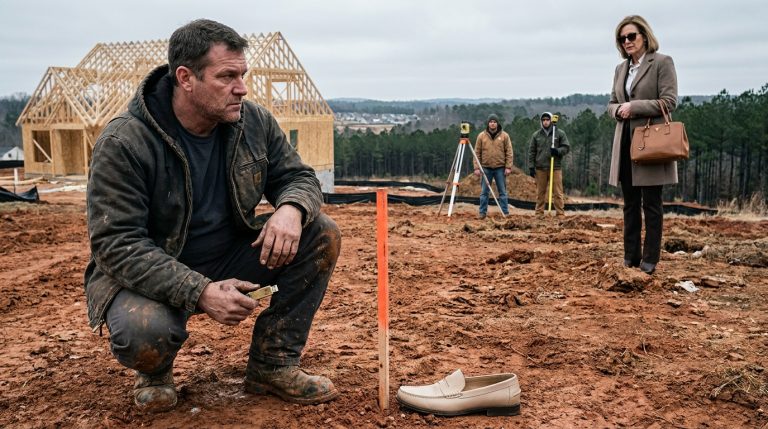
I spent the next four hours immersed in the minutiae of legal descriptions, metes and bounds, and surveyor’s notes. I started with my own property. I unrolled the massive, crinkling plat map, my eyes tracking the bold ink lines that defined the Miller homestead. It was a jagged, irregular shape—a topography I knew by heart, from the north pines to the gully that held the spring. And there, pressed against the eastern border, was the neat, artificial geometry of Oak Ridge Estates.
I took a breath, the dust tickling my throat. There it was: a thick, unambiguous line that severed their grid from my land. I found the surveyor’s margin note, handwritten in a script that looked like it had been drafted by a man with zero patience for bureaucratic nonsense: Parcel 4A is excluded from the covenants and jurisdiction of the Oak Ridge Estates development.
It was a smoking gun, resting in the quiet dark of the archive room. Legally, Karen Thorne had as much authority over my woods as she had over the migration patterns of the geese. Her violation notice wasn’t just a nuisance; it was a fabrication. She was trying to enforce rules on a sovereign island of land that had no business being in her little HOA empire.
I pulled out my phone and took a high-resolution photo of the map and the note. The digital image felt like a weapon. I shifted my focus to the HOA documents. I pored over their Covenants, Conditions, and Restrictions—a fifty-page tome that was a masterclass in petty, suburban fascism. It dictated the exact height of grass, the hue of exterior paint, and the placement of trash cans. It was a blueprint for a society that prioritized the appearance of perfection over the reality of community.
But as I read, a detail caught my eye. The text repeatedly referenced “Founders Green,” the five-acre park bordering my land. They spoke of it as “our park” and “HOA-maintained property.” The possessiveness was nauseating. I remembered that park being donated when I was younger, a vague memory of my grandfather standing in the field, talking to the county commissioners. Everyone had called it the “County Park on Miller Road.”
Why the shift? Why “Founders Green”?
I stood up and walked back to the counter, the smell of the old paper clinging to my clothes. “Marge,” I said, my voice steady. “I need the deed history for the five-acre parcel sitting on the southeast corner of my land. The one they’re calling Founders Green.”
Marge tapped at her terminal, the keys clacking in the silent room. She squinted, her brow furrowing. “Ah, here we go. Parcel 5B. Let’s see. A five-acre plot. It was carved out of the Miller family land about twenty years ago, wasn’t it?”
“Who was the grantor?”
Marge looked up over her glasses, her eyes narrowing in recognition. “It was your grandfather, Jack. John Miller. He donated that land to the county.”
The pieces clicked into place with the cold, satisfying finality of a bolt action rifle. My grandfather hadn’t sold that land to a developer; he had gifted it to the people of the county. He had given them a public space, a patch of green for anyone to enjoy. The HOA had simply reached out, claimed it, slapped a fancy name on it, and convinced the residents that it was their private playground.
“I need a copy,” I said, my heart rate accelerating. “Every page, every addendum.”
As the copier hummed, I stared at the blank wall, thinking of Karen Thorne in her golf cart, protecting her “private” property with such righteous fury. She hadn’t just been bullying me; she had been misappropriating a public trust. The information felt heavy, a load-bearing truth that had the potential to crack her entire world.
Marge handed me the packet, the pages still warm from the machine. “Something tells me things are about to get real interesting over at Oak Ridge, Jack.”
“It isn’t about being interesting, Marge,” I said, tucking the documents into the folder. “It’s about being right.”
I walked out of the records office and into the cooling afternoon air. The sun was setting, the sky a bruised, vibrant orange behind the pine trees. I looked down at the folder. It was more than a record of property lines; it was a roadmap for a counter-offensive. Karen Thorne thought she had the authority to dismantle my legacy. She had no idea that she’d built her own kingdom on a foundation of land she didn’t own, governed by rules that had no reach, and guarded by a history she hadn’t bothered to read.
The path forward was becoming clear. I didn’t need to fight her on her terms. I just needed to show everyone what she was really standing on.
CHAPTER 4: The Reversionary Key
I didn’t immediately reach for the packet Marge had given me. I sat there in the silence of my dining room, the oak table solid beneath my elbows, watching the last of the evening light die against the windowpane. The house was a sentinel, holding the history of the land in its very rafters, and for the first time in years, that history felt like a living, breathing thing.
The photocopied pages were spread out next to the HOA’s violation notice. It was a study in contrasts that made my jaw ache with suppressed tension. On one side, the HOA’s letterhead: a product of high-end printing, polished corporate branding, and empty, inflated threats. On the other, the deed of gift. It was thick, legalistic, and bore the stamp of the county clerk—a document that tasted of iron and integrity. It was signed with my grandfather’s hand, the ink aged to a dark, permanent brown.
I started with the legal description of the five-acre parcel. My eyes traced the boundaries, confirming the rectangle of land that bordered the subdivision. It was perfect. It was accurate. Then, I began to read the covenants.
My grandfather had been a man of few words, but when he wrote them down, they were meant to endure. He hadn’t just handed over the keys to the kingdom; he had set the terms of its survival. I found the section titled Conditions of Use. My pulse quickened, a steady, rhythmic thrumming in my ears.
The land is to be used in perpetuity as a public park, the text read, its language clear, crisp, and devoid of the HOA’s typical jargon-heavy obfuscation. Open for the enjoyment of all residents of Madison County without prejudice or exclusion.
I leaned closer, my breath hitching. Without prejudice or exclusion.
Karen Thorne and her board had been acting like they were the sole proprietors of this land. They had posted their signs, restricted access to residents, and chased away anyone who didn’t fit their carefully curated aesthetic. They had turned a public gift into a private badge of status. And in doing so, they had violated the foundational premise of the donation.
I turned the page, my fingers hovering over the next paragraph. I had heard rumors of a reversionary clause in old deeds, but I had always assumed they were myths—legal ghosts meant to scare the superstitious. But there it was, sitting in black and white: Should these conditions be violated, ownership of the land shall automatically revert to the grantor or his legal heirs.
Automatic. Ipso facto.
The silence in the room suddenly felt electric. I wasn’t looking at a deed anymore. I was looking at a kill-switch.
I sat back, the chair groaning under the shift in my weight. My grandfather had been smarter than anyone gave him credit for. He hadn’t just donated the land; he had built an insurance policy into the very architecture of the gift. He knew developers. He knew the way they operated—the way they made promises to get the land, then slowly, incrementally, eroded those promises until the original intent was buried under layers of corporate policy. He had anticipated the Karen Thornes of the world long before they were even born.
The irony was so sharp it almost tasted like copper. Karen Thorne had threatened to dismantle my grandfather’s legacy, unaware that she was living on top of the very trap he’d set for someone exactly like her. She had picked a fight over a fence line, trying to enforce her sterile suburban standards on my family’s land, and in doing so, she had practically begged me to take back the heart of her own development.
I could see the fallout in my mind’s eye with terrifying clarity. If I triggered this, the park would legally return to my hands. The playground, the manicured grass, the little retention pond—the “Founders Green” that was the centerpiece of their sterile little kingdom—would become mine again. I wouldn’t need to shout, or threaten, or even raise my voice. I would just need to file the paperwork.
But a weapon like this required a steady hand. If I moved too fast, if I made this a messy, public brawl, Karen would play the victim. She would paint me as a land-grabbing monster. She would leverage the sympathy of the neighborhood, and the legal battle would drag on for years, burning through my time and my savings. No, this had to be executed with the precision of the military engineering I’d practiced for twenty years. It had to be a surgical strike.
I gathered the papers, stacking them neatly. The folder wasn’t just a project anymore; it was an ultimatum. I needed a strategist. I didn’t need a shark, and I didn’t need a loudmouth. I needed someone who could see the angles as clearly as I could.
I looked at the phone on the counter. Sarah Jenkins.
I’d met her at the local hardware store months ago, a quick, sharp-eyed woman who hadn’t hesitated to complain about the HOA’s ridiculous regulations on vegetable garden mulch. She was a lawyer, and she lived in the belly of the beast. She knew the board, she knew the politics, and more importantly, she knew how much they despised the very rules they claimed to uphold.
I picked up the receiver, the plastic cool against my skin. I dialed her number, my mind already running through the opening moves of a conversation that would change everything. The war had been a defensive skirmish until now. With this deed in my hand, it was about to become something else entirely. It was about to become an eviction notice for a tyranny that had overstayed its welcome.
CHAPTER 5: Gathering the Assets
The receiver was cold against my ear, the plastic slightly cracked from years of use. I waited through the hollow, rhythmic pulse of the dial tone. Each second felt like a deliberate measurement of time, a countdown toward a point of no return. When she picked up, her voice was crisp—sharp, efficient, and guarded.
“Sarah Jenkins speaking. If this is about the drainage easement on the Miller property, I’ve already told the board that their survey is invalid.”
“It’s not the drainage, Sarah,” I said, my voice steady. “It’s about Founders Green.”
There was a silence on the other end, a pause that lasted just long enough for me to hear the faint, muffled hum of a home office environment—the clicking of a keyboard, the distant muffled sound of a television. The cautious air she’d adopted vanished. “Founders Green? The HOA’s ‘crown jewel’? You’re treading on holy ground, Jack. You have to be careful about conflicts of interest. I live there.”
“I understand,” I replied, keeping my eyes fixed on the manila folder sitting on the oak table. “But I think when you hear what I have, you’ll find the only conflict is between the board’s actions and the actual law. Can I buy you a cup of coffee? Somewhere neutral.”
“The café in Oak Creek,” she said immediately. “Thirty minutes.”
I hung up, the sharp click of the receiver sounding like a hammer cocking. The logistics of the next few hours were already arranging themselves in my mind like pieces on a board. I didn’t need to overthink; I needed to move. I grabbed my keys, the metal teeth biting into my palm, and headed for the door. The night air had turned, the autumn dampness clinging to the gravel as I walked to the truck.
The drive to Oak Creek was a quiet, singular focus. I didn’t turn on the radio. I let the silence dictate the pace, my mind mapping out the variables. Sarah Jenkins was an insider, and that made her the most valuable asset I could bring to the table. She knew the board members—the way they thought, the way they postured, the way they hid behind their CCRs (Covenants, Conditions, and Restrictions) like a shield. If she could see the logic in the reversionary clause, she would be the one to turn the weapon into something truly lethal.
The café was a small, dim space tucked into the corner of a brick-lined storefront. I saw her at a corner table, her laptop already open, her posture focused and intense. She didn’t look like a suburbanite; she looked like a prosecutor preparing for a grand jury. When I approached, she didn’t stand up, but her eyes, sharp and analytical, tracked my every movement.
“Mr. Miller,” she said, gesturing to the chair. “You have my attention. You mentioned a property matter. Don’t waste my time.”
I didn’t say a word. I simply reached into the manila folder and placed the documents on the table. The violation notice went down first—a flat, dismissive flick of the wrist. Then the plat maps. Finally, I laid out the deed of gift, the yellowed edges of the paper contrasting against the modern, sterile finish of the café table.
I watched her face as she worked through them. She was methodical, her eyes scanning the legal text with the speed of a machine. She started with the HOA’s fine, a small, cynical smile playing on her lips. Then she moved to the plat maps, her eyebrows rising in that slight, observant way that told me she was seeing the boundary errors they’d made. But when she hit the deed of gift, she stopped.
She read the covenant about public access. Her expression shifted. She read the reversionary clause—that iron-clad sentence that triggered the entire foundation of their “private” park. Then she went back and read it again, her breath hitching in a way that was almost imperceptible. She looked up at me, and the professional caution in her eyes had been entirely replaced by a bright, predatory gleam.
“Jack,” she said, her voice dropping, charged with a sudden, electric intensity. “This is one of the most beautiful legal instruments I’ve ever seen. Your grandfather wasn’t just a farmer. He was an architect of justice.”
“He was a man who believed in keeping his word,” I replied.
“This isn’t just a defense against a five-hundred-dollar fine,” she continued, her fingers hovering over the text. “This is a tactical nuke. They’re threatening you with petty bureaucracy, and you’re holding the deed to their heart. Do you have any idea what this means for their property values? For the board’s credibility?”
“I have an idea,” I said, leaning in. “But I need to know if you’re in. This isn’t going to be a simple letter-writing campaign.”
She didn’t hesitate. A wide, genuine smile broke across her face—a sharp, hungry look that told me she’d been waiting for a reason to tear the structure down from the inside. “In? Jack, I’d pay you to let me take this case. I know Karen Thorne. I know the board. They’ve been running that neighborhood like a personal fiefdom for years, drunk on the tiny bit of power they’ve managed to scrape together. This is a chance to restore the rule of law. What’s our first move?”
“We don’t threaten them,” I said, feeling the weight of the plan settling into place. “Not yet. We inform them. We present the documents and give them a choice. They can acknowledge the park is public and remove their exclusionary signage, or they can watch us file for the reversion. We give them the chance to surrender gracefully.”
“And if they refuse?”
“Then we exercise the clause,” I said, my voice cold. “And you help me take the park.”
She tapped her fingernails against the table, a rhythmic, thoughtful sound. “It’s perfect. It’s elegant. But we need more. We need evidence of their bad faith. We need to document every time they’ve blocked a non-resident. Every time they’ve threatened a homeowner who didn’t toe the line. We need to build a dossier so thick that their own lawyers won’t be able to look at it without laughing at the board’s incompetence.”
“I’ve already started,” I said, a grim sense of satisfaction growing in my chest. “I’ve got witnesses. People who have been chased away from the park. And I’ve got the violation notices they’ve been sending me, which we can use to show a pattern of harassment.”
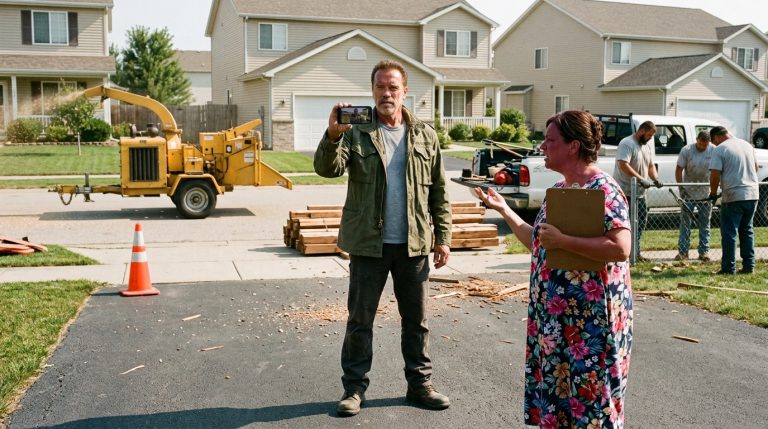
“Good,” she said, her eyes narrowing as she looked at the deed one last time. “Very good. Go home, Jack. Document every interaction, every phone call, every piece of paper that hits your porch. I’ll draft the notification letter. We’ll make it so precise, so historically grounded, that they’ll have no choice but to realize they’re walking into a woodchipper.”
As I left the café, the cool night air felt different—thinner, clearer. The friction of the meeting had been exactly what I needed. I wasn’t just fighting a neighbor anymore. I was initiating a systematic dismantling of a corrupt machine. I drove home, the headlights cutting through the darkness of the country roads, feeling the first, subtle tremors of the storm I was about to unleash. The board had no idea that their paper fortress was already buckling. They just hadn’t felt the weight of the walls coming down yet.
CHAPTER 6: The Deployment
The café was emptying out, the afternoon rush replaced by the long, thin shadows of early evening. Sarah’s laptop hummed with a low, steady frequency as she cycled through the slides we’d been building. The blue light from the screen cast sharp, angular shadows across her face, emphasizing the intense, focused set of her jaw. We weren’t just putting together a presentation; we were building a siege engine.
“This is the slide,” she said, tapping a key. The screen displayed a high-resolution scan of the deed of gift, the reversionary clause highlighted in a stark, neon-yellow box. “When this hits the projector at the clubhouse, it’s not going to be a lecture, Jack. It’s going to be an earthquake. The board members are going to realize they’ve been sold a lie, and the residents are going to realize they’ve been defrauded.”
“Keep it simple,” I reminded her, leaning back. The chair was hard, unforgiving, mirroring the tactical rigidity of the plan. “We don’t need a monologue. We let the document speak. We present ourselves as the reasonable party—the ones who tried to solve this quietly, and were met with harassment.”
“And the harassment file?”
I reached into the folder and pulled out the copies of the petty violation notices. “I’ve got every one of them. The fence height, the dog complaint, the ‘commercial activity’ nonsense. It’s all here, documented with time stamps and photos. We’ll show them not as complaints, but as a deliberate pattern of bad-faith litigation meant to intimidate.”
Sarah nodded, her eyes darting across the screen. “Perfect. It shows they were acting outside the scope of their authority, trying to bury you to hide their own overreach.”
I stood up and walked to the window. Across the street, the sun was hitting the glass of the local post office, the reflection blindingly bright. My mind was already three steps ahead, anticipating the chaos of the meeting. Karen Thorne would try to control the room. She would pivot, she would scream, she would try to paint me as the villain. But the truth was a heavy, immovable object. Once it was introduced into that room, there was no spinning it away.
“I need to reach out to the others,” I said, turning back. “Arthur Henderson, and the veterans. They need to be there. Their presence isn’t just a symbol—it’s a reminder that this isn’t just about my land. It’s about the community’s rights.”
“Do it,” Sarah said, her voice dropping. “But keep it quiet. If Karen hears you’re mobilizing, she’ll try to shut the meeting down or move it to a private venue. We need her to hold this meeting exactly where she planned—in the clubhouse, in front of her voters.”
I left the café and drove straight to the garage, the quiet of the truck providing a space to think. I made the calls. Each one was a brief, precise tactical briefing. They understood. They were ready. When I got home, the house felt different—not just a sanctuary, but a command post. I spent the remainder of the evening reviewing the slides, stripping away any emotional language, ensuring that the evidence was cold, hard, and undeniable.
But as I reached the final slide, I noticed something strange in the financial summaries Sarah had included from the HOA’s public records. It was a line item labeled ‘Community Beautification’ that seemed disproportionately high for a flower garden. I zoomed in on the figures, running the math in my head. The numbers didn’t add up. The project costs were inflated by nearly thirty percent, yet the documentation of the actual labor and materials was thin, almost non-existent. It was a ghost expense, a black hole in the budget that Karen Thorne had been feeding for months.
My hands tightened on the mouse. It wasn’t just a land grab. It was embezzlement.
I sat in the dark for a long time, the glow of the screen illuminating the room in flickering blue. The decoy secret—the park—was enough to win the fight. But the truth underneath it? The systematic theft of the community’s own money? That wasn’t just a reason to lose the park; it was a reason for Karen to lose everything.
I didn’t tell Sarah. Not yet. Some secrets needed to be held, to be deployed at the exact moment of maximum structural failure. I saved the slide, closed the file, and felt the weight of the night pressing against the windows. The path forward was clear. The trap was set. All that remained was for the target to walk into the kill zone.
CHAPTER 7: The Kill Zone
The clubhouse was a beige, sterile box designed for conformity, and right now, it was packed to the gills. The air felt thick, charged with the static electricity of a room waiting for a spark. Karen Thorne stood at the podium like a queen on a collapsing throne, her voice dripping with that practiced, saccharine sincerity that I had learned to identify as a precursor to a lie. She was holding court, painting a picture of an outside threat—a “land-grabbing agitator” who wanted to destroy the peace of the neighborhood for a quick buck.
I stood in the back, leaning against the cold wall, my hands tucked into my pockets. Beside me, Sarah was a statue of cool, clinical resolve, her gaze fixed on the podium with the patience of a sniper. The room was noisy, a low hum of indignant chatter that rose and fell like a tide. They were angry, and they were angry at me. That was exactly where I wanted them.
“This is not a Q&A session,” Karen snapped as Sarah moved to stand, her voice echoing too loudly off the low, acoustically dead ceiling. “This is a meeting for residents to decide how we defend our community assets.”
“My question is simple, Madame President,” Sarah’s voice cut through the room, clear and unyielding. “Before we decide on a course of action, shouldn’t the community be allowed to see the documents you’re talking about? Specifically, the deed to the park?”
Karen’s face tightened, the skin around her eyes pulling thin. “The legal documents are complex, Sarah. They’re meant to be interpreted by the board, not subjected to a public debate.”
“Then let us simplify them,” I said, stepping forward. I felt the gaze of the room shift. Fifty pairs of eyes, confused and suspicious, turned toward me. I reached into my pocket and pulled out the remote for the projector.
I pressed the button. The wall behind Karen lit up with a harsh, clinical glare. The projector hummed—a sound I’d heard a thousand times in briefing rooms, the sound of an objective reality about to overwrite a subjective fiction.
The title appeared on the wall: The Truth About Founders Green.
A collective murmur rippled through the audience, a sound of rustling paper and shifting chairs. Karen spun around, her face pale, the blue light from the projector turning her skin a ghostly, washed-out hue. She looked small against the backdrop of her own exposed lie.
“What is this?” she hissed, reaching for the microphone, her knuckles white. “You have no right!”
“I have every right,” I said, my voice carrying into the corners of the room. I didn’t raise it; I didn’t have to. The truth has a natural gravity. I pointed to the wall, where the deed of gift was projected in high resolution, my grandfather’s strong, sprawling signature at the bottom. “This document is the legal origin of the park. My grandfather, John Miller, donated this land to the county twenty years ago. It belongs to every resident of Madison County, not just the privileged few who bought into this development.”
I clicked again. The image zoomed into the highlighted reversionary clause. The yellow light was blindingly bright, turning the text into a beacon.
“Should these conditions be violated,” I quoted, the words steady and precise, “ownership shall automatically revert to the grantor or his legal heirs. That’s me.”
The room was deathly quiet. I could hear the hum of the projector—the only sound in a space that had been full of noise just moments ago. People in the front row were turning to look at their neighbors, their confusion deepening into something much darker: betrayal. They were realizing that their “Founder’s Green” wasn’t a gift they owned, but a public trust that had been stolen from them, and that their leadership had been lying about the very foundation of their community.
“He’s trying to scare you!” Karen shrieked, the veneer finally cracking, the composure of the HOA president shattered into shrill, panicked desperation. “He wants to bulldoze the playground! He wants to build a commercial hunting operation!”
“That’s a lie, and you know it,” I said, my voice cold. I clicked the remote one final time. The screen showed a list of three simple, clear conditions: Remove the illegal signage. Issue a public apology. Acknowledge the park’s public status. “I’m not a developer, Karen. I’m a neighbor. And I’m the man who owns the land that you’ve been using as a personal bargaining chip.”
I looked at the board members sitting to her left—men and women I recognized from the hardware store, the grocery, the post office. Their faces were an open book of dawning realization. The treasurer, a man I’d seen around, was staring at the screen as if it were a bomb.
“Karen,” he said, his voice quiet, almost a whisper that was amplified by the sudden, suffocating silence of the room. “Did the board know about this deed? Did you know about this clause?”
She didn’t answer. She couldn’t. The silence that followed was heavy, absolute, and terminal. The authority she had wielded for years hadn’t been overthrown; it had simply ceased to exist, stripped away by the simple, inconvenient weight of a record kept in an archive she had been too arrogant to consult.
I didn’t need to say another word. I turned and walked toward the exit, my boots rhythmic against the sterile floor. Sarah followed, her expression unreadable, and behind us, the room began to unravel. The shouting started, a disjointed, chaotic sound of voices rising, questioning, and accusing.
I didn’t look back. I reached the cool air of the night, the darkness hitting me like a physical comfort after the harsh, clinical light of the projector. The war wasn’t over, but the outcome was already written. Karen Thorne had walked into the room as a queen and was leaving it as a liability. The paperwork was ready, the truth was out, and by morning, the sign that had stood as a monument to her arrogance would be nothing more than a memory. I walked to my truck, the stars bright and indifferent above the pines, and for the first time in months, the property line didn’t feel like a boundary. It felt like a border I was finally done guarding.
CHAPTER 8: The Aftermath
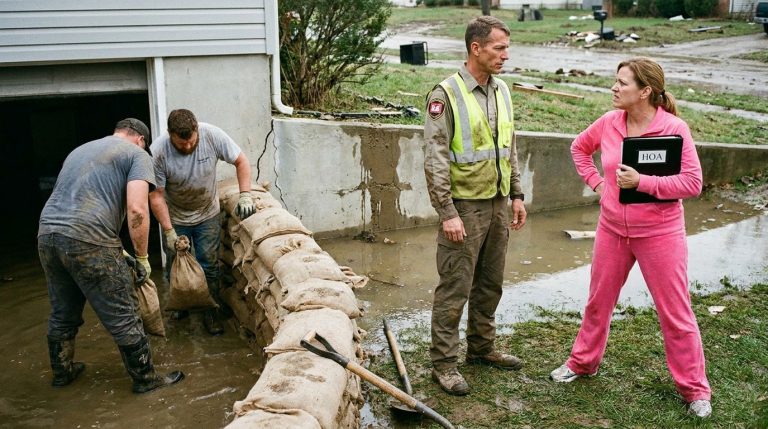
The fallout from the meeting hit with the cold efficiency of a winter storm. By the time I reached my truck, the parking lot was already buzzing with the erratic energy of a community experiencing whiplash. People were standing in small, tight clusters, their voices hushed, their expressions shifting from the blind anger Karen had cultivated to the hollow, confused realization of having been misled.
I didn’t stick around to witness the debates. The work was done. I drove home in a silence that felt heavier than the one that had preceded the meeting. Every shadow beneath the pines, every turn in the gravel drive, felt like a marker of a world that had just shifted on its axis.
The next forty-eight hours were a blur of documentation and legal maneuvers. Sarah was a whirlwind of professional precision. She moved through the HOA’s sudden collapse like a surgeon, ensuring that every demand we’d made was formalized, signed, and stamped. The private park sign was the first to go. I watched from my porch as a county crew arrived with a flatbed truck, their movements practiced and indifferent. They peeled back the “Founders Green” cedar plank and replaced it with a heavy, professional metal sign: John A. Miller Memorial Park – Public Park of Madison County.
It was a simple slab of metal, but as the sunlight caught the lettering, it felt like a monument to more than just my grandfather. It was a monument to the fact that secrets, no matter how carefully guarded by binders of bylaws and threats of litigation, eventually collide with the truth.
But the final act was far more brutal than a sign replacement. The audit Sarah pushed for turned out to be the true nail in the coffin for Karen Thorne’s tenure. The new, panicked board members—desperate to avoid being dragged down with her—had turned over everything to the district attorney. The embezzlement wasn’t a rumor; it was a paper trail.
I was at the dining table, cleaning my hunting gear, when the news came through a text from Sarah. Karen had been indicted. The charges were substantive, documented, and irrefutable. She wasn’t just losing her seat on the board; she was facing a reality that had no room for HOA rules or property IDs.
I walked to the window, the oil on my hands smelling of iron and persistence. I saw the clubhouse in the distance. The beige paint looked duller now, stripped of the manufactured prestige she had tried to drape over it.
The denouement felt less like a triumph and more like a necessary clearing of the air. Poetic justice, my grandfather used to say, is just the world finding its level again. Karen had tried to engineer an environment where she was the final word, but she hadn’t accounted for the fact that a community built on fear is the first thing to scatter when the lights are turned on.
Weeks later, the rhythm of life on the property finally settled into a quiet, enduring peace. The veterans came to hunt, their presence a respectful, low-profile ghost in the woods. We didn’t talk about the HOA or the court cases. We talked about the wind, the season, and the specific, stubborn ways that the land demanded to be treated.
One afternoon, I was out by the park boundary, mending a section of the fence that had been sagging under the weight of an old oak branch. My new neighbor, Tom, walked up with his young daughter. He looked different—lighter, as if the tension that had gripped the whole neighborhood had finally unspooled.
“The park looks good, Jack,” he said, gesturing to the meadow where the grass was long and swaying.
“It’s how it was meant to look,” I replied.
His daughter reached out, pressing a small, muddy hand against the fence rail. “My daddy says your grandpa was a good man,” she said, her voice clear and earnest.
I looked at the park, then back to the fence. The repair work was solid, the wires tight, the posts driven deep into the bedrock. I had spent my life building structures to survive pressure, but I realized then that the strongest things aren’t the ones that defy the wind—they’re the ones that hold the truth in place, no matter how much time, or how many petty tyrants, try to tear them down.
I turned back to my work, the metal of the fence cool and sturdy under my grip. The war was over. The park was open. And for the first time in a century, the Miller land was exactly what it was always intended to be: a quiet, unshakable foundation, held together by the only thing that actually lasts—an honest word, kept.