The Engineer’s Revenge: How a Retired Master Sergeant Drowned an HOA President’s Entitlement
CHAPTER 1: THE HIGH GROUND
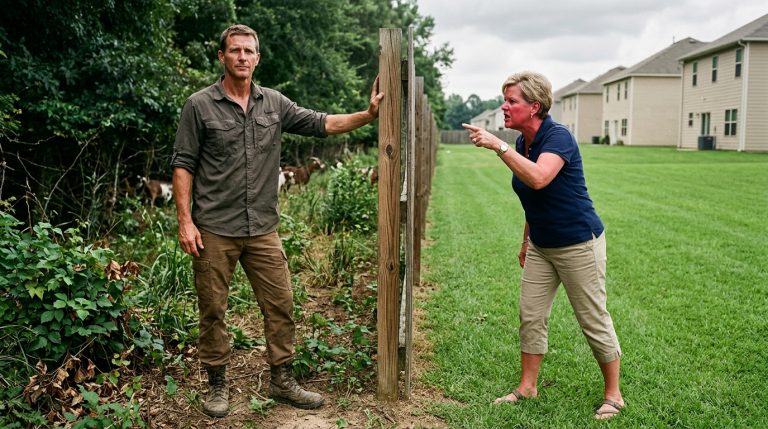
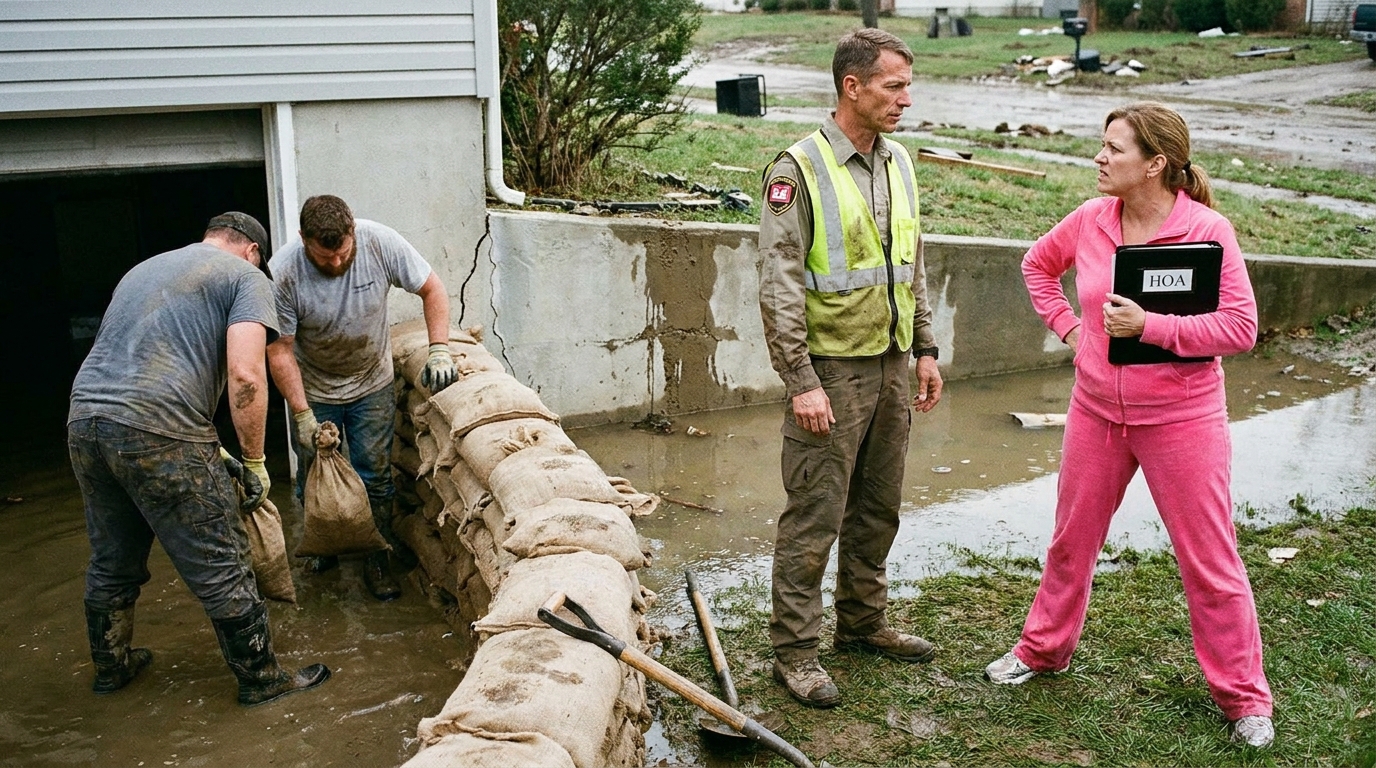
The humidity hit like a warm, wet blanket the second I stepped off my porch. Across the property line, the lurid pink of Karen’s tracksuit looked like a violent stain against the oak timber. She stood with her feet planted wide on the saturated turf, hands locked on her hips, watching two hired workers drop the final tan sandbag into place.
Between my five acres of wooded slope and her quarter-acre manicured lawn, the dam stretched three feet high, choking the natural gravel bed of the creek. The water was already losing its current, turning thick and glassy as it banked against the burlap.
“Your little stream is officially contained, Sergeant,” Karen called out, her voice dripping with the syrupy condescension of a woman who had never run into an immutable law of physics. She held a thick black HOA binder against her ribs like a shield.
I didn’t answer right away. I took a slow, deliberate breath, letting the red heat in my chest cool down into the cold, calculated stillness I’d relied on for twenty-five years in the Army Corps of Engineers. I walked to the edge of my lot, stopping just short of the fresh mud her crew had churned up.
“That’s not a little stream, Karen,” I said, keeping my tone flat, level, and entirely devoid of heat. “That’s a federally recognized Blue Line waterway. And you’ve just committed a felony.”
Her smirk didn’t even flicker. She took a step closer to the barrier, the heels of her running shoes sinking half an inch into the soft loam. “Section Four of the subdivision covenants states all water features must be contained within property boundaries. I’m protecting the neighborhood’s property values from your unkempt wilderness.”
She tapped the binder with a manicured fingernail, entirely blind to the fact that she was quoting a rule written for plastic koi ponds to justify damming a watershed that drained fifty square miles of preserve.
Right at the base of her foundation wall, near the egress window, a hairline crescent fracture in the concrete was already weeping a thin, dark ribbon of sulfur-smelling mud into her turf grass. She didn’t notice it. She was too busy soaking in what she thought was a victory.
“You can’t bully gravity, Karen,” I said, turning my back on her before she could offer another quote from her rulebook.
“I’ll see you in court, Mr. Davis!” she yelled after me, her voice shrill over the hum of a distant lawnmower. “Or at the board meeting when your fines double!”
I didn’t turn around. I walked up the gentle rise toward my custom build, my boots tracking dry pine needles across the driveway. Inside my study, the air was cool, smelling faintly of old paper and cedar. I pulled my weather monitoring tablet off its dock on the oak desk.
The radar map was painter-canvas red. A massive low-pressure system churning up from the Gulf was thirty-six hours out, projected to drop five to seven inches of rain directly over our watershed.
I unlocked the bottom drawer of my filing cabinet, pulled out the surveyor’s topographical maps for the county, and spread them flat over the desk. I traced the elevation lines with my thumb: my foundation sat at four hundred and fifty feet above sea level, anchored to bedrock with integrated French drains and graded swales.
Karen’s slab sat down in the natural catch-basin at four hundred and thirty-eight feet, with her basement floor sitting five feet below the natural bed of the stream she had just plugged.
I clicked my scarred steel Parker pen once, opened my logbook, and wrote down the exact time, water level, and weather parameters. The fuse was lit. All I had to do was make sure the paper trail was airtight before the sky opened up.
CHAPTER 2: BUILDING THE NETWORK
The ink settled into the paper, a permanent ledger of her stupidity. I capped the Parker pen with a sharp snap that echoed off the study walls, then pulled a fresh sheet of heavy bond paper from the top drawer.
Karen wanted to play a game of citations and local authority, but she didn’t realize that an Army Corps paper trail is built like a bunker. I drafted the formal notice in cold, dispassionate legalese, citing Clean Water Act Section 404 alongside the exact environmental exemptions buried in our own HOA bylaws.
I printed two copies, folded one into a crisp white envelope for certified mail, and slipped the second into my coat pocket. Outside, the air was growing heavier, thick with the electric tension of the incoming Gulf storm.
Walking down the driveway, the smell of damp pine gave way to the faint, metallic tang of pressurized mud lingering near the ditch. Karen was still sitting on her front porch, a glass of iced tea resting on the railing as she surveyed her new sandbag wall like a conqueror.
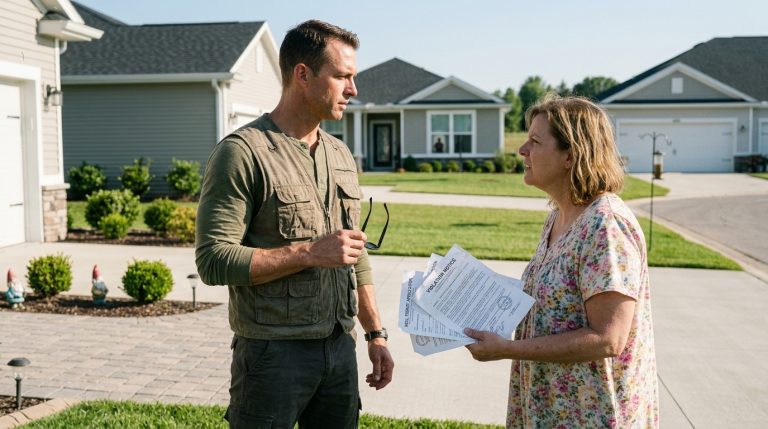
“For your records, Karen,” I said, stepping onto the edge of her concrete walk and extending the folded sheet. “Formal notice regarding your dam. I’d read it carefully before the rain hits.”
She snatched the paper, her eyes narrowing into small, bitter slits as her manicured thumb creaked against the page. “More of your scare tactics, Sergeant? You don’t intimidate me with fancy military talk.”
“I’m not trying to intimidate you,” I said, backing away toward the street without giving her an inch of leverage. “I’m giving you a chance to be intelligent. There’s a difference.”
I left her sputtering on the porch and cut across the street toward George Henderson’s driveway. George was standing near his open garage door, systematically wiping down a set of golf clubs with a gray shop rag, his shoulders hunched in a permanent posture of exhaustion.
“George,” I called out softly. “Got a minute?”
He looked up, his weathered face tightening instantly. “If it’s about the board, Mark, I really can’t. My doctor had to double my blood pressure meds last month.”
“It’s about the creek,” I said, stopping at the edge of his concrete slab. “She damned it with sandbags an hour ago. Placed them right on my property line.”
George dropped the rag into a plastic bucket with a dull thud. “Good Lord. Is she completely unhinged? That whole back corner is a watershed.”
“She thinks HOA rules override fluid dynamics,” I said. “Has she hit you with another notice this week?”
George let out a dry, bitter laugh, resting his weight against an iron driver. “One hundred dollars on Tuesday. Claimed my bird feeder was ‘attracting vermin’ because a couple of sunflower seeds blew onto her turf grass. I had to take it down just to keep her off my porch.”
“Keep the receipt for the fine,” I said quietly. “And talk to Maria down the road. We’re building a file.”
Ten minutes later, I was standing on Sarah Jenkins’s front porch two doors down. Sarah was a senior paralegal who spent her days reading corporate contracts and her evenings keeping her lawn spotless to avoid Karen’s clipboard. When she opened the door, her eyes immediately tracked past my shoulder toward the creek line.
“You’re here about the sandbags,” Sarah said, stepping aside to let me into her front hallway. “I saw the flatbed deliver them this morning.”
“She thinks the board’s insurance policy covers whatever happens next,” I said, setting my copy of the topographical map on her entryway table.
Sarah’s face hardened, a tight, cold smile cutting across her features as she reached into her briefcase on the bench. “Then she hasn’t read Section Twelve of the indemnification clause. The policy voids coverage the second a board member commits an illegal act or engages in gross negligence.”
She pulled out a thick blue folder, the tab marked with Karen’s house number in red ink. “I’ve been tracking her selective enforcement for eighteen months, Mark. If that dam backs up and causes structural damage, she isn’t just liable—she’s entirely on her own.”
“We need an emergency meeting called before the storm clears,” I said. “Ten percent of the neighborhood has to sign the petition.”
“I’ll have thirty signatures by dinner,” Sarah said, her voice dropping into a flat, professional register. “Let her keep her sandbags. We’re going to take her gavel.”
CHAPTER 3: THE DELUGE BEGINS
The sky didn’t just darken; it bruised into a deep, sickly yellow as the low-pressure system locked over the valley. I crossed the street back to my lot, my boots cutting through the standing water already gathering in the low cuts of Karen’s turf grass.
In my garage, I unlocked the steel footlocker on the workbench and pulled out three military-grade, weatherproof trail cameras. They were built for long-duration surveillance, equipped with infrared night vision and time-lapse intervals that didn’t miss a beat.
I mounted the first camera high in the trunk of an ancient red oak on my property line, establishing a wide, undeniable view that captured my house, the natural creek bed, the illegal sandbag barrier, and Karen’s backyard.
The second camera went onto a fence post five feet from the dam, angled directly at a wooden yardstick I drove into the soft mud of the creek bed. That camera was set to trigger every ten seconds, turning every fraction of an inch of rising water into hard, mathematical evidence.
For the third lens, I chose the low angle near the western boundary line. I aimed it straight across her property at her basement window wells, focusing on the thin, corrugated steel shields meant to keep runoff out of her subterranean rooms.
The sky tore open at 4:10 PM.
It wasn’t a gentle summer shower; it was a wall of falling water that rattled the oak leaves and turned my driveway into a shallow, sheet-flowing river. Within twenty minutes, three inches of rain slammed into the watershed, sending a surge down from the state preserve that hit Karen’s barrier like an iron wedge.
I watched from the large picture window in my study, a mug of black coffee cooling in my hand as the grey curtain of rain blurred the tree line.
Behind the three-foot sandbag wall, the trapped stream expanded from a quiet ten-foot trickle into a churning, violent brown pool forty feet wide. The water level on the yardstick climbed with terrifying speed—six inches, twelve inches, eighteen inches in less than forty-five minutes.
Karen’s house remained dark, save for a single light flickering behind her kitchen window. She was inside, likely assuming her burlap fortress was holding the line, completely blind to the basic mechanics of soil saturation.
Water doesn’t stop because a human places an obstacle in its path; it simply seeks the path of least resistance and builds hydraulic head until something gives.
On my side of the line, the engineered swales were performing flawlessly. The deep channels I’d graded years ago captured the overflow from my roof and driveway, guiding the rushing water smoothly around my slab and dropping it into the designated low-acreage flood zone away from any foundation.
Then, through the heavy sheets of rain, I saw the ground near Karen’s flowerbed begin to yield.
The soil wasn’t just wet; it was liquefying under the immense lateral pressure of the trapped water. A thick, dark trickle of mud escaped around the right flank of her sandbag wall, carving a raw, jagged trench through her prize-winning petunias and steering the entire force of the blocked creek straight toward her foundation wall.
CHAPTER 4: THE RUIN OF THE BASEMENT
The pressurized water didn’t stop to negotiate. It poured across her manicured lawn in a thick, swirling flood, filling the first steel window well in a matter of seconds.
The cheap plastic dome cover popped off under the rising weight, floating away like a plastic dish before tumbling down the newly formed trench. Inside her house, a light clicked on, casting a yellow rectangle through the glass just as the second window well overflowed.
Then came the structural failure.
Under the immense weight of the impounded water, one of her basement slider windows bowed inward, its vinyl frame groaning before the glass shattered with a muffled thump that was swallowed by the storm’s roar.
The water in the well instantly drained, creating a violent whirlpool as hundreds of gallons of muddy runoff rushed straight into her subterranean living area. It was like pulling the plug on a massive bathtub, except the drain led directly into her finished basement.
Across the property line, my land remained stable and dry. My French drains gurgled steadily, taking every drop that hit my slab and discharging it forty yards downstream into the wooded preserve.
A high-pitched shriek tore through the rain an hour later, echoing across the property line as the storm finally began to break into a quiet drizzle.
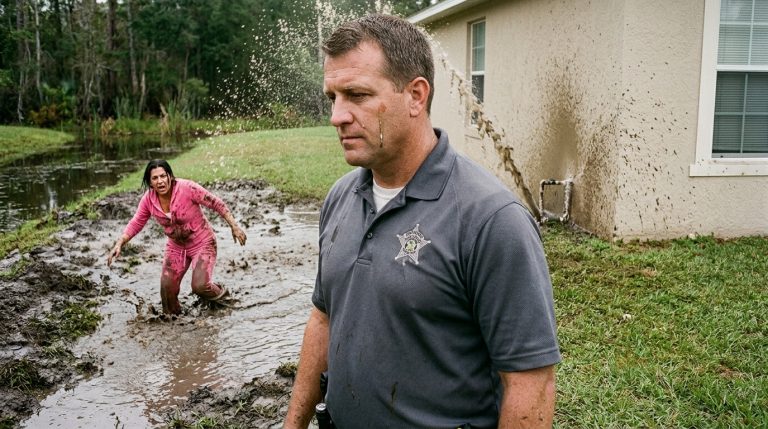
Karen came stomping through the mud, her pink tracksuit now plastered to her legs with dark brown sludge. Her hair was glued to her forehead, and her face was twisted into a grotesque mask of raw panic and rage.
She didn’t stay on the path. She trudged straight through the ruined, waterlogged bog she’d created, stopping right at the edge of my dry lawn with a trembling, muddy finger pointed at my chest.
“You did this!” she screamed, her voice cracking against the quiet morning air. “You diverted the water! You flooded my house on purpose! I’m calling the police!”
I set my cold coffee mug on the deck railing and took a slow, deliberate step toward the property line, keeping my hands resting loosely in my pockets.
“I didn’t touch a single shovelful of dirt, Karen,” I said, keeping my voice low and steady. “You damned a federal waterway with sandbags. The water simply took the path you built for it.”
“You’re going to pay for every inch of drywall!” she shrieked, her body shaking as she tried to maintain her authority while standing ankle-deep in liquefied topsoil. “The board will lien your property! I’ll take your house!”
“I have three high-definition cameras that captured the entire timeline from the moment your crew dropped the first bag,” I said, my tone as cold as the morning air. “And I have a signed certified mail receipt showing you were warned in writing twenty-four hours ago.”
Her jaw worked open and closed, but no sound came out. The rage in her eyes flickered, replaced by a sudden, hollow realization as she glanced back at the gaping, muddy trench leading straight into her broken window.
CHAPTER 5: THE OFFICIAL INVESTIGATION
The officer stepped out of his cruiser, his boots sinking two inches into the mess Karen’s lawn had become. He looked at her splattered pink tracksuit, then at the three-foot sandbag dam, and finally down the raw channel that emptied straight into her shattered basement window.
“He destroyed my foundation!” Karen shrieked, charging toward the officer with her arms flailing. “He dug a trench in the middle of the storm! He flooded my home on purpose!”
The officer held up a single, gloved hand. “Ma’am, stay back from the embankment. Sir,” he turned to me, “what’s your side of this?”
“I didn’t dig a single shovel of earth,” I said, my voice level and quiet. “I have technical documentation, topographical surveys, and high-definition time-lapse video covering the last forty-eight hours. Step inside my study and see for yourself.”
Ten minutes later, the officer stood in front of my desk monitor, watching the wide-angle camera playback. He watched the rain fall, the water pool behind the burlap, the pressure build, and the exact millisecond the impounded stream broke around the sandbag wall to carve its own path.
“She built the dam herself?” the officer asked, pointing at the clear frame of Karen directing her hired workers.
“She built it yesterday,” I said, placing the certified mail receipt and the USGS elevation maps side by side on the oak wood. “And here is the written warning I delivered to her hand before the storm hit.”
The officer let out a long, slow whistle, tapping his pen against his pad. “This isn’t a criminal matter for you, Mr. Davis. She constructed an unpermitted barrier on a natural watershed and directed the flow into her own foundation.”
Before the police cruiser even left the driveway, a dark green sedan bearing the Department of Environmental Quality seal pulled up behind it. Frank Miller, a senior field investigator with decades on the job, stepped out holding my overnight evidence packet in his hand.
He walked past Karen’s shouting form without a word, stepping straight to the edge of the creek bed. He looked at the sandbags, kicked one with the toe of his work boot, and took out a digital camera.
“Class One protected stream,” Frank muttered, snapping photos from three angles. “Section Four Hundred Four violation. Federal and state statutes. Fines start at ten thousand dollars a day per violation.”
Karen’s face drained from deep purple to a pasty, sickly white as Frank marched up her porch steps and handed her a thick yellow citation envelope.
“You can’t fine me!” she screamed, her voice cracking as her composure broke entirely. “The HOA covenants allow me to contain water features!”
“The State of Mississippi doesn’t care about your covenants, ma’am,” Frank said calmly, signing his clipboard. “Remove the bags, or the state will remove them and bill your personal assets.”
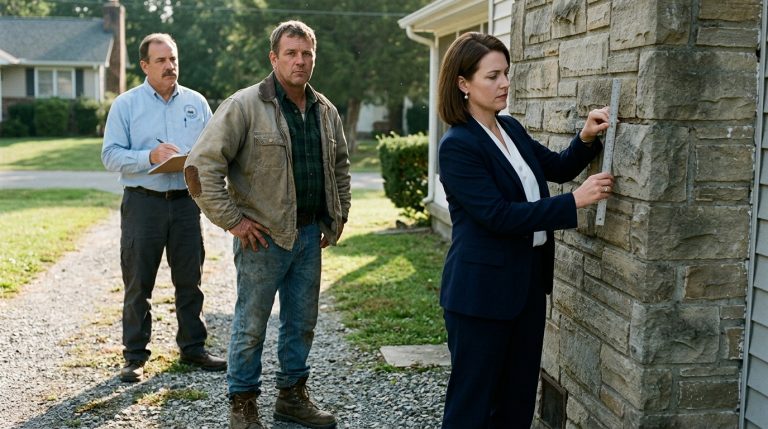
By four o’clock that afternoon, Arthur Vance, the senior claims adjuster for the HOA’s insurance carrier, arrived on site after receiving the formal notice Sarah Jenkins had dispatched. He took one look at the certified warning letter, inspected the seeping fracture near Karen’s egress well, and closed his leather folder.
“Claim denied, Miss Johnson,” Vance said, his voice completely flat as Karen trailed behind him on the ruined grass. “Gross negligence and intentional illegal acts are explicitly excluded under your board policy. The HOA will not cover your basement, and your personal policy will reject this under the flood exclusion clause.”
She stood alone in the center of her drowned lawn, surrounded by three official vehicles, holding a denied insurance claim in one hand and a state environmental citation in the other, her absolute authority crushed under the weight of her own audacity.
CHAPTER 6: THE NEW BALANCE
The vote inside the clubhouse wasn’t a debate; it was an eviction. Fifty-eight ballots cast, fifty-five in favor of immediate removal for gross negligence, willful misconduct, and intentional illegal acts.
Karen sat in the front row as Sarah Jenkins read the official tallies, her head down, her hands clutched around a empty plastic coffee cup that crumbled under her grip.
When the board transferred the interim gavel to Sarah, the room didn’t explode into wild cheer—it just exhaled a deep, collective sigh of relief that had been held for three years.
The aftermath came with the cold, unyielding precision of arithmetic. The state environmental fines, reduced only because the new board immediately authorized professional creek remediation, still cost five thousand dollars from the emergency reserve.
A special fifty-dollar assessment hit every mailbox in the neighborhood to cover the heavy machinery that pulled the sandbags, restored the natural gravel bed, and regraded the ruined channel.
Every resident paying that fifty dollars knew exactly whose vanity had written the bill.
Three weeks later, a yellow for-sale sign was hammered into the dry, patched lawn across the property line.
Karen sold to a corporate house-flipping outfit at a forty percent loss, taking whatever liquid cash was left after her insurance company initiated subrogation proceedings to recover their investigation expenses.
The day the moving truck pulled away, I sat on my deck with a mug of hot coffee, watching the creek return to its ancient rhythm.
The sandbags were gone, the willow saplings were anchored into the banks, and the water moved with a gentle, timeless burble through the shade of the red oaks.
Down the street, the dull thud-thud of a basketball hit the Rodriguez family’s driveway, accompanied by the bright, unbothered laughter of their kids.
Across the lane, George Henderson walked out onto his porch, carrying a fresh cedar bird feeder filled to the brim with sunflower seeds, hanging it proudly from the eave of his garage without checking behind his shoulder for a clipboard.
I clicked my scarred steel Parker pen once, laid it flat on the wooden arm of my deck chair, and leaned back into the quiet air.
Water always finds its own level, no matter how high someone tries to build a dam.