The Cold Chain of Evidence and the Shadow Across Cedar Street
CHAPTER 1: THE MISSED TURN AT CEDAR
The wipers scraped across the windshield, dragging oily rain into blurred red streaks.
I held the dented steel travel tumbler between my palms, letting the heat of the chamomile seep through my tired fingers.
Aaron’s dark sedan usually took the right bank onto Cedar Street at exactly midnight.
Tonight, his knuckles turned white against the vinyl steering wheel as he held the car straight, accelerating past the exit and into the unlit commercial stretch toward Alameda.
“Aaron,” I said, my voice flat, grounded in the quiet habit of sixty-one years. “Cedar was two blocks back.”
He didn’t check the rearview mirror. His jaw stayed set, rigid as weathered pine.
“Keep your hands on that cup, Lydia,” he said, his voice a low, heavy rasp that barely cut over the hum of the tires. “And don’t look back through the glass.”
The sedan swung into the empty parking lot of a closed commercial tile warehouse.
He cut the headlights, rolling the car into the deep shadow beneath a rusted loading dock.
The engine died, leaving only the wet thunk of raindrops hitting the roof.
“You are five minutes off schedule,” I said, setting the steel tumbler on my lap so it wouldn’t rattle against the door. “My porch light is on a timer. It goes dark at 12:10.”
“Your porch light won’t matter tonight,” Aaron said. He turned in his seat, his eyes hollowed out by the yellow streetlamp flickering a hundred yards away. “There’s an older grey Buick parked three doors down from your gate. Engine running. Headlights off.”
My pulse ticked once, hard against my throat, but I kept my breath steady.
“Los Angeles is full of dead cars, Aaron. People sleep in them.”
“Not this one,” Aaron said. He reached down and picked up a paper notepad from the center console, its pages soft and dog-eared from use. “He’s been there Tuesday, Thursday, and tonight. A man in a dark cap. He got out ten minutes before I picked you up from the archive.”
He flipped the notepad open, showing me columns of hand-written times and dates inked in tight, practical strokes.
“I watched him walk up your driveway, Lydia. He tried the latch on your side gate. Then he stood on the gravel and looked into your kitchen window.”
The metal of the tumbler felt suddenly freezing against my knuckles.
“Did he get in?”
“No,” Aaron said. “Because I tapped my horn twice from the corner, and he walked back to his front seat. But he didn’t drive away. He’s waiting for your light to go out.”
I closed my eyes for a fraction of a second, feeling the cold weight of my small bungalow—the peeling yellow paint, the loose latch on the back window, the silence that Daniel had left behind six months ago.
“Why?” I whispered. “I log civil case files. I don’t carry cash. I don’t own anything worth breaking a window for.”
“He isn’t looking for cash,” Aaron said softly. “Last week I picked up a fair on 4th Street. Heavy set, smelling like cheap gin and stale tobacco. He spent ten minutes complaining on a flip phone about an old woman in records who was digging where she didn’t belong.”
Aaron reached over and tapped the steel cup in my hands.
“He called you by name, Lydia. He said you were pulling files from the 1990s civil vaults. And he said if you took those papers home, he’d clear out your house before the sun came up.”
The rain rattled harder against the roof, a sharp, unrelenting rhythm in the dark.
I looked at Aaron’s hands—calloused, scarred at the knuckles from twenty years of commercial maintenance before his spine gave out.
“We don’t have a recording,” I said, the legal assistant in me calculating the brutal math of an empty claim. “We don’t have a license plate that isn’t smudged by rain. A notebook with hand-written times won’t pull a police unit to East L.A. at midnight.”
“I know,” Aaron said simply. “That’s why I’m not taking you home.”
CHAPTER 2: SHADOW ON THE PORCH
The tile warehouse parking lot was silent except for the low rhythmic tick of the sedan’s cooling manifold.
I looked down at Aaron’s open paper pad, reading his cramped, mechanical handwriting under the dim yellow ambient light of the dashboard.
“Cedar Street is six blocks north,” I said, setting the steel tumbler on the floorboard between my feet. “If we sit here, he knows we saw him.”
“He knows a car stopped,” Aaron said, his large hands resting heavy on the top of the steering wheel. “He doesn’t know what you’re doing next. That’s the only edge we have.”
“He tried my side gate,” I repeated, forcing my voice into the cold, methodical cadence I used for thirty years when cataloging missing probate files. “Which means he has a key, or he knows the bolt is rusted through.”
Aaron shifted the transmission into drive without turning on the headlights. “We don’t go to the front door. We coast down the alley behind the dry cleaners.”
The car moved through the wet asphalt like a gray stain, creeping behind the row of single-story East L.A. bungalows.
He cut the engine forty yards down from my property line, rolling to a stop behind a cluster of overgrown bougainvillea bushes.
Through the damp leaves, the dark silhouette of my small rear garage stood out against the pale streetlight streaming from the main avenue.
The back door of the garage was resting open by two inches—a thin line of absolute pitch black cutting through the grey wood.
“I locked that latch with a brass padlock on Sunday,” I whispered, my eyes tracking the broken wood along the frame.
“He didn’t use a crowbar,” Aaron murmured, his shoulder pressing against mine as he leaned toward the rear quarter-window to get a better angle. “Look at the dirt on the bottom sill. No wood splinters. He had a passkey.”
A sudden metallic clink echoed from the gravel alley—a small, sharp sound, like a ring striking an iron pipe.
I froze, my breath catching in my throat as Aaron’s hand shot out, broad and calloused, pressing flat against my shoulder to anchor me to the seat.
Through the rear glass, the grey Buick sat idling near the corner of Cedar, its exhaust pipe spitting faint white plumes into the rain.
The driver’s door didn’t open, but a dark arm extended from the window, dropping a wet paper cup onto the pavement before the sedan slowly rolled forward three feet and stopped again.
I leaned closer to the glass, my eyes catching something white stuck under the rubber seal of my own garage’s side window—a discarded, water-logged index card.
“That wasn’t there this morning,” I said, my voice dropping an octave as cold calculation replaced the initial shock. “That’s an archive file divider. Heavy cardstock, color-coded yellow on the top tab.”
Aaron didn’t look at the card; his eyes remained fixed on the grey Buick’s side mirror reflected in the streetlight.
“He isn’t just looking for records, Lydia,” Aaron said quietly. “He’s leaving markers. He’s timing how long it takes for someone to notice.”
I reached down and grabbed the handle of my travel tumbler, my fingers finding the familiar dent in the base.
“My legal pad,” I said, the realization settling into my spine like ice. “The one missing from my kitchen table. It didn’t have case numbers on it. It had my husband’s old union pension dates.”
Aaron turned his head slowly, his tired eyes narrowing in the dark. “Your husband?”
“Daniel,” I said. “He testified in a municipal contract audit back in ninety-four. Before we bought this house.”
The grey Buick’s brake lights flared red in the rain, casting a long, blood-colored glare across the wet gravel of the alley.
CHAPTER 3: THE VAULT DISCREPANCY
“We aren’t going to get police out here for a piece of cardboard,” I said, unhooking my fingers from the handle and forcing my shoulders down. “Not at one in the morning.”
Aaron put the sedan in reverse, rolling us backward through the alley until the bougainvillea bushes hid the rear of my lot once more.
“The archive,” he said, eyeing the rear view mirror as the grey Buick pulled away from Cedar Street, heading toward the freeway ramp. “If he’s moving files, he’s doing it on his shift.”
“He works contract security for the downtown building,” I replied, grabbing my tumbler from the floorboard. “He has the keycard for the perimeter and the basement corridor.”
We arrived at the downtown facility twenty minutes later, entering through the delivery basement where the legal records were staged for long-term storage.
The concrete walls smelled of damp dust, machine oil, and old cellulose—a heavy, dry scent I had breathed in every night for six months.
My keycard clicked in the scanner outside Vault B, the heavy iron lever yielding with a mechanical thud.
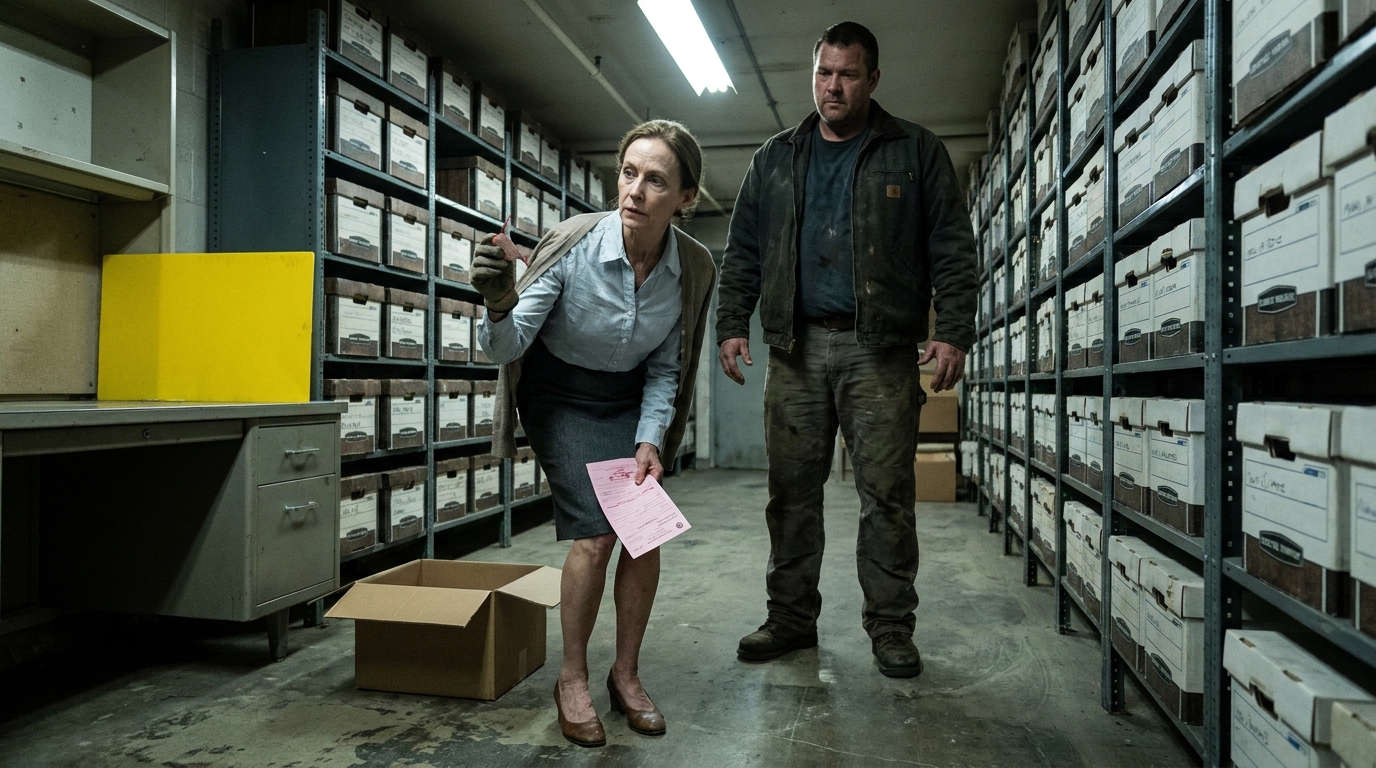
The long aisles stretched out beneath fluorescent tubes, rows of steel shelving holding thousands of gray archival boxes labeled with eight-digit civil docket numbers.
I didn’t head to the active audit stack; I walked straight to the manual sign-out binder on the metal desk near the emergency exit.
In an archive this size, digital scans were secondary—the physical paper chain-of-custody log was the legally binding record.
I flipped back through the physical ledger, tracing my index finger down the columns of black ink where security officers signed off on perimeter checks.
“Look here,” I said, tapping the paper.
Aaron leaned over my shoulder, his heavy breathing steady against the quiet hum of the climate control system.
The log entry for Tuesday night had a gap—a clean three-hour window between midnight and 3:00 a.m. where no guard signature appeared.
“He didn’t log his walk,” Aaron said.
“He logged it,” I corrected him, turning the page toward the light. “He used a dry ballpoint pen with no ink to leave blind indentations on the page, making it look like he signed at a glance.”
I pulled a soft lead graphite pencil from my pocket and ran the side of the lead lightly across the blank line.
The indentations filled with dark gray dust, revealing a name written in sharp, aggressive strokes: V. Hail.
Below the signature was a docket number crossed out three times with heavy ink lines: 1994-CV-8821.
My heart gave a single hard thump against my ribs.
I walked five aisles down to the 1994 municipal archives, reaching for the box listed on that hidden line.
The cardboard box was lighter than it should have been.
When I pulled the lid off, three-quarters of the thick paper files were missing, leaving only a single yellow divider and a folded piece of faded pink carbon paper at the bottom.
I picked up the pink slip. It was an old court summons receipt dated November 12, 1994.
At the bottom, signed in blue ink that had faded to brown over thirty years, was my husband’s signature: Daniel Moore, Expert Witness.
Scrawled right beneath Daniel’s signature, written in red wax pencil, was a single handwritten line: You took my license. I take your house.
“Lydia,” Aaron said, his voice dropping low as his boots shifted on the concrete behind me. “The basement security door just clicked locked.”
CHAPTER 4: THE CORNER IN THE BASEMENT
The steel door frame hummed as the mag-lock seated into the jamb, sealing the concrete basement off from the rest of the facility.
Heavy, uneven footsteps echoed down the main aisle—the dragging gait of a man who spent twelve hours a night on hard concrete floors in steel-toed boots.
Victor Hail stepped into the pool of yellow fluorescent light at the head of Aisle 5, his grey security uniform wrinkled at the sleeves, a heavy set of brass master keys jingling against his belt clip.
He didn’t pull a weapon; he pulled a silver keycard from his breast pocket and tapped it casually against his palm.
“You’re working off-clock, Lydia,” Victor said, his voice grating like gravel churning in a cement mixer. “Audit clerks don’t get overtime for crawling through thirty-year-old municipal trash.”
Aaron shifted two steps to my right, positioning his broad frame directly between Victor and the steel ledger table, his hands hanging loose and ready at his sides.
“The building log was altered,” Aaron said, his low voice vibrating through the tight aisle. “You used a dry pen to hide your sign-in.”
Victor let out a short, wet laugh, his eyes fixing on the faded pink summons receipt tucked into my fingers.
“A dry pen,” Victor sneered, stepping closer, his boots crunching on the fine paper dust coating the concrete floor. “You think some night-shift driver and a sixty-year-old widow are gonna bring a police detective down here over ink indentations?”
He pointed a thick, scarred finger straight at my face, his knuckle swollen from years of manual labor.
“Your husband stood on a witness stand in ninety-four and lied through his teeth about my maintenance logs,” Victor said, his jaw working as his breathing turned shallow. “Cost me my state license. Cost me my company. I spent thirty years taking night-shift security scraps while Daniel Moore retired on a school district pension.”
“Daniel didn’t lie,” I said, stepping past Aaron’s shoulder so Victor had to look me dead in the eyes. “You siphoned building funds from the disability civil settlement pool. I’m looking at the same handwriting on these altered 1994 logs that I saw on last week’s audit sheets.”
“That money was owed to me,” Victor snapped, his face flushing dark red as his voice cracked in the narrow concrete room. “The court ruined me. I just took back my back pay from cases no one cares about.”
He reached out a heavy hand, grabbing the edge of the steel shelving unit to steady his balance, his eyes locked onto the paper in my hand.
“Give me the paper, Lydia. You hand over that receipt and walk out the basement door, or I report a security breach. You’re trespassing after hours.”
“The manual ledger is already graphite-traced,” I said, tightening my grip on the steel tumbler until my knuckles turned white. “And you locked the door from the inside.”
Victor’s teeth gritted together as he took a hard, aggressive step forward, reaching directly for my arm.
CHAPTER 5: THE WEIGHT OF STEEL AND CONCRETE
Aaron moved before Victor’s fingers could graze the faded pink slip.
His broad shoulder slammed into Victor’s chest with a dull, heavy thump, driving the guard back two strides into the steel uprights of Aisle 4.
Shelves groaned under the impact, a dozen grey archival boxes sliding forward and dropping off the edge, spilling yellowed folders across the concrete floor.
Victor growled, his hand going wide to grab the metal frame, his boots slipping on the loose paper sheets.
“Get out of the way, old man!” Victor barked, shoving his forearm hard against Aaron’s chest.
Aaron didn’t swing; he planted his boots, his crushed vertebrae taking the strain as he used his bulk to pin Victor against the metal shelving unit, locking the guard’s right elbow against the steel bracket.
“Lydia,” Aaron grunted, his breath ragged, a bead of sweat breaking on his forehead under the harsh fluorescent lights. “The lever.”
I didn’t pause to watch the struggle. I spun on my heel and ran toward the main vault control box at the end of the aisle.
The vault door was a six-inch-thick steel rolling partition used to isolate fire zones in the basement.
It didn’t run on software—it ran on a counterweighted mechanical chain release mounted inside a wall-recessed iron cabinet.
Victor saw where I was heading. He lunged forward, throwing his full weight against Aaron, tearing his sleeve on a sharp metal corner as he broke free.
“You touch that chain and I’ll report a manual sabotage!” Victor yelled, his voice cracking with pure desperation as he stumbled through the scattered paper, his heavy boots kicking boxes aside. “I’ve got night coverage authority! They’ll throw both of you in a cell!”
He reached out, his thick fingers grabbing the rim of my travel tumbler resting on the ledger table, sweeping it off the metal surface.
The steel tumbler hit the floor with a loud clang, rolling across the concrete and jamming directly into the lower track of the rolling vault door.
Victor lunged for the wall cabinet, his hands wildly grasping at my arm to yank me away from the iron handle.
I didn’t pull back. I used his forward momentum, stepping sideways and driving my palm hard against the cabinet door, slamming the heavy iron panel shut directly on his fingers.
Victor let out a sharp, choked shout, pulling his hand back as he stumbled against the track.
I grabbed the mechanical release lever with both hands, throwing my full sixty-one-year weight downward.
The heavy iron gear disengaged with an ear-splitting screech of ungreased metal.
The six-inch steel rolling partition dropped from the ceiling frame, sliding down its tracks with the force of a falling anvil.
Victor scrambled backward, trying to kick his legs out of the doorway, but the steel door slammed down hard—stopping dead six inches from the concrete floor, wedged tight against the dented frame of my steel travel tumbler.
The tumbler held the weight, its thick metal walls crushed flat but resisting the full lock.
Victor lay on his back inside the vault, panting, his face red and slick with sweat, his fingers clawing at the six-inch gap under the door as he stared out at my boots.
“You can’t leave me in here!” Victor roared, his voice muffled behind the heavy steel slab. “I’m the head guard on duty! You’re nothing but a night clerk!”
I knelt down, resting my palms on my knees, and looked straight through the six-inch gap beneath the crushed steel cup.
“The Graphite trace on the ledger has your signature, Victor,” I said, my voice steady, cold, and clear. “And the 1994 summons receipt is in my pocket.”
Aaron stepped up beside me, his heavy hand resting on the top of the iron lever box, holding the mechanical lock in place.
“I’m keeping my hand on this brake until the morning shift manager gets down the stairs,” Aaron said.
CHAPTER 6: TEA ON A QUIET PORCH
The facility night manager arrived first, his tie unbuttoned at the collar, eyes wide as he looked from Aaron holding the iron lever to Victor trapped beneath the steel partition.
Two municipal officers followed behind him, their flashlight beams cutting through the floating paper dust of Aisle 5.
Victor didn’t stay quiet while they cranked the partition back up.
He shouted from the floor, claiming Aaron had ambushed him, insisting I was stealing sensitive settlement records, demanding that the officers check my bag for contraband.
“Check her coat!” Victor bellowed, his voice echoing off the concrete walls as the officers pulled him to his feet and snapped wrists behind his back. “She’s trespassing! She’s got no right to be in the 1994 stacks!”
I didn’t argue or raise my voice.
I reached into my pocket, pulled out the faded pink summons receipt with Daniel’s signature and Victor’s handwritten threat, and handed it directly to the lead officer alongside the graphite-rubbed ledger page.
The officer looked at the red wax pencil script, then at Victor’s grey guard uniform badge, and nodded once to his partner.
“Save it for the booking desk, Hail,” the officer said, guiding Victor down the corridor while the manager stood frozen, staring at the empty boxes scattered across the floor.
Sunday evening arrived six months later with a cool, dry breeze blowing off the East Los Angeles hills.
The yellow paint on my bungalow was no longer peeling; a fresh coat of grey latex sealed the front siding, and a solid iron latch sat screwed deep into the frame of my side gate.
I sat on the top porch step, holding a brand-new steel tumbler filled with hot peppermint tea.
Aaron’s dark sedan pulled up to the curb at 6:00 p.m. sharp.
He cut the engine, stepped out into the quiet twilight, and walked up the gravel path carrying a small paper bag of fresh lemons from his mother’s yard.
“Porch light timer is set for eight,” Aaron said, setting the bag down on the wooden railing before taking a seat on the step below mine.
“I know,” I replied, handing him a second porcelain mug. “I checked the wiring on Thursday.”
We sat in the quiet space of a neighborhood settling into dusk, listening to the soft hum of distant freeway traffic that never truly stops in L.A.
There were no court dates left on my calendar, no missing ledgers to trace, and no shadows lingering near my garage window.
Daniel’s memory no longer felt like an open wound waiting to be exploited; it sat steady inside the house behind me, quiet and undisturbed.
“My son called this morning,” Aaron said, taking a slow sip from his mug as he looked out toward the street. “He’s taking the Saturday shift off so we can fix my mother’s back fence.”
“That’s good, Aaron,” I said gently. “Fences take two people to hold straight.”
He nodded once, a heavy, quiet motion that carried years of unspoken relief.
I took a sip of my tea, feeling the warmth spread through my hands, perfectly steady against the cool evening air.