A Portrait of Stolen Time: Two Children, One Broken Mirror, and the Long Journey Home
CHAPTER 1: The Gallery Collision
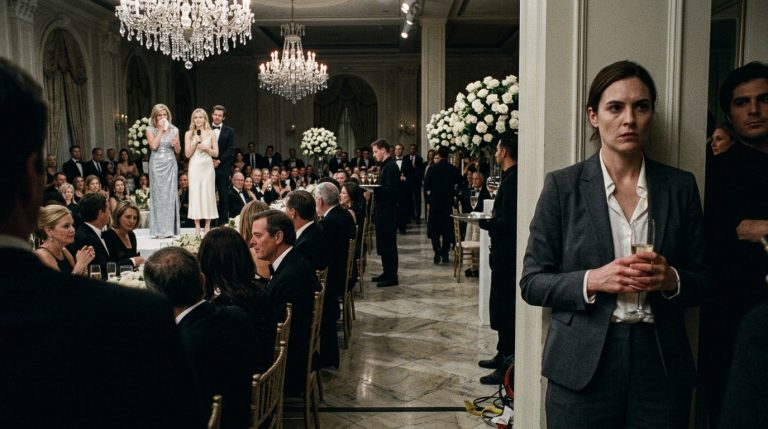
The gallery was a cathedral of soft chatter and aggressive, white-hot lighting. Maya squeezed Ethan’s hand, feeling the small, rhythmic thrum of his anxiety against her palm. He was a quiet boy, the kind who built worlds in the margins of his notebooks, and today, one of those worlds was on display.
Maya stood in front of his painting—a simple, honest depiction of their dinner table. Her smile, rendered in uneven brushstrokes, looked back at her with a warmth that made her throat tighten. But her eyes drifted to the side. There, next to her painted chair, was a stark, intentional void. An empty chair. She knelt, her silk skirt brushing the polished floor.
“Why the empty chair, baby?” she whispered.
Ethan didn’t look at her. His gaze was fixed on a painting five aisles over. “Because somebody is missing, Mom.”
The air in the room suddenly felt thin. Maya opened her mouth to offer a gentle comfort, but a sharp, sudden flash of camera light caught her eyes, momentarily blinding her. When her vision cleared, Ethan was gone. His hand had slipped from hers as if he’d been pulled by an invisible current.
She stood, scanning the crowd. The gallery was a blur of expensive perfume and shifting wool coats. She moved with a desperate, measured pace, her heart hammering a frantic rhythm against her ribs. She found him near the far wall, his back perfectly rigid. He wasn’t looking at the other children’s work. He was staring at a portrait of a woman waiting by a window.
It was her. It was Maya, painted seven years younger, her hair falling in a way she hadn’t worn it since she moved to Seoul.
Ethan stepped closer, his small fingers twitching at his sides. He looked like he was afraid the paint might melt if he breathed too hard. “Why did you draw my mom?” he asked.
A voice, soft as falling ash, drifted from the person standing in front of him. “I didn’t.”
The little girl turned. Maya felt the blood drain from her face, leaving her cold in the overheated room. The girl held a sketchbook to her chest, her knuckles white. She had Ethan’s eyes. She had Ethan’s chin. She was a mirror reflecting a tragedy Maya had kept buried for nearly a decade.
Ethan’s mouth parted, a soundless gasp escaping him. He looked at the painting, then at the girl, then back at the painting. The gallery noise—the laughter, the clinking of champagne glasses—seemed to drop away, replaced by the deafening silence of a secret being exhaled into the room.
“That’s my mom,” Ethan whispered, his voice trembling.
The girl frowned, a flicker of genuine confusion crossing her features. “No,” she said, her voice small and steady. “She’s my mom.”
Ethan stood frozen, but Maya saw the exact moment the shift happened—the look in his eyes changed from confusion to a cold, hard recognition. He reached out, his hand hovering inches from the girl’s shoulder, when a deep, gravel-voiced cough shattered the moment.
A man was walking toward them. He was draped in a black suit that looked like armor, his posture so sharp it cut through the crowd. People parted for him, a silent wake following his movement. He wasn’t looking at the art. He was looking at Ethan. And for the first time in seven years, the world stopped tilting—it began to crack.
CHAPTER 2: The Mirror Image
The silence in the gallery wasn’t empty. It was pressurized, a physical weight that pinned Ethan to the floorboards. The man in the black suit—the man with the cold, cutting posture—was closing the distance. Every step he took was precise, lacking the frantic, messy energy of the other parents. He moved like someone who had never once lost a game of chess.
Ethan felt the ghost of a dream ripple through his mind, one he’d had for as long as he could remember: standing in front of a mirror that didn’t reflect him, but rather someone else, someone whose glass was slowly spider-webbing with cracks. The thought felt like an intrusive, cold hand against his neck.
“Ella?” The man’s voice was deep, a low rumble that seemed to vibrate in Ethan’s own chest.
The little girl beside him—Ella—didn’t move. She was still gripping her sketchbook, her knuckles white. She looked at Ethan, then at the portrait of Maya on the wall, then at the man. The shock on her face was morphing into something harder, a dawning realization that the world she had been born into was built on a foundation of omission.
Ethan looked down at his own hand, then reached out to touch the fabric of Ella’s sleeve. It was the same material as his own school uniform. He felt a sudden, frantic need to anchor himself. He looked for his mother, Maya, but the crowd had surged, a wave of bodies separating them. He could see her silhouette near the refreshment table, her head turned away, scanning the room for him. She didn’t know yet. She didn’t know that the mirror was standing right next to him.
“Ella, we are leaving.” The man stood over them now. He didn’t look at Ethan directly, but Ethan felt the weight of his gaze like a physical pressure, like an invisible hand pushing him back.
“Dad, wait,” Ella said. Her voice was thin, almost breaking, but she didn’t step away from Ethan. She looked up at the man, her eyes wide and wet. “Why does he look like me?”
The man, Kim Tae-jun, paused. He didn’t blink. He didn’t even shift his weight. He merely looked down at Ethan, and for the briefest, most agonizing fraction of a second, the mask of ice cracked. A flicker of something raw, something tortured, passed behind his eyes. It was the look of a man who had spent seven years convincing himself that a lie was a mercy.
“It is a coincidence,” Tae-jun said, his voice flat. It was a lie so practiced it almost sounded like truth. He reached down and took Ella’s hand. His grip was firm, possessive. “Come along.”
“It’s not a coincidence,” Ethan said, his voice stronger than he felt. He had to say it. The words felt like stones he’d been carrying in his pockets, finally being thrown. “I have the same birthday. I like the same things. I—”
Tae-jun looked at him then, and the cold returned, absolute and biting. “You are a child playing with shadows. Go back to your mother.”
He turned, pulling Ella toward the exit. She stumbled once, her eyes locked on Ethan’s. She didn’t say goodbye, but as she was tugged away into the blur of the crowd, she let her sketchbook slide, just an inch, from her grip. A small, torn page drifted to the floor.
Ethan scrambled for it, his knees hitting the hard gallery floor. He snatched the paper up before anyone could step on it. It was a quick, frantic sketch—not of a portrait, but of two windows. In one, a woman sat alone. In the other, the same woman stood with a man whose face had been smudged by an eraser until it was just a dark, hollow shape.
“Ethan!”
His mother was there. Maya’s hands were on his shoulders, her grip tight, her breath coming in quick, shallow hitches. She looked at the paper in his hand, then at the retreating back of the man in the black suit, then back at her son.
“What is that?” she whispered.
Ethan looked at the sketch, then at his mother’s pale, trembling face. The gallery lights seemed to hum, a high, piercing sound that made his ears ring. He didn’t show her the paper. He tucked it deep into his pocket, his heart hammering against his ribs. He felt the cold, hard reality of the world pressing in, the secrets and the lies layered like the paint on the walls.
“Nothing, Mom,” he said, and for the first time in his life, he tasted the sharp, metallic tang of his own secret. “Just a drawing.”
Maya stood slowly, pulling him into her, but as she scanned the room, her eyes narrowed with a sudden, sharp intuition. She didn’t know what had happened, but she knew the air had changed. The gallery was no longer a place of pride. It was a trap, and she was already looking for the exit.
CHAPTER 3: The RainSlicked Window
The heavy glass doors of the gallery swung shut behind them with a hiss of pressurized air, sealing away the warmth and the light. Outside, Seoul had transformed. A sudden, violent downpour had turned the streets into a river of dark, reflective asphalt, and the city lights were now just fractured, neon blossoms bleeding into the wet pavement.
Maya didn’t move immediately. She stood under the thin, arched overhang of the gallery entrance, her hand still resting on Ethan’s shoulder. Her grip was tight—not painful, but urgent, as if she were trying to ground herself against a tremor only she could feel. She stared out into the rain, her jaw set in a line of brittle determination.
“Ethan,” she said, her voice barely audible over the roar of water hitting the concrete. “Who was that man?”
Ethan looked down at his shoes. They were pristine white, now spotted with dark, oily raindrops. He felt the sketch in his pocket, the corner of the paper digging into his thigh like a sharp reminder. He had been trained to be a quiet boy, to observe and keep his observations to himself, but the air tonight was thick with things left unsaid. He looked up at her, seeing the way the streetlights cast deep, weary shadows under her eyes.
“I don’t know, Mom,” he lied. The words felt slippery, coated in the same cold indifference the man in the suit had projected.
Maya turned to look at him, and for a moment, her gaze was so piercing that Ethan feared she would see right through the fabric of his jacket, right into the folded secret in his pocket. She sighed, a long, shivering sound that seemed to pull the warmth out of her. “We should go. It’s too cold to stand here.”
They stepped out into the deluge. The rain wasn’t a gentle patter; it was a deluge that forced them to hunch their shoulders and pick up their pace. They didn’t speak as they navigated the crowded sidewalk, their umbrellas clashing with the sea of black nylon passing by. Ethan watched the world through the periphery of his hood—the blurred faces of commuters, the rhythmic splash of tires through puddles, the flickering signs of corner shops. Every sound felt magnified, every shadow longer than it had any right to be.
They reached the subway entrance, a subterranean throat of concrete and yellow light. Maya led the way down the steps, her heels clicking a sharp, staccato rhythm against the tiles. The station was unusually crowded, a crush of people seeking refuge from the storm. They squeezed into a corner near the turnstiles, away from the worst of the drafty wind blowing down from the street.
“Wait here,” Maya said. She pulled her phone from her clutch, her thumb hovering over the screen. She looked hesitant, her finger trembling slightly. She stepped a few feet away, toward the edge of the stairs, and dialed a number.
Ethan watched her. He saw her lips move, saw the way she turned her back to the crowd, shielding her conversation. She was talking to someone. Not just checking a schedule—her posture was too defensive, her head tilted at that specific angle she only used when she was trying to keep a secret. He watched the way her shoulders slumped when the person on the other end answered. She wasn’t just talking; she was pleading.
He turned his back, leaning against the cold, tiled wall. He pulled the paper from his pocket just an inch, enough to confirm it was still there. Two windows. One empty.
A sudden jolt of electricity surged through the station as a train roared into the platform. The screech of metal on metal was deafening, a banshee wail that echoed off the vaulted ceiling. When the train doors opened, the crowd surged forward like a dam breaking. Maya hurried back to him, her face flushed, her eyes darting toward the subway entrance as if she expected someone to be following them.
“Come on,” she urged, her voice tight. “The train is here.”
They pushed into the carriage, finding a cramped space near the doors. As the train lurched into motion, plunging them into the dark, rhythmic tunnel, Ethan looked at his reflection in the black glass of the window. His face looked different in the artificial light—sharper, older. Beside him, Maya was staring at her own reflection, her expression a mask of guarded vulnerability.
The train rattled, a constant, vibrating pulse beneath their feet. Every time the lights flickered, Ethan saw the flash of the girl’s face—Ella—in his mind’s eye. He realized then that the girl wasn’t just a coincidence. She was a mirror, and the man in the black suit was the one who had shattered the glass seven years ago.
He didn’t know why yet. But as he watched his mother struggle to keep her hands from shaking, he knew that the comfort of their apartment—the yellow lights, the wooden furniture, the smell of dinner on the stove—was nothing more than a thin veil. And tonight, the wind and the rain were tearing that veil down, piece by piece. He looked at Maya, who was still staring into the dark, and he realized with a sinking heart that she was waiting for something to happen. She wasn’t just afraid; she was expecting it.
CHAPTER 4: The Art Camp Synchronicity
The art studio was a vast, open-vaulted space that smelled of linseed oil and damp, recycled air. The morning light filtering through the high, clerestory windows was muted, grayed out by the lingering aftermath of the previous night’s storm. Ethan walked in, his footsteps swallowed by the worn floorboards, his hand tight around the strap of his satchel.
He saw her almost immediately. Ella was already at their usual corner, hunched over a blank canvas with a focus that looked more like penance than practice. She was sketching in broad, aggressive strokes, the pencil lead scratching loudly against the tooth of the paper. As Ethan approached, she didn’t look up, but the rhythmic scraping of the lead against the canvas faltered, then stopped.
“You came,” she murmured. Her voice was flat, devoid of the cautious curiosity that had marked their first meeting.
Ethan sat down, setting his bag aside. He watched her for a moment. Her hair was pulled back tightly, revealing the exact same slope of the jawline he saw in his own reflection every morning. He pulled his sketchbook out, but he didn’t open it. Instead, he reached into his pocket and placed the torn, smudged sketch from the gallery on the table between them.
Ella’s eyes dropped to the paper. She didn’t touch it. She looked at the drawing of the two windows, the hollow space where a face should have been, and she flinched.
“He was angry, wasn’t he?” Ethan asked, his voice barely a whisper. He wasn’t talking about his own father; he was talking about the man in the suit. “Tae-jun.”
Ella finally looked at him. There was a bruise of exhaustion under her eyes. She reached out and traced the edge of the paper, her finger catching on a jagged, uneven tear. “He doesn’t talk about the past. He doesn’t talk about her.” She gestured toward the drawing. “But yesterday, when he saw us together… he didn’t look like a boss. He looked like he was dying.”
“My mom is the same,” Ethan said, pulling his own sketchbook toward him. He opened it to the very back, where he had been doodling the same shapes for weeks—the outline of a house he couldn’t quite remember, a tall, unidentifiable figure standing in a doorway. “She acts like if she doesn’t think about it, it doesn’t exist. Like it’s a room she’s locked and lost the key to.”
The studio was quiet, save for the hum of a distant ventilation fan and the occasional scrape of another student’s charcoal across the room. Ethan leaned in, his voice dropping an octave. “I checked the kitchen cabinet last night. The high one, where Mom keeps the old things.”
Ella’s attention snapped to him, her eyes widening. “And?”
“Photos,” Ethan said. “Old ones. They were together at a university. Seoul National. They looked… happy. Not just happy, but ordinary.”
Ella reached into her own satchel and pulled out a small, laminated slip of paper. She slid it toward him. It was a photograph, edges worn thin by years of being handled. It showed the same woman, Maya, laughing under a cherry blossom tree, her head resting on the shoulder of a younger, softer-looking version of the man in the black suit.
Ethan picked it up, his breath hitching. The texture of the photo felt ancient, a relic from a civilization that had been wiped off the map. He noticed something then, a detail he had missed in his own excitement. On the back of the photo, written in a cramped, hurried script, was a date: October 16th.
His own birthday.
“It’s not just a coincidence,” Ethan said, the weight of the realization settling into his bones. “It’s a design. They didn’t just drift apart. They were pulled.”
Ella nodded, her hand hovering over her canvas. She pointed to a jagged, deep scratch in the middle of her easel’s frame—a mark that looked like it had been gouged by a ring or a key. “He’s careful,” she whispered. “Everything he does is calculated. If he kept us apart, it wasn’t because he forgot. It was because he was keeping something away from us.”
“Or keeping us away from something,” Ethan countered.
The studio door creaked open, and the instructor—a middle-aged woman with paint-splattered fingers—walked in, breaking the tension. Ella quickly swept the photos into her book, her movements practiced and fluid. They didn’t speak as the lesson began. They worked in tandem, their hands moving in mirrored arcs, drawing the same shadows, the same shapes, the same empty spaces.
For the first time, Ethan understood the architecture of their lives. It wasn’t a story of absence; it was a story of enclosure. He looked across the room, watching the way the light hit the floor, and felt a strange, cold clarity. The man in the suit hadn’t just separated them; he had built a cage of silence around two different houses, and he had made sure the walls were thick enough that the cries couldn’t be heard.
But the silence was cracking. He felt it in the way Ella kept glancing at the door, in the way his mother had looked at him over her coffee that morning—with a fear that was slowly hardening into a weapon. They were no longer just children looking for answers. They were two pieces of a puzzle that the world had tried to discard, and they were finally, inevitably, snapping back together.
CHAPTER 5: The Stolen Evidence
The walk back to the apartment was a haze of gray light and the muffled sound of traffic. Ethan felt the weight of the photograph in his bag, a physical burden that seemed to pull at his shoulder. He left Ella at the crosswalk, their exchange brief and silent—a shared, terrified look that spoke of what they were about to do. He knew the risks. He had seen the way Kim Tae-jun looked at the world, like a predator who had mapped every exit.
When he reached the apartment, the door was unlocked. The air inside was still and smelled of stale coffee and the floral scent of Maya’s perfume. She was in her bedroom, the door closed, and the muffled sound of a radio playing low-fidelity jazz leaked through the wood. She was trying to act normal. That was the most terrifying part of all.
Ethan didn’t stop in the kitchen. He moved straight to his room, his heart hammering against his ribs like a trapped bird. He needed the box. The shoe box from the high shelf. He had already seen what was inside, but now he needed to look closer, to find the gaps in the story.
He didn’t use a chair this time. He was taller, and his fingers brushed the edge of the shelf, dragging the dusty container down. It hit his bed with a dull thud. He sat, the springs squeaking softly, and lifted the lid. The cardboard was soft, damp from the humidity of the city. He pulled out the photographs again, arranging them on his duvet.
Young Maya. Younger Tae-jun. The cherry blossoms.
He looked at the photo of them at the university, the one he had memorized, and then his breath caught. He tilted the paper toward the window, catching the dim, fading light of the sunset. There was a scratch on the surface—a long, jagged line running across the face of the man. It wasn’t an accident. It looked deliberate, etched in with something sharp. A key? A pin?
A shiver of paranoia moved down his spine. Had someone—his mother?—done that? Or had it been done before the photo ever reached the box? He felt a sudden, sickening sensation that he was being watched. He turned his head, staring at his bedroom door, listening to the creak of the floorboards in the hallway. Everything was too quiet.
He needed to see what Ella was doing. He needed to know if she had found the second half of the story.
He waited until the jazz on Maya’s radio faded into the static of a talk-show host, then he grabbed his coat and slipped out the back door. The city was a maze of wet alleys and high, imposing walls. He reached the street corner and pulled out his phone, his thumb hovering over the number Ella had written on a scrap of paper.
He didn’t call. He couldn’t. If the lines were monitored, he would be leading them directly to her. Instead, he started the long walk toward the district where the mansions stood, the “Gold Coast” of the city. The houses were fortresses, gated and shadowed. He stopped in the bushes across from a property that looked large enough to be a palace.
He saw a light on the second floor—a warm, golden glow spilling out of a window. That had to be her.
He watched, his lungs burning from the cold, damp air. A figure moved past the window. It was Tae-jun. He was pacing, his movements erratic, the complete opposite of the calm, cold man he had seen in the gallery. He kept stopping at the desk, his hand reaching for a drawer, then pulling back.
He was looking for something. Or he was guarding something.
Ethan’s phone vibrated in his hand. It was a message from an unknown number. Just three words: Don’t come closer.
He turned, the blood draining from his face, and saw a shadow detach itself from the wall behind him. It was a man in a black coat, his face obscured by the brim of a hat. He didn’t move toward Ethan; he just stood there, a silent sentinel, a reminder that the world was not as empty as it seemed.
Ethan dropped his phone into his pocket, his hands shaking so violently he could barely clasp them. The trap wasn’t just being set. It had been waiting for them to walk into it for seven years. He realized then that Layer 1—the idea of a simple family secret—was a lie. This was something much larger, something that involved more than just two broken parents.
He backed away, his feet finding the slick pavement. He didn’t run. He knew that if he ran, the shadow would follow. He walked with a forced, rhythmic pace, his eyes fixed on the distant, flickering streetlamp at the end of the alley. He had to get home. He had to keep the box. He had to be the one who stayed alive long enough to figure out why his own face had been used to build a prison.
CHAPTER 6: The Restaurant Breach
The restaurant was an island of artificial amber light in the middle of a storm-lashed city. Inside, the air was thick with the scent of roasted meat and the cloying, clattering symphony of fine dining. Ethan hovered in the shadows of the vestibule, his breath hitching in his throat. He had followed his mother, his feet aching from the miles of pavement, his mind reeling with the fragments of a family history he was only beginning to piece together.
Maya stood at the hostess stand, her silhouette stiff, her shoulders hunched. She was wearing the dark coat she had donned when they left the apartment, the fabric still damp, clinging to her frame like a shroud. She looked small—smaller than he had ever seen her—a woman defined by the spaces others had left for her.
Then, the door swung open.
The gust of wind that followed was savage, carrying the sharp, biting chill of the Seoul night. Kim Tae-jun stepped inside. He did not rush, did not apologize for the rain, and did not look at anyone else in the room. He walked with the heavy, predatory grace of a man who owned the very floorboards he stepped upon. His coat was black, impeccable, and as he shook the water from it, the motion seemed to silence the surrounding chatter.
He stopped ten feet from Maya.
Ethan held his breath. He pressed himself against the velvet-lined partition, his knuckles turning white. He saw his mother turn. He saw the precise moment she recognized him—the sharp intake of air, the way her hand flew to her throat, the sudden, violent tremor that betrayed her composure. It wasn’t just fear; it was the raw, unadulterated shock of seeing a ghost that had been walking in the light all along.
“Maya,” Tae-jun said. His voice was a low, grounded note that cut through the background hum of the jazz trio.
Maya did not answer. She stood frozen, her eyes searching his face—not for a villain, but for the man she had loved under the cherry blossoms years ago. She was looking for the flaw in his armor, the crack in the stone.
“You were always here,” she whispered, the words barely audible.
“I was never not here,” Tae-jun replied. He took a step forward, his shadow stretching out to touch the hem of her coat. “But you were safer if you believed I was gone.”
Ethan’s heart hammered against his ribs. He felt a sudden, suffocating surge of rage. He stepped out from the shadows, his presence unexpected, an aberration in the carefully staged confrontation. The sound of his shoe scuffing against the polished marble floor was like a gunshot in the room.
Both adults turned. Tae-jun’s eyes narrowed, his gaze locking onto Ethan. For a heartbeat, the man didn’t look like a mob boss. He looked older, tired, his face etched with the lines of a man who had traded his soul for a promise he couldn’t keep.
“Ethan,” Maya gasped, her voice breaking.
Ethan walked to them, his movements jerky, the adrenaline making his limbs feel disconnected. He reached into his satchel and pulled out the old shoe box, slamming it onto the table between them. The photos—the happy university students, the pregnant belly, the smiles—slid out across the white tablecloth like evidence in a trial.
“Is this the safety?” Ethan asked, his voice cracking but clear. “Is this the protection? You built a life for yourself on the back of our silence. You didn’t protect us, Tae-jun. You just hid us away like damaged inventory.”
Tae-jun stared at the photos. His jaw tightened, the skin pulling taut over his bones. He reached out, his hand hovering over the image of the young woman—his mother—but he didn’t touch it. “You don’t know the cost, boy.”
“I know the price,” Ethan countered, his eyes burning. “I’ve spent seven years paying it.”
At that moment, the door to the restaurant burst open again. Ella stood there, her hair plastered to her forehead by the rain, her coat heavy and sodden. She had clearly followed him, just as he had followed his mother. She didn’t look at Tae-jun. She looked at Maya, her eyes filling with a desperate, hungry longing that transcended the years of separation.
The restaurant, once a place of luxury, felt like a pressure cooker. The air grew dense, the light dimming as if the atmosphere itself were bracing for an impact. Tae-jun looked at his daughter, then at his son, and finally back to Maya. He looked like a man who had built a wall of glass and was now watching it shatter under the weight of his own lies.
He didn’t fight back. He didn’t offer a defense. He simply stood there, crumbling in the silence, while the two children who were the mirror image of his own shattered past closed the distance between him and the woman he had tried, and failed, to save.
CHAPTER 7: The Truth Unlocked
The silence in the restaurant had become a physical weight, thick and suffocating. Tae-jun didn’t look at the photos scattered on the white tablecloth anymore. He looked at Maya. His eyes, usually cold and impenetrable, were raw, the pupils blown wide as if he were staring into a blinding light.
“Protection,” Maya repeated, the word tasting like ash. She stood up, her chair scraping harshly against the floor, a sound that drew glances from the few other patrons still lingering in the corners. She walked around the table, her hands trembling as she grabbed Tae-jun’s wrists. They were hard, corded with tension. “Tell me exactly what you were protecting us from. And do not lie. Not tonight. Not after all this.”
Tae-jun looked at the children. Ethan and Ella were standing side by side, their reflections mirrored in the dark windows of the restaurant—a perfect, haunting doubling. He took a long, shuddering breath, his chest rising and falling in a rhythm that betrayed the immense effort it took to hold his composure.
“The organization,” he said, his voice barely a rasp. “My father’s shadow. When he died, the internal power struggle didn’t just target me. They came for the people who defined me. I wasn’t just losing a father; I was inheriting a war. The moment you became pregnant, Maya, you became the highest-value target in the city. A lever to force my hand, a blade to put against my throat.”
Maya felt the floor tilt. “So you pushed us away?”
“I created a vacuum,” he corrected, his voice hardening. “I made it look as though I had abandoned you. I planted rumors of affairs, of a man who didn’t care. I made you hate me so that you would leave the city. I ensured that the only connection you had to my life was the memory of a man who had betrayed you, not a man who was fighting a war.”
Ethan felt his stomach drop. The “mercy” he had imagined, the romanticized version of a man who loved them from afar, disintegrated. It wasn’t love; it was control. It was a cold, clinical decision made in a boardroom of shadows. He stepped forward, his voice ice. “And the cost? You traded our childhoods for your control. You thought you were saving us, but you were just deciding when we were allowed to be whole again.”
Tae-jun turned to Ethan, his expression flickering with a desperate, pathetic hope for understanding. “I thought if I gave you time—if I built a life where you were safe and hidden—I could finish the war. I thought I could come back to you once the field was clear.”
“The field is never clear,” Maya whispered, her eyes wide with a horrific realization. She looked at Ella, then at Ethan, and then back to the man who had been the architect of their exile. “You didn’t protect us. You just ensured that we would be strangers when the smoke finally cleared. You robbed us of seven years because you couldn’t trust us to stand beside you.”
The realization settled over the table like a funeral shroud. The decoy secret—the idea of a noble sacrifice—was gone. In its place was the truth: a man who had chosen his own path of suffering, dragging everyone he loved into his wake, all while believing he was the hero of the story.
Tae-jun’s shoulders slumped. The iron-clad posture he had maintained for years finally collapsed. He pulled his hands from Maya’s grip and looked down at his own palms, as if he were seeing the blood of seven lost years staining them. “I was a fool,” he admitted, the words hollow, devoid of any pride. “I thought the weight was mine alone to bear.”
Ella reached out, her small fingers hesitant, and brushed against his coat sleeve. “You were never alone, Dad. You just made sure we were.”
The tension in the room spiked, a jagged, electric current. Outside, a crack of thunder rattled the glass of the restaurant front, the vibrations humming through the table. They were standing in the wreckage of a life, the truth laid bare, but the safety Maya had lived in for seven years felt just as fragile, just as illusory. Tae-jun looked up, his eyes meeting hers, and for the first time, he didn’t look like a man in command. He looked like a man who knew his sentence had finally begun.
CHAPTER 8: The Chair at the Table
The restaurant was quiet, save for the rhythmic humming of the cooling units and the low, distant rumble of thunder. Tae-jun sat at the table, his hands pressed flat against the white linen cloth. He looked smaller, the sharp angles of his suit no longer projecting the armor of a boss, but the fatigue of a man who had finally put down a burden he had carried for seven years.
Maya watched him for a long moment. The anger that had sustained her through the years—the cold, hard knot of resentment she had nurtured to protect herself—felt suddenly hollow, a brittle shell that had been crushed by the weight of the truth. She looked at Ethan and Ella. They were sitting side by side, their hands clasped together on the table, their faces pale but steady. They were the bridge, the only reason the distance between these two shattered halves of a life could ever be crossed.
“You can’t just fix this with an apology,” Maya said, her voice steady, stripped of its earlier sharpness. “You spent seven years building a wall between us. It isn’t going to come down in an hour.”
Tae-jun nodded. He didn’t look for a way out; he didn’t offer a plea for mercy. “I know. I don’t expect forgiveness. I only expect to start earning it.”
Maya turned, her gaze lingering on the empty chairs that had been brought to the table to accommodate the twins. She sat down, her movements measured. Ethan mirrored her, his eyes searching his father’s face. Ella leaned in, her small hand reaching out to touch the photograph of her mother—the one she had kept tucked away, a talisman of a life she barely remembered.
For the next hour, they didn’t speak of the war, the organization, or the threats that had dictated their movements for years. They spoke of the small things. The way Ethan liked his toast, the books Ella had been reading, the quiet, mundane details of lives that had been lived in the margins of a larger, darker story. It was a slow, agonizingly delicate process, like repairing a piece of porcelain with gold-laced glue. Every word was an attempt to fill a gap that had existed for nearly a decade.
When the waiter finally arrived to clear the table, the mood in the restaurant had shifted. The storm outside had broken; the rain was a soft, steady rhythm now, tapping against the glass. Tae-jun stood, his movements stiff, and looked at them. He didn’t dominate the space anymore. He was simply a man, standing in the wreckage of his own design, waiting for a signal.
“I have a house,” Tae-jun said, his voice quiet. “It is not a home, but it is empty. And it is safe.”
Maya looked at him, then at the twins. She saw the hope in their eyes, the tentative, fragile blooming of a connection they had been denied. She looked down at the photograph still resting on the table, the image of a younger, brighter version of herself under the cherry blossoms. She reached out, sliding the photo into her pocket, and stood up.
They walked out of the restaurant together. The street was slick, reflecting the city lights in shimmering, fragmented pools of color. The air was cool and smelled of damp earth and coming autumn. They didn’t walk as a single unit—there were gaps between them, moments of hesitation and silence—but they were moving in the same direction.
Back at the apartment, the ritual was different. Maya set the table, but she didn’t set for two. She set for four. She pulled the extra chair from the corner, the one that had sat empty for years, a wooden monument to an absence they hadn’t known how to address. She placed it at the head of the table.
Ethan helped her, his movements fluid, his eyes brighter than she had seen them since the art gallery. When they were finished, the table was full. It was the first time in seven years that the chair wasn’t just a physical object—it was a seat of arrival.
Tae-jun stood by the window, watching them. He didn’t sit. He didn’t move to take his place. He stood in the shadows, a witness to the warmth he had nearly destroyed. Maya walked over to him, the floorboards creaking under her weight. She didn’t touch him, but she stood close, the air between them still charged with the residue of their history.
“You have a lot of work to do,” she said, her voice soft but firm.
“I know,” he replied, and for the first time, he smiled. It was a small, tight, genuine movement of his lips. “I have all the time in the world.”
The apartment settled into a quiet, pulsing peace. The rain continued to tap against the window, but inside, the cold was gone. The empty chair was occupied, the story of the separation was finally finished, and for the first time in their lives, the family didn’t have to look back to find themselves. They were right there, in the glow of the yellow light, finally, after all the silence, home.