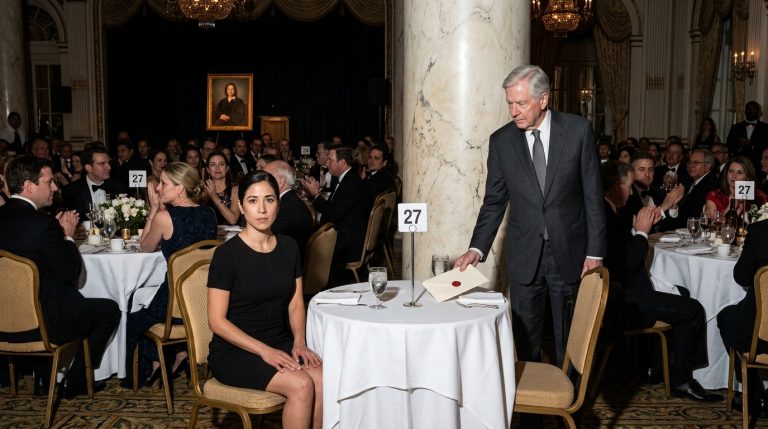
The Cookie Quartermaster: A Symphony of Kindnesses Left Behind in the Faded Halls of St. Jude
CHAPTER 1: The Hollow Room
The silence was the first thing that hit her.
Usually, room 214 was a cacophony of small, jagged sounds—the static hiss of the television, the rustle of newspapers, the sharp, gravelly clearing of Hank’s throat. But today, the air in the corridor seemed thin, pressurized. Emma gripped the wax paper bag so tightly the crinkle echoed against the pale green walls. Her sneakers, usually muted on the linoleum, sounded like gunshots with every tentative step.
She reached the doorway. The door was swung wide, an invitation to a void.
Inside, the transformation was clinical. The bed, which only yesterday had been the staging ground for their ritual—Hank’s fierce blue eyes, the crumb-covered lap of his gown—was stripped to the frame. The white sheets, the lumpy pillow that he had complained about with such dramatic flair, were gone. A pale, stretched vinyl mattress stared back at her, cold and indifferent. It looked naked. It looked like it had never held a human being at all.
“Mr. Hank?”
The whisper felt foolish, immediately swallowed by the hum of the hospital’s ventilation system. There was no growl. No demand for her to ‘scat.’ There was only the smell—a potent, chemical concentration of floor wax and the lingering, metallic tang of disinfectant.
Emma stepped onto the threshold, her gaze darting to the bedside table. Empty. Not a tissue, not a medicine cup, not even the faint dusting of crumbs she had learned to look for. The reality of the absence crashed into her, a physical weight in her chest. She had come prepared to trade—one day of school math for one moment of his grumpy, piercing company—but there was nothing left to trade with.
A shadow fell across the room, darker and more rigid than the nurse’s silhouette she was used to.
“Emma.”
Her mother’s voice was a frayed edge of sound. Mary Carter stood in the hallway, her light blue uniform stark against the peeling paint, a bundle of clean sheets clutched against her chest like a shield. Her face was etched with the weary lines of a double shift, but as she looked at her daughter standing in that barren room, the weariness shifted into something sharper—fear.
“I told you,” Mary said, her voice barely rising above the hum of the air conditioner. “I told you not to bother the patients. And this room… this room is on the list, Emma. It’s finished.”
Emma turned, her fingers still crimping the wax paper bag. “Did he go home, Mama? Did he get better?”
Mary’s eyes softened, the frustration bleeding out of her, replaced by a profound, hollow pity. She took a step toward the doorway, but before she could answer, the hallway erupted.
It wasn’t a sound of life. It was the rhythmic, synchronized percussion of heavy, polished leather hitting linoleum. Thump. Thump. Thump. It was a cadence of authority, devoid of the soft-soled quiet of the hospital staff.
Mary’s hand flew to Emma’s shoulder, pulling her back, pinning her against the doorframe just as the corridor darkened under the weight of six men. They moved like a single, jagged blade of steel, led by a man in a forest-green uniform that seemed to swallow the light. His medals glittered like cold, sharp stars.
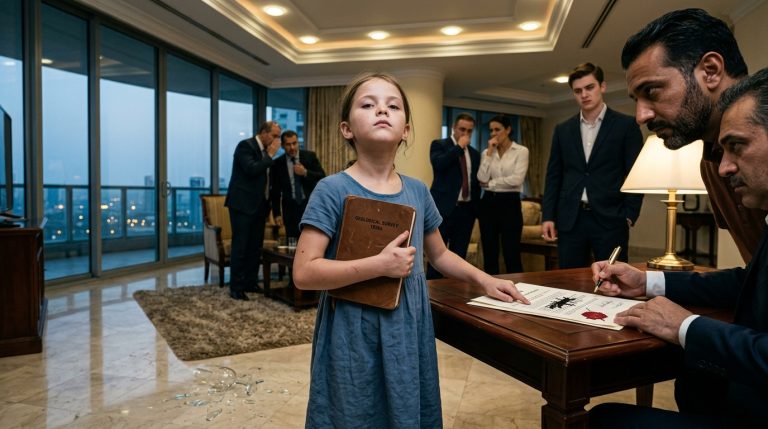
The hospital went mute. The nurse with the medicine cart froze, the orderly with the mop stopped mid-swipe, and the air turned brittle. The General stopped directly in front of room 214, his gaze locking onto the empty space—and then, with a terrifying, absolute precision, he locked onto Emma.
“I am here,” the General said, his voice a command that vibrated in the floorboards, “for the girl who brought him the cookies.”
CHAPTER 2: The Glass Corridor
The town car didn’t just drive; it glided. It was a silent, predatory movement that felt nothing like the rattling, exhaust-choking bus rides Emma took home from school. Outside the window, the familiar brick and peeling paint of the hospital district blurred into a stream of gray, then shifted as the car accelerated toward the city’s heart, where the skyline began to stretch upward in shards of glass and steel.
Emma sat perfectly still on the oversized leather seat. Her legs dangled, heels failing to touch the floor, which made her feel like a child playing a very dangerous game of dress-up. Beside her, her mother, Mary, was a statue of forced composure. Her hands, usually calloused and rough from years of scrubbing grout and wiping down hospital trays, were buried in her lap, fingers working a rhythm into her skirt—a frantic, tiny shredding of the fabric.
“Mama,” Emma whispered, the sound too loud in the pressurized cabin.
Mary didn’t turn. Her eyes were fixed on the back of the driver’s head, a man in a crisp black suit whose neck was thick and unmoving. “Just look at the window, Emma. Don’t touch anything.”
The reminder was a ghost of a thousand previous lessons. Be invisible. Don’t make them regret it. But the General, sitting opposite them, wasn’t looking at them with the stern, cautionary glare of a hospital administrator. He was watching the city pass by, his hands resting on his knees with a casual, terrifying confidence. He wore his uniform like a second skin, the medals on his chest catching the filtered light of the car’s interior, reflecting tiny, splintered rainbows onto the floor mat.
As the car wove through the tightening streets, Emma’s gaze drifted to the leather-bound picture frame she remembered from their living room—a mental image, a phantom sensation of her great-grandfather’s stoic, young face staring back at her from the frame on their mantel. Elias. The name felt heavy, like a stone she had just pulled from a river. He had fought, he had bled, and he had saved the man who was now, somehow, their secret benefactor. The weight of that history felt like a physical pressure against her ribs, making it hard to draw a full, steady breath.
“You look tired, Mary,” the General said, his voice dropping into the space. He didn’t look over; his eyes remained on the glass towers rising ahead.
Mary startled, her shoulders jerking upward. “I—I just need to finish my shift. I mean, I have things at home. Bills. The cat. We can’t just…”
“The bills are handled,” the General cut in, his tone not dismissive, but final. “Hank didn’t believe in loose ends. And he certainly didn’t believe in letting his friends worry about tomorrow.”
“He wasn’t our friend,” Mary whispered, her voice barely catching the air. “He was a patient. He was just a grumpy old man who didn’t like the Jell-O.”
The General finally turned. His blue eyes were not the fierce, sharp edges Hank’s had been; they were steady, calm, and deeply tired. “To the world, perhaps. To you, he was a challenge. To Emma, he was a mystery. But to himself, in those final months? He was a man taking inventory. He wasn’t looking for a caretaker, Mary. He was looking for someone who would recognize his worth when it was stripped down to nothing. He found that in you.”
The car swung sharply, entering the mouth of a private parking garage. The descent was immediate, plunging them into a cool, artificial twilight where the roar of the city traffic was cut off, replaced by the hum of the car’s engine and the click-clack of the security gate closing behind them.
When the car stopped, the driver exited, moving with practiced efficiency to open the General’s door. He stood at attention, a silent sentinel in the dark.
“Come,” the General said, stepping out.
The elevator they boarded was a stainless steel box that traveled upward with an alarming, frictionless speed. It felt like rising into a different atmosphere. When the doors finally slid open, the air smelled of expensive, treated wood—mahogany and ancient paper. It was a space designed to intimidate, a gallery of shadows and high-ceilinged silence.
Emma walked out, her sneakers squeaking on the thick, plush carpet that swallowed the sound of her footsteps. The office was immense. One whole wall was floor-to-ceiling glass, framing the city like a panoramic photograph, making the people below look like nothing more than drifting, insignificant motes of dust.
“Please,” the General said, gesturing to two small chairs that seemed deliberately placed to make them feel small. “Sit.”
Mary sat, her back rigid, her hands now clutching her purse so hard her knuckles turned the color of the pale vinyl mattress in room 214. Emma looked at the desk—a slab of dark wood that looked like it had been carved from a mountain—and then at the General.
He moved behind the desk, standing not as a man behind a barrier, but as a host in his own home. He looked down at them, a small, sad smile touching his lips.
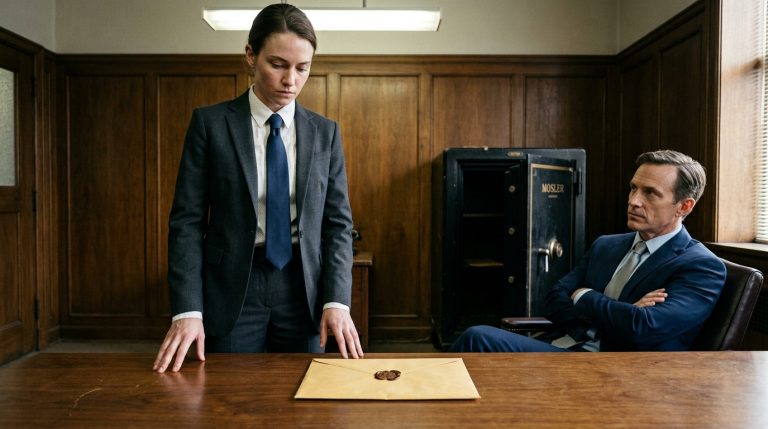
“I was Hank’s attorney,” he began, resting his palms on the desk. “But I was also the only person who knew why he checked himself into that hospital under his own name with nothing to his name. He was testing the world, yes. But he was specifically waiting for the one person who would treat him like a human being instead of a line item on a ledger.”
He leaned forward, his gaze shifting to Emma. “He called you the Quartermaster. He spoke of your cookies with more reverence than he spoke of his own board meetings.”
Emma looked at her mother. Mary was staring at the General, her expression a mix of terror and profound, agonizing hope. The room seemed to expand, the walls pushing outward, the scale of what they had walked into finally hitting the edges of Emma’s understanding. They weren’t here to sign papers. They were here to inherit a world they had spent their entire lives scrubbing the floors of.
CHAPTER 3: The Inheritance of Weight
Emma shifted from the chair, the plush carpet offering no resistance as she slid onto her knees. She felt small—not just because of the massive, dark-wood desk looming above, or the General’s watchful presence—but because the footlocker sitting before her seemed to hold a gravity of its own. It was a hunk of dark green, military-issue steel that had survived a world she only knew from grainy black-and-white photographs.
“May I?” the General asked, his voice shifting from the cold, authoritative cadence he used for the city to something quieter, almost reverent.
Emma nodded, her breath caught in her throat.
The General crouched, his movements deliberate and stiff with the habit of a lifetime spent in uniform. He reached for the heavy latch. It had been decades since it last moved, and the protest was a long, shuddering screech of rusted iron on iron—a sound that seemed to echo off the high walls of the office. With a final, sharp clack, the lid sprang up.
The smell that escaped was not of money or luxury. It was an olfactory time capsule: the dry, sharp scent of old canvas, the faint, biting aroma of metallic oxidation, and something else—a lingering, sweet-dusty odor like pressed flowers in a forgotten book.
Mary moved closer, drifting from her chair like she was pulled by an invisible tether. Her hand hovered in the air, trembling, as she peered inside. Her shock had shifted; the paralyzing fear of the legal battle was temporarily eclipsed by the sheer, crushing reality of the physical artifacts.
The General lifted the top layer—a thick, dark wool blanket. It was folded with a precision that bordered on religious. “Hank kept this for fifty years,” he murmured. “He called it the most comfortable thing he ever owned, because it was the only thing he had left after the war that hadn’t been bought with a salary.”
Emma reached out, her fingertips brushing the wool. It wasn’t the soft, synthetic fleece of her new bedding at home. It was coarse, scratchy, and felt like it carried the cold of a thousand winter nights. Beneath it, nestled in a velvet-lined recess, sat a small, deep-blue box.
The General lifted it, holding it out to Emma as if it were a fragile bird. Inside, resting on faded, yellowing satin, was a star—the Medal of Honor. It didn’t sparkle like the jewelry she had seen in store windows. It was heavy, oxidized, and muted, but it seemed to pull the light toward it.
“Elias Carter,” Emma whispered, the name feeling like a prayer. She looked at her mother. Mary was crying now, silent, rhythmic tears that tracks through the light makeup she’d worn for the meeting.
“He was a hero, Emma,” the General said. “He didn’t know he had a family. He didn’t know you existed. But he knew the man he saved. And that man spent the rest of his life making sure that, if he ever found the bloodline, he would make it impossible for you to be invisible again.”
Emma looked down at the footlocker again. There were two items left. One was a small leather-bound journal, its binding cracked and flaking, the title faded away entirely. The other was a coin. She reached for it—a heavy, brass-colored disc. She pulled the coin Hank had given her out of her pocket and compared the two. They were identical, save for the wear; the one from the box was smooth, polished by decades of thumb-rubbing.
“A division challenge coin,” the General explained, watching her. “It’s not currency. It’s an identity. It means you are part of the unit. You show that in any room of veterans, and you are family. He gave you his own, Emma. He didn’t just leave you his money. He left you his membership in the only family that ever truly understood him.”
Emma’s thumb traced the edge of the metal. She felt a phantom sensation—the memory of Hank’s swollen, shaky hand pressing it into her palm back at the hospital. He had called it ‘junk,’ but he had been holding it like a lifeline.
She turned her attention back to the journal. She opened the cover, the spine groaning in protest. The pages were dense with tight, cramped cursive. September 4th, 1944. Still raining. I hope we move out soon. I have a feeling this is it.
“He wrote everything down,” the General said softly. “He knew you would need proof. He knew they would call him crazy. He was documenting his reality so that when the time came, his voice would be louder than their accusations.”
Mary sat down on the floor beside Emma, her back against the leather chair, her exhaustion finally winning out. She picked up the blanket and laid it over her lap, the rough wool looking stark against her soft, blue uniform. For the first time, she looked at the room not as a trap, but as a sanctuary.
“We didn’t know him,” Mary said, her voice steadying. “I spent all those hours scrubbing, and I didn’t see him at all.”
“You saw him, Mary,” the General replied, standing up and moving to the window. He looked out over the sprawling city, his silhouette framed by the dying afternoon light. “You just didn’t know what you were looking for. You were the only one who didn’t look through him.”
Emma looked back at the journal. She didn’t want to read it yet. She wanted to savor the weight of the metal and the rough texture of the wool. This wasn’t just an inheritance; it was an anchor. She felt the sudden, terrifying, and beautiful shift in her life’s trajectory. She was no longer just the maid’s daughter who hid in a closet; she was a keeper of history.
“They’re coming, aren’t they?” Emma asked, her voice quiet but firm, not looking up from the box. “The Porters.”
“Yes,” the General said, his voice hardening into the cadence of a commander. “They’re coming. But they’re walking into a field that has already been mapped.”
He walked back to the desk, his face a mask of iron. He didn’t look worried. He looked ready.
CHAPTER 4: The Breach of the Gatekeepers
The doors didn’t just open; they were violated.
Junior entered first, his face a mottled, uneven red, his expensive, pinstriped suit jacket hanging slightly off one shoulder as if he’d been struggling to put it on while sprinting. Behind him, Brenda glided in, her posture so rigid it looked painful. She held a black leather briefcase like a weapon, her eyes not scanning the room, but dissecting it. Her gaze passed over the General, ignored the expensive mahogany, and landed squarely on Emma, who was still on her knees on the floor.
“Sinclair!” Junior barked, his voice cracking. The sound was thin and desperate, entirely lacking the gravelly, resonant power that Hank had possessed. “What is the meaning of this? We had to find out from a service that he had passed. Do you have any idea how that looks?”
Brenda didn’t wait for the General to answer. She was already moving, her heels clicking on the hardwood like a countdown. She stopped three feet from the footlocker. She didn’t look at Mary; she looked through her, as if Mary were a ghost or a piece of neglected furniture.
“General,” Brenda said, her voice a polished, chilling tone. “Why is the help here? And why are they handling my grandfather’s private effects?”
Mary stood up then. It was a slow, agonizing movement. She smoothed the front of her blue uniform, her hands shaking so violently she had to clench them into fists at her sides. She tried to step behind the General, seeking the invisible perimeter that had protected her for a decade, but the General stepped aside. He didn’t abandon her; he merely forced her to occupy the space he was clearing.
“Mary Carter is not ‘the help,’ Brenda,” the General said, his voice dropping into that low, dangerous register that made the room feel suddenly smaller. “She is the primary beneficiary of Henry Porter’s estate. And her daughter, Emma, is the executor of the private trust.”
Brenda’s laughter was a short, sharp bark—an ugly sound that made Emma flinch. “A billion dollars, held by a maid and a child? This is a legal absurdity. We’re here to inform you that we are filing for a full freeze of all assets. We’re contesting the will on the grounds of mental incompetence, General. Undue influence is a very simple thing to prove when you’re dealing with an eighty-four-year-old man in a charity ward.”
The lawyer, a hawk-faced man named Graves who had trailed in behind them, stepped forward. He didn’t look at the General; he looked at the floor, at the footlocker, at the journal Emma still held. His smile was a thin, predatory line.
“We’ll be deposing everyone,” Graves said, his voice oily. “The nurses, the orderlies, and especially this… young lady.” He gestured toward Emma. “We’ll have her on the stand. We’ll peel back every layer of this ‘friendship.’ We’ll see how many cookies it takes to buy a billionaire’s loyalty.”
Emma felt the world tilt. The flickering light from the overhead lamps seemed to stutter, and for a second, she felt as if she were back in the hospital hallway, watching the orderly mop up spills that weren’t there. The threat wasn’t just to the money; it was to the memory. They wanted to turn her moments with Hank—the dry, oatmeal raisin cookies, the slow, shaky bites, the trade—into something dirty.
“I didn’t buy anything,” Emma said. Her voice surprised her; it wasn’t the small, whispered thing she usually used to stay invisible. It was clear, resonant, and echoed against the high ceiling.
Brenda turned her head slowly, looking at Emma as if she were a specimen under a microscope. “You’re a ten-year-old girl, Emma. You have no concept of what is happening here. My father was confused, sick, and alone. You took advantage of a vulnerable man.”
“I was there,” Emma said, stepping away from the footlocker, feeling the rough texture of the medal still tucked into her pocket. “You weren’t. I know he hated the color green. I know he liked the old baseball games. I know he called his family ‘disappointments’ because that’s what he told me. He didn’t want you there. He was waiting for someone who didn’t want anything from him.”
The silence that followed was absolute. Junior’s mouth worked, but no sound came out. Brenda’s face was frozen, a mask of pure, unadulterated venom. The lawyer, Graves, didn’t move; he just stared at the General, waiting for a crack in the armor.
“You’re a child,” Brenda spat. “You don’t understand the world.”
“I understand,” Emma countered, her gaze unwavering, “that a friend doesn’t wait five years to visit. And I understand that you’re only here now because the bank account is locked.”
The General didn’t intervene. He stood like a monument, watching, allowing the friction to build, allowing the Porters to reveal exactly how little they knew of the man they were trying to claim. He knew the ‘arsenal’ was waiting, but he also knew that for this to hold, the truth had to be fought for in the moment.
“General,” Graves finally said, his voice tight. “We are done here. We have everything we need to begin. This… theater… ends when we get before a judge.”
“The judge is welcome to it,” the General replied, his voice calm. “But know this: you aren’t fighting a maid and a child. You’re fighting a record of every single day he spent in that hospital. You’re fighting the truth of how he spent his final months, and you are going to lose.”
As the Porters turned to leave, Brenda threw one last look over her shoulder at the footlocker, her eyes searching for something she could break, something she could strip away. She didn’t see the journal or the medal. She saw the girl. And for a moment, the air in the room felt ionized, charged with a conflict that was only just beginning to take its true form.
CHAPTER 5: The Deposition
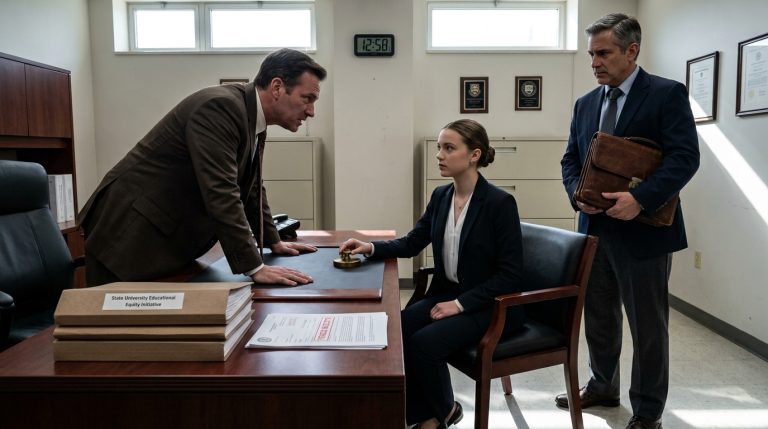
The deposition room was a sterile, windowless box tucked away in a skyscraper that felt miles removed from the peeling paint and bleach-soaked halls of St. Jude’s. The table was polished to such a high, reflective sheen that Mary could see the distorted reflection of her own face staring back—a pale, frightened mask framed by the blue of her uniform. She didn’t want to change. The General had suggested it, urged her to wear something ‘more appropriate,’ but Mary had insisted. She was not a billionaire’s beneficiary here; she was the woman who had scrubbed the floors.
Across from her, Graves sat with the patient grace of a spider at the center of a web. He had a fountain pen in his hand, rotating it against the light. Brenda and Junior sat against the wall, their presence a constant, heavy pressure on the nape of Mary’s neck.
“Mrs. Carter,” Graves began, his voice smooth, professional, and entirely devoid of warmth. “Let us be clear about the timeline. You were a maid. You were employed to clean rooms, not to provide companionship. Did you make a habit of fraternizing with the patients?”
Mary felt the phantom hum of the hospital’s ventilation system—the constant, low-frequency drone that had been the background music of her life for a decade. It pressed against her temples. “I… I would say hello,” she whispered.
“Just hello?” Graves leaned in, his shadow stretching across the table. “Or did you seek out wealthy patients? Did you, perhaps, notice which rooms had the most expensive flowers, or which patients received the most mail?”
“Objection,” the General’s voice rumbled from beside Mary. It was a solid, grounding sound. “The patient’s financial status was not public knowledge, nor was Mrs. Carter privy to it.”
Graves waved a hand dismissively. “The objection is noted. Let the record show the witness is unable to deny the proximity. Mrs. Carter, when did you first discover Mr. Porter was wealthy?”
“In your office,” Mary said, her voice finding a momentary, fragile strength. “After he was gone. I just thought he was a sad, old man.”
“A sad, old man,” Graves repeated, testing the words. “Whom you instructed your daughter to visit. A ten-year-old girl, Mrs. Carter. Did you use her as a tool? A way to soften him up, to get your foot in the door of his empathy?”
Mary’s heart skipped. The accusation hung in the air, a physical thing. She looked at Emma, who was sitting in the corner, her posture straight, her hands clasped tightly in her lap. Emma wasn’t crying. She looked at Graves with a cold, quiet observation that seemed to rattle him for a fraction of a second.
“I told her not to,” Mary said. The truth was her only shield, and she leaned into it. “I told her it was against the rules. I was afraid of Nurse Jacobs. I was afraid of losing my job.”
Graves slapped his palm against the table—a sharp, sudden crack that made Mary flinch. “So, she was defying the rules! And yet, you allowed it to continue. How convenient. The daughter sneaks in to see the lonely billionaire, and you just happen to turn a blind eye. Did you practice this story, Mrs. Carter? It’s a fairy tale for a court that values sentiment over facts.”
“It’s not a story,” Mary breathed.
“The truth is,” Graves continued, raising his voice, “that you were drowning in debt. We’ve seen the records. Late notices, rent arrears, the constant, clawing desperation of someone who has nothing. Did you find out about his family? Did you see your opening?”
Mary felt the room spin. The scent of the room—stale, artificial, and devoid of life—reminded her of the nights she’d spent staring at the ceiling, wondering if they’d have enough for the bus fare the next day. But then, she thought of the footlocker. She thought of the rough, wool blanket. She thought of Hank, not as a billionaire, but as a man who had finally found someone who didn’t want anything from him.
“I didn’t,” she whispered. “I was just cleaning.”
Graves looked at her with such profound, studied contempt that it was more painful than a shout. He turned away from her, his expression sharpening. “We’re done with this witness. Send in the child.”
Emma rose. She didn’t stumble. She walked to the chair, her legs swinging slightly, her feet not touching the floor. She looked at Graves, and for a moment, the room seemed to go silent. The flicker of the lights seemed to pulse in time with her steady, measured breathing.
“Hello, Emma,” Graves said, his voice dropping into that slick, patronizing tone he’d used before. “I’m just here to talk about your friend. Mr. Hank.”
“He was my friend,” Emma said, her voice clear.
“And did he promise you things, Emma? Did he promise you money, or a house? Did he tell you that if you brought him enough cookies, you’d never have to be a maid’s daughter again?”
Emma looked at him, her expression one of genuine, piercing confusion. “He didn’t have to promise anything. He was just Mr. Hank. He was sad. And his hands hurt.”
Graves leaned forward, his face twitching. “But he gave you a coin. A heavy, gold-looking coin.”
“It’s not gold,” Emma said calmly. “It’s a challenge coin. It’s a trade. He gave me his, I gave him mine. He told me I was a Carter. Like my great-grandpa. He said we were family.”
“Family!” Graves laughed, a hollow, grating sound. “He was senile! He was hallucinating. He thought a ten-year-old girl was a long-lost relative from a war that ended before he was born.”
“He wasn’t confused,” Emma said, her voice rising in the small, sterile room. “He was waiting for someone to know the truth. You just don’t know what the truth is.”
Graves threw his pen down, the clatter echoing like a gunshot. He looked at the General, his face pale with a sudden, jagged uncertainty. The General didn’t move. He only stared back, his hand resting on his briefcase, his eyes promising that the truth was not a matter of opinion, but a matter of record.
CHAPTER 6: The Friendship Wing
The ribbon-cutting was not a grand, screaming affair. It was quiet, steady, and punctuated by the soft shuffling of feet on the polished, sun-drenched floors. Where once there had been the pale, sickly green of St. Jude’s, there was now a warm, butter-yellow that seemed to catch and hold the light. The air didn’t smell of bleach and sharp ammonia anymore; it smelled of floor wax, yes, but also of the fainter, deeper scent of beeswax and the dry, paper-rich atmosphere of a library.
Mary stood behind the small, simple wooden podium. She wore a dress the color of the late-afternoon sky, a shade of blue that looked soft against the harsh, institutional memories of the place. She was a board member now. The title felt strange, like wearing a coat that was two sizes too big, yet as she looked out over the crowd—at the nurses, the orderlies, and the patients who were already filling the comfortable chairs of the new library—she felt the coat settling into place.
“My name is Mary Carter,” she said. Her voice didn’t waver. It lacked the polish of a politician or the practiced arrogance of the Porters. It was just hers—steady, earned, and real. “I used to work here. My job was to clean these floors. My job was to be invisible.”
She paused, her gaze catching George the orderly, who was grinning, his hand resting on the back of a chair.
“A man I knew,” she continued, her voice softening. “A man named Hank. He saw me. He saw my daughter. And he taught us that kindness is not a weakness. This wing… it’s not about the money. It’s about a trade. A cookie for a friendship. Today, we open this wing to honor him, and to honor every veteran here. To let you know we see you.”
The applause was not a roar; it was a ripple of genuine warmth that flowed through the room, touching the walls and the ceiling. Mary stepped down, and for a moment, the weight of the last six months—the terror of the depositions, the cold malice of the Porters, the surreal transition from survival to security—felt like something she had shed, like a heavy, winter coat left at the door.
In the corner of the room, tucked into a space that had once been a storage closet for broken gurneys, sat the green footlocker. It wasn’t a relic anymore. It was an anchor. Emma sat on a cushioned chair beside it, her legs finally reaching the floor. She was reading from the journal, the pencil-scratched pages of 1944.
“Listen to this, George,” she said, her voice bright.
George leaned in, his large, kind face illuminated by the amber glow of the library lamp. “Read it, Quartermaster.”
“October 10th, 1944. My feet are soaked, but Porter, Hank, he found a dry pair of socks for me. He just showed up with them. He said, ‘don’t get emotional.’ He’s a grumpy man, but he’s a good man.” Emma closed the book, the leather cover feeling supple under her hand. She looked up at the wall, at the small brass plaque that had been installed that morning. It didn’t list bank accounts or legal victories. It simply said: In memory of Hank and Elias, Friends.
The ultimate truth—that the fortune was never about testing the world, but about settling a debt of blood and loyalty—had been revealed in the courtroom, but here, it felt different. It felt lighter. The debt had been paid not in currency, but in the creation of this space, this yellow-walled sanctuary where the silence wasn’t empty, but full of stories.
Emma felt a hand on her shoulder. She turned to find the General standing behind her. He didn’t look like a soldier anymore. He looked like a man who had successfully completed a mission, his posture relaxed, the heavy medals packed away in a display case in his own study.
“He would have hated the plaque,” the General said, a smile pulling at the corners of his mouth. “He would have called it too soft. Too sentimental.”
“He wouldn’t have,” Emma said, tracing the brass lettering. “He would have complained that the font was too small.”
The General laughed, a deep, resonant sound that blended into the quiet hum of the library.
Mary walked over, joining them. She stood for a long moment, looking at the plaque, then down at the footlocker. The fear that had defined their lives—the fear of being seen, of being discarded—had been replaced by something quieter and more durable. She put an arm around Emma, pulling her close. They were not just the maid and her daughter anymore. They were the ones who remembered.
As the sun began to dip, casting long, golden shadows across the library floor, Emma felt the final knot of the journey untie. The Porters were gone, their contest collapsed under the weight of Hank’s own meticulous truth. The house with the blue door was waiting for them at home, a place of peace. But here, in this room, the legacy remained.
She opened the journal again. There were still pages to read, stories of a war that had defined a man, and a friendship that had eventually redefined a life. She began to read, her voice carrying across the library, a quiet, rhythmic cadence of words that bridged the gap between the past and the present, filling the room with the only thing that had ever truly mattered.