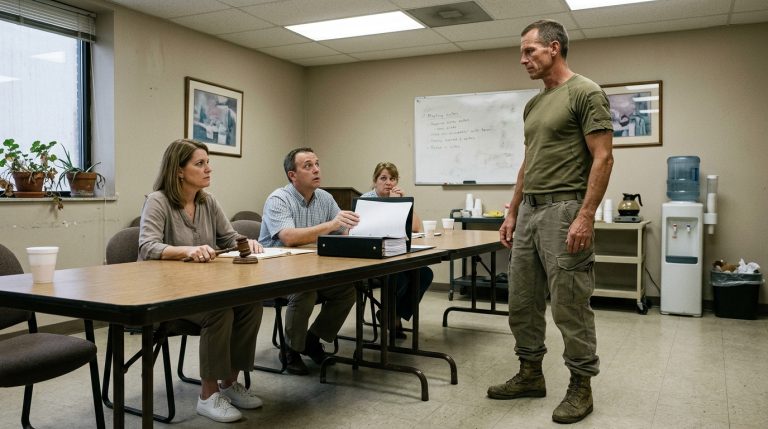
A Precise Demolition: How One Man’s Engineering Mind Dismantled a Suburban Tyrant’s Corrupt Empire
CHAPTER 1: THE ULTIMATUM
The sunlight in the backyard was humid and thick, hanging over the half-assembled frame of my greenhouse like a suffocating shroud. Karen Miller stood at the property line, her posture radiating that specific brand of suburban authority that assumes every neighbor is a subordinate. Her two board cronies flanked her, silent and grim, like gargoyles placed there to watch the impending execution of my project.
“That pile of junk is a violation, Mr. Davis,” she said, her voice syrupy with self-satisfied entitlement. “Five thousand dollars, effective immediately. Seventy-two hours to clear it, or we will.”
I turned slowly, the torque wrench still clamped in my grip. My pulse didn’t spike; it leveled out, the familiar, icy clarity of a military engineer taking over. I looked at the galvanized steel ribs, the stacks of polycarbonate panels, and the fresh concrete footings I had poured only last week. It was a structural masterpiece designed for my wife, Elena, a sanctuary built to keep her chronic pain at bay. To Karen, it was an aesthetic blight. To me, it was a precise calculation of local zoning laws, setback requirements, and county-permitted compliance.
“Abandoned?” I asked, my voice dangerously calm. I didn’t raise it. I didn’t gesture. I simply locked my gaze onto the gap between her eyes. “I was working on the frame ten seconds before you started shouting. The delivery receipts for these materials are timestamped from yesterday. How do you define ‘abandoned’, Karen?”
She sniffed, a sound like air leaking from a punctured tire. Her eyes didn’t flicker toward the structure; they were fixed on the power she held in her floral-patterned mumu. “It’s an eyesore. It violates the aesthetic harmony of Serenity Meadows. The board has voted, Mark. The fine stands.”
She spun on her heel, her cronies following in lockstep. They didn’t see the structural survey tucked into my back pocket or the official county permit sealed with a raised stamp in my front window. They saw only their own dominion. They didn’t realize that in declaring this “war,” they had handed me the exact coordinates of their own downfall. As they marched away, I noticed a detail I hadn’t seen before: the way Bob’s fingers twitched toward his pocket, reaching for a phone he wasn’t supposed to be holding during a “formal inspection.”
My wife, Elena, watched from the kitchen window, her hand pressed against the glass. Her face was pale, reflecting the silent terror of someone who thought we were about to lose everything. She didn’t know yet that the real fight hadn’t even begun, and that the woman walking toward her car was already standing on a crumbling foundation. I set the wrench down on the concrete footing and stared at the empty space where the polycarbonate panels were supposed to go. I had the permit. I had the law. And for the first time in years, I had a mission.
CHAPTER 2: THE PAPER FORTRESS
I didn’t turn around immediately. I stood in the backyard, letting the humid air settle against the back of my neck, staring at the raw, unfinished skeleton of the greenhouse. The galvanized steel beams glinted under the sun, sharp and unyielding. In the distance, the muffled sound of a neighbor’s lawnmower droned on, oblivious to the fact that a war had just been declared over a few hundred square feet of dirt.
I walked back toward the house, my boots crunching on the loose gravel. My mind wasn’t on the fine—five thousand dollars was a nuisance, not a catastrophe—but on the specific tone of Karen Miller’s voice. It was the voice of someone who believed the law was a suggestion rather than a framework. In the Army Corps, I had seen contractors try to cut corners on structural integrity using that exact same tone. They always thought they were the smartest people in the room until the inspectors arrived with the blueprints.
I stepped into the kitchen. Elena was leaning against the counter, the permit gripped in her pale, trembling hand. The overhead light caught the edges of the document, highlighting the raised seal that Karen had chosen to ignore.
“Mark,” Elena said, her voice barely a whisper. “She said they’d remove it. If they come with a crew, if they… if they tear this apart, the stress—” She didn’t finish. She didn’t have to. The autoimmune flare-ups were the shadow we lived in; any sudden spike in her environment could leave her bedridden for days.
I crossed the room and took the paper from her. My fingers brushed against hers, and I felt the cold sweat on her palms. I tucked the permit into my shirt pocket, right against my chest. “They won’t tear it down, El. Karen Miller doesn’t understand the difference between an HOA bylaw and a county-issued permit. She thinks she’s a queen, but she’s just an amateur playing with a rulebook she hasn’t bothered to read.”
I sat at the dining room table, pulling my laptop out of my bag. The screen flickered to life, casting a stark, blue light across the room. I opened the folder I’d been maintaining for the past six months. It contained every shred of documentation I had gathered before I even broke ground: the zoning surveys, the municipal building codes, the specific exceptions for climate-controlled structures in our district.
An intrusive memory surfaced, sharp and unwanted: the logistics briefings in the desert, the way we had to account for every gallon of fuel, every pound of rebar, or else the whole operation would stall. It was the same math here. Karen had the illusion of control, but she lacked the logistics to back it up. She had the “aesthetic harmony” clause—bureaucratic poetry with the density of fog—and I had a cold, hard, government-stamped reality.
I began to draft the rebuttal. I didn’t write it as an appeal; I wrote it as a notice of impending legal failure for the HOA board. My prose was stripped of emotion, clinical, and precise. I cited bylaw 17.4, the “aesthetics” weapon she favored, and then I juxtaposed it with the county permit 734-B. I didn’t ask them to reconsider the fine; I informed them that the fine was null and void under the supremacy of the county permit.
“You’re going to send this?” Elena asked, leaning over my shoulder. Her presence was a grounding weight, but I could feel the anxiety rolling off her in waves.
“I’m not just sending it,” I said, my fingers flying across the keys with a rhythmic, percussive force. “I’m giving them the opportunity to walk away before I turn this into an audit.”
I hit save and looked at the clock. It was late, the afternoon heat giving way to a stagnant, humid twilight. I clicked ‘Print’ and watched the laser printer hum to life, a steady, mechanical sound that felt like the cocking of a hammer. I was building a paper fortress. Every citation, every reference to the state statutes, every quote from the very bylaws they had failed to master—it was a brick.
When the pages slid out, I stood up and gathered them. They felt substantial, heavy with the weight of my intent. I walked to the front window. From this angle, I could see Karen’s house across the street. The lights were on in her study, a high-mounted window that looked directly down into my yard. She had been watching. She was likely watching now, waiting for the panic to set in, waiting for me to start dismantling the frame.
Instead, I placed the stack of papers in a large, official envelope. I would take this to the post office at dawn and send it certified, return receipt requested. When she signed for it, she wouldn’t just be signing for a piece of mail; she’d be signing for the start of an investigation she couldn’t possibly win.
“Elena,” I said, turning to her. Her face was still tight with worry, but the trembling in her hands had slowed. “Go upstairs. Get some rest. I’m going to spend the night reviewing their financial bylaws. If she wants a war of regulations, she’s going to get an engineer’s solution.”
I watched her walk out of the room, her silhouette softening in the dim light of the hallway. I looked back at the greenhouse, a skeleton of steel in the dark, and then back at the envelope on the table. The sharp edges of the paper were the only thing that mattered now. Karen Miller had crossed the property line, but she had failed to realize that the property line was just the beginning of the battlefield. The real conflict would be fought in the margins of her own paperwork, and I had already identified the first weakness in her line.
CHAPTER 3: THE AUDIT TRAIL
The hum of the hard drive was the only sound in the house, a steady, rhythmic vibration that matched the pulse of my own focus. I hadn’t slept. I hadn’t needed to. When you spend two decades managing the logistics of bridge construction in flood-prone zones, you learn that the biggest failures are rarely sudden; they are the result of years of small, ignored deviations from the plan.
I leaned back, my eyes gritty, and scrolled through another PDF of the Serenity Meadows HOA meeting minutes. They were a masterclass in bureaucratic omission. For eight years, the records were sparse, almost infantile in their simplicity. Every motion was recorded as “approved unanimously,” every expense summarized as “routine maintenance.” But in the margins of a filing from four years ago, something caught my attention—a discrepancy in the date of a contract renewal for the landscaping vendor, Greenscape Solutions.
I tapped the screen. The date of the renewal meeting was listed as a Tuesday in mid-November. I cross-referenced it with the official HOA master calendar, which was tucked into the appendix of the bylaws. That year, the HOA board had been scheduled for a community appreciation dinner on that exact Tuesday. I pulled up the dining venue’s public booking records—they were a registered non-profit too, after all. The reservation for the dinner had been made three weeks in advance.
It was a small, almost invisible detail: the board couldn’t have been in a meeting and at a dinner simultaneously. Karen hadn’t just been sloppy; she had fabricated the meeting entirely.
I didn’t feel a rush of triumph. I felt a cold, mechanical satisfaction. It was the same feeling I had when I’d find a miscalculation in the structural load of a temporary support beam—not panic, but the immediate, logical understanding of how to dismantle it. I opened a new spreadsheet, labeling the columns with the dates, the alleged motion, and the reality of their schedules. I began to build a timeline of “ghost meetings.”
The house was quiet, the only light coming from the monitor which turned the room into a stark, high-contrast landscape of shadows and harsh, blue-white glare. I moved to the secondary window, pulling up the Secretary of State’s public portal. I needed to see the corporate structure of Greenscape Solutions again.
As the page loaded, the texture of the work shifted. It wasn’t just about catching them in a lie anymore; it was about defining the scope of the fraud. If they had fabricated meeting minutes to justify payments to a vendor, they had committed felony-level forgery.
My gaze shifted to the window. Outside, the early morning light was beginning to bleed into the sky, turning the neighborhood from a void into a series of jagged, familiar shapes. I looked across the street. Karen’s house was still dark, but I could imagine her inside, resting in the absolute, arrogant certainty that her dominion was secure. She didn’t know that she was currently being audited by an engineer with nothing but time, a deep-seated need for precision, and a growing stack of digital evidence.
I stood up, my joints stiff, and walked to the kitchen to pour another cup of coffee. The ritual of it—the mechanical grind of the beans, the boiling water—felt like a pause in the assembly line. I thought about the greenhouse again. It wasn’t just a structure; it was the catalyst. If she hadn’t tried to tear it down, if she had just let me build it, I would have been a quiet neighbor, content to mind my own business. She had forced me to look, and now that I was looking, I wasn’t going to stop until the entire structure collapsed.
I returned to the table, the hot coffee burning my tongue, and went back to the ledger. I started looking for the physical receipts. If they were funneling money, they were doing it through invoices. I dove into the budget line items, tracing the payments from the HOA bank account to the landscaping firm. The amounts were rounded—unnervingly so. Five thousand, ten thousand, fifteen thousand. Real business expenses for landscaping were granular—taxes, materials, labor hours. These were clean, integer-based transfers.
I pulled a blank sheet of paper from my printer and sketched out the flow of funds. It was a simple, brutal equation. Karen was using the HOA as a private bank, and she was doing it with the blatant, unconcerned arrogance of someone who thought no one would ever bother to check the math.
I felt a presence behind me and turned. Elena stood in the doorway, wrapped in a thick wool blanket, her face pale in the dawn light. She had been awake for a while. She looked at the spreadsheets on the screen, the lines of data connecting across the monitors.
“You found something,” she said. It wasn’t a question.
“I found the pattern,” I replied, my voice steady. “They’re not just being difficult, El. They’re stealing from everyone in this neighborhood. And they’ve been sloppy enough that I can prove it.”
She walked closer, her hand resting tentatively on the back of my chair. The tension in her shoulders seemed to ease just a fraction, replaced by a cautious, budding resolve. She understood what this meant—that the battle wasn’t just about a building permit anymore, but about clearing the rot out of the foundation of where we lived.
“What do we do next?” she asked.
“Next,” I said, looking back at the screen, at the list of dates and the fabricated meeting minutes, “I need to talk to the neighbors. I need to know if anyone else has noticed the grass never actually looks like it’s being maintained, even though we’re paying for a premium service. I need to build a case that isn’t just mine. I need to make them see the structure of the theft.”
I closed the lid of the laptop, the screen plunging the room into gray, morning silence. The paper fortress was growing. I had the documents, I had the dates, and now I had the direction. Karen Miller was about to find out that when you build your kingdom on a lie, you don’t need a wrecking ball to bring it down. You just need to pull one loose thread.
CHAPTER 4: THE STRATEGIC COUNCIL
I stood in the center of my backyard, staring at the greenhouse frame. The sun was climbing, casting long, geometric shadows across the lawn. The air was cool, smelling of damp grass and the faint, metallic scent of the galvanized steel. I was waiting for Tom, the firefighter who lived three doors down, and the rhythm of the day felt suspended, a pause between the planning phase and the tactical execution.
Then, I heard it. The sputter of a lawnmower, then a sharp, violent metallic grinding, followed by a curse that drifted over the fence.
I didn’t wait. I walked to the edge of the property line, ducking under a low-hanging branch of a neighbor’s oak. Tom was standing over his mower, his shoulders slumped in a posture of profound, weary frustration. He had his hands in his hair, grease smearing his forehead.
“It’s the transmission,” I said, leaning my arms against the fence. “Sounds like the drive belt gave out, or the pulley snapped.”
Tom looked up, his expression one of pure, unadulterated exhaustion. “It’s the third time this month, Mark. This mower is held together by sheer willpower and a prayer. I don’t have the time to fix it, and I definitely don’t have the money for a new one.” He kicked the frame of the machine, a dull, hollow sound. “Karen probably has a bylaw against loud, broken lawnmowers now, too.”
This was the opening. It wasn’t the strategic, high-level council of war I had envisioned, but it was real. I pushed open the gate.
“Leave it,” I said, walking over and grabbing a wrench from his toolbox. “I’ve got the parts for a similar model in my garage. Let’s get it to my place. We can get it running in an hour.”
“I can’t ask you to do that, man,” Tom muttered, though he didn’t stop me from grabbing the rear handle.
“You aren’t asking. We’re just dealing with the environment,” I replied.
We hauled the machine back to my garage, the weight of it straining our arms. The garage was my sanctuary—organized, labeled, and precise. I had the tools laid out on a clean white towel, a stark contrast to the grease and dirt of the neighborhood. We worked in silence for a while, the only sounds the metallic clink of tools and the steady breathing of two men who were both tired of being pushed around.
As I tightened a bolt, I looked at Tom. He was staring at the floor, his jaw set in a hard, angry line. “You heard about the fine, didn’t you? The one she sent you for the basketball hoop.”
Tom sighed, a ragged, uneven sound. “Five hundred bucks. She called it an ‘aesthetic obstruction.’ My kid played on that hoop every day after school. Now he just sits inside, staring at his tablet. It’s like she’s trying to suck the life out of this street, piece by piece.”
I handed him a rag and waited. “She’s not just doing it for the look of the place, Tom. I’ve been looking at the HOA financials. The landscaping budget—the one she keeps raising every year—it’s going to her brother-in-law. And the pool maintenance? That’s going to Bob, another board member.”
Tom stopped wiping his hands. He looked at me, his eyes widening. “You’re serious? That’s… that’s theft.”
“It’s worse than that. It’s organized,” I said, my voice dropping to a low, tactical register. I didn’t tell him about the ghost meetings yet. I needed to keep the deeper intel secure until the right moment. “She’s bullying us because she thinks we’re too isolated to notice the pattern. But if we can get a few more people together—the Patels, Mrs. Gable—we can force a vote. We can get to the records.”
Tom looked at the mower, then back at me. He was a firefighter; he understood the concept of a firebreak, of sacrificing a small area to save the whole structure. “What do you need me to do?”
“I need you to stay quiet for now,” I said. “And I need you to keep your ears open. See if anyone else has been hit with these ‘aesthetic’ fines in the last few months. Document everything. Dates, times, the specific wording of her notices. Don’t confront her. Just collect the data.”
He nodded, a slow, determined movement. “I can do that.”
We spent the next forty-five minutes finishing the repair. When we finally pulled the starter cord, the engine roared to life with a clean, healthy hum. Tom looked at the machine, then at me. The exhaustion in his face was still there, but it was tempered by something else—a sharpening of the focus, a sense of direction.
“Thanks, Mark,” he said, his voice quiet.
“Don’t thank me,” I replied, standing in the doorway as he pushed the mower toward the street. “Just make sure you have that list ready by Saturday. We’re going to need to hold a meeting.”
I watched him walk away. The afternoon light was shifting, casting long, harsh shadows across the driveways. The neighborhood looked peaceful, almost idyllic, but I knew what was happening behind the closed blinds and the manicured lawns. There was a current of resentment, a hidden tension that Karen Miller had ignored for far too long. I had planted the first seed of the coalition. Now, I just had to wait for the storm to break. I walked back into the house, the cool air inside a relief, and sat down at the table. I wasn’t an engineer in a war zone anymore, but the principles of the structure remained the same: identify the load, find the stress points, and apply the pressure exactly where it would cause the most systemic collapse.
CHAPTER 5: THE POOL RECONNAISSANCE
The garage air was cool and smelled of synthetic oil and cold steel. I stood there for a moment, the door partially open, watching the neighborhood through the narrow gap. Everything looked normal—manicured lawns, quiet streets, the soft morning light reflecting off the chrome of a parked sedan. But my perception had shifted. I wasn’t just looking at the neighborhood anymore; I was scanning it for liabilities.
I turned back to my workbench, where my laptop sat, the screen dark. I reached out to wake it, but my hand hesitated. I remembered the way Karen had looked at me during the initial confrontation—the smug, untouchable confidence. She hadn’t just been a HOA president; she had been a gatekeeper. And gatekeepers rely on surveillance. I pulled my phone from my pocket. It was a standard device, but for the first time, it felt like a tracking beacon. I powered it off, wrapping it in a thick, metallic Faraday pouch I’d kept since my time in the Corps.
I needed to see the pool. Not from the street, and certainly not with any electronic gear that could be pinged or traced. I needed to see it with my own eyes, to understand the physical reality of the neglect I suspected.
I slipped out the back way, moving through the narrow corridor between my house and the neighbors’. I kept low, my movements instinctual, honed by years of navigating terrain where visibility was a tactical liability. I stayed within the shadows cast by the dense hedges that separated the properties. The air felt heavy, and the silence of the neighborhood, usually so comforting, now felt like a shroud.
As I approached the pool perimeter, I could hear the faint, rhythmic slapping of water against the tile—a sound that should have been peaceful but, in the context of what I knew, sounded like a metronome ticking down. I reached the chain-link fence, overgrown with thick, thirsty ivy. I found a spot where the vegetation was dense enough to provide cover and pressed myself against the cold, rusted links of the fence.
The pool was empty, the water a dull, stagnant turquoise. My eyes went immediately to the mechanical room—the heart of the facility. I watched the door. It was ajar, a jagged line of shadow against the bright concrete. Someone had been there. I could see the edge of a maintenance cart protruding from the opening—a small, careless detail that stood out like a warning beacon.
I scanned the deck. The drain cover in the deep end was visible, a flat, antiquated disc of metal that looked like a trap door waiting for a trigger. It was, as I had suspected, a glaring violation of the Virginia Graeme Baker Act. It wasn’t just a mistake; it was a refusal to adhere to basic, life-saving physics.
Then, I saw something else. Near the chemical storage unit, a pile of discarded containers was strewn haphazardly across the deck. I focused, my breath held in my chest. They weren’t just discarded; they were labeled—muriatic acid and chlorine bleach, sitting in direct, unfiltered sunlight. The sheer negligence made my stomach tighten. It was a volatile, volatile combination, one that required only a small shift in temperature or a stray drop of moisture to create a lethal cloud of gas.
The reality of the situation hit me with the force of a physical blow. Karen wasn’t just playing at power; she was maintaining a facility that was, by every metric of my experience, a death trap. And she was doing it while charging the residents for “professional” service.
I heard a sound—the crunch of gravel from the parking lot. I went rigid, pressing my back into the cool ivy.
A shadow moved across the pool deck—a man in a utility shirt, walking with the heavy, unhurried gait of someone who felt entirely at home. It was Bob, the board member, the man who owned the “professional” pool service. He carried a clipboard, but he didn’t check the chemical levels. He didn’t look at the drain. He walked straight to the mechanical room, stepped inside, and kicked the door shut behind him.
My mind raced. I couldn’t confront him, not here, not now. I needed the documentation, the proof that the work hadn’t been done. I checked my pulse, forcing it to slow, forcing the adrenaline to dissipate into the focus I had mastered a thousand times before.
I saw Bob emerge a moment later, empty-handed, and head toward his truck. He looked satisfied, the posture of a man who had completed his shift, who had collected his check, and who had absolutely no idea that he had just been observed by someone who knew exactly how to dismantle his entire, fragile reality.
I waited until he had cleared the lot, the rumble of his truck fading into the distance, before I moved. I didn’t go to the pool. I didn’t leave a footprint. I retreated exactly the way I had come, the cold, sharp truth of the pool’s condition burning in my mind.
I got back to the house, entered the garage, and retrieved my phone from the Faraday pouch. My hands were steady, but the room felt different. The air was sharper, the edges of the tools more defined. The mask of suburban bliss had fully fractured for me. I didn’t see a neighborhood anymore; I saw a series of structural failures, and I knew exactly which one to pull first. I sat down at the table, pulled a blank notebook toward me, and began to map out the connections—the link between the drained pool and the dry, dying landscape, all pointing back to the same central, crumbling axis.
CHAPTER 6: THE INSPECTORS ARRIVAL
The morning air felt thin, sharp enough to cut, as I leaned against the exterior wall of my garage. My eyes were fixed on the community pool’s entrance, a hundred yards away across the empty street. I had spent the last two hours analyzing the data points in my notebook: the dates of the “ghost meetings,” the inflated landscaping invoices, and now, the visual confirmation of Bob Jenkins’s unsupervised access to the mechanical room. The pattern was no longer a theory; it was a structural failure in the HOA’s management, a crack that was ready to split open.
I saw the government-issue Ford Explorer pull into the lot. It didn’t roll; it stopped with a sudden, authoritative finality. Chief Inspector Evans stepped out, his uniform crisp and his movements radiating a focused, non-negotiable intent. He didn’t waste time with pleasantries or neighborhood greetings. He checked his clipboard, looked at the pool gate, and walked toward it with the rhythmic, steady stride of a man who dealt in the absolute language of safety regulations.
I didn’t move. I remained in the shadows, my back against the cold siding of the garage. I watched as Evans reached the gate. He didn’t pull the latch; he didn’t even look at the sign. He stood back, his boots planted on the concrete, and pulled a set of master keys from his belt.
He didn’t just walk in; he conducted a diagnostic. He stopped at the gate latch, his gloved fingers testing the tension of the hinge—a move that made me smile. He was checking for the self-closing mechanism, the one I had identified from my perimeter walks. The gate hung slightly, limp, refusing to snap shut. He noted something on his clipboard, his pen making a sharp, aggressive mark.
As he moved toward the mechanical room, I felt a surge of tension in my muscles. This was the moment I had engineered. I had anonymous-tipped the department, providing them with the exact inspection report numbers and the precise nature of the violations I had confirmed earlier that week. Now, it was out of my hands. It was the law versus the lies.
Suddenly, a car pulled into the lot—a floral-print SUV that I recognized instantly. Karen Miller. She had been alerted, likely by a neighbor who saw the inspector, or perhaps by her own paranoia. She exited the car with a speed that was almost desperate, her floral mumu fluttering in the morning breeze. She was heading toward Evans, her face a portrait of indignant, rehearsed authority.
I stepped out from behind the garage, moving into the open, but keeping my distance. I needed to see this. I needed to see how the queen of Serenity Meadows would react when confronted with the one thing she couldn’t dismiss or bury in a committee vote.
Her voice carried across the morning quiet, thin and sharp. “You! You have no authority to be here! This is a private facility!”
Evans didn’t even turn his head as he unlocked the mechanical room door. He didn’t give her the satisfaction of a confrontation. He stood in the doorway, his back to her, and simply spoke, his voice projecting with a professional, deafening calm. “I am Chief Inspector Evans of the County Health Department. This facility is currently under an emergency inspection for documented, repeated violations of the Virginia Graeme Baker Act.”
Karen stopped. She was only ten feet away, her hands pressed to her chest. “Violations? There are no violations! This is a malicious act! I’ll call the board, I’ll call—”
Evans turned then, and the look he gave her was flat, devoid of any interest in her anger. He held up a file, the edges of the pages frayed and worn. “I have the last three years of reports here, ma’am. Improper chemical storage, non-compliant drain covers, faulty electrical bonding. Your facility has been cited five times. All of them remain unaddressed.”
He moved into the pump room, and the sound of his voice became muffled, but the authority of it remained absolute. I saw Bob Jenkins pull into the lot a moment later, his truck skidding to a halt. He ran to the gate, his face pale, his eyes darting from Karen to the inspector. He stopped short, his posture collapsing as he saw the open pump room door—the very door he had kicked shut only days before.
The scene was a beautiful, chaotic disintegration of their control. I could see the panic unfolding in their movements—the way Bob hovered at the gate, unwilling to approach the inspector, the way Karen’s face went from indignant red to a sickly, pale white as Evans began to list the fines, his voice rising in volume until it dominated the pool deck.
“The fine for the chemical storage alone is five thousand dollars,” Evans announced, stepping back out onto the deck. “The drain cover violation is a federal offense, and given the history of your non-compliance, I am ordering an immediate, indefinite closure of this facility.”
The finality of it hung in the air, a physical weight. The pool, which had been the jewel of Karen’s ego, was suddenly nothing more than a liability, a cold, empty expanse of water that now served as the anchor for her downfall. I turned away, the sharp, jagged adrenaline of the moment settling into a deep, cold satisfaction. I didn’t need to see the rest. The structural integrity of their reign had been compromised, and they had just witnessed the first, unavoidable phase of the demolition. I walked back toward my house, the path feeling different beneath my feet, the weight of the work I had done beginning to settle into a new, quiet sense of progress.
CHAPTER 7: THE TRIBUNAL
The middle school auditorium smelled of floor wax and stale air, a sterile, institutional space that felt completely at odds with the storm brewing inside it. I stood in the wings, my briefcase heavy against my leg, watching the crowd file in. It was a sea of faces I had seen in passing for years—neighbors who mowed their lawns, walked their dogs, and lived in the quiet, unspoken terror of the HOA’s arbitrary whims. They looked weary, their posture slumped, but there was a flicker of something else in their eyes now: a tentative, fragile spark of collective defiance.
Karen Miller sat on the stage, flanked by Bob and Linda. Under the harsh, overhead fluorescent lights, they looked less like rulers and more like figures caught in the glare of an oncoming train. Karen was adjusting her floral mumu, her hands moving with a repetitive, jerky motion that betrayed a frantic, hidden agitation. She wasn’t holding court anymore; she was being corralled.
The auditorium grew quiet as I stepped onto the stage. The sound of my shoes against the wooden floorboards was amplified, a singular, rhythmic beat that drew every eye toward the podium. I didn’t look at the crowd; I looked at the whiteboard I had set up earlier, covered in the meticulous, damning geometry of my evidence.
“For eight years,” I began, my voice steady, amplified by the house speakers, “we have been told that Serenity Meadows is managed for our collective benefit. We have been told that our dues ensure harmony and aesthetic consistency.”
I paused, letting the silence hang in the air, a physical pressure. I looked directly at Karen. She met my gaze for a second, then snapped her eyes to the floor.
“Tonight, I’m not here to talk about aesthetics,” I continued, my voice dropping to a colder, more clinical tone. “I’m here to talk about the physical and financial structure of the environment we live in.”
I began the presentation. It wasn’t a speech; it was an engineering report. I walked them through the timeline of the “ghost meetings,” the fabricated records, and the financial discrepancies I had uncovered. I displayed the bank statements alongside the invoices for Greenscape Solutions, highlighting the suspicious, rounded numbers. I watched the crowd’s faces shift—confusion giving way to realization, then to a simmering, collective anger.
Then, I shifted the projection. A high-resolution image of the community pool appeared on the screen, followed by the inspection reports from the county. I didn’t need to summarize the findings. I simply pointed to the text highlighted in red—Imminent public danger. Willful non-compliance.
“These are not bureaucratic errors,” I said, my voice resonating against the back wall. “These are deliberate, calculated choices. This is the condition of our community’s largest asset, maintained by the very people who were supposed to be our stewards.”
A murmur erupted from the audience, a low, rumbling sound that quickly grew into a vocal tide of outrage. People were standing, pointing toward the stage, their anger finding a voice.
“Resign!” someone shouted.
“Where is our money?” another demanded.
Karen tried to stand, her face a blotchy, furious red. “This is unauthorized! This meeting is not—”
“This meeting is a formal quorum of homeowners,” David, the lawyer, interrupted from the front row, his voice calm and authoritative. He held up a copy of the bylaws, the pages marked with dozens of colored flags. “Per the bylaws, we have the legal standing to review these actions. And per the laws of this state, you are currently in breach of fiduciary duty.”
The room seemed to tilt. The power dynamic, so carefully constructed over the last eight years, had suddenly shifted, the weight of the collective truth crushing the authority Karen had wielded like a weapon. Bob and Linda sat frozen, their eyes wide, their hands clasped in their laps as if trying to shrink away from the stage itself.
I felt the structural tension of the room at its limit. It was no longer a negotiation; it was a demolition. I looked at the crowd, then back at the whiteboard. The evidence was irrefutable, the pattern of corruption so blatant that even the most timid neighbor could see the rot.
“I move for a vote of no confidence,” I said, my voice ringing out, clear and final. “And the immediate removal of the current board of directors.”
The response was immediate and overwhelming. A sea of hands went up, a forest of defiance that filled the auditorium. The air was thick with the sound of voices, a roar of repudiation that left no room for doubt.
Karen looked at the crowd, then at the exits, her face reflecting the sudden, jarring recognition of her own obsolescence. The queen of the neighborhood was gone, and in her place was a woman who had finally, unequivocally, run out of road. I turned away from the podium, my work done, and walked back into the shadows of the wings, the heavy, metallic vibration of the collapse finally fading into a deep, quiet resolve. The infrastructure had failed, and in its place, the neighborhood was beginning to reclaim itself, one vote at a time.
CHAPTER 8: CATHARSIS
I walked off the stage, the wood groaning slightly under my boots. The auditorium was a scene of controlled chaos. Neighbors were standing in small clusters, their voices animated, the paralyzing weight of the last eight years visibly lifting from their shoulders. Tom was already near the exits, already coordinating with the new interim board, his expression one of tired, triumphant relief.
Karen sat on the stage behind me, a static figure in a floral mumu that now looked like nothing more than a costume for a play that had just been shut down. She wasn’t fighting anymore. She was staring at her hands. The transition from the untouchable president of Serenity Meadows to a woman facing legal ruin had been absolute, and the speed of it was disorienting.
I didn’t stop to gloat. I made my way through the crowd, nodding to Mrs. Gable, who was clutching a handkerchief, her eyes shining with tears. She didn’t say anything, but she reached out and briefly touched my arm—a silent, weightless gesture of gratitude that meant more than any speech.
I walked out of the auditorium and into the cool, still air of the evening. The street was quiet, the houses looking the same as they had yesterday, yet entirely transformed. The invisible tension, the constant, low-level anxiety that had permeated the neighborhood, was gone.
I headed home. My garage was exactly as I had left it: orderly, precise, the tools aligned on the bench, the air smelling of oil and steel. I sat down at my workbench and pulled the final, thickest folder of the evidence—the audit trail that would be delivered to the District Attorney’s office in the morning—into the center of the workspace. I didn’t feel the need to open it. The work was done.
I went into the backyard. The greenhouse stood under the moonlight, the galvanized steel ribs catching the pale glow, the structure solid and silent. I walked inside, the air heavy with the scent of damp earth and the rare, delicate orchids Elena loved. The temperature was perfect. I checked the digital readout of the climate-control system—a system I had designed, built, and defended. It was holding steady.
Elena was there, waiting near the back wall, her hand resting on the smooth surface of the potting bench I had built for her. When I entered, she turned, and for the first time in years, the tension that usually tightened the skin around her eyes was gone.
“Is it over?” she asked.
“It’s over,” I said, moving to her side. I reached out and took a small, handheld sander from the bench, turning it over in my palm. There was a rough spot on the edge of the wood, a splinter I had missed during the frantic rush to finish the structure before the HOA notice arrived. I switched the tool on, the low hum filling the small, fragrant space, and carefully smoothed the wood until it was perfectly flush, perfectly clean.
It was a small, inconsequential action, but it felt like the final step in a long, complex project.
“The board is gone,” I said, putting the tool down. “The audit is in motion. The pool is going to be fixed—not by Bob, but by a company that actually knows how to handle the safety codes. Nobody is going to be fined for their garden anymore.”
She nodded, leaning into me, and we stood there for a long time, listening to the quiet, rhythmic sound of the misting system—a sound of life, of nurturing, of progress. The chaos of the last few months—the threats, the clandestine meetings, the tactical inspections—felt like a distant, half-forgotten memory.
We walked back into the house, and I locked the back door, the metallic click of the deadbolt signaling the final, permanent end of the threat. Karen Miller was already a chapter in a file that was about to be closed. I looked at the kitchen window, at the dark street outside, and saw a neighbor—a young man, one of the Patels—walking his dog down the sidewalk. He wasn’t looking over his shoulder. He wasn’t hurrying. He was just walking, in the calm, steady rhythm of a man who belonged to a home, not a kingdom.
The weight of the last eight years finally drained from my shoulders, leaving me with a profound, quiet exhaustion. I sat at the table, watching the first light of a new day begin to touch the horizon. The mission was complete. The structure was sound. And for the first time in a long time, the silence wasn’t a warning; it was just peace.