A Legacy of Ash and Iron: The Calculated Dismantling of a Syndicate Built on Deception
CHAPTER 1: The Perimeter Breach
The silence in the penthouse was not the silence of peace; it was the pressurized quiet of a predator waiting for the air to shift. Vincent Torino stood by the floor-to-ceiling windows, watching the gray rain blur the city lights. He wasn’t looking at the skyline; he was looking at the reflection of the room behind him, scanning for the slightest tremor in the shadows.
He reached into his breast pocket, his fingers finding the cool, uneven surface of the broken watch. He thumbed the cracked crystal, a habit born of a decade of suppressed grief. Then, the burner phone on the desk signaled again. A new coordinate. His estate’s perimeter—the north quadrant, near the old oak trees.
He didn’t move toward the door. He moved toward the wall safe hidden behind a minimalist landscape painting. His movements were clinical, stripped of urgency, even as the threat to Emma—the granddaughter he’d only just accepted—hummed in his ears like a live wire. He bypassed the security override and pulled out a suppressed piece of iron, the weight familiar and grounding.
The security monitor in the corner of his peripheral vision flickered. A single pixelated movement, a shadow detaching from the oak tree, barely visible against the storm. It wasn’t a random trespasser. The gait, the measured pace, the way the figure paused at the sensor line—this was professional.
“They think I’m still the man I was yesterday,” Vincent whispered to the empty room.
He moved to the service elevator, bypassing the main foyer. If they were in his perimeter, they expected him to respond from the study, to flush them out through the main hall. He walked into the stairwell, his leather soles making no sound on the concrete. He reached the ground floor and checked the weapon’s chamber.
He realized then that the device on his desk hadn’t just sent him coordinates; it had deactivated the internal perimeter alarm for exactly ten seconds. A professional courtesy. Or a taunt.
He reached the threshold of the service door and paused, his hand hovering over the handle. The air outside smelled of wet earth and impending violence. He could hear the faint, rhythmic crunch of gravel under a boot. One person. He didn’t rush. He counted the seconds in his head, waiting for the exact moment the intruder would be forced to reset their own position against the wind.
He gripped the handle, turned it, and stepped into the rain, his mind already calculating the trajectory of the shadow emerging from behind the oak.
“You’re late,” Vincent said, his voice cutting through the storm like a blade.
The shadow stopped. It didn’t reach for a weapon. It stood perfectly still, turning toward him with a slow, deliberate grace that made Vincent’s breath hitch in his throat—a movement he hadn’t seen in twelve years.
CHAPTER 2: The Echo of a Ghost
The figure beneath the oak tree turned with an agonizingly slow grace. The rain turned the stranger’s hair into a dark, plastered halo, and the light from the security floodlamps caught the sharp, familiar line of a jaw that Vincent had traced in his memories for over a decade. It was the movement—the way the head tilted, the weight shifted to the balls of the feet—that stopped Vincent’s heart.
He didn’t fire. He couldn’t. The logic of his life, built on the solid bedrock of dental records and ashes, felt like it was dissolving into the wet grass.
“You haven’t changed, Vinnie,” the voice said. It was raspier, hardened by years of smoke or silence, but the cadence was unmistakable.
“Who are you?” Vincent demanded, his voice a gravelly rasp. He stepped forward, the barrel of the pistol steady, though his hand burned with a cold, kinetic energy.
The figure stepped out of the shadow of the oak. It wasn’t Maria. It wasn’t Sophia. It was a man, tall and lean, dressed in a tactical charcoal windbreaker that bled into the darkness of the trees. He held his hands out, palms open—a gesture of surrender that felt like a trap. As the light hit his face, Vincent recognized the ghost of his past: Marcus, the man who had been his second-in-command during the days at the docks, the man who had supposedly died in the same warehouse explosion that claimed his family.
“I’m the man who stayed dead so you could become the monster you needed to be,” Marcus said.
Vincent’s mind raced, his tactical training screaming at him to put a round into Marcus’s shoulder and drag him into the interrogation suite. But the psychological phantom hit him like a physical blow. The smell of the rain on the concrete, the way the wind rattled the oak branches—it mirrored the night at the docks, the night he had kissed Maria goodbye and promised to be home. He could smell her perfume, a faint ghost of jasmine, clashing with the metallic tang of wet gunpowder.
“You’re a dead man, Marcus,” Vincent said, his voice dropping to a low, lethal hum. “And dead men don’t climb walls to talk.”
“I didn’t come to talk,” Marcus replied, his eyes scanning the windows of the mansion where Emma was sleeping. “I came to warn you. The man you’re looking for—the architect of that night—he’s not a shadow in the syndicate. He’s the one who held your hand while you grieved. He’s the one who ensured you never looked for the truth.”
Vincent felt the shift. The decoy. The layer of the mystery he had been operating under. He had been looking for a rival, a corporate enemy, a ghost in the machine. But Marcus was pointing at the foundation of his own ascent.
“The mentor,” Vincent whispered, the name tasting like ash.
“He needed a weapon, Vincent,” Marcus said, his voice cold and detached, devoid of the camaraderie that used to define their brotherhood. “He couldn’t mold you while you were anchored to that apartment, to that life. He had to burn the anchor. But he’s a perfectionist. He left a trail, and he’s realized you’ve finally started to follow it.”
Vincent kept his weapon trained on Marcus’s chest. The air between them was thick with the scent of ozone and wet rot. Every instinct he possessed told him to pull the trigger, to stop the conversation and force the truth out through sheer, brutal necessity. But Marcus was the only bridge to the last twelve years.
“If you’re here to warn me,” Vincent said, taking a measured step closer, the mud sucking at his boots, “then you’re here to be used. Start talking. How did you get out? How did she get out?”
Marcus looked toward the house, then back at Vincent, his expression unreadable. “There’s a safe in the basement of the old dock office, the one that burned. There’s a file there—not just on the fire, but on the contingency plans for the Torino family. Your mentor didn’t just want you to lead; he wanted you to be an extension of his own will. If you go to that office, you’ll find more than just answers. You’ll find the reason why he hasn’t killed you yet.”
Vincent narrowed his eyes. “Why tell me this now?”
Marcus took a step back, melting into the rain-slicked darkness of the trees. “Because he’s finished with the prototype, Vincent. He’s moving on to the final design.”
Before Vincent could lunge, a high-pitched whine erupted from the edge of the estate—a drone, likely silent until the final moment, cutting through the storm. Marcus vanished into the treeline, his movement fluid and practiced. Vincent raised his weapon and tracked the drone, but it was already banking, ascending rapidly into the low clouds.
He was left alone in the rain, the taste of betrayal bitter on his tongue. He looked back at the house. Emma was still asleep, unaware that her arrival had triggered a cascade of revelations that threatened to pull the walls of his world down. He felt the cold metal of the watch in his pocket. It wasn’t just a relic of the past anymore; it was a timer.
He turned toward the house, his stride heavy and purposeful. The hunt had changed. He wasn’t just chasing the truth anymore; he was bracing for the collision with his own history. He reached the door, paused, and looked back at the empty oak tree. He would go to the docks. He would find that file. But first, he needed to make sure the castle was impenetrable.
The mentor. The man who had been a father to him in every sense but blood. The man who had taught him how to end careers with a glance. Vincent realized with a chilling certainty that the reason he had risen so high, so fast, wasn’t just his own skill. It was because he had been playing on a board built specifically for him.
He entered the house, the warmth of the foyer failing to thaw the ice in his veins. He had a war to manage, and for the first time, he was fighting on his own terms.
CHAPTER 3: The Ghost in the Ledger
Vincent didn’t move for a long count of sixty seconds. He stood in the entryway, the silence of the house pressing against his eardrums, heightened by the residual hum of the storm outside. The foyer was a cavern of marble and polished wood, cold to the touch and devoid of the chaotic, lived-in warmth that Maria had once brought to their small apartment. He felt like a stranger in his own fortress.
He walked to the security hub, a hidden console behind a mahogany panel in the library. His movements were automated, precise. He scrolled through the exterior camera logs, the footage flickering in monochrome blue. He saw himself walking into the rain, the sudden movement of the trees, and the telltale thermal signature of the drone as it climbed. Nothing else. No secondary team, no breach of the inner perimeter. Marcus had been alone, and he had been deliberate in leaving no trace behind.
“Too clean,” Vincent muttered.
He accessed the communication logs, pulling up the history of the last two hours. There was no digital residue of the conversation, no interception of the signal he had used to mask his own security grid. Marcus wasn’t just a survivor; he was a technician of the underworld. If he wanted to disappear, he did so with the efficiency of a man who had spent a decade refining his absence.
Vincent left the library and climbed the stairs to the guest wing. He checked the door to Emma’s room. It was cracked just enough to hear the steady, rhythmic sound of her breathing. She was safe, for now. But the house—this expensive, isolated shell—suddenly felt vulnerable. It was a target, a monument to a man who had built his reputation on being untouchable.
He returned to his study and pulled a heavy, iron-bound ledger from the wall safe—not the one containing his current assets, but the encrypted archive of his earliest days. He began to cross-reference dates. The night of the fire. The insurance claims. The shell companies that had funneled the money. He worked with a surgical focus, his mind operating in the cold, binary logic of his trade.
He didn’t need to be told who the mentor was. He knew the name, though he had buried it behind layers of loyalty and respect for years. He looked at the signature on a series of documents from his first major promotion: Julian Thorne. The man who had taken Vinnie out of the gutters of Little Italy and handed him the keys to the city. The man who had been the only person to visit him in the hospital the night after the fire, the man who had sat by his bed for hours, offering the only comfort Vincent had known in his grief.
“You were the anchor, Julian,” Vincent whispered, the name feeling like a curse.
He stood up and walked to the window. The rain had slowed to a drizzle, the city lights below forming a blurred, glowing constellation. If Thorne had been the architect, then every war Vincent had fought, every rival he had eliminated, and every alliance he had forged over the last twelve years had been a move in Thorne’s game. Vincent wasn’t just a protégé; he was a piece on a board, moved into position to eliminate Thorne’s competition, all under the guise of mentorship and guidance.
He reached for his coat. He had to go to the docks. He had to see if the file Marcus mentioned actually existed, or if he was being led into another of Thorne’s carefully constructed traps.
He moved through the house with a quiet, predatory grace. He didn’t take the main car. He took the inconspicuous black sedan, a vehicle that blended into the midnight traffic of the industrial district. As he drove, he felt the weight of the past. He wasn’t just driving to a location; he was driving back into the fire.
The industrial district was a graveyard of broken cranes and rusted shipping containers. The old dock office, the one that had served as the hub of their operations back when he was still Vinnie, was a skeleton of scorched steel and shattered glass. The site had been condemned and abandoned, a rotting scar on the harbor’s edge.
Vincent parked the car under the flickering light of a distant streetlamp and exited, his hand finding the grip of his piece. He didn’t need to look for a path; he remembered the layout of the foundation. He stepped over the rotted wood of the threshold, his boots crunching on shards of glass. The smell of sulfur and stale water was still thick in the air, a sensory ghost of that final night.
He moved to the corner of the office where the floorboards had been reinforced with steel plates. He knelt, his fingers finding the seam in the concrete. He applied pressure, and the hidden catch released with a mechanical groan. A small, water-tight compartment slid open.
Inside, there was a single, silver-locked box. He lifted it out, the weight of it anchoring him to the spot. It was sealed with a stamp he hadn’t seen since he started his own empire—Thorne’s mark.
He cracked the seal, his heart rate steady despite the surge of adrenaline. Inside were photographs. Not of the fire, but of him. Vincent, in the years after the loss, going through the motions of his life. Thorne hadn’t just used him; he had been watching him, documenting the transformation from a broken man into the enforcer he had become.
There was a document at the bottom of the box, yellowed with age. It was a set of instructions, a blueprint for the Torino Syndicate’s expansion. Vincent scanned the pages, and his blood turned to ice. The expansion plan, the very strategy that had made him the most powerful man in the city, had been pre-written, detailed to the last transaction.
He was never the architect of his own empire. He was merely the construction crew.
He heard the crunch of gravel outside, a sound too deliberate to be the wind. He froze, his hand tightening on the ledger. Someone else was here. And based on the rhythm of the footsteps, they weren’t trying to hide.
CHAPTER 4: The Shadows Edge
Vincent didn’t hesitate. He dropped into a crouch behind the heavy steel filing cabinet, the rusted edges biting into his knuckles. His breathing slowed, becoming shallow and measured, a habit honed in the dark years before he had become a name people feared. He slid the magazine from his piece, checked the count by feel, and seated it back with a dull, satisfying click.
The door groaned on its hinges. A sliver of pale moonlight cut across the floorboards, illuminating the dancing dust motes in the stagnant air. A figure stepped into the frame, silhouetted against the gray night. They moved with a tactical economy—no wasted motion, no hesitation. They weren’t looking for a fight; they were looking for the box.
Vincent waited. He let the intruder cross the threshold, letting them commit to the center of the room. As the figure reached for the hidden floor compartment, Vincent rose, his weapon extended, his voice a cold tremor in the darkness. “Don’t.”
The figure froze. It was a woman, dressed in dark, non-descript tactical gear. She didn’t drop to her knees; she didn’t throw her hands up. Instead, she leaned back slightly, her posture radiating a dangerous, quiet competence. She turned slowly, her face obscured by a tactical mask.
“You’re not supposed to be here, Vincent,” she said. The voice was synthesized, distorted to mask its origin.
“And you’re not supposed to exist,” Vincent countered, his finger hovering over the trigger. “Who sent you? Thorne?”
The woman tilted her head. “Thorne is a distraction. You’re looking at the shadows, but you’re ignoring the wall they’re cast upon.”
She moved—not toward him, but toward the side of the room, her hand darting into her vest. Vincent tracked her, but she didn’t pull a weapon. She pulled a small, silver device and rolled it across the floor. It stopped at his feet. A pulse-emitter. He recognized the tech; it was proprietary, developed by his own security team. It would scramble the local electronics, including his own comms and the digital trail he had been relying on.
“I’m here to stop you from making a mistake,” she said, her voice steady. “The box you’re holding—it’s not proof. It’s a roadmap. If you follow it, you’ll walk exactly into the perimeter Thorne has built for you.”
Vincent didn’t lower his guard. He looked down at the silver box in his hand, then back to the masked intruder. “You know a lot for someone who doesn’t exist.”
“I know that your daughter didn’t die in that fire because she was never in the building,” she said.
The sentence struck him with more force than a physical blow. His grip on the weapon wavered, the metal slick with his own sweat. “Who are you?”
She took a step toward him, then stopped. “I’m the person who has been cleaning up the mess Thorne made for twelve years. And if you want to see your daughter again, you need to stop playing the game he designed. Stop the investigations. Stop the phone calls. Go back to your house and wait.”
“Wait for what?”
“For the signal.”
She turned and moved toward the window, her silhouette blurring against the gloom. Before Vincent could shout, a sudden, sharp metallic sound echoed from the corner of the room. He pivoted, his eyes catching a small, strange object nestled in the rafters—a miniaturized tracking beacon, not of his design, nor of Thorne’s. It was pulsing with a soft, rhythmic amber light.
It was a piece of tech he had seen only once before: in the hand of the girl, Emma.
“Wait,” he called out, but the woman was already moving, vaulting over the back of the ruined desk and disappearing into the dark corridor beyond the office.
Vincent didn’t chase. He couldn’t leave the box, and he couldn’t leave his position. He watched the space where she had stood, his mind racing. The beacon in the rafters pulsed again. He walked to the wall and ripped it free. It was cool to the touch, and on its underside, etched in microscopic, laser-burned precision, was a set of numbers.
He didn’t recognize them, but they weren’t coordinates. They were a frequency.
He looked around the room, feeling the weight of the conspiracy pressing in from all sides. He had come here looking for the architect, only to find that the architecture itself was a living, shifting thing. The decoy secret—Thorne as the puppet master—felt less like a truth and more like a carefully laid trail of breadcrumbs designed to keep him busy.
He stepped out of the ruins of the dock office and into the cold night air. The city was quiet, oblivious to the fact that its king was being dismantled from the inside out. He walked back to his sedan, his mind replaying the woman’s words. You’re looking at the shadows, but ignoring the wall.
He checked his comms. Dead. The pulse-emitter had done its work. He was effectively blind, cut off from his network, his security, and his influence. For the first time in twelve years, Vincent Torino was truly, dangerously alone.
He got into the car, his hands steadying on the wheel. He drove not toward his estate, but toward the one place where he had felt a flicker of something real—the bakery in Little Italy.
The streets were empty, the neon lights of the city casting long, distorted shadows that seemed to point in the direction of his own ruin. He pulled to the curb and killed the engine. The bakery was dark, save for a single light in the room above the shop. Emma was up there, sleeping.
He sat in the dark, watching the window. The box sat on the passenger seat, a weight that promised to drag him under. He realized then that Marcus, the woman, the beacon—they were all moving parts of a mechanism he didn’t control. And if he wanted to save what little remained of his life, he had to stop playing the role Thorne had written for him.
He took the box, wrapped it in his coat, and walked toward the back entrance of the bakery. He didn’t knock. He used the master key he’d forced himself to keep, his movements silent. He had to know. He had to know if the girl upstairs was the key to the wall, or just another shadow.
He climbed the stairs, each step a testament to his own exhaustion. He reached the door to the small apartment, and for the first time in his life, Vincent Torino hesitated to open a door. He wasn’t afraid of what was behind it; he was afraid of what he would find out about himself.
CHAPTER 5: The Architects Decoy
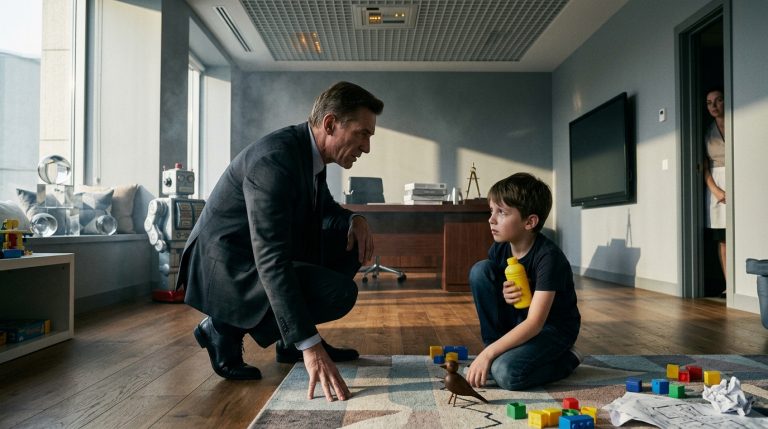
Vincent stared at the door. It was a flimsy thing, painted in a peeling, cream-colored enamel that looked like it had been applied decades ago. It wasn’t the reinforced steel of his penthouse or the heavy industrial portals of his warehouses. It was the door of someone who had lived in the margins, and for a moment, the juxtaposition stopped him. The most powerful man in the city was standing in a narrow, dimly lit hallway in Little Italy, about to invade the sanctity of a child’s sanctuary.
He reached out, his hand steadying on the knob. It wasn’t locked. It clicked open with a soft, rusted protest that sounded like a scream in the quiet of the night.
He stepped inside. The room was small, sparse, and smelled faintly of flour and yeast. A single window looked out onto the alley where he had first seen Emma. The bed was tucked into the corner, a mound of mismatched quilts. Emma was curled beneath them, her breathing soft and rhythmic. She was tucked tight against the wall, as if she were still protecting herself from the cold of the world outside.
Vincent moved across the floor, his eyes darting from shadow to shadow. He wasn’t looking for a threat; he was looking for proof. He placed the heavy silver box on a small, unsteady wooden table that groaned under the weight. He didn’t open it. Instead, he began to look at the room itself.
There were drawings taped to the wall, crude charcoal sketches of a man in a charcoal suit. His suit. His tie. His posture. They weren’t the drawings of a child who had seen a stranger; they were the drawings of a child who had been observing him from the shadows for a long time.
He walked to the bookshelf. It was filled with cheap, dog-eared paperbacks—fairy tales, adventure stories, and a thick, well-worn book on urban navigation and survival. He pulled it from the shelf. Inside, tucked between the pages, was a photograph. It was a picture of the warehouse—the same one that had burned twelve years ago. But this photo had been taken from the inside, looking out toward the dock’s edge. It was dated a week before the fire.
The room seemed to tilt. The smell of burning sugar, a stray scent from the bakery ovens below, drifted through the floorboards. It was the smell of the night the fire started. The scent ignited a dormant cluster of memories—the way Maria had looked that evening, the way Sophia had clung to his leg, the feeling of absolute, unbreakable certainty that his life was a fortress.
He had been so sure that the fire was a tragedy, a random act of violence in a world he didn’t control. But what if it was a transition? What if the life he was living—the power, the money, the isolation—wasn’t the result of a survivor rising from the ashes, but the result of an architect placing a piece exactly where it needed to be?
He looked at the bed again. Emma shifted in her sleep, a soft murmur escaping her lips. She reached out, her hand clutching at the air, and for a terrifying second, Vincent saw her hand close around the pendant she wore.
He stepped toward her, his heart hammering against his ribs. He needed to know. He reached out to pull the edge of the blanket back, to get a better look at the girl who had turned his reality into a question.
As his fingers touched the fabric, Emma’s eyes snapped open.
They didn’t look like a child’s eyes. They were wide, focused, and utterly devoid of fear. She didn’t scream. She didn’t recoil. She looked at him with the cold, calculating intelligence of someone who had been expecting him to break into her room.
“You found the box,” she said. Her voice was not the voice of the girl who had begged for bread outside the bakery. It was flat, toneless, and possessed the chilling clarity of someone who had practiced that line a hundred times.
Vincent pulled his hand back as if he had been burned. “Who are you?”
She sat up, the quilts sliding from her shoulders. She looked at the silver box on the table, then back at him. “You’re looking for the man who planned the fire, Vincent. You think it’s Julian Thorne. You think he groomed you to be his successor. That’s the story he wrote for you.”
She climbed out of bed, her bare feet making no sound on the floor. She moved to the table and touched the lid of the silver box. “You’re the architect of your own prison. Thorne didn’t build it. You did, every time you made a choice, every time you pulled a trigger, every time you chose power over the people you were supposed to protect. The fire wasn’t an ending. It was a filter.”
Vincent felt the room close in. The walls, decorated with his own image, seemed to be vibrating. “And you? What are you? A tool? A ghost?”
“I’m the audit,” she said.
The door behind him clicked shut, the sound final and absolute. The hallway outside, once empty, was now filled with the low, steady sound of movement—multiple people, pacing, securing the perimeter. Vincent reached for his weapon, but his holster was empty. He looked down; his belt, his jacket, the very equipment he had relied on for twelve years was gone.
He was standing in the middle of a room he didn’t recognize, in a house he didn’t own, facing a child who was the master of his fate.
“Thorne is arriving in ten minutes,” Emma said, walking to the window and peering out at the street. “He thinks he’s coming to claim the inheritance he groomed you for. But he doesn’t know that the ledger in that box has been replaced. He doesn’t know that for every move you made, I’ve been making a counter-move.”
She turned to him, a faint, sad smile touching her lips. “You wanted the truth, Vincent. But the truth isn’t a secret you find in a box. It’s the reality you wake up to when the fire finally stops burning.”
Vincent looked at the table. The silver box was open, and the ledger inside was gone. In its place was a mirror. He looked into it and didn’t see the man who owned half the city. He saw a man who had spent twelve years staring into a fire, unaware that he was the one holding the torch.
He had been played, not just by Thorne, not just by his enemies, but by his own capacity for vengeance. He turned to the door, his mind racing through tactical exits, through alliances, through the scorched landscape of his empire. But for the first time in his life, he didn’t have a plan. He had only the cold, sharp realization that he was standing in the center of the trap he had helped build.
CHAPTER 6: The CounterMove
Vincent did not waste breath on questions. He moved toward the door, his hands open, testing the lock. It was solid. He turned back to Emma, whose eyes tracked his every muscle twitch with an unnerving, adult stillness. The room, which only moments ago had felt like a refuge, now felt like a pressurized cage. The smell of burning sugar from the bakery below had deepened, thick and cloying, a sensory reminder of the fire that had supposedly defined his life.
“You don’t understand,” Vincent said, keeping his voice low, measured. “Thorne isn’t just a mentor. He is a predator. If he’s coming here, it isn’t for an inheritance. It’s to close the loop.”
Emma didn’t blink. “He’s coming here because I invited him.”
The revelation hit with the force of a structural collapse. Vincent looked at the child—the granddaughter he had spent the last day trying to protect—and saw not a victim, but a strategist. The pieces of the last twelve years began to reconfigure themselves in his mind. The shelter network, the anonymous tips that had led him to specific rival syndicates, the “charity” that had built his reputation—it hadn’t been his own intuition. It had been breadcrumbs.
Suddenly, the floorboards vibrated. A deep, resonant thrum moved through the building, and the light in the apartment flickered, dimmed, and then vanished. The power grid for the entire block had been tripped. The darkness was absolute, save for the faint, silvery moonlight filtering through the dusty windowpanes.
“Stay here,” Vincent commanded, his voice dropping into the familiar cadence of a man giving an order in the middle of a raid.
He didn’t wait for her compliance. He lunged for the window, his hands finding the frame. It was painted shut, years of grime sealing it against the world. He braced his feet against the wall and pulled, the wood groaning, a splintering sound that tore through the quiet. He didn’t have his gear, but he had his hands, and he had the sheer, grinding momentum of a man who had finally realized he was being liquidated.
The glass gave way with a sharp, shattering crash. He stepped onto the fire escape, the iron frame shivering beneath his weight. He didn’t look back at the room. He needed to get to the street level, to see if he could intercept Thorne’s arrival before the man stepped into the trap Emma had set.
He descended the rusted stairs, his boots finding purchase on the slick metal. Below, in the alley, a black car pulled to the curb, its headlights doused. A door opened. A man stepped out, his silhouette impeccable—the charcoal suit, the precise posture, the unmistakable air of command.
Julian Thorne.
Vincent stopped on the third-story landing. He watched as Thorne stood by the bakery entrance, looking up at the apartment window. He wasn’t armed. He wasn’t flanked by guards. He stood with the relaxed, dangerous confidence of a man who owned the air he breathed.
“Vincent,” Thorne’s voice drifted up, carried by the damp night air. It wasn’t the voice of a villain. It was the voice of the man who had sat by his hospital bed, the man who had taught him how to read a ledger, how to identify a leak, how to control a city. “I know you’re up there. And I know you’ve seen the box.”
Vincent stayed in the shadows, his heart rate spiking. This was the moment—the confrontation he had been building toward, the collision between the decoy and the reality. But as he watched, he saw something that stopped him. Thorne was checking his watch, his gaze not fixed on the apartment, but on a point further down the alleyway.
Thorne was waiting for someone else.
Vincent realized then that Emma hadn’t just invited Thorne. She had set a collision course between the master and the student. If Vincent dropped down, if he made his presence known, he was entering the firing line. If he stayed silent, he was going to witness the truth of his own manufacture.
He looked back toward the apartment window. Emma was standing there now, a small, dark shape against the glass. She was holding the pendant, the silver cross-design glinting in the pale moonlight. She wasn’t watching Thorne. She was watching Vincent.
He understood the trap now. It wasn’t about killing him. It was about making him see.
He gripped the railing of the fire escape, his knuckles white. The smell of the burning sugar was overwhelming now, a suffocating, sweet rot. He thought of Maria, of the way she had hummed while she folded laundry, and he realized with a sharp, agonizing clarity that the memory was a construct. He couldn’t remember her voice. He could only remember the sound of a voice he had been told was hers.
The entire foundation of his grief, the engine that had powered his rise to power, was a lie. He wasn’t a man who had lost a family. He was a man who had been recruited, molded, and deployed, and the “loss” had been the final step in the conditioning process.
Thorne began to walk toward the back door of the bakery.
Vincent didn’t wait. He didn’t care about the risk. He pushed off the fire escape, jumping toward the fire escape of the adjacent building, his hands catching the edge, his body swinging out over the alley. He dropped, his boots hitting the pavement with a heavy, muted thud.
He stood, the pain in his shoulders a welcome anchor. He was out of the trap, and he was finally, truly in the dark. Thorne was already at the door, his hand resting on the handle, unaware that the shadow he had groomed was standing ten feet behind him, ready to dismantle everything.
CHAPTER 7: The Silent Debt
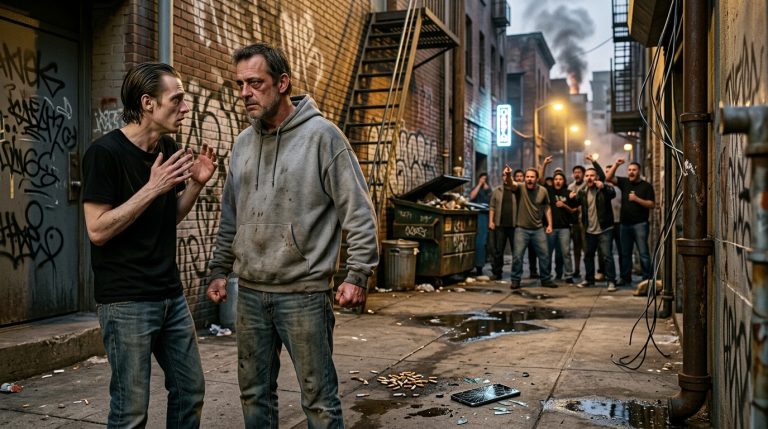
Vincent stepped out from behind the dumpster, the shadows of the alley swallowing his frame. He moved without sound, his boots—stripped of their soles to minimize friction—barely registering on the damp pavement. Thorne was still at the door. He wasn’t rushing. He was performing a ritual, his touch on the handle almost reverent, as if he were entering a sanctuary rather than a trap.
Vincent felt the cold bite of the night air. He didn’t have his weapon, but he had the weight of the last hour, the crushing reality that the man in front of him had spent twelve years orchestrating the “tragedy” of the Torino family as a necessary pruning of a human bonsai. He felt a surge of cold, analytical rage—not the hot, frantic anger of a grieving man, but the precise, surgical intent of a predator who had finally identified the parasite feeding on his life.
“You’re early, Julian,” Vincent said.
Thorne didn’t start. He didn’t turn around with a weapon in hand. He simply pulled his hand back from the door, adjusted his cuffs, and rotated with the smooth, languid grace of a predator who found himself thoroughly unimpressed by the ambush. He looked at Vincent, his eyes flicking over the disheveled suit, the lack of a holster, and the raw, dangerous intensity in Vincent’s face.
“I expected you to be in the study, guarding that empty box,” Thorne said. His voice was warm, the same tone he had used to lecture Vincent on the virtues of patience and the long game. “I suppose Emma has a way of stripping away one’s more predictable habits.”
“She isn’t your pawn,” Vincent replied, closing the distance. “And this city isn’t your board.”
Thorne laughed softly, a dry sound that had no humor in it. “You’re still thinking in terms of power, Vincent. You think this is about territory, or money, or who commands the largest slice of the illicit pie. You always were the best student I had, but you never grasped the lesson of the fire. The fire wasn’t about destruction. It was about liberation.”
Thorne gestured toward the bakery, his hand sweeping over the dark, crumbling architecture of Little Italy. “Before that night, you were a man constrained by morality, by the nagging, pathetic tether of a family that made you weak. I didn’t destroy them. I freed you from them. I gave you the focus of a god. Look at what you’ve built in the silence I gifted you.”
“You built it,” Vincent corrected, stopping five paces away. “You didn’t give me a gift. You built a mirror.”
Vincent stepped into the sliver of light coming from the streetlamp, his eyes locked onto Thorne’s. He saw the flicker of something—a genuine, almost paternal pride that was far more terrifying than any threat. Thorne truly believed he was the architect of a masterpiece. He had no concept of the cost, no capacity to understand that he had created a monster who was now holding the blueprints for his own undoing.
“I want to know about Maria,” Vincent said, the question raw and tearing at his throat. “Was she in on it? Did you pay her to vanish, or did you make her?”
Thorne’s expression shifted, a shadow crossing his face. “Maria was the only variable I couldn’t fully account for. She was smarter than you, Vincent. She saw the potential for the rot years before I did. But she wasn’t a victim. She was the one who suggested the fire.”
The world seemed to lose its color. The rain, the pavement, the very air itself felt thin, brittle. Vincent stared at Thorne, searching for the lie. He found none.
“She knew you were never going to reach your potential as long as you were Vinnie the Enforcer,” Thorne continued, his voice dropping. “She realized that for you to rule, Vinnie had to die. And he had to die with a cause, with a purpose that would justify any amount of cruelty. She sacrificed herself to make you the man you are today.”
Vincent felt the ground beneath him vibrate. The lie he had been fed—the idea that he was a victim—was replaced by a much darker, much deeper truth. He hadn’t been fighting a conspiracy to find his family. He had been living in a curated hell created by the people who had claimed to love him most.
He didn’t move. He didn’t speak. He reached into his pocket and pulled out the small, amber-pulsing beacon he had ripped from the wall. He tossed it at Thorne’s feet.
Thorne looked down at the light, his eyes narrowing.
“Emma isn’t my granddaughter, is she?” Vincent said, his voice terrifyingly calm.
Thorne didn’t look up. “She’s the audit, Vincent. She’s the final calculation.”
A sudden sound—the mechanical whine of a drone—descended from the roofline, its spotlight snapping on and pinning Thorne against the brick wall of the bakery. It was the same drone Vincent had seen at his estate.
Emma appeared in the doorway, her silhouette sharp against the internal light of the shop. She held a small, black tablet. She wasn’t looking at Thorne. She was looking at Vincent, her eyes reflecting the cold, clinical distance of a ghost.
“The audit is complete,” she said.
Thorne straightened, his posture losing its relaxed composure as he realized the weight of the silence. He looked at the girl, then at Vincent, the realization of his own obsolescence dawning on him with the slow, inevitable weight of a falling blade. The game he had designed was no longer his to control.
Vincent didn’t wait for the next move. He turned toward Emma, leaving Thorne to the mercy of the light. He was done with the architects. He was done with the blueprints. He was finally, violently, awake.
CHAPTER 8: The Broken Mirror
Vincent didn’t move. He stood in the damp, claustrophobic space between the bakery and the rusting fire escape, his eyes fixed on the man who had been his North Star for twelve years. Julian Thorne remained motionless under the harsh, white glare of the drone’s spotlight. He didn’t look at the girl. He didn’t look at the drone. He looked only at Vincent, and for the first time, the veneer of untouchable authority cracked.
“You really believe her,” Thorne said, his voice barely audible over the high-pitched whine of the drone’s rotors. “You believe that a child—a project—knows more about your life than the man who built it.”
“I don’t believe anyone,” Vincent said. He stepped out from the shadows, his movements jagged, unpolished, a stark contrast to Thorne’s practiced stillness. “I’m done believing. I’m just observing.”
Thorne smiled, a tight, thin line that didn’t reach his eyes. “You’re observing a collapse, Vincent. If you take this path, there is no empire waiting for you at the end of it. There is only the realization that you were never the king. You were the janitor.”
Emma stepped forward, the blue light of the tablet illuminating her face with an alien glow. “He’s stalling, Vincent. The police are five minutes out. He’s already signaled his personal detail. He’s going to execute the protocol—he’s going to burn this block, the bakery, and anyone standing in it to hide the trail.”
Vincent felt the shift in the air—the sudden, static charge of impending violence. Thorne reached into his jacket, his movements slow, deliberate. He wasn’t reaching for a weapon; he was reaching for a trigger.
“She’s right, of course,” Thorne said, his voice dropping to a whisper. “But she’s naive. She thinks she can control the fire. I taught you better than that, didn’t I?”
Thorne pressed a button on a small, obsidian-cased remote. Nothing happened. The drone continued its steady hum. The alley remained silent. Thorne’s brow furrowed, his thumb pressing the button again, harder this time.
“It’s over, Julian,” Emma said. Her voice was flat, devoid of the childish cadence she had used when they first met. “I didn’t just inherit the system. I updated it.”
The drone’s light shifted, its intensity increasing until it was blindingly bright. Vincent had to shield his eyes, the glare washing out the alley, the brickwork, the very reality of the space. In the chaos of the light, he saw Thorne stumble, his perfect posture failing him for the first time in a decade.
“What did you do?” Thorne demanded, his voice cracking.
“I removed the variables,” Emma replied.
Vincent saw his opening. He didn’t go for Thorne; he went for the tablet. He lunged, his body hitting the wet pavement as he scrambled toward the girl, his mind screaming at him to seize the mechanism of control. He reached for Emma’s arm, but she was already moving, her agility unnatural, her reactions faster than his own.
She slipped past him, and in the movement, she dropped something—a small, silver object that skittered across the cobbles. Vincent scrambled to catch it, his fingers closing around the cold, familiar texture of the broken watch he had carried for twelve years.
He looked up. Thorne was backing away toward the mouth of the alley, his face a mask of cold, concentrated rage. He didn’t look like a mentor anymore. He looked like a cornered animal, his eyes darting toward the street, toward the shadows, toward an escape that wasn’t there.
“You think you’ve won,” Thorne spat at the girl. “You think you can dismantle twelve years of work in a night? You’re just a mirror, Emma. You’re just another reflection of the chaos I taught him to master.”
“I’m not the mirror,” Emma said, her voice echoing in the confined space. “I’m the glass. And I’m about to break.”
She tapped the tablet again. A sound ripped through the alley—a high-frequency pulse that caused the windows of the bakery to vibrate in their frames. Thorne collapsed to his knees, his hands clutching his head, his composure finally shattering into a silent, agonizing gasp.
Vincent stood, the watch clutched in his palm. He looked at Thorne, then at the girl, then at the empty, dark alley. He had come here looking for the architect, but as he watched Thorne struggle against the invisible weight of the system he had built, he realized that the truth was much more terrifying.
He hadn’t been fighting a man. He had been fighting the infrastructure of his own soul. He had been fighting the man he had chosen to become.
He didn’t run to Thorne. He didn’t rush to Emma. He walked to the center of the alley, where the drone’s spotlight was burning a hole into the pavement, and he stopped. He looked down at the watch in his hand. The crystal was shattered, the hands frozen at 4:01—the exact minute of the fire.
He realized that the watch hadn’t just stopped that night. It had been holding time in place, a psychic anchor that prevented him from moving forward. He raised his hand and, with a sudden, violent motion, he hurled the watch against the brick wall.
It didn’t just break; it disintegrated. And as the pieces scattered across the alley, the silence that followed was heavy, absolute, and, for the first time in twelve years, completely his own.
The stage was set for the end. The trap was sprung. And the only question left was which of them would be left standing in the ruins.
CHAPTER 9: The Siege of Illusions
The alley was a graveyard of broken glass and fractured light. Thorne struggled to his feet, his breathing ragged, his hand still clutched at the base of his skull where the frequency pulse had hit him with the force of a hammer. He wasn’t the untouchable patriarch anymore; he was a man aging before Vincent’s eyes, the sharp edges of his tailored coat now hanging loosely on a frame depleted of its vitality.
Vincent didn’t look at the drone or the tablet. He walked toward Thorne. His movements were not the tactical, measured strides of a syndicate boss. They were the heavy, tired steps of a man walking out of a long, dark dream. He stopped inches from Thorne, the height difference between them no longer a factor of authority, but of simple, physical proximity.
“You talked about liberation,” Vincent said, his voice flat, devoid of the jagged anger that had fueled him. “You said you burned my life to build a god. But gods don’t bleed, Julian. And they certainly don’t fear the truth.”
Thorne straightened, wiping a smear of blood from his temple. He looked at the shattered remains of the watch on the pavement, then up at Vincent. A terrifying calm had replaced his rage. “You think you’ve seen the truth? You’ve only seen the cage, Vincent. You haven’t seen the person who locked it. You think the girl is your salvation? You think this ‘audit’ is for your benefit?”
He gestured toward the bakery. Emma stood in the doorway, her silhouette sharp, the tablet in her hand glowing with a deep, pulsing violet light—the color of a master override.
“Look at her,” Thorne whispered, his voice gaining a hollow strength. “Look at the way she moves. She didn’t come to save you. She came to inherit the structure. I didn’t train you to be the boss. I trained you to be the transition. She’s the next version. I was just the beta test.”
Vincent felt a cold, sharp spike of dread. He looked at Emma. She was watching them, not as a child watching a dispute, but as an engineer watching a machine wind down. She wasn’t just a survivor of his past; she was the architect of his current reality. Every tip, every lead, every “lucky” break he had encountered over the last forty-eight hours had been a stress test.
“She’s a child,” Vincent said, though the words sounded hollow even to his own ears.
“She’s a result,” Thorne replied. “And you, Vincent? You’re just the obsolete code.”
The alley erupted in sound—not the hum of the drone, but the heavy, mechanical thud of tactical gear hitting the pavement at both ends of the street. Thorne’s personal detail had arrived, but they weren’t moving toward Vincent. They were moving toward the bakery. They were moving toward Emma.
Vincent realized the tactical reality of the situation: Thorne hadn’t been stalling for escape; he had been stalling for the arrival of a cleanup crew, a team designed to execute the final, messy end of the project.
“Vincent,” Emma said, her voice cutting through the rising tide of boots and shouting. She held the tablet out toward him. “If you want to end this, if you want to be more than a prototype, you have to let go of the structure. I’ve encrypted the entire history of the syndicate into this device. Every bribe, every murder, every lie Thorne ever told. But it’s linked to the security grid of the estate. If you take this, you destroy your life, your empire, and everything you built. You become nobody. Again.”
Vincent looked at the tablet, then at the wall of black-clad men moving toward the door. He felt the weight of the last twelve years—the power, the fear he had inspired, the cold, isolated comfort of his penthouse. It was an empire built on ashes, and he was being asked to set the match.
He looked at Thorne, who was watching him with a mixture of pity and curiosity. The man who had shaped him was waiting to see if his creation would choose the power he had given him, or the freedom he had promised him.
Vincent took a breath. He didn’t look back at the ruins of his watch. He didn’t look at the bakery. He reached out and snatched the tablet from Emma’s hand.
The moment his fingers touched the glass, the drone overhead spiraled, its rotors whining as it plummeted toward the street, a dying star of burning metal. The lights in the neighborhood surged, then exploded into total, impenetrable blackness.
He had chosen. The structure was breaking. The truth was no longer a secret; it was a detonation.
He didn’t wait for Thorne’s reaction. He pivoted, his body slamming into the first of the approaching tactical guards, his movements raw, unrefined, and fueled by a decade of suppressed kinetic energy. The siege had begun, and for the first time in his life, Vincent wasn’t the man holding the leash. He was the man holding the detonator.
CHAPTER 10: The Architects End
Vincent did not stop moving. The men in black were closing in, their movements synchronized and cold, but they lacked the singular, lethal drive that had propelled Vincent through the last twelve years. He wasn’t fighting for an empire; he was fighting for the space to finally see clearly. He disarmed the first guard, the sound of the impact—a sickening thud against the wet pavement—echoing off the narrow brick walls. He felt the weight of the tablet in his pocket, the entire history of the syndicate now contained in a fragile, glowing screen.
Thorne remained on his knees, his hands pressed to the cold cobbles, his breath coming in ragged, shallow hitches. He looked up as Vincent crossed back toward him, his eyes devoid of the pride that had fueled his arrogance. There was only a hollow, terrifying clarity.
“You think you’ve taken the power, Vincent?” Thorne whispered, his voice gaining a sudden, dangerous strength. “You’ve only inherited the target.”
Vincent reached down and grabbed Thorne by the lapels, hauling him up until their faces were inches apart. He didn’t see a mentor. He didn’t see the man who had shaped his rise. He saw a brittle, frightened shell. “I don’t want the power. I don’t want the structure. I want the reality you spent twelve years burying.”
“You want to know about Sophia?” Thorne laughed, a wet, rattling sound. “She didn’t run away. She didn’t hide. She stayed. She was the one who fed the information to the internal affairs leaks that kept the police off our backs for a decade. She was the one who made sure the Torino name was synonymous with brutal efficiency, so that when the time came, the collapse would be complete. She didn’t want you to be a king, Vincent. She wanted you to be the martyr.”
The words cut through the remaining fog of Vincent’s conditioning. He turned his head toward the bakery. Emma—or Sophia, or whatever name the architect of his demise currently held—was standing in the doorway, her arms folded, watching the scene with the detached curiosity of an auditor finalizing a ledger.
She walked forward, her footsteps echoing in the silence. The tactical guards had stopped their advance, their weapons lowered, their attention shifting to the small, unassuming figure approaching from the shadows.
“The audit is complete, Julian,” she said, her voice clear, youthful, and utterly devoid of the warmth he had spent years mourning. “You built a machine designed to survive everything except the truth. And the truth is that your ‘prototype’ was always meant to be discarded.”
She looked at Vincent, her eyes meeting his with a sudden, devastating softness—a flicker of the daughter he had lost, or perhaps just the final, cruelest manipulation of the prototype. “I’m sorry, Papa,” she said. “But the fire had to be real. You couldn’t be the man I needed to destroy the system if you were still half-attached to the version of you that loved me.”
Vincent felt the weight of the tablet in his pocket. He realized then that he had no choice. He pulled it out, its screen still pulsing with the violet light, and he looked at the interface. There was one command available: DELETE. It wouldn’t just wipe the data. It would trigger a hard-wipe of every node in the syndicate’s network, crashing the financial backbone of the empire and leaving everyone—Thorne, the guards, the rivals—with nothing.
It was the ultimate act of sabotage. It was the only way to kill the architecture.
Thorne watched him, his expression hardening. “If you hit that, you go down with us. You’ll be nobody. You’ll have no money, no leverage, no life.”
“I never had a life,” Vincent said. He felt the cold iron of the alleyway, the smell of the damp night, the singular, overwhelming peace of a man who had finally stopped playing the game. “I had a script.”
He pressed his thumb against the screen. The violet light flared, blinding and intense, and for a second, the entire alleyway was flooded with the image of a burning building—the memory, the construct, the lie.
Then, the world went black.
The silence that followed was total. The drone fell, the guards stood down, and Julian Thorne slumped against the brick wall, his eyes vacant, the man who had been the shadow of the city finally extinguished by the loss of his own creation.
Vincent didn’t look back. He walked to the mouth of the alley, toward the street where the city lights were beginning to flicker back on, one by one. The empire was gone. The architect was broken. And he was standing in the center of a life that was finally, terrifyingly, blank.
He didn’t know who he was, or what he would do when the sun rose, but as he stepped out into the cool, morning air, he touched the space where his watch had been, and he smiled. For the first time in twelve years, he wasn’t keeping time for anyone. He was just breathing.