A Jar of Echoes: How a Billionaire and a Widow Found Connection in the Quietest Moments
CHAPTER 1: THE UNSEEN ARCHITECTURE
The foyer was a cathedral of marble, designed to make anyone standing in it feel small. Usually, Rosie thrived in that smallness; it was a coat of invisibility she wore to protect herself. But this morning, as she pulled her coat from the hanger, the silence didn’t feel empty. It felt expectant.
She set her cart down, the wheels clicking softly against the polished floor. Before she could even begin the ritual of the morning—the dusting of the foyer table, the inspection of the high-reaching cornices—she saw it.
On the mahogany side table, sitting perfectly centered in the pool of morning sunlight, was a cup. It wasn’t the fine china the Hartwells kept for display; it was a simple, ceramic mug, stained slightly at the rim. Beside it, a single book lay open, facedown.
Rosie walked toward it, her heart performing that familiar, sideways skip. The house felt different, like a room where the furniture had been subtly rearranged while she was gone. She touched the spine of the book—a collection of poetry, the pages dog-eared at a section regarding loss and the endurance of stone.
She wasn’t supposed to read the books. The library was a space for dusting, not for lingering. But the book was here, in the foyer, an intentional bridge between the world she cleaned and the world Adrian occupied.
She heard a footstep—not the frantic pace of a businessman, but the measured, deliberate gait of a man who had nowhere else to be. She didn’t turn around. She watched his reflection in the oversized mirror above the table. Adrian Hartwell was standing in the doorway of the dining hall, sleeves rolled up, a smudge of charcoal on his thumb.
“I found it,” he said, his voice quiet, lacking the abrasive edge of his usual authority. “The poetry. I thought… it was honest.”
Rosie turned, her hands naturally smoothing the apron she wore, a habit born of nervous composure. “It’s a long way from the office, Mr. Hartwell.”
“Adrian,” he corrected, the name sounding foreign on his tongue but sticking there, nonetheless. He walked closer, and the space between them seemed to vibrate with the weight of the last few weeks—the diner, the Mason jar, the shift in the air.
“The library,” he continued, “has always been full of words. I’m just starting to hear them.”
Rosie looked at the mug, then back at him. She noticed the way his eyes tracked the movement of the sunlight across the floor, avoiding her gaze for a split second before grounding himself. There was a new, unsettling intimacy to his presence. He wasn’t the man who avoided the house; he was the man who was finally, painfully, learning to live in it.
He reached out, his hand hovering near the table as if to steady the book, but he stopped short of touching it. His thumb rubbed against his forefinger, a nervous tic that looked exactly like the one she saw in the mirror when she was worried about rent.
“I have something to ask,” he said, and the air in the foyer suddenly felt very thin, as if they were standing at the edge of a cliff, waiting for the wind to decide which way they would fall.
He looked at her then, directly, and the expression on his face was a mirror of her own unspoken fear: the terror of being seen for who they really were, rather than what they produced.
“Is Lily coming today?” he asked.
“She’s at the park,” Rosie said, her pulse quickening. “She brought Gerald. She’s teaching him how to identify trees.”
Adrian looked at the empty foyer, and for a heartbeat, his face fell—a jagged, raw look of disappointment that he tried to hide behind a mask of indifference. He turned toward the hallway, but paused, his back to her.
“I bought a toy,” he whispered, so quietly she almost missed it. “A metal detector. I thought… well, if she’s looking for coins, she might want to look for them in the soil, rather than just on the sidewalk.”
Rosie felt a sudden, sharp ache in her chest. She watched him walk away, leaving the mug and the book behind, and she realized then that the silence of the Hartwell estate had been replaced by something far more dangerous. It wasn’t just quiet anymore; it was a conversation, and they had both just taken the first, terrified step toward the middle.
She looked down at the book. The marked page was about the things we leave behind in the dirt, and the roots that grow around them. As she picked it up, a slip of paper fell out from the inside cover, hitting the floor with a soft, decisive slap.
It wasn’t a receipt. It was a photograph—an old one, black and white—of a young man standing in a field of rubble, holding a shovel. It wasn’t Adrian.
Rosie stared at the face in the photo, her blood running cold. It was the face of the man who had hired her at the staffing agency fourteen months ago.
CHAPTER 2: THE ANATOMY OF AN INTERVIEW
The photograph felt heavy, as if the black-and-white ink were made of lead. Rosie stared at the man in the picture—the agency director, Mr. Sterling—standing in that field of rubble. He looked younger, his face unlined by the calculated exhaustion she had associated with his office when he’d placed her here. Fourteen months ago, he had sat across from her at a desk that smelled of stale coffee and industrial cleaner, his eyes scanning her resume with the detachment of a man auditing a ledger.
You need this, don’t you? he had asked. It hadn’t been a question of sympathy. It had been an assessment of leverage.
Rosie looked up from the photo, her gaze scanning the foyer of the Hartwell estate. The marble was cool, unforgiving, and the grand staircase curved upward like a spine. Why would a man like Adrian Hartwell, a man who supposedly lived in a different stratosphere than the staffing agency that placed domestic help, have a private photograph of Mr. Sterling? And why was it hidden inside a book about loss?
She slid the photo back into the pages of the poetry book, her fingers trembling slightly. The “unbroken silence” of the house felt different now—it wasn’t just empty; it was curated. Every object, every piece of art, every book left in her path seemed to be a deliberate placement in a much larger, more complex design.
She turned and saw Adrian standing at the far end of the hallway, by the entrance to the library. He hadn’t left. He was watching her. The way he stood was still and perfectly balanced, his hands clasped behind his back. He didn’t look like a CEO checking on an employee; he looked like a curator waiting to see if a specific exhibit had been properly understood.
“Is something wrong, Rosie?” he asked. The question was soft, but it carried the weight of a weight-bearing wall.
She clutched the book to her chest, the hard edges of the cover biting into her palms. “I just… I found this.” She gestured to the book. “I didn’t mean to pry, but it slipped out.”
Adrian walked toward her, his footsteps silent on the rug. He didn’t reach for the book. He stopped a respectful distance away, his eyes moving to the cover. A flicker of something—regret? Recognition?—crossed his features before he smoothed it over with a practiced, impenetrable calm.
“That photograph,” he said, his voice dropping an octave, “is a reminder. People like to think that life is a series of clean slates. They think that when a building falls, you just clear the rubble and start over.”
“And you don’t?” Rosie asked, her voice sounding thinner than she intended.
Adrian looked toward the front door, his gaze drifting to the spot where Lily had placed the coins on the bank counter weeks ago. “I used to think that was the only way to operate. Efficiency, precision, the removal of obstacles. But rubble is never just rubble, Rosie. It’s what remains of the structure that was there before. If you don’t acknowledge it, the foundation of whatever you build next will always be crooked.”
He reached out then, and this time, he didn’t stop. He gently took the book from her hands. He didn’t check the photograph. He simply closed the volume and held it against his side.
“The agency,” he said, changing the subject with a jarring pivot that forced her to follow his lead. “They have a specific protocol for their staff. They like to ensure that every placement is… manageable. I believe Sterling referred to it as ‘maintaining equilibrium’.”
“I’m just a maid, Adrian,” Rosie said, her guard instinctively coming up, the familiar protective wall of the working class rising between them.
“No,” he replied, and his tone was sharp, devoid of the soft edges he’d been curating for her. “You are the only person who has entered this house and not been terrified by the amount of space it occupies. You don’t look at the walls as barriers. You look at them as things that need to be maintained.”
He turned and began walking back toward the library, not checking to see if she was following. It was a command disguised as an invitation. Rosie hesitated, her heart still hammering against her ribs like a trapped bird. Every instinct told her to turn around, to grab her cart, to finish the dusting and leave, to keep the distance that had kept her safe for fourteen months.
But the memory of the photograph—of the director in the field of rubble—tethered her to the spot. She knew the agency. She knew the way they operated. If Adrian Hartwell was connected to Sterling, then she wasn’t just an employee here. She was a data point in an experiment she hadn’t signed up for.
She followed him into the library. The room smelled of old paper and the faint, lingering scent of the charcoal he had been using. He stood by the window, his back to her, looking out at the overgrown rose bushes.
“The bonus,” he said, not turning around. “The ‘accounting error.’ You haven’t checked with the agency yet, have you?”
Rosie stopped, the question hanging in the air like a sudden chill. “I didn’t think I needed to. You said it was corrected.”
“I said the error was corrected,” he said, turning to face her. His eyes were hard, the calculation back in full force, a cold, clinical blue. “I never said it was an error on their end. I wanted to see if you would notice the change in the net balance. Most people don’t. They just accept the deposit.”
Rosie felt a surge of indignation, a heat that had nothing to do with the room’s temperature. “You tested me?”
“I verified you,” he corrected, his voice as smooth as polished stone. “In this house, Rosie, silence isn’t just an absence of sound. It’s a choice. And I needed to know exactly who I was inviting into the architecture of my life.”
He walked toward her, and the distance between them, which had felt like a bridge building, suddenly felt like a trap closing.
“I have a project,” he said, his voice dropping to a conspiratorial whisper. “It isn’t on any financial list. It isn’t a building or a merger. But it requires someone who understands the difference between something that is broken and something that is just waiting to be repaired.”
He reached into his pocket and pulled out a small, heavy object—a key, rusted at the bow, with an ornate, Victorian design. He didn’t give it to her. He held it between them, a silent challenge.
“Are you going to keep cleaning, Rosie? Or are you going to help me figure out why the agency sent you to me in the first place?”
CHAPTER 3: THE LIBRARYS SECRET
Rosie did not reach for the key. She stood perfectly still, her hands resting at her sides, palms open to show she had nothing to hide—a gesture she had learned in the hospitals and the cramped offices of social workers. She watched the way Adrian held the metal, his thumb tracing the jagged, rusted edges of the bow. He looked less like a billionaire and more like a man holding a shard of his own history, something he wasn’t quite sure how to dispose of.
“You’re asking me to investigate the people who gave me my life,” she said, her voice steady, stripping away the professional deference she usually wore. “You’re asking me to find out why they placed me here, in your house, with my daughter.”
Adrian finally let his hand drop to his side, though he didn’t put the key away. “I’m asking you to look at the patterns, Rosie. You’re good at cleaning. You see the grime that builds up in the corners, the dust that settles behind the heavy furniture. This—the agency, the way they hand-picked you for this specific estate—that is dust. It’s an accumulation of design that you’ve been cleaning around without ever questioning why it’s there.”
He turned back to the window, the late afternoon light casting long, amber shadows across the spines of the books. “I was an efficient man. I valued people for their utility, just like the agency did. But when I watched you at the bank, when I saw what that little girl of yours did with those coins, I realized that I had been optimizing my life into a vacuum. There was no room for anything that couldn’t be quantified.”
Rosie took a half-step forward. The room felt smaller now, the high ceilings closing in. She thought of Lily’s ‘Gerald’, the jar that sat on their kitchen table filled with coins that meant more than their face value. “And you think I’m the key to your optimization?”
“I think you’re the only person who can see what’s actually in the corners,” he said. He reached out and placed the key on the desk, the metal clinking softly against the polished wood. “That key opens a storage locker in the downtown branch. Not the one you use. A smaller one. I stopped paying the fees three months ago, expecting the agency to empty it. They haven’t. They’re waiting for someone to claim it, or perhaps they’re waiting to see who goes looking.”
Rosie looked at the key. It was a physical, tangible thing, a contrast to the high-level financial games Adrian usually played. “Why me? Why not just go yourself?”
“Because if I go, it’s a business transaction,” he replied, his gaze locked on hers. “If you go, it’s a curiosity. And they don’t know how to handle curiosity. They only know how to handle transactions.”
He walked to the bookshelf, pulling a worn, leather-bound volume from a middle shelf. He didn’t open it; he simply held it, his fingers moving over the gold-leaf lettering. “My father left this library to me. Most of the books haven’t been touched in twenty years. But there’s one—a hidden ledger of sorts—that isn’t a book at all. It’s a record of every contract the agency has serviced for Hartwell Capital. If you look at the entries, you’ll find that I wasn’t the only one being managed.”
The weight of the request hit Rosie in the gut. She wasn’t just a maid anymore; she was being drawn into a web of corporate surveillance and hidden histories. She felt the urge to refuse, to walk out of the library, to take Lily and move to a different town where the floors were just floors and the houses didn’t have secrets.
But then she remembered the photograph of Sterling in the rubble. She remembered the look on his face when he’d told her she needed the job. It hadn’t been an act of charity. It had been a placement.
She reached out and took the key. It was heavy, cool to the touch, and felt strangely familiar, as if it were a piece of a puzzle she had been assembling without knowing it.
“If I do this,” she said, her voice dropping, “I need to know one thing. Does this involve Lily?”
Adrian’s expression softened, the hard lines around his mouth fading. “Lily is the reason I’m asking. She saw through the silence of this house in an afternoon. She saw that we were lonely, and she tried to fix it with a handful of change. If there is a truth to be found in those files, Rosie, it’s the truth of why the world works so hard to keep people like us from seeing that we’re the same.”
He stepped back, giving her space. “The library is yours for the afternoon. I have a conference call in the study. I won’t be back until six.”
He left the room, his footsteps echoing on the hardwood before fading into the distance. Rosie stood alone in the center of the library, the key clutched in her hand, surrounded by thousands of books whose stories she was only now beginning to read. She walked to the desk, the key clicking against the wood as she laid it down, and turned her attention to the shelf he had indicated.
The silence of the estate was no longer an echo of her own thoughts; it was a challenge. She reached for the leather-bound volume, her heart beating a steady, determined rhythm against her ribs. She was going to see what was behind the furniture.
CHAPTER 4: THE ARCHITECTURE OF LOSS
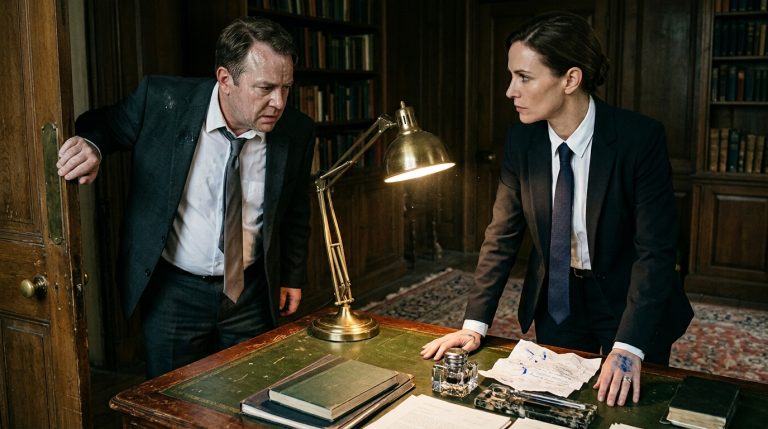
Rosie’s hand hovered over the ledger, the paper dry and brittle, yellowed by the slow oxidation of decades. The book was not an accounting ledger in the traditional sense; it was a sprawling, handwritten map of human dependencies. Each entry was dated, coded with initials, and marked with a monetary value that seemed almost arbitrary.
Her finger rested on the row marked with her own name.
Martinez, R. – Placement 14m. Status: Monitored.
Beneath it were two other names, both crossed out with heavy, aggressive slashes of black ink. She scanned the dates. Both had been placed at the Hartwell estate for roughly eighteen months before being moved. She frowned. She had been told the agency’s turnover was due to high standards and rigorous scheduling, but looking at the dates, a pattern emerged—both departures coincided with a significant expansion of the estate’s structural renovations.
A shadow fell across the desk. Rosie flinched, pulling her hand away as if the paper were burning. Adrian was standing in the doorway, his silhouette stark against the dim light of the hallway. He didn’t look like a man in a hurry for a conference call.
“You found the list,” he said, his voice devoid of surprise. It wasn’t an accusation; it was an acknowledgment of an inevitable discovery.
“Why was I being monitored?” Rosie asked, her voice tight. She stood up, the chair scraping sharply against the floor, a sound that seemed to shatter the library’s composure. “You told me the bonus was a test of integrity. This… this looks like surveillance. You were tracking the others, too.”
Adrian walked into the room, his movements slow, deliberate. He stopped by the desk, his gaze dropping to the open ledger. “The agency didn’t just place staff, Rosie. They managed a portfolio of risks. Every person they brought into this house was screened for vulnerabilities. They were looking for people who were broken, people who were already carrying a load, because people with nothing to lose are the most dangerous to a man in my position.”
“And what was my vulnerability?” she whispered.
He didn’t look away. “Lily. And Marco’s death. You were the perfect candidate for the ‘silent, compliant survivor’.”
The truth of it was like a cold stone in her stomach. She had spent fourteen months believing her own narrative—that she was a hardworking woman who had lucked into a stable placement through honest effort. In reality, she had been a carefully selected variable in a system of corporate control.
“Why show me this now?” she demanded.
“Because I am trying to dismantle the architecture of the house,” he said, and for the first time, she saw a flicker of genuine desperation in his eyes. He reached into his jacket and pulled out a small, leather-bound notebook—not a ledger, but a personal diary, its spine cracked and worn. “This belonged to my father. He started this arrangement with the agency before the company was even public. He was afraid of the loss he hadn’t yet experienced. He thought that if he controlled the people around him, he could prevent the things he loved from leaving.”
He placed the diary on top of the ledger. “I’m not trying to control you, Rosie. I’m trying to see if I can be the person who breaks the cycle. The agency thinks I’m still the man who requires this ‘equilibrium.’ They have no idea I’ve invited you to look behind the curtain.”
Rosie looked at the diary. She felt a profound, heavy sadness for the man who had written it, and a sharper, more immediate pain for her own complicity. She had walked through these halls for over a year, cleaning the marble, dusting the frames, and humming to herself, all while existing within a cage she hadn’t noticed because the bars were padded with convenience.
“If I go to this locker,” she said, her voice barely audible, “what am I going to find?”
“Proof,” Adrian said. “Not just of the agency’s reach, but of why they were so invested in keeping you here. It isn’t just about labor, Rosie. There’s something tied to Marco’s accident that they didn’t want you to see.”
The air in the room seemed to go still. Rosie looked at the key on the desk, then back at Adrian. The professional mask he had spent forty years constructing was gone, leaving behind only the raw, messy reality of a man who was finally tired of living in a masterpiece of his own isolation.
She picked up the key. The metal was no longer cold; it had absorbed the heat of her own palm. “I’m going to the locker,” she said, and her voice held a note of steel that she hadn’t known she possessed. “But not because you asked me to. I’m going because I’m done being an exhibit.”
She walked past him, her boots clicking with a finality that echoed off the mahogany bookshelves. As she reached the door, she paused, not looking back. “If you’re lying to me, Adrian, don’t be in this house when I get back.”
The silence she left behind was not the empty, cathedral silence of the estate. It was the heavy, pregnant quiet of a storm about to break.
CHAPTER 5: THE LOCKERS DECOY
Rosie did not look back. She exited the estate through the service entrance, the heavy iron door clanging behind her with a finality that made her flinch. The walk to the bus stop was a blur of gray concrete and the persistent, nagging feeling of being watched—not by Adrian, but by the city itself. Every businessman moving with purposeful speed, every lingering figure near the bus stop, felt like a potential asset of the agency.
She gripped the key in her pocket, her thumb tracing the rusted teeth of the bow. She reached the bank branch, a mid-block structure squeezed between the dry cleaner and the phone repair shop, just as the midday heat began to radiate off the pavement. She stood outside the glass, her reflection staring back—tired, composed, and utterly unrecognizable as the woman who had scrubbed these floors just weeks ago.
She was ten feet from the entrance when a dark sedan—the same model she’d seen months ago—slowed down at the curb. The window rolled down just an inch, a sliver of darkness in the bright afternoon. A man in a plain gray suit sat behind the wheel, his eyes not on the road, but on the bank entrance.
Rosie didn’t hesitate. She didn’t walk into the bank. Instead, she ducked into the narrow, trash-strewn alleyway beside the dry cleaner. Her heart hammered against her ribs, the rhythm of a predator’s chase. She waited, her back pressed against the cold, damp brick, her breath coming in ragged, shallow bursts.
Calculate, she told herself. Don’t panic. Calculate.
She realized then that the agency wasn’t just watching the estate; they were watching the nodes of the system they’d built. If Adrian was right, the locker wasn’t just a storage space—it was a pressure point.
She moved deeper into the alley, climbing over a discarded stack of shipping pallets, her hands scraping against rough, splintered wood. She emerged on the street behind the bank, the rear loading bay door ajar. She didn’t think about the risk—she thought about Lily. If the agency was keeping secrets about Marco’s death, then every second she spent hesitating was a second she was failing her daughter.
She slipped through the loading bay, the interior cool and smelling of floor wax and ozone. She bypassed the main floor and navigated the narrow service corridors toward the safety deposit vault. She wasn’t an employee, but she was a cleaner—she knew how to move through restricted spaces without triggering notice. She timed her movements with the hum of the ventilation, stepping out of sight whenever a teller rounded the corner.
The vault room was empty, the air heavy with the scent of static and dry, stagnant time. She found the locker bank, her breath catching as she scanned the numbers. 412. It was tucked away in a corner, shielded by the shadow of a support pillar.
She inserted the key. It resisted for a moment, the lock stiff with disuse, then yielded with a sharp, metallic click.
She pulled the drawer open. Inside, there was no massive conspiracy file, no smoking gun regarding Marco. There was only a single, heavy envelope addressed to Hartwell, A., and beneath it, a small, silver locket.
Rosie opened the envelope with trembling fingers. It contained a list of names—her name, her sister’s name, and the names of the two women who had been placed at the estate before her. Beside each name was a bank account number, and next to that, the words: Scholarship Fund – Deferred Maintenance.
It was a scholarship for Lily. A full, comprehensive, multi-year fund, anonymous, set to trigger upon the anniversary of Marco’s death.
She stared at the ledger, the decoy secret falling away to reveal the hollow reality of Layer 1. The agency hadn’t been monitoring her to hurt her—they were managing the payouts, ensuring the scholarship funds stayed tied to the estate’s “stability.” They were using her daughter’s future as leverage to keep her compliant, to keep her scrubbing the floors, to keep her in the Hartwell house where she could be watched.
Her breath hitched. The locket beneath the papers caught the light—a simple, elegant piece she recognized instantly from the photographs in her own apartment. It had belonged to Marco’s mother. It had gone missing the day he died.
The agency hadn’t just managed her placement. They had looted her history to ensure she remained indebted to the system.
She heard the heavy thud of a vault door closing in the distance, followed by the measured, authoritative gait of footsteps on the polished stone floor. They weren’t Adrian’s. These steps were faster, more aggressive.
Rosie grabbed the envelope and the locket, stuffing them into her pocket. She didn’t have time to process the betrayal—not the agency’s, and not the fact that Adrian had known about the funds and stayed silent. The realization hit her with the force of a physical blow: Adrian hadn’t been testing her integrity; he had been watching her be manipulated, waiting to see if she would finally break.
She turned to flee, but the vault door was already closing, the electronic lock engaging with a final, echoing thrum. She was trapped in the vault, the key still in the lock, the sound of the agency’s enforcer just outside the heavy steel frame.
CHAPTER 6: THE RECALIBRATION
The darkness was not absolute; a sliver of ambient light leaked through the gap at the top of the vault door, casting long, fractured shadows across the rows of silent lockers. Rosie pressed her back against the cool steel, the envelope and the locket feeling like burning coals against her hip. Every shadow seemed to stretch toward her, a physical manifestation of the paranoia that had been simmering since she left the Hartwell estate. She heard a metallic scrape outside—a key, or perhaps a tool—and her breath hitched, her lungs feeling as though they were filled with the dust of the crumbling records she had just uncovered.
They’re coming to finish it, she thought, her hands trembling as she felt along the interior wall for a release, a handle, anything. Sterling knew the moment I walked into the bank. The whole ‘placement’ was a closed loop designed to terminate exactly here.
She misread the scrape as the grinding of a lock, and she spun around, striking her shoulder against a metal locker with a sharp, sickening thud. The pain was grounding. It forced her to focus, to push past the irrational certainty that death was inches away. She knelt, her fingers flying over the floor, searching for a seam in the concrete, a gap where the vault wall might be less reinforced. She didn’t find a exit, but she found the emergency bypass panel near the floor, a small, recessed steel plate that looked as if it hadn’t been touched in decades.
She needed leverage. She looked at the rusted key still in the lock on the other side of the door, then back at her own reflection in the polished surface of a nearby deposit box. She was not the compliant survivor anymore. She was the one who had seen the ledger. She grabbed her heavy, sturdy cleaning shoe and used the heel to hammer against the bypass plate. The metal groaned, protesting under the force, but eventually, the casing popped free, revealing a series of wires and a manual manual lever.
Outside, the footsteps stopped. “I know you’re in there, Rosie,” a voice called out—dry, thin, and frighteningly familiar. It was Sterling. “There’s no point in making this difficult. The Hartwell estate is already being secured. You don’t have anywhere to go.”
Rosie didn’t answer. She jammed the handle of her metal file—which she’d always carried in her apron for ’emergency repairs’—into the wiring, hoping to short the electronic lock. A shower of sparks erupted, illuminating the vault in a brilliant, blue-white flash that left her temporarily blinded. She felt the heavy mechanism inside the door begin to shift, a slow, deep vibration that resonated through the floor.
Not for them, she realized, her mind suddenly racing with the clarity of a desperate animal. For me.
She threw her entire weight against the lever, the rusted metal biting into her skin. The vault door groaned, the heavy steel seal breaking with a sound like a gunshot. As the door swung outward, she didn’t wait for it to clear; she lunged through the opening, shoulder-first, tumbling onto the hard tile of the vault corridor.
Sterling was standing there, his face illuminated by the flickering overhead lights. He looked exactly as he had in the photograph—the same sharp eyes, the same predatory stillness—but now, he held a sleek, black document case. He wasn’t reaching for a weapon. He was reaching for his phone.
“You think you’ve uncovered a conspiracy,” he said, his voice mocking in its calmness. “You haven’t. You’ve only uncovered the maintenance costs of a life you didn’t earn.”
“It’s not a scholarship, is it?” Rosie stood up, wiping the concrete dust from her knees, her eyes fixed on his. “It’s a bribe. A deferred payment for the silence of a widow.”
“It’s a structure,” Sterling countered, taking a step toward her. “Adrian is a man who builds things. He needed to build a safety net to ensure his own guilt didn’t compromise his capital. You were the beneficiary of that guilt. If you take those documents to the press, you don’t just destroy the agency. You destroy the fund that is currently paying for your daughter’s future. You think you’re fighting for justice? You’re fighting to strip your own child of everything she has.”
Rosie felt the locket in her pocket, the cold weight of it pushing against her hip. She saw the truth now—not just the financial manipulation, but the emotional trap. Adrian and the agency were two sides of the same coin, using her and Lily as the currency to buy their own peace of mind.
“I’m not fighting for justice,” Rosie said, her voice dropping into a dangerous, low calm that caught Sterling off guard. “I’m fighting to be the one who decides what my daughter is worth.”
She didn’t run. She stood her ground, looking at the man who had traded her husband’s death for an entry in a ledger. She felt the fear evaporate, replaced by a cold, sharp resolve. The trap was still there, but she finally understood how the mechanism worked. She reached into her pocket, pulled out the envelope, and held it out, not to Sterling, but to the security camera mounted in the corner of the ceiling—the camera that was undoubtedly recording the entire transaction.
She turned and walked toward the exit, ignoring Sterling’s shout, her footsteps rhythmic and steady. The corridor seemed to stretch, but she didn’t quicken her pace. She was the one in control now. The architecture of the cage was still standing, but she had just found the door.
CHAPTER 7: THE FINAL REALITY
The walk back to the Hartwell estate felt like traversing a different city. The streets, which had always seemed like daunting, impenetrable structures of wealth and distance, now looked like simple, solvable puzzles. Rosie didn’t take the bus. She walked, her stride purposeful, the locket in her pocket a steadying, heavy reminder of what was truly hers.
When she reached the estate, the gates were wide open, the security system’s soft hum replaced by a jarring, unnatural silence. She didn’t head for the service entrance. She walked up the main steps, her shoes marking a rhythm on the marble that sounded, for the first time, like her own.
Adrian was in the library, standing by the fireplace, the ledger from the desk open in his hands. He looked up as she entered, his face stripped of the guarded, curated masks he wore for the world. He looked older, his shoulders slumped as if the weight of the house were finally pressing down on him in truth.
“Sterling called,” he said, his voice quiet, almost hollow. “He told me you had the documents.”
Rosie pulled the envelope and the locket from her pocket, placing them on the desk. She didn’t say a word. She watched the way he reacted to the sight of the locket—his breath catching, his hand moving involuntarily toward the desk as if to protect it.
“He told me the scholarship fund was a bribe,” Rosie said, her voice even, devoid of the tremor she had felt in the vault. “He told me it was the price of my silence regarding Marco.”
Adrian looked at her, his eyes searching hers for a judgment she had already made and moved past. “It wasn’t a bribe, Rosie. Not originally.”
“Then what was it?”
“It was an inheritance I was trying to give away,” he said, his voice rough. “When Marco died… the investigation was closed within hours. The agency had already flagged it as an ‘industrial accident’ with a settlement that barely covered the funeral. I saw the file a week later. I knew the safety protocols had been ignored to hit a production deadline. I couldn’t undo the accident. I couldn’t bring him back. So, I used the fund to ensure Lily would never have to be ‘managed’ by the agency the way I had been.”
He pointed to the ledger. “The ‘Deferred Maintenance’ entry—that wasn’t a bribe for your silence. It was a holding account. I was waiting for the right moment to tell you, but I was a coward. I was afraid that if you knew where the money came from, you’d walk away, and the one good thing I’d managed to do in twenty years would disappear.”
Rosie felt the weight of his confession—not as a defense, but as a map of his own internal prison. He hadn’t just been controlling her; he had been trying to buy his own absolution with money he didn’t know how to give.
“You didn’t want to save me,” she said, realizing it for the first time. “You wanted me to be the evidence that you weren’t the man your father was.”
“I wanted to be better,” he admitted, his gaze drifting to the window. “But I realized, watching you at the bank, that you never needed my help. You were already stronger than the entire system that put you here. I wasn’t saving you, Rosie. I was just holding onto your coat-tails, hoping that if I stood close enough, some of your resolve would rub off.”
The tension that had held them both—the employer and the maid, the billionaire and the widow—suddenly snapped. It wasn’t a romance, and it wasn’t a partnership. It was an acknowledgment of two people who had been forced into the same cage and were now standing at the door, finally deciding which way to step.
“I’m leaving,” Rosie said, her voice final. “I’m taking the fund, but I’m taking it on my terms. I’m moving the money to a private trust. No more agency oversight. No more ‘monitoring’.”
Adrian nodded, a slow, solemn motion. He reached into his desk and pushed a document across the wood. It was a transfer of ownership for the estate’s land—a small, subdivided plot that held no corporate value, just a house that was sturdy, quiet, and far from the noise of the city.
“It’s not much,” he said. “But it’s free of the ledger.”
Rosie looked at the document. She didn’t thank him. She simply picked it up, tucking it alongside the locket. She turned to leave, but paused at the door, glancing back one last time at the man who had built his life on the foundations of other people’s rubble. He wasn’t looking at the ledger anymore. He was looking at the empty space where the locket had been, his face finally, completely, still.
She walked out into the cool evening air, the document in her hand, the path ahead clear, unburdened, and entirely her own to build.
CHAPTER 8: THE QUIET BLOOM
The transition was not marked by fanfare or the dramatic closing of a chapter, but by the mundane, rhythmic tasks of a Tuesday morning. Rosie stood at the edge of the new property—the small, weathered house Adrian had signed over. It was a structure of humble proportions, the paint peeling in soft, curling strips of cream and sage, the porch steps worn smooth by the passage of time. It was a space that required labor, care, and a steady hand, and as she looked at the overgrown garden, she felt not the frantic need to “get through the day,” but the quiet, intentional urge to cultivate the next.
Lily was already there, wandering the perimeter with Gerald in one hand and a stick in the other, tapping at the bases of ancient, gnarled rose bushes. She was humming—a soft, meandering sound that mimicked the one Rosie had used to soothe her own restless mind for years.
“Mama,” Lily called out, her voice bright and unburdened. “The dirt here is hungry. It wants to grow things.”
Rosie walked toward her, the transfer documents tucked safely in her coat pocket, the silver locket resting against her chest. She had spent the last few weeks untangling the threads of the scholarship fund. It hadn’t been easy; the legal maneuvers were dense and labyrinthine, a final, lingering defense mechanism of the system she had exited. But with the help of a pro-bono advocate recommended by Mrs. Cho—the grandmother who had never asked for more than twelve dollars—the funds were officially, legally, and permanently locked into a trust for Lily. Adrian had remained at a distance, exactly as she had requested, though he had sent a single, unsigned card on the day she moved in. It contained no apology and no promises, only a pressed, dried flower from the estate’s south wall.
She reached the rose bushes and knelt beside her daughter. The earth was dark, rich, and cool, sticking to her fingernails in a way that felt like grounding. She dug her fingers into the soil, feeling the fine, gritty texture of the world she was finally building for herself.
“We’ll start here,” Rosie said, her voice steady and clear. “We’ll clear the weeds first. Then we’ll feed the soil. And then, we’ll plant something that lasts.”
She thought of the estate, of the library full of borrowed confidence, and the man who had sat in it, surrounded by the manifestations of his own loneliness. She realized now that Adrian wasn’t a villain, and he wasn’t a hero; he was simply a man who had been taught that life was an equation to be solved rather than a garden to be tended. He would likely spend his remaining years trying to reconcile that, in the cavernous, echoing halls of a house that was finally, truly, just a house.
She reached into her pocket and pulled out the locket. She hadn’t told Lily about it yet, not the full story. She had told her that it belonged to her grandmother, a piece of a history that hadn’t been lost, just misplaced. She clasped the chain around Lily’s neck, the metal glinting in the morning light.
“Is this the important thing, Mama?” Lily asked, holding the locket in her small hand, her dark eyes reflecting the clarity of the morning sky.
Rosie looked at the house, at the garden, and then out toward the horizon where the city hummed, indifferent to her small, hard-won victory. She had spent three years calculating risks, suppressing empathy, and moving through the world like a ghost in other people’s stories. She was tired of sharp edges. She was tired of the weight of secrets.
“Yes, baby,” Rosie said, smoothing the hair away from Lily’s face. “It’s part of the important thing. But the most important thing is that we’re here, and we’re building it ourselves.”
She stood up, brushing the dirt from her trousers. A truck pulled up at the end of the driveway—a local contractor she had hired to help with the roof. He wasn’t a professional agent, and he didn’t care about margins or calculated risk. He was a man with a hammer and a lunchbox, someone who understood the value of a day’s work and the simple, profound peace of a structure that held firm.
Rosie turned away from the memory of the Hartwell estate. She didn’t look back to see if the gates were closing. She didn’t check for ghosts. She stepped onto the porch, the wood creaking a welcoming, familiar greeting. She opened the front door, and as she stepped into the hallway, the light followed her inside, soft and warm, casting no shadows. She hummed, the sound full and unhidden, the melody of a woman who had finally stopped carrying the weight of a life she didn’t choose, and had started, piece by piece, to build the one she did.