The Deepening: How Marcus Thorne Disassembled the Sovereign Tyranny of Whispering Pines, One File at a Time
CHAPTER 1: The Paper Threshold
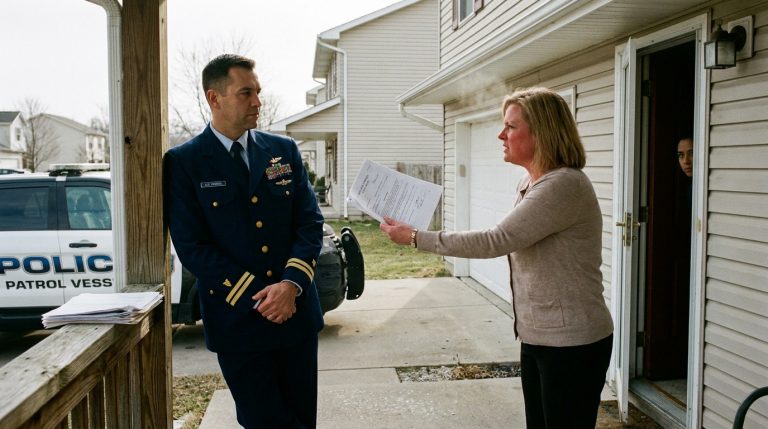
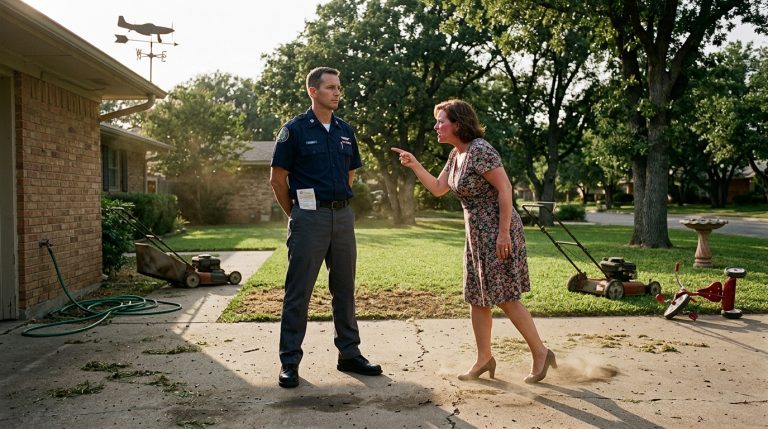
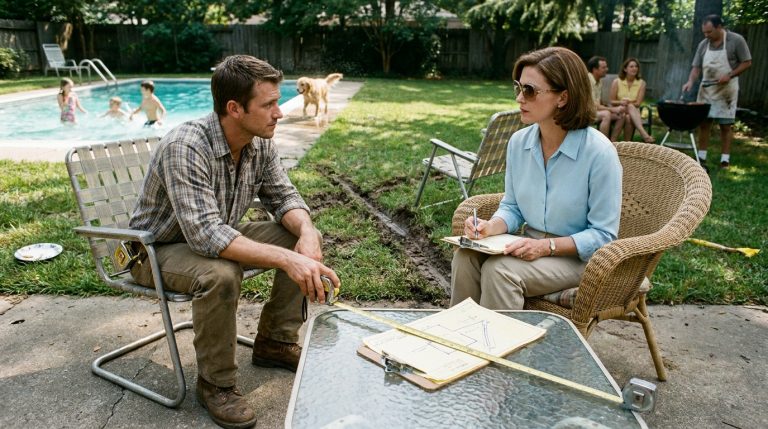
The late afternoon sun hit the manicured grass of Whispering Pines with an aggressive, antiseptic brightness. I didn’t blink. Behind my sunglasses, I watched Karen Miller stand on the property line, her floral mumu fluttering like a flag of suburban tyranny. She was crushing my county well-drilling application into a useless, wrinkled sheath.
“You will absolutely not be drilling a hole in this community, Mr. Thorne,” she announced, her voice a brassy horn of indignation that carried across the cul-de-sac.
I kept my hands at my sides. I didn’t reach for the paper; I didn’t raise my voice. I focused on the way the wind caught the hem of her sleeve—a minor movement that told me she was nervous, regardless of the volume of her projection. She expected a brawl. She expected the new guy to flush with anger, to plead for common sense, to hand her the social capital she needed to cast me as an aggressor.
“This is Whispering Pines Estates,” she continued, fanning out a stack of pastel-colored violation notices with her free hand. “We have standards. Your personal well is a direct threat to the aesthetic and geological stability of this neighborhood.”
I inhaled slowly, letting the smell of cut grass and ozone fill my lungs. My name is Marcus Thorne. I had spent twenty years finding water in the dust of war-torn provinces, negotiating with men who carried rifles instead of HOA handbooks. The irony of being lectured on “geological stability” by a woman in orthopedic sandals was sharp enough to cut, but I felt only a cold, mechanical clarity.
“Approval is denied,” she added, her eyes narrowing behind her oversized sunglasses. “And you have until Friday to rectify the unapproved perennials in your front bed, the garden hose placement, and the height of your mailbox. Escalation begins on Monday.”
She was reaching for the horizon now, trying to box me in before I had even opened the gate.
“Thank you for your preliminary assessment, Karen,” I said, my voice dropping into the low, even register I used to calm panicked engineers. “I’ll expect your formal written denial citing the specific covenant article that prohibits well drilling within the ten business days stipulated by the bylaws. Please send it via certified mail.”
I didn’t wait for a rebuttal. I turned my back, the friction of my boots against the pavement the only sound in the sudden silence. As I walked toward my front door, I caught a glimpse of a neighbor peering from behind a clean window, their silhouette flickering like a ghost. I stepped inside, the latch clicking with a finality that signaled the shift from civilian life to something far more calculated. The battle wasn’t against the well permit. It was against the shadow she cast over the entire street.
I sat at my desk and pulled up the blank HOA Project folder. I reached for my pen, but before I could type a single word, my eyes caught a small, out-of-place detail on the desk surface—a stray leaf from a species of tree that didn’t grow in our yard, tracked in from the hallway.
I frowned. I hadn’t been in the hall today.
CHAPTER 2: The Intrusion
The leaf wasn’t supposed to be there. I stood motionless in the center of my study, the late afternoon sun filtering through the blinds in thin, dusty bars that sliced across my desk. The leaf was small, jagged, and unmistakably distinct: the serrated edge of a honey locust. I didn’t have a honey locust tree. My neighbors didn’t have one.
I picked it up between my thumb and forefinger. It was dry, brittle, the veins etched like a map of a place I’d rather not revisit. The sight of it triggered a phantom sensation—the grit of desert sand in my teeth, the smell of scorched hydraulic fluid, and the sound of a command base tent flapping in a violent, hot wind. It was the memory of a survey mission in the Helmand Province that had gone south because someone had moved a stake, just a few inches, to alter the geological assessment. Small discrepancies, I had learned the hard way, were rarely accidents. They were signatures.
I didn’t turn around, but my posture stiffened. The house felt too quiet. I had been inside for less than five minutes, and the front door was locked. My window locks were magnetic sensors I’d installed myself. Yet, someone had been in my hallway, or at the very least, had been close enough to the house for a stray leaf to ride in on their clothing.
I set the leaf on the blotter and scanned the room. My files were undisturbed. My computer monitor was in sleep mode. But the air in the room felt heavy, displaced. I moved to the hallway, my steps silent on the hardwood. I was a hydrogeologist, trained to read the land, but that meant I was also trained to read people. When you strip away the layers of pretense, everyone leaves a trail. Karen Miller was a predator who operated in the daylight, but this—a silent intrusion, a subtle psychological marker—felt like a different caliber of threat.
I reached the hallway and looked at the floorboards. There, barely visible under the low light, was a microscopic dusting of red clay. It wasn’t the topsoil of Whispering Pines, which was a dark, rich loam. This was the dense, orange-tinged clay of the undeveloped county land on the western border. The land where the aquifer was most accessible.
My heartbeat remained steady, a rhythm of controlled precision. If Karen had sent someone into my home, she wasn’t just playing local politics anymore. She was playing hardball, and she was doing it with a lack of sophistication that was dangerous. Desperation is the mother of error.
I walked to the kitchen and poured a glass of water, watching the clarity of the flow. I needed to know the community’s social terrain, to understand how deeply she had her talons sunk into the people living around me. If she was watching my house, she was likely watching theirs, too. I needed a mirror.
I pulled my phone from my pocket and checked my notes. The Garcias, the elderly couple two doors down, were the most vulnerable. They had been targets before; they would be targets again.
I stepped out the back door, moving toward the shadow of the fence line. The sun was dipping below the horizon, casting long, sharp silhouettes that stretched across the lawns like reaching fingers. I saw Mr. Garcia in his yard, bent over a row of struggling hydrangeas. He looked exhausted, his shoulders slumped under the weight of an invisible burden. He didn’t see me until I was at the fence.
“Mr. Garcia,” I said, keeping my voice low, pitched only for him.
He jumped, his hand fluttering to his chest. When he recognized me, his eyes darted toward the street, a reflex born of two years of psychological attrition. “Marcus,” he whispered, glancing at the window of the house across the way—Karen’s house. “You shouldn’t be here. She’s… she’s watching.”
“Let her watch,” I said, my gaze locking onto his. I didn’t offer a platitude. I offered the only currency that mattered in a war of attrition: information. “I’m not here to talk about the well, Mr. Garcia. I’m here because someone was in my home today. And I think they’ve been in yours, too.”
His face paled, the lines around his mouth deepening into canyons. He didn’t ask how I knew. He just looked down at his garden shears. “She leaves notes,” he murmured, his voice barely audible. “Inside the mailbox. Sometimes, she puts them in the morning paper. She knows our routine, Marcus. She knows when the doctor’s appointments are. She knows exactly how much money we have in our savings.”
He looked up at me, his eyes brimming with a tired, silent pleading. “She doesn’t just want the community to look a certain way. She wants us to know that she knows everything.”
I felt the cold fire in my chest burn brighter. The isolation of the vulnerable—that was her control mechanism. By making them feel watched, she made them feel powerless.
“Do you still have the notes?” I asked.
He hesitated, then nodded. “In the folder. The one with the lawyer’s bills.”
“Keep them,” I instructed, my voice firm. “Don’t hide them. Keep them in a place where you can find them instantly. And if she approaches you, if she tries to threaten, you don’t argue. You just record. Do you have a smartphone?”
“Elena does,” he said.
“Good. Tell her to keep it charged. And tell her to start documenting every interaction, every time she sees Karen near your property line, every time a new ‘violation’ appears. Don’t fight her. Just observe. She’s counting on you to break. We’re going to make sure that doesn’t happen.”
As I walked back to my house, the neighborhood felt different. The manicured lawns, the clean windows, the quiet cul-de-sacs—it was all a mask. Behind the pristine surfaces, there was a web of fear, and I was beginning to see the individual strands. My house stood at the end of the street, dark and silent, but as I approached, I noticed a detail I had missed before.
The light on my front porch, which I distinctly remembered turning off, was glowing with a faint, steady hum.
Someone had been here. They hadn’t just left a leaf. They had sent a message. I reached for the handle, my grip firm, and stepped into the dark.
CHAPTER 3: The Intelligence Phase
The porch light was a simple fixture, a decorative glass orb that should have been dark. Instead, it hummed, the filament glowing with an unnatural intensity that made the surrounding shadows look like oil stains against the siding. I didn’t reach for the switch. I didn’t reach for a weapon. I stood in the threshold of my hallway and looked, really looked, at the doorframe.
A tiny scuff mark, no larger than a coin, marred the paint near the latch. It was fresh. The door hadn’t been picked; it had been tested. A physical probe, conducted by someone who wanted to see if I was the type to leave the house unlocked when I went to talk to the neighbors.
My house was no longer a sanctuary; it was a contested territory. I closed the door, locked the deadbolt, and engaged the secondary chain. The clicks sounded like gunshots in the sudden silence of the house. I moved into the study and sat at the desk, the glow of the dual monitors casting a sterile blue light over my work. I wasn’t going to sleep. Karen Miller had made the first move on my private ground, and that shifted the rules of engagement.
I opened the folder titled HOA Project and pulled up the subfolder for the county plat maps. I needed to see what she saw. I overlaid the survey data of the common areas with the municipal water utility lines, tracing the red ink of the grid. There, on the southern edge of the development, the municipal lines dipped. It was a standard architectural layout, but something about the proximity of the main line to Karen’s property caught my attention.
I brought up the tax assessment records, the ones I had pulled earlier that afternoon. The numbers didn’t align. The HOA paid a premium for common-area maintenance, but the acreage they claimed to be servicing—the land that required constant “Suburban Solutions” oversight—included a massive, undeveloped buffer zone that, according to the original county plat, was not part of the common land at all. It was county-owned, rugged terrain.
I leaned back, the leather of my chair creaking. Karen wasn’t just skimming from the landscaping budget. She was billing the HOA for work done on land they didn’t even own, and then using the “maintenance” of that land as a pretext to funnel money into the phantom company run by her brother-in-law. It was an embezzlement scheme masquerading as aesthetic preservation.
I began to map the flow. I cross-referenced the invoices from Green Pastures Landscaping with the satellite imagery of the property. Every time a major invoice was cleared, a new upgrade appeared on Karen’s personal estate. The timeline was a perfect, rhythmic pulse of theft. But to prove it, I needed a witness—someone who had seen the trucks, someone who knew that the “common area” work was a fiction.
I stood up and paced the room. My military training had taught me that in any insurgent environment, the civilians are the key. I needed to find someone who had been employed by the HOA, someone who had seen the ledger or the work crews. I turned my attention to the list of service contractors I had downloaded from the county records.
Most were legitimate, high-volume companies. But one, Advanced Drainage Solutions, had appeared in the minutes only twice in the last three years, both times for large, unexplained expenses. I pulled up their registration. The address was a suburban garage three towns over.
I checked the clock: 3:12 AM. The world outside was dead silent, the kind of silence that happens before a major storm. I sat back down and opened a browser window, beginning a deep-dive search into the owner of Advanced Drainage Solutions. Within twenty minutes, I had a name: Marcus Vane. I ran a quick background check through a public records aggregator. Vane was a former HOA board member who had resigned abruptly four years ago—right around the time Karen Miller had taken the presidency.
I stared at the name. A resignation. A pattern of unexplained payments. A board president with a controlling grip. I felt the pieces of the puzzle beginning to lock into place with a satisfying, metallic click. The “standards” she enforced were not just about aesthetics; they were about keeping the neighborhood under a microscope so that no one would notice the discrepancy in the drainage reports.
I heard a sound then—a soft, rhythmic tap against the exterior siding of the house. It wasn’t the wind. It was the deliberate, measured sound of a finger against the wall.
I turned off the monitors, plunging the room into darkness. I didn’t move. I waited, my breath slowing, my ears tuned to the frequency of the house. The tapping stopped. A moment later, a beam of light—the sharp, narrow cone of a high-powered flashlight—swept across the window, lingering for a second on the blinds before moving on.
They were still watching.
I didn’t react. I reached into my desk drawer and pulled out a small, portable digital recorder. I wasn’t just going to document the embezzlement; I was going to capture the intimidation. If she wanted to play a game of shadows, I would give her a show.
I moved to the back window and watched the flashlight beam disappear toward the cul-de-sac. It was Karen’s house. I could see the reflection of a light turning off in her upstairs window. The trap was widening, and for the first time, I felt the sharp, exhilarating edge of a fight I knew I could win. I had the facts, I had the timeline, and now, I had the confirmation of her desperation.
I sat in the dark for a long time, watching the street, my mind already drafting the next phase of the operation. Tomorrow, I would visit the county clerk’s office. Tomorrow, I would find Marcus Vane. And tomorrow, I would start making the foundation of Karen Miller’s sovereign nation shake.
CHAPTER 4: The Midpoint Trap
I didn’t sleep. I spent the remainder of the night in the blue, flickering hum of the study, the digital recorder sitting on my desk like a live grenade. The flashlight beam had been a sloppy, amateurish move—a signature of someone who was arrogant enough to believe I wouldn’t notice, or perhaps someone who wanted me to know I was being watched. Either way, the message was received.
At 6:00 AM, the neighborhood began to wake. The sound of a trash truck hydraulics grinding down the street signaled the start of the suburban day. I watched through the blinds as Karen Miller stepped onto her porch, dressed in a crisp jogging suit, her movements exaggerated and deliberate. She checked the street, her gaze lingering on my house for a heartbeat too long, before she set off for her morning walk.
She didn’t know I was watching her. She didn’t know that my house, once a passive dwelling, had become a sensor array.
I left the study and moved to the kitchen, making coffee with the same methodical precision I used to calibrate seismic equipment. I didn’t drink it. I poured it into a thermos and stepped into the hallway. I checked the lock again. I had installed a thin, tension-sensitive wire across the inner frame—a simple, low-tech way to ensure that if anyone opened the door while I was gone, I would know.
My plan for the day was twofold: The county records office and a cold visit to the garage where Advanced Drainage Solutions was supposedly operated. I pulled out of the driveway, the tires crunching on the gravel, and noted a dark sedan parked two houses down. It hadn’t been there the night before. I didn’t acknowledge it; I didn’t speed up. I simply drove with the practiced anonymity of a man who had spent years operating in high-threat environments.
The county clerk’s office was a labyrinth of beige walls and buzzing fluorescent lights. I bypassed the public terminals and headed straight for the restricted records wing. I had a legitimate inquiry—a dispute regarding HOA jurisdiction over county-owned buffer zones. The clerk, a weary woman with glasses on a chain, processed my request with the listless indifference of someone who had seen a thousand petty property battles.
“You’re looking for the original plat surveys from thirty years ago?” she asked, her fingers dancing over the keyboard. “Those are in the deep-storage archives. It’ll take a while.”
“I have time,” I said.
While she worked, I pulled up the HOA’s most recent financial filings on my phone, specifically searching for the signature block on the last four years of tax returns. Every single one was signed by Karen Miller. That was expected. But I scrolled further, to the attached addendums, and found the supplemental service agreements. The signature on the Suburban Solutions contract wasn’t just Karen’s—it was countersigned by a man named Gary Jenkins.
Gary. The timid-looking man from the board.
I sat back, the realization hitting me with the force of a physical blow. The board wasn’t just Karen’s puppet; it was a collaborative enterprise. The embezzlement was a shared liability. I took a photo of the document, the screen glare reflecting in my eyes. I was moving closer to the core, but the surface tension of the mystery was beginning to pull taut.
I left the clerk’s office with a thick envelope of maps and headed toward the address for Advanced Drainage Solutions. The garage was in a dilapidated industrial park, a place of rust, grease, and forgotten ambitions. I pulled into the lot, the sedan from the neighborhood nowhere to be seen.
The garage door was halfway up. A man was hunched over a heavy-duty hydraulic press, his back to me. He was thick-shouldered, wearing a stained shop apron that had seen better decades. I approached slowly, my boots on the concrete floor making just enough sound to signal my presence without sounding like an attack.
“Mr. Vane?” I asked.
The man stiffened. He didn’t turn around immediately. He finished the cycle of the press, the metal groaning as it yielded, before he slowly stood and turned to face me. He had the face of a man who had spent his life being pushed around—small, nervous eyes, a receding hairline, and a constant, twitching apprehension.
“Who’s asking?” his voice was raspy, unused to conversation.
“My name is Marcus Thorne. I live in Whispering Pines.”
The mention of the neighborhood worked like an electric shock. His face went pale, his hands gripping the edge of the workbench. “I don’t do work for that place anymore,” he said, moving to pull the garage door down. “You have the wrong place.”
“I’m not here for drainage work, Marcus,” I said, my voice steady, projecting the calm authority of a man who had nothing to lose and everything to prove. I stepped into the garage, blocking his path to the cord. “I’m here because I know about the invoices. I know about the payments from the HOA that didn’t go to drainage. I know about the money that disappeared.”
He stopped, his eyes darting to the phone in my hand, then to the door. He was terrified—not of me, but of what would happen if he spoke.
“If you know about the money,” he whispered, his voice trembling, “then you know you’re walking into a fire. She doesn’t just want the money, Thorne. She wants the control. And she’s not alone.”
“Tell me,” I demanded, closing the distance between us. “Who is she working with?”
He looked at me, a genuine, raw fear breaking through the surface of his anxiety. He reached for a heavy metal cabinet, opened it, and pulled out a manila folder, tossing it onto the workbench.
“They aren’t just taking the money,” he said, his voice cracking. “They’re using the records—the files on everyone in the neighborhood. They’re blackmailing the owners who have the most to lose. They’re not just an HOA, Thorne. They’re a data-mining operation. They’re selling the residents’ personal histories to the highest bidder.”
The information was so grotesque, so far beyond petty embezzlement, that I felt a moment of absolute stillness. The “standards” were a front for a massive, organized violation of privacy.
“Look at the file,” he urged. “It’s all there.”
I opened the folder, but as I did, my phone chimed. A notification from my home security system. A motion alert.
Motion detected: Front porch.
The camera feed, pushed instantly to my screen, showed Karen Miller standing at my front door, a heavy, official-looking document in her hand. She was staring directly into the lens, a slow, predatory smile spreading across her face. She knew exactly where I was. And she knew exactly what I was finding.
The game had shifted from a skirmish to an all-out war. I closed the folder, grabbed the files, and looked at Vane. He was shaking, his eyes wide.
“She’s already destroyed the original records,” he warned. “If you don’t have those, you have nothing.”
I turned and walked out of the garage, the weight of the file in my hand feeling like an anchor. My home was being breached, and I had the proof. But as I pulled out of the lot, I realized I hadn’t been followed. She wasn’t chasing me. She was leading me home.
CHAPTER 5: The Alignment
I eased the car into my driveway, keeping my movements deliberate. My hands were steady on the wheel, but my pulse was a rhythmic drum against my ribs. Karen Miller was standing near my front door, her posture perfectly vertical, a stark silhouette against the neutral siding of my home. She wasn’t pacing. She was waiting with the cold, unyielding patience of a statue.
I parked the car, the engine clicking as it cooled in the humid afternoon air. I didn’t get out immediately. I checked the rear-view mirror—the street was empty, a tableau of suburban perfection that felt increasingly like a stage set. I slid the manila folder containing the proof of the embezzlement and the hints of the blackmail operation under the passenger seat, tucking it deep into the mechanical recess of the frame.
I opened the door and stepped out. The air smelled of freshly mowed grass and the faint, underlying metallic tang of the well-drilling site. Karen didn’t look at me until I was ten feet away. She was holding a thick document, its edges reinforced with heavy-duty staples, the word “NOTICE” stamped in bold, uncompromising red ink.
“You’re late, Marcus,” she said, her voice devoid of its usual performative charm. It was flat, transactional.
“I had errands,” I replied, closing the car door with a dull thud. I walked toward the porch, maintaining a pace that was neither aggressive nor submissive—the steady, measured stride of a man on his own ground. “You’re trespassing, Karen.”
She ignored the comment, holding out the document. “This is a formal cease-and-desist regarding the ongoing unauthorized modifications to your property. The board has reviewed your file. We find it entirely non-compliant with the community’s safety standards.”
I didn’t take the paper. I stood on the bottom step, looking down at her, forcing her to tilt her head back. It was a small physical advantage, but it mattered. “The board hasn’t met, Karen. We both know that. And there is no ‘non-compliance’ clause for a project that has already been approved by the county.”
A flicker of genuine irritation crossed her face, a hairline fracture in her mask. “The county doesn’t understand the complexities of Whispering Pines. We are a sovereign entity when it comes to our internal covenants.”
“Is that right?” I asked, my voice low. “Because I just came from the county records office. I also stopped by a garage in the industrial park three towns over. I think your ‘sovereign entity’ is starting to look a lot like a criminal enterprise.”
The effect was instantaneous. Her pupils dilated, and for a split second, she looked like she might lose her footing. She retreated a half-step, her heel catching on the edge of the porch. It was the first time I had ever seen her look anything other than completely in control.
“You don’t know what you’re dealing with,” she said, her voice dropping to a harsh whisper. “You think this is about a well? You think this is about paint colors or mailbox heights? You’re a bug on a windshield, Marcus. You see the collision, but you have no idea who’s driving the car.”
“Then show me,” I countered, stepping closer, closing the distance until I was well within her personal space. “Show me who’s driving. Because right now, all I see is a woman who’s been stealing from her neighbors to pay for her patio, and who’s terrified that the people she’s been blackmailing are finally going to realize they have the power to ruin her.”
She gripped the document so hard her knuckles turned white. “They’ll never believe you. To them, you’re the erratic, obsessive new guy who’s obsessed with drilling holes in the earth. I’ve already set the narrative.”
“Narratives change,” I said, turning my back on her to reach for my house key. “Especially when they’re proven to be lies. I have the documents, Karen. I have the signatures. I even have the audio.”
I unlocked the door and stepped inside, leaving her standing on the porch. I didn’t lock it behind me—not yet. I wanted to see if she would follow. I walked into the hallway, my eyes tracking the tension in the room. A breeze had picked up, blowing the curtains in the study, and I noticed the wire I had set on the doorframe was snapped.
She hadn’t just been waiting. She had been inside.
My home had been compromised, and the file I had tucked under my car seat was now the only leverage I had left. I didn’t panic. Panic was a waste of cognitive load. I moved to the window and watched her through the gap in the blinds. She wasn’t leaving. She was pulling out her phone, her thumb moving rapidly across the screen.
She was calling the board. Or maybe she was calling someone else.
I walked to the kitchen and grabbed my phone, opening the group chat I had established with the Garcias and the Wilsons. I typed a single line: The board is mobilizing. Be ready.
The house felt like a pressurized cabin, the air thick with the realization that the midpoint of this fight had passed. The decoy—the embezzlement—had been exposed, but the true depth of the operation, the blackmail, was still a hidden, jagged thing lurking in the dark. I needed to bring the rest of the neighborhood into the light, and I needed to do it before Karen could initiate her next move.
I heard the sound of a vehicle pulling into the driveway—a heavy, utilitarian truck with a familiar logo on the side: Advanced Drainage Solutions. But it wasn’t the man I had met in the garage. Two men in uniform were climbing out, carrying heavy-duty equipment.
The pressure was mounting. She wasn’t just stalling anymore; she was escalating to direct physical confrontation. I stepped onto the back porch, my eyes tracking the neighbors’ windows. The GarcAs were watching. The Wilsons were watching. The neighborhood was starting to stir, and I knew that this time, when the conflict peaked, it wouldn’t be settled by a document. It would be settled by the collective realization of the truth.
CHAPTER 6: The Clubhouse
The truck idled in my driveway, the heavy diesel engine vibrating through the soles of my shoes. The two men stood by the open side panel, their movements practiced, their faces obscured by the brims of their caps. They didn’t look like contractors. They looked like enforcers who had been handed a work order they didn’t care to read.
“You’re on private property,” I said, my voice cutting through the mechanical drone. I didn’t move from the porch. I watched them, my hands loosely at my sides, tracking their hands for any tell of equipment or intent.
“We got a permit,” the taller one said, his eyes scanning the property with a cold, detached efficiency. “HOA order. We’re here to inspect the drainage impact of your well-drilling site. Move or we go around.”
He started to reach for a heavy, steel-toed boot, moving toward the side of my house. I didn’t shout. I didn’t move. I pulled my phone from my pocket and dialed a number—not 911, but the sheriff’s deputy I had met at the county records office only hours prior. I hit speakerphone, the dial tone sounding thin against the growl of the truck.
“Deputy Miller,” the voice crackled through.
“Deputy, this is Marcus Thorne. I have two individuals currently attempting to force entry onto my property under the guise of an HOA inspection order. I’m requesting an immediate patrol presence to resolve a potential trespass.”
The tall man stopped, his hand hovering over the latch of his tool kit. He looked at his partner, then at the house, and finally at me. The air in the driveway was suddenly brittle, the kind of stillness that precedes a snapping wire.
“It’s just an inspection, Thorne,” he said, his tone losing some of its bluster. “Don’t make this a scene.”
“The scene is already happening,” I replied. “And you’re the ones writing the script. I suggest you step back to your vehicle.”
They hesitated, the tension in the driveway thick enough to taste. Then, the sound of Karen’s voice drifted from the street—a sharp, shrill command. “Leave it! We don’t have time for this.”
She was still watching from the edge of my lawn, her phone pressed to her ear. She was coordinating something—a retreat, a pivot, or perhaps a different approach. The men climbed back into the cab, the truck reversing with a aggressive, grinding gear-shift that rattled the porch railings.
I didn’t let my guard down. I watched them pull away, but I knew this was just a tactical repositioning. I turned and walked into the house, my mind already working on the next requirement of the roadmap: the special meeting. If they were escalating to direct intimidation, they were running out of time.
I went to my study and opened the folder from Vane’s garage. I spent the next four hours cross-referencing every name, every date, and every dollar amount. The scope of it was staggering. It wasn’t just embezzlement; it was a total social and financial colonization of the residents. They were systematically tagging homeowners who had debt, medical issues, or family conflicts, and then creating “violations” that forced them into the orbit of Suburban Solutions.
At 7:00 PM, I headed to the clubhouse. The room was already filling up. The GarcAs were there, sitting in the front row, Elena clutching her folder like a shield. The Wilsons arrived a moment later, their son Leo in his chair, his expression stoic, almost defiant.
The room was a pressure cooker. As I walked to the front, the low murmur of conversation died instantly. Karen sat at the long table, flanked by Gary and Brenda. She looked tired—the foundation of her control was cracking—but her eyes remained sharp, fixed on me with a hatred that felt ancient.
She stood up, the gavel in her hand not even bothering with the ritual of the opening. “This meeting is out of order,” she announced, her voice strained. “There is no quorum for a special session.”
“Check the bylaws, Karen,” a voice called out from the back. It was the neighbor I hadn’t met, the one who had cited the article from memory. “We have the signatures. We have the quorum.”
I walked to the front of the room, my heart a calm, steady rhythm. I didn’t look at Karen. I looked at the room, at the faces of people who had been lied to, stolen from, and manipulated. I pulled the manila folder from Vane’s garage and laid it on the table.
“I’m not here to talk about a well anymore,” I said, my voice clear and projecting to the very back of the room. “I’m here to talk about what’s been happening in the dark. I’m here to talk about where your money went.”
The room was dead silent. I could hear the hum of the fluorescent lights, the ticking of the clock on the wall, the sound of my own breathing. I reached for the projector remote, my thumb hovering over the button.
“This isn’t an HOA,” I said, catching Karen’s gaze, watching her go still, a statue of pure, unadulterated fear. “This is a business. And you’ve all been paying the overhead.”
I pressed the button. The screen glowed white, then filled with the stark, damning numbers of the embezzlement trail. The silence that followed was broken only by the sound of Karen’s chair scraping against the floor as she tried to stand, her face a mask of disbelief and impending ruin. The final act had begun, and the truth was finally starting to breathe.
CHAPTER 7: The Collapse
The projected figures hung in the air, a luminous grid of theft that seemed to mock the very walls of the clubhouse. I held the remote, my thumb steady, as the last of the room’s collective shock bled away into a sharpening, visceral rage. The room was not just quiet; it was cold—a vacuum created by the sudden withdrawal of support for the woman at the head of the table.
Karen Miller hadn’t moved. She was staring at the screen, her features locked in a rictus of disbelief. The gavel, which she had wielded like a scepter only moments before, lay on the table, its wood dull and unremarkable under the harsh lights. Gary, the board member who had blindly countersigned the fraudulent contracts, had retreated so far into his chair that he seemed to be trying to merge with the upholstery. Brenda, the third leg of the board’s tripod, was pale, her hands trembling as she flipped through a stack of papers, clearly looking for a lie that wasn’t there.
“You’ve been paying for her patio, her water feature, and her retirement,” I said, my voice cutting through the silence like a whetted blade. “Every time you were fined for a ‘standard violation,’ you weren’t just paying for the upkeep of Whispering Pines. You were paying for the privilege of being ignored while she funneled your equity into her own personal estate.”
A man in the back stood up. It was the neighbor with the satellite dish, the one Karen had targeted months ago. “I want to know about the blackmail,” he said, his voice raw. “You told me if I didn’t remove the dish, you’d report my mortgage arrears to the bank. How did you know about that, Karen?”
The question hung in the air, a lit fuse. One by one, others stood. A woman who had been bullied into silence about a tree-trimming dispute; a man who had been threatened with legal action over a paint color that hadn’t even been outside the approved palette. The room was no longer a meeting; it was a gathering of ghosts coming back to demand account.
Karen finally turned, her eyes darting toward the exits. She was trapped. There was no bylaw to hide behind, no architectural code to weaponize, no neighbor she could pit against another. She was surrounded by the very people she had spent years isolating.
“I did what was necessary,” she hissed, the mask finally slipping. “You people have no idea how a community stays valuable. It takes structure! It takes discipline! You should be thanking me.”
The absurdity of the claim was met with a low, collective growl.
“I make a motion for a vote of no confidence,” the woman from the front row repeated, her voice steady and implacable.
“Seconded,” Tim Wilson added, his hand raised high.
The paper ballots appeared as if by magic—scraps of torn notebook paper, envelopes, napkins. People were writing their fury, their betrayal, their rejection of the last five years of tyranny. I stood to the side, my role as the architect of this dismantling largely complete. I watched as the pitcher was filled, the sound of the paper falling into it like the counting of heartbeats.
When the result was read—a 28-to-2 landslide—the release was deafening. It wasn’t cheers, but a long, ragged exhale of a neighborhood that had been holding its breath for far too long.
Karen didn’t look at the results. She looked at me. Her expression wasn’t one of remorse; it was a cold, hollowed-out hatred that promised that this wasn’t the end. She reached for her bag, her movements jerky and frantic. She knocked the water bottle off the table, the plastic rolling across the floor, its cap spinning in a rhythmic, irritating circle.
“This isn’t over,” she spat, her voice cracking as she shoved past the chairs. “You think you’ve won? You’ve destroyed the only thing that kept this place from falling apart. You’ll see. When the bills come due and the landscaping goes to rot, you’ll be the first ones crawling back to me.”
She stormed out, the door slamming with a finality that shook the frames on the wall. No one followed. No one moved to stop her. She was already gone; the force of her personality, the gravity she had imposed on the neighborhood, had vanished the moment the vote was cast.
Mr. Garcia stepped up to the front, his small, frail frame suddenly seeming to fill the space Karen had left behind. “The interim board is in place,” he said, his voice quiet but resonant. “We have a lot of work to do. But tonight, we start by reclaiming our own house.”
He looked at me, a silent, profound nod of recognition. I left the clubhouse, walking out into the cool, sharp air of the evening. The sky was a deep, bruised purple, the stars beginning to prick through the haze. My car was in the lot, the manila folder still tucked under the seat, a collection of papers that had successfully brought down a sovereign nation built on lies.
I didn’t feel triumph. I felt an exhaustion that settled deep into my bones, the kind of fatigue that only comes after the structure of a long-held secret is finally broken. I looked at the neighborhood, the lights in the houses beginning to shine one by one, a constellation of individual lives that were no longer being watched by a single, malicious eye. The fight was almost over. All that remained was the final, inevitable reckoning.
CHAPTER 8: The Resurgence
The morning air was crisp, biting into the skin like a warning. I stood at the edge of my property, the mud of the previous night’s rain still clinging to my boots. The drilling rig, a towering steel beast of hydraulics and iron, dominated the cul-de-sac. It was a violent, industrial intrusion into the carefully curated “aesthetic harmony” of Whispering Pines, but to me, it was the sound of reality returning to the earth.
I didn’t have to wait long. Karen Miller’s car pulled into the driveway adjacent to mine. It wasn’t the triumphant entry of an HOA president; it was the desperate, frantic arrival of a woman who had run out of ground. She didn’t bother with her usual poise. She climbed out of the driver’s seat, her hair disheveled, her suit jacket wrinkled. She was carrying a legal folder, but it was just paper—a useless armor against the reality that the county sheriff’s deputies were already waiting for her.
She saw me standing near the rig. She didn’t look at the drilling crew, nor at the neighbors who had gathered on their porches, watching the final act of a long, cold winter. She walked straight toward me, her eyes locked on my face with a terrifying, hollow intensity.
“You think this is over,” she said, her voice a serrated whisper. “You think you’ve uncovered some grand conspiracy, but you’ve only broken the lock on a door that was keeping everyone safe.”
“You weren’t keeping them safe, Karen,” I replied, my voice calm, the resonance of the drilling rig providing a low, rhythmic bass to my words. “You were harvesting them. The financial records were just the decoy. The blackmail—the medical files, the mortgage data, the history of every family in this street—that was the operation. You were selling their lives to the highest bidder.”
She stumbled back, a genuine shock registering on her face. She hadn’t realized how much Vane had given me. She hadn’t realized that the “data-mining operation” was no longer a secret.
“I did what I had to do to survive,” she muttered, the justification pathetic in the light of day. “The neighborhood needed guidance. They needed someone to hold the lines.”
“They needed a neighbor,” I said, stepping aside as the deputies moved in from the street.
The arrest was professional, clinical, and mercifully quiet. As they cuffed her, she didn’t fight. She went limp, a sudden, complete collapse of the persona she had inhabited for years. She was just a woman in a wrinkled suit, being led away from the only thing that had ever mattered to her: the appearance of control.
I watched the cruiser pull away. Then, I turned back to the rig. The lead driller, Gunny, looked at me and nodded. I gave him the signal. The drill bit began to rotate, a high-pitched, metallic whine that grew into a powerful, rhythmic thrumming. The shaft bit into the earth, cutting through the layers of clay and stone that had been used as a barrier for so long.
The cooling-down of the atmosphere was immediate. The neighborhood felt lighter, the air less brittle. I walked to the edge of the pit, where the water was beginning to well up—a dark, cool reflection of the sky.
I had promised myself I would fix the damage. I walked over to the Wilson’s front door, where the ramp was being reinforced by a new, professional crew. I looked at the wood, the quality of the craftsmanship, the way it served a real, tangible need. I picked up a stray piece of lumber, a splintered edge, and sanded it down with a piece of sandpaper I’d kept in my pocket. A small, physical repair to a much larger, structural wound.
Tim Wilson came out, his son Leo behind him in his chair. They didn’t say a word. They just looked at the well, then at the house, then at me. We shared a nod—a silent acknowledgement of the cost of the fight and the value of the peace that had followed.
The well was finished by noon. I walked to the pump, turned the valve, and watched the water arc into the garden. It was clean. It was pure. I leaned against the house, the wood warm under the midday sun. The “No-Time-Skip” war was over. The records had been turned over to the Attorney General, the financial trail was locked, and the blackmail operation was being systematically dismantled by the authorities.
I thought back to the leaf I had found on my desk in the first week. The small, jagged thing that had felt like an intrusion. It seemed like a lifetime ago. I looked out over the street, at the neighbors reclaiming their yards, the children playing without fear of a “standard violation” notice. The neighborhood wasn’t perfect, and it would take years to fully recover from the rot that had been buried in its financial foundation. But it was breathing.
I sat on the porch, the water fountain humming in the background. I felt the deep, resonant stillness of a man who had completed his survey. The earth beneath me was stable, the water was running clear, and for the first time since I’d moved here, I felt at home.