The Weight of the Sky: A Calculus of Rust, Iron, and the Price of Quiet Sovereignty
CHAPTER 1: THE FRICTION OF PAPER
“That thing is an unregistered aeronautical obstruction, and I am giving you twenty-four hours to remove it before I tear it down myself.”
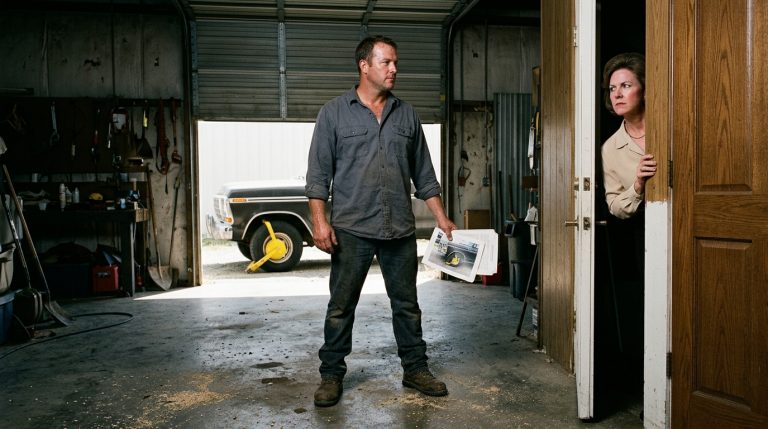
The words hit the humid afternoon air like a cracked exhaust pipe. Mark Miller didn’t flinch. He stood in the center of his driveway, the soles of his boots planted firmly against the hot, oil-stained concrete. The sun was a physical weight on his shoulders, baking the smell of dry earth and cut grass into his clothes.
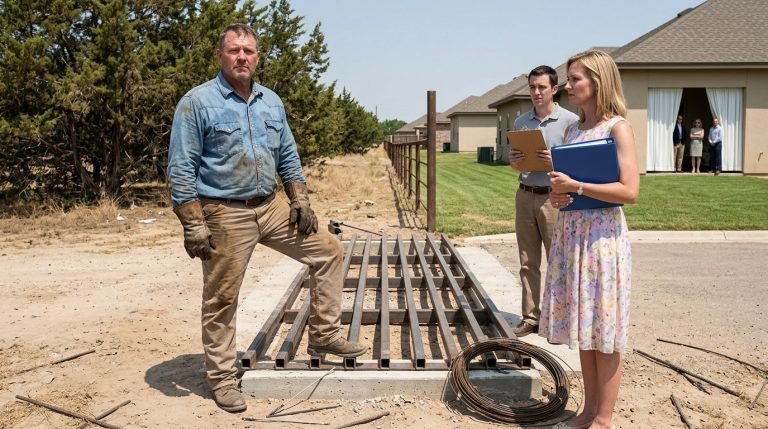
Karen stood three feet away. Her floral dress was stretched tight across her chest, her breathing heavy, erratic. She looked less like a neighbor and more like a rusted engine running permanently in the red. Her finger, heavy with a gold ring that dug into her swollen knuckle, stabbed the air toward the roof of Mark’s house.
Up there, the weather vane—a handcrafted steel P-51 Mustang his father had forged—caught the brutal glare of the sun. It spun lazily, a quiet scrape of metal on metal, doing exactly what it was built to do.
“Federal airspace,” Karen hissed, closing the distance. She held a clipboard like a shield. “A clear and present danger to every aircraft in this sky. Five thousand dollars, Mark. You are endangering the community, and you will pay for the privilege of your arrogance.”
She slapped the paper flat against his chest.
Mark didn’t reach for it immediately. He let the paper slide down his shirt, catching it just before it hit the driveway. The paper was crisp, thick stock. Expensive. He folded it slowly, his thumbs pressing hard along the crease. As an air traffic controller, his entire life was governed by the exactitude of procedure. He spent his days in a dark, climate-controlled tower, keeping aluminum tubes full of thousands of lives from turning into fireballs over the suburbs. He understood the mechanics of disaster. Disaster never started with a crash. It started with a miscalculation.
Karen had just made a catastrophic miscalculation.
“Karen,” Mark said. His voice was low, devoid of the erratic spike of her anger. He spoke with the tired, pragmatic tone of a man assessing a damaged load-bearing wall. “You have absolutely no idea what you’ve just done.”
“I am the President of this Association,” she barked, her neck flushing a mottled purple. “I know exactly what I am doing. You have until tomorrow.”
She turned on her heel, her sensible heels scraping hard against the concrete as she marched back toward her own immaculately edged lawn.
Mark watched her go. He slipped the folded violation into his back pocket, the edges stiff against his jeans. The confrontation should have been over. It was a standard, petty exchange of suburban hostilities. But as he watched her retreat, his eyes caught a discrepancy.
It wasn’t her posture, which was rigid and triumphant. It was her shoes.
Caked around the edges of her sensible heels, contrasting sharply with the bone-dry, manicured perfection of Oak Meadows, was a thick, wet layer of deep red clay. It was a specific, dense subsoil—the kind you only hit if you were digging deep into the earth. Deep enough to reach the bedrock. Deep enough to be hiding something massive.
Mark looked from the heavy red mud tracking across the asphalt, back to the paper in his hand, and finally toward the foundation of Karen’s house.
She wasn’t angry. Beneath the yelling, beneath the bloated authority, her hands had been shaking. She was terrified.
CHAPTER 2: THE AIRSPACE LOG
The heavy front door of Karen’s brick colonial clicked shut, the sound carrying crisp across the strip of asphalt separating their properties. Mark stood unmoving on his driveway. His thumb traced the sharp, triple-folded seam of the violation notice in his back pocket, but his gaze remained fixed down on the pavement where her heels had left their mark. The deep red clay didn’t belong in Oak Meadows. The topsoil here was standard, pale-gray suburban fill, engineered to hold sod and nothing deeper. That damp, iron-heavy crimson had come from a low-elevation excavation—the kind that required heavy machinery to break through the limestone shelf three miles east.
He turned toward his own porch, his boots crunching lightly against the dry grit of the driveway. Every step felt deliberate, a calculated absorption of kinetic energy. The sun was dipping lower, casting long, sharp shadows through the mature oak trees, casting the profile of the steel P-51 Mustang on his roof into a elongated silhouette across the lawn. He didn’t look back at her house. The rules of engagement had shifted; emotional reactivity was a structural flaw.
Mark climbed his porch steps, opened the heavy oak door, and stepped into the cool, quiet interior of his home. The house smelled faintly of old wood polish and the copper tang of the vintage tools lined up in the garage workshop. Sarah was in the kitchen, the distant clink of silverware against ceramic indicating she was setting the table for dinner. He didn’t interrupt her. He crossed the hardwood floor directly to his small home office near the rear of the house.
He sat at his desk, the dark walnut surface cool under his palms. From his desk drawer, he pulled a yellow legal pad and an old drafting pencil, the graphite thick and heavy. He laid the folded $5,000 fine flat, pinning it down with a rusted iron weight his father had used to balance scale models. Karen had signed the bottom with a flourish that threatened federal enforcement.
To the untrained eye, it was an HOA president overstepping her bounds. To a controller trained to read the subtext of an airspace conflict before the transponders even flashed, it was a tactical diversion.
He opened his laptop, logging into the secure portal for the Northwood Regional Airport administration. His fingers moved across the keys with the mechanical rhythm of a man who spent eight hours a day typing flight strips. He didn’t look at the HOA bylaws; he opened the regional topographic zoning charts from twenty years ago, long before the subdivision developers had laid the first pipe.
As the screen loaded, his eyes caught the digital watermark at the bottom of the public survey index: Archival Records under The Vanguard Deed.
He stopped. The name was a ghost from his early Air Force days—a property holding firm that specialized in purchasing peripheral military buffers before the bases downsized. He didn’t click it yet. He couldn’t afford to chase shadows when the immediate vector required documentation.
He pulled his phone from his pocket and dialed the direct line to the tower supervisor’s desk. The line rang twice before the gravelly voice of Frank Connelly cut through the static.
“Connelly.”
“Frank, it’s Miller,” Mark said, his voice dropping into the flat, unhurried cadence used when two aircraft are tightening their separation on final approach. “That civilian complaint we discussed on the lawn three days ago? It just went live. Five thousand dollar fine for endangerment of federal airspace.”
A dry, metallic cough came through the speaker. “She actually put it on paper?”
“She slapped it against my chest,” Mark said, his eyes scanning the topographic lines on his screen. “She’s alleging structural hazard, pilot blinding, and navigational interference. She used the magic words, Frank. She officially declared a civilian structure an active threat to commercial operations.”
“The idiot,” Frank grumbled, the sound of a heavy ceramic mug thudding onto a desk audible in the background. “She doesn’t know the sector boundaries. Our primary approach corridor passes miles clear of your chimney.”
“Exactly,” Mark said, his pencil tip hovering over the legal pad. “Which means when the complaint hits the regional office, it has to be logged under the standard safety protocol. I want the paper trail pristine. Every eye dotted, every mile logged. If she wants the FAA involved, we give her the full weight of the federal machine.”
“It’s a conflict of interest for you to sign the final clearance, Miller.”
“I’m not signing the clearance,” Mark replied, his voice hardening like cold iron. “I’m doing the preliminary field survey. Secondary duty, sector non-tower obstructions. I’m going to investigate her complaint with the exactitude of a crash reconstruction. Every test she forced by writing that letter is going to produce a federally stamped page.”
There was a long silence on the line, followed by the slow, rhythmic click of Frank’s pen. “She’s playing chess with a guy who owns the board, Mark. I’ll log the incoming file the second it routes from regional. Just keep it by the book.”
“There is no other way to do it,” Mark said.
He hung up, the phone clicking into its cradle. He reached down, picking up the folded violation notice once more. The paper felt different now—no longer an insult, but the first document in a case file that would grind an empire to dust.
CHAPTER 3: THE CERTIFIED DELIVERY
The phone settled back into its cradle with a dry, black-plastic snap. For three seconds, Mark remained motionless at the walnut desk, his palm resting flat against the cool surface of the housing, listening to the absolute stillness of his home office. Outside the high window, the twilight had bled out completely, replaced by a dense, rural darkness that always crept into the edges of the development after hours. He stood up, the joints of his knees popping slightly in the silence.
He didn’t waste movement. Reaching down to the lower drawer, he pulled out a stack of heavy, official FAA safety communication envelopes—thick, parchment-grade paper with a deep blue federal emblem pressed into the upper corner. From the printer tray, he retrieved the formal notification letters he had run off during his lunch break at the regional center. The typography was clean, set in standard government-issue typeface, completely devoid of emotion or preamble.
He slid the first copy—the demand for owner cooperation—into his own folder. The second document, addressed to Karen Peterson, went into the envelope. He sealed the flap with a firm drag of his thumb, the dry glue catching with a scratchy whistle.
Mark walked out of the office, down the short hallway, and out through the front door. The nocturnal air had shifted, losing the thick heat of the sun but retaining a dry, dusty friction that smelled of parched grass and distant gravel pits. He descended his concrete porch steps, keeping his gaze straight ahead. The streetlights in Oak Meadows were spaced exactly one hundred yards apart, leaving the middle of the road in a deep, gray shadow where the asphalt felt cold even through the thick rubber soles of his utility boots.
He crossed the property line without a sound. Karen’s house sat like a massive dark block against the pines, its white colonial trim turned a pale, chalky silver in the dark. No lights showed through the heavy draperies of the front windows, but as Mark reached the edge of her manicured turf, the faint, low hum of a mechanical pump vibrated through the sod under his feet. It was a rhythmic, straining pulse, coming from the deep recess behind her crawlspace access door. A drainage system running on a bone-dry night.
Mark stepped onto her aggregate walkway, the small stones rough and abrasive against his boot soles. He approached the dark timber of her front door. Beside the brass lockset sat an old-fashioned, heavy iron mail slot, its exterior flap discolored by green patina and pitted by years of salt-heavy air.
He reached into his pocket and withdrew the official envelope. As he extended his hand to lift the iron flap, his fingers brushed against the rim of the opening.
The metal didn’t just feel old; it felt loose. The heavy anchoring screws that held the frame against the solid oak door were backed out by a full quarter-inch, the raw wood underneath chewed and splintered as if the entire assembly had been subjected to an immense, distorting downward pull. A thin trail of fine, red clay dust—the exact same dense subsoil he had seen on her heels—was caught in the crevice between the iron frame and the shifting timber.
Mark paused, his thumb holding the flap open an inch. From the interior side of the door, a low draught of air leaked out. It didn’t smell like a standard, air-conditioned foyer. It carried a distinct, dank odor of wet silt, rusted iron, and the rotten-egg tang of stagnant sulfur water rising from an open deep-trench excavation.
He pushed the envelope through. The thick paper resisted for a fraction of a second against the internal brush seals before sliding free, dropping into the dark house with a sharp, hollow clink against the slate tile flooring inside.
Mark let the iron flap drop. The metal banged shut with a dull, heavy vibration that echoed briefly off the brick pillars of the porch. He didn’t wait. He stepped back off the aggregate path, his eyes sweeping down the foundation wall where the white mortar lines showed a series of hairline fractures, jagged and dark, stepping upward through the brickwork like frozen lightning.
He walked back across the dark street toward his own property, his hands slipped deep into his pockets, his mind already mapping out the dimensions of the structural inspection he would execute at nine hundred hours.
CHAPTER 4: THE 0900 AUDIT
The transition from the shadow of the brick porch to the blinding daylight of morning offered no relief from the dry, scraping dust of the street. Mark stood exactly at the border where Karen’s aggregate walkway met the driveway. The sun had returned with a vengeance, beating down on the crisp khaki of his trousers and radiating off the metal surface of the heavy surveyor’s clipboard in his hand. His watch face read precisely 09:00.
He lifted a gloved hand and pressed the door chime. The interior chime echoed—a short, tinny mechanical rattle that died instantly. Mark kept his posture balanced, his left hand holding the thick case folder marked FAA-N774-P51-MV tight against his ribs.
The heavy lock mechanism inside ground open, the internal latch catching with a dry, metallic screech that bespoke a total lack of lubrication. The oak door swung back exactly five inches. Karen stood in the gap, her face entirely devoid of the previous day’s theatrical righteousness. A tight line formed between her eyebrows, her eyes bloodshot, tracking the blue emblem on his navy polo shirt with a visible tremor.
“Miss Peterson,” Mark said, his tone flattened to the clean, transactional frequency of an official clearance. “Agent Miller. I am here to execute the formal field survey and interview log under case directive 7400.2P. As noted in the federal dispatch, we will require an indoor location to establish the baseline documentation before checking lines of sight.”
Karen did not speak immediately. Her fingers wrapped around the edge of the wood door, the knuckles white and dry, the skin around her gaudy gold ring appearing raw. She looked over his shoulder toward the empty street, then down at the official federal safety manual visible at the top of his clipboard.
“This is completely unnecessary,” she said, her voice dropping into a raspy, defensive register. “The board is reviewing the matter. The fine is internal.”
“The moment the safety division received an electronic allegation of navigational signal interference,” Mark replied, stepping forward with an unhurried but unyielding momentum that left no space for refusal, “the jurisdiction shifted to the regional field office. Federal code requires immediate physical verification of all reported hazards.”
She retreated two steps, allowing the door to swing wider. The change in the home’s atmosphere was instantaneous. The foyer smelled intensely of the same sulfurous, stagnant groundwater he had detected through the mail slot the night before, mixed with a heavy mask of industrial air freshener.
“The dining room,” she muttered, turning away without waiting to guide him.
Mark followed her into the formal room, his boots making a dull, leaden sound on the slate floor tiles. The massive mahogany table in the center was polished to a mirror finish, but as he laid his metal clipboard down, the surface vibrated slightly. The water in a crystal pitcher on the sideboard showed a distinct, constant series of concentric rings—a high-frequency tremor coming from deep below the floorboards.
“Please be seated,” Mark directed softly, pulling a heavy high-backed chair out for her.
Karen sat, her frame dropping into the cushion with a rigid, defensive stiffness. Her hands went immediately to her lap, her fingers twisting a loose thread on her sleeve. Her breathing was shallow.
Mark drew a chair opposite her. He opened the aluminum hinge of the clipboard, the metal giving off a loud, ringing clack that caused her shoulders to twitch. He laid out the fresh log sheets, his thick drafting pencil resting between his thumb and forefinger.
“Let the record show the interview portion began at 09:02,” Mark noted aloud, his pencil point making a dry scratch against the paper. “Miss Peterson, let us address your statement filed on the safety registry regarding the P-51 structure. You explicitly alleged, under paragraph three, that the reflective steel surface is capable of causing temporary blindness to flight crews during landing configurations. Describe the precise instrumentation or visual baseline you used to calculate that elevation glare.”
Karen’s chin lifted, a desperate attempt to find her prior authority, but her eyes kept shifting toward the closed window where the shadow of the weather vane spun on the lawn. “The sun hits it. It’s common sense. It reflects light directly up into the sky.”
“Common sense is not a metric recognized by the regional safety board,” Mark said, his voice level, cold, and rhythmic. “You did not perform a solar angle calculations index? You did not document a pilot report from the Northwood corridor?”
“No,” she snapped, a hot flush of red rising on her neck. “I am the president of this development. It is my job to prevent liability before it happens.”
“Then you are confirming the statement was speculative rather than observational,” Mark noted, his pencil moving without pause. “We will record that as an unverified projection. Now, let’s look at the second claim: navigational signal disruption.”
He reached down, turning a page in his folder to expose a photocopy of a technical log. As he did, a small slip of green paper tumbled out from the pocket of the folder—a printed title sheet bearing the words Section 81-Crimson: Archival Subsurface Survey. He slid it back into the envelope with a slow, deliberate scrape of his thumb, noting how Karen’s gaze locked onto the document, her mouth going completely dry.
“You stated that the steel structure interferes with high-frequency GPS tracking,” Mark continued, ignoring her sudden paleness. “To achieve that level of RF degradation, the structure would require a continuous active power source or a grounding rod penetrating directly into a high-density metallic matrix below the topsoil. Are you aware of any such underground infrastructure beneath these lots, Miss Peterson?”
Karen’s hand flew to her collarbone, her fingers digging into her skin through the fabric of her blouse. “I don’t know anything about the plumbing or the ground. It’s just a piece of metal on your roof. You’re trying to make this about something else.”
“I am making it about the record,” Mark said, leaning forward until the polished metal edges of the clipboard reflected the cold light from the window. “Every line you wrote is a formal accusation. If it lacks an empirical foundation, it becomes a documented event of bad-faith filing. We are going to go through every single paragraph. Next line: structural degradation of the airspace corridor.”
He did not look up from the paper, his arm resting on the walnut veneer, feeling the low, rhythmic vibration of the hidden pumps down in the dark, straining against the unseen earth.
CHAPTER 5: THE CALLOUSES OF THE NEIGHBORS
The graphite point lifted from the log sheet with a small, sharp scratch. Mark closed the aluminum hinge of his clipboard, the metallic clap reverberating off the formal dining walls like a small breaker tripping. Karen sat across from him, her posture locked, her thumbs digging hard into the fabric of her skirt as the silent hum of the basement drainage system continued to pulse through the floorboards.
“That concludes the preliminary deposition under Section 7400,” Mark said, his voice flat, maintaining the cold cadence of the sector desk. “The physical site assessment moves outside now. You will receive the certified logging notice by standard carrier.”
He stood up, the legs of the heavy chair scraping against the slate tiles with an unyielding grit. Karen didn’t move to follow him. Her face remained tight, graying at the temples, her eyes fixed on the walnut grain where the crystal pitcher still showed faint rings of concentric vibration. Mark crossed the foyer, opened the heavy front door, and stepped out onto the aggregate walkway.
The heat of the sun had reached its peak, baking the dry dirt of the lawns and turning the asphalt into a radiating line of dark heat. Instead of returning across the street to his own driveway, Mark turned right. The clipboard was heavy against his side, the corner of the aluminum frame biting through his shirt as he walked the perimeter of the adjacent lot.
Old Mr. Henderson was already out, his form bent over a row of parched rose bushes near the curb. A pair of heavy, rusted iron shears hung from his hand, the blades stained dark with dried plant sap and the gritty residue of the local topsoil.
“Mark,” the old man grunted, adjusting his grip on the handles. He didn’t straighten completely, his spine holding the stiff, defensive curve of a man who spent his life expecting an eviction notice. “Saw the car. Saw her on your lawn yesterday too. She slap you with the beige paint violation yet?”
“Worse,” Mark said, stopping at the edge of the turf. “Endangerment of federal airspace. She filed a formal hazard report on the Mustang.”
Henderson let out a dry, rattling laugh that turned into a cough. He wiped his brow with a sleeve that smelled of old fertilizer and damp earth. “The plane? The one your old man built? She’s out of her mind. She gave me three hundred last month because the thorns grew past the public concrete easement. Said the postal truck couldn’t clear ’em.”
Mark leaned down, his eyes scanning the base of the brick retaining wall separating Henderson’s lot from Karen’s. The mortar lines here were clean, but the lower course of brick was discolored—saturated with a dark, oily sheen that looked like industrial run-off.
“Did she show you the ledger for those fines, Mr. Henderson?” Mark asked softly.
“Ledger? Hell no,” the old man spat, tapping the iron shears against a stone border. “Just a printout from the Oak Meadows portal. But you want to talk about ledger work, talk to the Garcías across the street. Carlos says the neighborhood maintenance fund is bone dry, but we haven’t seen a paving truck in four years.”
Mark opened his case file, pulling out one of the blank affidavit templates Dave had drawn up. The paper felt stiff, rough against his fingers under the dry afternoon wind. “I need you to sign an assessment document. Not about the roses. About the frequency of the notices. We’re building a structural timeline.”
Henderson took the pen, his calloused thumb pressing hard against the plastic barrel as he signed his name across the bottom line. “If you’re tearing down her fence, Mark, you use every nail I’ve got.”
Mark took the paper back, sliding it behind the FAA safety log. He turned toward the asphalt, his boots catching the fine grit of the road as he crossed over toward the García property. Before he reached the porch, his eyes caught the small corporate logo printed on the back of a utility truck parked three doors down—a faded stenciled seal reading Vanguard Structural Supply.
The piece of paper inside his folder—the title sheet referencing the subsurface survey—seemed to gain weight against his ribs. The alignment wasn’t accidental. The fines weren’t about property values or the height of the grass. The cash was moving somewhere into the dark, hidden behind the administrative screens of the HOA, while the very ground beneath their foundations was beginning to slide.
CHAPTER 6: THE AERIAL PERSPECTIVE
The pocket of Mark’s folder was stiff with the collective weight of twelve signed, grain-textured affidavits as he climbed into the cockpit of the Cessna 172. The cabin smelled of fuel vapor, baked vinyl, and the dry iron tang of old instrument panels. Dave’s partner from the flying club, a quiet mechanic named Jerry, was already in the left seat, his calloused hands resting on the worn plastic of the yoke. The engine caught with a harsh, metallic cough, sending a shudder through the aluminum floorboards that felt identical to the low-frequency vibrations humming beneath Karen’s basement.
“Airspace is clear to the east,” Jerry said over the drone of the propeller, his voice thin through the aviation headset. “We’ll hold two thousand feet. It’s a legal flight path, but we’ll keep the circle wide.”
Mark adjusted his headset, the hard plastic cups pressing tight against his ears. He adjusted his camera, the heavy telephoto lens cold against his fingers as he pointed it out the side window. As the Cessna climbed away from the asphalt of Northwood Regional, the small suburban cluster of Oak Meadows shrank into a neat grid of green lawns and white roofs, looking like a surveyor’s blueprint dropped onto the parched landscape.
From two thousand feet, the perspective shifted. The clean, straight lines of the roads no longer looked straight.
“Take her east, Jerry,” Mark instructed, his voice flat in the intercom. “Bring us right over the buffer line of the old base.”
The plane banked, the wingtip pointing down toward a long, neglected stretch of pine forest bordering the subdivision. Mark raised the camera to his eye, adjusting the focus ring. Through the lens, the uniform green of the neighborhood faded. Directly behind Karen’s property, stretching in a diagonal scar through three adjacent backyards, the turf was a pale, sulfurous yellow. It wasn’t standard drought damage. The soil was slumping, forming a shallow, sunken trough that aligned perfectly with the old perimeter road of the decommissioned military runway.
He snapped the shutter, the mechanical clack of the camera lost in the engine’s roar. He zoomed closer to the edge of Karen’s lot, where her concrete retaining wall met the dirt.
Suddenly, a sudden shudder went through the aircraft—not from turbulence, but from a localized thermal rising directly from the barren ground below. Mark’s hands jarred, the lens shifting focus toward the deep drainage culvert at the rear of the development. Sitting in the gravel pool of the culvert was a rusted steel drum, partially exposed by the recent shifting of the dry earth. Stenciled across its decaying surface, visible only from this angle, was a faded red designation code: Section 81-Crimson.
Mark’s breath caught slightly in his throat. He held the shutter down, taking four rapid exposures of the exposed metal.
The pieces of the puzzle were no longer sliding; they were locking into place. The HOA’s massive fines weren’t an administrative error, and Karen’s desperation wasn’t simple greed. She wasn’t just hiding structural sinkholes to save her own home. The entire development was built directly over a buried history, and the ground was literally giving way beneath her feet.
“Jerry,” Mark said, his eyes still locked on the camera screen. “Bring us down. I have what I need for the file.”
The plane banked again, the metallic hum of the engine settling into a steady, descending whine as they left the parched, shifting grid of Oak Meadows behind.
CHAPTER 7: THE WEIGHT OF THE HAMMER
The tires of the Cessna met the asphalt with a sharp, dual chirp that sent a violent shudder through the cabin’s aluminum frame. Mark kept his hand braced against the cold window molding as Jerry taxied toward the hangar, the engine’s loud whine slowly dropping into a rhythmic, metallic rattle before dying completely. The sudden absence of the propeller’s roar left a heavy, vibrating silence in Mark’s ears. He unbuckled his harness, stepped down from the wing onto the heat-baked runway, and immediately walked to his truck. There was no transition time to waste; the aerial images stored on his camera card were already cooling into evidence.
The drive downtown was forty minutes of high-pacing transit, the tires of his truck humming a low, flat tune against the concrete joints of the interstate. He didn’t turn on the radio. He watched the horizon, where the distant, shimmering skyline of the city rose out of the parched valley like a row of broken teeth.
By the time he parked in the multi-story garage beneath Dave’s office, the shadows had lengthened into deep, violet gashes across the concrete floor. Mark took the elevator to the fourth floor, the files tucked secure under his arm inside a heavy, fiber-reinforced satchel.
The office of Chen & Associates smelled of stale coffee, old leather binders, and the dry, warm scent of laser printers running at capacity. Dave was waiting at the massive conference table, his sleeves rolled to his elbows, surrounded by neat columns of documentation.
“You look like you just came out of a trench, Miller,” Dave said, his voice quiet, devoid of his usual courtroom boom. He gestured to the empty center of the table. “Show me what the sky gave you.”
Mark unzipped the satchel. He didn’t offer a summary; he laid the printed aerial photographs flat against the polished mahogany. The images showed the clear, yellow-brown scar cutting across the back of the properties, culminating in the deep, slumping hollow behind Karen’s retaining wall. He dropped the close-up shot of the culvert directly in the center.
Dave leaned forward, his spectacles sliding slightly down the bridge of his nose. He adjusted the angle of his desk lamp, the harsh light casting a yellow circle over the rusted, stenciled lettering on the metal drum: Section 81-Crimson.
“That’s not an EPA leak, Mark,” Dave murmured, his finger tracing the edge of the slump line. “That’s military surplus. Aviation ordnance or toxic chemical storage from the fifty-base decommissioning.”
“It’s both,” Mark said, sitting down in the leather chair, the leather creaking under his weight. He opened the secondary folder, drawing out a yellowed, fragile document. “When the developers bought the land from the military under The Vanguard Deed, they signed a subterranean indemnity clause. They knew the containment cells were buried forty feet down. But Karen didn’t just inherit the presidency—she inherited The Oxidized Ledger.”
He slid a bound, hand-tabbed notebook toward Dave. It was a copy of the old development association’s private financial records from twenty years ago, which Carlos García had retrieved from a damp basement storage locker. The columns of numbers were written in faded blue ink, detailing massive, unvouched cash transfers labeled simply as Sub-surface Stabilization.
“She wasn’t using the fines to fix her garden, Dave,” Mark said, his voice hardening. “She was buying truckloads of heavy bentonite grout from Vanguard Structural to pump into the cavities beneath her basement. Every time she fined Mr. Henderson or the Garcías, she was purchasing another five tons of concrete to keep her own foundation from sinking into the old base’s waste pits.”
Dave let out a slow, heavy breath, his eyes scanning the columns of the ledger. “The fines were her personal excavation budget. She couldn’t let anyone do unapproved digs or install structural attachments because if they hit the bedrock, they’d rupture the containment caps of Section 81-Crimson. The state would condemn the entire subdivision.”
“And her home would be the first to drop,” Mark added. “She played the dictator to hide a sinkhole.”
Dave stood up, crossing the room to the heavy Xerox machine in the corner. “Then we don’t just sue her for harassment. We attach the entire FAA field assessment, the topographical run-off maps, and the ledger copies as Exhibit A. We serve the board, and we serve her personally.”
For the next four hours, the office was filled with the rhythmic, mechanical chunking of the high-speed collator. Mark hand-fed the pages, his thumbs growing grey with toner dust as they compiled the final one-hundred-and-fifty-page report. They bound each copy in a heavy, navy-blue cardstock cover, securing the spines with brass split-pins that required the full pressure of his palms to bend flat.
At exactly twenty-one hundred hours, the door of the office opened, and a tall, thin man in a charcoal suit stepped into the room. He carried a leather satchel, his expression completely blank, professional, and detached.
“Mr. Chen,” the process server said, adjusting his collar. “I have the two packages. You want them delivered simultaneously?”
“Nine o’clock tomorrow morning, Harold,” Dave said, sliding the heavy, brass-bound folders across the mahogany table. “Conspicuously. On the front porch.”
Mark watched the server lift the files, their heavy weight shifting into his leather bag with a dry, final rustle. The legal machinery was set. The flight plan was logged, and there was no turning back.
CHAPTER 8: THE RECKONING OF OAK MEADOWS
The brass buckle of Harold’s satchel fastened with a final, dry pinch of leather. Mark stood in the doorway of the office, his hand resting against the cold, industrial door frame as the process server turned, his hard-heeled shoes clicking down the linoleum hallway toward the elevators. Mark followed him out into the quiet night, the air in the concrete stairwell smelling of damp stone and exhaust. He climbed into his truck, the engine catching with a low, rumbling vibration that matched the heavy stillness of his chest.
He drove back to Oak Meadows under a canopy of dark, silent pines. When he pulled into his driveway, the headlights swept across the grass, catching the sharp silhouette of the P-51 Mustang weather vane on his roof. It was motionless, waiting for the wind. Across the street, the pump beneath Karen’s crawlspace was still chugging, a faint, metallic rattling that sucked wet sand from the hollows of the earth. Mark lay awake on his cot in the study, his eyes tracking the slow arc of the streetlights through the blinds, listening to the rhythm of the water being desperately moved in the dark.
Morning broke with a pale, limestone glare. At precisely 09:00, Mark stood at his front window, a mug of black coffee cooling in his hand. Through the glass, he watched Harold’s sedan pull quietly to the curb. The server stepped out, his suit coat buttoned, carrying the thick, navy-blue folders. He did not hesitate. He walked straight up Karen’s aggregate path and rang the bell.
When the door opened, the handoff was over in three seconds. Harold’s voice, flat and carrying across the asphalt, reached Mark’s porch: “Karen Peterson, you have been served.” The heavy oak door slammed shut so hard the iron mail slot rattled, but the strike had landed. An hour later, the property management office received its copy. By noon, the neighborhood’s silent cellular networks were screaming.
The emergency meeting was set for nineteen hundred hours in the community clubhouse.
The room was a sterile box of painted drywall, smelling of old pine cleaner and floor wax. Folding chairs had been scraped across the linoleum in double rows, packed to the walls with neighbors who sat in rigid, expectant silence. Carlos García stood near the back, his heavy builder’s hands resting on the frame of his chair, while Mr. Henderson sat in the front row, his weathered fingers clutching his original blue-penciled violations like weapons.
Mark walked in with Dave. They took their seats at the front, directly facing the long, folding utility table where the four remaining board members sat. George, the accountant, was sweating through his linen shirt, his pencil tapping an erratic, nervous code against his legal pad.
The side door opened, and Karen walked in.
She wore a dark, formal suit, but her hair was damp at the collar, and her posture was brittle. She did not look at the crowd. She took her seat in the center of the table, her hands flat on the plastic laminate.
“This meeting is called to order,” George squeaked, his voice cracking against the microphone. “We are here to discuss pending structural litigation against the board and the presidency.”
Karen grabbed the microphone, her knuckles white, her voice cutting through the speaker with a desperate, raspy screech. “This is an unconstitutional ambush. One resident has used his federal position to fabricate a safety threat to cover his own flagrant violations of our covenants. He is trying to bankrupt this community.”
Dave stood up. He did not use the microphone. His voice had the dry, crushing weight of a hydraulic press.
“We are not here to discuss paint shades, Miss Peterson,” Dave said, laying three thick, brass-bound binders onto the table with a heavy, hollow thud. “We are here to discuss The Vanguard Deed.”
The room went completely silent. The only sound was the high-frequency hum of the clubhouse refrigerator.
“Twenty-six years ago,” Dave continued, his fingers tapping the first binder, “the developers of this subdivision purchased this parcel under a federal base-realignment contract. That contract explicitly barred any deep excavation or foundation modifications under a clause marked Section 81-Crimson. Why? Because directly beneath these lots lies a decommissioned military aviation chemical dump. The containment caps are forty feet down, sealed in clay.”
Karen’s mouth opened, but no sound came out. Her eyes darted toward the exit door, her shoulder twitching.
“For three years,” Dave said, opening the second binder—the copy of The Oxidized Ledger—”Miss Peterson has been systematically fining this neighborhood for imaginary violations. Over eighty thousand dollars has been collected. That money did not go to the paving fund. It was paid directly to Vanguard Structural for continuous subterranean grout injections beneath lot forty-two. Her own house is sinking because the clay cap over Section 81-Crimson is failing, and she used your money to prop up her floorboards while keeping the toxic reality quiet.”
George, the accountant, looked at the ledger pages Dave slid toward him. His face turned the color of dry plaster. “This… these transfers aren’t in the public audit. Karen, what is this?”
“It was to save the property values!” she screamed, her voice cracking as she leaned over the table, her face contorting into a desperate, cornered mask. “If the state found out, the mortgages would be defaulted! I was protecting you! I was keeping the ground stable!”
“You were funding a personal cover-up of a hazardous site by extortion,” Mark said from his seat, his voice low and cold. “And you used my father’s memory as your lever.”
Mr. Henderson stood up, his voice shaking with thirty years of built-up dust. “I make a motion for a vote of no confidence. We remove her now. Today.”
“Second,” Carlos García barked from the back.
George looked at the other three board members. None of them would look at Karen. “All in favor,” George whispered.
Every hand in the room went up, a forest of dry, calloused palms lifting in the fluorescent light. Karen stared at them, her chest heaving, her fingers clutching her purse so hard the vinyl seams groaned. She let out a dry, choked rattle, pushed her chair back until it clattered to the floor, and fled through the side exit, the door banging shut behind her.
The silence that followed was deep, clean, and total.
By mid-autumn, the dust had finally settled back into the earth.
The litigation was resolved in a quiet, binding settlement that stripped Karen of her property to satisfy the community restoration fund, her house condemned and sealed by state environmental engineers who arrived with concrete trucks to permanently stabilize the deep shafts of Section 81-Crimson. Her perfect lawn was replaced by a gravel monitoring pad, but the rest of the neighborhood remained. The vague, weaponized language of the bylaws had been burned out of the books, replaced by a simple, three-page charter written by George and Carlos.
Mark stood in his garage, the air cooling as the October breeze swept through the open door. The smell of hot iron and dry grass had been replaced by the crisp scent of falling leaves. He held his father’s P-51 weather vane in his hands, resting the heavy steel fuselage on his workbench. The brass bearings at the pivot had been choked with grit from the dry summer winds.
He picked up a small metal file, its teeth worn grey with years of use, and slowly cleaned the rusted shoulder of the mounting rod. The metal shavings fell onto the concrete like fine grey sand. He applied three drops of clear oil to the sleeve, sliding the steel shaft into place. He gave the propeller a gentle push with his thumb.
It spun. Silent. Perfect. Consistent.
He walked out onto his lawn, the ground firm and cool under his boots. Sarah was sitting on the porch steps, a wool blanket pulled over her knees, watching Lily paint a small wooden box on the grass. Mark walked to the side of the house, climbed the sturdy aluminum ladder, and slid the weather vane back onto its iron perch on the peak of the roof.
He climbed down, sliding the ladder into its brackets against the wall, and walked over to the porch. He sat beside Sarah, his hand finding hers under the fold of the blanket. The steel Mustang caught the last red rays of the autumn sun, turning slowly to face the northern wind, a quiet guardian spinning over a valley that had finally found its peace.