The Echo of the Unspoken: How a Daughter’s Courage Reclaimed the Legacy of a Wounded Soldier
CHAPTER 1: The Fraying Edge
The ink on Maya’s essay had bled slightly at the corners, a result of how tightly she had gripped the page for three consecutive days. Her father’s story—the one he never told, the one she had painstakingly reconstructed from his old, yellowing journals and the heavy silence that permeated their living room—lay before her.
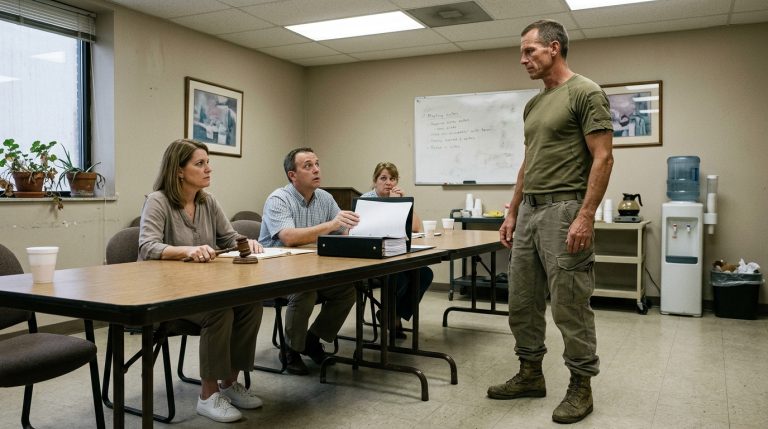
“Mr. Whitman, arms folded, standing behind his desk,” the classroom air tasted like chalk dust and floor wax. It was a suffocating, sterile flavor.
Maya stood at the front, her fingers finding the slight ridge of a scar on her own thumb—a nervous tick she’d picked up from watching her father pace the garage at night. She looked at the faces of her classmates. They were blank slates, their youth a soft, unblemished surface that felt alien to her. She thought of her father’s hands, mapped with thin, silvery lines of skin that had been grafted and stretched to accommodate what he had survived.
“My dad isn’t famous,” she began, her voice catching on the sharp edge of a memory she didn’t own but felt with a visceral intensity. “But he gave up pieces of himself so other families didn’t lose all of theirs.”
The silence that followed wasn’t peaceful. It was hollow, the kind of space that invites decay. Mr. Whitman didn’t just disagree; he dismantled. His smirk was a surgical tool, and he wielded it with a precision that suggested he hadn’t spent a single day of his life fearing for anything beyond his own grading rubric.
“That’s emotional, Maya,” he said, the words sliding out like oil. “But let’s remember, trauma doesn’t equal heroism. Maybe pick someone who chose to serve instead of someone who chose to get hurt.”
The laughter that followed was a physical sting, a dull ache that bloomed in the center of her chest. Maya looked down. The crumpled essay was no longer a tribute; it was a testament to her own foolishness. She saw the fraying edges of her sleeves, the way the light caught the dust motes in the air, turning them into tiny, dancing ghosts. She retreated to her desk, the wood grain feeling cold and unforgiving against her fingertips.
That night, the house was a sanctuary of shadows. Her father was in the kitchen, the rhythmic clack-drag of his cane punctuating the stillness. Maya sat in her room, the door ajar, listening to the familiar, weary cadence of his existence. She pulled the shadow box from her closet. The glass was cool, clouded by a layer of dust that had gone undisturbed for years.
Inside, the bronze star caught the moonlight, a dull, tarnished gold that held more history than the entire civics textbook in her backpack. She touched the seal on the folded letter—the one from Central Command she wasn’t supposed to read. Her fingers trembled as she unfolded the parchment. It wasn’t the words that caught her; it was the date, the signature, and the sudden, freezing realization that the man she had been serving coffee to every morning for her entire life was a secret geography of pain she had barely begun to map.
A floorboard creaked in the hall. Maya didn’t close the box. She kept her eyes on the letter, waiting for the shadows to lengthen, for the silence to stop feeling like a shroud and start feeling like an opening.
CHAPTER 2: The Fragile Geometry
The morning light didn’t arrive with the warmth Maya expected. Instead, it crawled across her bedroom floor like a slow, pale stain, highlighting the dust that danced in the stagnant air. She was still sitting on the edge of her bed, the letter from Central Command pressed so tightly against her palm that the paper’s edge bit into her skin.
She didn’t know what she had been looking for when she opened the shadow box, but she hadn’t expected to find a blueprint of her own inadequacy. Every line of the official, sterile military prose was a reminder that she had spent years looking at her father and seeing only a tragedy—a man defined by his limp, his scars, and the way he leaned on his cane. She had been observing the shadow, never the substance.
Downstairs, the floorboards groaned. Her father was awake.
Maya stood up, her joints feeling stiff, and shoved the letter back into the box, but she didn’t latch it. She left it slightly ajar, a small, dark mouth waiting to swallow her composure. She walked to the mirror and studied her reflection. She looked like a student, all neat hair and pressed collars, but her eyes looked older, haunted by the realization that she hadn’t known the man in the kitchen for a single day of her life.
Breakfast was a study in practiced, hollow habits. Her father sat at the head of the table, his movements deliberate, every action tempered by the physical cost of his body’s history. He reached for the coffee carafe, his scarred hand trembling just enough to catch the light, but he caught it and poured with a steady, practiced grace.
“School,” he said, his voice a low, gravelly hum. It wasn’t a question, but a command for the routine to continue.
“Yeah,” Maya replied, her voice sounding thinner than she intended. She watched him. She saw the way his eyes remained fixed on the center of the table, avoiding the peripheral, as if he were still mapping a perimeter that had ceased to exist years ago.
“You okay, Maya?”
The question was a trap. If she told him she knew, the silence between them—which had always been their version of intimacy—would shatter. She felt the phantom of his past intrude, a sudden, intrusive thought that he hadn’t saved those men out of some grand, cinematic impulse, but because he was simply an anchor in a world that was constantly trying to drift away. She saw the way he shifted his weight, the sharp geometry of his posture, and realized he wasn’t just tired; he was waiting for the next hit.
“Fine,” she lied, the word tasting like copper.
The drive to school was a long, suffocating span of highway. Neither of them spoke, but for the first time, Maya noticed the way her father scanned the road—not with worry, but with a terrifying, calm vigilance. When they reached the school gates, she grabbed her bag and stepped out into the damp, gray morning.
Mr. Whitman was already standing near the entrance, his presence a jarring, abrasive note in the morning air. He was talking to a colleague, his arms folded in that same defensive, arrogant sprawl, his laughter carrying over the noise of the idling buses like a jagged blade.
As Maya walked past, he caught her eye. His smirk wasn’t mean—it was worse. It was pitying. “Ready to finish that essay, Caldwell? Or have you found some more ‘heroic’ fiction to fill the gaps?”
The question hung in the air, a challenge that demanded she shrink. Maya felt the weight of the dog tag in her pocket—a small, heavy stone she had moved from the shadow box. It was cold, metallic, and real.
She looked at Mr. Whitman, really looked at him, and saw the fragility in his smug, perfectly ironed life. He was a man who lived by the rule of the syllabus, who thought that if he could categorize the world, he could control it. He hadn’t realized that the world was currently tilting beneath his feet, and that she was no longer looking for a teacher—she was looking for a leverage point.
She didn’t speak. She didn’t drop her eyes. She just nodded once, a gesture so sharp and dismissive that the teacher’s grin faltered for a fraction of a second. She walked into the building, the heels of her shoes clicking against the linoleum with a rhythmic, steady cadence. She wasn’t just a student anymore. She was a witness, and for the first time, she understood that the truth wasn’t something you shouted; it was something you held in the silence, waiting for the exact moment the light hit it just right.
She entered the classroom. The air here was thicker, heavy with the scent of unwashed gym clothes and stagnant dreams. She sat at her desk, opened her notebook to a blank page, and didn’t write a single word. She just waited, watching the door, knowing that the man who had taught her to endure—the man who was currently parked out by the curb, watching the windows—would eventually realize that she didn’t need to be protected from this place.
She needed to be the one to open the door.
CHAPTER 3: The Signal Fire
The school hallway was a cavern of polished linoleum and lockers that clicked like teeth. Maya stood near the bank of vending machines, the fluorescent lights overhead buzzing with an erratic, insect-like persistence. She wasn’t waiting for a bell. She was waiting for the inevitable.
Ever since the morning encounter, the school had felt different—not necessarily louder, but thinner, as if the reality everyone else was operating under was being stretched to the breaking point. She pulled the dog tag from her pocket, rubbing the fused metal between her thumb and forefinger. It was warm. It had always been warm, she realized, she just hadn’t been holding it long enough to notice.
She watched the door to the janitor’s closet. Dean Reyes, the man who had been a silent fixture in the hallways for years, moved with a sudden, sharp efficiency that didn’t match the labor of his work. He was cleaning the glass on the trophy case, but his eyes weren’t on the smudges. They were tracking the rhythm of the school—the shift changes, the movement of the administrators, the way the air currents seemed to change whenever the principal walked by.
Maya stepped closer, her heart hammering a slow, heavy rhythm against her ribs. “Dean?”
The janitor paused, the rag still pressed against the glass. He didn’t turn his head immediately. He finished the wipe, then slowly angled his body toward her. His face was a map of lines and hard-won stillness, the kind of face that didn’t bother with small talk. He looked at her, then down at the hand tucked deep in her pocket.
“The wind’s changing, Maya,” he said. His voice was gravelly, low, and carried the weight of things left unsaid.
“My dad,” she started, then stopped. She didn’t know how to articulate the shift. She felt like she was standing on the edge of a cliff, and for the first time, she wasn’t afraid of the fall—she was curious about what was waiting at the bottom. “He told me they were coming.”
Dean Reyes let out a soft, humorless huff of breath. He adjusted his grip on the mop handle, his knuckles white against the weathered wood. “Your father never asked for them to come. He’s never asked for anything. That’s the point you’re missing.”
“Then why?”
“Because,” Reyes said, leaning in just enough that she could smell the faint, sharp scent of industrial soap and old, metallic oil. “You don’t let a house burn down when you know the people inside. They aren’t here for him, Maya. They’re here for the debt. And debts like that, they don’t get paid in flowers and speeches. They get paid in showing up.”
He turned back to the trophy case, his movements once again mechanical, efficient, and entirely hidden in plain sight. Maya watched him, the world around her losing its mundane, scholastic sheen. The school wasn’t a place of learning anymore; it was a theater, and the actors were all waiting for a cue that only a few of them could actually hear.
She walked out into the courtyard during the lunch break, seeking the solitude of the back bleachers. The air outside was crisp, smelling of ozone and impending rain. She climbed to the top row and sat, pulling her knees to her chest. From here, she could see the parking lot. She saw her father’s truck, still parked in the same spot, the back bumper rusted into a permanent, jagged grin.
She looked at her own hands. They were trembling, but not from fear. It was an anticipation, a physical resonance with the network that was currently vibrating across state lines. She thought of the letter in her shadow box, the way the ink felt like a physical weight, and wondered how she had lived for sixteen years without hearing the hum of the connections that tethered her father to the rest of the world.
A phone buzzed in her pocket. It was a restricted number. She didn’t answer it; she didn’t need to. She just stared at the screen, watching the light flicker out, leaving her in the quiet space between seconds.
The school bell rang, a sharp, dissonant scream that fractured the silence. Maya didn’t move. She felt the school around her—the thousands of tiny, meaningless interactions, the trivial grievances, the hollow laughter—and realized how precarious it all was. It was a structure built on the assumption of comfort, completely unaware that the foundation had already been compromised.
She stood up, her coat fluttering in the breeze. She wasn’t going back to class. She wasn’t going to sit in a room and listen to someone talk about ‘modern heroes’ as if they were abstract concepts. She headed toward the front gate. She had a message to send, and for the first time, she knew exactly how to deliver it without saying a single word.
CHAPTER 4: The Weight of Presence
The rain started as a fine mist, turning the world into a gray smear of low light and dampened sound. Maya gripped the strap of her bag, her knuckles white. She didn’t retreat to the shelter of the overhang. She stayed where the sidewalk met the perimeter of the asphalt lot, watching as the first of the nondescript sedans and trucks turned off the main road.
They didn’t drive like civilians. They moved in a staggered, calculated formation, their engines humming with a low, rhythmic growl that vibrated through the soles of her shoes. There were no sirens, no flashing lights, and no sense of urgency. It was a procession.
She saw her father’s truck near the center of the line. It didn’t look like an old, rusted vehicle anymore; in the context of the arriving caravan, it looked like a standard—a focal point around which the others orbited. As the vehicles came to a halt, the silence that followed was absolute. The rain intensified, tapping against the metal roofs, but no one stepped out for several heartbeats.
Then, the doors opened in near-perfect synchronization.
Maya watched, her breath hitching in her throat. Men and women emerged, their forms obscured by the drizzle, their faces unreadable. They didn’t look like soldiers in the way she had imagined—no uniforms, no medals pinned to chests. They wore leather jackets, worn denim, and heavy-duty work clothes that had seen better days. But their presence was staggering. It felt as if the air pressure in the parking lot had shifted, creating a vacuum that centered entirely on the school building.
She saw the man with the steel leg, his gait uneven but profoundly purposeful. She saw a woman with a calm, weathered face who scanned the horizon with an intensity that made the surrounding neighborhood feel suddenly exposed. They weren’t armed, but they carried themselves with the dangerous, quiet confidence of people who knew exactly what they were worth—and what they were there to claim.
“Maya.”
Her father’s voice was close. She turned, and he was standing there, his cane resting against his hip. He didn’t look like the man who paced the kitchen at night. He looked like the man described in the general’s letter. His posture was straighter, his gaze locked onto the school’s main entrance.
“They’re here,” she whispered.
“They’re remembering,” he corrected softly. He didn’t look at her; he was watching the platoon coalesce, the group forming a loose, informal line that blocked the path from the parking lot to the school doors. “Don’t look for a fight, Maya. Look for the truth.”
The principal, Mr. Harris, had emerged from the building, likely alerted by the sheer weight of the arriving group. He looked small, his suit damp, his eyes darting between the veterans and the line of students who had begun to crowd toward the windows. He opened his mouth to speak, to offer some rehearsed administrative line about private property, but the words died in his throat as Colonel Marks stepped forward.
The Colonel didn’t raise his voice. He didn’t need to. He simply stood there, his hands loose at his sides, his presence so heavy it seemed to press the very air out of the courtyard.
“We are here for a correction,” the Colonel said. The sound traveled clearly through the wet air, cutting through the tapping of the rain. “There is a misunderstanding in the history being taught here. We have come to offer the primary source material.”
Maya watched Mr. Whitman emerge from behind the principal, his usual smirk replaced by a sudden, frantic uncertainty. He looked at the veterans, his eyes skimming over their scars and their hands, searching for a sign of weakness he could exploit, a vulnerability he could use to regain control. He didn’t find one. He found only a mirror of his own insecurity, reflected back by people who had nothing left to prove to anyone.
The atmosphere was electric, a static charge that made the hair on Maya’s arms stand up. The students were no longer whispering; they were watching, their faces pressed against the glass, some with their phones out, others just staring, paralyzed by the sheer gravity of the moment.
“I think you have the wrong idea,” Whitman stammered, his voice cracking. “This is a private, educational institution. You have no—”
“We have exactly the authority that sacrifice dictates,” the woman with the eyepatch interrupted, her voice cool and precise. She stepped forward, her movement fluid, closing the distance until she stood directly in front of the teacher. She didn’t look at his face. She looked at his hands, which were twitching against his grading binder. “You have been teaching that wounds are evidence of failure. We are here to show you that they are evidence of survival.”
The rain intensified, a sudden downpour that hissed against the asphalt. Nobody moved. Maya felt the threshold of the school building as a physical wall, and the veterans were currently dismantling it, brick by imaginary brick. The decoy secret—the idea that this would be a loud, public humiliation—began to feel inadequate. This wasn’t about humiliation. It was about the slow, agonizing realization of irrelevance.
Mr. Whitman tried to step back, but there was nowhere to go. The platoon had effectively closed the perimeter. Maya felt a sudden, sharp pang of pity for him—not because he was about to lose his job or his reputation, but because he was about to realize that his entire worldview had been a shadow play, and the lights had just been turned on.
“Let’s go inside,” the Colonel said, looking at the principal.
Harris stepped aside, his face pale, his authority vanishing like breath on a cold window. The doors swung open, the heavy metal frames groaning in protest. As the platoon began to walk in, Maya followed, her feet moving of their own accord. She looked back at the empty parking lot once, then turned toward the dark, echoing interior of the school. The story wasn’t just being written now; it was being corrected.
CHAPTER 5: The Unspoken Witness
The hallway seemed to stretch into an infinite, suffocating tunnel, the flickering fluorescent lights casting long, jagged shadows that danced in rhythm with the platoon’s steady, unhurried advance. Maya kept her eyes locked on the back of her father’s jacket. He didn’t walk with the limp she was used to seeing; he walked with a measured, heavy gait that seemed to ground the very floor beneath them.
Every step forward felt like a retraction of the past five years. She remembered the nights he spent in the garage, the quiet intensity with which he treated his gear as if it were a physical extension of a soul he had misplaced, and she realized now that he wasn’t mourning. He was waiting.
They reached the door to the civics classroom. It stood slightly ajar, a sliver of light spilling out onto the floor—a stark, sterile illumination that felt completely at odds with the storm gathering in the hallway.
The platoon didn’t pause. They didn’t knock. They flowed into the room like water filling a basin, their sheer, heavy presence displacing the air. Mr. Whitman was standing at the chalkboard, a piece of white chalk caught between his thumb and forefinger, his mouth open as if he were mid-sentence. He froze. The chalk snapped, the sound unnervingly loud in the sudden, absolute silence.
The room, once filled with the restless, distracted energy of thirty teenagers, fell into a deep, hollow quiet. Maya hovered near the doorway, her gaze shifting between her classmates—who were suddenly, terrifyingly still—and the teacher, whose smug veneer of intellectual superiority was dissolving in real-time.
Colonel Marks stepped to the front desk. He didn’t occupy the teacher’s space; he stood before it, an immovable object. He placed a heavy, leather-bound folder onto the desk. It landed with a dull, final thud.
“Mr. Whitman,” the Colonel said. His voice was calm, conversational, and utterly terrifying. “You’ve spent the week discussing the impact of heroism. You’ve curated a narrative that suggests injury is an administrative oversight.”
Whitman tried to pull himself back together. He took a sharp, jagged breath, his hands trembling as he reached for the folder, but his fingers hovered, paralyzed by the sheer, unblinking focus of the woman with the eyepatch, who stood just to the Colonel’s right, watching him with the detached, analytical gaze of a predator.
“I… I think this is highly irregular,” Whitman sputtered, his gaze darting toward the principal, who remained in the corner, his back pressed against the wall as if he were trying to merge with the cinderblock.
“Regularity is a construct of those who have never had to build a life out of the wreckage,” the woman replied. She reached into her pocket and pulled out a small, tarnished brass item. She set it on the desk next to the folder. It was a dog tag, the edges jagged from a high-heat exposure. It wasn’t the one Maya had in her pocket; it was different, a companion piece to a story that had been torn in two.
“These aren’t props,” the Colonel added, nodding toward the tag. “They are the physical manifestations of a debt that you have treated as a punchline. You teach these students that they should strive for impact. We are here to tell them that impact doesn’t always look like a monument. Sometimes, it looks like a scarred hand, a broken gait, and the silence of a man who saved your seat in a classroom because he chose to keep his own back to the blast.”
Maya watched the teacher’s face as he looked at the artifacts. The arrogance was gone, replaced by a raw, naked realization of his own smallness. He looked at the students, at the rows of faces—some curious, some terrified, all of them finally seeing what was in front of them.
“I didn’t…” Whitman started, but his voice lacked the steel it had held only hours ago. “I didn’t know.”
“We know,” the Colonel said. The simplicity of the statement was more damaging than any threat. “That is why we are here. To ensure that from this point forward, you do.”
Maya felt a shift in the air, a movement of weight that transcended the physical. She saw her father standing to the side, his hands clasped behind his back, his eyes fixed on the students, not the teacher. He wasn’t watching the confrontation; he was watching the students realize.
She realized then that the decoy secret—the idea that this was about destroying the teacher—had been the shield she was using to protect herself from the real truth: that she was the one who had needed to learn this. She was the one who had questioned the worth of her father’s sacrifice. She was the one who had seen his scars and interpreted them as a lack, rather than a testament.
The room was so quiet that the sound of the rain against the windows seemed to grow in volume, a rhythmic, pulsing reminder that the world was still turning, indifferent to their small, human collisions. Maya felt the dog tag in her pocket—the one she had recovered—as a hot, living weight. She didn’t look at Whitman again. She looked at her father, and in his posture, she found the only anchor she would ever need.
He didn’t need to speak. He didn’t need to defend himself. He simply stood there, an echo of a history that was finally, finally being heard. The teacher was a broken man, not because he had been defeated, but because he had been revealed. The truth was in the room, and it wasn’t a lesson—it was a weight.
CHAPTER 6: The Kintsugi Heart
The classroom was quiet, a silence so total it felt like the entire building had held its breath. Mr. Whitman sat at his desk, his gaze fixed on the desktop. The folder, once a weapon of academic vanity, now looked like nothing more than a collection of papers—old combat logs, letters of commendation, and the handwritten notes of a four-star general who remembered the man Whitman had dismissed as ‘broken.’
The platoon began to exit. They didn’t march; they simply moved with a shared, wordless momentum. They didn’t look at the students, and they certainly didn’t look at the teacher. Their job here wasn’t to punish—it was to reveal.
Maya stood by the door, her hands still tucked in her pockets, the cool, fused weight of the dog tag a grounding anchor. She watched her father. He didn’t walk out with a flourish. He simply turned, his gait slow and deliberate, and navigated the aisle with a quiet, rugged dignity. He paused at Maya’s desk, his hand brushing the surface for a fleeting second—a touch that carried the weight of a thousand unspoken conversations.
He didn’t say anything, but he didn’t need to. In that gesture, Maya felt the shift. The barrier she had built between them—the one constructed of pity and incomplete understanding—had dissolved. He wasn’t the man she had pityingly observed from the school gates; he was the center of a world she hadn’t known existed.
As the last of the veterans stepped into the hallway, the school’s atmosphere underwent a transformation. The tension that had tightened the halls all week snapped, leaving behind a lightness that felt almost jarring. Students began to stir, chairs scraping against the linoleum, low murmurs rising like the hum of a hive. But the murmurs were different now. They weren’t snickers or gossip; they were the sounds of people realizing they had been present for something they would be trying to articulate for years.
Maya walked out into the hallway, trailing the platoon until they reached the entrance. The rain had stopped, and the afternoon sun was beginning to break through the clouds, casting long, golden fingers of light across the damp asphalt of the parking lot. The air smelled of wet earth and change.
She watched as the platoon dispersed. No handshakes, no elaborate goodbyes. They moved to their cars, the quiet efficiency of their arrival mirrored in their departure. Colonel Marks gave a short, sharp nod toward the school entrance, then climbed into his sedan. Her father stood by his truck, the rust on the tailgate catching the late-afternoon sun.
Maya walked toward him. She didn’t look at the other students who were still trickling out of the doors, watching the departure from a distance. She focused entirely on the distance between herself and the man waiting by the truck.
When she reached him, he was leaning against the rusted metal, his cane resting at his side. He looked tired, the kind of deep, marrow-level exhaustion that only comes from years of carrying a heavy burden, but his eyes were clear.
“You didn’t have to do this,” Maya said, her voice soft.
He looked at her, and for the first time, she saw a flicker of the man he was before the war, before the fire, before the silence. “I didn’t do this for me, Maya. I did this so you’d stop looking at the scars and start looking at the reason for them.”
He reached into his jacket pocket and pulled out a small, rectangular object. He pressed it into her hand. It was a secondary patch, worn and frayed at the edges, the colors muted by time and exposure. “They don’t teach this in the civics textbook,” he said. “Respect isn’t given. It’s earned in the places where no one else is watching.”
Maya held the patch. It was rough, its threads unraveling, but it felt warmer than anything she had ever owned. She looked at her father—really looked at him—and saw the beauty in his brokenness. He wasn’t a tragedy. He was a vessel that had held the weight of others so they didn’t have to, and in that realization, she felt her own heart knit itself back together. It was the Kintsugi of their lives—the cracks were where the strength had always been.
“I’m ready to go home,” she said.
He nodded, a small, genuine smile touching the corners of his mouth. “Home. That sounds right.”
As they drove out of the lot, the school falling away in the rearview mirror, Maya didn’t look back at the building. She looked at the patch in her lap. The silence between them in the truck wasn’t the heavy, suffocating weight she had grown up with. It was something new—a shared, resonant peace. The story wasn’t over, but for the first time, she knew that she was a part of it, and that was more than enough. The horizon ahead was wide, clear, and finally, undeniably, their own.