The Sovereign’s Boundary: A Veteran’s Stand Against Suburban Tyranny and the Fight for Home
CHAPTER 1: THE CRIMSON STAIN
The crimson paint was still tacky under my thumb, bleeding into the 150-year-old oak grain like fresh blood on winter snow.
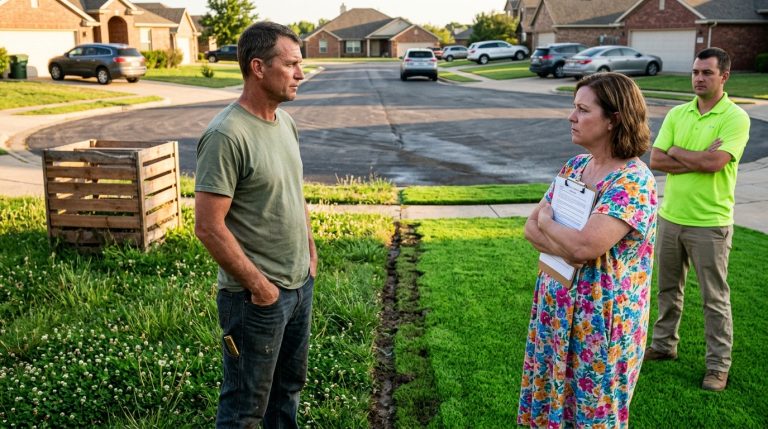
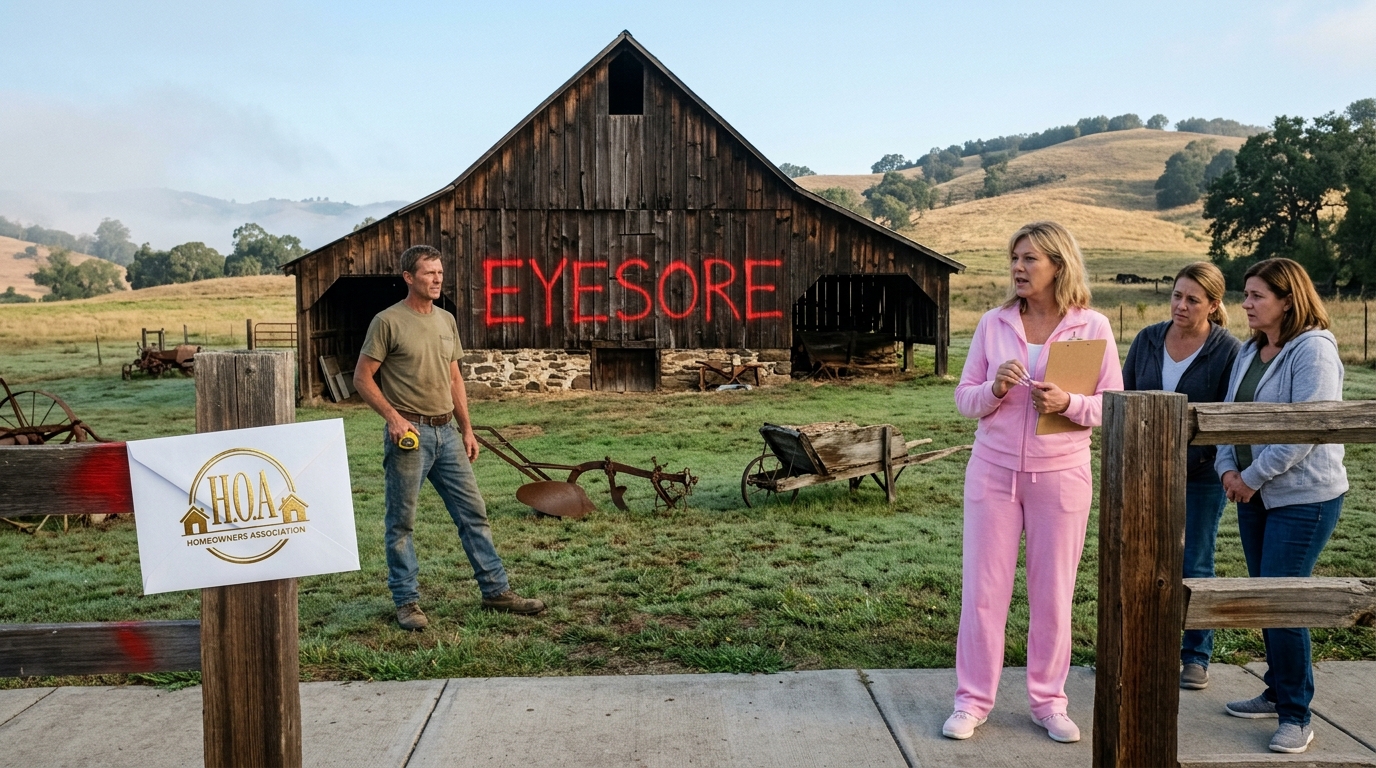
I wiped my hand on my work pants, the rough denim scratching against my calloused skin. Fifty yards away across the dew-damp lawn, a pastel pink tracksuit shimmered under the harsh morning sun. Karen Weatherbee lowered the cheap aerosol can with a deliberate, gloating flourish, her face flushed with the arrogance of an absolute monarch.
“That’ll teach you to respect the aesthetic harmony of this community, Major,” she called out, her voice cutting through the quiet morning air like rusty shears.
I didn’t yell. I didn’t surge forward. Twenty years in the Army Corps of Engineers—building bridges under mortar fire and analyzing structural stress points in barren dust bowls—teaches you one primary truth: anger is dead weight.
My thumb found the worn steel casing of the 25-foot Stanley tape measure clipped to my belt. Click. Snap. The metallic recoil echoed off the fieldstone foundation of the barn.
“This isn’t your property, Karen,” I said, my voice dropping into the quiet, flat register I used when evaluating unexploded ordnance.
“Everything visible from the road falls under Golden Meadows jurisdiction, Mr. Davies,” she snapped, taking two steps backward onto the public concrete sidewalk, her sequined jacket catching the light like a cracked mirror. “Your dilapidated eyesore lowers property values for everyone. Consider that paint a public notice.”
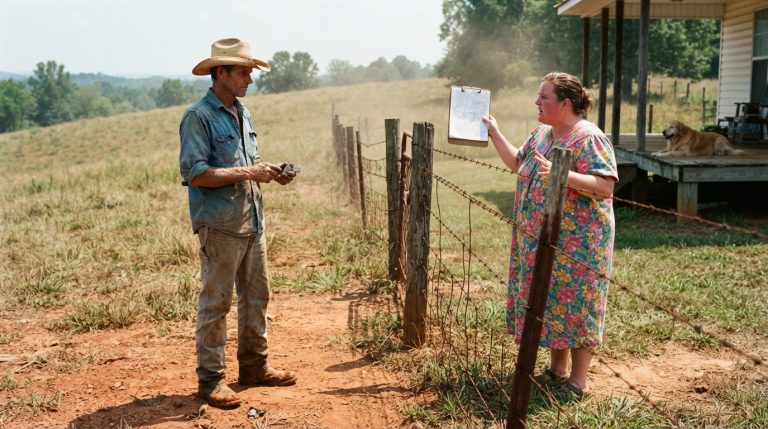
I looked past her to the weathered flank of the barn. The word EYESORE stretched six feet wide in garish red block letters across hand-hewn oak beams that had survived three major blizzards and a century of hard farming.
Beside the fresh red paint, wedged into a hairline crack in the rustic cedar fence post, sat a pristine, unblemished white envelope with an embossed gold HOA logo—completely untouched by the morning dew.
My pulse stayed steady at sixty beats a minute. In my mind, the grid lines were already laying themselves out. Angles of approach. Environmental hazards. Legal tolerances.
She thought she had just defaced a barn. She had no idea she had just handed me the fuse, the firing pin, and the ordnance layout. In seventy-two hours, I was going to hand her the invoice.
CHAPTER 2: PAPER TRAIL AND PROBING
I stood on the gravel driveway, my thumb locked onto the steel casing of the tape measure while the crisp paper of the embossed envelope felt unnaturally stiff between my fingers.
Karen turned on her heel, her pink tracksuit shrinking into the distance as she marched back toward the manicured sea of identical houses. She didn’t look back once. She didn’t need to—tyrants never check behind them when they believe the law is sitting squarely in their lap.
I slid my thumb under the flap of the envelope and slit it open with a slow, measured tear. Inside was a single sheet of heavy bond paper, cold and smooth under my calloused hand.
Notice of Covenant Violation: Non-Compliant Mailbox.
The letter cited Section 4, Paragraph B of the Golden Meadows HOA Bylaws. According to the fine print, my sturdy steel mailbox—the one mounted on an oak post that the rural postal carrier had delivered to for three years without complaint—was an illegal structure. It mandated an approved black faux cast-iron model with gold leaf numbering, available exclusively through the board’s preferred vendor for three hundred and fifty dollars. Failure to comply incurred a fine of twenty-five dollars a day.
I didn’t lose my temper. In the Corps, when an obstacle drops into your lap, you don’t curse the mud—you measure its depth. I walked up the porch steps, sat at the kitchen table, and dialed the phone number listed at the bottom of the notice.
“Golden Meadows Homeowners Association,” a voice cooed after three rings, sharp and syrupy like honey mixed with ground glass. “This is Karen speaking.”
“Karen, this is Jack Davies,” I said, keeping my tone as flat as an iron skillet. “I’m looking at this mailbox notice. My parcel is a grandfathered ten-acre farmstead. We aren’t part of the subdivision.”
A long, deliberate exhalation came through the speaker, heavy with the performance of an adult explaining simple arithmetic to a child.
“Mr. Davies,” she said, her voice dropping into that smooth, practiced condescension. “While your little historical anecdote is charming, when the developer established Golden Meadows, your property was included within the master plan’s jurisdiction. The previous owner signed the accession agreement at closing. Your ignorance of the covenants does not grant you an exemption.”
“The previous owner was eighty-two and moved to a nursing home in Florida,” I replied softly.
“The signature is legally binding, Mr. Davies,” she snapped, the syrup evaporating from her tone, leaving only the sharp edge underneath. “Replace the mailbox by the end of the month, or the daily fines will accrue directly against your property title. Have a blessed day.”
The line went dead before I could answer.
I didn’t set the phone down hard. I picked up my brass tape measure, unspooled six inches of steel, and let it snap back into its housing with a loud, metallic clack.
Ten minutes later, I was in the basement, digging through the banker’s boxes of closing documents we’d signed eight months ago. Buried beneath thirty pages of title insurance and county tax assessments, I found it: a single, densely typed page tucked behind the survey plat.
Accession Agreement to Golden Meadows Covenants.
I ran my thumb over the line where the previous owner had signed. Right beneath his shaky ink script sat a small, subtle anomaly—a stamp from the original developer’s closing attorney, marked with a red filing code that didn’t match the county land registry format.
I leaned back in the wooden chair, the smell of old paper and damp concrete surrounding me in the quiet cellar. Karen thought she had trapped me in her web of petty bylaws, but she had just handed me a paper trail. And in my experience, when someone goes out of their way to build a trap that tight, it’s usually because they’re hiding what’s underneath the floorboards.
CHAPTER 3: BUREAUCRATIC TRENCH WARFARE
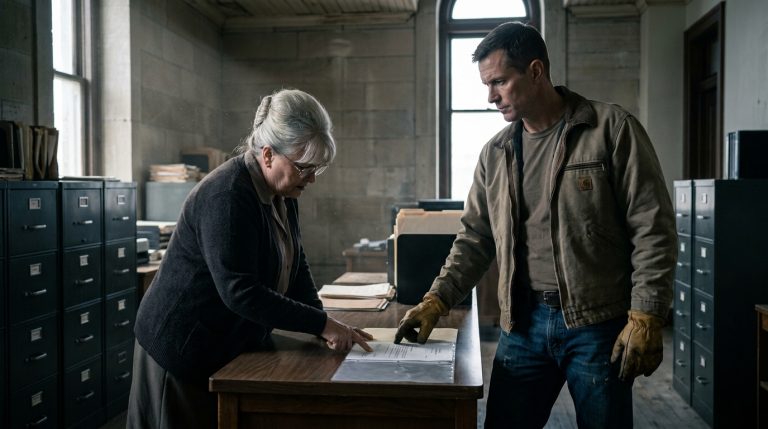
I sat at the wooden kitchen table at midnight, a stone-cold cup of black coffee at my elbow, staring down into the disorganized box of HOA meeting minutes Karen had dumped on my porch.
She thought burying me in five years of unindexed paper would make me drop my legal document request. She didn’t realize that sorting through chaotic logistics records under lantern light was how I’d spent half my military career.
My thumb ran over the brass housing of my tape measure resting on the table. Click. Snap. I pulled up a fresh spreadsheet on my laptop and began inputting every contract, vendor name, and line-item disbursement.
By 2:00 a.m., the pattern wasn’t just clear—it practically jumped off the screen in bright neon line items.
The community landscaping contract went exclusively to Lawn & Order LLC, owned by Karen’s brother-in-law. The tennis court repaving project—fifty percent over budget—was awarded to a concrete firm registered under her sister’s maiden name. And those mandatory three-hundred-and-fifty-dollar black cast-iron mailboxes? They were sourced through a shell company linked directly to a PO box registered under Karen Weatherbee’s personal name.
This wasn’t an HOA board maintaining neighborhood standards. It was a private family bank account funded by ninety-four intimidated homeowners.
The front doorbell rang the next afternoon at three o’clock sharp. I opened the door to find Karen standing on the porch, clipboard tucked under her arm, flanked by two women from the Architectural Review Committee.
“Mr. Davies,” Karen said, her chin tilted up just enough to project effortless authority. “Your ninety-day window for the barn demolition plan has expired. Since you have failed to submit a compliant removal contract, the daily fines of one hundred dollars will now begin accruing.”
I reached into my back pocket, pulled out a thick, bound folder, and handed it directly to her.
“That’s a certified structural report from a licensed historic timber engineer,” I said calmly. “Along with a state preservation survey confirming the barn was constructed in 1874. It’s structurally sound, fully repairable, and exempt from arbitrary teardown demands under state historical statutes.”
Karen didn’t open the folder. She didn’t even look at the cover page. She simply tapped her acrylic fingernails against the wooden edge of her clipboard with a sharp, rhythmic clack-clack-clack.
“The committee doesn’t care about old wood, Jack,” she said, dropping the formal title entirely, her voice tightening into a razor edge. “We care about compliance. Your plan is denied. Demolish the eyesore, or we will place a lien on this house.”
“Then you’d better start reading the financial disclosures you sent me,” I said softly, leaning against the doorframe. “Because every dollar you try to take from my property line is going to cost you ten times as much in court.”
Her eyes narrowed, a single tight muscle twitching along her jawline before she turned and marched down the steps. She had the power of the board, but I had the math. And math doesn’t lie.
CHAPTER 4: ESCALATE AND TRAP
Standing on the barn roof at sunrise with a heavy roofing hammer in my palm, I watched a pastel pink golf cart come screaming down the asphalt and skid to a halt in a spray of gravel.
Karen leaped out before the wheels had even stopped rotating, her face mottled and distorted with a furious, unhinged rage.
—What do you think you are doing on that roof?— she shrieked, her voice cracking across the morning quiet as she shook a clipboard like a weapon. —That is unapproved structural work! I demand you come down immediately or face five thousand dollars a day in municipal fines!—
I didn’t yell back. I drove a galvanized nail into the standing-seam metal with two clean strikes of the hammer, the sharp ring echoing off the fieldstone walls.
—I am mitigating water damage per my fiduciary duty as a property owner, Karen— I called down calmly, wiping sweat from my forehead with the back of my wrist. —Your own engineering notice recommended protecting the timber frame.—
She sputtered, her jaw working silently as her fingers dug deep into the edges of her clipboard.
—You will regret this!— she screamed, spinning the golf cart around and kicking up another cloud of dust as she tore back toward the subdivision.
That evening, after Sarah and Lily were asleep, I sat in my dark office upstairs and booted up the monitor connected to the four-way night vision security system. The green-tinted screens displayed crystal-clear angles of the barn flanks and property perimeters.
For hours, the screen remained dead quiet except for a stray raccoon wandering across the gravel drive.
Then, at 2:17 a.m., the motion sensor clicked softly on camera three.
A bulky, hooded figure crept out from the shadows between the neighboring McMansions, moving with a clumsy, hurried waddle. Even under the infrared glare, the gait was unmistakable.
I didn’t reach for a phone or sound an alarm. My finger rested quietly on the mouse, clicking the record button to ensure every frame of the high-definition stream was safely backed up to an encrypted off-site cloud server.
On the screen, Karen stopped directly in front of the newly repaired southern wall of the barn, popped the cap off a rattle can, and began aggressively laying down a fresh coat of red spray paint.
She stood back, admired her handiwork with a grotesque, triumphant grin, and then scuttled back into the dark.
The trap was no longer just set—it had been sprung by her own hand.
CHAPTER 5: THE AMBUSH AND THE CHECK
Standing in Karen’s ornate foyer at 8:00 a.m., I watched her face drain of blood as lawyer Marcus slid the tablet across the heavy marble table.
She stood frozen in a silk dressing gown, her knuckles gripping the back of a gilded chair while her eyes darted from the screen to my face. The green-tinted night vision footage played on continuous loop: her hooded figure moving stealthily across the grass, raising the aerosol can, and etching the crimson scar across my family’s barn.
—That is a forgery— she stammered, her voice cracking into a high-pitched wheeze as she backed away against the wall. —A digital fake. You planted that.—
Marcus didn’t blink. He reached into his leather briefcase and pulled out a heavy evidence bag containing a battered red paint can.
—Deputy Miller recovered this from the community dumpster thirty minutes ago— Marcus said, his tone flat and unyielding. —Your fingerprints are on the casing, the chemical composition matches the residue on the timber, and the county warrant for felony criminal mischief is already drafted for a judge’s signature.—
Karen’s breathing turned shallow and erratic. She reached out blindly, her fingers trembling so violently she nearly knocked over a porcelain vase on the side table.
—This is about the barn— she whispered, her arrogant facade completely shattering under the weight of the impending cell block. —You can’t do this over a coat of paint.—
—It’s not just about the paint, Karen— I stepped forward, my voice cutting through her panic like a cold blade. —It’s about five years of systematic embezzlement through your brother-in-law’s landscaping company, the fake mailbox shell corporation, and the fraudulent accession filings you used to bleed ninety families dry.—
Marcus laid out the second, thicker stack of documents across the marble top.
—You have ten minutes to decide— Marcus stated, tapping a single line on the settlement form. —Write a personal check for two hundred and seventy-five thousand dollars to cover property damages, legal fees, and punitive fines, sign your immediate resignation from the board, and list this house for sale within thirty days. Do it now, or we file the class-action fraud suit and hand the arrest warrant directly to the sheriff.—
Karen stared at the papers, her chest heaving as she realized every single trap she had laid for others had finally snapped shut around her own neck.
She turned on her heel, shuffled toward a gilded mahogany desk with dead, leaden steps, and pulled out her checkbook. Her hand shook so badly she could barely hold the golden fountain pen against the blue paper.
I watched the ink bleed across the lines, spelling out the exact price of her unearned tyranny. She tore the slip free, slid it across the marble without a word, and collapsed back into her chair as we turned toward the open door.
CHAPTER 6: THE AFTERMATH AND THE SANCTUARY
Standing in the center of the newly finished barn loft at sunset, I breathed in the sharp, clean scent of fresh pine and oil paint while muffled laughter drifted up from the neighbors gathered below.
The red spray paint was gone, chemically stripped down to the raw 150-year-old oak by a crew of historic preservation specialists. Every penny of the settlement had gone straight into reinforcing the fieldstone foundation, laying down straight board-and-batten siding, and raising a solid standing-seam roof that would weather a century of hard winters.
Downstairs, Sarah was talking with the Millers near my workbench, her coffee cup resting steady against a freshly poured concrete floor.
Old Mr. Henderson stood by the oversized double doors, running a weathered thumb over the smooth, dark-stained wood of the restored main beam.
—That’s proper joinery right there— Mr. Henderson muttered approvingly, nodding as he looked out over the open pasture. —Built to last.—
I reached into my pocket, my fingers brushing against the cold steel casing of my tape measure. I didn’t unspool it. I didn’t need to measure angles anymore. The boundaries were set, the structure was sound, and the unearned noise of the subdivision had been permanently locked out.
Justice wasn’t about shouting matches or petty retaliation. It was about holding a hard, unyielding line until an artificial structure collapses under the sheer weight of its own corruption.
Karen was gone, her house sold to a quiet young family, her name reduced to a bitter memory down the road.
The barn stood tall against the evening sky, no longer an ideological battleground, but a monument to ordinary endurance. I gripped my coffee mug with both hands, letting the warmth settle into my palms as the sun dipped below the tree line, leaving nothing behind but quiet, hard-earned peace.